
TL;DR
- A solid stone fabricator buys raw slabs, cuts them to your template, polishes the edges, and installs the finished countertop.
- Labor and materials together run $40 to $200 per square foot depending on stone type, edge profile, and shop quality.
- Get three itemized quotes, check the shop's CNC equipment, and see finished work in person.
- Those three moves catch most bad shops.
What does a solid stone fabricator actually do?
A solid stone fabricator takes a raw slab, usually 2 or 3 centimeters thick, and turns it into a finished countertop ready to be set in your kitchen or bathroom. The job runs through a fixed chain of steps: templating the existing space, programming or marking cuts, cutting with a waterjet or bridge saw, shaping edge profiles on a CNC router or hand grinder, polishing, and installing.
The fabrication step is where most of the labor cost lives. A slab you buy from a distributor is raw material and nothing more. The fabricator adds every dollar of value after that, deciding how to orient the slab for the best veining, minimizing waste in the cut layout, and matching seams so they nearly disappear.
Some fabricators are vertically integrated, meaning they also import or distribute slabs and sell them to you at a markup. Others are pure cut-and-install shops that buy from local distributors. Neither model is inherently better for the customer, but a shop that both sells slabs and fabricates them can sometimes offer a better bundled price because they earn margin on both sides.
The trade takes real skill. Stone does not forgive mistakes the way wood does. A mis-cut granite slab is usually scrap. That irreversibility is why experienced template technicians, precise digital templating tools, and well-maintained saws matter so much to the finished result.
What types of stone do fabricators typically work with?
Most fabrication shops handle the full range of natural and engineered stone. The common materials are granite, marble, quartzite, soapstone, onyx, travertine, and engineered quartz (brands like Silestone, Caesarstone, and Cambria).
Granite is still the bread-and-butter for many shops because it is hard, consistent, and familiar. Granite countertops are among the most fabricated surfaces in the U.S., and nearly every shop has the tooling for it. Marble is more porous and softer, so it needs sharper blades and more careful handling to avoid chipping. Quartzite is harder than both and demands more aggressive tooling. Soapstone is soft, but it chips easily at thin edges.
Engineered quartz is now the most popular countertop category in the U.S. [1] Fabricating it is more demanding on tooling than most natural stone, because the resin binders in quartz composites generate heat that can cause delamination if cutting speeds are wrong. A shop that has not fabricated much quartz can burn through tooling fast and leave rough edges behind.
Some specialty shops also work with ultra-compact surfaces like Dekton and Neolith, which are sintered stone panels made at very high pressure and temperature. These need diamond blades rated for the extra hardness and specific cutting protocols. Not every granite shop owns the equipment or has the experience, so ask directly if you want an ultra-compact surface.
A good shop can show you completed projects in most of these materials, not granite alone. If their portfolio is exclusively one or two stone types, that tells you something real about their range.
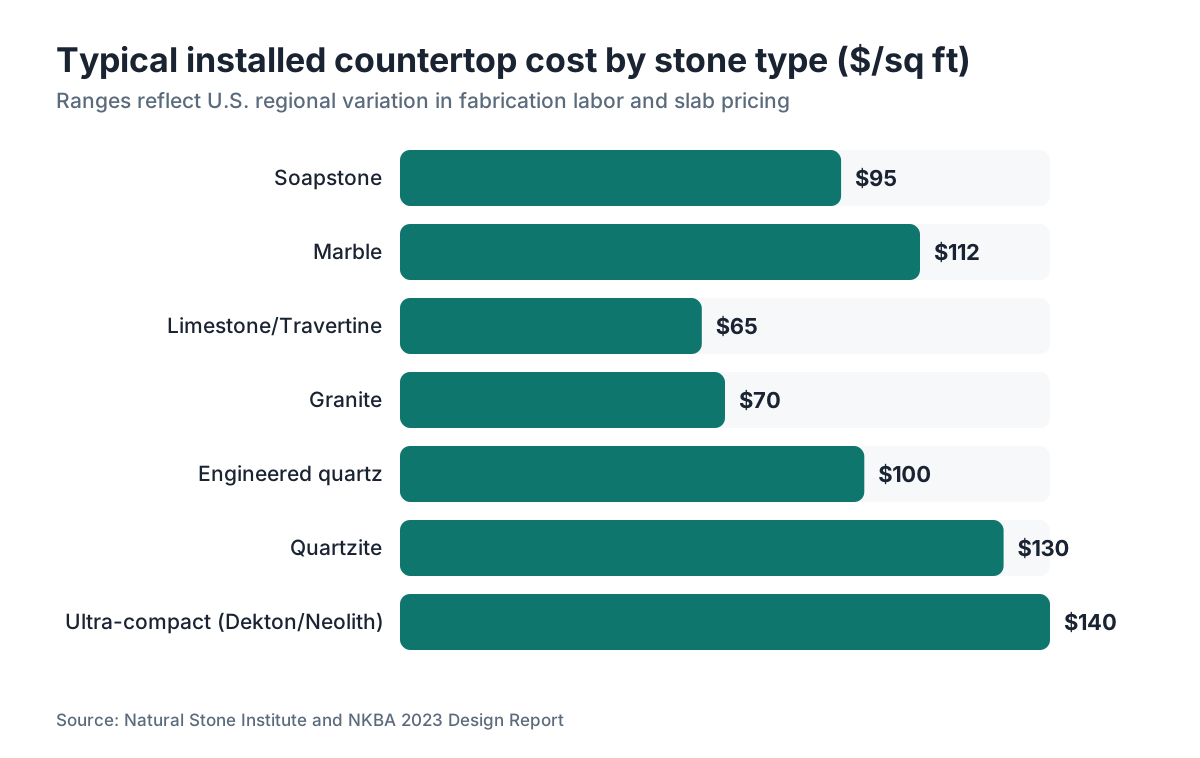
| Stone type | Relative hardness (Mohs) | Fabrication difficulty | Typical installed cost ($/sq ft) |
|---|---|---|---|
| Soapstone | 1.5 to 2.5 | Low to moderate | $70 to $120 |
| Marble | 3 to 4 | Moderate | $75 to $150 |
| Limestone/Travertine | 3 to 4 | Moderate | $40 to $90 |
| Granite | 6 to 7 | Moderate | $40 to $100 |
| Quartzite | 7 | High | $60 to $200 |
| Engineered quartz | ~7 | Moderate to high | $50 to $150 |
| Ultra-compact (Dekton/Neolith) | ~8 to 9 | Very high | $80 to $200+ |
How much does stone fabrication and installation cost?
Any single number misleads you here, because costs swing wildly. In the U.S. the range runs from roughly $40 per square foot installed for a basic granite out of a high-volume shop up to $200 or more per square foot for exotic quartzite, complex edge profiles, and a custom fabricator with low shop volume.
The National Kitchen and Bath Association estimated in its 2023 Design Report that countertop budgets across all materials averaged $4,400 for a full kitchen project, with natural stone kitchens running higher. [2] That covers a typical kitchen of roughly 50 to 70 square feet of countertop, which works out to about $63 to $88 per square foot as a rough midpoint for natural stone installed.
Several variables move the price more than the stone type does. Fabrication labor rates in San Francisco or Manhattan can run 40 to 60 percent higher than in mid-sized Midwest cities, purely because shop overhead and wages differ. Edge profile complexity matters too. A simple eased edge is usually in the base price, while a full mitered waterfall edge or a stacked double ogee can add $20 to $50 per linear foot. Cutouts for sinks, cooktops, and faucet holes are usually charged separately, often $50 to $150 per cutout.
Template fees sometimes show up as a separate line item, ranging from $0 (if you commit to the job) to $150 to $300 for a standalone templating visit. Digital templating with a laser or LiDAR tool is more accurate and often faster than cardboard, and some shops charge a small premium for it.
Demolition and removal of the old countertop is rarely in a fabrication quote. Expect a separate charge of $3 to $10 per square foot, or plan to rip it out yourself.
For fabricators running their own shops, cost control often comes down to minimizing offcuts. Better nesting of job layouts across a slab cuts material waste and lifts margin directly. Software that automates cut layout optimization, like the nesting engine inside SlabWise, can recover 10 to 20 percent of a slab on complex multi-piece jobs. That math matters when slabs cost $400 to $2,000 each. [3]
What equipment does a professional stone fabrication shop need?
Equipment separates a serious fabrication shop from a cut-rate operation faster than almost any other single factor. The core machines are a bridge saw, a CNC router (often called a CNC machining center in the trade), an edge polisher, and a waterjet cutter if the shop does high-complexity work.
A bridge saw is the primary cutting tool. Entry-level bridge saws start around $15,000 to $20,000. Industrial-grade automated bridge saws with digital readouts and automatic tilting heads run $80,000 to $200,000. Saw quality drives cut straightness and finish. A wobbly or worn blade on a cheap saw leaves micro-chips on the cut face that read as rough seams later.
A CNC router handles edge profiles and shape cutting. Modern 5-axis CNC machines can run any edge profile automatically from a programmed design file, which keeps every piece in a job consistent. Hand grinding still happens in smaller shops and can produce beautiful results with a skilled operator, but it is slower and harder to keep even across long runs.
Waterjet cutters use high-pressure water mixed with abrasive garnet to cut stone without heat or blade contact. They are essential for cutting fine shapes, inlays, and tile medallions. Not every shop owns one, and the shops that do tend to take on more custom architectural work.
Support equipment includes vacuum lifting systems (stone is heavy, a standard kitchen slab weighs 400 to 900 pounds), polishing tables, seam setters, and diamond tooling inventory. Consumable tooling is a real ongoing cost. Diamond blades for a bridge saw run $300 to $800 each and last a variable number of cuts depending on the stone hardness.
Digital templating tools like the Proliner from Prodim or laser scanners from Leica capture field dimensions digitally and feed them straight into CNC programming software, killing manual re-entry errors. Shops using digital templating report fewer remakes, though clean industry-wide data on remake rates is hard to find.
How do you find and vet a solid stone fabricator near you?
The best referral comes from a local kitchen designer, general contractor, or cabinet installer who sees fabricator work every week. They know which shops hold seam quality, show up on time, and handle callbacks without drama. Word-of-mouth inside the trade predicts quality better than online reviews for this kind of work.
Review platforms like Google, Houzz, and Yelp can surface shops near you, but read the negative reviews closely. A pattern of complaints about seam placement, late installs, or cracked stone near sink cutouts matters more than the overall star count.
When you contact a shop, ask to see the showroom and, ideally, the fabrication floor. A clean, organized shop with labeled slabs and maintained machines is a proxy for how carefully they will treat your project. Ask what templating method they use, whether they run a CNC or grind edges by hand, and how they handle a remake if a slab is damaged during fabrication.
Ask for references from completed jobs in the same material you are specifying. A shop that has installed 200 kitchens in white quartzite carries a very different risk profile than a shop working its third quartzite job. [4]
Get at least three written quotes that itemize material, fabrication labor, edge profile charges, cutout charges, and installation separately. Comparing bundled lump sums is nearly impossible. A quote that lumps everything together is worth less than a detailed line-item breakdown.
Check whether the shop belongs to a trade organization like the Natural Stone Institute (the merged Marble Institute of America and Building Stone Institute). Membership is no guarantee of quality, but it signals some investment in professional standards and continuing education. [5]
What questions should you ask a fabricator before signing a contract?
A handful of direct questions reveal a lot about a shop's professionalism and fit before any money changes hands.
First, ask who owns and does the installation. Many shops subcontract installation to independent crews. That is not automatically bad, but it changes who is accountable when something goes wrong. Ask whether the install crew is their own employees or subs, and whether they warranty the subcontractor's work.
Second, ask about the warranty. Material defects are typically the slab supplier's responsibility, not the fabricator's. But fabrication defects like rough seams, chips, or mis-cut edges should sit with the shop. A clear written warranty covering fabrication workmanship for at least one year is a good sign.
Third, ask about the timeline from template to installation. For a standard kitchen, a well-run shop can complete templating, fabrication, and installation in 10 to 21 days. Longer lead times during busy seasons are normal, but a shop quoting 6 to 8 weeks for a routine job may be short-staffed or over-scheduled.
Fourth, ask about seam placement. On multi-piece countertops, seam location is part structural decision and part aesthetic. Ask to see a layout drawing before fabrication starts, and get seam placement agreed to in writing.
Fifth, ask how they handle breakage during install. Stone breaks. It happens even to good shops. The answer you want is that they carry the risk and re-fabricate at their cost, not yours.
How does the templating process work and why does it matter so much?
Templating is the step where the fabricator measures your actual space. It is the one point in the process where field reality gets translated into the cut file that drives the saw, and any error here cascades downstream into every piece.
Traditional templating uses strips of cardboard or luan plywood hot-glued together in place to build a physical template of the countertop shape. The template rides back to the shop, where it gets traced onto paper or entered by hand into cutting software. The method works well in skilled hands, but it adds measurement transfer errors.
Digital templating uses a laser arm device like the Prodim Proliner, which captures points directly off the walls and cabinets into a digital file. The resulting DXF or DWG file feeds straight into CNC programming software with no manual re-entry. Shops that use digital templating consistently report fewer field callbacks for tight fits and wall irregularities. [6]
For the homeowner, the takeaway is simple: ask your fabricator which method they use. Cardboard is not a dealbreaker, but it puts more weight on the experience of the person doing the templating. If they use digital templating, confirm the equipment is calibrated and the technician has formal training on it.
Templating should also happen after cabinets are fully installed and leveled. Templating over unlevel or shifting cabinets is a common source of countertop fit problems, and the fabricator will often rightfully disclaim responsibility for it.
What is the difference between a fabricator and a stone supplier or distributor?
The distinction matters for your wallet and your accountability chain. A stone distributor or importer buys slabs directly from quarries or international suppliers and sells them to fabricators or end customers. They do not cut, polish, or install anything. Their job is to source, warehouse, and sell slabs. Names like MSI International, Arizona Tile, Bedrosians, and United Marble are examples of distributors operating at scale across the U.S. [7]
A fabricator buys from distributors (or directly from quarries if they are large enough) and does the physical transformation of the slab into a countertop. A fabricator who also runs a slab warehouse is sometimes called a full-service stone company or an integrated fabricator.
For you as a homeowner, the simplest setup is usually a fabricator who either has a slab yard on-site or a preferred relationship with a nearby distributor. You pick your slab, the fabricator templates your kitchen, cuts and polishes your countertop, and installs it. One relationship, one point of accountability.
Complications start when you buy a slab yourself from a distributor and then hire a separate fabricator to cut it. If something goes wrong, each party points at the other. The distributor says the fabricator cut it wrong. The fabricator says the slab had a hidden fissure. Sorting that out is miserable. If you do want to buy your own slab, make the fabricator inspect and accept the slab before fabrication begins, in writing.
You can check fabricator-supplied stone pricing against distributor retail by visiting a local stone yard and asking for the cash-and-carry price on the same material. The difference is often $5 to $15 per square foot, which is the fabricator's material margin.
How does solid stone compare to solid surface, engineered wood, and laminate countertops?
Solid stone is not the only material fabricators touch, and it helps to see how it stacks up against the alternatives at the fabrication and performance level.
Solid surface materials like Corian are polymer-based products that a separate category of fabricators handles with woodworking tools rather than stone saws. Corian countertops can be thermoformed into curves and have invisible seams because the adhesive joins are the same material. Stone cannot do that. Solid surface costs less, typically $45 to $95 per square foot installed, and it is repairable with sanding. It is not heat-resistant the way granite is.
Laminate countertops like Formica are fabricated by different shops again, usually cabinet shops, using a substrate and a bonded laminate surface. Formica countertops and laminate countertops run $20 to $50 per square foot installed and are never fabricated by stone shops. Comparing them to stone is a material-category shift, not a price difference.
Butcher block countertops are wood products cut and finished by woodworkers, not stone fabricators. They run $40 to $100 per square foot installed and need periodic oiling and sealing.
For the homeowner choosing between stone and the alternatives, durability, heat resistance, and resale perception favor natural stone in a kitchen. Stone is also the only category a solid stone fabricator touches, so if you want stone, you need a stone fabricator, not a general countertop installer.
For more on the full range of kitchen countertops options and how they compare, the material trade-offs go well past price per square foot once you factor in longevity and maintenance.
How should homeowners care for stone countertops after installation?
Once your countertop is set, maintenance is entirely on you. How you treat the stone decides whether it looks the same in 10 years or shows every mistake.
Sealing comes first. Most natural stones except engineered quartz need periodic sealing with a penetrating stone sealer to cut porosity. Granite typically needs sealing every 1 to 3 years depending on the stone's density. Marble and limestone are more porous and may need sealing annually or even twice a year in a heavy-use kitchen. Engineered quartz needs no sealing at all, because the resin binders make it essentially non-porous.
For daily cleaning, mild dish soap and water works on most stone surfaces. Skip anything acidic, including vinegar, citrus-based cleaners, and anything labeled a bathroom cleaner, because acid etches calcite-bearing stones like marble, travertine, and some limestones. How to clean stone countertops is a topic where the material type sets the rules almost entirely.
Specific materials like quartzite and soapstone differ a bit. How to clean quartzite countertops and how to clean soapstone countertops cover the details for those stones.
The fabricator's care responsibility ends at installation, though a good shop hands you written care instructions. Ask for them if they do not offer them on their own.
What does a fabricator need to run a profitable, well-organized shop?
This section is aimed at fabricators, though homeowners reading it will see what separates an efficient shop from a chaotic one.
Job costing accuracy is the foundation. A shop that cannot price jobs correctly will either underbid and lose money or overbid and lose the job. Accurate quoting means knowing your machine rates, labor rates, consumable costs per square foot by material, and your expected waste percentage by job type. Many small shops still price from gut feel instead of actual cost data, which is why margin problems run so deep in the trade.
Scheduling and workflow sequencing set your throughput. A shop with one CNC machine can run only one job at a time on that machine. How jobs get batched, how templates flow into cut files, and how install crews get loaded all decide revenue per day. A bottleneck at any one station leaves expensive machines sitting idle.
Slab inventory management is a quieter source of profit and loss. Remnants from cut jobs eat floor space, need to be catalogued, and either sell at a discount or turn into dead inventory that costs money to dispose of. Shops that actively sell remnants to homeowners for bathroom vanities and small projects recover material cost that would otherwise evaporate.
Digital quoting and nesting software has become a real competitive tool for mid-sized and larger shops. Tools like SlabWise handle both the customer-facing quote and the back-end cut layout optimization, cutting the manual handoff between sales and the shop floor. For shops cutting 20 to 50 jobs per month, the time savings and error reduction on complex multi-piece jobs is measurable.
Staff retention is the hardest problem in fabrication right now. Skilled CNC operators and install crews are genuinely scarce. Shops that pay well, invest in training, and keep good equipment running tend to keep people. Shops that cut corners on maintenance drive up frustration and turnover.
The U.S. Bureau of Labor Statistics classifies stone cutters and carvers under occupation code 51-9194. Median wages for stone sawyers and cutters were $42,200 per year as of May 2023, though fabrication shop operators with CNC skills often earn considerably more. [8]
What are the safety requirements in a stone fabrication shop?
Stone fabrication carries one of the more serious occupational health risks in the trades: silica dust. Cutting granite, engineered quartz, and other silica-containing materials throws off fine respirable dust that causes silicosis, an incurable and potentially fatal lung disease. The risk from engineered quartz is especially high because quartz composites contain up to 93 percent crystalline silica. [9]
OSHA's standard for occupational exposure to respirable crystalline silica (29 CFR 1910.1053 for general industry) sets a permissible exposure limit of 50 micrograms per cubic meter as an 8-hour time-weighted average, down from the previous 100 micrograms limit, which took effect in 2018. [10] Table 1 in the standard specifies engineering controls by task type, including wet cutting and local exhaust ventilation (LEV) requirements for stone saws.
For fabrication shops, compliance means wet-cutting on all saws and waterjets, proper LEV on dry operations like edge grinding, mandatory respiratory protection when engineering controls fall short, regular air monitoring, and medical surveillance for exposed workers.
The National Institute for Occupational Safety and Health (NIOSH) has published guidance specifically on silica hazards in the stone fabrication industry, noting that engineered stone (quartz composite) cutting can generate silica exposures far above the permissible exposure limit without proper controls. [11]
Shop owners who ignore silica control do more than create health liability for their workers. OSHA has sharply increased enforcement in the stone fabrication sector since 2017, and citations for silica standard violations can run into tens of thousands of dollars per violation.
Proper PPE means half-face respirators rated P100 or N95 at minimum during any dry cutting, grinding, or sweeping. Wet mopping instead of sweeping is required to keep dust from getting kicked back into the air.
Are there industry certifications or standards for stone fabricators?
Formal certification in stone fabrication is less regulated than in some other trades, but industry bodies have built credentials worth knowing about.
The Natural Stone Institute (the merged Marble Institute of America and Building Stone Institute) runs a Qualified Fabricator Program (QFP) that assesses shop capabilities across equipment, process, and quality control criteria. [5] Membership and QFP participation are voluntary, but shops that go through the process have shown a baseline commitment to professional standards.
ASTM International publishes standards for natural stone testing and specification, including ASTM C503 for marble, ASTM C615 for granite, and ASTM C616 for quartzite. [12] These define minimum physical property requirements for stone sold in the U.S., but they do not govern fabrication quality directly.
The Tile Council of North America (TCNA) publishes installation method standards referenced in many commercial building specifications. Where stone tile enters a project alongside countertop fabrication, TCNA methods come into play.
For individual workers, the National Center for Construction Education and Research (NCCER) offers a masonry curriculum that includes stone work, though it leans toward structural masonry rather than countertop fabrication. Some technical colleges, especially in stone-heavy markets, run continuing education in CNC operation and stone finishing.
From the homeowner's side, certification matters less than seeing actual work and checking references. But a fabricator who takes part in Natural Stone Institute programming is at least engaged with the professional community in their trade.
Frequently asked questions
How long does countertop fabrication take from template to installation?
For a typical kitchen, expect 10 to 21 calendar days from the templating visit to installation day. High-volume shops with strong scheduling hit the shorter end. Custom work with complex edge profiles, waterfall islands, or specialty stone can run 3 to 5 weeks. The longest delays usually come from slab back-orders, not fabrication time. Ask your shop for a specific production schedule when you sign the contract.
Can a stone fabricator work with slabs I bought separately?
Yes, most fabricators will work with customer-supplied slabs, sometimes called CSM (customer-supplied material). They charge a standard fabrication and installation rate but will not warranty the material itself. Before agreeing, the fabricator should inspect the slab for hidden fissures, thickness variations, and defects. Get that acceptance in writing. If the slab breaks during fabrication due to a pre-existing flaw, liability gets disputed fast without a written acceptance record.
What is the difference between 2cm and 3cm stone, and which should I choose?
2cm slabs are about 3/4 inch thick and 3cm slabs are about 1.2 inches thick. Most residential countertops today use 3cm because it is stronger, needs no plywood build-up underneath, and shows a thicker, more substantial edge. 2cm stone costs less per square foot but usually needs a laminated substrate that adds the labor cost back. For kitchen countertops, 3cm is the standard recommendation from most fabricators.
What causes countertop seams to be visible, and can a fabricator hide them?
Seam visibility comes from four things: color variation in the stone across the seam, surface height mismatch between the pieces, gap width, and epoxy color match. A skilled fabricator minimizes all four using a seam setter to level the pieces, color-matching the epoxy to the stone background, and placing seams away from high-contrast veining. On busy, veined stones like marble, some seam visibility is unavoidable. On uniform granites, good seams nearly vanish.
Does the fabricator or the homeowner supply the slab?
Either model works. Most homeowners let the fabricator source the slab because the shop has distributor relationships and better pricing. You typically visit the distributor's slab yard with the fabricator or on your own to pick your specific slab, then the fabricator buys it. Buying the slab yourself can save $5 to $15 per square foot on the material markup, but it shifts some risk and the slab transport headache to you.
Is engineered quartz harder to fabricate than natural granite?
Engineered quartz is in many ways more demanding to fabricate than granite. The high silica content (up to 93 percent) speeds up blade wear and makes dust control critical. The resin binders generate heat during cutting that needs careful water cooling to avoid delamination at cut edges. CNC tooling costs run higher on quartz than on most granites. Fabricators experienced with quartz manage this well, but mostly-granite shops can struggle with quartz edge quality.
What should I look for when visiting a stone fabrication shop?
Look at the shop floor organization first. Clean, labeled slab storage, maintained machines, and systematic workflow staging all predict how carefully your job gets handled. Ask to see completed edges and seams on a finished piece, more than slabs. Check whether they wet-cut everything or do any dry grinding without ventilation, which is a silica safety red flag. A disorganized shop with loose safety habits tends to produce inconsistent fabrication.
Can a fabricator repair a cracked or chipped stone countertop?
Minor chips at edges or corners can be filled with color-matched epoxy and polished down to an acceptable result by most fabricators. Full cracks through the slab are harder to repair invisibly and usually mean the section needs replacement. Hairline fissures natural to the stone (not fractures) can be stabilized with a penetrating resin. Most fabricators offer repair services, though they may charge a trip fee plus labor. Matching the exact polish level on a repair is the hardest part.
Do fabricators install the sink during countertop installation?
Stone fabricators cut the sink opening and can often drop in or help position an undermount sink during installation. They do not do the plumbing connection. The sink usually gets set and siliconed to the underside of the countertop by the fabricator, and then a licensed plumber reconnects the drain and supply lines. Confirm this division of work with both your fabricator and plumber before installation day so neither shows up expecting the other to have finished.
What is overhang, and how much can stone countertops overhang without support?
Overhang is how far the countertop extends past the face of the cabinet below. For 3cm stone, most fabricators recommend a maximum unsupported overhang of 10 to 12 inches. Beyond that, corbels, brackets, or a knee wall carry the load, especially with heavier stones like quartzite or thick marble. For seating overhangs at a kitchen island, 12 to 15 inches is the typical target, which almost always requires support. Confirm your shop's specific guidance for your stone thickness.
How do I know if a fabricator's price is fair?
Get three itemized quotes from shops that have fabricated your chosen material before. Compare line items, more than totals. Check that each quote includes template, fabrication, edge profile, cutouts, and installation. Outliers in either direction deserve scrutiny. A price 30 percent below the others may reflect lower-quality tooling, uninsured labor, or hidden charges. A price 30 percent above should come with a real reason like proprietary equipment, premium warranty, or designer-grade finishing.
Are stone fabricators licensed or regulated?
Licensing requirements vary significantly by state and locality. In many states, countertop fabrication and installation falls under a general contractor license, a specialty trade license, or in some jurisdictions no license requirement at all. California, for example, requires a C-54 (ceramic and mosaic tile) or D-42 (limited specialty) license for stone installation work under the California Contractors State License Board. Always verify your local requirements and ask any fabricator for proof of current licensure and general liability insurance.
Sources
- IBISWorld, Stone, Concrete, and Glass Industry Report (US): Engineered quartz is now the single most popular countertop category by revenue in the U.S. market
- National Kitchen and Bath Association, 2023 NKBA Design Report: Average countertop budget across all materials in a full kitchen project was approximately $4,400 in 2023
- SlabWise, Nesting and Quoting Software Overview: Automated cut layout nesting can recover 10 to 20 percent of a slab on complex multi-piece jobs
- Natural Stone Institute, Fabricator and Installer Guidance: Fabricator experience with a specific material type is a primary factor in installation quality outcomes
- Natural Stone Institute, Qualified Fabricator Program: The Natural Stone Institute offers a Qualified Fabricator Program assessing shop capabilities across equipment, process, and quality control
- MSI International, Stone Distributor Overview: MSI International operates as a large-scale stone slab distributor selling to fabricators and contractors rather than performing fabrication itself
- U.S. Bureau of Labor Statistics, Occupational Employment and Wages, May 2023, SOC 51-9194: Median annual wages for stone sawyers and cutters (SOC 51-9194) were $42,200 as of May 2023
- NIOSH, Silica Hazards in Engineered Stone Fabrication (NIOSH Health Hazard Evaluation Program): Engineered stone (quartz composite) countertop fabrication can generate silica dust exposures far exceeding the permissible exposure limit without proper engineering controls; quartz composites contain up to 93 percent crystalline silica
- OSHA, Occupational Exposure to Respirable Crystalline Silica, 29 CFR 1910.1053: OSHA's permissible exposure limit for respirable crystalline silica is 50 micrograms per cubic meter as an 8-hour time-weighted average under 29 CFR 1910.1053
- NIOSH, Preventing Silicosis in Construction, Stone Finishing, and Related Industries: NIOSH has published guidance specifically on silica hazards in the stone fabrication industry including engineered stone risks
- ASTM International, ASTM C615 Standard Specification for Granite Dimension Stone: ASTM C615 defines minimum physical property requirements for granite dimension stone sold in the U.S.
Last updated 2026-07-10