TL;DR
- Silestone is an engineered quartz surface made by Cosentino.
- It's roughly 90% ground natural quartz bound with polymer resins.
- Installed cost runs $50 to $120 per square foot, driven by color, thickness, and region.
- The surface is non-porous, stain-resistant, and backed by a 25-year limited warranty.
- It is not heat-proof.
- Use trivets, always.
What exactly is Silestone and how is it made?
Silestone is a brand of engineered quartz made by Cosentino, a Spanish company founded in 1940 and now one of the largest surface producers in the world [1]. Each slab starts as roughly 90% ground natural quartz crystals mixed with polymer resins, pigments, and, in newer lines, recycled glass or mirror particles. That mixture goes into molds, gets pressed under high pressure and vibration, then cures into a slab that's cut and polished to standard thicknesses of 1.2 cm, 2 cm, or 3 cm.
The quartz crystals are held together by resin, not cement (as in concrete countertops) and not left in raw natural form (as in quartzite). So the finished product has almost no open pores. That's the defining trait of engineered quartz as a category, and of Silestone specifically. Bacteria, wine, oil, and acidic liquids sit on top instead of soaking in.
Cosentino rolled out what it calls HybriQ technology in 2021 across much of the Silestone line. According to Cosentino, HybriQ slabs use a higher share of recycled and renewable materials than the classic formulations [1]. Shopping on environmental grounds? Check the specific collection instead of assuming the whole brand qualifies.
Silestone is not quartzite. Quartzite is a natural metamorphic rock. Silestone is a manufactured composite. People mix these up constantly, and it's worth settling before you start comparing samples.
How much do Silestone countertops cost?
Installed cost usually lands between $50 and $120 per square foot. Most kitchens fall in the $65 to $90 range once you add fabrication, edge profiles, and basic installation [2]. The slab material alone, before any work happens, commonly runs $25 to $60 per square foot depending on the color series.
Cosentino sorts Silestone into entry, mid, and premium series. Entry colors like Blanco Norte or plain grays sit at the bottom. Statement and limited collections, especially the ones with heavy marble-style veining, push toward the top. Thickness moves the number too. Going from 2 cm to 3 cm adds $10 to $20 per square foot in most shops.
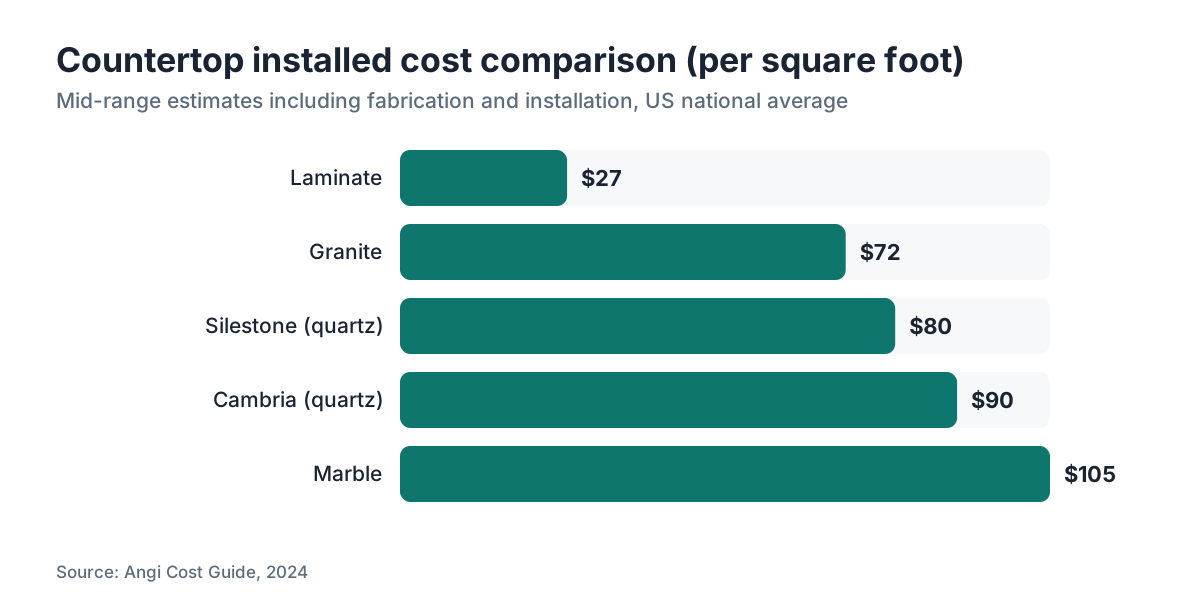
Here's how Silestone sits against other common surfaces:
| Surface | Installed cost (per sq ft) | Needs sealing? | Warranty |
|---|---|---|---|
| Laminate | $15, $40 | No | Varies by brand |
| Silestone (quartz) | $50, $120 | No | 25 years (limited) |
| Granite | $45, $100 | Yes, periodically | None from material mfr |
| Cambria (quartz) | $60, $130 | No | Lifetime (limited) |
| Marble | $60, $150 | Yes, frequently | None |
Lowe's sells Silestone through its countertop program, and installed pricing there generally matches the ranges above. In-store promotions sometimes knock down fabrication fees during spring and fall sales. Pull at least two local fabricator quotes alongside any big-box quote. Independent shops often beat box-store pricing on edge profiles and sink cutouts.
A standard 40-square-foot kitchen countertop in mid-range Silestone costs somewhere between $2,600 and $3,600 fully installed. That's a real-world number, not a best case. Waterfall edges, curved sections, and complicated layouts run the total up fast.
Is Silestone durable enough for everyday kitchen use?
For almost anything a household throws at it, yes. Quartz surfaces score high on abrasion resistance, and Silestone rates 7 on the Mohs hardness scale, the same as natural quartz [3]. Keys, pots, and normal kitchen tools won't scratch it in ordinary use.
The resin binder is where the limits show up. Resin softens and can discolor under sustained heat. Cosentino warns plainly against setting hot pans or heat-generating appliances directly on the surface [4]. A pan pulled from a 500°F oven and parked on the stone for thirty seconds can leave a permanent mark. Trivets and hot pads aren't optional on any engineered quartz. They're the rule.
Impact resistance is good, not perfect. A dropped spoon does nothing. A heavy cast iron pan landing on an edge or corner can chip or crack it. The corners near sinks take the most risk because the stone is unsupported on two sides.
UV exposure matters if sunlight hits your counters directly. Some Silestone colors can yellow or fade near windows over the years. The warranty excludes damage from prolonged UV, so think it through for a south-facing kitchen with big windows. Lighter neutral colors seem to show fade more than dark tones, though nobody has published controlled long-term data on this.
In bathrooms, laundry rooms, and other indoor wet areas, Silestone handles stains and moisture well. Outdoors is a different story. Cosentino does not recommend Silestone for outdoor use because of UV and thermal cycling [4].
How does Silestone compare to granite and other quartz brands?
The honest answer depends on what you care about most.
Granite countertops are natural stone, so every slab has a one-of-a-kind pattern. Some varieties run harder (up to 8 on Mohs), all need periodic sealing, and none carry resin that heat can hurt. Granite usually costs a little less installed than premium Silestone, though exotic granites can beat any quartz price. Want something no factory ever touched? Granite. Want predictability and zero sealing? Silestone.
Marble countertops come up because Silestone sells several marble-look collections. Real marble is soft (Mohs 3 to 4), etches from acids like lemon juice or vinegar, and asks for serious maintenance. The Silestone marble-look alternatives skip all of it. The surface won't etch. Whether the look satisfies you is taste, not performance.
Cambria countertops are the closest rival. Cambria is also engineered quartz, made in the US, and carries a lifetime limited warranty against Silestone's 25-year term. People often credit Cambria's patterns with more convincing stone looks. Prices sit close. Cambria typically runs $5 to $15 per square foot higher than comparable Silestone. Neither brand is a mistake. They fight over aesthetics more than performance now.
Corian is a solid surface, not quartz. It's softer, sands out for repair, and costs less. See Corian countertops if that tradeoff appeals to you.
Silestone's 25-year warranty is one of the longer ones in quartz, but read the exclusions. It covers manufacturing defects. It does not cover heat damage, cuts, chips from impact, or discoloration from chemical exposure [4].
What colors and styles does Silestone come in?
As of 2024, Cosentino offers Silestone in well over 70 colors across collections like Eternal, N-Boost, Sunlit Days, and the original Classic line [1]. The range runs from solid whites and blacks to concrete looks to detailed vein patterns.
The Eternal collection is Cosentino's answer to marble-look demand. Colors like Eternal Calacatta Gold and Eternal Statuario put bold gray or gold veining on white backgrounds. They sell hard in remodels where people want the marble look without the maintenance.
N-Boost colors use a surface treatment Cosentino calls "nanotech" that adds depth and color intensity. In practice, light reads off the surface differently than standard polished quartz. These usually sit in the mid to upper tiers.
Finishes go past standard polished. Suede (honed, soft texture) and volcano (rougher, matte) finishes come in most collections. Both hide fingerprints better than polished, though polished stays the easiest to wipe clean of spills.
Edge profiles from fabricators include eased, beveled, bullnose, ogee, and mitered. Waterfall edges, where the material runs vertically down the cabinet side to the floor, need matching slabs and a lot more fabrication time. Budget an extra $40 to $80 per linear foot for a waterfall edge.
Silestone comes in standard slabs around 55 by 120 inches. Jumbo slabs (63 by 130 inches) are available in some colors and cut down on seams over long runs.
How do you clean and maintain Silestone?
Daily cleaning is simple. Warm water, a few drops of dish soap, a soft cloth. That handles 95% of kitchen messes. The surface is non-porous, so no sealer is ever needed over Silestone's life [4].
For dried or stuck-on food, a plastic scraper works. Skip metal scrapers. They can dull the finish on polished slabs over time. A non-abrasive cream cleaner like Bar Keepers Friend (the liquid version, not the powder) handles stubborn stains without hurting the surface.
Stay away from these: full-strength bleach, oven cleaners, paint strippers, drain cleaners with strong alkalis, and nail polish remover (acetone). Cosentino's care guide lists these as capable of permanently damaging the surface [4]. The resin binder is the weak point, and harsh solvents go after it.
For stone care logic that applies across surface types, how to clean stone countertops covers it well.
To lift permanent marker or grease, isopropyl alcohol (rubbing alcohol) on a soft cloth works on most Silestone colors without damage. Test a hidden spot first if you're unsure.
Here's what homeowners underestimate. Cutting directly on Silestone dulls your knives faster than it scratches the stone. The quartz is harder than steel blades. Use a cutting board, not because the counter will mark right away, but because your knives will lose the fight.
Silestone needs no special deep-cleaning treatments, no polishing compounds, no annual sealer. That simplicity is a genuine edge over natural stone. See how to clean quartzite countertops for what natural stone maintenance actually asks of you.
Is Silestone heat-resistant?
It's heat-tolerant up to a point, not heat-proof. That difference is the whole story.
Cosentino rates Silestone to handle normal heat from everyday tasks, like a warm mug or a plate that briefly rests on the surface. They're explicit that hot pots and pans off the stovetop or out of the oven, and countertop appliances like slow cookers and toasters, should never sit directly on it [4].
The reason is the resin. Polymer binders in engineered quartz generally start softening or yellowing somewhere between 150°C and 200°C (roughly 300°F to 390°F). A pan out of a 450°F oven sits well above that. The mark it leaves, discolored or slightly warped, is permanent and not covered by warranty.
Cosentino introduced HybriQ+ in its higher-end 2022 and later collections, which the company says improves thermal performance over earlier formulas [1]. Independent test data on how much that shifts real-world heat limits isn't public as of this writing. So the practical advice holds: use trivets.
If heat resistance ranks high for how you cook, natural granite takes heat better because no resin is involved. That's one spot where granite has a real edge.
What does the Silestone warranty actually cover?
Silestone carries a 25-year limited warranty registered through Cosentino [4]. That's one of the longer material warranties in countertops and a real selling point.
What it covers: manufacturing defects, including unexpected cracking, crazing of the surface, or separation not caused by outside force or bad installation.
What it excludes is a long list worth reading before you buy. Heat damage, cuts, chips from impact, staining from improper care, UV-related color change, damage from chemicals Cosentino doesn't recommend, and problems from installation errors are all out [4]. The warranty is also non-transferable. Sell the house, and the new owners don't inherit the remaining term.
To register, you need the original purchase receipt and your fabricator's information. Cosentino handles registration through its website. Skipping registration is a common mistake, and without it the claim gets harder.
Fabricators and installers carry their own workmanship warranties, usually one to two years. If a seam cracks or a sink cutout fails in the first year, that's an installation issue and the fabricator's problem, not Cosentino's.
What should fabricators know about working with Silestone?
Silestone cuts and finishes like other engineered quartz. Diamond blades and diamond polishing pads are standard. Dry cutting is possible, but wet cutting controls dust far better and is the shop norm for both worker health and surface quality.
Silica dust is the serious occupational issue in quartz fabrication. Engineered quartz, Silestone included, carries high crystalline silica content. OSHA sets a permissible exposure limit (PEL) for respirable crystalline silica at 50 micrograms per cubic meter of air as an 8-hour time-weighted average [5]. OSHA states the standard "requires employers to limit worker exposures to respirable crystalline silica and to take other steps to protect workers." In practice that means engineering controls (wet methods, local exhaust ventilation), respiratory protection where controls can't reach the limit alone, and regular exposure monitoring.
California's Division of Occupational Safety and Health (Cal/OSHA) issued specific guidance on engineered stone countertop fabrication after documented silicosis cases among countertop workers [6]. Several states have moved to tighten enforcement. Check your state OSHA agency's current guidance, more than the federal minimums.
For shops quoting Silestone, material waste and nesting efficiency hit margin directly. A tool like SlabWise models slab layouts digitally before cutting, which trims remnant waste and tightens quotes. Getting square footage right upfront, including edge linear feet, sink cutouts, and cooktop openings, is where most quoting errors start.
Seam placement on Silestone follows the same rules as other quartz. Keep seams out of high-stress areas, plan them at inside corners instead of across open spans, and match veining direction on adjacent pieces for patterned colors. The Eternal series takes more layout planning because the veining is directional and customers spot mismatches.
Where can you buy Silestone countertops?
Cosentino sells Silestone through several channels in the US. The main ones are independent stone fabricators, big-box home improvement stores, and kitchen and bath showrooms.
Lowe's sells Silestone through its countertop program, usually with sample displays in-store and an order process that connects you to a Lowe's-affiliated fabricator. Lowe's installed pricing generally lines up with independent shops, though edge profiles, sink cutout charges, and installation fees vary. The upside at Lowe's is integrated project coordination. The tradeoff is less control over which fabricator does the work.
Independent fabricators are often the better route for complex layouts, specific edge profiles, or anyone who wants to walk a slab yard and pick a piece. Silestone slabs are made for consistent appearance, so slab-picking matters less than with natural stone, but seeing your chosen color under your kitchen lighting still helps.
Cosentino runs regional distribution centers across the US and a network of Cosentino City showrooms in major metros where you can see full-size slabs. Their website has a dealer locator. You can't buy directly from Cosentino as a homeowner. Everything routes through an authorized fabricator.
For the bigger picture on the kitchen countertops market and where quartz fits, that piece maps the landscape in more detail.
How does installation work and what affects the timeline?
Silestone installs like any stone countertop. The fabricator comes to your home to template, either with physical sticks or, more and more, a digital laser templater. That visit takes 30 to 60 minutes for a typical kitchen. Then the shop programs the cuts and schedules install, usually 5 to 14 days after templating depending on backlog.
Install day runs 2 to 5 hours for most kitchens. Old counters come out first (you can often pull them yourself to cut labor cost, so ask). The new slabs come in, get set dry, adjusted, then bonded with silicone or a color-matched adhesive at the seams. Undermount sinks get clipped and sealed. Most fabricators want you to keep the counters dry and unloaded for 24 hours while the adhesive cures.
For a full walkthrough of the countertop installation process, including prep, what goes wrong, and old counter removal, that guide covers each step.
What stretches the timeline: backordered colors (some Eternal series colors run 4 to 8 weeks if your distributor is out), complex seam layouts that need extra templating, or waterfall edges that need book-matched slabs.
Good fabricators nest pieces from a slab in software before cutting, both to cut waste and to confirm there's enough material. A shop that won't confirm your slab layout before cutting is a yellow flag. Shops running digital nesting tools like SlabWise catch material shortfalls before a blade touches stone, which matters a lot when a specific Silestone color has a 6-week lead time.
Plumbing reconnection isn't part of the countertop install. You'll need a plumber, or your own two hands if you're comfortable, to hook the sink and disposal back up after the counters are in.
Are there any sustainability or health concerns with Silestone?
Two issues come up over and over: silica dust during fabrication (covered in the fabricator section above) and end-of-life disposal.
Silestone and engineered quartz in general are hard to recycle. The resin-quartz composite doesn't separate back into clean components. Most waste heads to landfill, a real drawback next to natural stone, which repurposes more easily. Cosentino's HybriQ formulation uses recycled content and renewable energy in production, which helps the manufacturing side but not disposal [1].
For homeowners, the finished surface is inert. Once cured and polished, the resin and quartz combination doesn't off-gas or leach anything under normal use. The California Air Resources Board (CARB) sets formaldehyde emission standards for composite wood products [7]. That standard targets wood-based products, not quartz, but Cosentino states its products meet indoor air quality standards.
The crystalline silica concern is a fabrication hazard, not a use hazard. Sitting at a Silestone counter exposes you to nothing. The risk falls on fabricators cutting, grinding, and polishing the material in shop environments.
Australia moved in 2024 to ban engineered stone for new residential installations, citing silicosis rates among fabrication workers [8]. The US hasn't followed with a ban, but OSHA enforcement on silica in fabrication shops has climbed. Worth knowing if you're in the business.
Frequently asked questions
How long do Silestone countertops last?
With normal use and care, Silestone should last 25 years or more, which is why Cosentino backs it with a 25-year limited warranty. The main threats to longevity are heat damage from pots set directly on the surface, impact chipping at edges and corners, and prolonged direct sunlight that can shift color over time. None of those are defects. They're use conditions the warranty excludes.
Does Silestone stain easily?
No. The non-porous resin-quartz surface resists most common kitchen stains including wine, coffee, oil, and juice. Liquids sit on top instead of soaking in. Permanent marker and some strong dyes can leave a mark if left for hours, but isopropyl alcohol lifts most of them. Wipe spills promptly and you're fine. Unlike granite or marble, Silestone never needs sealing to stay stain-resistant.
Can you cut directly on Silestone?
You can, but don't. Silestone is harder than steel knife blades, so the surface won't show cut marks, but the quartz dulls your knives much faster than a cutting board would. Always use a cutting board. The countertop stays fine. Your knives are the ones that lose.
Is Silestone the same as quartz?
Silestone is a brand of engineered quartz, so yes and no. All Silestone is engineered quartz, but not all engineered quartz is Silestone. Other brands like Caesarstone, Cambria, MSI, and LG Viatera make similar products. The category is engineered quartz, or quartz composite. Silestone is Cosentino's brand name for their version of it.
How does Silestone hold up in bathrooms?
Very well. The non-porous surface resists water, humidity, and common bathroom chemicals, and it needs no sealing. The one limit is the same as in kitchens: don't set hot styling tools like flat irons or curling wands directly on it. A small protective mat for styling tools near a vanity is smart. Silestone is one of the better bathroom vanity top choices.
What's the difference between polished, suede, and volcano finishes on Silestone?
Polished is high-gloss and mirror-like, makes colors pop, and cleans easily, but shows fingerprints and water spots. Suede is honed and matte, softer looking, hides fingerprints better, and costs about the same as polished. Volcano has a more textured, rocky feel and forgives fingerprints the most, though it's harder to wipe fully clean on heavily textured spots. Finish availability varies by color collection.
Can Silestone be used outdoors?
Cosentino does not recommend Silestone for outdoor use. UV exposure fades color and degrades resin over time, and the thermal cycling of outdoor temperatures stresses the resin-quartz bond. The warranty also excludes outdoor installation. For outdoor kitchens and bars, porcelain tile, natural granite, or purpose-made outdoor solid surface products suit the job better.
How much does it cost to install Silestone at Lowe's vs. an independent fabricator?
Lowe's Silestone programs typically run $65 to $100 per square foot installed, which overlaps heavily with independent fabricator pricing. The difference usually comes down to edge profile options, turnaround time, and the specific installer Lowe's assigns. Independent shops may beat Lowe's on edge pricing and often let you visit and confirm layout before cutting. Get quotes from both before you decide.
Does Silestone need to be sealed?
No, never. Sealing is for porous natural stone like granite, marble, and limestone. Silestone's engineered quartz is non-porous, so sealers have nothing to bond to and add no benefit. Any product sold as a quartz sealer is at best pointless and at worst leaves a cloudy residue. Skip it.
How do I compare Silestone vs. Cambria?
Both are engineered quartz with similar hardness and stain resistance. Cambria is made in the US (Le Sueur, Minnesota) and offers a lifetime limited warranty against Silestone's 25-year term. Cambria typically costs $5 to $15 more per square foot. Design-wise, people often describe Cambria's patterns as more realistic natural stone looks. Silestone offers more total colors and finishes. Day-to-day performance differences are minimal.
What are the most popular Silestone colors for kitchens?
Eternal Calacatta Gold, Eternal Statuario, Blanco Norte, and Iconic White consistently rank as top sellers based on fabricator ordering patterns. White and off-white tones dominate because they work with almost any cabinet color. Gray tones like Gris Expo and concrete-look options have grown steadily. Bolder colors like Posidonia Green or the Sunlit Days collection draw buyers looking for something distinctly non-marble.
Is Silestone safe for food prep?
Yes. The cured surface is non-porous and doesn't harbor bacteria under normal use. NSF International, which sets food safety standards for commercial settings, certifies food contact surfaces including non-porous engineered quartz. Because Silestone has no open pores, bacteria can't survive in surface pockets the way they can in wood or unsealed stone. Standard soap-and-water cleaning after food prep is enough.
How heavy is Silestone and will my cabinets support it?
At 3 cm thickness, engineered quartz weighs about 18 to 20 pounds per square foot. A typical 40-square-foot kitchen countertop runs 700 to 800 pounds total. Standard kitchen cabinets built to code handle that load, but very old cabinets, thin-walled frameless cabinets, or island bases spanning over 36 inches without support should be checked before install. Your fabricator should flag any structural concern.
Can Silestone be repaired if it chips or cracks?
Small edge chips can be filled with color-matched epoxy by an experienced stone repair tech. The fix is usually visible up close but not obvious from across the room. Full cracks through the slab are much harder to hide, and major structural cracks often mean replacement. Prevention is the real answer: go easy at sink corners, don't stand on counters, and avoid point impacts on edges. Some fabricators offer repair services, so check locally.
Sources
- Cosentino Group, Silestone product information and HybriQ technology: Silestone is manufactured by Cosentino, contains approximately 90% natural quartz, and HybriQ technology increases recycled and renewable material content
- Angi, Quartz Countertop Cost Guide: Installed quartz countertop costs typically range from $50 to $120 per square foot depending on color, thickness, and region
- U.S. Geological Survey, Mineral Resources Program, Quartz mineral data: Natural quartz rates 7 on the Mohs hardness scale
- Cosentino, Silestone Care and Maintenance Guide: Cosentino advises against placing hot pots or heat-generating appliances directly on Silestone and lists chemical exclusions; the 25-year limited warranty excludes heat, UV, and impact damage
- U.S. Occupational Safety and Health Administration, Respirable Crystalline Silica Standard for Construction and General Industry: OSHA sets a permissible exposure limit of 50 micrograms per cubic meter of air as an 8-hour TWA for respirable crystalline silica
- California Department of Industrial Relations, Cal/OSHA guidance: Cal/OSHA issued specific guidance on engineered stone countertop fabrication following documented silicosis cases among countertop workers in California
- California Air Resources Board, Composite Wood Products Program: CARB sets formaldehyde emission standards for composite wood products used in indoor environments
- NSF International, Standards for Food Equipment (NSF/ANSI 51): NSF International certifies food contact surfaces and non-porous engineered quartz surfaces have been evaluated under food safety standards
Last updated 2026-07-09