TL;DR
- Silestone is engineered quartz made by Cosentino, roughly 90% crushed quartz bound with polymer resin.
- It costs $50 to $120 per square foot installed, never needs sealing, and resists most stains and scratches.
- It can discolor from sustained UV exposure and chip at unsupported edges.
- Direct heat cracks it.
- For most kitchens and baths, it holds up well.
What exactly is Silestone and how is it made?
Silestone is engineered quartz made by Cosentino, a Spanish stone company founded in 1979 that now operates in more than 110 countries [1]. The slab starts as crushed natural quartz, usually around 90% of the finished product by weight, mixed with pigments, polymer resins, and sometimes recycled glass or mirror chips. That mix gets vibro-compacted under vacuum, pressed under high pressure, and cured with heat. What comes out is a non-porous slab with color that runs consistent all the way through.
Quartz the mineral rates 7 on the 10-point Mohs hardness scale [10]. That makes the finished surface harder than marble (5 to 5.5 Mohs) and about even with granite (6 to 7 Mohs). The polymer binder adds a little flexibility that pure mineral stone lacks, which helps during fabrication. It also means sustained high heat can damage the slab in a way granite shrugs off.
Silestone is not stone in the geologic sense. The quartz particles inside it are real mineral quartz, but the slab itself was never in the ground. That distinction changes what you should expect from it, and it shapes the marketing you will hear. Showrooms sometimes sell Silestone as "natural quartz." That phrase describes the mineral content, not where the product came from.
How much does Silestone cost per square foot in 2025?
Installed Silestone runs $50 to $120 per square foot in most U.S. markets, and the average project lands around $70 to $85 [2]. Material alone, before fabrication and installation, usually falls between $25 and $65 per square foot depending on the color line.
Cosentino splits Silestone into three rough tiers. Entry colors in the Classic line (solid whites and grays) sit at the bottom. Mid-range collections like Eternal and Ethereal Glow add movement and veining. The premium lines, including Silestone made with the HybriQ+ process and its higher recycled-glass content, carry the top material cost.
A standard 30-square-foot island in a mid-range color with a straight eased edge runs roughly $2,100 to $2,550 installed in most metros. A full kitchen (perimeter counters plus island, say 55 to 70 square feet) lands at $3,850 to $8,400 depending on edge profile, cutouts, and local labor.
The costs that catch homeowners off guard:
- Complex edge profiles (waterfall, ogee) add $15 to $45 per linear foot above a standard eased edge.
- Undermount sink cutout: $100 to $250 per sink.
- Removal and disposal of old counters: $150 to $400.
- Extra seams in awkward layouts add labor time and a little material waste.
Fabrication software like SlabWise helps shops quote Silestone jobs accurately and cut slab waste, which feeds straight into the price a homeowner sees.
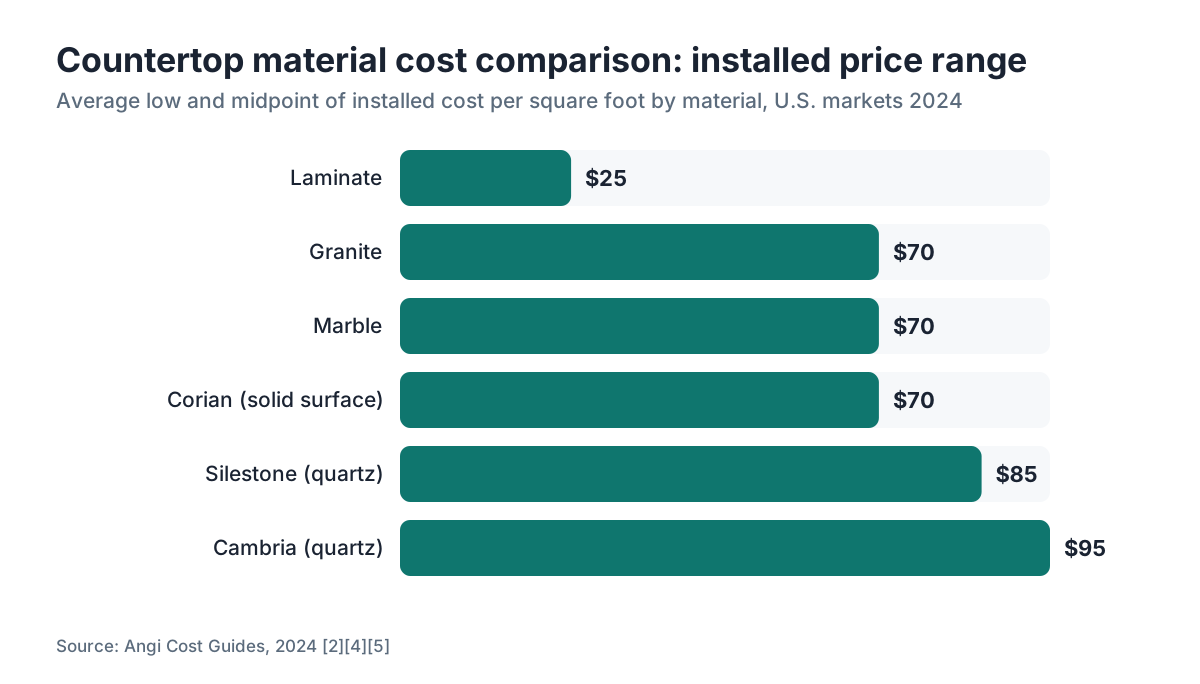
Silestone sits in the same band as other mid-tier engineered quartz brands. Cambria (made in the U.S.) typically runs $60 to $130 per square foot installed [3]. Our Cambria countertops guide runs the head-to-head. Granite can come in cheaper at $40 to $100 per square foot installed depending on the slab, though exotic granites blow past that range [4]. The table below lays it all out.
How does Silestone compare to granite, marble, and other quartz brands?
| Surface | Installed cost ($/sq ft) | Hardness (Mohs) | Needs sealing? | Heat resistance | UV stable? |
|---|---|---|---|---|---|
| Silestone (quartz) | $50, $120 | ~7 (mineral) | No | Low-moderate | No |
| Cambria (quartz) | $60, $130 | ~7 (mineral) | No | Low-moderate | No |
| Granite | $40, $100 | 6 to 7 | Yes, annually | High | Yes |
| Marble | $40, $100 | 5 to 5.5 | Yes, frequently | Moderate | Yes |
| Corian (solid surface) | $45, $95 | Soft (varies) | No | Low | Partial |
| Laminate | $10, $40 | Very soft | No | Low | Partial |
Sources: [2][3][4][5]
Silestone's edge over natural stone is consistency. Every slab in a given color looks nearly identical, which matters when a large kitchen or a run of bath vanities needs more than one slab to look like one piece. Granite slabs from the same bundle can vary a lot.
Where granite wins is heat. Set a 400 degree cast iron skillet straight on a Silestone slab and you can trigger thermal shock that permanently discolors or cracks the resin binder. Granite takes it without complaint. This happens in real kitchens all the time. Trivets cost two dollars. Use them.
Against marble, Silestone wins on maintenance and it isn't close. Marble etches (surface acid damage) from lemon juice, vinegar, or wine. Silestone does not etch. Young kids, a baking-heavy house, or a client who won't commit to marble's care routine all point to engineered quartz. Our marble countertops guide digs into that trade-off.
Against Corian and other solid surface, Silestone is harder and more scratch-resistant, but Corian can be sanded and repaired in place. A deep gouge in Silestone usually means replacement. Our Corian countertops article covers that repair story if it matters to you.
Against laminate, Silestone is far more durable and looks more like stone. Laminate costs a fraction of the price and has gotten genuinely good. If budget is the whole story, read our laminate countertops guide before you write it off.
Does Silestone need to be sealed?
No. Silestone is non-porous straight from the factory, so a sealer has nothing to soak into and does nothing for you [1]. This is one of the main reasons people pick engineered quartz over natural stone.
Granite is porous and should be sealed every 1 to 3 years depending on the stone and the sealer [4]. Marble is more porous still and soaks up stains and acid damage fast without regular sealing. Silestone skips all of that.
Here is what that means day to day. You don't buy sealers, book annual maintenance, or run a water-drop test on your counter. Red wine, coffee, and most cooking oils can sit for hours without leaving a permanent mark, as long as you wipe them up eventually. Strongly pigmented stuff like turmeric paste or permanent marker can leave a surface stain, but a mild abrasive cleaner usually lifts it.
One caveat. Some very light Silestone colors show residual staining from harsh chemicals like bleach if it sits long enough. That is dye transfer into the resin, not true porosity. It is uncommon, but it isn't impossible.
Is Silestone scratch-resistant and durable for everyday kitchen use?
Silestone handles daily kitchen use well. A knife won't visibly scratch the surface, but it will dull your blades fast because the quartz mineral is harder than most knife steel. Use a cutting board anyway.
The surface resists chips and cracks under normal loads. The weak points are unsupported overhangs and thin sections near cutouts, especially the narrow strip between a sink cutout and the front edge. A hard hit there can crack the slab. Good fabricators add a sub-deck or plywood support under long overhangs for exactly this reason.
Heat is the real durability question. Cosentino's own care guidance recommends against setting hot pots and pans directly on the surface [1]. A jump from 70 degrees to 400 degrees at one contact point can crack or discolor the resin binder. The mark is usually a whitish or dark blotch that does not polish out, and it isn't covered by warranty because Cosentino calls it improper use.
UV light is the related concern Cosentino is honest about. Earlier Silestone lines can yellow or fade under prolonged direct sun. That matters for counters near big south-facing windows and for outdoor installs. Some newer HybriQ+ formulations show better UV stability, but for an outdoor kitchen a UV-stable natural stone like granite or a purpose-built outdoor surface is the safer call.
What is Silestone HybriQ and is it better than standard Silestone?
HybriQ is Cosentino's updated manufacturing process, announced around 2019 and now used across most of the current catalog. It swaps part of the traditional polyester resin for a hybrid mineral and recycled-glass binder [1]. Cosentino says HybriQ products use 99% recycled water in production and run on 100% renewable electricity at their plants.
HybriQ+ (the plus designation) pushes further with higher recycled content, including post-consumer glass. Cosentino markets these lines as the greener option, and the manufacturing claims show up in its published sustainability reports.
On performance, Cosentino claims better stain resistance and surface consistency with HybriQ. Independent third-party testing that confirms a specific advantage over older Silestone lines is not something I have seen published, so treat that claim with some skepticism. What is documented: these surfaces carry the same NSF/ANSI 51 certification for food contact as the earlier lines [6].
If you are choosing between an older Classic color and a newer HybriQ+ color at a similar price, the newer line is the better pick on both performance and environmental grounds. But don't pay a big premium for HybriQ alone unless the environmental story matters to you. Over ten years in a home kitchen, you are unlikely to notice the durability difference.
How do you clean Silestone and keep it looking good?
Daily cleaning is simple: warm water, a little dish soap, a soft cloth. That handles 95% of what a kitchen throws at it. Dry the surface afterward to keep water spots from building up, especially if you have hard water.
Dried-on food or grease comes off with a plastic scraper. Skip metal scrapers. They can leave fine gray marks from the metal itself.
Stubborn stains give way to a 50/50 mix of isopropyl alcohol and water. For dried adhesive or ink, acetone (nail polish remover) works, but use it sparingly and rinse well afterward.
What to keep away from the surface:
- Bleach and strongly alkaline or acidic cleaners used over and over. They dull the finish with time.
- Abrasive pads (steel wool, Scotch-Brite). They scratch the polish even when you can't feel it happening.
- Silicone-based polishes and waxes. They leave a film that grabs grime.
Cosentino sells its own Silestone Care product, but there is nothing special about it. A pH-neutral stone cleaner from any hardware store does the same job.
For general stone cleaning principles, our how to clean stone countertops guide carries over well here. Just ignore the sealing steps, because Silestone doesn't need them.
What warranty does Silestone carry?
Cosentino backs Silestone with a 25-year limited residential warranty under current published terms [1]. It covers manufacturing defects, structural defects under normal use, and color consistency problems.
What it leaves out matters just as much. The warranty excludes heat damage (hot pots), impact damage, improper installation, use of non-approved cleaners, and normal wear. Outdoor installs get a shorter warranty period with specific conditions attached.
The warranty transfers to a new homeowner, which adds a little resale value for the paperwork-inclined.
To keep the coverage, Cosentino requires installation by a fabricator registered in its network. If a random contractor cuts and installs the slab without registration, you may lose warranty protection. Ask your fabricator whether they are Cosentino-registered before you sign anything.
25 years beats most flooring warranties and matches high-end appliances. In practice, most Silestone counters outlast the warranty with no drama. The failure modes that do show up (heat damage, edge chips) tend to happen early, from user error, not from the material breaking down over time.
What are the available colors and finishes?
Cosentino's active Silestone catalog runs past 90 colors as of 2024, sorted into collections [1]. The range covers:
- Neutral whites and creams (Blanco Orion, White Storm, Pearl Jasmine)
- Grays from light ash to deep charcoal (Cemento Spa, Kensho, Eternal Serena)
- Bold colors including deep navy, sage green, and terracotta tones
- Marble-look patterns with soft veining (Calacatta Gold, Eternal Calacatta)
Finish options have grown a lot in recent years. The current line includes:
- Polished: the high-gloss standard, reflective and easy to wipe clean
- Suede: a matte texture with a soft feel that hides fingerprints better
- Volcano: an uneven, tactile texture meant to mimic natural stone, which needs more cleaning attention in the crevices
Thicker slabs (3 cm) are standard for countertops. Some colors come in 2 cm for vertical work like backsplashes and shower walls.
Discontinued colors are a real risk with any engineered quartz brand. On a phased renovation, buy extra material during the first install. Matching a Silestone color three years later can be difficult or flat-out impossible if the color has been retired.
How does Silestone hold up in bathrooms compared to kitchens?
Silestone does very well in bathrooms. Because it is non-porous, no mold or mildew can grow in the surface itself, unlike grout joints or poorly sealed natural stone. Vanity tops, shower walls, and tub surrounds in Silestone stay easy to keep clean.
For shower walls, use 2 cm Silestone and make sure the installer runs tight seams at the corners sealed with a matching silicone. Water that sneaks behind a bad seam damages the substrate, not the Silestone, but it is still a problem you have to fix.
Vanity tops take far less mechanical abuse than kitchen counters. The main risks are dropping a glass bottle on an edge (which can chip) and leaving high or low pH acne or cleaning products sitting on the surface.
One honest note. Very busy veined patterns can read a little artificial in a bathroom, where you're close to the surface, compared to a kitchen island you view from across the room. Simple colors and subtle patterns look more natural at arm's length near a mirror. That's subjective, but worth weighing in the showroom.
What do fabricators need to know about cutting and installing Silestone?
Silestone fabricates much like other engineered quartz, but a few specifics matter.
Blade choice: diamond bridge saw blades rated for engineered quartz handle it well. The resin binder wears blades a little differently than pure granite does. Keep blades sharp. Dull blades chip cut edges.
Edge polishing: Silestone's finish (polished especially) reaches a consistent sheen because the resin fills the micro-porosity. It polishes cleanly through a standard quartz sequence (50 to 3000 grit with water cooling).
Templating matters more than usual here because veined patterns need careful orientation matching between slabs. Measure twice. Digital templating cuts error on complex layouts.
Support requirements: Cosentino recommends support every 18 to 24 inches under unsupported spans, with a maximum unsupported overhang of 12 inches for 3 cm material before you add support [1]. Waterfall edges that run full height to the floor need real mounting hardware, more than adhesive at the miter.
Seam placement: keep to standard practice and avoid seams directly over undermount sink cutouts. Put seams in low-stress spots and use a color-matched epoxy. Silestone's branded seam adhesives come matched to the catalog colors.
Shops running quoting and nesting software like SlabWise can cut Silestone material waste on complex jobs, which matters when slabs run $400 to $900-plus at the wholesale level.
Silicosis risk during dry cutting and grinding of quartz-containing stone is a serious occupational hazard. OSHA and the National Institute for Occupational Safety and Health (NIOSH) have published guidance on engineered stone fabrication. Wet cutting and proper respiratory protection are required, not optional [7][8].
Is there a silicosis risk homeowners should know about?
A finished, installed Silestone countertop poses no silicosis risk to homeowners. The hazard lives in the shop, during dry cutting, grinding, and polishing of quartz-containing engineered stone, where fine respirable crystalline silica dust gets kicked into the air.
OSHA cut its permissible exposure limit for respirable crystalline silica in 2016 to 50 micrograms per cubic meter of air as an 8-hour time-weighted average, down from the old 100 micrograms [7]. NIOSH has found that engineered stone can generate silica dust concentrations during dry fabrication that reach roughly 100 times those from natural granite under equivalent cutting conditions [8].
That exposure has caused serious illness and death among countertop fabricators in the U.S., Israel, Spain, and Australia. OSHA and NIOSH issued a joint hazard alert aimed specifically at engineered stone countertop fabrication [8]. California's Cal/OSHA enacted additional engineered stone rules effective 2024, including mandatory wet cutting, HEPA vacuums, and respiratory protection programs [9].
As a homeowner, your installed counter is nothing to worry about. But when you pick a fabricator, it's fair to ask whether they wet cut and run proper dust controls. Shops that protect their workers usually run better in every other way too.
Frequently asked questions
Is Silestone the same as quartz countertops?
Silestone is one brand of engineered quartz, made by Cosentino. "Quartz countertops" is the broader category, which also includes Cambria, Caesarstone, MSI Q, and others. All engineered quartz surfaces are roughly 90% crushed quartz mineral bound with resin, but each brand uses different formulations, patterns, and thickness options.
Can you put hot pots on Silestone?
No. Cosentino explicitly recommends against setting hot pots, pans, or electric griddles directly on Silestone. Sudden heat can crack or discolor the resin binder, and that damage isn't covered by the warranty. Use trivets or hot pads. This is the single most common source of Silestone damage in home kitchens.
How long does Silestone last?
Silestone carries a 25-year limited residential warranty from Cosentino. In practice, a properly installed and cared-for counter can last the life of the home without structural failure. The main failure modes are edge chips from hard impacts and heat damage from hot cookware, and both come from misuse rather than the material aging.
Does Silestone stain easily?
Silestone is non-porous and resists most common kitchen stains: coffee, red wine, olive oil, and most food dyes. Prolonged contact with very dark pigments like turmeric paste or permanent marker can leave a surface stain that takes some scrubbing. Strongly colored chemicals like undiluted bleach or oven cleaner can discolor the resin if left in contact for a long time.
How does Silestone compare to Caesarstone?
Both are engineered quartz in a similar price range ($50 to $120 per square foot installed). Caesarstone is an Israeli brand and one of the earliest in the U.S. market. Silestone has a larger color catalog and more finish options (polished, suede, volcano). Performance is comparable. Brand availability varies by region, and your fabricator's familiarity with a specific brand often matters more than the brand itself.
Can Silestone be used outdoors?
Cosentino offers limited outdoor warranty coverage for some lines, but earlier and current standard lines can fade or discolor under prolonged UV. For an outdoor kitchen, confirm with your fabricator and Cosentino whether your specific color is rated for outdoor use. For most outdoor work, a UV-stable natural stone like granite or a purpose-built outdoor surface is the safer long-term choice.
What is the thinnest Silestone available and where is it used?
Silestone comes in 2 cm (about 3/4 inch) and 3 cm (about 1-1/4 inch) thicknesses. The 2 cm is mostly for vertical work like backsplashes, shower walls, and furniture panels where weight matters. For countertops, 3 cm is standard and structurally preferable. A 2 cm countertop needs full plywood underlayment support.
How do you repair a chip or crack in Silestone?
Small edge chips can sometimes be filled with color-matched epoxy and polished down, though a perfect invisible repair is rare. Cracks through the slab can't be fixed in a way that restores structural integrity, so that section usually needs replacement. This is a real disadvantage compared to solid surface materials like Corian, where surface damage can be sanded out.
Is Silestone safe for food contact?
Yes. Silestone holds NSF/ANSI 51 certification for food-zone materials, meaning it has been tested and found acceptable for surfaces that contact food. The non-porous surface doesn't harbor bacteria the way porous stone can. Standard cleaning with soap and water is enough for food safety in a home kitchen.
How heavy is Silestone and does it need extra cabinet support?
Standard 3 cm Silestone weighs about 18 to 20 pounds per square foot. A kitchen with 60 square feet of counter adds roughly 1,100 pounds. Standard face-frame or frameless cabinets built to normal residential specs handle this without modification. Very old or structurally compromised cabinets should be inspected before installation.
What is the difference between Silestone's polished, suede, and volcano finishes?
Polished is a high-gloss mirror finish that shows colors most vividly but also shows fingerprints and water spots. Suede is a low-sheen matte that hides smudges and feels softer. Volcano has a rougher, textured surface that mimics natural stone closely but needs more attention to keep the texture clean. All three are available across most of the current catalog.
How much does a full kitchen Silestone project cost?
A full kitchen (perimeter counters plus island, typically 55 to 70 square feet) in a mid-range color runs roughly $3,850 to $8,400 installed in most U.S. markets. That range reflects regional labor differences, edge profile complexity, sink cutouts, and any removal of old counters. Get at least three quotes from registered Cosentino fabricators to anchor your specific cost.
Can Silestone be installed over existing countertops?
Technically possible, but not recommended. Installing over old laminate or tile adds height that can conflict with appliances, sinks, and upper cabinets. The existing surface has to be perfectly flat and structurally sound, which old counters rarely are. Most fabricators and the Cosentino warranty require installation over proper cabinetry or substrate, not layered on top. Full removal is the standard approach.
Where is Silestone manufactured?
Cosentino manufactures Silestone mainly at its facilities in Almeria, Spain, with added capacity in the U.S. at a plant in Stafford, Texas. The U.S. facility serves North American markets to cut shipping time and carbon footprint compared to fully imported slabs. The HybriQ process at these plants runs on 100% renewable electricity per Cosentino's published sustainability reports.
Sources
- Cosentino Group, Silestone product and care documentation: Silestone composition, HybriQ process, 25-year warranty terms, heat and UV guidance, and fabrication support requirements
- HomeAdvisor / Angi, Quartz Countertop Cost Guide: Installed engineered quartz countertop cost range of $50, $120 per square foot in U.S. markets
- Cambria Company, product and pricing information: Cambria quartz countertops installed cost range of $60, $130 per square foot
- HomeAdvisor / Angi, Granite Countertop Cost Guide: Granite countertop installed cost range of $40, $100 per square foot
- HomeAdvisor / Angi, Countertop Cost Guide by Material: Comparative cost ranges for marble, laminate, and solid surface countertops
- NSF International, NSF/ANSI 51 Food Equipment Materials Standard: NSF/ANSI 51 certification covers food-zone surface materials including engineered quartz
- U.S. Occupational Safety and Health Administration (OSHA), Silica Rule Final Rule 2016: OSHA permissible exposure limit for respirable crystalline silica set at 50 micrograms per cubic meter as 8-hour TWA, effective 2016
- NIOSH / OSHA, Hazard Alert: Worker Exposure to Silica during Countertop Manufacturing, Finishing, and Installation: Engineered stone dry fabrication can generate silica dust concentrations up to 100 times higher than natural granite; joint OSHA/NIOSH hazard alert issued for countertop fabricators
- California Department of Industrial Relations / Cal/OSHA, Engineered Stone Regulation: California enacted specific engineered stone fabrication regulations effective 2024 requiring wet cutting, HEPA vacuums, and respiratory protection programs
- U.S. Geological Survey (USGS), Mineral Resources Program: Quartz and Silica: Natural quartz mineral hardness of 7 on the Mohs scale
Last updated 2026-07-09