TL;DR
- A granite fabrication shop cuts, edges, and installs countertops from raw slabs.
- Installed granite runs $40 to $120 per square foot depending on stone grade, edge profile, and region.
- The full job, from template to install, takes 7 to 14 days.
- This guide covers what fabricators actually do, how a quote breaks down, and the exact questions to ask before you sign.
What does a granite and stone fabrication shop actually do?
A shop like Rocktops takes a raw stone slab, usually 9 to 10 feet long and 5 to 6 feet wide, and turns it into countertops that fit your kitchen or bathroom to the millimeter. Five stages get you there: sourcing slabs, templating, cutting, edge profiling, and installation.
Templating is where most homeowners first touch the process for real. A tech comes to your home, measures every run of base cabinets or vanity, and either shoots a laser template or builds a physical one from thin strips of material. That file drives every cut the shop makes.
Cutting happens on bridge saws and CNC routers. A bridge saw does straight cuts and rough shaping. A CNC router handles curved cutouts, sink openings, cooktop holes, and anything with complex geometry. High-volume shops run both. Smaller shops sometimes farm out the CNC work.
Edge profiling is the step homeowners underestimate. Running a full bullnose, ogee, or waterfall edge across 40 linear feet can add $10 to $20 per linear foot to the job. A simple eased or beveled edge costs less and looks sharp in a modern kitchen.
Installation is where the pieces meet. Fabricators join sections with epoxy and color-matched seam filler, then set the slabs on cabinets with adhesive and mechanical clips. A good crew installs a full kitchen in three to five hours.
How much does granite and stone fabrication cost per square foot?
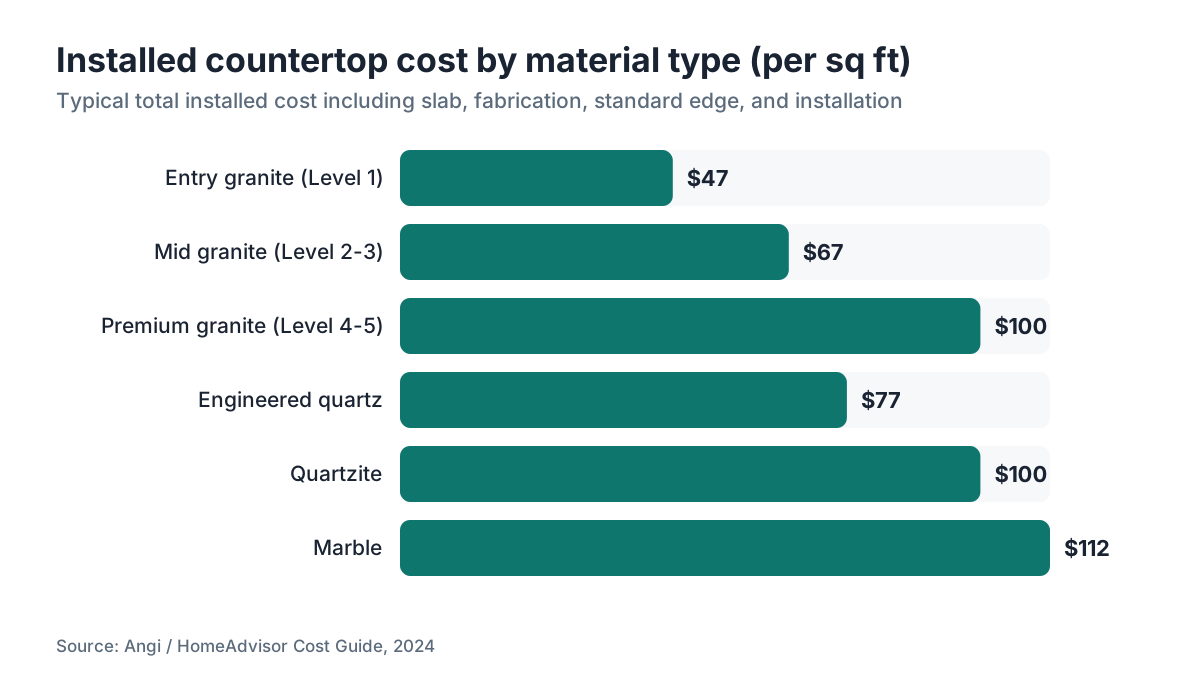
Installed granite runs $40 to $120 per square foot in the U.S., with mid-grade granite (Level 2 or 3) landing around $55 to $80 for most residential kitchens. [1] Those numbers cover the slab, fabrication labor, a standard edge, and installation. They do not cover demo of the old counters, plumbing reconnection, or a tile backsplash.
Here is how stone type moves the total installed cost per square foot:
| Stone type | Low estimate | High estimate | Notes |
|---|---|---|---|
| Entry-level granite (Level 1) | $40 | $55 | Limited color selection, common patterns |
| Mid-grade granite (Level 2-3) | $55 | $80 | Most popular range, wide selection |
| Premium/exotic granite (Level 4-5) | $80 | $120+ | Rare quarries, dramatic movement |
| Quartzite | $70 | $130 | Harder than granite, quarried similarly |
| Marble | $75 | $150 | Etches and stains, needs maintenance |
| Engineered quartz | $55 | $100 | Consistent pattern, no sealing needed |
Those ranges come from aggregated retail quotes and industry price surveys. Actual pricing swings with your metro, slab availability, and shop overhead. [1][2] Shops in San Francisco or New York run 20 to 35 percent above national averages. Rural shops often run 10 to 15 percent below.
The biggest variable homeowners miss is slab waste. Slabs sell in full lots. If your kitchen needs 52 square feet but the layout burns 30 square feet in cutouts and drops, you still pay for the whole slab, or close to it. A good fabricator shows you the layout before cutting so you see exactly what you're buying.
For grading tiers and what Level 1 through 5 really means in practice, the granite countertops guide goes deeper on the stone itself.
What is the typical timeline from quote to installed countertops?
Most residential granite jobs take 7 to 14 calendar days from signed contract to install day. [2] Here's the breakdown:
- Day 1 to 2: Signed contract, slab confirmed at the yard or warehouse.
- Day 2 to 4: Template appointment scheduled and completed.
- Day 4 to 8: Fabrication at the shop (cutting, profiling, polishing).
- Day 8 to 14: Installation scheduled and completed.
Slab availability is the slowest link. If the shop stocks your stone or a local distributor has it, things move fast. If they have to pull an exotic slab from a regional warehouse or set up a direct import, add one to three weeks.
Busy seasons stretch it further. Spring renovation season (March through May) and the pre-holiday push (October through November) can tack two to four weeks onto the baseline at high-volume shops. Got a hard deadline, like a contractor finishing cabinets on a set date? Say so up front and ask the fabricator to confirm capacity in writing.
One thing nobody spells out: you usually can't use your kitchen sink the day of install, and sometimes for 24 hours after while the adhesive cures. Tell your plumber the countertop install date before they schedule the reconnection.
What should you look for when choosing a stone fabrication shop?
Equipment, experience, and straight answers matter more than the name on the truck. Here's what separates a shop you should hire from one you should skip.
Do they own their CNC equipment? Shops that sub out CNC work add time, add markup, and lose control over quality. Ask flat out: do you cut and finish everything in-house?
Can they show you finished edge samples? Any real shop keeps physical edge profiles on hand. A paper brochure instead is a yellow flag.
Do they offer digital templating? Laser templating (Proliner and similar tools) beats manual strips for accuracy, especially in older homes where walls run out of square. [3] A manual-only shop isn't automatically bad, but ask why.
How do they handle seam placement? Seam placement is part art, part engineering. A good fabricator talks it through with you before cutting. You want seams away from high-traffic zones and set where the pattern transitions naturally.
What does the warranty cover, and for how long? Most shops warrant fabrication workmanship for one to two years, not the stone itself. Cracks from bad support, lifting seams, and chip-outs in the first year should be their problem.
Ask about the install crew. Some shops sub out installation to a separate contractor. That isn't automatically bad, but it means a different crew owns the last mile of your project, and warranty talks get muddy.
Reviews help but only so far. A shop with 200 reviews and a 4.6 average tells you more than one with 12 reviews and a 5.0. Read for mentions of seam quality, how they handled problems, and whether they showed up on time.
What stone types do fabrication shops typically work with?
Most full-service shops handle at least six to eight materials. Granite is still the most-installed natural stone countertop in the U.S. [4] A good shop does much more than granite, though.
Granite is an igneous rock, hard, and fairly resistant to heat and scratching. It needs sealing about once a year, depending on porosity. The granite countertops guide covers sealing schedules and porosity testing.
Quartzite is a metamorphic rock that reads like marble but runs harder and more stain-resistant. Stone yards mislabel it constantly, so ask for a scratch or acid test if you aren't sure what you're actually buying. [5]
Marble is soft (about 3 on the Mohs scale versus 6 to 7 for granite) and etches when acidic liquids sit on it. [6] It's beautiful and genuinely works in low-acid kitchens or bathrooms, but it asks for more care than most people expect. The marble countertops guide covers care routines in detail.
Engineered quartz (Cambria, Silestone, Caesarstone) is roughly 90 to 94 percent ground quartz bound with polymer resin. [7] Fabrication is similar to natural stone, but quartz slabs run heavier and get slightly more brittle at thin sections, which changes how shops handle them. The Cambria countertops guide has brand-specific details.
Soapstone is soft (Mohs 1 to 2). Fabricators shape it with standard tools but finish it differently. [8] Quartzite and soapstone care diverge enough to warrant separate guides: how to clean quartzite countertops and how to clean soapstone countertops.
Porcelain slab countertops are common now too. Porcelain is UV-stable, non-porous, and heat-resistant, but it demands diamond tooling and a careful hand because it chips at cut edges faster than stone.
How do fabricators price a job and what goes into a quote?
A countertop quote has five cost buckets: material (the slab), fabrication labor, edge work, cutouts, and installation. Know each one and you buy smarter.
Material cost is slab square footage times a per-square-foot rate set by stone grade and the market. Distributor slab prices can shift 10 to 20 percent in a single quarter on import costs and quarry output. [9] Most fabricators lock your slab price once you select and approve a specific slab.
Fabrication labor covers all the cutting, edge profiling, seam grinding, and polishing done in the shop. Most shops bundle it into the per-square-foot price. Shops doing hand-finishing charge more. High-volume CNC shops charge less.
Edge work usually prices per linear foot, separate from the field area. A simple eased edge may be included. A full bullnose might add $12 to $18 per linear foot. An ogee or waterfall profile runs $18 to $30 per linear foot at many shops. [1]
Cutouts add up fast. A standard undermount sink cutout runs $75 to $175. A cooktop cutout is similar. Faucet holes cost $20 to $40 each. A complex configuration stacks these line items quickly.
Installation covers the crew, the truck, and the adhesives. Many shops fold it into the per-square-foot price. Others bill it separately at $200 to $600 depending on complexity.
Run a fabrication shop? The quoting tools at SlabWise build accurate quotes with all five buckets in one place, handling material pricing, edge pricing by linear foot, and cutout line items so you're not stitching together a spreadsheet.
Here's the surprise that gets homeowners: minimum job charges. Plenty of shops set a floor of $800 to $1,500 no matter the square footage. A small vanity top often hits that minimum even when the raw area would cost half as much.
What happens during the templating appointment and why does it matter so much?
Templating is the measurement step that drives every cut the shop makes. Get it wrong and the slabs don't fit. Get it right and the install goes clean.
A template tech usually spends 45 minutes to 2 hours in your home. They measure every countertop run, mark cabinet heights, note where appliances sit, flag walls that are out of square, and lock in where seams go. For an undermount sink, they need the sink itself or a manufacturer template to cut the right opening.
Digital laser templating uses a device that shoots laser points across your cabinets and records exact coordinates. Prodim (makers of the Proliner) leads this segment. [3] The file exports straight to the shop's CNC machines. Measurement error usually stays under 1 millimeter.
Manual templating uses thin plastic or cardboard strips taped to the cabinet tops and traced at the wall. It works fine with an experienced tech but leans harder on human skill.
Your job at the appointment: confirm seam placement, verify the sink model, and speak up about overhang depth (typically 1.5 inches on a standard run, up to 12 inches on an island if the support is there). [10] This is the last checkpoint before cutting starts. Changes after templating cost money.
What questions should homeowners ask before hiring a fabrication shop?
These questions separate the shops that handle problems well from the ones that vanish after install.
-
Can I come to the shop and approve my specific slabs before cutting? Any real shop says yes. Slab selection is personal, and photos lie.
-
Will you show me a seam diagram before fabrication starts? You want to approve seam locations in writing.
-
What equipment do you use for cutting and templating? Digital templating and in-house CNC are good signs.
-
How do you handle a damaged piece on install day? Accidents happen. The right answer: we re-cut a replacement at no charge and reschedule.
-
What's your workmanship warranty, and for how long?
-
Do you or a subcontractor do the installation? If a sub, who owns warranty claims?
-
What's your lead time right now? Ask specifically, not for a generic number.
-
What's included in the price, and what line items could add cost?
A fabricator who bristles at these questions is telling you something. A good shop answers them without blinking, because they field them every week.
How does stone fabrication affect sealing, maintenance, and long-term care?
Fabrication quality shapes how a countertop performs for years, more than on day one. Edge profiles with tight, polished faces seal better than rough-cut ones. Well-ground seams leave less gap for bacteria or staining agents to creep into. A shop that polishes cut edges thoroughly cuts the odds of micro-cracking at stress points around sink cutouts.
For natural stone, most homeowners reseal every one to two years depending on porosity and use. [11] The water test is simple: drop a quarter-sized puddle on the stone. If it soaks in within 10 to 15 minutes, reseal. If it beads for 20 minutes or more, you're fine.
Granite sealers run from penetrating impregnators (the right pick for daily kitchens) to topical coatings that sit on the surface. Impregnators soak into the pore structure without changing how the stone looks. [11]
If your fabricator offers to seal at install, take them up on it. They can hit all sides while the countertop is accessible, before it goes into place.
For daily cleaning, keep it plain: mild dish soap and water, and skip acidic cleaners (no vinegar or lemon products on marble or limestone). The how to clean stone countertops guide covers product choices and frequency.
Engineered quartz needs no sealing. That's a real win for people who don't want a maintenance calendar. The tradeoff: quartz can discolor under sustained heat and UV exposure in ways natural stone usually shrugs off.
What are the differences between granite fabrication and quartz fabrication?
Both materials run through similar shop equipment, but the differences are real and they hit quality and price.
Granite slabs vary a lot piece to piece. Each one is a unique cross-section of natural rock, so matching a pattern across a seam takes skill and sometimes luck. Quartz slabs are manufactured for consistency. Seam matching is more predictable, but the look is less one-of-a-kind.
Cutting granite on a bridge saw throws silica dust. Proper shops run water-cooled blades and dust suppression. OSHA's standard for respirable crystalline silica sets a permissible exposure limit of 50 micrograms per cubic meter of air as an 8-hour time-weighted average. [12] OSHA's rule states the PEL directly: "The employer shall ensure that no employee is exposed to an airborne concentration of respirable crystalline silica in excess of 50 µg/m3, calculated as an 8-hour TWA." Ask a shop straight up whether they have OSHA-compliant dust control, both for worker safety and because sloppy dust management tends to travel with sloppy everything else.
Quartz gets slightly more brittle at thin cross-sections, so shops have to handle it more carefully during transport and flips. Chips at cut edges show up more with quartz than granite when a shop rushes.
Finishing standards differ too. Granite often gets a final hand polish after CNC work. Quartz arrives with a factory finish that survives fabrication well, though edge profiles still need shop grinding and polishing.
Fabrication labor alone (material aside) tends to run similar for granite and quartz at most shops. The material cost is where the real price gap lives. Comparing against non-stone options? The laminate countertops, Formica countertops, and Corian countertops guides give honest reads on durability and total cost.
How do fabrication shops manage waste and material efficiency?
Stone waste is baked into the business. Every sink cutout, cooktop hole, and odd corner leaves a drop (an off-cut). A typical kitchen generates 20 to 40 percent material waste once you count layout inefficiency, cutouts, and guard stock. [2]
Shops handle drops a few ways. Some sell small drops straight to homeowners at a discount for vanities or small projects. Others build drops into the original quote, using off-cuts from other jobs to finish your smaller sections.
Nesting software trims waste by laying out every piece for a job on a virtual slab before the saw touches anything. Good nesting cuts waste by 8 to 15 percent on complex projects. [13] SlabWise handles nesting and ties it to the original quote, so the shop isn't entering measurements twice.
For homeowners, the practical move is simple: ask whether the shop can use a drop for your small bathroom vanity. If they have matching material, you save money and they send less to the landfill. It doesn't always pan out, but it's worth the ask.
Disposal of stone waste is mostly unregulated at the federal level (granite and quartz off-cuts count as non-hazardous solid waste under RCRA), though local rules vary. [14] The silica dust from dry cutting is the regulated stream, and OSHA governs it as an air contaminant rather than a solid waste.
What are realistic warranty and service expectations from a fabrication shop?
Warranty terms vary a lot in this trade, and almost nothing is standardized nationally. Here's what the better shops offer and what counts as standard.
Workmanship warranty: most shops warrant fabrication defects (seam separation, chip-outs from cutting, sink cutout cracks) for one to two years. A seam lifting in month three is a workmanship issue. A seam lifting in year four after heavy water exposure probably isn't.
Natural stone warranty: the stone itself carries no manufacturer warranty because it's a natural material. Fabricators aren't on the hook for natural fissures that were in the slab, though they should point them out before cutting.
Engineered quartz warranty: different story. Cambria and other major makers offer 10-year limited warranties on the material, covering manufacturing defects. [7] Those warranties require professional installation and proper care. Fabricators have to follow the manufacturer's installation specs to keep the warranty valid.
Installation warranty: covers the physical install, adhesive bonds, and hardware. Usually one year.
Get warranties in writing before you sign. "We stand behind our work" is not enforceable. Ask for a copy of the written warranty policy before the contract.
For the full install process from a homeowner's seat, including what to expect from the crew on install day, the countertop installation guide covers it.
Frequently asked questions
What is the average cost of granite countertop fabrication and installation?
Installed granite averages $40 to $120 per square foot depending on stone grade, edge profile, and location. Entry-level Level 1 granite runs $40 to $55 installed. Mid-grade Level 2 or 3 granite typically lands at $55 to $80 per square foot. Exotic or premium slabs can top $120. Those figures include slab cost, fabrication labor, a standard edge, and installation, but not demo or plumbing work.
How long does granite countertop fabrication take from measurement to install?
The standard timeline is 7 to 14 calendar days from signed contract to installation. That covers 1 to 2 days for scheduling and slab confirmation, 1 to 2 days for the templating appointment, 4 to 6 days for shop fabrication, and 1 to 2 days for installation scheduling. During busy seasons (spring and pre-holiday), expect 3 to 5 weeks at high-volume shops.
What is digital templating and is it better than manual templating?
Digital templating uses laser-based measuring devices, such as the Prodim Proliner, to record precise cabinet coordinates and export them straight to CNC machines. Accuracy typically stays under 1 millimeter. Manual templating uses physical strips traced along the cabinet surface and leans more on the tech's skill. Digital is more accurate, especially in older homes with walls out of square, but both methods work well in experienced hands.
Do I need to seal granite countertops after fabrication?
Yes, almost all granite needs an initial seal and periodic resealing, typically every one to two years. Many fabricators apply sealer during installation. Test porosity yourself with the water drop test: if a quarter-sized puddle absorbs in under 15 minutes, reseal. Penetrating impregnating sealers are the right type for kitchen granite. Surface coatings sit on top and wear off faster.
What is the difference between granite and quartzite, and does it affect fabrication?
Granite is an igneous rock (Mohs hardness 6 to 7); quartzite is a metamorphic rock (Mohs 7 to 8). Quartzite is harder and more heat-resistant but fabricates similarly to granite on standard shop equipment. The main issue is mislabeling: many stone yards sell soft marble or dolomite as quartzite. Ask for a scratch test with a steel file or a drop of lemon juice. Quartzite won't etch; marble and dolomite will.
What questions should I ask a fabrication shop before signing a contract?
Ask whether they do digital templating, whether fabrication is in-house or outsourced, whether you can approve your specific slabs before cutting, how seam placement is decided, what the warranty covers and for how long, whether installation is handled by their own crew or a sub, and what their current lead time is. A shop that answers all of these easily is a shop worth hiring.
Can I use remnant or drop slabs from a fabrication shop to save money?
Yes. Most shops accumulate drop pieces from larger projects and sell them at reduced rates. Drops work well for small bathroom vanity tops, bar areas, or laundry room counters. Pricing varies widely, from a few hundred dollars to near full slab price for desirable material, but it's almost always cheaper than ordering a new slab. Ask the shop what they have on hand before buying new.
What silica dust safety standards should a fabrication shop follow?
OSHA sets a permissible exposure limit for respirable crystalline silica of 50 micrograms per cubic meter of air as an 8-hour time-weighted average. Shops must use wet cutting, local exhaust ventilation, or equivalent dust control to meet it. A shop that dry-cuts stone without dust suppression is violating OSHA standards and putting workers at serious risk of silicosis. It's fair to ask any shop about their dust control practices.
Does engineered quartz have a manufacturer warranty that covers fabrication shops?
Yes. Major engineered quartz makers, including Cambria, typically offer 10-year limited warranties on the material, covering manufacturing defects. These warranties require professional installation and proper care as conditions. The fabrication shop must follow manufacturer installation specs or the warranty can be voided. Get confirmation from your fabricator that they're a certified or registered installer for the quartz brand you choose.
How do fabrication shops handle sink cutouts and cooktop openings?
Sink and cooktop cutouts are made with CNC routers using diamond-tipped tooling. For undermount sinks, the shop needs either the sink itself or the manufacturer's paper template to cut the correct opening. Cooktop cutouts follow manufacturer specs. Cutout charges typically run $75 to $175 for a sink and similar for a cooktop, billed separately from the per-square-foot countertop price. Faucet holes run $20 to $40 each.
What is a typical minimum job charge at a granite fabrication shop?
Most granite and stone shops set a minimum project charge between $800 and $1,500, regardless of square footage. It exists because templating, setup, cutting, and installation carry fixed labor costs that don't scale down for small jobs. Small bathroom vanity tops with only 5 to 10 square feet of material often hit this minimum, which pushes the effective per-square-foot cost well above a full kitchen project.
How does nesting software affect material waste in stone fabrication?
Nesting software lays out every cut piece for a job on a virtual slab before any cutting starts. Good nesting reduces material waste by 8 to 15 percent on complex projects compared to manual layout. For fabricators, that directly hits material cost and profit on each job. For homeowners, a shop that runs efficient nesting is less likely to run short mid-job or charge for a second slab it didn't need.
What stones are hardest for fabricators to work with?
Porcelain slabs are among the toughest because they chip at cut edges faster than stone. Very thin quartzite (under 2 centimeters) can fracture during handling. Heavily veined marble needs careful handling and seam matching that slows fabrication. Loose, crumbly granite with natural fissures can crack at cutout edges. Experienced shops handle all of these routinely, but they price the complexity into their quotes.
Can homeowners visit the shop to watch their slabs being cut?
Some shops allow it with advance notice; others restrict shop floor access for safety and insurance reasons. The more useful visit is the slab yard, where you select and approve your specific slabs before they head to the shop. Most shops welcome that step. Ask your fabricator when to come to the yard, because the window between signing and cutting is usually only a few days.
Sources
- HomeAdvisor (Angi), Granite Countertop Cost Guide: Installed granite countertops range $40 to $120 per square foot including slab, fabrication, edge, and installation; edge profiles add $10 to $30 per linear foot.
- Natural Stone Institute (formerly Marble Institute of America), Residential Stone Fabrication Standards: Standard residential fabrication lead time is 7 to 14 days; typical kitchen project material waste is 20 to 40 percent of slab area.
- U.S. Geological Survey, National Minerals Information Center, Dimension Stone: Granite is the most commonly installed natural stone countertop material in the United States.
- Natural Stone Institute, Consumer Guide to Stone Countertops: Quartzite is frequently mislabeled at stone yards; acid and scratch tests help distinguish true quartzite from marble or dolomite.
- National Park Service, Mohs Hardness Scale (Geology education material): Marble measures about 3 on the Mohs hardness scale versus 6 to 7 for granite, making it softer and more prone to etching and scratching.
- Cambria, Warranty and Care Documentation: Cambria offers a 10-year limited warranty on engineered quartz surfaces covering manufacturing defects, requiring professional installation.
- National Park Service, Mohs Hardness Scale (Geology education material): Soapstone measures roughly 1 to 2 on the Mohs hardness scale, making it much softer than granite and requiring different finishing methods.
- U.S. International Trade Commission, DataWeb Import Statistics: Granite and stone slab import prices fluctuate 10 to 20 percent per quarter based on international quarry output and shipping costs.
- Natural Stone Institute, Dimension Stone Design Manual (fabrication and installation guidelines): Standard countertop overhang is 1.5 inches on base cabinets; island overhangs beyond 12 inches require structural support per industry guidelines.
- Natural Stone Institute, Stone Care and Maintenance guidance: Most granite countertops require resealing every one to two years; penetrating impregnating sealers are recommended for kitchen applications.
- U.S. Occupational Safety and Health Administration, Crystalline Silica Rule (29 CFR 1910.1053): OSHA's permissible exposure limit for respirable crystalline silica is 50 micrograms per cubic meter of air as an 8-hour time-weighted average.
- Intermac / Biesse Group, CNC Nesting for Stone Fabrication: CNC nesting software reduces stone material waste by 8 to 15 percent on complex countertop jobs compared to manual layout.
- U.S. Environmental Protection Agency, Resource Conservation and Recovery Act (RCRA): Granite and quartz fabrication solid waste (stone chips, drops) is classified as non-hazardous solid waste under federal RCRA regulations.
Last updated 2026-07-09