TL;DR
- A handful of companies control most of the quartz countertop market: Caesarstone (Israel), Silestone by Cosentino (Spain), Cambria (USA), MSI, Vadara, and HanStone.
- They all sell engineered stone made from roughly 90 to 94% crushed quartz bound with polymer resins.
- Brand matters for warranty, silica content disclosure, and price, not for the basic chemistry.
What is engineered quartz and who actually makes it?
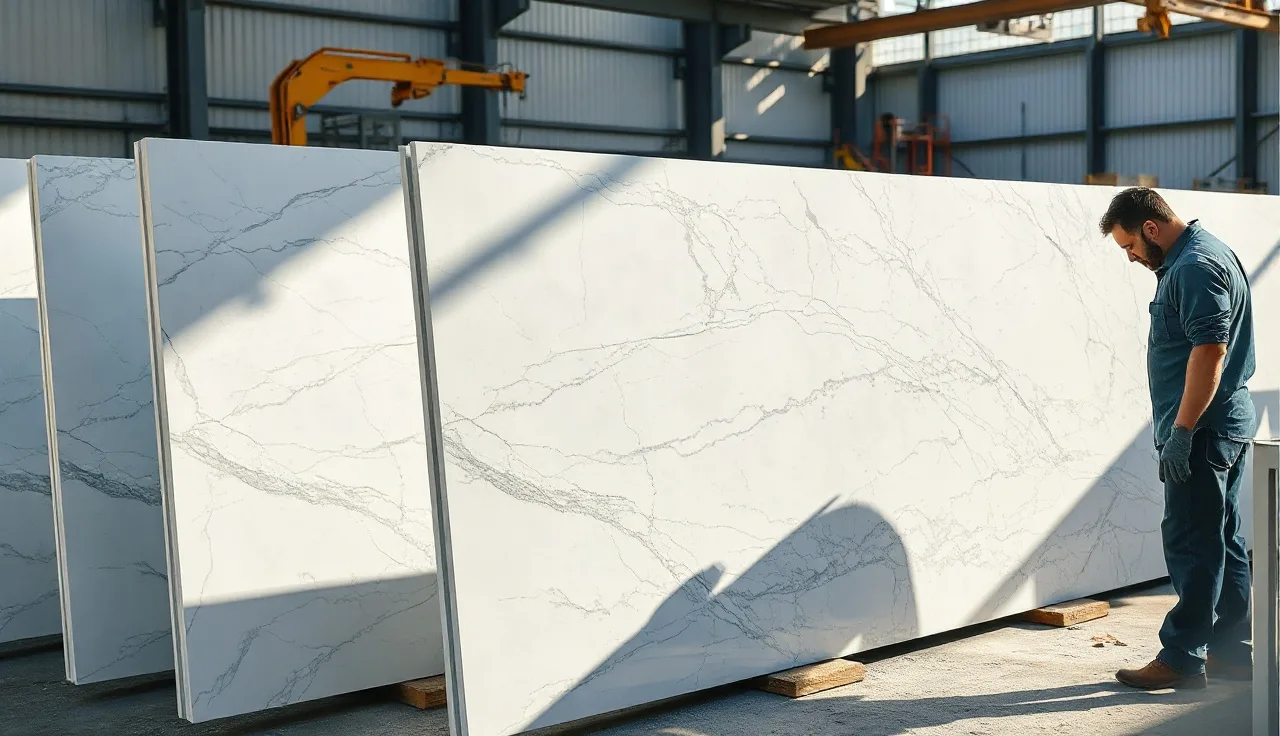
Engineered quartz countertops are manufactured slabs, not natural stone. The process takes crushed quartz aggregate, typically 90 to 94 percent by weight, and binds it with polyester or epoxy resins under vacuum and vibration, then cures the slab under heat and pressure. The result is a dense, non-porous surface that looks like stone but behaves more like a very hard composite.
The key word is manufactured. A quartz slab with a Silestone label was made in a factory to a controlled spec, not quarried and cut from whatever the earth gave up that year. That's the core difference from granite or marble. It also means two slabs from the same batch match almost exactly, which matters if you're doing a large kitchen or running multiple jobs from one order.
Who actually makes these slabs? The global market has a few dominant players. Caesarstone went public and largely created the premium segment in the US. Cosentino makes Silestone. Cambria is privately held in Le Sueur, Minnesota, and is the only large manufacturer producing in the United States [1]. MSI (M S International) sources from multiple factories, mostly in Asia. HanStone is the brand from Hyundai L&C, a South Korean conglomerate. Vadara is a premium line sourced from Spain. Compac, Technistone, and Quarella operate mostly in European markets.
Then there are the private-label lines. Big-box retailers sell quartz under store brands or exclusive trade names that are manufactured by one of the factories above. See a name you don't recognize? Ask the distributor where it was actually made. The factory of origin matters more than the brand name on the label, because that tells you the quality control standard and whether the product carries US safety disclosures for crystalline silica.
Which quartz countertop manufacturers are the biggest in the US market?
Market share data for quartz countertops isn't published cleanly by any single source, but industry tracking and publicly reported revenues give a working picture.
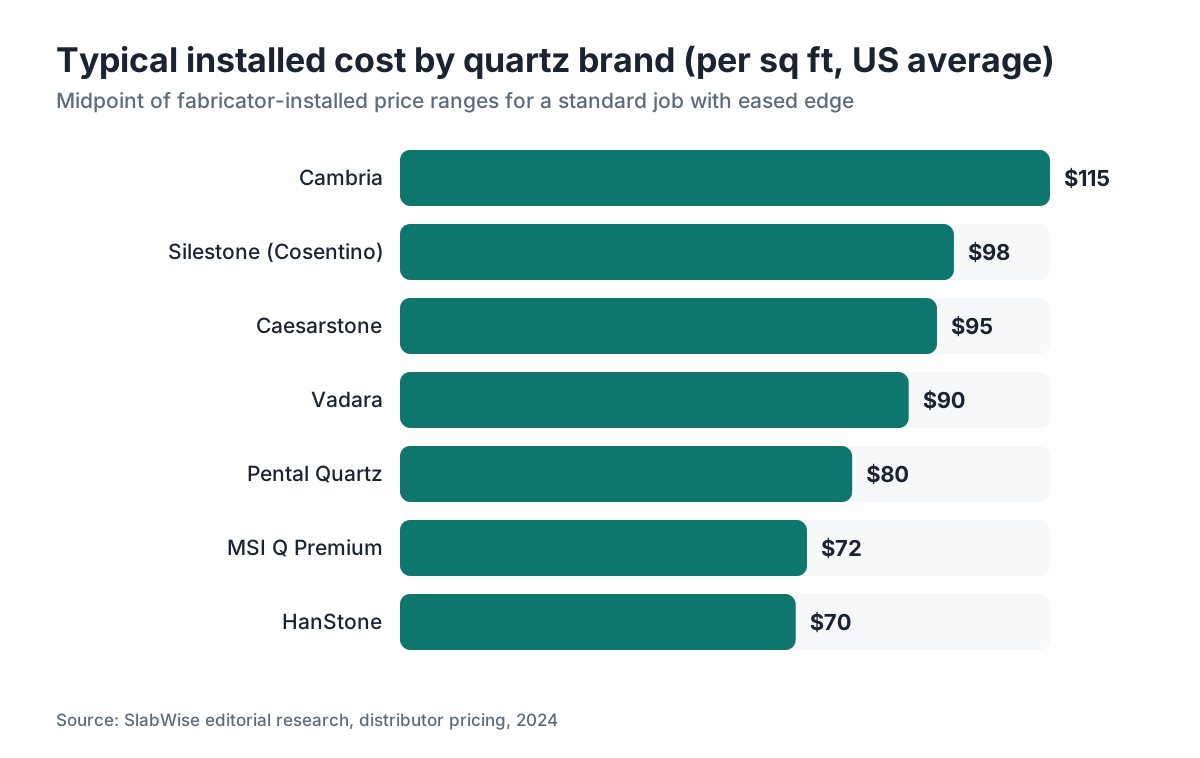
| Manufacturer | HQ / Origin | US Production | Est. US Price Range (installed, per sq ft) |
|---|---|---|---|
| Caesarstone | Israel | No | $70 - $120 |
| Silestone (Cosentino) | Spain | No (US distribution hubs) | $65 - $130 |
| Cambria | USA (Minnesota) | Yes | $80 - $150+ |
| MSI Q Premium | USA HQ, Asia factories | No | $55 - $90 |
| HanStone | South Korea | No | $55 - $85 |
| Vadara | Spain | No | $70 - $110 |
| Pental Quartz | Italy / distributed US | No | $60 - $100 |
Prices above reflect typical installed cost from a fabricator, not slab-only cost. Slab-only from a distributor runs roughly $30 to $80 per square foot depending on brand and color. Installed prices swing hard by region: the same Cambria slab costs more in Manhattan than in Columbus, Ohio.
Caesarstone reported total revenue of approximately $504 million in 2023, with North America as its largest market [2]. Cosentino does not break out Silestone separately but reported group revenues above 1.5 billion euros in recent years, with the US as its top single-country market. Cambria does not publish financials as a private company.
For a fabricator pricing jobs, the distributor relationship matters more than the brand ranking. Some regions have strong MSI distribution, others lean Silestone or Caesarstone. What's available locally, at what lead time, and at what dealer cost decides what's realistic to spec.
Is there a difference in quality between quartz brands?
Yes, but the differences are narrower than the marketing budgets suggest.
All major brands use the Bretonstone process or a licensed variant of it, patented by the Italian company Breton SpA [3]. The basic chemistry is the same. Here's where brands actually differ.
Quartz content and particle grading. Higher-end slabs use better-graded aggregate with consistent particle size, which produces a more uniform surface with fewer voids. Cheaper lines cut costs with filler.
Pigment quality and UV resistance. Outdoor-rated quartz, which Silestone and a few others sell, uses UV-stable pigments. Standard indoor slabs can fade with prolonged direct sun over years.
Surface finish consistency. Premium lines hold tighter thickness tolerances. A slab sold at 3 cm that actually varies between 2.7 and 3.1 cm creates real problems for fabricators during install.
Warranty terms. Cambria offers a lifetime warranty to the original purchaser [4]. Caesarstone offers a limited lifetime warranty. Silestone's warranty has varied by product line. MSI and HanStone typically offer 10 to 15 year warranties. Read the fine print: most warranties exclude heat damage, which is the most common failure mode.
Silica safety disclosures. This is the factor that matters most right now. Crystalline silica dust, generated during dry cutting and grinding of quartz slabs, is linked to accelerated silicosis in fabrication workers. The Australian government effectively banned engineered stone with greater than 40 percent crystalline silica content in July 2024 [5]. The US has no equivalent ban, but OSHA has enforceable permissible exposure limits for respirable crystalline silica [6]. Some manufacturers now publish the crystalline silica content of their products. Others don't. If you're a fabricator, that disclosure matters for your safety program.
For homeowners, the honest answer is that a mid-tier HanStone or MSI slab installed by a good fabricator will outlast a premium Caesarstone slab installed sloppily. Fabrication and install quality dominate the outcome.
Where is quartz manufactured, and does the country of origin matter?
Most quartz slabs sold in the US are made outside the US. Caesarstone's primary production is in Israel plus a facility in Richmond Hill, Georgia, though that US plant has had capacity questions in recent years [2]. Cosentino makes Silestone in Spain. HanStone comes from South Korea. Many MSI lines are produced in India, Vietnam, or China.
Cambria is the exception. Every slab they sell is made in Le Sueur, Minnesota. They've made US production a real brand pillar, more than a flag-waving note. For commercial projects with domestic content requirements or Buy American provisions, that distinction carries contractual weight.
Does country of origin affect the actual slab you install? Sometimes. Quality control practices vary. Import tariffs can affect pricing, and the Section 301 tariffs on Chinese goods, which have shifted several times since 2018, have directly changed MSI and HanStone pricing in the US market [7]. A tariff spike raises the cost of a Chinese-sourced slab. A fabricator quoting long-lead commercial projects has to account for that.
From a material performance standpoint, the country of origin matters less than the specific factory and its ISO certifications. Ask your distributor which factory made a given slab run, more than which country.
How do quartz countertops compare to other countertop materials?
Quartz's main competitors are natural stone (granite and marble), solid surface (Corian and similar), laminate, and butcher block. Each has a different cost profile and performance envelope.
Our kitchen countertops article has a full surface-by-surface breakdown, but here's a quick frame. Quartz wins on stain resistance and maintenance ease versus granite countertops or marble countertops, both of which need periodic sealing. Quartz loses to those materials on heat tolerance (always use trivets with quartz) and on resale perception in high-end markets where buyers specifically want natural stone.
Against laminate countertops or Formica countertops, quartz is heavier, harder, and three to five times more expensive installed. But laminate can't be refinished or repaired the same way and doesn't carry the same durability expectations.
Against Corian countertops and solid surface generally, quartz is harder and more scratch-resistant but can't be shaped as freely. Solid surface allows sink integration with no visible joint and can be sanded to repair scratches.
Butcher block countertops pair well with quartz in kitchen designs: quartz for the main runs, wood for an island or prep zone.
For cleaning and maintenance, quartz is easier than most natural stone. You don't need specialty cleaners. Compare that to how to clean quartzite countertops or how to clean soapstone countertops, both of which have real ongoing care demands.
What warranties do major quartz manufacturers offer?
Warranty terms are where manufacturers actually differentiate, and the gaps are big.
Cambria's lifetime residential warranty is the industry's most aggressive. It covers manufacturing defects for the life of the installation as long as the original purchaser owns the home [4]. That's a genuine differentiator, not marketing spin, though it has the usual exclusions: impact damage, misuse, outdoor installation.
Caesarstone's limited lifetime warranty covers manufacturing defects but requires registration within 30 days of install and has a list of exclusions that any fabricator or homeowner should read before selling it as a benefit.
Silestone has restructured its warranty several times. As of recent product lines, they offer a 25-year warranty on most products, which is long but not lifetime. Check the specific product line documentation, because older and newer lines differ.
MSI and HanStone generally offer 10 to 15 year warranties. For a countertop that realistically lasts 20 to 30 years with normal use, a 10-year warranty covers maybe half the product's life.
Fabricators, listen up: warranty claims almost never come from the slab itself failing. They come from install issues, edge chip-outs that weren't caught, or seam failures. Your workmanship warranty, not the manufacturer's material warranty, is what homeowners actually claim against. Keep that in mind when you're shopping for the cheapest slab to squeeze margin.
What is the silica safety issue with quartz countertops and which manufacturers address it?
This is the single biggest development in the quartz industry right now, and it's not getting enough attention in consumer-facing coverage.
Engineered quartz contains 90 to 94 percent crystalline silica by weight. When fabricators cut, grind, or polish these slabs dry, they generate very fine respirable dust. Prolonged exposure to that dust causes silicosis, a progressive and irreversible lung disease. A 2019 study in JAMA Internal Medicine documented an outbreak of accelerated silicosis among Israeli countertop workers, with a median age of 45 at diagnosis [8]. Australian and Israeli health authorities then moved aggressively to regulate or ban high-silica engineered stone.
OSHA's silica standard for construction, 29 CFR 1926.1153, sets a permissible exposure limit of 50 micrograms per cubic meter of air as an 8-hour time-weighted average, and an action level of 25 micrograms [6]. Fabricators who dry-cut quartz are likely in violation of this standard without proper wet cutting and respiratory protection. OSHA has been issuing citations.
Australia banned engineered stone products with greater than 40 percent crystalline silica content effective July 1, 2024 [5]. No US equivalent ban exists yet, but legislation and regulatory pressure are building.
What are manufacturers doing? Cosentino launched Silestone HybriQ, which they describe as using a hybrid mineral and recycled glass composition to reduce quartz content. Caesarstone has released some lower-silica lines. Most standard lines still sit at 90-plus percent quartz. The safest approach for a fabricator right now: wet-cut everything, run proper vacuum extraction, require respiratory protection. Don't wait for a manufacturer to solve this for you.
For homeowners, the silica risk is a worker health issue, not a use issue. The finished, installed countertop poses no silica exposure risk in normal home use.
How do quartz manufacturers price their products, and what affects the cost?
Quartz slab pricing moves through a distribution chain before it reaches you. The manufacturer sells to a distributor. The distributor sells to a fabricator. The fabricator sells to the homeowner with fabrication and install folded in.
At the distributor level, slab costs for standard-format 3cm slabs (roughly 55 by 120 inches, though full slabs run larger) are typically $30 to $80 per square foot, varying by brand, color complexity, and any exclusive distribution arrangements. Exotic or proprietary colors cost more. The white and gray bread-and-butter colors are cheaper.
What homeowners pay installed depends on region, edge profile complexity, number of cutouts, and the fabricator's overhead. The $65 to $150 per square foot installed range cited above is real, but outliers exist in both directions. A plain white quartz with a straight eased edge in a low-cost-of-living market can hit $55 installed. A Cambria Brittanicca with a waterfall edge in a coastal metro easily clears $200.
Fabricators, the software side of pricing matters here. Accurate quoting requires knowing your slab cost, your waste factor from nesting, your edge linear feet, and your shop rate. Tools like SlabWise are built to model quartz job costs this way, cutting the time it takes to produce an accurate quote and reducing the margin errors that come from eyeballing layouts. Still quoting on a spreadsheet or by feel? You're either leaving money on the table or underpricing jobs.
For homeowners, the honest budget question: $80 to $100 per square foot installed is a reasonable midpoint for a mid-tier quartz with a standard edge in most US markets. Price your project from there and adjust for your region and your specification choices.
Are there quartz manufacturers focused on sustainability?
The industry's sustainability claims range from genuinely meaningful to mostly marketing.
Cosentino's HybriQ technology for some Silestone lines uses recycled glass and other minerals to partly substitute for virgin quartz. They report that certain HybriQ lines are made with 20 percent recycled content and use 99 percent recycled water in the manufacturing process [9]. That's specific enough to take seriously, though independent verification matters.
Cambria markets its US manufacturing as reducing transport emissions relative to imported slabs. For US buyers, that's real, though manufacturing emissions from the process itself remain.
Caesarstone has published environmental product declarations (EPDs) for some product lines. EPDs are standardized lifecycle assessments governed by ISO 14044 and relevant product category rules. If a manufacturer publishes an EPD, it's a third-party verified document, not a press release.
None of the major manufacturers make a zero-impact product. Resin production is a petrochemical process. Quartz mining has environmental costs. Shipping heavy slabs across oceans burns fuel. The most honest framing: quartz is a long-lasting surface, and durability is itself a sustainability argument. A countertop that lasts 30 years beats three 10-year laminate replacements in total lifecycle impact.
For LEED projects or green building specifications, ask your distributor for the EPD and the specific recycled content percentage. Don't accept vague sustainability language without documentation.
How do fabricators source quartz slabs, and what should homeowners know about this?
Fabricators don't usually buy direct from the manufacturer unless they run a high-volume relationship with a brand like Cambria's dealer network. Most fabricators source through regional distributors: MSI, Pental, Arizona Tile, Dal-Tile, Floor & Decor's commercial division, and local independent stone distributors.
Homeowners sometimes ask why they can't just buy a slab themselves and have it cut. You can, technically, but most distributors sell to the trade, not retail. And a slab without fabrication is just a heavy, fragile rectangle you can't install yourself. The fabrication is where most of the cost actually lives.
For homeowners comparing quotes, the key is to spec the same material when comparing fabricators. Ask each shop to quote you on a specific brand, line, and color, so you're comparing their fabrication and install cost, not apples to oranges on the slab. A cheap quote often means a cheaper (lower tier) slab substituted in, not a more efficient shop.
For countertop installation specifics on what to expect during the install process, that's a separate topic worth reading before you sign anything.
Fabricators, a tight distributor relationship affects your pricing more than any other single factor. Volume commitments, payment terms, and a trusted rep who can pull you a slab from inventory when a job needs a match six months later, those things matter more than chasing the lowest per-sheet price on a spot buy.
What should you ask before buying quartz from any manufacturer or fabricator?
Here's a short checklist that works for a homeowner buying for a kitchen or a fabricator evaluating a new line to carry.
First, ask for the warranty document in writing before you commit. Not a summary, the actual warranty. Check what's excluded, whether registration is required, and what the claims process looks like.
Second, ask what country and factory the slab was produced in. This matters for tariff exposure on long-lead commercial jobs and for quality assurance.
Third, ask whether the product has an NSF/ANSI 51 certification for food contact surfaces [10]. Most major brand quartz slabs do. It's a baseline expectation.
Fourth, ask about thickness tolerance. A 3 cm slab should be 3 cm. If a line has loose tolerances, find out before you buy a job's worth of material.
Fifth, for fabricators: ask whether the distributor stocks full slabs in the color you need, or if they're cut-to-order from import. Lead times matter when a homeowner has contractors lined up.
Sixth, ask for the crystalline silica content or an SDS (Safety Data Sheet) for any line you're going to cut regularly. As a fabricator, you need this for your safety compliance documentation regardless of what OSHA is or isn't currently auditing in your market.
These aren't aggressive questions. Any distributor or manufacturer rep worth working with will have the answers.
Frequently asked questions
Which quartz countertop brand is the highest quality?
There's no single answer, but Cambria consistently ranks at the top for US-made production, lifetime warranty, and tight quality control. Caesarstone and Silestone are also premium tiers. The brand matters less than the fabricator installing it. A mid-tier slab installed perfectly outperforms a premium slab installed carelessly. Look at the fabricator's work as closely as you look at the brand.
Is Cambria quartz better than Caesarstone?
Both are premium products. Cambria's advantages: US manufacturing, a genuine lifetime warranty, and consistently tight tolerances. Caesarstone's advantages: wider distribution, more color options in some markets, and often lower price. If domestic production and the lifetime warranty are priorities, Cambria wins that comparison. On a tighter budget, or needing a color Cambria doesn't make, Caesarstone is a legitimate choice.
Where is MSI quartz manufactured?
MSI sources its Q Premium Natural Quartz line from factories in multiple countries, primarily in Asia including India and Vietnam, with some lines from other regions. MSI's headquarters are in California and they have US distribution facilities, but the slabs themselves are imported. Ask your MSI distributor rep for the specific factory of origin for any line you're considering if it matters for your project specs.
Is quartz from China safe for countertops?
Yes, for homeowners using an installed countertop. The finished, cured slab is chemically stable and non-porous. Country of origin doesn't change how the surface performs in normal use. The silica safety issue is a fabrication worker concern, not a homeowner use concern. For fabricators, the country of origin affects tariff costs and can affect quality consistency, but not safety of the finished product.
What is the cheapest quartz countertop brand that is still good quality?
MSI and HanStone consistently offer the lowest entry prices among major brands without falling into truly low-quality territory. Both use the standard Bretonstone-derived process. MSI has wide US distribution, which helps with pricing. You'll find installed prices starting around $55 to $65 per square foot in cost-efficient markets. Stay with established brand lines rather than unbranded private-label slabs at closeout pricing, which have no warranty support.
How long do quartz countertops last?
With normal kitchen use, quartz countertops realistically last 20 to 30 years or longer before showing meaningful wear. They can chip at edges if hit hard, and they can discolor with prolonged direct UV exposure or from certain chemical cleaners. Heat is the real enemy: thermal shock can crack or discolor quartz, which is why trivets are not optional. The surface itself doesn't degrade or require sealing the way natural stone does.
Can quartz countertops be repaired if they chip or crack?
Minor chips at edges can be filled with color-matched epoxy by an experienced fabricator or stone restoration specialist. The repair is usually visible on close inspection but functional. Full cracks through the slab are harder to address and typically require a section replacement. Because quartz is a manufactured product, getting a replacement piece that matches a discontinued color is difficult. Report any chips to your fabricator quickly; fresh repairs are cleaner than old ones.
Do quartz countertop manufacturers sell direct to homeowners?
Almost never. Major manufacturers like Caesarstone, Silestone, and Cambria sell through distributor networks to fabricators. Homeowners buy from a fabricator who sources through a distributor. Some manufacturers maintain showrooms or website color tools to help homeowners choose a product, then direct them to an authorized fabricator. Buying a slab yourself is theoretically possible at some distributors, but you'd still need a licensed fabricator to template, cut, and install it.
What is the difference between quartz and quartzite countertops?
Quartz countertops are manufactured using crushed quartz bound with resin. Quartzite is a natural metamorphic rock quarried and cut into slabs. They're completely different products. Quartzite is harder and more heat-resistant than engineered quartz but requires sealing and has natural variation. Engineered quartz is non-porous and consistent but can't handle heat the way quartzite can. The similar names cause a lot of confusion at the point of sale.
Is silica from quartz countertops dangerous to homeowners?
No. The silica risk is specific to fabrication workers who cut, grind, and sand unfinished slabs. That process generates fine respirable dust. The finished, installed countertop is inert in normal household use. You won't generate hazardous silica dust by cooking, cleaning, or using your countertop normally. The risk sits entirely in the fabrication shop, which is why OSHA's 2016 silica rule matters so much for that workforce.
What should I look for in a quartz warranty before buying?
Check four things: whether the warranty is truly lifetime or has a year cap; whether registration is required within a time window after install; what's excluded (heat damage, impact, outdoor use, and commercial use are common exclusions); and what the actual claims process looks like. A warranty that requires the original manufacturer to inspect before any repair is approved is effectively hard to use. Cambria's lifetime warranty has the most favorable terms among major brands.
How much does quartz countertop installation cost?
Installed cost, meaning slab plus fabrication plus install, runs roughly $65 to $150 per square foot for most major brands in most US markets. Simpler jobs with standard edge profiles sit on the lower end, complex waterfall edges or exotic colors on the high end. Regional labor costs shift this range hard: coastal metros run 20 to 30 percent higher than mid-country markets. For a typical 40-square-foot kitchen, budget $2,600 to $6,000 installed as a realistic range.
Are there US-made quartz countertop manufacturers?
Cambria is the largest and most prominent fully US-made quartz manufacturer, producing all slabs in Le Sueur, Minnesota. Caesarstone has operated a US production facility in Georgia. Most other major brands are imported. For projects with domestic content requirements, Buy American provisions, or buyers who specifically want US-sourced material, Cambria is the primary answer in the premium tier.
Sources
- Cambria Company LLC - About Cambria: Cambria is a privately held, family-owned company manufacturing all quartz slabs in Le Sueur, Minnesota, and is the only major manufacturer producing quartz countertops in the United States.
- Caesarstone Ltd. - 2023 Annual Report (SEC Filing): Caesarstone reported total revenues of approximately $504 million in 2023, with North America as its largest market segment.
- Breton SpA - Engineered Stone Technology: The Bretonstone process, patented by Italian company Breton SpA, is the foundational manufacturing technology used by all major engineered quartz slab producers.
- Cambria - Warranty Information: Cambria offers a lifetime warranty to the original residential purchaser covering manufacturing defects for the life of the installation.
- OSHA - Occupational Exposure to Respirable Crystalline Silica, 29 CFR 1926.1153: OSHA's permissible exposure limit for respirable crystalline silica in construction is 50 micrograms per cubic meter of air as an 8-hour time-weighted average, with an action level of 25 micrograms per cubic meter.
- United States Trade Representative - Section 301 Tariffs on China: Section 301 tariffs on Chinese goods have affected the cost of imported quartz slabs in the US market, with tariff rates and product classifications shifting multiple times since 2018.
- JAMA Internal Medicine - Accelerated Silicosis in Artificial Stone Workers, 2019: A 2019 study in JAMA Internal Medicine documented an outbreak of accelerated silicosis among Israeli engineered stone countertop fabrication workers, with a median age of 45 at diagnosis.
- Cosentino - Silestone HybriQ Technology: Cosentino reports that Silestone HybriQ lines use a hybrid mineral and recycled glass composition and are produced using 99 percent recycled water in the manufacturing process.
- NSF International - NSF/ANSI 51 Food Equipment Materials: NSF/ANSI 51 is the standard governing food equipment materials including countertop surfaces; certification confirms the material is safe for food contact use.
Last updated 2026-07-09