TL;DR
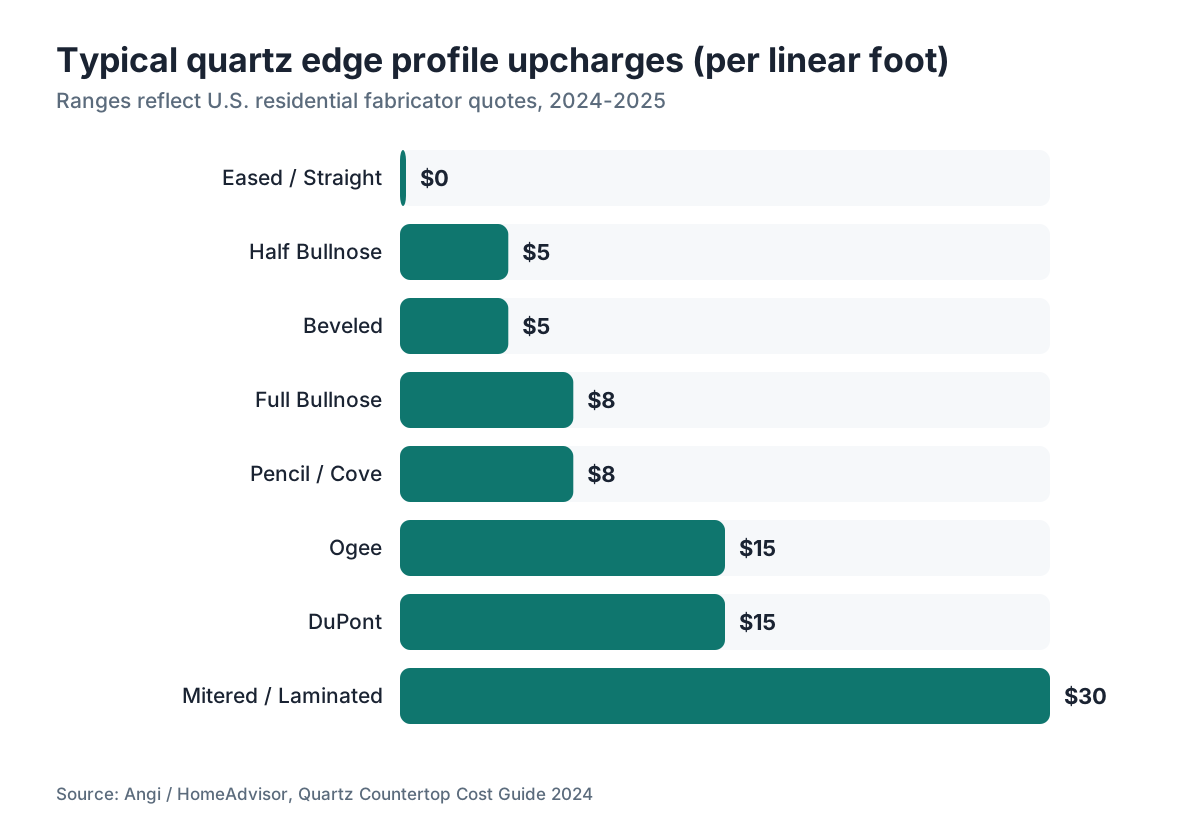
- Quartz edges run from free (eased) to $30+ per linear foot for decorative profiles like ogee or a mitered build-up.
- Most homeowners pay $5 to $15 per foot for a mid-tier profile such as bevel or bullnose.
- Your edge affects cost, cleaning effort, safety, and how thick the slab looks.
- Fabricators mill these on a CNC or by hand, and complexity drives the price.
What are the standard quartz countertop edge profiles?
Every quartz countertop has an exposed front edge, and that edge gets shaped into one of about a dozen common profiles. This is one of the few design decisions on a countertop job you'll actually see every day, and it moves the price.
Here are the profiles fabricators really offer, simplest to most complex:
Eased (or straight): A 90-degree corner with a tiny radius knocking off the sharpest part. This is the default. Almost every shop includes it free because it takes almost no CNC time.
Beveled: A flat angled cut, usually 45 degrees, along the top corner. Clean, modern, a little visual interest. Small upcharge, often $2 to $6 per foot.
Bullnose (full and half): A full bullnose rounds the entire thickness into a semicircle. A half bullnose rounds only the top corner. Both read soft and traditional. Full bullnose takes more grinding time and usually costs more than half.
Ogee: An S-curve, concave into convex. This is the ornate look from granite kitchens of the 2000s. It eats tooling time and sits near the top of the price range.
Dupont (or DuPont): A step profile with a small flat notch below the top surface. It adds visual weight. Softened notch corners get it called a "Dupont with radius."
Waterfall: Not really a profile on the top itself. It means the slab wraps vertically down the cabinet side to the floor. It costs a lot more because it needs extra material, mitered joints, and more installation labor.
Mitered (stacked or laminated): Two pieces of quartz joined at a 45-degree miter to fake a thicker slab. Common when a designer wants the look of 6-cm stone using standard 3-cm material. The miter is the edge.
Triple pencil, chiseled, and specialty profiles exist too. A chiseled or leathered edge mimics natural stone. A triple pencil stacks three small rounded grooves. These live mostly in showrooms and rarely show up in everyday residential work.
How much do different quartz edge profiles cost?
Edge pricing swings by region, shop overhead, and how your fabricator bills. Some fold a basic eased edge into the slab price. Others itemize every foot. Real market pricing still follows a steady pattern.
| Edge Profile | Typical Upcharge (per linear foot) |
|---|---|
| Eased / Straight | $0 (usually included) |
| Half Bullnose | $2 to $8 |
| Beveled | $2 to $8 |
| Full Bullnose | $5 to $12 |
| Pencil / Cove | $5 to $12 |
| Ogee | $10 to $20 |
| DuPont | $10 to $20 |
| Mitered / Laminated | $20 to $40+ |
| Waterfall (per side) | $300 to $800+ |
Those ranges reflect shop quotes across the U.S. through 2024 and 2025. [1] The low end shows up in markets with heavy fabricator competition and shops running efficient CNC equipment. The high end reflects custom finishing, hand-polishing, or expensive urban labor.
A typical kitchen perimeter runs 30 to 40 linear feet of exposed edge. Swap a free eased edge for a $10 ogee and you'll add $300 to $400 before tax. That's real money. It's also one of the smaller lines on a full quartz job where material alone might run $2,000 to $5,000.
Cambria, Caesarstone, and Silestone do not set your edge price. That cost comes entirely from your fabricator's labor and tooling. [2] The slab brand has essentially no effect on what an edge costs to mill.
Here's what shops don't always spell out: they charge for every exposed foot, including the sides of an island. Measure your island perimeter before you assume the upgrade is cheap. A large island can carry 14 to 18 feet of exposed edge on its own.
Which edge profile should you choose for your kitchen?
Three things decide this: your kitchen's visual style, how you clean, and whether kids or elderly people use the counter.
Modern or minimalist kitchen? Eased or beveled almost always looks best. They let the quartz color and pattern carry the room without clutter at the edge. Flat-front cabinets and simple hardware plus an ogee edge looks wrong, every time.
Traditional or transitional kitchen with raised-panel cabinets and ornate hardware? An ogee or DuPont fits the logic. The decorative edge matches the weight of the cabinetry.
Simpler cleans better. Every crevice traps crumbs and grease. The ogee's S-curve is genuinely harder to wipe than a flat bevel. Bullnose edges clean easily because they have no concave groove. If you run a damp cloth across the edge after cooking, you'll feel the difference.
For safety around young kids, skip a raw square corner. A half or full bullnose removes the sharp corner entirely. Most fabricators soften an eased edge free. Ask specifically for "eased with radius" instead of a square 90-degree break.
Here's the honest answer most fabricators give when you press them: eased or beveled edges look good in about 80% of kitchens, they age well, and they don't fight the countertop surface. Ornate profiles are personal taste, not a resale driver. Real estate data on whether an ogee edge adds home value is essentially nonexistent.
Does the edge profile affect how thick your countertop looks?
Yes, and this is one of the best practical reasons to care about your edge beyond looks.
Standard quartz slabs come in 2-cm (roughly 3/4 inch) and 3-cm (roughly 1-1/4 inch) thicknesses. Most residential jobs use 3-cm because it installs without a plywood substrate and looks more substantial. [3]
A 3-cm slab with an eased edge shows the real 3-cm profile. That reads modern and correctly scaled. A mitered edge joining two pieces fakes a 6-cm slab, which looks thick and heavy, sometimes called "waterfall thick" in design shorthand.
A laminated or built-up edge gets a similar thick look by gluing a strip of matching quartz to the underside of the front edge. It's less structurally sound than a full miter but cheaper. Some shops do this on islands where the thick-edge look matters most.
Bullnose on a 3-cm slab can look heavy or dated to some eyes, because the rounded shape emphasizes the full slab thickness. On a 2-cm slab, a bullnose looks thin and delicate, which some designers like for bathroom vanities.
So: want a thin, contemporary counter? Choose eased or beveled with 3-cm, or even 2-cm with an eased edge. Want thick and rich? Go mitered or laminated.
How do fabricators actually cut and finish quartz edges?
Most production shops mill profiles on a CNC bridge saw or a CNC edge-shaping machine (sometimes a CNC router with diamond tooling). The machine runs a diamond-tipped bit along the quartz, cutting the programmed profile. CNC time for a simple eased edge is measured in seconds per foot. An ogee with multiple passes takes a lot longer.
After shaping, the edge runs through polishing wheels in finer and finer grits, finishing at 3,000+ grit to match the polished slab surface. This is where hand labor comes in, especially on complex profiles with concave sections a wheel can't reach cleanly. That hand-polishing time is the main reason ornate profiles cost more.
Smaller shops without CNC hand-route and hand-polish every edge. Results can be equal or even better on custom profiles, but it takes more time and skilled labor, and that shows up in the price.
Quartz is harder to work than marble and softer than granite on abrasion, but it's an engineered composite of roughly 90 to 94% ground quartz bound in polymer resin. [4] The resin means it polishes predictably and holds a profile without the chipping risk you get on some granites. That's a real edge quartz has over natural stone for decorative work.
Pricing edge work accurately comes down to line-item math: CNC time, diamond tooling wear, polishing pads, labor. Software like SlabWise lets fabricators build each profile as a named line item with its own per-foot cost, so the quote reflects the real cost without hand recalculation.
See also: countertop installation for what happens after the edge is finished.
Are some edge profiles a bad fit for quartz specifically?
A few profiles that work fine in granite get tricky in quartz.
Chiseled or hand-chipped edges are rough and irregular by design. On granite, the natural crystal structure makes a chiseled edge look authentic. On quartz, a manufactured composite, the same look can read fake because you're roughing up a material engineered to be uniform. Some shops offer it. Most don't bother.
Very thin profiles, like a 2-cm mitered edge on white quartz, can reveal the particle structure at the seam if the two pieces aren't perfectly color-matched and the joint isn't flawless. Light-colored slabs from the same batch still vary. Ask your fabricator about this before you commit to a mitered edge on white or cream quartz.
Ogee profiles on quartz can show tooling marks in the concave section if the shop's diamond tooling is worn or the polishing step gets rushed. Ask to see a sample of their ogee work in quartz specifically, not a stock photo.
On a bathroom vanity, an extremely thick mitered edge can look wrong proportionally. Scale matters. A 6-cm-look edge on a 22-inch-deep vanity overwhelms the piece.
What is a waterfall edge on a quartz countertop?
A waterfall edge means the quartz slab runs continuously down the side of the cabinet to the floor, a vertical sheet of stone. It's an island treatment in most cases, though it shows up on peninsula ends too.
A true waterfall needs at least two pieces: the horizontal top and a vertical side. The joint is mitered at 45 degrees so the pattern seems to flow around the corner. On quartz with a linear pattern, this can look stunning. On a random pattern, the match at the miter is often imperfect unless the fabricator bookmatches or plans the cut carefully.
Cost is heavy. You pay for extra material (a full side drop can need a separate slab piece), the mitering, the seaming labor, and often extra brackets or support. Added cost per waterfall side typically runs $300 to $800 at most shops. On complex islands with two waterfall sides, $600 to $1,500 is not unusual. [1]
Waterfall edges also need careful structural planning. The vertical panel has to be secured to the cabinet carcass. If the cabinet isn't plumb and level, the miter seam shows a gap. That's an installation problem more than a fabrication one, and both parties have to coordinate.
For kitchen countertops on islands where you want a furniture-like look, waterfall is the single most dramatic upgrade you can make. It also photographs extremely well, which is why it shows up in design media far more than it shows up in actual kitchens.
How does edge choice compare across countertop materials?
Edge options and pricing differ by material in ways worth knowing.
Granite edges work like quartz: CNC-milled, diamond-polished. Pricing is similar, though some exotic granites chip more during milling, which raises cost and risk on complex profiles. See granite countertops for material-specific notes.
Marble is softer and chips more on thin or sharp profiles. Fabricators often steer you away from very sharp bevels on marble. See marble countertops.
Laminate (like Formica) has post-formed edges built into the sheet, or raw edges covered with a matching laminate strip. The plastic strip works, but it can't copy a stone profile. See laminate countertops and Formica countertops.
Butcher block edges are routed wood profiles: roundover, chamfer, or square. They refinish if they chip or dent. See butcher block countertops.
Corian and other solid surfaces can be thermoformed, so edges can be shaped in ways stone can't. Integrated drainboards and sculpted edges are on the table. See Corian countertops.
Quartz has consistent color and pattern through the full slab thickness, so polished profiles come out clean and uniform. That's a genuine advantage over natural stones where the material shifts color or pattern from surface to edge.
| Material | Edge Profile Options | Typical Edge Upcharge | Repairability |
|---|---|---|---|
| Quartz | All standard profiles | $0 to $30+/LF | Low (chip repair possible) |
| Granite | All standard profiles | $0 to $30+/LF | Low |
| Marble | Most, avoid sharp | $0 to $30+/LF | Low |
| Laminate | Post-form, strip | Usually included | Very low |
| Butcher Block | Wood router profiles | Often included | High (resand) |
| Solid Surface | Custom shapes possible | Often included | High (sand/buff) |
| Quartzite | Similar to granite | $0 to $30+/LF | Low |
Can you change a quartz countertop edge after installation?
Technically yes. Practically, it's rarely worth it.
A fabricator can grind and re-profile an installed edge. The hard part is doing it in place without wrecking cabinets, backsplash tile, or the quartz surface. Dry grinding throws off huge amounts of fine quartz dust, a serious respiratory hazard. [5] Any in-place edge rework means plastic-sheeting the area, the homeowner out of the kitchen, and proper respiratory protection for the worker.
Labor cost for this retrofit often matches a new install, because the fabricator can't use the CNC in place. It's hand work only.
The more common request is someone who wants a laminated edge to make a thin slab look thicker. A fabricator can glue a strip of matching quartz to the existing edge. Doable, but it depends on finding matching material from the same batch, which is not guaranteed years after the original job.
Practical advice: make your edge decision before fabrication. Changing your mind during the quote costs nothing. Changing it afterward costs real money.
How do you get an accurate quote that includes edge costs?
Edge pricing is one of the lines that most often causes sticker shock when the final invoice beats the verbal estimate. A few moves help.
First, ask your fabricator to itemize edge feet and edge profile cost separately from slab material. Any shop running quoting software does this in seconds. You want to see a line like "Ogee edge, 34 LF x $12/LF = $408" instead of a lump sum.
Second, walk the shop and ask to see sample profiles in quartz, not photographs. Colors shift in photos. Profile depth, polish quality, and the real look in person can differ a lot from a showroom image.
Third, measure your own edge footage before you get quotes. Run a tape along every exposed edge: the front of the counter, the island perimeter, any peninsula ends. Add them up. If two fabricators quote wildly different total footage, ask why.
Shops running SlabWise can generate itemized PDF quotes showing edge profiles, footage, and per-foot cost in the same document as the slab pricing, which makes bids easy to compare side by side.
Last, ask whether inside corners or sink cutout edges are included or extra. Many fabricators don't polish the edge inside a sink cutout (nobody sees it) and don't charge for it. Some do charge for eased inside-corner returns. Know before you sign.
What edge profiles hold up best in high-use kitchens?
Durability for quartz edges is less about the profile and more about the material's toughness. Quartz sits harder than most natural stones on the Mohs scale, and the polymer binder cuts brittleness. [4] Still, some profiles take a working kitchen's abuse worse than others.
Sharp profiles, especially a thin bevel or a knife-edge on a mitered slab, chip the easiest if someone drops a heavy pan against them. The contact point is tiny and the material has nothing to spread the impact.
Bullnose and full-radius profiles spread impact across a curved surface and rarely chip in normal use. This is the profile many fabricators recommend for households with kids or kitchens that see heavy daily traffic.
Ogee and DuPont profiles have raised detail that can chip on a direct hit, and the concave section can gather cracks from impact in ways a simple rounded edge won't.
Waterfall panels are most vulnerable at the floor-level base, especially on high-traffic islands where people kick the base all day. Quartz panels near the floor should have a small clearance gap instead of sitting flat on the finished floor, so subfloor movement doesn't stress the panel.
Cleaning is easy on any polished quartz edge, because quartz is non-porous and needs no sealing. [2] That's a real advantage over marble countertops, where the edge can stain if acidic liquid hits an unsealed spot.
Frequently asked questions
What is the most popular quartz countertop edge profile?
Eased and beveled edges are the most commonly chosen profiles in residential quartz jobs as of 2024. Most fabricators include them free, they read clean and modern, and they work with both traditional and contemporary cabinetry. Bullnose was the default for years before design trends shifted toward flatter, more minimal edges.
How much does an ogee edge cost on a quartz countertop?
An ogee edge typically adds $10 to $20 per linear foot on top of your base countertop price. For a kitchen with 35 linear feet of exposed edge, that's $350 to $700 extra. Prices vary by region and shop. Always ask for an itemized quote showing edge footage and per-foot cost separately.
Is a bullnose edge or an eased edge better for a family with young children?
Bullnose is safer. It rounds the top corner completely, removing the sharp 90-degree edge an eased profile leaves. For counters at hip or chest height for small kids, a full bullnose or at minimum a half bullnose is a reasonable pick. Ask your fabricator for an "eased with radius" if you want the flat look but a softened corner.
Can I get a waterfall edge on a 2-cm quartz slab?
Yes, but it looks noticeably thinner than a waterfall on 3-cm material. Most designers spec 3-cm for waterfall treatments because the thickness creates the furniture-like presence that makes the cost worth it. On 2-cm, the effect is more delicate, which some people prefer for a lighter look.
Do Cambria or Silestone charge extra for certain edge profiles?
No. Quartz manufacturers sell slabs; your local fabricator mills and finishes the edges. Cambria, Silestone, and Caesarstone do not control edge pricing. That cost is entirely between you and the shop doing your fabrication. Different fabricators quoting the same Cambria slab can have very different edge upcharges.
What edge profile is easiest to clean?
Full bullnose and eased edges are the easiest. Both have no concave sections to trap crumbs, grease, or cleaning residue. Ogee and DuPont profiles have grooves and notches that collect debris and need a narrow tool or brush to clean well. If low-maintenance cleaning matters to you, skip profiles with decorative grooves.
What is a laminated or mitered quartz edge and why is it so expensive?
A mitered edge joins two pieces of quartz at a 45-degree angle to fake a thick slab. It costs more because it needs extra material, precise CNC mitering, careful alignment to match the pattern, and skilled seaming. Added cost typically runs $20 to $40+ per linear foot for the miter itself, on top of the extra material cost.
Does the edge profile affect the resale value of my home?
There's no credible data showing a specific edge profile adds measurable resale value. Buyers notice whether countertops look fresh and current, not which edge you chose. A dated ogee on otherwise plain cabinetry can read old-fashioned to some buyers. Design neutrality is the safest choice for resale.
Can quartz countertop edges be repaired if they chip?
Minor chips can be filled with a color-matched epoxy or quartz repair kit. The repair is usually visible on close inspection, especially on dark or patterned quartz. A large chip or a broken corner on a complex profile is very hard to hide. Specifying a rounded profile in high-impact areas prevents chips better than planning to repair them.
How long does it take a fabricator to mill a quartz edge?
On CNC equipment, a simple eased edge runs in seconds per foot. A complex ogee with multiple passes and hand-polishing can take several minutes per foot. For a full kitchen, edge work happens in the same CNC session as the cutouts and runs 1 to 3 hours total depending on profile complexity and footage.
Is quartz dust from edge cutting dangerous?
Yes. Quartz dust contains crystalline silica. The U.S. Occupational Safety and Health Administration (OSHA) sets a permissible exposure limit of 50 micrograms per cubic meter of air for respirable crystalline silica over an 8-hour workday. Fabricators are required to use wet cutting, vacuum extraction, or respiratory protection during quartz edge work. This is not a DIY task.
What edge profile works best on a bathroom vanity countertop?
Eased, beveled, or half bullnose all work well on vanities. The thinner 2-cm slabs common in bathrooms look best with simpler, lighter profiles. A heavy ogee or mitered edge can look out of proportion on a narrow vanity. If you're using 3-cm quartz for a vanity, a slight bevel or coved edge adds refinement without visual weight.
Do inside corners on quartz countertops need a special edge treatment?
Inside corners are typically cut with a small radius (often 1/8 to 3/8 inch) instead of a sharp 90-degree angle. Sharp inside corners are stress points in any stone and can crack over time, especially if the countertop flexes during install or use. A small radius in an inside corner is standard practice, not an upgrade.
Sources
- HomeAdvisor / Angi, Quartz Countertop Cost Guide 2024: Quartz edge profile upcharges and waterfall edge cost ranges in the U.S. residential market
- Caesarstone, Technical Specifications and Care Guide: Quartz countertops are non-porous and do not require sealing; edge pricing is set by fabricators, not manufacturers
- Natural Stone Institute (formerly Marble Institute of America), Dimension Stone Design Manual: Standard residential quartz slab thickness is 3 cm for countertops without plywood substrate
- Silestone by Cosentino, Technical Data Sheet: Engineered quartz is roughly 90 to 94% ground quartz bound in polymer resin; hardness and non-porous surface characteristics
- U.S. Occupational Safety and Health Administration (OSHA), Crystalline Silica page: OSHA permissible exposure limit for respirable crystalline silica is 50 micrograms per cubic meter of air (8-hour TWA); quartz fabrication is a high-exposure operation
- National Institute for Occupational Safety and Health (NIOSH), CDC: Quartz countertop fabrication generates high levels of respirable crystalline silica dust; wet cutting and ventilation required
- Cambria, Edge Profile Catalog: Quartz edge profiles offered by fabricators working with Cambria quartz; manufacturer does not set edge pricing
- Consumer Product Safety Commission (CPSC): Sharp countertop corners identified as an injury risk in kitchen safety context
- Remodeling Magazine, Cost vs. Value Report 2024: Kitchen countertop upgrades and their average return on investment in U.S. home resale context
Last updated 2026-07-09