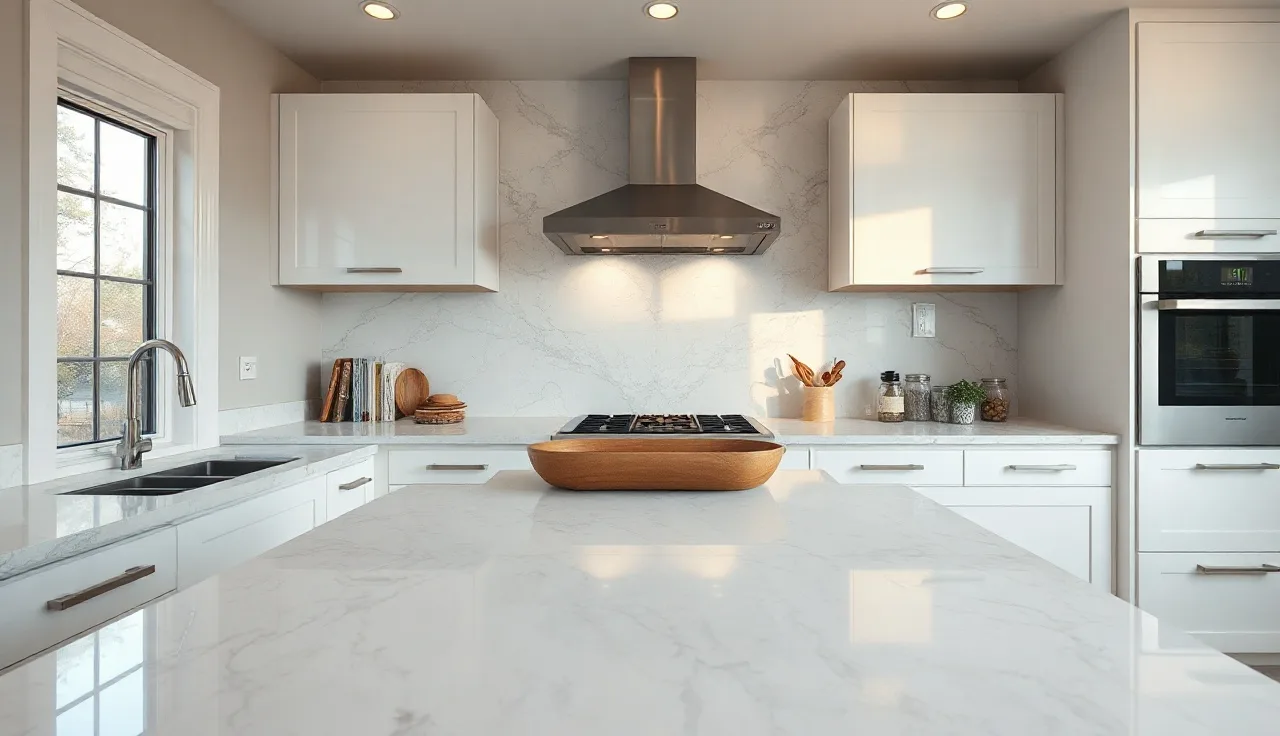
TL;DR
- Pairing a quartz backsplash with quartz countertops gives you one non-porous surface that never needs sealing.
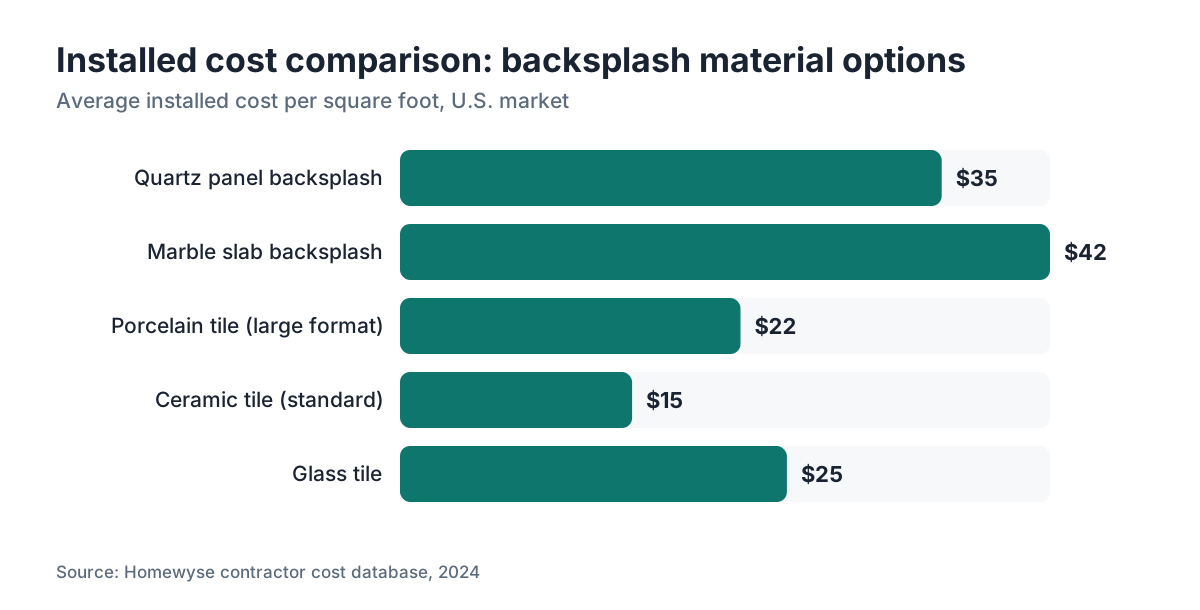
- Expect to pay $20 to $50 per square foot installed for the backsplash.
- Three decisions drive the job: match or contrast the slab, how you fill the transition seam (silicone, never grout), and whether you go full-height or a simple 4-inch strip.
What does a quartz backsplash actually cost?
A quartz backsplash runs roughly $20 to $50 per square foot installed. You'll see quotes outside that range in both directions, driven by your market, the edge profile, and how much cutting happens around outlets and windows [1]. That figure is the backsplash only. If your countertops are being fabricated at the same time, the backsplash material often comes from remnants of the countertop slab, which cuts material cost hard.
The labor split is the part people miss. A standard 18-inch tile backsplash takes a tile setter maybe half a day. A full-height quartz slab backsplash, say 18 to 24 inches of continuous stone from counter to upper cabinets, takes a stone fabricator with a CNC bridge saw, a polishing line, and a crew using suction cups to set panels that weigh 80 to 150 pounds. Different trade, higher labor rate per square foot.
For a typical kitchen with 20 to 30 square feet of backsplash area, the installed total for quartz panels runs $400 to $1,500. Full-height designs covering 30 to 50 square feet push toward $1,000 to $2,500. These are real-world ranges from contractor cost databases, not sticker prices [1].
Here's the move most homeowners skip: if your fabricator is already cutting your counters, ask for a combined quote. The template, mobilization, and setup costs get shared across both pieces, and the remnant material may already be paid for inside the countertop price.
Should you match or contrast your quartz backsplash to the countertop?
This is mostly a look question, but a few practical wrinkles are worth knowing before you commit.
Matching means same brand, same color, same finish. The eye doesn't stop at the counter edge, so the kitchen reads larger and calmer. It's the dominant move in high-end remodels right now, especially with white and light-gray quartz that mimics Calacatta and Carrara marble. The catch: slight color variation between slabs from the same production run is normal, and two pieces cut from different slabs of one SKU can look noticeably different under kitchen lighting.
Contrasting sidesteps that entirely. Put a lighter backsplash over a dark counter, or the reverse, and you're no longer trying to make two cuts pass as one continuous surface. Plenty of designers pick this route on purpose to kill the batch-match anxiety.
There's a third option fabricators like. Use the same quartz in a different finish. Polished counter, honed or leathered backsplash. Same material, zero batch-matching worry, and the texture change reads as a deliberate choice.
If you want the matched look and the line between counter and backsplash matters to you, ask your fabricator to pull both pieces from the same slab and orient the veining so it flows continuously. That's called flow-match or bookmatch. It adds cost. It also gives you something tile can't touch.
What are the pros and cons of quartz for a backsplash compared to tile?
Quartz panels beat tile on some things and lose on others. Neither wins across the board.
The case for quartz is short and strong: no grout lines to scrub, no grout to reseal, no individual tiles to crack or pop loose, and a surface that's completely non-porous so grease and bacteria can't soak in [2]. If you hate cleaning grout, that alone can settle it.
The case against quartz is just as real. It costs more upfront. Installation needs a stone pro, not a tile setter. Large panels are heavy and demand a flat, sound substrate. And if a panel cracks or chips, you don't swap one tile, you replace a panel. Repairs are also harder to hide on a continuous quartz face than in a grout-jointed tile field.
Here's the direct comparison:
| Factor | Quartz panel backsplash | Ceramic/porcelain tile backsplash |
|---|---|---|
| Typical installed cost (per sq ft) | $20 to $50 | $10 to $30 |
| Grout joints | None (caulk seams only) | Yes, require periodic sealing |
| Sealing required | No | Grout lines: yes |
| Repairability | Panel replacement | Individual tile replacement |
| Weight per sq ft | 6 to 14 lbs (3/4" thick) | 3 to 5 lbs (standard field tile) |
| Matching countertop material | Exact match possible | Color/texture match only |
| DIY-friendly | No | Yes, for many homeowners |
The weight is not a footnote. Quartz at 3/4-inch thickness weighs about 13 pounds per square foot [3]. A full-height 24-square-foot backsplash tops 300 pounds. Your wall has to carry that, and mechanical anchoring with construction adhesive plus fasteners is not optional.
Full-height slab backsplash vs. 4-inch quartz backsplash strip: which one makes sense?
These are two different products that get lumped under one phrase. Knowing which one you actually want saves money and confusion.
A 4-inch quartz backsplash is a thin strip, usually the same thickness as the countertop, running along the back edge of the counter. It fills the gap at the wall, protects the most splatter-prone zone, and finishes the line cleanly. It's often cut from the same slab as the counter and rolled into the countertop quote. Most fabricators price it as a simple add-on, roughly $5 to $15 per linear foot.
A full-height slab backsplash runs from the countertop up to the bottom of the uppers, usually 15 to 20 inches. Bigger panel, more weight, tighter templating around outlets and switches, and a real jump in cost. It also reads as a design statement, and it's what most people picture when they search "quartz countertops with backsplash" and land on those magazine kitchens.
Here's how I'd think about it. The 4-inch strip is the floor for waterproofing and a finished edge. Full-height is the upgrade. Tight budget? Do the 4-inch strip in your countertop material and run cheaper tile or paint above it. Done right, that transition looks clean and intentional.
One fabricator note that saves callbacks: the 4-inch strip gets caulked, not grouted, where it meets the counter. Grout is rigid and cracks as the counter flexes slightly under load. Color-matched 100% silicone is the correct joint material there [4].
How do you handle the seam between a quartz countertop and backsplash?
The seam where the horizontal counter meets the vertical backsplash is the single most-asked detail in a quartz install. The short version: fill it with color-matched silicone, never grout, and anchor each piece independently. Here's the full method fabricators use.
Start with the joint fill. Quartz counters move slightly with temperature swings and the weight of what you set on them. Rigid grout develops a hairline crack within months. The right fill is 100% silicone caulk color-matched to the quartz [4]. Good fabricators keep a matching caulk for every major brand and color they run.
Second, the counter surface and the backsplash panel should not be glued face-to-face with epoxy. They meet, get caulked, and each piece carries its own load. The countertop anchors to the cabinet. The backsplash bonds to the wall with construction adhesive (Loctite PL Premium or similar) plus mechanical fasteners on a large panel [4].
Third, watch the built-up edge. If your counter has a laminated double or triple stack at the back to fake a thick slab, that stacked edge changes how the backsplash sits. The panel should rest on the counter surface or butt tight to the wall, never get forced into a gap between the two. Measure twice before you template.
For homeowners, the after-the-fact check is easy. Look at that seam for grout. If you see grout, ask your installer to cut it out and replace it with silicone. That one request saves you a callback inside the first year.
What quartz brands work well for a matched backsplash and countertop?
Most major quartz makers sell full slabs, so a fabricator can cut both counter and backsplash from the same production lot. The brands with the widest availability and the most consistent slab color are Caesarstone, Cambria, Silestone, MSI Q Premium, and Hanstone [5][6].
Cambria is made in the U.S. and sold only through authorized dealers, which gives it tight control over color consistency between slabs [6]. If batch-matching is your top worry, Cambria's production standards make it one of the easier brands for a matched counter-and-backsplash job. Our Cambria countertops guide goes deeper on their lineup.
Caesarstone and Silestone are imported and stocked at most stone distributors. Both make large 63x126-inch slabs, which matters when you're cutting a counter and a full-height backsplash from one slab [5]. If both pieces fit on a single slab, color consistency is nearly guaranteed.
MSI's Q Premium line prices below the premium brands and sells through big-box stores, which affects where your fabricator sources it. Some shops add a small upcharge to pull material from a box store instead of their regular distributor, purely for the handling logistics.
One practical habit: tell your fabricator up front that you want a matched backsplash. They can mark and cut both pieces from the same slab during fabrication. That's far easier than hunting for matching material weeks later.
How do you maintain a quartz backsplash, and does it need sealing?
No, quartz never needs sealing. It's engineered stone, roughly 90 to 95 percent ground quartz crystals bound with polymer resins [2]. That resin binder makes it non-porous. Unlike granite or marble, quartz doesn't absorb liquids and won't stain from olive oil or red wine if you wipe it up within a reasonable window.
Routine cleaning is warm water and mild dish soap on a soft cloth. For stuck-on grease or cooking residue, a non-abrasive cleaner or diluted degreaser handles it. Many quartz brands carry NSF certification tied to bacterial resistance, so antibacterial sprays add nothing, and harsh chemicals can degrade the resin over time [2].
Avoid these on a quartz backsplash: full-strength bleach, abrasive scrubbers or steel wool, oven cleaner, and prolonged direct heat. A backsplash behind a range catches grease splatter and, with a gas burner, occasional flame proximity. Quartz shrugs off brief heat, but sustained high heat can yellow or crack the resin.
Inspect the caulk seam at the base once a year. Silicone can grow mold in a humid kitchen. If it does, that's cosmetic, not structural, and recaulking is a straightforward DIY afternoon.
More on keeping stone surfaces right is in our guide on how to clean stone countertops.
How does a quartz backsplash compare to natural stone options like marble or granite?
Marble and granite backsplashes look stunning, and they carry maintenance costs quartz doesn't. That's the whole trade.
Granite is porous and needs resealing every one to three years to hold off stains [7]. A granite backsplash behind a range, where oil and tomato sauce are flying, will stain if the sealer has worn and you don't wipe fast. Granite also weighs more than quartz (roughly 15 to 16 lbs per square foot at 3/4-inch) and takes more work to fabricate, which pushes cost up.
Marble is even more porous, and it reacts to acid. Lemon juice, vinegar, and tomato splatter etch it, leaving dull spots that need professional polishing to remove [8]. A marble backsplash in a kitchen you actually cook in will look etched within a year. Some people love that aged, worn patina. Just don't call it low-maintenance.
Quartz sidesteps both problems. The resin binder makes it acid-resistant and stain-resistant with no sealing, which is why it's become the default for families who cook every day. Our granite countertops guide covers granite in full, and marble specifics live in the marble countertops guide.
One honest caveat. Quartz doesn't have the depth and movement of a real Calacatta slab or a dramatic granite. The veining is printed or pressed, not formed by geology. If authentic stone character matters more to you than easy upkeep, that's a fair preference, not a mistake.
What do fabricators get wrong on quartz backsplash installations?
This one's for homeowners watching for red flags and for shops wanting to tighten their process. Four mistakes cause almost every quartz backsplash callback.
First, the wrong joint material at the counter-to-backsplash seam. Grout cracks. Silicone doesn't. Basic stuff, but callbacks pile up because some tile setters and even some stone installers still reach for grout out of habit.
Second, weak wall prep. A quartz panel telegraphs every bump, screw head, and crooked stud line through its face when the substrate isn't flat. New drywall is usually fine. An older kitchen with layers of paint, tile mastic, and old tile needs the wall addressed before you template.
Third, outlet cutouts done without a water-cooled CNC core drill or router. A 3/4-inch panel cut with a dry angle grinder gets micro-fractures around the cutout. They hide at install and then creep into visible cracks over time. Water-cooled tools are the standard. Ask about it if your fabricator is cutting on site.
Fourth, no room for thermal movement at the ends of a long run. A continuous panel running a full 12-foot wall needs a small gap at each end, caulk-filled, so it can move. Pinch a panel tight between two walls and it can crack.
For shops running high volume, accurate square footage from your templating software before the slab hits the saw prevents the worst mistake of all: running short on material mid-job. Tools like SlabWise quote and nest both pieces from one slab layout, so you're not guessing on remnant coverage.
What does the installation process look like from template to completion?
Template to completion runs about a week, and the sequence is fixed. Knowing it helps you manage the timeline and spot when something's off.
Templating comes first. The fabricator measures every dimension of the counter run and the backsplash area, marking outlet locations, window sills, and any wall irregularities. Digital templating with a laser tool takes one to two hours for an average kitchen.
Fabrication follows. Counters and backsplash panels get cut, edged, and polished at the shop. Two to five business days for a standard kitchen. Cutouts for outlets and switches in the backsplash add time.
Installation day runs four to eight hours for an average kitchen. Counters go in first, set and secured to the cabinets. Then the backsplash panels get set, bonded to the wall with adhesive, and checked for plumb and level. Seams at inside corners and between panels are matched, color-blended, and every perimeter joint gets caulked.
Give the adhesive and caulk 24 hours to cure before you use the kitchen normally [4]. Your fabricator should tell you this. Many don't.
More on the full process is in our countertop installation walkthrough.
Is quartz a good choice in a rental or budget kitchen?
It depends on the budget and the goal, and here's how I'd run the math.
Quartz counters with a matching backsplash make sense in a rental when you're targeting the higher end of the market and the counters are part of a broader renovation that raises rent or cuts vacancy. Quartz holds up to tenant use better than laminate, cleans easily, and never needs resealing. For that scenario, it pays.
For a budget rental where the numbers won't support $60 to $100 per square foot for counter and backsplash combined, laminate counters with a simple painted or ceramic tile backsplash get the job done for a fraction of the cost. Laminate has come a long way in looks and durability. Details are in the laminate countertops guide and the Formica countertops guide.
For a long-term primary residence, the maintenance savings on quartz add up over ten-plus years. No sealing, easy cleaning, and a surface that still looks close to new after a decade of real use is worth real money. The higher upfront cost amortizes well.
One data point worth keeping. The 2023 U.S. Houzz Kitchen Trends Study reported quartz as the most popular countertop material in remodeled kitchens, cited in 26 percent of renovations [9]. Consumer demand backs the spend in most primary housing markets.
How do you get an accurate quote for quartz countertops with backsplash?
A quote that holds at installation needs a few things from both sides. Get these right and the final invoice matches the estimate.
For homeowners: measure and give the total linear footage of your counters and the square footage of the backsplash area separately. Measure backsplash as height times width per section, then subtract windows and large appliance housings. Bring photos of anything odd, like angled walls, deep window sills, or a range hood that breaks up the backsplash run.
For fabricators: quote counter and backsplash as separate line items with their own square footage. A single lump sum makes it impossible for the customer to see what they're paying for and harder for you to manage waste. Edge profiles, sink cutouts, cooktop cutouts, and outlet cutouts each get a named line.
The gap between quote and final invoice usually comes from three places: extra cutouts outside the original scope, backsplash panels needing extra cuts around an awkward window or outlet, and change orders when the homeowner switches material after templating. A written quote that lists every assumption is your best protection against all three.
Shops juggling multiple jobs move faster with quoting software that pulls square footage straight from a template into a priced line item, instead of doing the arithmetic by hand on a notepad. That notepad math is where errors compound fastest in a busy week.
Frequently asked questions
Can I use the same quartz slab for both the countertop and the backsplash?
Yes, and it's the recommended approach for a matched look. A standard 63x126-inch quartz slab has enough material for most counter runs and a full-height backsplash in an average kitchen. Ask your fabricator to pull both pieces from the same slab and mark them before cutting so the veining direction stays consistent.
Do quartz backsplash panels need to be sealed?
No. Quartz is engineered with a polymer resin binder that makes it non-porous. Unlike granite or marble, it does not absorb liquids and does not require sealing at installation or at any point afterward. Cleaning with mild soap and water is all the maintenance it needs.
What thickness should a quartz backsplash panel be?
Most quartz backsplash panels are cut from 3/4-inch (2 cm) or 1-1/4-inch (3 cm) slabs. The 3/4-inch thickness is more common for backsplash work because it's lighter and easier to handle on a vertical surface. The 4-inch strip backsplash is typically cut to match the countertop thickness for a continuous profile.
How long does a quartz backsplash installation take?
Template to completion runs about one week for most jobs. The template appointment takes one to two hours. Fabrication takes two to five business days. The installation day itself takes four to eight hours for a typical kitchen. Allow 24 hours after installation before using the kitchen normally so adhesives and caulk can fully cure.
Can quartz handle the heat behind a gas range backsplash?
Quartz tolerates brief heat exposure but is not rated for sustained high heat. The polymer resin in engineered quartz can yellow or crack if exposed to prolonged direct flame or temperatures above roughly 300 degrees Fahrenheit. Most fabricators recommend a stainless steel or ceramic tile insert immediately behind a high-output gas range, with quartz panels on either side.
What's the difference between a quartz backsplash and a quartzite backsplash?
Quartz is an engineered material made from crushed quartz crystals and resin. Quartzite is a natural metamorphic rock quarried from the earth. Quartzite is porous and requires sealing, like marble or granite. Quartz does not. They look similar in name but have very different maintenance requirements. Don't let a supplier swap one for the other without being explicit about it.
How do I clean a quartz backsplash behind the stove?
Warm water with a few drops of dish soap handles everyday grease splatter. For baked-on grease, a diluted kitchen degreaser applied for a minute before wiping works well. Avoid bleach at full strength, abrasive scrub pads, and oven cleaner sprays. All of those can degrade the resin surface over time and cause dullness or discoloration.
What is the best grout color to use with a quartz backsplash?
If you have a full quartz panel backsplash, there's no grout at all. The only joint is a silicone caulk seam at the counter-to-backsplash junction and at any panel-to-panel seams. If you're using quartz on the countertop and tile above it, the grout color for the tile is a design choice independent of the quartz. A light-gray or white grout tends to read as neutral against most quartz colors.
Can I do a quartz backsplash as a DIY project?
Rarely, and only for very small panels. Quartz at 3/4-inch thickness weighs 13 pounds per square foot, requires water-cooled diamond tools to cut, and polished edges require shop equipment. A standard 18-by-36-inch panel weighs close to 60 pounds and needs two people with suction cups to set safely. Most homeowners are better off leaving this to a stone fabricator.
Why is my quartz backsplash seam turning yellow or brown?
Discoloration at the seam is almost always the caulk, not the quartz. Silicone caulk in a kitchen environment can mold or yellow over two to five years, especially in a low-ventilation space. The fix is to remove the old caulk with a plastic scraper and apply fresh color-matched silicone. The quartz itself does not discolor under normal conditions.
Does a quartz backsplash add home value?
Indirectly, yes. The 2023 Cost vs. Value Report from Remodeling Magazine found that kitchen remodels return 30 to 85 percent of cost depending on scope and market. Quartz surfaces are consistently cited in real estate listings as a premium feature. The backsplash alone won't drive appraisal value, but a cohesive quartz counter-and-backsplash pairing is a marketable upgrade.
How much overhang should a quartz countertop have before I need support brackets?
The guideline from the Natural Stone Institute (formerly the Marble Institute of America) is that unsupported overhangs in quartz should not exceed about one-third of the slab's width, and anything past 12 inches on a 3/4-inch slab typically needs corbel support. Most fabricators set steel corbels at 24-inch intervals for seating overhangs of 12 inches or more.
What's the best way to find a fabricator who does quartz backsplash panels?
Ask countertop showrooms directly whether their fabrication shop does slab backsplash panels or only tile. Not all stone shops have the setup to do the precise outlet cutouts and polished edges required. Ask to see photos of prior jobs. A fabricator who quotes both countertop and backsplash together from the same slab is a sign they're comfortable with the full scope.
Sources
- Homewyse, Quartz Backsplash Installation Cost: Installed cost of quartz backsplash panels runs roughly $20, $50 per square foot depending on region, edge work, and cutout complexity
- NSF International, NSF/ANSI 51 Food Equipment Materials Standard: Engineered quartz is composed of roughly 90 to 95% quartz crystals bound with polymer resins, making it non-porous and eligible for NSF food-contact certification
- Natural Stone Institute, Dimensional Stone Design Manual: Quartz slab at 3/4-inch thickness weighs approximately 13 pounds per square foot; installation requires appropriate substrate and mechanical support
- Tile Council of North America, TCNA Handbook for Ceramic, Glass, and Stone Tile Installation: Flexible silicone caulk, not grout, is the correct material for movement joints including the countertop-to-backsplash joint; construction adhesive plus mechanical fasteners required for large panels
- Caesarstone, Product Specifications and Slab Dimensions: Caesarstone produces slabs in 63x126-inch format, enabling fabrication of both countertop and full-height backsplash panels from a single slab
- Cambria, Manufacturing and Quality Standards: Cambria quartz is manufactured in the U.S. and sold exclusively through authorized dealers, supporting tighter color consistency control between production lots
- Natural Stone Institute, Care and Maintenance Guidelines for Natural Stone: Granite is porous and requires periodic sealing, typically every one to three years, to maintain stain resistance on horizontal and vertical surfaces
- Natural Stone Institute, Understanding Etching on Marble and Limestone: Marble reacts to acidic substances including lemon juice, vinegar, and tomato-based foods, causing etching (dull spots) that require professional polishing to remove
- Houzz, 2023 U.S. Houzz Kitchen Trends Study: Quartz was cited as the countertop material used in 26 percent of remodeled kitchens surveyed in the 2023 Houzz Kitchen Trends Study, making it the most popular countertop material in renovations
- Remodeling Magazine, 2023 Cost vs. Value Report: Kitchen remodels return 30 to 85 percent of project cost depending on scope and market, with premium material finishes cited as a marketable upgrade in real estate listings
- U.S. Geological Survey, Industrial Minerals: Quartz and Silica: Quartz is among the most abundant minerals in the earth's crust; engineered quartz products use high-purity ground quartz as their primary raw material
Last updated 2026-07-09