TL;DR
- Polishing marble countertops runs from a quick buff with polishing powder (under $20, 30 minutes) to a full diamond-pad restoration by a pro at $2 to $8 per square foot.
- Light etching and dullness respond well to DIY methods.
- Deep scratches, severe etching, and full-surface rehoning need professional wet-grinding with diamond abrasives.
What does polishing marble actually do?
Polishing marble is not cleaning it. Those are two different jobs, and confusing them is the fastest way to burn an afternoon.
Cleaning lifts contamination off the top: grease, food, soap film. Polishing changes the physical texture of the stone itself. Look at a polished surface under a microscope and you see extremely fine scratches all running the same direction, so tight and shallow that light bounces off them evenly. That even bounce is the gloss you see. When acid hits the stone (citrus, vinegar, wine, coffee), it dissolves a thin skin of calcite and leaves micro-pits that scatter light in every direction. The spot looks dull or hazy even after you wipe it clean.
Polishing re-abrades that ruined texture back to something consistent. You are removing a tiny layer of stone, on purpose. A high-polish shop finish (usually 1800-grit or above) sits at a surface roughness average (Ra) of roughly 0.1 to 0.4 micrometers. A visible etch can push that Ra up by ten times. Polishing brings it back down.
Honed marble is a separate case. A honed finish lives around 400-grit and has an intentional matte or satin look. Etching barely shows on honed stone because the surface already scatters light. Rub polishing powder into honed marble and you introduce gloss right where you worked, which makes the repair louder, not quieter. Know your finish before you touch a product.
What causes marble countertops to dull and etch in the first place?
Marble is calcium carbonate, CaCO3, the same mineral family as limestone and travertine [1]. Acids react with calcium carbonate and produce calcium salts, water, and carbon dioxide gas. The reaction is fast, runs at room temperature, and needs almost no acid to get going. Lemon juice sits around pH 2. Vinegar is pH 2 to 3. Even carbonated water is acidic enough to etch given time.
The usual kitchen offenders are citrus juice, tomato sauce, wine, coffee, and any cleaner carrying vinegar or citric acid. Bathroom marble takes damage from toothpaste, mouthwash, perfume, and hair products. Hard water deposits are calcium carbonate themselves, so they don't etch, but scrubbing them off with an abrasive pad will scratch the surface. Plain wear from cutting boards, ceramic plates, and grit dragged across the top adds fine scratches over the years.
Here is what surprises most homeowners. The etch often starts before the spill even sits. Pour orange juice, and in the 10 to 20 seconds it takes to grab a cloth, the reaction is already underway.
Sealing does not stop etching. A sealer is a penetrating resin that keeps liquid from soaking into the pores and staining. It does nothing for surface calcite under acid attack [2]. This trips people up constantly. They re-seal, then wonder why the etch is still staring back at them.
What supplies do you need to polish marble countertops at home?
The supply list depends on what you're fixing. Mild dullness and light etching need different tools than deep scratches or widespread surface wear.
For light etching and routine shine, you need:
- A marble polishing powder (Miracle Sealants Granite, Marble & More Polish Powder, or Tenax Marble Polishing Powder are common). These carry oxalic acid and very fine abrasives, usually around a 3000-grit equivalent.
- A soft white cotton cloth, or a low-speed buffer with a white polishing pad.
- Clean water and a pH-neutral stone soap for prep.
- A clean microfiber cloth for buffing dry.
For moderate etching (visible from a standing position, more than a few square inches):
- Diamond hand polishing pads in a grit sequence. A workable order for surface repair is 400, 800, 1500, 3000. Some fabricators finish at 5000 or 8000.
- A small angle grinder or random orbital polisher with a backing plate sized to the pads (100mm or 125mm).
- A spray bottle for water. Diamond pads for stone run wet.
- Painter's tape to guard adjacent surfaces.
For full countertop resurfacing (deep scratches, leveling lippage, years of wear):
- This crosses into pro territory. Floor-style planetary grinders or variable-speed wet polishers with 5-inch or 7-inch diamond pads work up from 50 or 100-grit all the way to 3000. Water management, pad pressure, and machine weight make it genuinely hard to DIY without practice.
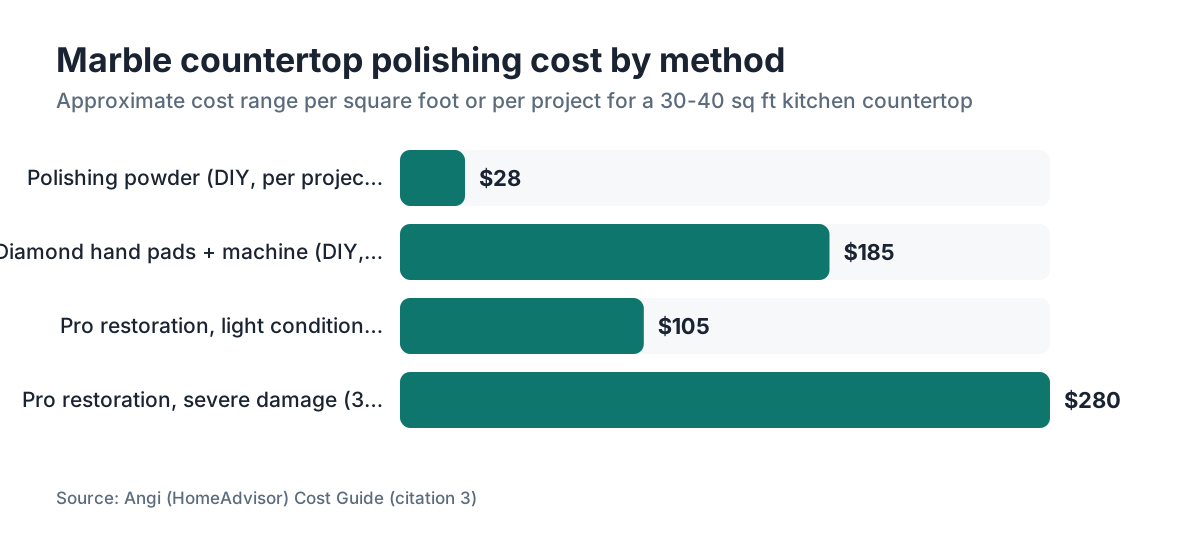
Budget reality: a polishing powder kit runs $15 to $40. A set of diamond hand pads runs $25 to $80 depending on quality. A random orbital polisher fit for stone runs $80 to $200. A professional stone restoration contractor charges roughly $2 to $8 per square foot, depending on condition, region, and marble type [3].
How do you polish marble countertops step by step?
Here is the core DIY sequence for a polished (not honed) marble countertop with light to moderate etching.
Step 1: Clean the surface thoroughly. Use a pH-neutral stone cleaner, not dish soap. Dish soap leaves a film that fights the polishing. Rinse with clean water. Let it dry all the way. You cannot judge etch on a wet surface.
Step 2: Assess the damage under raking light. Hold a flashlight or phone torch low across the surface. Etches show up as lighter patches. Scratches throw tiny shadows. This tells you whether polishing powder covers it or you need a full diamond-pad sequence.
Step 3 (polishing powder method): Sprinkle a little powder on the etched spot. Add a few drops of water to make a paste. Fold a soft cloth into a firm pad and work the paste in small circles with moderate pressure. You should feel slight drag. Work 2 to 5 minutes per small etch. Wipe the residue with a damp cloth, buff dry, and inspect under raking light again. Repeat as needed.
Step 4 (diamond pad method for deeper work): Wet the surface. Start with the lowest grit that cuts through the etch (usually 400 or 800 for surface etching, 200 for actual scratches). Work overlapping passes across the area, keeping the pad moving the whole time. Apply moderate, even pressure. Move up a grit only when the scratches from the previous grit are gone. This is the step people rush, and it shows. Do not jump from 400 to 3000 to save time. Each grit exists to erase the scratches the last one left.
Step 5: After your finest grit (3000 or above), apply a marble polishing powder or cream to raise the final gloss. Skip this on honed marble.
Step 6: Once the surface is dry and you're happy, apply a penetrating stone sealer if the marble was due anyway. Post-polish is good timing, because you have a clean, open-pore surface waiting [2].
One honest note. On Calacatta or Statuario with a mirror finish from the fabricator, a truly invisible home repair is hard. Shops polish on large flat lapping machines under controlled pressure. Hand work leaves a slightly different scratch pattern that can catch the eye in raking light. You can get 90 percent of the way, which is fine for daily life. Matching it dead-on sometimes takes a pro.
What is the difference between polishing powder, polishing cream, and a diamond pad?
These three do the same job at different depths of cut.
Polishing powder carries a mild acid (usually oxalic) and extremely fine abrasive particles. The acid grabs iron and some surface staining while the abrasive refines the texture at a high-grit level. It is a finishing tool, not a cutting tool. It handles etches shallow enough that you can barely catch them with a fingernail.
Polishing cream or paste is the same chemistry in a different carrier. Some creams drop the acid and rely on abrasion alone. Use these for maintenance polishing and for adding gloss to a surface that's already in decent shape.
Diamond pads are resin-bonded diamond abrasive on a flexible backer. They cut hard at low grits and refine at high grits, and they run wet. Unlike powders, they physically remove stone, so they can take on scratches, deep etches, and surface inconsistencies. A 400-grit pad cuts. A 3000-grit pad polishes. Same principle as sandpaper, except diamond is far harder and lasts much longer on stone than silicon carbide or aluminum oxide.
Here is how they stack up:
| Product | Grit equivalent | Best for | DIY difficulty | Cost |
|---|---|---|---|---|
| Polishing powder | 3000-8000 | Light etching, maintenance gloss | Easy | $15-$40 |
| Polishing cream/paste | 2000-5000 | Routine maintenance, minor haze | Easy | $10-$30 |
| Diamond hand pads (set) | 200-3000 | Moderate etching, surface scratches | Moderate | $25-$80 |
| Pro diamond grinder | 50-3000 | Full restoration, deep scratches | Difficult (pro) | $2-$8/sq ft |
Powder and cream are real DIY winners. The diamond pad sequence is doable at home with patience. The pro grinder work is where you pick up the phone.
Can you remove deep scratches from marble countertops yourself?
Depends on the depth, and your fingernail is the test. If your nail catches in the scratch, it's deep enough to need material removal with diamond abrasives starting low (200 or even 100). If your nail slides over it but you can still see it, polishing powder or a 400-grit pad will likely clear it.
On truly deep scratches, the honest answer is DIY gets you most of the way, but the risk of a flat spot is real. A flat spot is a shallow depression where you polished harder in one place than another, and it shows up in raking light as a ripple in the reflection. Pro restorers run machines heavy enough to hold steady pressure across a wide area, which keeps flat spots from forming.
Want to try it anyway? Use a small pad and keep your work zone no bigger than the scratch plus about an inch on each side. Feather the edges by easing off pressure as you move outward. That blends the repair into the surrounding gloss. Edge feathering is the single most useful skill in hand stone polishing.
Never run a Dremel or angle grinder at speed without water. Dry grinding heats the calcite fast, and that can trigger thermal shock and micro-cracking. Keep the surface wet with any rotary diamond tool [4].
How much does it cost to have marble countertops professionally polished?
Professional marble polishing and restoration in the United States generally runs $2 to $8 per square foot for standard countertop work, with specialty marbles, severe damage, or very large installs pushing past that [3]. A 30 square foot island lands at $60 to $240. A 50 square foot kitchen run lands at $100 to $400.
What pushes cost up:
- Severe etching that forces a coarse starting grit (more passes, more time)
- Deep scratches at a repair or seam
- Marble scrubbed with abrasive pads in the past, which needs more aggressive cutting
- High-contrast marbles like Nero Marquina, where any inconsistency jumps out
- Travel time and minimum job fees (many restoration contractors set a $150 to $300 minimum)
What pulls cost down:
- Newer stone in good shape that just needs a high-grit pass
- Small isolated areas (though the minimum still applies)
- Local competition
Fabricators quoting restoration alongside a new install should break the restoration into its own line item. Software like SlabWise lets fabricators log material-specific upcharges and restoration line items right in the quote, which cuts down the back-and-forth on final pricing.
DIY costs a fraction of that. A polish powder kit, a set of diamond hand pads, and a random orbital polisher (if you don't own one) total roughly $120 to $250, one time. If you plan to keep the marble for years, that's a reasonable buy. The pads survive many restorations.
How often should you polish marble countertops?
There's no fixed schedule, because it rides entirely on use. A marble bathroom vanity that only sees toothpaste and water might go 5 to 10 years between serious polish work. A marble kitchen island worked hard every day might want light polishing once or twice a year if the owners aren't strict about coasters and cutting boards.
Maintenance polishing with a cream or powder every 6 to 12 months is a sensible rhythm for a kitchen top under moderate use. It's not heavy lifting. Twenty to 30 minutes, and it keeps small etches from stacking into moderate ones.
The bigger lever is behavior. Keep acids off the surface, use cutting boards, wipe spills right away. No amount of polishing replaces that. A marble top used carelessly needs professional restoration every 2 to 4 years. The same slab treated well can go a decade.
Seal fresh after polishing. How often to seal depends on the marble's porosity and the sealer's rated life (usually 1 to 5 years). The water bead test tells you when it's failing: drop water on the surface, and if it soaks in within 3 to 4 minutes instead of beading, reseal [2].
What should you never use on marble countertops?
The list of marble-killers is longer than most people expect.
Never use anything with vinegar, lemon juice, or citric acid. That includes a pile of "natural" and "eco" cleaners sold as safe alternatives to chemicals. They are acids. They etch marble [1]. Citric acid and acetic acid show up in eco-certified cleaners that still react with calcium carbonate [8].
Never pour bleach on marble. Bleach (sodium hypochlorite) is alkaline, not acidic, so it won't cause the same chemical etch. But it can discolor the stone and break down some sealers over time. Very dilute bleach (under 1 percent) is sometimes used against biological growth on exterior stone, but it has no place on a polished interior countertop.
Never use abrasive scrub pads (green Scotch-Brite, steel wool) on a polished finish. They lay thousands of fine scratches across the whole surface and leave a dull haze you then have to polish out.
Never grab generic granite cleaners packed with surfactant blends or citric acid. "Granite cleaner" is not "stone cleaner." Read the ingredients or the pH. Aim for pH 7 to 8. Strong alkalis above 10 can affect some marble finishes too.
Never run a dry diamond pad at speed. Always wet.
Never brush on a topical wax or acrylic floor finish. These trap dirt, yellow over time, and are miserable to remove. They coat the stone instead of polishing it, and the result looks cheap. Penetrating sealers only [2].
For safe cleaning across stone types, the how to clean stone countertops guide covers pH ranges and product types in more detail.
Is there a difference between polishing marble versus granite or quartzite?
Yes, and chemistry is the reason.
Granite is silica-based (feldspar, quartz, mica) and doesn't react to acids at household concentrations. You can set a lemon on granite and walk away. Polishing granite is about mechanical abrasion with no acid worry [5]. The diamond pad sequence looks similar, but you have more time and less chemical risk.
Quartzite is also silica-based and acid-resistant. People confuse it with marble constantly, because white quartzite and Carrara marble can look almost identical, but they behave nothing alike. For cleaning and polishing quartzite, see the how to clean quartzite countertops guide.
Marble is calcium carbonate and uniquely open to acid etching, which is why it earns its own detailed treatment. The physical mechanics (diamond grits, pad sequence, wet work) match across all natural stone. What changes is the sealer chemistry, the cleaning product restrictions, and how often you maintain it.
Engineered quartz (brands like Cambria, see the Cambria countertops overview) is polymer-bound. It doesn't etch, it can't be diamond-pad polished at home, and it's maintained on a different track from natural stone.
For a material comparison on durability and maintenance, the marble countertops overview covers what to expect before you install.
If you have granite countertops, the polishing approach is mechanically similar but without the acid worry, which makes the whole job more forgiving.
When should you call a professional instead of DIYing?
Be straight with yourself about four situations.
First, if the scratch or etch is deep enough that your fingernail catches noticeably, pro equipment beats hand pads. Try it if you want, but manage expectations.
Second, if the damage covers more than 30 to 40 percent of the surface, hand polishing the whole thing to a consistent finish is exhausting and the odds of uneven results climb fast. A pro with a planetary grinder finishes a full kitchen top in a few hours and leaves it more even than you can manage by hand.
Third, if the marble has lippage (one slab or tile riding higher than another at a seam or a bad install), you need equipment heavy enough to bridge and flatten it. Not a hand-pad job.
Fourth, if the marble was coated at some point with wax, acrylic, or an unknown product, a pro has to strip that coating first. Stripping usually means chemical strippers and aggressive mechanical work, well past a typical homeowner setup.
For any of these, get two or three quotes from stone restoration contractors. Ask flat out whether they use a planetary wet grinder or hand-held gear for countertops. Either can work, but the answer tells you if they do this regularly or once in a while. Ask for photos of finished countertop work, not floors. Different skills, different surfaces.
If you're weighing replacement against restoration, the countertop installation guide walks through what a full replacement actually costs and involves.
Does polishing remove the sealer from marble countertops?
Yes. Mechanical polishing (especially diamond pads at lower grits) strips or partly strips any penetrating sealer in the worked area. That's fine, because you should reseal after polishing anyway.
Polishing powder at high grit is gentler and may not fully disturb the sealer, but it still changes the surface topography, so resealing afterward is still the right call.
The National Terrazzo and Mosaic Association recommends sealing after any restoration or polishing to protect the freshly opened stone [6]. Most penetrating marble sealers use fluoropolymer or silicone chemistry to fill the pore space without leaving a surface film. Apply per the manufacturer's instructions, allow full dwell time (usually 10 to 20 minutes), and wipe off any excess before it hazes.
For fabricators: if you offer polishing or surface restoration, build sealer application into the scope of work and price it into the quote. Leaving a freshly polished but unsealed surface for the customer to finish is a common source of callbacks.
Frequently asked questions
Can I use a car polishing compound on marble countertops?
No. Car polish is made for clear-coated paint, not calcium carbonate. Some carry silicones, waxes, or mild acids that can haze or stain marble. Use a product made for natural stone or polished marble. The stone polishing market has plenty of good dedicated options in the $15 to $40 range built for this exact job.
Will polishing marble remove stains as well as etching?
Not the same way. Etching is surface texture damage, and polishing fixes it by re-abrading the surface. A stain is colorant that soaked into the pores. You lift stains with a poultice (a drawing agent like baking soda or diatomaceous earth mixed with a solvent matched to the stain type). Address the stain first, then polish out any related etch, then reseal.
How do I know if my marble countertop has a polished or honed finish?
Run your hand across it. A polished finish feels glassy and reflects like a mirror. A honed finish feels slightly matte or silky, with a soft, diffused sheen instead of a bright reflection. If you can clearly see your own reflection in it from a standing position, it's polished. If it reflects light but you can't make out distinct reflections, it's honed.
How do I polish marble countertops around the sink without water getting everywhere?
Tape off the sink with painter's tape and drape a dry towel over the bowl. For the diamond pad sequence, work small sections and use a spray bottle with measured squirts instead of running water. Wipe excess immediately with a sponge. Work away from the drain edge toward the center so water doesn't pool around plumbing connections.
Can you polish marble countertops to a higher gloss than the original fabrication finish?
Technically yes, but it takes pro-grade lapping. Shops polish marble on large flat lapping tables through progressively finer grits, finishing with an 1800 to 3000 grit pass plus a final compound. Hand polishing at home restores close to the original gloss but rarely beats it. If you want more gloss than the fabricator delivered, that's a conversation for a stone restoration company.
Is marble polishing powder the same as marble cleaning powder?
No. Marble cleaning powder (or powder cleaners like Bar Keepers Friend) usually carries oxalic acid for stain removal but has a different abrasive profile and pH, and it isn't built to rebuild a polish. Marble polishing powder is formulated with fine abrasives and buffing agents to raise gloss. Using a cleaning powder in a polishing context can scratch the surface at the wrong grit.
How long does it take to polish marble countertops yourself?
A single small etch (a few square inches) with polishing powder takes about 20 to 30 minutes including prep and cleanup. A full countertop in fair condition treated with a 400 to 3000 diamond pad sequence on a random orbital polisher takes 2 to 4 hours for an average kitchen. Add about an hour if you're resealing afterward.
Will polishing powder fix a ring mark left by a glass on marble?
Yes, usually. A ring from a glass is almost always an etch from an acidic drink (citrus, wine, soda). The white or dull ring is surface texture damage, not a stain. Polishing powder worked in circles over the ring for 2 to 4 minutes typically clears it or knocks it way down on a polished finish. If it lingers, try a 400-grit diamond hand pad before calling it a pro job.
Can I rent marble polishing equipment instead of buying it?
Some tool rental centers (Home Depot Tool Rental, Sunbelt Rentals) carry angle grinders and random orbital polishers. You still buy the diamond pads separately, since consumables are rarely included. For a one-time restoration, renting the machine and buying a $30 to $60 pad set is economical. If you have marble throughout the house and expect annual maintenance, owning the gear pays off within two or three uses.
Does polishing marble also re-seal it?
No. Polishing and sealing are separate steps. Polishing changes the surface texture. Sealing applies a penetrating resin that blocks liquid from soaking into the pores. Always seal after polishing, because the fresh surface has an open pore structure. Give it 30 minutes to dry after the final polish step, apply a penetrating stone sealer, let it dwell, and wipe the excess.
What is the shelf life of marble polishing powder once opened?
Most marble polishing powders contain oxalic acid, which is stable when kept dry. Sealed and away from moisture, an opened container typically stays good for 2 to 3 years. If the powder has clumped hard or smells strongly of decay, replace it. Clumping keeps the powder from mixing evenly into a paste, which gives you uneven polishing results.
Can I polish cultured marble (not real marble) the same way?
No. Cultured marble is a polyester resin composite with a gel coat surface, not natural calcium carbonate. Stone diamond pads will destroy the gel coat. Cultured marble gets polished and repaired with automotive-grade compounds and buffing wheels made for gel coat. Check whether your countertop is natural or cultured first. Natural marble feels cold and heavy; cultured marble is lighter and warm to the touch.
Sources
- USGS National Minerals Information Center: Marble and Limestone: Marble is metamorphic calcium carbonate (CaCO3), the same mineral family as limestone and travertine, making it reactive to acidic substances.
- Natural Stone Institute (formerly Marble Institute of America), Natural Stone Care & Maintenance: Penetrating sealers block liquid absorption into stone pores but do not protect the calcite surface from acid etching; sealers should be reapplied after polishing.
- Angi (formerly HomeAdvisor), Marble Polishing and Restoration Cost Guide: Professional marble polishing and countertop restoration costs approximately $2 to $8 per square foot in the United States.
- OSHA, Crystalline Silica standard and construction industry guidance: Dry grinding of natural stone generates respirable dust and thermal hazards; wet grinding is the standard control method recommended for stone abrasion work.
- USGS National Minerals Information Center: Granite: Granite is a silica-based igneous rock composed primarily of feldspar and quartz, which are not reactive to typical household acids.
- National Terrazzo and Mosaic Association, stone restoration guidance: Sealing is recommended following any restoration or polishing work on natural stone surfaces to protect the freshly worked stone.
- Natural Stone Institute, ANSI/NSI 373 Natural Stone Sustainability Standard: Polished marble finishes are defined by surface roughness averages in the sub-micron range, achieved through progressive diamond abrasion in stone fabrication.
- EPA Safer Choice Program, cleaning product ingredient safety: Citric acid and acetic acid (vinegar) are common ingredients in eco-certified cleaning products that are nonetheless reactive with calcium carbonate surfaces.
- ASTM International, C503 Standard Specification for Marble Dimension Stone: ASTM C503 classifies marble as calcium carbonate-based metamorphic dimension stone and provides baseline physical property standards including hardness and absorption.
Last updated 2026-07-09