TL;DR
- Pink marble countertops run $60 to $250 per square foot installed, driven by the stone variety, slab thickness, and your region.
- True pink marbles include Rosa Portogallo, Breccia Oniciata, and Rosso Levanto.
- They're softer than granite, need annual sealing, and etch fast near acids.
- For a low-traffic bathroom they're stunning.
- For a busy kitchen, go in with open eyes.
What exactly is pink marble, and which stones qualify?
Marble is a metamorphic rock: limestone or dolomite that got squeezed and heated underground until the calcite crystals recrystallized [1]. The pink and rose colors come from iron oxide impurities, manganese minerals, or organic material that was trapped in the parent limestone before metamorphism. No two blocks look the same.
Not everything sold as "pink marble" is true marble. Some stones with that label are quartzite, limestone, or travertine. The distinction matters for durability. Quartzite is harder and more acid-resistant. True marble (calcite-based) reacts visibly with acidic liquids like lemon juice or vinegar, which is one of the fastest field tests you can run in a showroom.
The most common true pink marbles in the U.S. market:
| Stone Name | Origin | Primary Tone | Notes |
|---|---|---|---|
| Rosa Portogallo | Portugal | Dusty rose, cream veins | Widely stocked, mid-range price |
| Breccia Oniciata | Italy | Warm rose, burgundy breccia | Dramatic pattern, harder to source |
| Rosso Levanto | Turkey/Italy | Deep rose-red, white veins | Often classified as red marble |
| Pink Porrino | Spain | Pale blush, minimal veining | Actually a granite; very durable |
| Tennessee Pink | USA | Soft salmon-pink | Domestic supply, lower freight |
| Calacatta Rosa | Italy | White with pink-peach veining | Premium pricing, high demand |
| Onyx Rosato | Various | Translucent pink-amber | Onyx, not marble; needs backlighting |
Notice that Pink Porrino is a granite. Fabricators see this mixup constantly. If a slab in the yard is labeled "pink marble" and the surface shows no veining at all, only a uniform speckle, you're probably looking at granite. For durability, that's a lucky mistake [2].
How much do pink marble countertops cost?
Pricing has three layers: material, fabrication, and installation. You need all three to get a real number.
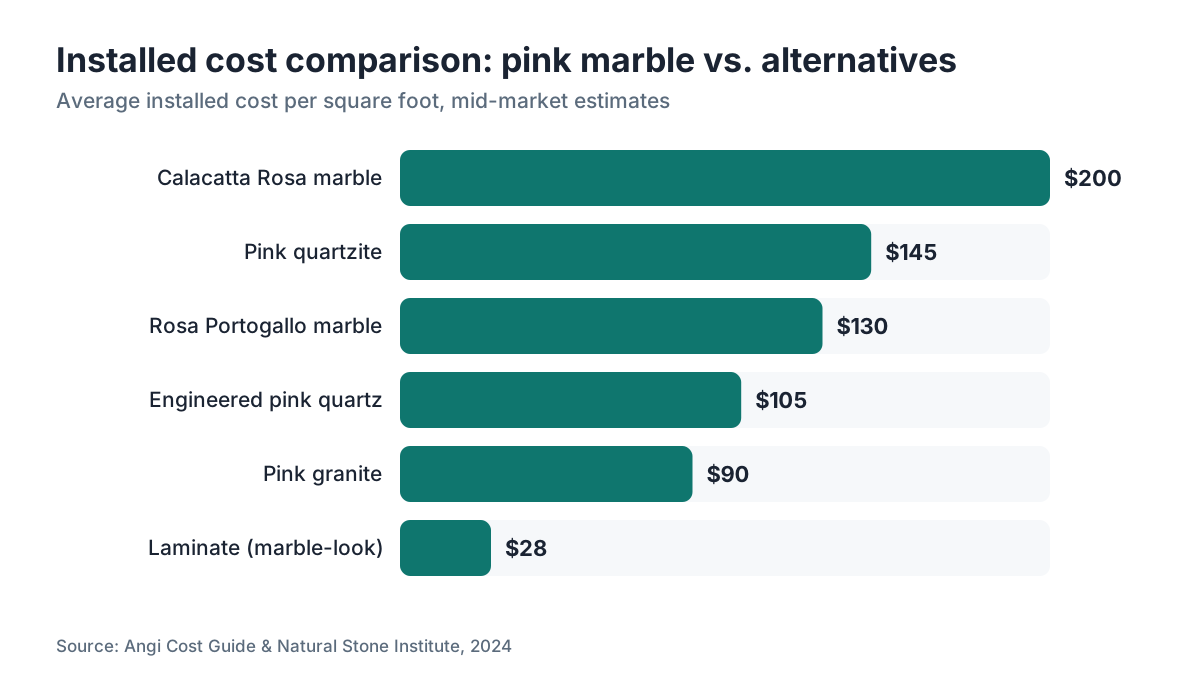
Material (the slab itself) runs roughly $40 to $180 per square foot for pink marble depending on rarity, country of origin, and slab quality. Common Rosa Portogallo sits near the bottom of that range. Calacatta Rosa and Breccia Oniciata push the top. Exotic slabs from a single Italian or Portuguese quarry with a very particular coloring can run higher still.
Fabrication adds $25 to $60 per square foot for most residential jobs. That covers cutting, edge profiling, polishing, and cutouts for sinks and cooktops. A full bullnose or waterfall edge costs more than a simple eased edge. Cutouts add up too: each undermount sink cutout typically runs $75 to $200 depending on region [3].
Installation runs $10 to $30 per square foot. Sometimes it's baked into the fabrication quote, sometimes it's separate. Ask explicitly.
Putting it together:
| Project Type | Estimated Installed Cost |
|---|---|
| Small bathroom vanity (15 to 25 sq ft) | $900, $6,250 |
| Full kitchen (40 to 60 sq ft) | $2,400, $15,000 |
| Large kitchen with island (70 to 90 sq ft) | $4,200, $22,500 |
These ranges span the full spread, from commodity Rosa Portogallo in a regional market to premium Calacatta Rosa in a high-cost city. The honest midpoint for a typical kitchen in good-quality Rosa Portogallo is around $120 to $150 per square foot installed.
Sealing is an ongoing cost. Expect to pay a pro $1.50 to $4.00 per square foot to reseal, or $20 to $60 for a bottle of impregnating sealer if you do it yourself [4]. Budget for annual treatment.
For a broader look at what everything else costs, the kitchen countertops guide lines up 12 materials side by side.
How durable is pink marble as a countertop surface?
Marble ranks 3 to 4 on the Mohs hardness scale [5]. A copper penny scores about 3, and granite sits at 6 to 7. That gap shows up every day in a kitchen. A set of keys dragged across an unsealed marble surface will scratch it. Ceramic dishes slid across the counter will scratch it. A diamond ring will scratch it.
Etching is the other problem, and it's the one that surprises people. The calcite in marble reacts with acid. Lemon juice, wine, tomato sauce, vinegar-based cleaners, even sparkling water left sitting long enough can dissolve a thin layer of the polished surface and leave a dull spot. It looks like a water stain, but it isn't. You can't wipe an etch away. You either live with it, hone the whole surface to a matte finish (which hides etch marks better than a high polish), or have the top professionally re-polished.
Heat resistance is actually decent. Marble is stone, and brief contact with a warm pan won't crack or scorch it. Extended contact with a very hot pan can cause thermal shock in theory, though that's far less of a real-world problem with marble than with engineered quartz. Use trivets anyway.
For kitchens: pink marble works beautifully on an island used mostly for serving, not heavy prep. On a main cooking run with a sink, be honest about whether you're the kind of cook who wipes spills right away. Plenty of people run marble kitchens happily for decades. The look they develop (a patina, if you're being charitable) is a feature or a bug depending on your personality.
For bathrooms: pink marble is close to ideal. Toothpaste and soap are mildly alkaline, not acidic, so etching is much rarer. Traffic is lower. The luxury factor is high. This is where marble earns its price.
Compare the maintenance profile with granite countertops, which shrug off acid and need sealing far less often.
What is the best way to seal and maintain pink marble countertops?
Sealing marble does not make it etch-proof. That's the single biggest misconception homeowners bring in. A penetrating impregnating sealer fills the pores of the stone and slows liquid absorption, which buys you more time to wipe up a spill before it stains. It does nothing against the chemical reaction between acid and calcite. Etching happens on the surface. Sealer lives below it.
With that cleared up, here's the practical routine:
Sealing: Use a water-based or solvent-based impregnating sealer rated for calcite stone. The Marble Institute of America publishes guidance on sealer selection criteria [6]. Apply annually in kitchens, every 2 to 3 years in bathrooms. The water bead test is simple: drop water on the surface. If it soaks in within 4 to 5 minutes rather than beading, reseal.
Daily cleaning: Warm water and a pH-neutral dish soap on a soft cloth is genuinely all you need. Skip anything with bleach, ammonia, or vinegar. Most commercial bathroom cleaners are too acidic or alkaline for marble. The how to clean stone countertops guide goes deeper on product picks if you want specifics.
Etch repair: Fine etches on a polished surface can sometimes be knocked back with marble polishing powder (tin oxide products). Severe etching needs professional honing or re-polishing. Many fabricators offer this as a restoration service.
Chips and cracks: Marble chips more readily than granite at edges and around sink cutouts. A colored epoxy filler matched to the stone fixes small chips. A crack that runs across the full slab is structural and needs a professional look.
How does pink marble compare to quartz or quartzite alternatives?
If you love the look but dread the maintenance, three alternatives are worth a real look.
Engineered quartz in pink tones (Silestone, Caesarstone, and others make blush and rose colorways) is non-porous, never needs sealing, and shrugs off household acids. It doesn't look like natural stone up close. The pattern repeat is visible if you know to look for it. It also can't take the heat marble can, and prolonged UV exposure fades some colors.
Pink quartzite is harder to find but worth the hunt. Stones like Bella White or Fantasy Brown (which straddles the marble-quartzite line) can carry rose and blush tones. Quartzite is silica-based rather than calcite-based, so it doesn't etch the way marble does. It still needs sealing. Ask your supplier for the water absorption test data, run under standards like ASTM C97, to confirm you're getting true quartzite and not a soft marble that got mislabeled [7].
Pink granite exists, and Pink Porrino from the earlier table is the most common example. It's close to bulletproof in a kitchen. No etching, low porosity, chip-resistant. The tradeoff is a uniform speckle rather than the dramatic veining of marble.
| Feature | Pink Marble | Pink Quartz (engineered) | Pink Quartzite | Pink Granite |
|---|---|---|---|---|
| Etching resistance | Low | High | High | High |
| Scratch resistance | Low | Medium | High | High |
| Sealing needed | Yes (annual) | No | Yes (less often) | Rarely |
| Heat resistance | Good | Poor | Good | Good |
| Natural veining | Yes | No | Yes | No |
| Price range (installed) | $60, $250/sq ft | $55, $150/sq ft | $65, $200/sq ft | $50, $140/sq ft |
For a lower budget that still wants warm pink, laminate countertops and formica countertops offer marble-look prints at $15 to $40 per square foot installed, with obvious tradeoffs in resale appeal and lifespan.
Fabricators who want to tighten quoting on jobs like these, where material choice drives waste, edge complexity, and markup, can see how SlabWise handles multi-material quoting in a free demo.
Which kitchen and bathroom styles work well with pink marble?
Pink marble is one of the more opinionated material choices you can make, and that's a good thing if you know what you're signing up for.
The color plays best in rooms that lean warm. Cream, ivory, and warm white cabinetry (think Benjamin Moore White Dove or Chantilly Lace) let pink marble read as soft and grown-up rather than loud. Greige works too. Against cool bright white or ultra-modern flat-panel gray, the pinkish tones can look accidental.
Brass and unlacquered brass hardware is a natural pairing. The warm metal echoes the rose undertones without fighting them. Matte black works if the rest of the room is warm, but it can push the palette toward sharp contrast instead of warmth. Chrome reads cold against pink marble.
Bathrooms are where pink marble has lived for a century, and there's a reason. A polished Rosa Portogallo vanity top in morning light is genuinely beautiful. It photographs extremely well, which is half of why demand keeps climbing.
For kitchens, consider a honed or leathered finish over a high polish. Honed surfaces hide everyday scratches and etch marks far better. The tradeoff is that honed marble stains more readily, so sealing discipline matters more, not less.
Design guidance from the National Kitchen and Bath Association points fabricators and homeowners toward material choices that fit the primary user's daily workflow ahead of pure aesthetics [8]. That's practical advice, and it's the right way to think about a soft stone in a hard-working kitchen.
What should you look for when buying a pink marble slab?
Buy from the slab, not from a sample chip. This is the most important thing anyone can tell you about natural stone, and it goes double for pink marble, where color swings hard from one block to the next and even within a single slab.
Visit the yard in person. Bring your cabinet door sample or a paint chip from the room. Look at the slab in natural light and under indoor lighting, because pink shifts a lot between warm incandescent and cool LED. A slab that reads blush pink under showroom light can look salmon or even terra cotta at home.
Ask about the quarry lot. Slabs from the same block match better than slabs from different lots. If your project needs more than one slab (most kitchens do), pull them from the same bundle or lot number and book-match them for the most coherent look.
Check the thickness. Standard residential slabs come in 2 cm (about 3/4 inch) and 3 cm (about 1.2 inch). For marble, 3 cm is strongly preferred. Better structural integrity, a full eased edge without laminating, and a more substantial feel. If a shop is selling you 2 cm, ask whether the edges will be laminated and what that adds to the cost.
Learn to spot natural fissures. Marble has them, and they're not cracks. A fissure is a separation along a crystal boundary that formed in the stone. It's stable and not a defect. Actual cracks run through the stone and get filled, usually with epoxy resin. Ask the yard to point out any filled repairs before you buy.
Shops that use digital templating and nesting software can show you exactly how your slab gets cut before a single wet saw pass. That's especially useful for pink marble, where the placement of veining across your runs is the whole point. SlabWise is one tool fabricators use for this. Ask yours whether they do digital layout previews.
How does countertop installation work for pink marble?
Marble installation follows the same sequence as any natural stone: template, fabricate, deliver, set. The details matter more with marble because the material is less forgiving than granite.
Templating happens after cabinets are installed and walls are finished. Digital templating uses a laser measuring system to capture the exact geometry of the space, including out-of-square walls (almost every residential kitchen has them). That template drives the CNC cuts at the shop, which cuts waste and improves seam placement.
Fabrication for marble needs slower saw speeds and finer polishing steps than granite. A rushed cut leaves micro-fractures at the edges that show up later as chipping. Good fabricators know this. When you get quotes, ask specifically how much marble they've run, more than natural stone in general.
Delivery is the high-risk moment. Marble slabs are heavy (3 cm slabs weigh roughly 18 to 20 pounds per square foot) and brittle across narrow spans [9]. A long, narrow run, like a peninsula with an overhang, can crack in transport if it isn't supported right. Professional crews use foam pads and A-frame carts. DIY install is possible for experienced hands, but a cracked $2,000 slab is a costly lesson.
Setting uses silicone adhesive, plus epoxy color-matched to the stone where seams fall. Seams are inevitable in most kitchens. Ask your fabricator to show you the seam placement plan before fabrication starts. Good placement (at a sink, behind a faucet, in a low-visibility spot) can make a seam nearly invisible. Bad placement is hard to live with.
For a full walkthrough from contract to install day, see the countertop installation guide.
Does pink marble add value to a home?
Natural stone countertops keep showing up as a feature that moves buyer perception, though pinning down countertop material as its own variable in home value is genuinely hard. The National Association of Realtors doesn't break out countertop material in its resale data at a level that answers this cleanly [11].
What the research does support: kitchen remodels recover an average of 67 to 80% of their cost at resale, according to Remodeling Magazine's annual Cost vs. Value report [10]. High-end kitchen remodels (which usually include natural stone) tend to recover a lower percentage than midrange ones, because the price ceiling in a neighborhood caps how much premium buyers will pay.
Pink marble is a trend, and trends cut both ways. When it fits current design taste (and it does right now, driven hard by social media and the design press), it reads as a premium feature. If the trend cycles out, it can read as dated. White marble has longer staying power in buyer psychology because it's been the classic for generations.
The honest answer: pink marble is unlikely to hurt resale if the rest of the kitchen is well done, and it may help in markets where buyers skew younger, design-forward, and shopping in a bracket where stone is expected. In a modest price bracket, you may not get the premium back.
For comparison, the cambria countertops and corian countertops guides cover how engineered stone and solid surface hold up in the same value conversation.
What are the common mistakes people make with pink marble countertops?
Buying from a sample. The slab is the product. A 4-inch chip tells you the stone type and rough color family. It tells you nothing about the veining, color variation, or movement in the slab you'll actually get. Select from the full slab, every time.
Choosing a polished finish in a high-use kitchen. A polished pink marble surface where people cook daily will show etches, scratches, and wear within months. Honed finishes hide all of that dramatically better. Most homeowners who are unhappy with marble in a kitchen are unhappy with a polished finish specifically.
Using the wrong cleaners. Windex, Clorox, Scrubbing Bubbles, most tile cleaners, and anything with citric acid will etch or damage marble over time. It wrecks both the seal and the stone surface. The fix is pH-neutral soap and water.
Skipping the sealer because "the fabricator sealed it." Fabricators usually seal at installation, which is good. But that first seal often wears fastest, because the stone is clean and thirsty. Maintenance sealing after that is on you. Set a calendar reminder.
Not planning for seam visibility. Pink marble with dramatic veining looks stunning, but if the vein runs at a steep angle across a seam line, the mismatch is jarring. Ask about book-matching adjacent pieces and show your fabricator the preferred seam location before fabrication starts.
Going too thin. Two-centimeter marble with a laminated edge is fine, but those edges chip more readily than 3 cm solid material. The extra material cost is usually worth it for the durability.
Frequently asked questions
Is pink marble too trendy for a long-term investment in my kitchen?
Trendy is a real concern. White Carrara marble has been popular for decades; pink marble is newer to mainstream taste and driven partly by social media aesthetics. If you're staying 10+ years, trend risk matters less. If you're renovating to sell in 3 to 5 years, a more timeless stone or a blush quartz may be safer. The stone itself lasts indefinitely if cared for; the taste for pink is what evolves.
Can pink marble be used in outdoor kitchens?
Technically yes, practically not ideal. Marble is porous, and freeze-thaw cycling in cold climates can cause spalling where water trapped in the pores expands. UV exposure also affects some pink tones over time. Outdoor use voids the warranty from most fabricators. Granite or quartzite are far better outdoor choices. If you want pink outside, pink granite is almost bulletproof.
What finish, polished or honed, is better for pink marble?
Honed is the more forgiving choice for kitchens. A polished surface looks spectacular out of the box but shows every etch mark, light scratch, and water spot. Honed (matte) surfaces disguise those same flaws. The tradeoff: honed stone is slightly more porous and stains a bit more readily, so sealing discipline matters more. For bathrooms, polished is fine because etching risk is much lower.
How heavy is a pink marble countertop, and do my cabinets need reinforcement?
A 3 cm marble slab weighs roughly 18 to 20 pounds per square foot. Standard residential base cabinets with 3/4-inch plywood decks usually handle this load without modification. Very long spans (over 36 inches unsupported) may need corbels or added support. Tell your fabricator the cabinet brand and construction so they can assess your layout. Old or custom cabinets may need inspection first.
What is the difference between Rosa Portogallo and Calacatta Rosa marble?
Rosa Portogallo is a Portuguese marble with a consistent dusty-rose to salmon background and subtle cream or gray veining. It's widely stocked in U.S. yards and priced toward the middle of the pink marble range. Calacatta Rosa is Italian, with a whiter background and rose-pink veining rather than an overall pink field. It's rarer, more expensive, and the veining makes it more dramatic. The two read very differently on a countertop.
Does pink marble etch if I use a sealer?
Yes. Sealer prevents staining by slowing liquid absorption into the pores. Etching is a surface-level chemical reaction between acid and calcite. Two different mechanisms. No penetrating sealer stops etching. Topical (surface) sealers can add some etch resistance but change the look of the stone and peel over time. If etch resistance is your priority, quartzite or quartz is a better material than marble.
Can a fabricator source pink marble locally, or does it need to be special-ordered?
It depends on your market. Large metros with active slab yards often carry Rosa Portogallo and sometimes one or two other pink varieties in stock. More unusual stones like Breccia Oniciata or Calacatta Rosa usually need to come from an importer, which adds 2 to 6 weeks and sometimes a freight premium. Ask your fabricator to check their distributor network and find something you can view in person before ordering sight-unseen.
How many slabs do I need for a typical kitchen with a pink marble countertop?
A standard kitchen of 50 to 60 square feet usually needs 1 to 2 slabs depending on slab size and layout. Full quarry slabs typically give roughly 55 to 65 square feet of usable surface once you account for saw cuts and waste. A kitchen with an island almost always needs a second slab. Ask your fabricator for a nesting layout showing exactly how your job gets cut before you commit to a specific slab.
Is Tennessee Pink marble a good alternative to imported pink marble?
Tennessee Pink is a legitimate domestic marble quarried in the southeastern U.S. It has a soft salmon-pink tone and tends to be more consistent in color than heavily veined European varieties. Because it's quarried here, freight costs are lower, which can make the total installed price more competitive. Availability varies by region. It's a good choice if consistent color matters to you and you prefer domestic stone.
What edge profiles look best on pink marble countertops?
Eased or slightly beveled edges look clean and let the stone speak. An ogee or full bullnose can look heavy and dated on a material as soft in color as pink marble. Many designers prefer a simple square-with-slight-bevel edge for a modern kitchen and a more substantial detail like a chiseled or waterfall edge for a bolder, traditional look. Your fabricator can show you edge samples in the actual material; view them in person.
How do I repair a chip in my pink marble countertop?
Small chips at edges or around sink cutouts can be repaired with a two-part stone epoxy tinted to match the stone. Fabricators often do this at installation and can come back for later chips. DIY epoxy kits exist, but color-matching is the hard part. A bad color match is more visible than the chip itself. For significant chips or a crack, call the original fabricator first. Surface scratches may improve with marble polishing powder.
Can I put a hot pan directly on pink marble?
Marble tolerates heat better than engineered quartz because it's natural stone. Brief contact from a warm or moderately hot pan is unlikely to cause visible damage. Extremely hot pans straight from the oven or stovetop can cause thermal stress, and there's the practical concern of scorching the sealer. The safer habit is a trivet or hot pad. Not because marble will dramatically fail, but because there's no upside to the risk.
What questions should I ask a fabricator before ordering pink marble countertops?
Ask: Can I select from the actual slab? What's the slab lot number, and do you have more from the same lot if I need extra material? Will the job be digitally templated? Where will seams fall, and can I see the layout before cutting? What's included in the fabrication price (edge profile, cutouts, delivery, installation)? Do you seal at installation? What warranty do you offer on the fabrication work? Clear answers to each save headaches later.
Sources
- USGS Mineral Resources Program, Marble: Marble forms from metamorphism of limestone or dolomite under heat and pressure, with color variation from mineral impurities including iron oxides
- USGS Minerals Information, Granite: Granite is a silica-based igneous rock ranking 6 to 7 on the Mohs scale, harder and more acid-resistant than calcite-based marble
- HomeAdvisor (Angi) Cost Guide, Countertop Installation: Undermount sink cutouts for stone countertops typically run $75, $200 depending on region and fabricator
- Marble Institute of America, Care and Maintenance of Natural Stone: Professional resealing of natural stone countertops runs approximately $1.50, $4.00 per square foot; DIY impregnating sealers cost $20, $60 per bottle
- USGS Mohs Hardness Scale educational materials: Marble rates 3 to 4 on the Mohs hardness scale; granite rates 6 to 7
- Marble Institute of America, Sealer Selection Guidance: The Marble Institute of America publishes guidance on selecting penetrating impregnating sealers for calcite-based stones including marble
- ASTM International, ASTM C97 Standard Test Methods for Absorption and Bulk Specific Gravity of Dimension Stone: ASTM C97 water absorption test standards are used by stone industry professionals to assess porosity and classify stone types
- National Kitchen and Bath Association (NKBA), NKBA Design Guidelines: NKBA design guidelines recommend countertop material selection account for the primary user's workflow and usage patterns, not aesthetics alone
- Natural Stone Institute, Stone Weight Reference Data: Three-centimeter marble slab weighs approximately 18 to 20 pounds per square foot
- Remodeling Magazine, Cost vs. Value Report 2024: Kitchen remodels recover an average of 67 to 80% of their cost at resale according to Remodeling Magazine's annual Cost vs. Value survey
- National Association of Realtors, 2023 Remodeling Impact Report: NAR remodeling impact data shows kitchen upgrades including countertop materials positively influence buyer perception but do not isolate countertop material as an independent resale variable
Last updated 2026-07-09