TL;DR
- You can paint marble countertops with epoxy or chalk paint plus a tough topcoat, but the result is fragile next to real stone.
- Prep decides everything (clean, degrease, sand lightly).
- That's the line between two years of decent use and peeling within months.
- Budget $50 to $300 in materials for a standard kitchen.
- Most fabricators treat it as a temporary fix, not a renovation.
Can you actually paint marble countertops?
Yes, you can paint marble countertops. The more honest question is whether the result holds up in a real kitchen, and the track record there is mixed.
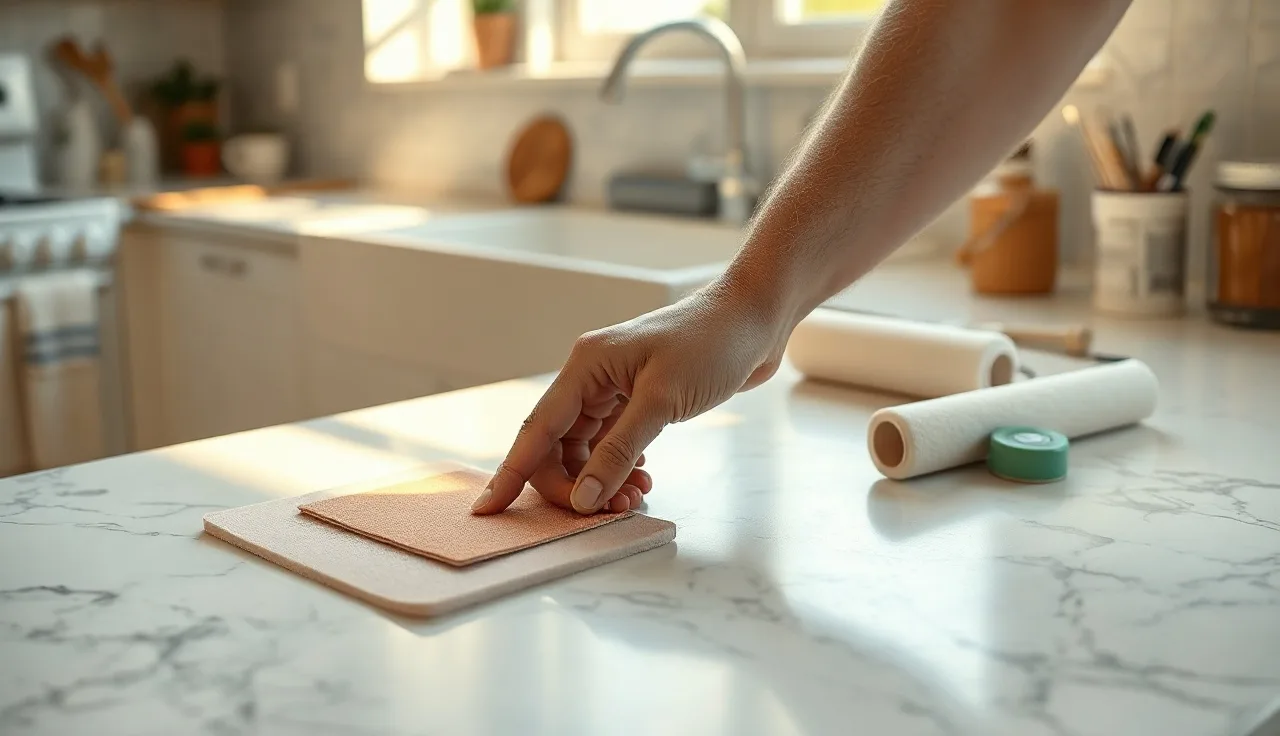
Marble is dense, non-porous once sealed, and smooth. That combination makes adhesion genuinely difficult. Paint needs something to grab onto, and polished marble offers almost nothing. A light mechanical abrasion (120- to 150-grit sandpaper across the whole surface) changes that equation enough to get a working bond, but you have to follow through with the right primer and topcoat or the paint peels inside a year.
Painted marble holds up best on low-traffic surfaces: bathroom vanities, laundry room counters, a decorative island that nobody preps food on. Kitchen counters are the hardest test. They see daily cutting boards, wet pots, and cleaning sprays. Doable, but you'll maintain them.
One thing fabricators and designers agree on: painting marble is reversible, in the sense that you can strip it later and return to the stone underneath, assuming the marble wasn't damaged during prep. That's worth knowing if you're renting or if you bought a house with dated pink marble and want to buy time before a full replacement.
What kind of paint works on marble countertops?
Not all paint behaves the same on stone. The type you choose matters more than the color or the brand.
Epoxy paint or epoxy coating kits are the most durable option for countertops. Two-part epoxy systems (a resin and a hardener mixed just before application) cure chemically rather than just drying, which gives them far better hardness and heat resistance than standard paint. Kits like Rust-Oleum's Countertop Coating line or the Giani Granite Paint kits use this chemistry. Once cured (usually 72 hours before light use, 7 days before full use), they resist most common kitchen chemicals and minor abrasion [1].
Chalk paint is popular in DIY circles because it bonds to almost any surface without sanding, has a matte finish that hides imperfections, and costs $20 to $45 per quart. The catch: chalk paint alone is too soft for countertops. You must apply two to three coats of a hard wax or a water-based polyurethane over it, and even then it's softer than an epoxy finish. Fine for a vanity. Wrong for a busy kitchen counter.
Latex or acrylic paint without a primer and without an epoxy or polyurethane topcoat will fail on marble. The surface won't hold it. If you're set on a color that only exists in a standard latex formula, apply a shellac-based primer first, then the latex, then at least two coats of water-based polyurethane in satin or semi-gloss.
Milk paint gets mentioned in the same breath as chalk paint. It's even softer and needs the same hard topcoat. On countertops, treat it like chalk paint: fine for low-traffic surfaces, marginal everywhere else.
Here's the comparison across common options:
| Paint type | Adhesion to marble | Durability (countertop use) | Approx. material cost (kitchen) | Topcoat required? |
|---|---|---|---|---|
| 2-part epoxy kit | Excellent with prep | High | $80, $250 | Usually included |
| Chalk paint + poly | Good with prep | Medium | $50, $120 | Yes, essential |
| Chalk paint + wax | Good with prep | Low-medium | $45, $90 | Yes (wax) |
| Standard latex + primer | Moderate with prep | Low-medium | $40, $80 | Strongly recommended |
| Milk paint | Good with prep | Low | $35, $70 | Yes, essential |
What does it cost to paint marble countertops?
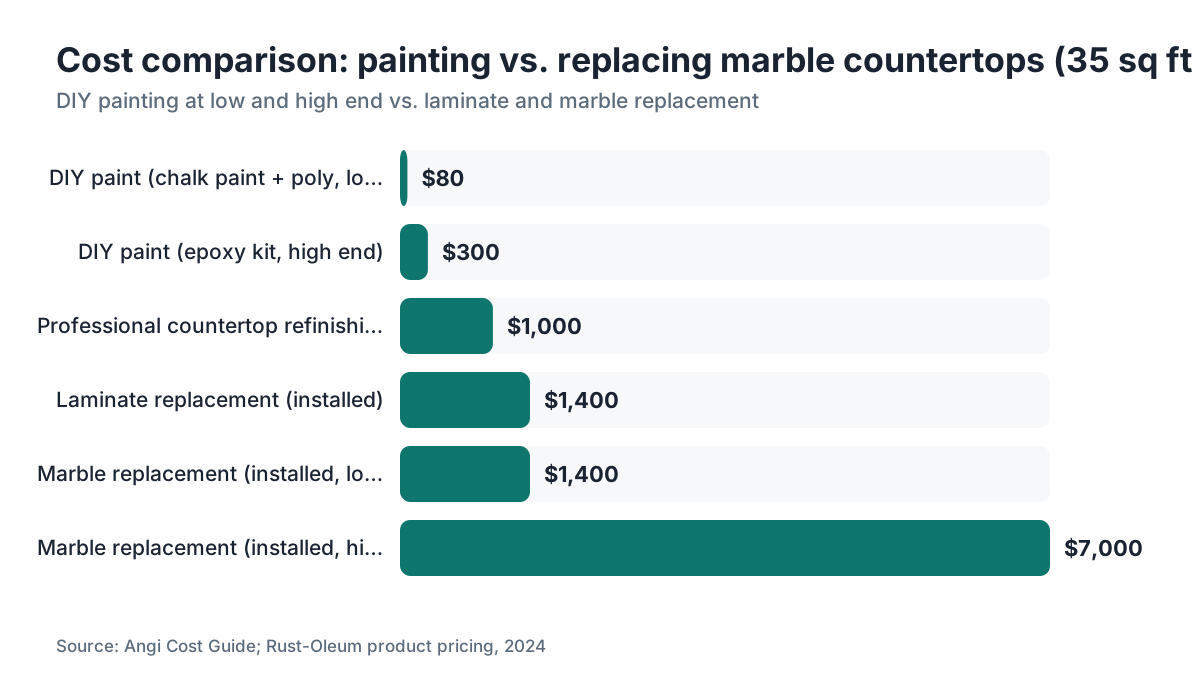
Material costs for a DIY paint job on a typical kitchen (roughly 30 to 40 square feet of countertop) run $50 to $300 depending on the product you pick [1].
Basic chalk paint plus a quart of water-based polyurethane sits at the low end, around $50 to $80. A quality two-part epoxy kit for countertops runs $80 to $180. If you want a faux-stone finish with layered colors and a glossy topcoat, some specialty kits reach $250 to $300 for a full kitchen.
Professional application (a painter or a countertop refinishing company) adds $300 to $700 in labor for an average kitchen, bringing the total to $400 to $1,000. That's still far below replacement, which for marble runs $40 to $200 per square foot installed depending on slab grade and edge profile [2]. For 35 square feet, replacement might be $1,400 to $7,000.
Hidden costs that catch people off guard:
- Sandpaper and supplies: $15 to $30 for the right grits (120, 150, 220) plus a sanding block or orbital sander pads.
- Painter's tape and plastic sheeting: $10 to $20. Epoxy drips are permanent.
- Degreaser and acetone: $10 to $15. Skip this step and adhesion fails.
- Touch-up materials: Buy 10 to 15% more paint than you think you need. Marble surface variation makes coverage unpredictable.
If the marble is cracked, badly stained, or structurally compromised, painting it throws money at the wrong problem. A fabricator can tell you in ten minutes whether the slab is worth keeping. SlabWise's instant quote tool can give you a baseline replacement cost before you decide whether painting makes financial sense.
How do you prep marble countertops before painting?
Prep is everything. More painted marble jobs fail from bad prep than from bad paint.
Step 1: Clear and protect the space. Remove everything from the counters. Tape off the backsplash, walls, sink edges, and cabinet faces with painter's tape. Lay plastic sheeting over the floor and appliances. Epoxy in particular is nearly impossible to remove from grout or cabinet finishes.
Step 2: Clean thoroughly. Use a pH-neutral dish soap and warm water first, then wipe the entire surface with acetone or denatured alcohol on a clean cloth. This removes cooking grease, soap film, and the residual sealer that most marble countertops carry. Any of those left on the surface blocks adhesion. Don't skip the acetone wipe even if the counters look clean.
Step 3: Sand. Use 120- to 150-grit sandpaper to scuff the entire polished surface. You're not removing the polish completely, just dulling it enough to give the primer something to grab. Wipe away all dust with a tack cloth or a slightly damp microfiber cloth, then let it dry completely.
Step 4: Fill chips and cracks. Use a marble or stone filler (or a two-part epoxy filler) for any chips. Let it cure fully and sand flush. Paint will not hide a chip the way people hope. It tends to make surface defects more visible.
Step 5: Apply primer. A shellac-based primer (Zinsser BIN is the most widely available) bonds to nearly any surface and creates the base the topcoat needs [11]. Two thin coats, letting each dry fully, beats one thick coat. Thick primer coats sag and create texture problems.
Step 6: Let it cure. Don't rush. Shellac primer dries in 45 minutes but takes a few hours to fully harden. Epoxy systems have specific mix ratios and pot lives that the manufacturer spells out. Follow them exactly. The chemistry is unforgiving.
How do you apply paint to marble countertops without brush marks?
Brush marks and roller texture are the most common complaints after a painted countertop job. The surface is smooth, so every imperfection in application shows.
For epoxy kits, a foam roller made for smooth surfaces gives the most even finish. Work in sections, and use a foam brush to cut in around the edges where the roller can't reach. Most two-part epoxy kits have a pot life of 20 to 30 minutes after mixing, so mix only what you can apply in that window.
For chalk paint or latex, a high-density foam roller (4-inch is easier to control than 9-inch on a counter) cuts texture significantly. Apply two to three thin coats rather than one thick one. Let each coat dry to the touch before the next.
Sand lightly between coats with 220-grit sandpaper and wipe with a tack cloth. That removes dust nibs and texture buildup. Five minutes of work, a visible difference.
For topcoats, water-based polyurethane goes on best with a high-quality synthetic brush or a foam applicator pad. Natural bristles leave drag marks. Apply with long, even strokes in one direction. Two to three coats gives reasonable durability. Four coats is better for a kitchen.
Temperature and humidity affect drying. Most paint and epoxy manufacturers specify application between 60°F and 90°F with humidity below 70%. A cold garage in January or a humid summer kitchen introduces variables that cause adhesion problems and milky finishes. The EPA notes that volatile organic compounds (VOCs) in epoxy and polyurethane products call for good ventilation during application and curing [3]. Open windows, run a fan, wear respiratory protection.
How long does painted marble last before it needs touch-up or redoing?
Lifespan varies a lot based on traffic, topcoat quality, and how the surface gets used.
A chalk paint finish with two coats of water-based polyurethane on a bathroom vanity can look decent for three to five years with normal care. That same finish on a kitchen counter where people set hot pans, slide cutting boards, and clean with multi-purpose sprays might show wear in 12 to 18 months.
A properly applied two-part epoxy kit on a kitchen counter, maintained well, holds up two to four years before visible wear appears at high-contact spots (around the sink, near the stove, at a prep area). That range comes from manufacturer longevity claims and the experience of refinishing contractors, not a controlled peer-reviewed study. Nobody has published rigorous long-term data on consumer epoxy countertop coatings.
Factors that shorten lifespan dramatically:
- Setting hot pots or pans directly on the painted surface. Epoxy and polyurethane both yellow and soften under sustained heat.
- Using abrasive scrubbers or powder cleansers.
- Cleaning with bleach, ammonia, or alkaline degreasers (many common kitchen sprays fall into this category).
- Skipping the prep steps above.
Factors that stretch it:
- Four or more topcoat layers.
- Applying a fresh topcoat every year or two before wear reaches the color layer.
- Using trivets and cutting boards religiously.
- Cleaning only with mild dish soap and water.
Can you paint over marble countertops to look like a different stone?
Yes, and this is where painted marble gets interesting instead of just practical.
Several products are built to mimic quartz or granite patterns over an existing stone or laminate surface. Giani Granite Paint kits, Rust-Oleum's Transformations line, and a handful of smaller specialty brands sell kits with multiple sponge-application colors, a base coat, and a finishing coat, all designed to create the veining and depth that reads as stone from a normal viewing distance [9].
Results run from surprisingly convincing to obviously fake depending on applicator skill and the specific kit. YouTube tutorials (search the brand name plus "countertop kit") give a realistic preview of the skill the process demands. Painting white marble to look like white quartz is a subtle transition, and the result can pass casual inspection. Painting dark green marble to look like Calacatta means fighting the material the whole way.
Faux-finishing techniques used by decorative painters (sponging, feathering, dragging) can beat kit methods, but they take practice. A decorative painter who specializes in faux finishes charges $15 to $40 per square foot for countertop work, which narrows the gap with replacement.
If your goal is a marble look on a non-marble surface, compare the cost of painting against replacing with laminate countertops or Formica countertops. Both now come in convincing marble patterns at $15 to $40 per square foot installed, and both will outlast any paint job by a decade or more.
What are the downsides of painting marble countertops?
There are real ones, and the DIY content ecosystem tends to soft-pedal them.
You cover a natural material with resale value. Marble countertops, even dated or damaged ones, carry positive weight in a home listing. Painted countertops, regardless of quality, read to buyers and appraisers as a DIY workaround. If you're selling within two to three years, painting may hurt more than it helps.
Heat resistance is genuinely worse. Most epoxy topcoats start to soften around 250°F to 300°F. Marble tolerates heat far better. A hot cast-iron pan moved from the stove to the counter is a non-event on marble. On a painted surface, it can permanently damage the finish.
The paint can trap moisture. If the marble has micro-cracks, or if prep missed a section of sealer, water gets under the paint and lifts it from below. You won't see it coming until the paint bubbles up.
Maintenance never stops. Polished marble you reseal once a year and mostly ignore. A painted surface needs topcoat refreshing, careful cleaning product selection, and periodic inspection for chips or wear spots that need touching up before they spread.
It's not food-safe the way stone is. The FDA's food contact surface guidance covers commercial settings, but the principle carries home: once a painted countertop chips or scratches, the underlying layers can harbor bacteria differently than solid stone [4]. If you prep food directly on the counter without a cutting board, painted marble is a bigger hygiene concern than bare stone.
None of this means painting is wrong. It means going in clear-eyed about what you're trading for the lower cost.
How does painting marble compare to replacing it?
The cost comparison is simple. Cost isn't the only factor.
Painting a 35-square-foot kitchen counter runs $50 to $300 in materials (DIY) or $400 to $1,000 with professional refinishing. Replacement marble (material plus fabrication plus installation) runs roughly $1,400 to $7,000 for the same area at current market prices [2]. Even at the top of the painting range, you're saving thousands.
But painting lasts two to four years under kitchen conditions. Replacement marble, properly sealed, lasts the life of the home. On a 10-year timeline you might repaint two or three times, spending $1,000 to $3,000 total, against a one-time replacement at $3,000 to $7,000. The math isn't as lopsided as the upfront number suggests.
For a fabricator advising a client, the read is usually this: if the marble is structurally sound and the owner is on a tight timeline or budget, painting buys time. If the marble has significant cracks, thermal damage, or deep staining, replacement produces a better outcome and a better long-term spend.
Alternatives worth pricing before you commit to paint:
- Laminate countertops and Formica countertops: $15 to $40/sq ft installed, 15- to 20-year lifespan.
- Corian countertops (solid surface): $35 to $75/sq ft installed, repairable surface.
- Butcher block countertops: $30 to $100/sq ft installed, refinishable.
- Granite countertops: $40 to $150/sq ft installed, extremely durable.
Fabricators who use countertop quoting software like SlabWise can generate quick cost comparisons across materials for clients weighing their options, which makes the paint-versus-replace conversation more concrete than ballpark estimates [8].
The honest recommendation: if the marble matters to you aesthetically or as an asset, replace it properly. If it's a rental, a flip, or a budget crunch, paint it and go in knowing the timeline.
How do you care for painted marble countertops?
The rules for painted countertops are stricter than for bare stone, but they aren't complicated.
Cleaning: Mild dish soap and warm water. That's daily cleaning, done. Windex, Lysol spray, and bleach-based cleaners attack polyurethane and epoxy topcoats over time, dulling the finish and eventually causing it to peel. If you need to disinfect, a diluted white vinegar solution (1 part vinegar to 3 parts water) is gentler than commercial disinfectants, though even that should be rinsed off quickly because extended acid contact degrades some coatings.
Heat: Always use trivets. No exceptions.
Cutting: Always use a cutting board. Knives cut through epoxy and polyurethane the same way they cut through food.
Touch-ups: Keep a small amount of your topcoat in a sealed container. When a spot starts to dull or chip, a targeted topcoat pass over that area (lightly sand first with 220-grit, clean with acetone, apply topcoat) extends the life of the finish. Ignore a small chip and water gets underneath, spreading the damage.
Annual refresh: Once a year, check the condition. If the topcoat looks hazy or dull across the surface, a light sanding with 320-grit followed by a fresh topcoat resets the clock without redoing the entire paint job.
For more on cleaning and maintaining stone and stone-like surfaces without wrecking them, the guides on how to clean stone countertops and how to clean quartzite countertops cover pH-neutral cleaners and what chemicals to avoid.
Is painting marble countertops worth it, or should you explore other options?
Painting marble makes sense in a narrow set of conditions: you want a change now, the budget doesn't allow replacement, the marble is structurally sound, and you accept the maintenance trade-off.
It doesn't make sense if you're planning to sell soon, if the marble has structural damage, or if you want a result that looks and performs like new countertops. Paint is paint. It covers a surface. It doesn't transform one.
For renters, painting is almost always the wrong move. It modifies the property without (usually) lease permission, and you'll be financially liable for restoration. Check your lease and get written landlord approval before touching a rented countertop.
For homeowners who genuinely want a new look and a long-term solution, the decision between painting and replacing comes down to timeline and budget. A fabricator or kitchen designer can give you a real replacement quote in under an hour. Set that number against the realistic multi-year cost of maintaining a painted surface and the choice often makes itself.
If you're keeping the marble but want to improve its condition, professional honing and polishing (offered by most stone restoration companies) can remove surface scratches and stains and reseal the stone for $4 to $8 per square foot [7]. That's less than most paint jobs, and it leaves you with actual marble. Worth pricing before you open a can of paint.
For a wider view of material options across the kitchen, the kitchen countertops and marble countertops guides cover material comparisons, cost ranges, and what to ask a fabricator.
Frequently asked questions
Can you use regular wall paint on marble countertops?
You can, but it won't hold up. Wall paint is formulated for vertical surfaces that don't take abrasion, heat, or wet contact. On a countertop, standard latex wall paint chips and wears within weeks without a very hard primer underneath and multiple coats of polyurethane or epoxy on top. If you have leftover wall paint, use it as a tinted base under a proper epoxy topcoat, not as the final surface.
Do I need to seal painted marble countertops?
The topcoat (epoxy or polyurethane) works as the seal on a painted surface. You don't apply a separate stone sealer over paint. What you should do is refresh the topcoat every one to two years when it shows dulling or wear. A separate penetrating stone sealer applied over paint won't adhere properly and can cloud the finish.
How long do I have to wait before using the countertop after painting?
For epoxy kits, most manufacturers specify light use after 72 hours and full use after 7 days of curing. For chalk paint plus polyurethane, the polyurethane needs at least 48 to 72 hours before light contact and 7 days before full use. Rushing this is the single most common reason paint jobs fail early. The paint may feel dry to the touch long before it's actually hardened.
Can painted marble countertops be used for food prep?
Not directly. Paint, epoxy, and polyurethane surfaces are not food-safe the way solid stone or solid surface materials are, especially once they show any scratches or chips. Always use a cutting board. For raw meat, use a designated board you sanitize separately. A chipped or scratched painted surface can harbor bacteria like any damaged food-contact surface.
Will painting marble hurt the resale value of my home?
Almost certainly, compared to intact marble. Buyers and appraisers typically read painted countertops as a cosmetic workaround rather than an improvement. If the underlying marble is in good condition, painting it before a sale is probably the wrong move. If the marble is badly damaged and painting is your only near-term option, disclose it honestly. Buyers factor it in. What they don't like is discovering it later.
What paint color works best on marble countertops?
White and off-white are the most forgiving because they read as natural stone and hide minor texture variation better than dark colors. Dark colors show every dust particle and reveal wear at high-contact spots more visibly. If you want a dark counter, a very matte finish forgives more than a glossy one. Color choice is personal, so apply a test patch in a low-visibility area first to confirm you like the finish before committing.
Can you paint just part of a marble countertop?
Technically yes, but partial painting looks bad in most cases. The paint edge creates a visible line where the painted surface meets bare marble, and the texture and sheen differences are obvious. If you're painting to cover a stain or damaged section, the patch will show. Paint the entire counter as one surface. If the damage is localized, professional stone repair or honing is usually a better answer than spot painting.
How do I remove paint from marble countertops if I change my mind?
Paint removal from marble takes chemical strippers or mechanical sanding, both of which risk scratching or etching the stone underneath. Acetone removes some paint types but not cured epoxy. Citristrip and similar gel strippers are gentler on the stone but still need careful application. After stripping, the marble will likely need professional honing and polishing to restore the surface. It's doable but not trivial, and worth budgeting $4 to $8 per square foot for professional restoration afterward.
Is chalk paint or epoxy paint better for marble bathroom vanities?
For a vanity with light daily use (toothbrushes, soap, light moisture), chalk paint with two to three coats of water-based polyurethane works fine and gives you more color and finish options. Epoxy is more durable but more finicky to apply and has stronger fumes. For a kitchen counter, epoxy earns the extra trouble. For a bathroom vanity, chalk paint plus a good topcoat is the reasonable, simpler choice.
Can you paint cultured marble countertops the same way as natural marble?
The process is similar, but cultured marble (a gel-coat resin surface over a calcium carbonate base) is already a manufactured finish, not natural stone. The main difference is that cultured marble's gel coat is slightly more flexible than stone, so it can develop micro-crazing under paint over time. Prep is the same: degrease thoroughly, sand lightly with 150-grit, prime with shellac-based primer. Epoxy kits work well on cultured marble.
What's the best way to get a smooth finish on painted marble?
Use a high-density foam roller for all coats, apply thin coats rather than thick ones, and sand lightly with 220-grit between coats. For the final topcoat, a foam applicator pad pulled in one direction gives the smoothest result. Keep the room at 65°F to 85°F and humidity below 70%. Temperature and humidity swings cause texture problems more often than applicator choice does.
Can you use a spray paint on marble countertops?
Spray paint (rattle-can aerosol) is generally too thin and too soft for countertops. Some specialty countertop spray products exist, but they're usually a bonding primer rather than a finish coat. If you want a smooth finish and are considering spray, a professional with an HVLP sprayer applying thinned epoxy topcoat beats consumer aerosol cans easily. For most DIY situations, a foam roller gives a better outcome than spray cans.
Will painted marble countertops scratch easily?
More easily than bare marble, yes. Natural marble rates 3 to 4 on the Mohs hardness scale, which means it scratches with a knife but resists light abrasion. Cured epoxy topcoat is harder than latex but softer than stone. Keys, jewelry, and rough-bottomed pots all scratch painted surfaces over time. Scratches on a painted countertop go through the topcoat into the color layer, which shows. Trivets and cutting boards handle most of this.
Sources
- Rust-Oleum Corporation, Countertop Coating product information: Two-part epoxy countertop coating kits cure in approximately 72 hours to light use and 7 days to full use; material costs for consumer kits range roughly $80 to $250 depending on kit size and formulation.
- HomeAdvisor (Angi), Marble Countertop Installation Cost Guide: Marble countertop installation costs typically range from $40 to $200 per square foot installed, depending on slab grade, thickness, edge profile, and regional labor rates.
- U.S. Environmental Protection Agency, Indoor Air Quality: Volatile Organic Compounds: Epoxy and polyurethane coatings release volatile organic compounds (VOCs) during application and curing; adequate ventilation is required to maintain safe indoor air quality.
- U.S. Food and Drug Administration, Food Code: Food Contact Surfaces: Food contact surfaces must be smooth, non-absorbent, and easily cleanable; chipped or scratched surfaces can harbor pathogens.
- National Institute of Standards and Technology (NIST), Mohs Hardness Scale reference: Marble rates approximately 3 to 4 on the Mohs hardness scale, making it softer than granite and more susceptible to surface scratching.
- University of Minnesota Extension, Selecting Kitchen Countertops: Stone restoration professionals typically charge $4 to $8 per square foot for marble honing and polishing services.
- National Kitchen and Bath Association (NKBA), Kitchen and Bath Market Index: Material and labor costs for countertop replacement vary significantly by region and material type, with laminate at the low end and natural stone at the high end of the market.
- Giani Inc., Granite Paint Countertop Kit Instructions: Giani's multi-step kit uses layered sponge-application colors to simulate stone veining over existing countertop surfaces including marble and laminate.
- California Air Resources Board (CARB), Architectural Coatings Regulation: California regulates VOC content in architectural and specialty coatings including floor coatings; some epoxy products sold nationally comply with CARB limits while others do not.
- Zinsser (Rust-Oleum), BIN Shellac-Based Primer product data: Shellac-based primers like Zinsser BIN bond to glossy surfaces including sealed stone and are commonly recommended as the first coat under paint on non-porous surfaces.
Last updated 2026-07-09