TL;DR
- You can paint Formica kitchen countertops for $50 to $250 in materials.
- The job works best with a bonding primer, a waterborne alkyd or epoxy topcoat, and obsessive surface prep.
- Results hold up 2 to 5 years with normal use before chips and wear show.
- It's a budget bridge, not a permanent fix.
Does painting Formica countertops actually work?
Yes, it works. There are caveats worth knowing before you buy anything.
Formica is a brand name for high-pressure laminate (HPL), a material made by fusing resin-saturated kraft paper layers under heat and pressure, then bonding them to a particleboard or MDF core [1]. The surface is dense, non-porous, and slick. That's exactly why most paints won't stick to it without help. Standard latex wall paint peels off Formica in weeks.
Use a shellac-based or adhesion-promoting bonding primer, then the right topcoat, and the paint grabs the surface well enough to survive typical kitchen use. The finish won't be as hard as the original laminate. It scratches more easily. Hot pans will mar it. But for a rental, a flip, or a kitchen you're tolerating for a couple of years while you save for a real renovation, it's a legitimate move.
Fabricators and designers tend to roll their eyes at painted laminate, and there's a reason. The performance gap between painted Formica and a replacement laminate countertop or a solid-surface slab is real. But "works" and "works like new stone" are different bars. Know which one you're measuring against.
What are the real costs to paint a Formica countertop?
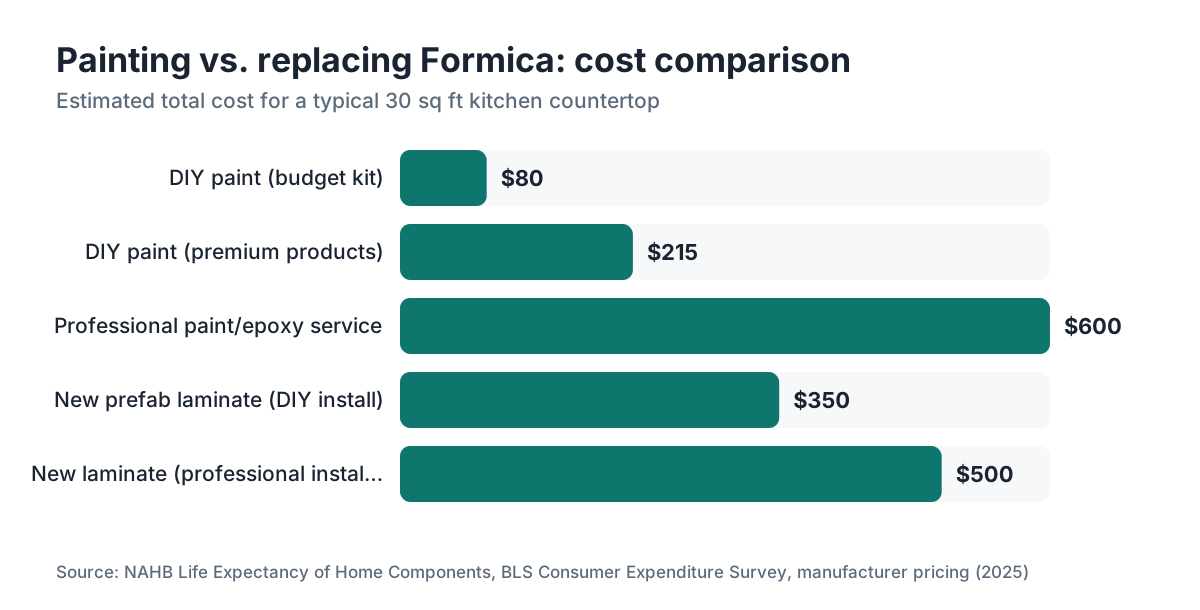
Materials for a typical kitchen run $50 to $250, depending on the products you pick and whether you buy a countertop-specific kit or assemble your own supplies.
Here's a realistic breakdown for a 30-square-foot kitchen:
| Item | Budget option | Mid-range option |
|---|---|---|
| Bonding primer (quart) | $15, $20 (Zinsser BIN shellac) | $25, $35 (Rust-Oleum Universal) |
| Topcoat paint (quart) | $20, $30 (waterborne alkyd) | $40, $60 (epoxy-based kit) |
| All-in-one countertop kit | n/a | $70, $120 (Rust-Oleum Countertop Coating) |
| Sandpaper (120 and 220 grit) | $5, $10 | $5, $10 |
| Foam roller and brushes | $8, $15 | $8, $15 |
| TSP or degreaser cleaner | $5, $8 | $5, $8 |
| Total | $53, $83 | $108, $213 |
Labor is zero if you do it yourself. Hire a painter and expect $150 to $400 for labor on top of materials, depending on your market and the scope. A professional epoxy coating service, which pours a two-part epoxy rather than brushing on paint, runs $300 to $800 for an average kitchen.
Compare that to new laminate. Installed laminate countertops typically cost $20 to $60 per linear foot, meaning a 10-foot run costs $200 to $600 [2]. Painting looks less compelling when you're only saving a few hundred dollars and trading durability for it. Run that math before you start.
What kind of paint actually sticks to Formica?
Three categories work well. Everything else is a gamble.
Waterborne alkyd paint (sometimes called alkyd-modified latex or "enamel") is the best everyday choice. It goes on like latex but cures to a hard, water-resistant film closer to oil-based paint. Benjamin Moore Advance and Sherwin-Williams Emerald Urethane Trim Enamel are popular examples. A quart runs $30 to $50. You need a bonding primer underneath.
Two-part epoxy coatings are harder, more chemical-resistant, and more durable than waterborne alkyds. They have a short pot life once mixed (20 to 45 minutes typically), they need good ventilation, and they cost more. Stone-coat epoxy countertop kits fall here. These give you the longest-lasting result.
All-in-one countertop coating kits like Rust-Oleum Countertop Coating are built for this job. They pair a bonding agent with a topcoat. The convenience is real. The durability is middle of the road.
What doesn't work: standard interior latex, chalk paint (lovely on furniture, terrible here), and spray paint. None of them cure hard enough for a horizontal work surface that gets wet, cleaned, and used daily.
One thing fabricators know that DIY guides skip: brush-on paint gives you almost any color you want, but if you're chasing a stone or granite look, a rolled-on stone-effect kit is the closest you'll get without real stone. Curious what actual stone costs? The granite countertops and marble countertops pages give honest price ranges.
How do you prep Formica countertops before painting?
Prep is the whole game. A mediocre topcoat over good prep beats a great topcoat over lazy prep by years.
Step one is cleaning. Use a TSP substitute or a dedicated degreaser, not dish soap. Grease, cooking oil, and silicone residue from cleaning products are invisible adhesion killers. Wipe down every inch, let it dry completely, and do it again if your counters are more than a few years old.
Step two is scuff sanding. Run 120-grit sandpaper on a sanding block over the entire surface to knock down the gloss. You're not removing the laminate coating, just dulling it so the primer has something to grab. Wipe off all dust with a tack cloth or a damp rag you then let dry.
Step three is taping and masking. Tape off the backsplash, sink edge, and any adjacent surfaces with blue painter's tape. Formica often has a beveled or bullnose edge that needs paint too, so don't skip it.
Step four is primer. Apply a shellac-based bonding primer (Zinsser BIN is the most commonly cited product in this category) or a high-adhesion water-based primer. Roll it on thin, let it dry per the label, then apply a second coat. Don't rush this.
Step five is light sanding between coats. Once the primer dries, sand very lightly with 220-grit to remove any raised grain or nibs, then wipe clean before the topcoat.
Skipping any of these steps is the number-one reason painted Formica fails early.
How many coats of paint does Formica need?
Two coats is the minimum for most topcoats. Three is better on horizontal surfaces that see heavy use.
Apply each coat thin rather than trying to get full coverage in one pass. Thick coats stay soft longer, sag on vertical edges, and show brush marks. A thin coat that cures hard is worth more than a thick coat that stays slightly tacky.
Between topcoats, a very light pass with 220-grit smooths imperfections and gives the next coat something to bond to. Wipe the dust off before each coat.
Curing time matters more than drying time. Paint can feel dry to the touch in an hour or two but may not reach full hardness for 7 to 30 days depending on the product [3]. Most waterborne alkyds hit full cure around 30 days. During that window, treat the surface gently: no abrasive cleaners, no heavy pots, no cutting on it. After full cure it's still softer than Formica's original surface, but it's meaningfully tougher than it was mid-cure.
How long does paint on Formica countertops last?
Realistically, 2 to 5 years before visible wear becomes a problem in a working kitchen.
The range is wide because durability rides on how you use the counter. A lightly used laundry room counter might look good for 7 or 8 years. A main prep surface with daily chopping, hot pans, and frequent scrubbing can show chips and wear spots in 18 months.
The edges and the area around the sink fail first. Water intrusion at the edge joint is the classic failure point for laminate in general [4], and painted laminate is no different. If your Formica already shows edge swelling or delamination, paint won't fix it and may trap moisture and speed up the damage.
Want more life out of it? Use cutting boards religiously. Use trivets for hot items. Clean with mild soap and a soft cloth, not abrasive scrubbers. Skip silicone-based spray cleaners that degrade the finish over time.
A finishing topcoat of water-based polyurethane (two thin coats) over a fully cured paint job adds real protection, especially on high-traffic areas. Few countertop paint guides mention this step. It's worth doing.
What are the most common mistakes when painting laminate countertops?
Rushing the prep. It's first because it accounts for most failures. People sand lightly, prime once, and start topcoating within an hour. The adhesion never builds and the paint lifts at the edges within months.
Using the wrong primer. Bonding primers are not all equal on slick laminate. Standard drywall primer will not work. You need a shellac-based primer or a product labeled specifically for adhesion to glossy or non-porous surfaces.
Painting over damaged laminate. If the Formica has chips, swollen edges, or areas lifting from the substrate, paint makes those worse. Visible seams and chips read right through topcoats.
Ignoring ventilation. Two-part epoxy products especially can off-gas hard. Use them with open windows, a fan pushing air outside, and a real respirator, not a dust mask. The EPA has guidance on VOC exposure from architectural coatings worth reviewing [5].
Not waiting for full cure. This one is sneaky. The surface seems fine, you start using it normally, and the paint gets damaged during its most vulnerable window. Mark the cure date on your calendar and actually wait.
Expecting perfection. Brush-and-roll on a large horizontal surface shows some texture, some roller stipple, maybe minor lap marks. Want a glass-smooth finish? You need spray application (which brings its own headaches) or a poured epoxy system, not brush-on paint.
Is painting Formica countertops worth it compared to replacing them?
It depends entirely on your situation.
Painting makes sense if you're renting and want a quick improvement you can live with, if you need to sell a house and want to freshen the kitchen on a tight budget, or if you're genuinely years from a full renovation and the current counters bother you every day.
Painting is probably not worth it if the laminate is badly damaged (swollen, delaminating, or extensively chipped), if you cook heavily and would repaint in two years anyway, or if you're within a year of a planned renovation where new countertops are already budgeted.
Here's the economic reality: replacement laminate is cheaper than most homeowners assume. Prefab laminate sections at home improvement stores run $10 to $30 per linear foot for material alone, and DIY installation on a simple straight run is within reach for a reasonably handy person [2]. At that price, $150 in paint materials plus two weekends of work, for a result that may last half as long as the replacement, is a genuinely close call.
If the budget caps out well below even basic replacement, or you're in a rental where you can't touch the counters, painting is reasonable. Go in with clear eyes.
Fabricators who quote countertop work lean on tools to price material options fast. SlabWise's quoting software lets shops generate instant material comparisons, so homeowners can see the real spread between laminate, solid surface, and stone before committing to a workaround like painting.
Thinking about what comes after painting? The kitchen countertops and laminate countertops guides walk through the full replacement landscape. Butcher block countertops and Corian countertops are other budget-adjacent options worth comparing.
Can you use a countertop paint kit, or should you buy products separately?
Kits are convenient and work well enough for most DIYers. Buying components separately gives you more control and often better performance.
The main all-in-one kits as of 2025: Rust-Oleum Countertop Coating, Rust-Oleum Transformations (the stone-look system), and Giani Granite countertop paint kits. Prices run $70 to $120 for a kit that covers roughly 35 to 50 square feet [8]. Everything comes in one box, the instructions are plain, and reviews are generally positive from people who follow the prep directions.
The catch is that all-in-one kits are formulated for compatibility, not maximum performance. A purpose-selected bonding primer plus a high-end waterborne alkyd topcoat produces a harder, longer-lasting surface than most kits. But assembling that combination means knowing what you're buying, and a product-selection error can cause compatibility problems.
For first-timers, or anyone who just wants it done without research, use a kit. For anyone who's done finish carpentry or cabinetry painting and is comfortable picking products, buy a proper shellac primer and a waterborne alkyd. You'll get better results.
Check two things on any kit's documentation before you buy: the coverage rate and the recoat window. Some kits have strict timing between coats, and violating them causes adhesion failures no warranty will cover.
Done with the counters and thinking about maintenance on stone or solid surfaces elsewhere in the house? The how to clean stone countertops guide covers which products are actually safe on which surfaces.
What colors and finishes look best on painted Formica?
Satin and semi-gloss hold up better than matte on horizontal work surfaces. Matte feels more premium but shows grease marks, resists a clean wipe, and wears visibly in high-touch areas.
Neutral and dark colors hide wear better than white or cream. A white painted counter that chips flashes raw substrate or primer immediately. A dark charcoal or gray shows chips much later in their life.
Stone-effect kits (Giani and similar) layer a base coat with sponged accents to mimic granite or marble. Done carefully, they read surprisingly well from a few feet away. Up close, they read as painted. Whether that's acceptable depends on how often you're six inches from your countertop.
Solid colors are simpler to apply, easier to touch up, and look more like a deliberate choice (painted cabinets matched to a painted counter can look intentional). Stone effects look more ambitious but leave less room for error in application.
If you're trying to approximate real stone and the budget stretches, get at least one quote for actual material. A fabricator's price on a small laminate or solid-surface run might surprise you. The Cambria countertops page shows what premium quartz looks like at the top of the range, which helps you understand what you're trying to fake.
How do you touch up or repair painted Formica countertops?
Touch-ups work reasonably well if you move fast after a chip or scratch, and worse the longer you wait.
For small chips: lightly sand the edges of the damaged area with 220-grit to feather them, clean with a tack cloth, then apply a thin touch-up coat of the same paint and topcoat you used originally. The repair shows up close but nearly disappears from standing height.
For larger damaged areas: the whole countertop, or at least the whole section between seams, needs repainting for the touch-up to blend. Spot repairs on big areas almost always show.
Save leftover paint in a tightly sealed container, labeled with the product name, date, and color number. Shelf life for waterborne coatings stored above freezing is typically 1 to 2 years once opened. After that, the chemistry drifts and the color match wanders even if you rebuy the same color.
Widespread failure rather than spot damage tells you the original prep was inadequate or the product was a bad match for the use. Then the question is whether to strip and repaint properly or start planning a replacement. Stripping old paint off Formica without wrecking the substrate is hard. Chemical strippers can attack the laminate, and water-based strippers can cause swelling and delamination. A clean recoat over the old paint (after scuff sanding and degreasing) is usually the better path if the existing paint hasn't bubbled or peeled broadly.
Are there health or safety concerns with painting countertops in a kitchen?
Yes, and they deserve real attention in a space where you prepare food.
VOC emissions from primers, paints, and especially two-part epoxy coatings can be significant during application and for days after. The EPA treats volatile organic compounds from architectural and industrial coatings as an indoor air quality concern [5]. Use cross-ventilation during application and for at least 24 to 48 hours after. If you have young children or anyone with respiratory conditions at home, plan for them to be out of the space during application and for a day or two after.
Once a coating is fully cured, the food-contact picture changes. Most waterborne alkyds and two-part epoxies, fully cured, are considered food-safe by their makers, but "fully cured" is the operative phrase. The FDA regulates coatings meant to contact food under 21 CFR Part 175 [6], and most consumer countertop paints are not specifically certified under those standards. In practice, if you're not cutting on the surface and you clean it before food prep, the risk is low. If you're concerned, call the paint manufacturer and ask for their food-contact documentation.
Lead paint is a separate issue for homes built before 1978. If you're repainting in an older home and you can't be sure the laminate surface was never painted before, test for lead before sanding. The EPA's Renovation, Repair and Painting (RRP) rule [7] applies to contractors in pre-1978 housing, and the logic about sanding lead paint applies to DIYers too. Test kits run $10 to $20 at hardware stores [10].
Frequently asked questions
Can you paint Formica countertops without sanding?
Technically yes, using a strong shellac-based primer, but durability suffers noticeably. Scuff-sanding breaks the gloss on the laminate and gives the primer something to grip mechanically. Skip it and you raise the odds of peeling within the first year. If sanding truly isn't possible, degrease aggressively and use two coats of shellac primer at minimum.
What is the best primer for painting Formica?
Shellac-based primer, such as Zinsser BIN, is the most consistently recommended product for slick laminate. It bonds to non-porous surfaces better than most water-based primers. Water-based bonding primers made for glossy surfaces (Zinsser Bulls Eye 1-2-3 and similar) also work, though shellac-based products have a stronger track record on Formica specifically [9].
How long does painted Formica last in a kitchen?
Expect 2 to 5 years in a regularly used kitchen with proper prep and a quality topcoat. The range is wide because use patterns vary so much. Light-use surfaces last longer. A heavily used prep area with frequent cleaning and cutting may show wear in 18 months. Edges and the sink surround typically fail first.
Can you paint Formica countertops white?
Yes. White is one of the most common choices. The downside is that white shows chips immediately, because the substrate or primer beneath is a contrasting color. If you go white, keep the original paint for touch-ups and fix chips promptly. A light sanding and a quick coat over small chips keeps white painted counters looking decent between full repaints.
Do you need to seal painted Formica countertops?
It's a good idea. Two thin coats of water-based polyurethane over a fully cured paint job add real scratch and water resistance. Use a satin or semi-gloss sheen. Let the polyurethane cure fully before regular use, typically 7 days. Not every countertop paint guide mentions this step, but it consistently extends the useful life of the finish.
Can you paint laminate countertops to look like granite?
With a stone-effect kit (Giani Granite, Rust-Oleum Transformations, and similar), you can get a result that reads like stone from a few feet away. The technique layers a base coat and sponged accent colors to build depth. Up close it reads as painted. It's a legitimate budget option if you understand the visual result you're getting.
What paint do you use on Formica specifically?
Waterborne alkyd enamel or two-part epoxy over a shellac-based bonding primer. Standard latex paint doesn't cure hard enough for a horizontal kitchen surface and will peel. All-in-one countertop coating kits (Rust-Oleum, Giani) are made for this use and are a reasonable choice for first-timers willing to accept middle-of-the-road durability for the convenience.
Can you paint over chipped or damaged Formica?
Minor chips in the laminate surface can be filled with a color-matched laminate repair paste or sanded smooth before painting. Swollen edges, water damage to the particleboard core, or widespread delamination cannot be fixed by painting. Those conditions require replacement. Painting over serious substrate damage traps moisture and speeds up the deterioration.
How much does it cost to have countertops professionally painted?
A professional painter charges $150 to $400 in labor for a typical kitchen, on top of $50 to $150 in materials. A poured two-part epoxy countertop service, where a contractor applies a decorative epoxy system, typically runs $300 to $800 for an average kitchen. DIY with kit products costs $70 to $250 in materials depending on what you choose.
Will painting Formica countertops increase home value?
Probably not measurably. Buyers and appraisers usually see painted countertops as a temporary fix, not an upgrade. A fresh, clean paint job helps a kitchen show better during a sale, which can matter at the margin. But it doesn't add assessed value the way new stone or quality laminate countertops might.
How do you clean painted Formica countertops without damaging them?
Mild dish soap and a soft cloth or sponge. Avoid abrasive scrubbing pads (they scratch the topcoat), bleach-based cleaners (they degrade many paint films over time), and silicone spray cleaners (they leave residue that ruins adhesion if you ever need to touch up). Rinse with clean water and dry rather than leaving standing water on the surface.
Is Formica the same as laminate?
Formica is a brand name. Laminate (or high-pressure laminate, HPL) is the material category. Formica Group is one of several manufacturers. Other brands include Wilsonart, Pionite, and Nevamar. For painting purposes, all HPL products behave the same, and the same prep and product choices apply no matter which brand the laminate is.
Can you use chalk paint on Formica countertops?
Not recommended for kitchen countertops. Chalk paint cures soft and porous, which makes it excellent for furniture that gets a decorative wax seal but poor for horizontal surfaces that get wet and need frequent cleaning. It wears, stains, and chips quickly on a working countertop. Use a waterborne alkyd or epoxy-based product instead.
How do you remove paint from Formica if you change your mind?
Carefully. Chemical paint strippers can damage or discolor laminate, and sanding through the decorative layer ruins the Formica permanently. The safest approach is to test a paint remover on a hidden area first and work in small sections. Heat guns can soften paint for scraping but risk delaminating the laminate if used too aggressively. Repainting over the existing paint is often easier than full removal.
Sources
- Formica Group, About Formica Brand Laminate: Formica is high-pressure laminate made by fusing resin-saturated kraft paper layers under heat and pressure, bonded to a particleboard or MDF core.
- U.S. Bureau of Labor Statistics, Consumer Expenditure Survey (home improvement cost context): Installed laminate countertops typically cost $20 to $60 per linear foot; prefabricated sections at home improvement stores run $10 to $30 per linear foot for materials.
- Sherwin-Williams, Coatings Technical Information (cure vs. dry time): Waterborne coatings can feel dry to the touch within hours but may not reach full hardness for 7 to 30 days depending on the product.
- National Association of Home Builders (NAHB), Life Expectancy of Home Components: Edge swelling and water intrusion at the edge joint are classic failure points for laminate countertops; NAHB cites laminate countertop life expectancy in the range of 10 to 15 years under normal use.
- U.S. Environmental Protection Agency, Indoor Air Quality (VOCs from coatings): The EPA classifies VOC emissions from architectural and industrial coatings as a category of indoor air quality concern.
- U.S. Food and Drug Administration / eCFR, 21 CFR Part 175 Indirect Food Additives: Adhesives and Components of Coatings: The FDA regulates coatings intended to contact food under 21 CFR Part 175; most consumer countertop paints are not specifically certified under these standards.
- U.S. Environmental Protection Agency, Renovation, Repair and Painting (RRP) Program: The EPA's RRP rule applies to contractors working in pre-1978 housing and addresses risks from sanding lead-containing surfaces including painted surfaces.
- Rust-Oleum, Countertop Coating Product Page: Rust-Oleum Countertop Coating kits cover approximately 35 to 50 square feet and retail in the $70 to $120 range as of 2025.
- Zinsser (Rust-Oleum), BIN Shellac-Based Primer: Zinsser BIN shellac-based primer is formulated to bond to slick, non-porous surfaces including laminate and is widely cited as the most effective primer for Formica painting projects.
- U.S. Consumer Product Safety Commission, Lead in Consumer Products: Lead paint test kits are widely available for $10 to $20; homes built before 1978 may have lead-containing paint on any surface including previously painted laminate.
Last updated 2026-07-09