TL;DR
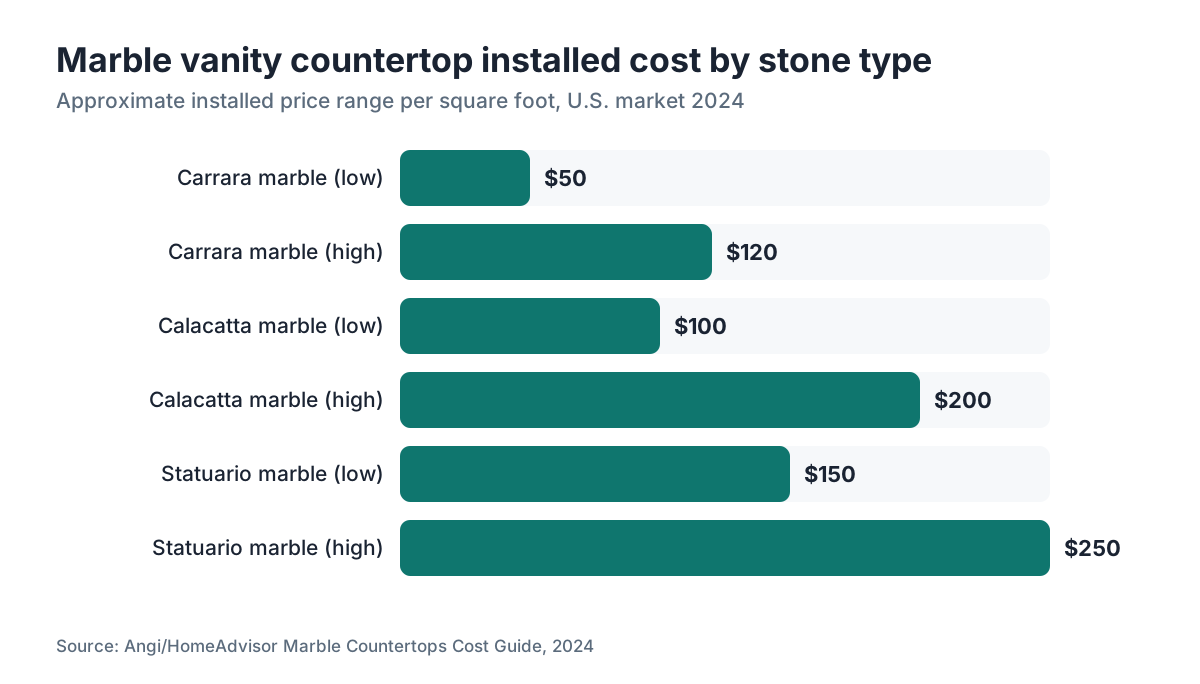
- Marble vanity countertops run $50 to $250 per square foot installed, set by marble type, thickness, and edge detail.
- They look beautiful and help resale, but they etch and stain when left unsealed or ignored.
- For a low-traffic guest bath or powder room, marble is a smart pick.
- For a daily-use master bath with kids, think hard first.
What does a marble vanity countertop cost?
The honest installed price for a marble vanity countertop is $50 to $250 per square foot, and that spread is real, not padding. [1] The low end is imported Carrara in a standard thickness (3/4 inch or 2 cm) with a simple eased or beveled edge, cut by a mid-size local shop. The high end is book-matched Calacatta Gold or Statuario in 3 cm, with a mitered waterfall edge, from a high-end fabricator in a big metro.
A typical double-vanity top, say 25 inches deep by 60 inches wide with two undermount sink cutouts, works out to about 10 to 12 sq ft of finished surface. Add the backsplash if you want one. At a mid-range $100/sq ft all-in, that's a $1,000 to $1,200 job before tax. At $200/sq ft you're at $2,000 to $2,400. Those figures line up with what the National Kitchen and Bath Association reports for average bathroom countertop spend in its member survey. [2]
Here's what pushes the number up fast. Ogee or waterfall edges add $15 to $40 per linear foot. Vessel sink cutouts usually cost less than undermount because there's less precision finishing inside the hole. 3 cm slabs cost 15 to 25% more than 2 cm for material alone. Book-matching doubles both waste and labor time.
Compared to granite countertops or laminate countertops, marble lands above granite and well above laminate on both price and how much maintenance it demands.
Which types of marble work best for a bathroom vanity?
Not all marble is the same rock. The word covers a range of metamorphic limestone with different calcite content, crystal structure, and vein density. For vanities, those differences matter a lot.
Carrara is the workhorse. It's the most common white marble in the U.S. market, quarried in the Apuan Alps of Tuscany. Fine grain, soft gray veining, fairly consistent color. It's also the cheapest of the white Italian marbles, which is why it turns up everywhere from IKEA bath accessories to hotel lobbies. The catch: it's softer than Calacatta and etches visibly against acidic stuff like toothpaste, mouthwash, and most bathroom cleaners. [3]
Calacatta comes from a smaller area near Carrara but reads brighter white with bolder, more dramatic veining. It costs more, sometimes two to three times as much as Carrara. The drama in the veins is genuine and it photographs beautifully. It's still calcite. It still etches.
Statuario has the whitest background and the most graphic, flowing veins. It's the rarest of the three and commands the highest price. For a vanity it's genuinely stunning. It's also the choice that hurts most when something goes wrong, so be honest with yourself about your habits.
Thassos is a Greek white marble, nearly pure calcite, almost no veining, reads bright white. It looks incredible with chrome fixtures and a stripped-down design. It's also more porous than the Italian marbles and needs diligent sealing.
For bathrooms, the practical durability ranking runs like this: Calacatta and Statuario (denser grain, a touch more etch-resistant) ahead of Carrara (softer, more variation in quality), ahead of Thassos (beautiful but thirsty). None of them are bulletproof. That's the honest answer.
Does marble hold up in a bathroom?
Marble holds up in a bathroom if you manage it right. Two threats do the damage, etching and staining, and they're different problems with different fixes.
Etching is a chemical reaction. Marble is calcium carbonate, and acid dissolves it. Toothpaste is mildly acidic. Mouthwash often is. So are perfume, hairspray, and most bathroom tile cleaners. Let any of these sit on polished marble, even briefly, and they dull the finish in that spot. You get a matte patch on an otherwise glossy surface. It's not a stain you wipe off. It's surface removal. [3] A pro can re-hone and re-polish the stone to fix it, but that's not a weekend job.
Staining is separate. Marble is porous, and liquids that sit long enough soak in and discolor the stone. Hair dye is the horror story in every marble forum, and it's earned. A single hair-color application left on marble for 30 minutes can stain it permanently. Red wine, dark makeup, and rust from metal cans stain too.
Sealing slows staining but does nothing for etching. This is the single biggest misunderstanding about marble care. Impregnating sealers (penetrating sealers, not topcoat waxes) fill the pores and buy time against liquid soaking in. They don't touch the chemical reactivity of the surface. [9]
In a guest bathroom or powder room where nobody leaves acidic liquids on the stone, marble holds up fine for decades. In a master bathroom where two people groom every morning, it needs real habits: wipe spills right away, use pH-neutral cleaners, put stone-safe coasters under anything that might drip. If that sounds like too much, read how to clean stone countertops and decide honestly whether you'll follow through.
For context on a zero-maintenance alternative, Cambria countertops (an engineered quartz) are non-porous, don't etch, and need no sealing. They're a rational pick for the exact bathrooms where marble struggles.
How do you seal a marble vanity countertop?
Sealing marble is a job you can finish yourself in under an hour. You want an impregnating (penetrating) sealer, sometimes labeled a stone sealer or tile sealer. Skip topcoat sealers and wax on vanity surfaces. They sit on top, wear unevenly, and make the stone look plasticky.
The Natural Stone Institute (formerly the Marble Institute of America) recommends a simple water test to check whether a stone needs sealing: drip water on the surface and time how long before it darkens the stone. [9] If it darkens in under 4 minutes, seal it. If it takes 10 minutes or more, sealing is optional. Most new marble vanity tops benefit from sealing before first use.
The steps are short. Clean the surface with a pH-neutral stone cleaner and let it dry completely (at least 24 hours if the top is freshly installed). Wipe the sealer on with a clean cloth, covering everything evenly. Let it soak 10 to 15 minutes per the product instructions. Buff off the excess before it dries to a haze. Let it cure 24 to 48 hours before use.
How often to reseal? Every 6 to 12 months for a bathroom vanity in daily use. Run the water test once a year to check. Two sealers earn consistent praise from fabricators: DuPont StoneTech Professional and Miracle Sealants 511 Impregnator. Neither claims to stop etching, and any sealer that does is lying to you.
What I'd actually do: seal at installation, then reseal every 12 months on a guest bath and every 6 months on a daily-use master bath. Put it on the calendar. It takes 45 minutes and it's the biggest single thing you can do to protect the money you spent.
What thickness should a marble vanity top be?
Two thicknesses are standard: 2 cm (about 3/4 inch) and 3 cm (about 1-1/4 inch). Both ship as slabs before fabrication, and both work for vanities, but they feel and behave differently.
2 cm marble is lighter and cheaper. It's common in prefabricated vanity tops and fine for spans under 36 inches. On longer runs, a 2 cm slab needs a plywood or MDF substrate underneath for support, because marble that thin can flex and crack over a long unsupported span. [10] Most fabricators add substrate automatically on 2 cm jobs, but ask to confirm.
3 cm marble is stiffer, heavier, and pricier. It doesn't need a substrate. The extra mass makes edges look more substantial too, which is part of why high-end projects reach for it. The difference between a 2 cm eased edge and a 3 cm eased edge is obvious in person. For a vanity with a thick apron or furniture-style base, 3 cm suits the proportions.
For most residential bathroom vanities, 3 cm is what I'd choose when the budget allows. The price delta is real (roughly $10 to $25/sq ft more at the slab level), but the substrate step disappears and the finished edge looks better. On a small powder room vanity where cost matters, 2 cm with proper substrate is perfectly fine.
How does marble compare to quartz for a vanity top?
This is the comparison most homeowners are really trying to settle, so here's the direct answer.
Engineered quartz (Silestone, Caesarstone, Cambria) is roughly 90 to 93% ground quartz bound with polymer resin. [6] The resin makes it non-porous, so it doesn't stain and doesn't need sealing. The quartz makes it harder than marble. It doesn't etch, because the surface is resin, not calcite. For a bathroom with real daily use, quartz beats marble on every practical measure.
Marble wins on looks in the eyes of most designers and most people who've seen both in person. The veining in a natural slab is genuinely different from the printed or engineered patterns in quartz, which can look good but often read as repetitive or a little artificial up close. Marble also carries resale perception. Plenty of buyers link real marble to quality in a way manufactured stone doesn't quite match.
Cost depends entirely on the products you're comparing. Entry-level quartz runs $60 to $80/sq ft installed, close to entry-level Carrara. High-end quartz from Cambria or MSI reaches $120 to $150/sq ft installed. Calacatta Gold marble can push $200 to $250/sq ft. Neither material is categorically cheaper.
| Factor | Marble | Quartz |
|---|---|---|
| Etching risk | High (calcite reacts to acid) | None (resin surface) |
| Staining risk | Moderate (seal every 6 to 12 months) | Very low (non-porous) |
| Heat resistance | Good (natural stone) | Moderate (resin can discolor) |
| Appearance | Natural variation, no repeats | Consistent but can look manufactured |
| Typical installed cost | $50, $250/sq ft | $60, $150/sq ft |
| Resale perception | Strong | Good |
| Maintenance | Active (seal, wipe spills fast) | Minimal |
Kids in the bathroom and you're not the type to wipe things up right away? Get quartz. Bathroom mostly for you, you care about the look, and you'll build the habits? Marble is a genuinely rewarding surface to live with.
What edge profiles work well on a marble vanity?
Edge profiles are aesthetic and practical at once. With marble, some profiles hold up better than others, because marble chips at sharp corners.
Eased edge (a slight softening of the 90-degree corner) is the most chip-resistant and the most minimal. It fits modern and transitional bathrooms. This is what I'd choose on a daily-use vanity where the edge gets bumped and knocked.
Bevel edge cuts a 45-degree face on the top corner, catching light and adding a little detail. A touch more vulnerable to chipping than eased, but still reasonably tough.
Ogee is the classic S-curve. It looks ornate, suits traditional and transitional designs, and resists chipping because the curved geometry spreads impact differently than a sharp corner. The cost: ogee runs $15 to $40 per linear foot more than eased, depending on the shop.
Waterfall edge (the slab runs vertically down the side of the cabinet to the floor) is a high-labor, high-material choice. It needs two pieces of marble mitered at 45 degrees so the veining flows continuously. On Calacatta or Statuario with dramatic veining, it looks exceptional. It also costs a lot, easily $500 to $1,500 added to a vanity depending on size.
With marble, skip knife-edge or pencil-edge profiles on a daily-use bathroom. They chip. Marble is brittle at thin edges, and a bathroom door swinging into the vanity corner is a real scenario, not a hypothetical.
Full-service fabricators who quote and template properly will lay out every option with pricing. If yours won't, ask more questions. Shops that run quoting software like SlabWise can show per-edge pricing during the quote, which makes comparison easier before you commit.
How is a marble vanity top installed?
Installing a marble vanity top follows the same sequence as any stone countertop, but marble adds a concern at every step.
Templating comes first. A fabricator sends a tech to take exact measurements of your cabinet, or the space where it'll sit. Modern shops use digital templating or direct laser measurement. Older shops use cardboard or luan. Either works if done carefully, but digital templating cuts the odds of a miscut, which matters a lot with a $500-plus slab of marble.
Fabrication happens at the shop. The slab gets cut to shape, sink cutouts get made, edges get profiled and polished. For undermount sinks, the sink rail (the finished inside edge of the cutout) is polished and usually gets a clip or epoxy attachment for the bowl. Fit and finish is decided here. Ask to see the finished top at the shop before it ships if you can.
Delivery and set. Marble is heavy. A 3 cm slab at 60 inches wide by 25 inches deep weighs roughly 80 to 100 pounds. Two people minimum. The top gets set dry first to check fit, then set with silicone adhesive. Plumbing goes in after the stone is down.
Backsplash. A standard marble backsplash runs about 4 inches tall and gets cut from the same slab for visual continuity. It's siliconed to the wall and caulked at the top edge. Going with a full tile backsplash instead? The marble top gets a caulk joint (not grout) where stone meets tile.
For the full sequence and what to watch at each stage, countertop installation walks through it in detail.
After install, wait 24 hours before sealing so any silicone off-gasses fully, and 24 hours after sealing before you use the sink normally. [11]
Can you use marble for a vessel sink vanity top?
Yes. A vessel sink sits on top of the countertop instead of undermounting, so the marble top just needs a simple drain hole rather than a finished undermount cutout. That's a less complex, usually cheaper, fabrication step.
The thing to plan for is height. A vessel sink adds 5 to 7 inches above the countertop, so the finished rim can land 36 to 42 inches off the floor. Standard comfortable countertop height is around 31 to 36 inches. Going vessel means the cabinet should be shorter than standard to make up the difference.
For marble, a vessel setup keeps more of the slab visible, which is a real benefit. An undermount sink eats the visual area inside the cutout. With a vessel, the full 25 by 60-inch surface stays unbroken except for the drain hole, so the veining does the talking.
The stone around the drain hole needs careful sealing, because water drips off the faucet handle area constantly. This is one of the higher-wear zones on a marble vanity top. Keep it sealed and wipe it dry after each use.
What are the real downsides of marble in a bathroom?
Let's be direct about what goes wrong, because a lot of marble content online skips right past it.
Hair dye is the single worst substance for a marble vanity. Most permanent dyes carry hydrogen peroxide and ammonia or substitute oxidizers that react with calcite and soak into porous stone fast. Thirty minutes of contact can stain marble permanently. No household trick reliably pulls a deep dye stain out of marble. You're looking at a professional poultice treatment (which may or may not work) or a new top.
Etching builds up invisibly for months, then becomes obvious all at once. People don't notice it day to day because each incident is tiny. Then they catch the marble in certain light and see a surface full of dull patches. Master baths get this the worst, with toothbrushing twice a day and toothpaste splatter constant.
Seams show up on wide vanities. Marble slabs run about 55 to 65 inches wide. A double vanity wider than roughly 60 inches may need a seam. In Carrara, with soft gray veining, seams hide well. In Calacatta or Statuario, with bold directional veins, a seam is obvious unless the fabricator matches color and vein carefully.
Cracking is rare but possible if the substrate or cabinet shifts. Marble has less flex tolerance than granite or quartzite. A 2 cm top without proper support is exposed. Water getting behind a poorly sealed backsplash joint can also cause trouble at the wall edge over the years.
None of this means never use marble. It means go in with accurate expectations. For how other natural stones handle these same issues, how to clean quartzite countertops and how to clean soapstone countertops show what real maintenance looks like across stone types.
How do you remove stains and etch marks from a marble vanity?
Etching and staining need completely different fixes. Confuse the two and you waste your effort.
Etch marks are surface damage: the calcite is actually removed or disrupted. They show as dull, slightly rough patches on a polished surface. For minor etching, a marble polishing compound or etch remover (products like Etch Remover from MARBLELIFE, or similar) can re-level and re-polish the spot to a degree. They work by micro-abrasion, basically re-polishing the stone. On light etching they genuinely work. On deep or widespread etching, a stone restoration pro re-hones and re-polishes with diamond abrasives. That typically runs $200 to $600 for a vanity-size surface.
Stains are a different animal. Poultice treatment is the standard method. A poultice is an absorbent material (diatomaceous earth, baking soda, or commercial stone poultice powder) mixed with a chemical agent matched to the stain type (hydrogen peroxide for organic stains like coffee or makeup, acetone for oil-based stains) into a paste. Spread it thick over the stain, cover with plastic wrap, tape the edges, and let it sit 24 to 48 hours. As the paste dries, it draws the staining agent up out of the stone. [4] It works best on fresh stains. Old or deep ones may need multiple rounds or professional gear.
Hair dye stains fight poultice treatment hard. Some stone pros combine hydrogen peroxide gel with extended dwell time. Results vary, and I wouldn't promise anyone a clean recovery.
Prevention beats remediation every time. The building stone industry's guidance is plain: seal before use, reseal on schedule, wipe spills immediately, use pH-neutral cleaners. [9] Stay away from bleach, vinegar, citrus-based cleaners, and any bathroom cleaner not specifically labeled safe for natural stone.
Is marble good for a small or powder room vanity?
Powder rooms and guest baths are honestly where marble makes the most sense for people who love the look but dread the upkeep. Think about what actually happens in a powder room. Guests wash their hands. That's it. No toothpaste, no hair dye, no perfume sitting on the counter. The maintenance load is low and the visual payoff is high.
A small powder room vanity might be 18 by 22 inches, or a wall-mounted pedestal with a marble shelf. Material cost on a surface that small is minimal, maybe $200 to $500 total in Carrara, less if a fabricator cuts it from a remnant. Remnant marble is a real option here: shops keep off-cuts from bigger jobs and often sell them at a steep discount. Ask.
For a small vanity, white Carrara with a simple edge and a wall-mounted faucet is a classic combination that works in traditional, transitional, and even contemporary rooms depending on how the rest of the space is finished. Thassos white with a polished nickel faucet in a stripped-down powder room looks extraordinary in person.
The case against marble in a powder room is weak. The case for it, given how rarely the surface gets stressed, is strong. This is the one use case where I'd recommend it without reservation.
If you're also weighing the larger marble countertops picture beyond vanities, including kitchens, that's a longer and messier conversation given the acids that show up in cooking.
How do fabricators price and quote a marble vanity top?
If you're a fabricator reading this, marble vanity pricing has a few quirks worth flagging.
Material cost per square foot swings more on marble than granite because of tight quarry geography and quality tiering. A Carrara slab might wholesale at $8 to $15/sq ft. Calacatta runs $25 to $60/sq ft wholesale at minimum, and premium lots of Calacatta Gold clear $100/sq ft wholesale. [1] Your material multiplier has to reflect the actual slab tier, not a generic stone line item.
Sink cutouts on marble need slower tooling than granite, because marble is more brittle and cracks at cutout corners if you rush. Budget extra time. A standard undermount cutout that takes 15 minutes in granite can take 20 to 25 minutes in marble if the fabricator works carefully.
Waste factor drives the number on book-matched or directionally veined marble. You may need 30 to 40% more slab than the finished surface area to land the vein match. On a $50/sq ft wholesale slab, that waste is manageable. On a $100/sq ft slab, it's a serious cost that has to be in the quote or you eat it.
Edge polishing time on 3 cm marble runs longer than granite for the same profile, because marble's crystal structure polishes differently. Shops that calibrated their time costs on granite tend to underprice marble edges as a result.
Shops running quoting software like SlabWise can build material tiers and per-operation time costs specifically for marble, so the quote reflects the actual job instead of a generic stone markup. That matters on Calacatta jobs, where the margin is real but so is the risk.
For bathroom work generally, the same principles that govern kitchen countertops pricing apply, except bathroom jobs are smaller surfaces where edge and cutout costs eat a bigger share of the total.
Frequently asked questions
How long does a marble vanity countertop last?
A properly sealed, maintained marble vanity top can last the life of the home, 50 years or more. The stone itself doesn't deteriorate under normal bathroom use. What changes is the finish. Unsealed or neglected polished marble develops etching and dull patches. A honed surface shows less etching visually, which is why many designers pick honed for daily-use bathrooms.
What's the difference between honed and polished marble for a vanity?
Polished marble has a glossy, mirror-like finish that shows etching as dull patches against the shine. Honed marble has a matte finish and hides etching much better, because the whole surface is already matte. Honed is more forgiving in a daily-use bathroom. Polished looks more dramatic in photos. Both etch equally from acid; the only difference is how visible the damage is.
Is Carrara marble good for a bathroom vanity?
Carrara is a reasonable pick for a bathroom vanity, especially a guest bath or powder room. It's the cheapest Italian white marble and widely available. The downside is it's softer than Calacatta and etches visibly against acidic products. For a master bath with daily cosmetic use, Carrara demands real habits. For a low-traffic bathroom, it's a beautiful, cost-effective option at $50 to $120/sq ft installed.
Can you put hot tools on a marble vanity?
You can, but it's not ideal. Marble handles brief heat better than engineered quartz, which has resin that can discolor. Still, a very hot flat iron set directly on polished marble can cause thermal shock cracking in thin slabs, and repeated heat can affect the finish over time. Use a heat mat or silicone pad for hot styling tools. Putting one down takes about three seconds.
How do I get toothpaste etch marks off marble?
Toothpaste etches marble because it's mildly acidic or abrasive. For light etch marks, a marble polishing powder or etch remover (applied with a damp cloth and buffed) can restore the shine to a degree. For severe or widespread etching, you need a stone restoration pro who re-hones and re-polishes with diamond pads. That typically costs $200 to $600 for a vanity-sized surface.
Does marble increase home resale value in a bathroom?
Real marble in a bathroom is generally viewed positively by buyers and appraisers. The National Association of Realtors' remodeling reports consistently show bathrooms as high-ROI projects, and natural stone reads as a positive qualifier. [7] That said, the resale lift from marble specifically versus quality engineered quartz isn't well-documented in controlled studies. The perception benefit is real. The exact dollar premium is hard to isolate.
What's the best cleaner to use on a marble vanity?
Use a pH-neutral stone cleaner labeled safe for marble. Spray, wipe, done. Never use vinegar, bleach, hydrogen peroxide on finished surfaces, citrus-based cleaners, or standard bathroom sprays like Scrubbing Bubbles or Tilex. Those are acidic and etch marble on contact. For daily cleaning, warm water and a soft microfiber cloth handle most of it. Save the stone cleaner for weekly maintenance.
How do I choose between a marble slab and marble tile for a vanity top?
A marble slab is one continuous piece, so there are no grout lines to clean on the horizontal surface. Marble tile brings grout lines, which stain and grow mildew in a bathroom. For a vanity top, slab is almost always the better call if the budget allows. Tile makes more sense on bathroom floors and walls, where a single slab would be impractical or too costly to fabricate.
How much does it cost to replace a marble vanity top?
Replacing a marble vanity top costs about the same as installing a new one, $50 to $250/sq ft installed, plus removal of the old top ($50 to $150 typically). The main variable is whether you can reuse the existing undermount sink. If it was epoxied to the old marble, it may not survive removal cleanly. Confirm with your fabricator first. Budget $800 to $2,000 for a standard double-vanity replacement.
What is a prefabricated marble vanity top?
A prefabricated marble vanity top is a pre-cut slab in standard sizes (typically 25 inches deep, in widths of 31, 37, 43, 49, 61 inches) with a pre-finished edge and sometimes a pre-cut sink hole. They sell at home improvement stores and online. Prices run $150 to $600 for Carrara in standard sizes. Quality varies. The fit is close but rarely perfect, and edge finishing is usually eased or beveled only. Custom fabrication fits better and offers more choices.
Can you repair a chipped marble vanity edge?
Small edge chips can be repaired with color-matched epoxy or resin fill by a stone restoration pro. The repair shows up close if you hunt for it, but from normal viewing distance it reads fine. Larger chips or cracks near a sink cutout are harder to repair well and may point to a structural weak spot. Prevention matters: don't bang heavy objects into marble edges, and choose an eased or ogee profile over a sharp knife edge.
Is cultured marble the same as real marble?
No. Cultured marble is a manufactured product made from ground limestone or marble dust mixed with polyester resin, cast in a mold, and coated with a gel coat. It's not natural stone. It's much cheaper ($10 to $40/sq ft installed), weighs less, and doesn't etch because the surface is resin. It can scratch, and the gel coat can crack or yellow over time. A reasonable budget option, but a completely different product from a natural marble slab.
How do I find a fabricator for a marble vanity top?
Look for a stone fabricator, not a general contractor who subcontracts stone work. Ask whether they have marble experience specifically, since marble needs slower tooling and more care than granite. Ask to see finished marble jobs. Get three quotes; pricing varies a lot by market and shop. Good fabricators template in person before quoting, never over the phone sight-unseen. Check Google reviews for mentions of marble work specifically.
Sources
- HomeAdvisor / Angi, Marble Countertops Cost Guide: Marble countertop installed costs typically range from $50 to $250 per square foot depending on type, thickness, and region
- National Kitchen and Bath Association, NKBA Design + Industry Survey: NKBA annual member surveys report average bathroom countertop spend benchmarks used in cost comparisons
- Natural Stone Institute, Care and Cleaning of Natural Stone: Calcite-based marbles etch when exposed to acidic substances because acid dissolves the calcium carbonate surface
- University of Minnesota Extension, Caring for Marble and Natural Stone Surfaces: Poultice treatment (absorbent material plus chemical agent) is the recommended method for drawing stains out of porous natural stone
- Marble Institute of America / Natural Stone Institute, Comparative Stone Specification Guide: Engineered quartz products contain approximately 90-93 percent ground quartz bound with polymer resin, making them non-porous and resistant to staining and etching
- National Association of Realtors, 2023 Remodeling Impact Report: Bathroom remodels consistently rank among the highest ROI home improvement projects; natural stone surfaces are a positive qualifier in buyer perception
- Natural Stone Institute, Sealers and Surface Treatments Technical Bulletin: Impregnating (penetrating) sealers reduce porosity and slow staining but do not prevent chemical etching on calcite-based stones including marble; water-absorption test indicates whether sealing is needed
- Marble Institute of America (now Natural Stone Institute), Dimension Stone Design Manual: Standard slab thicknesses for countertop applications are 2 cm and 3 cm; 2 cm applications typically require substrate support for spans exceeding approximately 36 inches
- EPA, Indoor Air Quality: Building Materials and VOCs: Silicone adhesives used in stone installation should be allowed to off-gas before sealing; waiting 24 hours after installation before sealing is standard practice
Last updated 2026-07-09