TL;DR
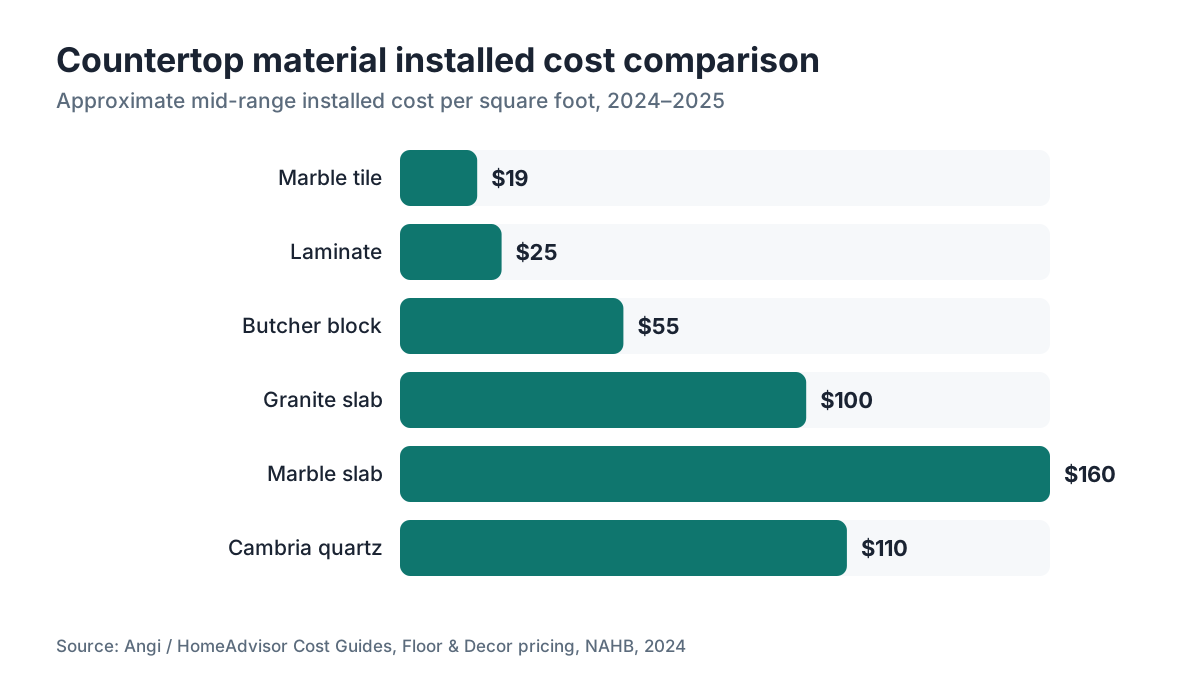
- Marble tile countertops run $10, $25 per square foot installed, compared to $75, $250 for marble slabs.
- They look beautiful, but the grout lines collect grime, the tile corners chip, and marble etches and stains without regular sealing.
- They make the most sense in low-traffic bathrooms, or as a budget path to a marble look in kitchens where you accept the maintenance trade-offs.
What is a marble tile countertop and how does it differ from a marble slab?
A marble tile countertop is a counter surface built from individual marble tiles, typically 12×12, 12×24, or 4×4 inches, set in thinset mortar on a substrate and grouted at the joints. A marble slab countertop is cut from a single continuous piece of natural stone, usually 3/4 inch or 1.25 inches thick, templated to fit and installed without visible seams across most of the run.
The practical difference is big. With tiles, you get grout lines. Grout lines trap bacteria, grease, and food particles unless they are sealed and cleaned hard. With a slab, you get one continuous surface that wipes down in a single pass. Slabs cost dramatically more, though. A polished Carrara marble slab installed typically runs $75, $250 per square foot depending on material grade, edge profile, and your region [1]. Marble tile installed runs roughly $10, $25 per square foot for materials and labor combined, though premium large-format marble tile in exotic varieties can push higher [2].
The substrate matters too. Tile goes over cement board or Schluter-style uncoupling membranes, and the tile itself can be as thin as 3/8 inch. Slabs need cabinets engineered for the weight (roughly 18 to 20 lbs per square foot for a 1.25-inch slab) and a shop-fabricated piece. If your cabinets can't handle that load or your budget won't stretch, tile is a real alternative worth understanding honestly.
How much does a marble tile countertop actually cost?
Material and labor costs vary by tile size, marble variety, substrate prep, and your market, but here is the honest range based on industry pricing data.
| Component | Low end | High end |
|---|---|---|
| Marble tile (material) | $3/sq ft | $15+/sq ft |
| Cement board substrate | $0.50/sq ft | $1.50/sq ft |
| Thinset + grout + sealer | $1/sq ft | $2/sq ft |
| Professional installation labor | $5/sq ft | $10/sq ft |
| Total installed | $10/sq ft | $28+/sq ft |
Carrara marble tile, the most popular choice by a wide margin, sits in the $4, $8 per square foot range for 12×12 tiles from major tile distributors [2]. Calacatta is typically $10, $20 per square foot at retail. Large-format tile (24×24 or 24×48) tends to cost more per square foot and takes more skill to set level, which drives labor up.
DIY installation can cut $5, $10 per square foot off the total if you're comfortable with tile work. A 30-square-foot kitchen countertop could run $300, $450 in materials if you do it yourself. But a countertop is not a floor. The edges are exposed, corners get bumped hard, and lippage (tiles not perfectly flush) is immediately visible and catches crumbs. Get at least two bids from tile setters before deciding to DIY.
Don't ignore ongoing costs. A good penetrating sealer runs $20, $50 per application, and you need to reapply every six to twelve months on a countertop that sees daily use [3]. Slab marble owners have the same sealing job, but at least they don't have grout to worry about.
What are the real pros and cons of marble tile countertops?
Let me be direct about both sides.
What marble tile does well. The look is genuinely beautiful. Marble has been used in architecture for thousands of years, and no engineered product fully copies the veining depth and warmth you get from real stone. Tile makes that look accessible at a fraction of slab cost. Tiles are also replaceable. If one cracks or chips badly, a skilled tile setter can cut out and relay the damaged tile without touching the rest of the counter. With a slab, a serious crack usually means a full replacement or a visible repair.
Tile is also lighter. At roughly 3 to 5 lbs per square foot for a 3/8-inch tile plus mortar bed, the load on your cabinets is much lower than a 1.25-inch slab. For older cabinet boxes, or remodels where structural reinforcement isn't practical, that matters.
Where marble tile falls short. Grout is the biggest practical problem. Standard sanded grout in a kitchen collects grease and food even when sealed, and it is nearly impossible to keep the same color as the day it went in. Epoxy grout holds up far better and resists staining, but it is harder to work with and costs more. A light grout color (which matches marble aesthetically) makes staining more visible. A dark grout color protects the appearance of the joints but looks odd against white Carrara.
Marble itself etches. Acids including lemon juice, vinegar, wine, and tomato sauce leave dull spots on a polished marble surface by chemically reacting with the calcium carbonate in the stone [4]. This is true for both slab and tile. Honing the surface (a matte finish rather than a high polish) makes etching less visible but doesn't stop it. If your kitchen sees regular cooking and you're not prepared to treat the surface carefully, marble in any form is a hard sell.
Corner and edge chipping is also more common with tiles than with thicker slab material. A tile edge is typically only 3/8 to 1/2 inch thick. Hard impacts crack it. Bullnose tiles (with a finished edge) help the look but don't change the physics.
What type of marble tile works best for countertops?
Not all marble tiles are right for countertop use. Floors see different stress than countertops, and many tiles marketed for flooring are too thin, too soft, or too porous for a counter.
For countertops, check thickness and finish rather than the PEI wear rating used for ceramic floor tile. A minimum 3/8 inch (10mm) tile thickness is workable; 1/2 inch (12mm) is better for durability at exposed edges. Some manufacturers offer marble tiles in 3/4 inch thickness specifically for countertop applications, which approaches slab-like durability.
Marble hardness is measured on the Mohs scale. Most commercial marble falls between 3 and 4 [5]. That is softer than granite (6 to 7) and much softer than quartzite (7+). Softer means more open to scratching and etching. Denser, harder varieties like Nero Marquina (black marble from Spain) and Bardiglio resist etching slightly better than classic white Carrara, though none are immune to acids.
Finish matters. Polished marble shows etching and scratches more clearly, because the contrast between a mirror finish and a dull etch spot is high. Honed marble hides etching better and feels more matte. Brushed or leathered finishes are less common in tile form but also hide wear well. For a kitchen counter you plan to actually cook on, honed or brushed is the practical pick.
Large-format tiles (18×18 or 24×24) cut the number of grout lines, which is a real advantage on a countertop. The trade-off: larger tiles are harder to set perfectly flat on a counter substrate, and any lippage jumps out. A tile setter with real countertop experience (more than floors) is essential for large-format work.
How do you install marble tile on a countertop?
Installing marble tile on a countertop is a legitimate DIY project if you have tiling experience. If you don't, hire a tile setter who has done countertops specifically, more than floors or showers.
The basic sequence: remove old countertop, check cabinet tops for level and structural soundness, install 1/2 inch cement board (Hardibacker or Durock are common brands) screwed to cabinet tops, apply thinset mortar, set tiles, let cure 24 hours, grout, let cure 72 hours, seal.
A few countertop-specific concerns. First, the edge treatment. You need a way to finish the exposed front edge of the counter. Options include bullnose tiles (tiles with one finished rounded edge), marble pencil rail trim pieces, wood edge banding, or a tile waterfall edge. Plan this before you buy tile, because bullnose pieces often cost more per linear foot than field tile.
Second, layout planning. On a countertop with a sink cutout and corners, your grout lines need to line up visually. Dry-lay the full counter before spreading any thinset. Mark your layout lines. A grout line running right through the center of a sink cutout looks bad.
Third, use a white polymer-modified thinset under marble. Gray thinset can telegraph through thinner tiles and discolor light marble. Marble is translucent enough that what sits behind it matters.
Fourth, grout choice is genuinely important here. For kitchen countertops, epoxy grout (Mapei Kerapoxy and similar products) resists staining far better than cement-based grout and does not need sealing [6]. It is harder to work with and must be cleaned off tile faces fast before it sets, but for a counter you want to keep looking good for years, it earns the extra effort.
Sealing: after all grout has cured, apply a penetrating impregnating sealer to the marble surface and grout (if using cement grout). Products like Miracle Sealants 511 Impregnator are widely available. The sealer soaks into the stone's pores and slows oil and water absorption. It does not prevent etching from acids. Reseal every six to twelve months, or when water no longer beads on the surface [3].
How do you clean and maintain marble tile countertops?
Daily maintenance is simple but unforgiving of bad habits. Wipe up spills right away, especially acids (lemon, vinegar, wine, coffee, tomato). Use a pH-neutral dish soap and warm water for everyday cleaning. Skip commercial cleaners marketed as "all purpose" or "multi-surface," because many contain citric acid, bleach, or ammonia that will etch marble or break down the sealer.
The Marble Institute of America recommends pH-neutral cleaners formulated for natural stone [4]. Stone-specific cleaners from companies like StoneTech, Aqua Mix, or Method (stone formula) are a safe bet. For stubborn grease, a small amount of dish soap is fine. Rinse well.
Grout lines need periodic deeper cleaning. A stiff-bristle brush (not metal) with a baking soda paste works for light staining. For grout that has darkened a lot, a commercial grout cleaner safe for natural stone is the next step. Test any cleaner on a hidden area first.
For etching (dull spots from acid exposure): light etching on a polished surface can sometimes be reduced with a marble polishing powder (tin oxide based) worked in with a damp cloth. Deeper etching usually needs professional honing or polishing. On a honed surface, light etching is much less visible. That is why plenty of marble countertop owners deliberately choose honed over polished.
You can find more general guidance on caring for natural stone in our guide to how to clean stone countertops.
How does marble tile compare to other countertop materials?
It helps to put marble tile in context against the other materials people seriously consider.
| Material | Installed cost (approx.) | Etches? | Grout lines? | DIY-friendly? |
|---|---|---|---|---|
| Marble tile | $10, $28/sq ft | Yes | Yes | Moderate |
| Marble slab | $75, $250/sq ft | Yes | No | No |
| Granite countertops | $50, $150/sq ft | No | No | No |
| Laminate countertops | $10, $40/sq ft | No | No | Yes |
| Butcher block | $30, $80/sq ft | No | No | Yes |
| Cambria quartz | $70, $150/sq ft | No | No | No |
| Porcelain tile | $15, $40/sq ft | No | Yes | Moderate |
Here is the honest comparison. If you want the marble look without the marble maintenance, large-format porcelain tile printed with marble patterns has improved dramatically and is highly acid-resistant. It won't etch. Grout lines stay an issue with any tile format. If you're set on real marble, the tile vs. slab question comes down to budget and whether you can live with grout lines.
If your budget is under $30 per square foot and you want something durable and low-maintenance, laminate countertops or a good solid-surface like Corian will beat marble tile on every practical metric. They just don't look like marble.
For a broader overview of all your options, kitchen countertops covers the full range.
Can you use marble tile in a bathroom vs. kitchen countertop?
Bathroom vanity countertops are where marble tile actually makes a lot of sense. Traffic is lower. Acid exposure is minimal (toothpaste is mildly abrasive but far less destructive than lemon juice). Aesthetic payoff is high relative to cost, since bathroom counters are smaller surfaces. A 20-square-foot bathroom vanity top in marble tile is a reasonable weekend project for someone with tiling experience.
Kitchens are a harder case. If you cook often and are not prepared to wipe up spills immediately, seal every six months, and accept some etching over time, marble tile in a kitchen will frustrate you. The grout lines will show every dropped bead of coffee or olive oil splash unless you keep them clean obsessively.
Still, plenty of people have marble tile kitchen countertops they love and have used for fifteen or twenty years. The deciding factor is usually lifestyle. People who keep a tidy kitchen and treat the surface with awareness do fine. People who want a countertop they can abuse and ignore should look elsewhere.
Outdoor kitchens are a hard no for marble tile. Freeze-thaw cycles crack tile and mortar, and outdoor exposure speeds up etching and staining a lot.
What are the common mistakes people make with marble tile countertops?
Using the wrong grout is probably the most costly mistake. Light-colored cement grout on a kitchen counter stains within months. If you install marble tile in a kitchen, epoxy grout, or at minimum a premium stain-resistant cement grout sealed right after installation, is not optional.
Skipping the substrate is the next most common error in DIY projects. Tiling directly over plywood without a cement board layer gives you a surface that moves seasonally with humidity and temperature, which cracks grout and eventually loosens tile. Plywood alone is not a stable substrate for tile countertops.
Buying tiles without checking they're from the same dye lot (also called the calibration lot) causes visible color variation across the counter. Marble varies naturally, but tiles from different production runs can have noticeably different background tones. Buy 10 to 15% extra from one lot.
Not planning for heat is a frequent oversight. Marble tolerates moderate heat better than engineered quartz, but the grout joints and thinset mortar can crack over time from the repeated thermal shock of hot pots set directly on the surface. Use trivets.
Hiring a floor tiler rather than someone experienced with countertops is the last big one. The edge details, layout precision, and substrate requirements on a counter are different from a floor. Ask specifically about countertop experience before booking anyone.
Fabricators quoting jobs that mix tile and slab work, or tracking material waste across tiled countertop projects, can use tools like SlabWise to manage layouts and cut offcut waste at the estimation stage.
How long does a marble tile countertop last?
The stone itself lasts indefinitely under normal conditions. Marble has been used in buildings for centuries, and the material does not degrade simply from age. What fails is the installation system: grout cracks, thinset bonds weaken, individual tiles chip or crack from impact.
A well-installed marble tile countertop, on a proper substrate with quality thinset, good grout, and regular maintenance, can last 20 to 30 years or more before it needs more than spot repairs. Compare that to laminate, which typically shows serious wear after 10 to 15 years in a busy kitchen [7].
Grout will need regrouting in high-use areas at some point, usually 10 to 15 years in a busy kitchen. Individual tile replacements can happen anytime there's a hard impact. Neither is a big project if you kept extra tile from the original installation (which you always should).
The biggest risk to lifespan is not the material, it's the installation quality. A countertop tiled over an inadequate substrate, with poor thinset coverage or cheap grout, will fail in five to seven years. Spend money on the installation rather than trying to save there.
What does countertop installation involve and when should you hire a pro?
Removing an old countertop, prepping the substrate, setting tile, finishing edges, and grouting a standard 30-square-foot kitchen counter takes an experienced tile setter about one full day. Add a day for curing before grouting, and another half-day for grouting and cleanup. The surface is not usable for about 72 hours after grouting.
For most homeowners, the edge treatment is the hardest part to get right. Exposed tile edges on a kitchen counter that will see daily use need a finished, durable treatment. Buying bullnose marble pieces that match your field tile exactly takes planning ahead. Many marble tile varieties don't come in bullnose, which forces you to use a different edge treatment, or have bullnose pieces cut from field tile (which a tile or stone shop can do for a fee).
Hire a professional if your substrate needs significant leveling work, you have an L-shaped counter with an inside corner, you are installing tiles larger than 18×18, or you've never tiled a countertop before. The cost difference for professional installation ($5, $10 per square foot in labor) is almost always worth it on the visible surfaces in a kitchen.
For the broader installation process and what to expect, countertop installation covers the full scope.
Want to compare quotes across materials before committing? SlabWise's instant quote tool lets homeowners see real material and fabrication costs for their specific counter dimensions without waiting for a shop callback.
Is a marble tile countertop worth it?
For bathroom vanities: yes, usually. The cost is accessible, the look pays off, maintenance is manageable, and the smaller surface area limits your exposure if something goes wrong.
For kitchen countertops: it depends on you, not on the material. If you are genuinely ready to seal it twice a year, wipe spills right away, use cutting boards without exception, and accept that the surface will develop some patina over time (light etching, slight grout discoloration between deep cleanings), a marble tile kitchen counter will reward you with a beautiful surface at a fraction of slab cost.
If you want something you can treat like a workhorse and forget about, marble tile is the wrong choice. Granite countertops need much less babying, and engineered options like Cambria quartz are essentially maintenance-free by comparison.
The honest answer: marble tile sits in a category where you are buying beauty and taking on a maintenance obligation in exchange. Know what you're signing up for, install it right, and it's a genuinely worthwhile surface. Go in underinformed and it becomes the kitchen feature you resent.
Frequently asked questions
How much does it cost to install marble tile on a countertop?
Expect $10, $28 per square foot installed, including tile, cement board substrate, thinset, grout, sealer, and professional labor. A 30-square-foot kitchen counter typically runs $300, $850 total. Carrara marble tile sits around $4, $8 per square foot at retail; premium varieties like Calacatta run $10, $20. DIY installation saves $5, $10 per square foot in labor.
Does marble tile etch and stain on a countertop?
Yes. Marble is calcium carbonate and reacts with acids including lemon juice, vinegar, wine, and most cooking liquids, leaving dull spots called etches. These are chemical reactions, not surface stains, and sealer does not prevent them. Penetrating sealer does help slow water and oil-based staining. Choosing a honed rather than polished finish makes etching far less visible in daily use.
What is the best grout for marble tile countertops?
Epoxy grout is the best choice for kitchen marble tile countertops. It resists staining, does not require sealing, and holds color far better than cement-based grout in high-use environments. Mapei Kerapoxy and Laticrete SpectraLOCK are commonly used products. Cement grout is cheaper and easier to work with but will stain unless sealed promptly and maintained religiously.
Can marble tile countertops be used in a kitchen?
Yes, with realistic expectations. Kitchen marble tile countertops can last 20-plus years if properly installed and maintained. The practical trade-offs are grout lines that collect grime, acid etching from cooking spills, and the need to reseal every six to twelve months. People who keep a clean kitchen and treat the surface carefully are generally happy with them; those who want a low-maintenance surface are not.
How do you seal marble tile countertops?
Apply a penetrating impregnating sealer (like Miracle Sealants 511 or StoneTech BulletProof) after the grout has fully cured, typically 72 hours after grouting. Clean the surface thoroughly first. Apply the sealer per the product directions, let it penetrate for 5 to 10 minutes, then wipe off excess. Reapply every six to twelve months or whenever water stops beading on the surface.
How thick should marble tiles be for a countertop?
A minimum of 3/8 inch (10mm) thickness is workable, but 1/2 inch (12mm) or thicker is better for countertop durability, particularly at exposed edges where thinner tiles chip more easily. Some specialty marble tiles are available in 3/4 inch thickness specifically for countertop use. Thicker tiles are heavier and cost more but offer significantly better edge strength.
What substrate do you use under marble tile countertops?
1/2 inch cement board (such as Hardiebacker or Durock) screwed to the cabinet tops is the standard substrate. Do not tile directly onto plywood alone; plywood flexes with humidity changes and causes grout cracks and tile loosening over time. Some installers use Schluter DITRA uncoupling membrane over plywood as an alternative. Either approach provides a stable, moisture-resistant base.
How do you finish the edges of a marble tile countertop?
Options include bullnose tiles (tiles with a pre-finished rounded edge), marble pencil rail trim pieces, wood edge banding, or a waterfall tile edge using field tiles. Bullnose in the same marble variety is the cleanest look but must be ordered specifically and often costs more than field tile. Plan edge treatment before purchasing tile; not every marble style comes in bullnose.
Can you put hot pots on marble tile countertops?
Technically marble tolerates heat better than most engineered surfaces, but repeated thermal shock to grout joints and thinset mortar can cause cracking over time. More importantly, a single very hot pan can crack an individual tile. Use trivets or hot pads as standard practice. This is good advice for any tiled surface, especially marble.
How does marble tile compare to a marble slab countertop?
Marble tile runs $10, $28 per square foot installed versus $75, $250 for a slab. Tile has grout lines that require ongoing maintenance; slabs are monolithic and wipe down easily. Slabs have fewer chips at edges because they are 3/4 to 1.25 inches thick. Individual tiles can be replaced if damaged; a slab crack is much harder and costlier to address. Aesthetically, slabs show continuous veining that tiles cannot replicate.
How long does a marble tile countertop last?
The marble itself can last indefinitely. A well-installed tile countertop on a proper substrate with quality grout should remain structurally sound for 20 to 30 years with normal maintenance. Grout in high-use areas may need regrouting after 10 to 15 years. Individual tile replacement can happen anytime. Poor installation quality, particularly inadequate substrate preparation, is the main cause of early failure.
What is the difference between Carrara and Calacatta marble tile?
Carrara marble has a white to light gray background with soft, feathery gray veining. It is quarried widely in the Carrara region of Italy and is the most affordable white marble. Calacatta marble has a whiter background with bold, thick veining in gold and gray tones. It is rarer and commands a premium, typically $10, $20 per square foot at retail versus $4, $8 for Carrara.
Can marble tile countertops be repaired if a tile cracks?
Yes. A cracked or chipped tile can be removed by cutting the grout lines, carefully chiseling out the tile, cleaning the substrate, and setting a new tile in thinset. Regrout the joints once cured. The repair is nearly invisible if you kept extra tiles from the original installation, which is why buying 10 to 15% extra and storing it is standard practice. With a slab, this kind of localized repair is far harder.
Sources
- HomeAdvisor (Angi), Marble Countertop Cost Guide: Marble slab countertop installation costs typically $75, $250 per square foot depending on grade and region.
- Floor & Decor, Marble Tile product pricing: Carrara marble tile retails for approximately $4, $8 per square foot; Calacatta varieties range $10, $20 per square foot.
- Marble Institute of America, Natural Stone Care and Maintenance: Penetrating sealers on natural stone countertops should be reapplied when water no longer beads on the surface, typically every 6 to 12 months for kitchen counters.
- Marble Institute of America, Caring for Natural Stone Surfaces: Acids including lemon juice, vinegar, and wine etch polished marble by chemically reacting with calcium carbonate; pH-neutral cleaners are recommended.
- U.S. Geological Survey, Mineral Resources Program: Marble: Marble is a metamorphic rock composed primarily of calcium carbonate (calcite) and falls between 3 and 4 on the Mohs hardness scale.
- Mapei, Kerapoxy Epoxy Grout Technical Data Sheet: Epoxy grout does not require sealing and resists staining in wet and high-traffic environments such as kitchen countertops.
- National Association of Home Builders, Study of Life Expectancy of Home Components: Laminate countertops have an expected lifespan of approximately 10 to 15 years in normal residential use.
- Tile Council of North America, ANSI A108 Installation Standards: TCNA standards specify cement board as an appropriate substrate for tile in countertop applications; direct installation over plywood alone is not a rated method.
- U.S. Geological Survey, Dimension Stone Statistics and Information: Marble is classified as a dimension stone; the USGS tracks domestic quarrying and import volumes annually.
- Schluter Systems, DITRA Uncoupling Membrane Installation Handbook: Uncoupling membranes over plywood provide a stable substrate for tile by accommodating differential movement between tile and substrate, reducing grout cracking.
Last updated 2026-07-09