TL;DR
- Penetrating (impregnating) sealers are the right pick for marble countertops.
- They soak into the pores and slow liquid absorption without changing the look.
- A good sealer applied right buys you time to wipe up spills before they stain.
- Nothing makes marble acid-proof or scratch-proof.
- Reapply every 6 to 24 months depending on use.
What does a marble countertop sealer actually do?
A sealer reduces how fast marble absorbs liquid. That's the whole job. It gives you more time to wipe up a spill before it soaks in and stains. It does not make the stone bulletproof, and a lot of homeowners find that out the hard way.
Marble is a metamorphic rock made mostly of calcite (calcium carbonate). Calcite is porous, so liquids work their way into the stone over time. It also reacts with acids, including the ones in your kitchen every day: lemon juice, vinegar, wine. A sealer does nothing for that reaction. Etching, the dull rough spot left after acid hits the surface, is a chemical reaction with the stone itself. The sealer sits down in the pores. It doesn't coat the surface like paint, so acid still reaches the calcite.
What a sealer does handle is absorption staining. Think olive oil, red wine, coffee, anything that physically penetrates and discolors the stone from the inside. The sealer fills part of the pore network with a water-repelling and oil-repelling resin, so the stone drinks those liquids more slowly. You still have to wipe the spill. You just get a bigger window to do it.
Get this straight up front and you save yourself real grief. Seal your marble, catch an etch from a squeeze of lemon, and conclude the sealer failed, and you've drawn the wrong lesson. The sealer was never going to stop that etch. It would have happened either way.
What type of sealer is best for marble countertops?
Penetrating (impregnating) sealers are the right choice for a marble countertop in almost every case. The other category, topical sealers, forms a coating on top and doesn't hold up on a work surface. The Building Stone Institute and most working fabricators steer people toward penetrating sealers for kitchens [7].
Topical sealers sit on the surface and form a film. They change the look, sometimes a lot, and they scratch, peel, and wear unevenly. A kitchen counter gets touched hundreds of times a day. A topical coating shows wear lines within months, and fixing it means stripping and recoating. Skip them for kitchen marble.
Penetrating sealers get absorbed into the pores and bond there. The surface still looks and feels like natural stone. There's no film to peel. When they wear out, protection just fades until you put down another coat.
Within penetrating sealers, you've got a few chemistries:
Silane/siloxane sealers are water-based repellents. Great at blocking water-based stains, cheaper, easy to find.
Fluoropolymer (PFAS-based) sealers repel water and oil both. Kitchen messes are full of cooking oil, so these were the go-to for counters for years. Regulatory pressure is changing that. The U.S. Environmental Protection Agency keeps tightening PFAS restrictions [1], and several manufacturers have reformulated. Read the current spec, not last year's.
Silicone-based products land in the middle on oil resistance and lifespan.
For a marble kitchen counter, get a penetrating sealer rated for both water and oil, with a stated cut in absorption rate. Products made for marble or other calcite stones run a lower viscosity so they can get into tighter pores. Granite sealers work, but they may not penetrate as well, because marble pores tend to be finer. See our guide to granite countertops for how the choice shifts on that stone.
Bathroom vanity tops mostly see water and soap. A silane/siloxane sealer is fine there and costs less.
How do you test whether your marble needs sealing?
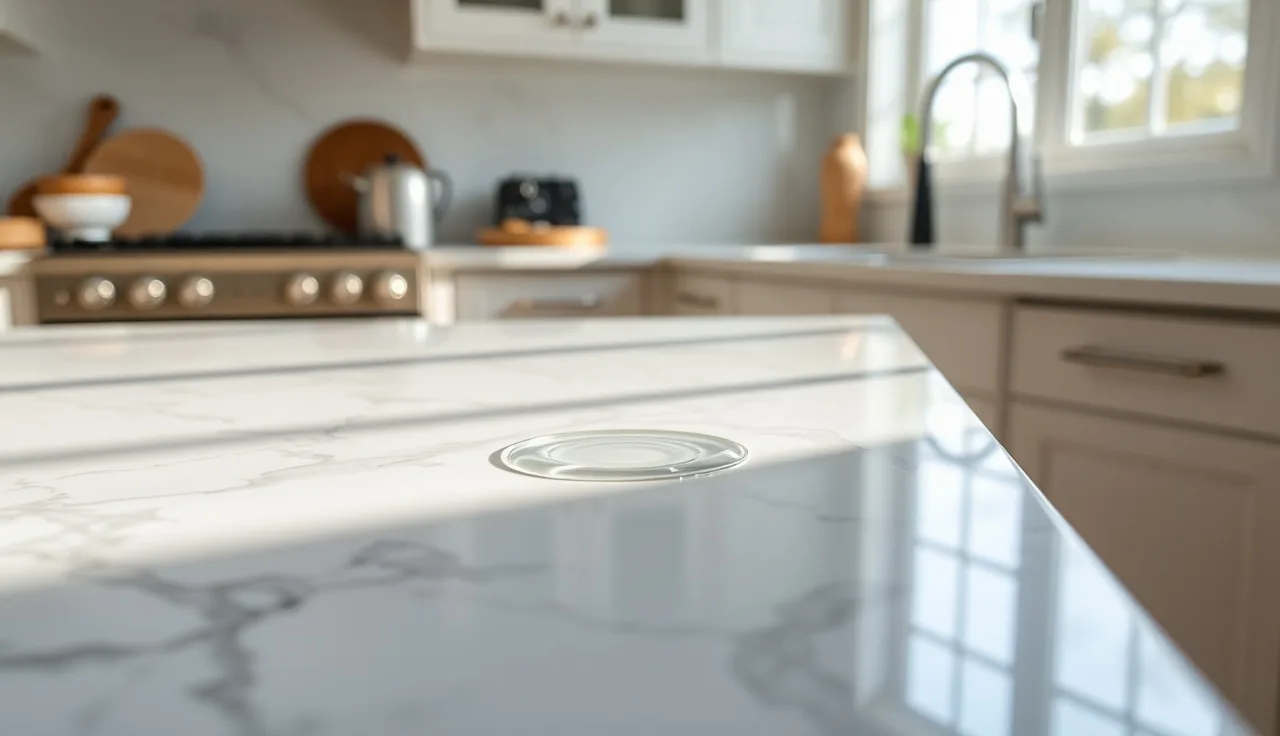
The water drop test is the standard field check, and it takes about five minutes [2]. Put roughly a tablespoon of water on the marble and watch it for 10 to 15 minutes. If the water beads and stays beaded, the sealer is still working. If the water darkens the stone as it soaks in, the stone is open and needs sealing.
Most stone industry guidance treats this as the main indicator, and it beats any calendar.
Run an oil test too, with a little mineral oil or cooking oil, because some stones shed water but drink oil. Leave a few drops for 10 minutes, wipe clean, check for darkening.
A counter that's never been sealed, fresh from the fabricator, almost always shows absorption. Most marble straight off the line either hasn't been sealed or got a quick factory coat that's really just temporary protection. Ask your fabricator at install whether they sealed it and which product they used.
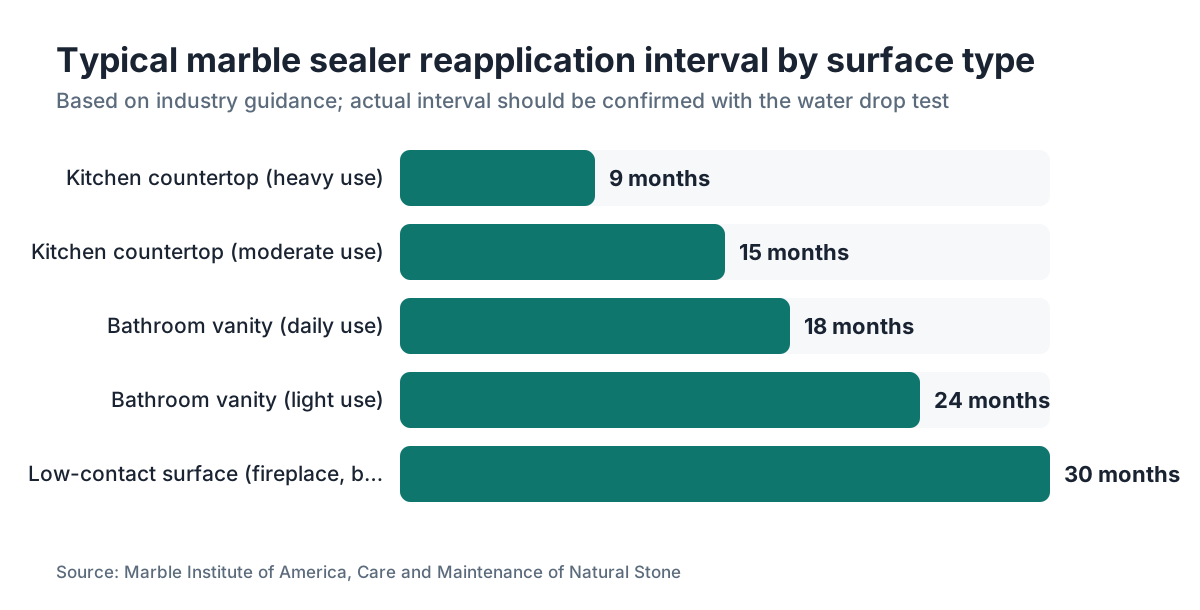
The test also tells you when to reseal. Don't go by the date on your calendar. Test first. Marble in a quiet guest bathroom might still pass after two years. The same slab in a busy kitchen can fail in six months.
How often should you reseal marble countertops?
It depends, and the water drop test is a better guide than any fixed schedule. That's the honest answer. For a starting range, most fabricators and stone care manufacturers say test kitchen counters every 6 to 12 months and reseal when the test shows absorption [2]. For bathroom vanity tops, 12 to 24 months is common.
Several things push you toward the short end. Heavy cooking means more oil and steam. Harsh cleaners, anything acidic or alkaline including a lot of general kitchen sprays, break down sealer over time. Abrasive scrubbing physically pulls sealer out of the pores near the surface. Cutting boards and trivets stretch sealer life. Using the counter as a cutting board wrecks it.
The brand matters too. A fluoropolymer penetrating sealer from a major stone care maker might claim a 10 to 15 year protection period under ideal conditions. Real kitchens aren't ideal. Most stone care pros put realistic life at 1 to 3 years for kitchen marble no matter what the label says.
Resealing is not a big job. One countertop takes under an hour including dry time. A quality sealer runs $20 to $60 a bottle and covers multiple applications on a typical kitchen. There's no reason to stretch the interval trying to squeeze the last penny out of a bottle.
How do you apply marble countertop sealer correctly?
The steps are simple, but a few details separate a sealer that works from one that hazes and peels off the top.
Step 1: Clean thoroughly. The surface has to be free of grease, wax, old sealer residue, and cleaner film. Use a pH-neutral stone-safe cleaner. Anything acidic or alkaline can etch the marble or leave a film that blocks absorption. Let it dry completely. If you just wiped it down, give it at least an hour. Moisture in the pores blocks the sealer from getting in.
Step 2: Apply sparingly. Pour or spray a thin, even layer. Less is more. You want the stone to absorb what it can hold. Extra product sitting on top doesn't drive deeper. It just leaves a residue that hazes.
Step 3: Watch for absorption. On open marble, the stone often pulls the product in within 5 to 10 minutes and the wet patch shrinks as it soaks. Let the first coat sit for the time on the label (often 15 to 20 minutes).
Step 4: Wipe off the excess. Before the sealer dries on the surface, wipe away anything that didn't absorb. This is the step DIYers skip, and it's the cause of that hazy white film. Use a clean dry cloth. Work in sections on big counters so you're not chasing sealer that already dried.
Step 5: Second coat if needed. First-time sealing or very open stone benefits from a second coat 30 to 60 minutes after the first. Wipe off excess again.
Step 6: Cure time. Stay off the counter for at least 24 hours after the final coat. Full cure varies: some products claim 24 hours, others 48 to 72 for full chemical bonding. Water on the surface during that window can interfere.
Ventilation matters. Most penetrating sealers are solvent-based and the fumes are strong. Open windows, run a fan. If you're sensitive to VOCs, wear a real respirator, not a dust mask.
What are the best sealers for marble countertops right now?
There's no single universal winner. The market keeps shifting and lab conditions don't match your kitchen. But some product types perform well consistently, and a few specific products have solid track records with fabricators.
Here's how the main types stack up:
| Sealer type | Oil repellency | Water repellency | Durability | Avg. cost per application |
|---|---|---|---|---|
| Fluoropolymer penetrating | High | High | 1-3 years (kitchen) | $8-$20 |
| Siloxane penetrating | Low-medium | High | 1-2 years (kitchen) | $5-$12 |
| Silicone penetrating | Medium | High | 1-2 years (kitchen) | $4-$10 |
| Topical/coating | High (new) | High (new) | 3-6 months before wear | $10-$25 |
Cost per application assumes typical bottle coverage on a 30 to 40 square foot kitchen. Real cost depends on how open the stone is on the first coat.
Products fabricators recommend a lot include Tenax Hydrex (fluorocarbon-based), Miracle Sealants 511 Impregnator (easy to find at home improvement stores), and DryTreat STAIN-PROOF Original (an Australian product with a strong commercial track record and a 15-year manufacturer guarantee, though real kitchen life runs shorter). StoneTech BulletProof Sealer penetrates well on tight-pored stones like marble.
For kitchen marble specifically, the fluoropolymer penetrating products have the edge on oil repellency. For bathroom vanities and lower-use surfaces, a good siloxane product usually does the job and sidesteps the PFAS question.
Check the current formula every time. Several brands reformulated between 2022 and 2024 as PFAS scrutiny climbed, and performance shifted with some of those changes. The bottle on the shelf may not match a review written two years ago. ASTM International publishes a standard guide for evaluating sealer performance on dimension stone, including penetration depth and repellency, if you want to compare specs on solid ground [8].
Can you seal marble yourself or should you hire someone?
Sealing marble is a DIY job. You don't need professional tools or training. The real risks are leaving excess sealer on the surface (haze), applying to a dirty or wet surface (poor penetration), or using the wrong product for your stone.
Sealing for the first time after install? Read the directions, then test in a small hidden spot first. That confirms the product won't react oddly with your specific stone. Some marble has mineral inclusions or quarry treatments that can discolor.
So when do you hire out? A very large install, multiple connected surfaces, or marble with existing stains or etches you want fixed before sealing. A stone restoration company can clean, hone, and seal in one visit. Professional cleaning before sealing isn't required for routine maintenance, but it's worth considering if you've never done it or the stone has years of buildup.
Professional sealing on a typical kitchen counter runs roughly $100 to $300 depending on region and area, based on stone restoration contractor pricing. That's hard to justify for a routine reseal when a $30 bottle and an hour of your time gets the same result. For a full restoration (honing out etches, deep cleaning, then sealing), the pro route earns its keep.
If you're a fabricator quoting jobs with marble, building sealer application into your install workflow and tracking which sealers you stock is something a good quoting system should support. SlabWise lets fabricators attach material notes and recommended aftercare to quotes, so customers walk away with the right product info from day one.
What should you avoid putting on sealed marble countertops?
Even with a fresh coat of a good sealer, marble keeps its chemical weak spots. The sealer doesn't touch them.
Acids are the main concern. Lemon juice, lime juice, vinegar, tomato sauce, wine, and most salad dressings all carry acids that react with calcite and cause etching. The reaction is fast. A drop of lemon juice can etch polished marble in under a minute. Keep these off the surface, or wipe them the second they land. The sealer buys you no meaningful time here.
Alkaline cleaners do their damage slower, wearing the sealer down over time. Ammonia glass cleaners, bleach solutions, and many commercial degreasers are too harsh for sealed marble. Use a pH-neutral stone-specific cleaner for daily cleaning [3]. Plenty of multi-surface sprays that work fine on quartz or laminate will slowly strip the sealer off marble.
Heat is less of a chemical issue, but setting a hot pan directly on polished marble can cause thermal shock in some cases, and the fast temperature swing can stress the sealer bond right in that spot. Use a trivet.
Abrasive scrubbers (steel wool, rough pads, powder cleansers) physically strip sealer and scratch the surface. Even nylon scrubbers used regularly wear things down faster than you need. A soft cloth or soft sponge handles daily cleaning.
For how other natural stone surfaces compare, see our guide to how to clean stone countertops and the details on how to clean quartzite countertops, which runs into similar acid sensitivity.
How is sealing marble different from sealing other natural stones?
Marble and granite both take penetrating sealers, but their pore structures and chemistry differ enough that the approach isn't identical [4]. Marble is calcite. Granite is mostly silicate. That one fact changes almost everything about how they behave.
Granite is made largely of silicates (quartz, feldspar, mica), which don't react with acids. Granite porosity varies a lot. Some granites are dense enough that they barely need sealing, while others, like the popular absolute black stones, are actually basalt and absorb almost nothing. The water drop test still applies, but granite forgives acid exposure in a way marble never will.
Quartzite gets confused with marble because it looks similar, but it's silica-based and far more resistant to acid etching, though it still needs sealing for stain protection [5]. Choosing between marble and quartzite for a kitchen? Quartzite is the more forgiving stone by a wide margin.
Limestone and travertine are calcite-based like marble and just as vulnerable to acid etching. Same sealer approach, though travertine's open pores often need more product per square foot.
Soapstone needs no sealing at all. Its tight grain blocks liquid absorption, and mineral oil goes on to even out color, not to seal. See how to clean soapstone countertops for that different path.
Engineered quartz (like Cambria countertops) is non-porous and never needs sealing. That's one of the big practical wins of engineered stone over natural marble in a high-use kitchen.
How much does sealing marble countertops cost?
DIY sealing is cheap. A 24-ounce bottle of a quality penetrating sealer costs $20 to $60 at most home improvement stores and online, and that covers 50 to 200 square feet depending on how open the stone is. A standard kitchen install of 40 to 50 square feet uses a fraction of a bottle on a maintenance reseal, so per-application cost often lands at $10 to $20 or less.
Professional sealing alone (no restoration) typically runs $1 to $3 per square foot based on contractor pricing in U.S. markets, which puts a 40 square foot kitchen at $40 to $120. Some contractors set minimums of $150 to $200 for a service call.
Add restoration (honing, polishing, or removing stains before sealing) and you're looking at $5 to $15 per square foot or more, depending on the stone's condition and local labor rates.
Over the life of the countertop, sealing costs are small next to the stone itself. Marble installed runs $75 to $250 per square foot depending on material grade and region [6]. Spending $30 a year on sealer to protect a $5,000 countertop is easy math.
The real cost shows up when you don't seal, or seal badly: stains. Deep oil stains can sometimes come out with a poultice (a paste of an absorbent material and a solvent drawn into the stone over 24 to 48 hours), but old deep stains may be permanent. A pro can polish out etches, but repeated etching on polished marble eventually needs a full honing and re-polish.
For how marble fits the full range of surfaces, see marble countertops and kitchen countertops.
Does sealing affect the look of marble?
A properly applied penetrating sealer should be invisible on marble. Once it's fully absorbed and the excess is wiped away, you shouldn't be able to tell the stone was sealed. Color, sheen, and texture stay the same.
When appearance problems show up, they're almost always application errors. Sealer left sitting on the surface instead of wiped off dries into a hazy white or cloudy film. On polished marble, that's obvious and it looks bad. A sealer remover and more careful reapplication usually fixes it, but it's tedious.
Topical sealers are the category that actually changes appearance, sometimes on purpose. Color-enhancing sealers deepen the color, like how stone looks when it's wet. Some people love that effect on certain marbles. Others hate it. Test any color-enhancing product in a hidden spot before you commit.
For polished white marble like Carrara or Calacatta, use a standard impregnating sealer and apply it carefully. These stones show haze more clearly than dark ones. Take your time on the wipe-off.
Working with honed marble (matte finish) instead of polished? Same sealer types, but honed surfaces are more porous and may need more product on the first coat. Honed marble also shows oil stains more easily than polished, so sealing matters even more there.
What happens if you never seal marble countertops?
The stone won't fall apart. Unsealed marble is still marble. It doesn't crack or degrade from a lack of sealer. What changes is that staining gets much easier and much faster.
With no sealer, the pore network is wide open. A splash of red wine or coffee can absorb in seconds and leave a permanent stain if you don't wipe it right away. Cooking oil, butter, and greasy fingerprints leave marks that fight cleaning. Over time, unsealed kitchen marble tends to develop patchy discoloration from a run of small spills that never got cleaned up in time.
Etching happens regardless. Unsealed marble etches just as readily as sealed. Pair that with easy staining and unsealed kitchen marble looks worn and dirty within a few years.
Bathroom vanity marble without sealer does better, since the exposures are mostly water and soap, neither a heavy staining risk. But hard water rings and soap scum soak into unsealed marble and get harder to remove over time.
Marble in a low-contact spot, like a fireplace surround or a bathroom floor with mostly foot traffic, can reasonably go longer between sealings. A kitchen counter should never go more than a year without at least testing, and ideally resealing.
If marble's maintenance feels like more than you want to sign up for, engineered quartz is worth a look. Cambria countertops and similar products are non-porous, never need sealing, and resist acids better than marble. Still comparing? kitchen countertops has a broader material rundown.
What do fabricators need to know about marble sealing at installation?
If you fabricate stone, sealing is part of your install workflow whether you frame it that way or not. Customers assume their new countertop is ready to use. If it isn't sealed, or got only a temporary factory polish, the first coffee spill in week one becomes your phone call.
A few practices that pay off:
Apply a penetrating sealer at the shop before delivery, or on-site right after install. Run the water test before you leave. If the stone still absorbs, put down a second coat.
Write down what sealer you used and hand the customer aftercare instructions on paper. Verbal instructions get forgotten by dinner. A simple card that says "use this type of cleaner, reseal every 12 months with this type of product" heads off most post-install support calls.
For marble, make sure customers understand the acid etching limit before install, not after. Set that expectation before they pick the stone, or at least before delivery, and you avoid real conflict down the line. Customers who know they're buying a material that needs care stay happier with it long-term.
Managing several marble jobs and need to track which products went on which install, plus follow-up notes? Good fabrication software helps. SlabWise supports job-level notes and customer-facing documentation inside the quoting workflow, so aftercare communication becomes part of your standard process instead of an afterthought.
For broader install context, see countertop installation.
Frequently asked questions
How soon after installation can I seal new marble countertops?
You can seal immediately after installation, and you should. There's no cure time for marble the way there is for some other materials. The one requirement is a clean, dry surface before you apply. If the fabricator used water during cutting and polishing, let the stone sit 24 to 48 hours after install so residual moisture evaporates from the pores before you seal.
Can I use the same sealer on marble and granite?
Yes, most quality penetrating sealers work on both. But sealers made specifically for marble usually run a lower viscosity to get into marble's finer pores. A granite sealer applied to marble may not penetrate as deeply. Products labeled for all natural stone are generally fine for both. Always run a small test first to confirm no unexpected reaction.
Will sealing marble prevent acid etching?
No. Penetrating sealers do not prevent etching. Etching is a chemical reaction between acid and the calcite in the marble, and it happens at the surface no matter what's in the pores. The sealer sits inside the pore network, not on top. Only a physical barrier like a coating or laminate would block acid contact, and those aren't practical for marble countertops.
Is there a sealer that makes marble maintenance-free?
No product makes marble maintenance-free. Sealers cut staining risk and buy cleanup time, but they don't remove the need to wipe spills fast, avoid acids, and stick to pH-neutral cleaners. If you want minimal maintenance, engineered quartz (non-porous, no sealing) or a solid surface like Corian is a fundamentally different proposition than natural marble.
How do I remove sealer haze from marble?
Haze happens when excess sealer dries on the surface instead of getting wiped off. To remove it, apply a sealer stripper or remover (the same companies that make sealers make these) and follow the directions. On polished white marble, haze shows clearly and may need several passes. After stripping, let the surface dry fully, then reapply the sealer and wipe off excess before it dries.
What's the difference between a sealer and a marble polish?
A sealer is a liquid that absorbs into the pores to slow staining. A marble polish is a surface treatment, often a spray-and-buff product, that boosts sheen and adds a little surface protection but doesn't penetrate the stone in any meaningful way. Polish helps the marble look good between sealings but doesn't replace sealing. Some polish products also carry a sealer component, so check the label.
Can sealer change the color of my white marble?
A standard penetrating impregnating sealer applied correctly should not visibly change white marble. Color-enhancing sealers are built to deepen and saturate color, and they will affect white marble. Avoid color-enhancing products on white or light marble unless you've tested a hidden spot and like the result. Haze from poor application can also throw a white cast on darker marble.
Does honed marble need more sealing than polished marble?
Yes. Honed marble has a more open surface texture than polished, because polishing compacts the pores slightly. Honed surfaces absorb sealer faster and usually need more product on the first application. They also show oil stains more readily, since the matte surface gives less contrast to hide marks. Plan on more frequent testing and resealing for honed marble in kitchen use.
Are natural stone sealers safe for food preparation surfaces?
Most penetrating stone sealers are safe for incidental food contact once fully cured, typically 24 to 72 hours after application. Stone industry guidance says follow the manufacturer's cure time before food contact. Cutting directly on the sealed surface isn't recommended regardless of food safety, since it scores both the marble and the sealer. Always use a cutting board.
What cleaner should I use on sealed marble?
Use a pH-neutral cleaner made for natural stone, or a diluted dish soap solution. Avoid vinegar, lemon juice, bleach, ammonia, and general kitchen sprays, all acidic or alkaline enough to etch marble and break down sealer over time. Many stone care brands sell combination cleaner-and-maintainer products for daily use, which can stretch the life of the sealer between full reapplications.
How long does a marble sealer last?
In a kitchen with daily use, expect 1 to 2 years from a quality penetrating sealer under realistic conditions, regardless of label claims. Manufacturer claims of 10 to 15 years reflect ideal or commercial conditions. The most accurate answer: run the water drop test every 6 to 12 months and reseal when the stone starts absorbing. Actual lifespan depends on use intensity, cleaners, and the specific product.
Should I seal marble before or after grouting nearby tile?
If your marble counter sits next to tiled areas with grout work, let the grout cure fully (usually 24 to 72 hours minimum, check the grout maker's spec) before sealing the marble. Sealer applied while grout is still off-gassing can affect adhesion and color. Apply the marble sealer after all installation work is done and the surfaces are clean and dry.
Does sealing marble work on outdoor kitchen countertops?
Sealing outdoor marble is harder to keep up, because UV exposure and temperature swings break down many sealers faster, and rain or dew can interrupt curing. Marble itself is a poor choice outdoors in freeze-thaw climates, since water in the pores can expand and cause spalling. If you have outdoor marble, use a penetrating sealer with UV resistance stated on the label and plan to reseal more often than indoor marble.
Sources
- U.S. EPA, PFAS Regulations and Restrictions: EPA regulatory actions on per- and polyfluoroalkyl substances (PFAS) are affecting formulations of fluoropolymer-based stone sealers
- Marble Institute of America, Care and Maintenance of Natural Stone: The water drop absorption test and resealing frequency guidance for natural stone countertops
- Marble Institute of America, Care and Maintenance of Natural Stone: Recommendation to use pH-neutral cleaners on sealed natural stone to avoid degrading sealers
- USGS, National Minerals Information Center (dimension stone data): Compositional differences between granite (silicate-based) and marble (calcite-based) affecting their chemical properties and porosity
- U.S. Geological Survey: Quartzite is silica-based and substantially more resistant to acid etching than calcite-based marble
- National Kitchen and Bath Association: Marble slab countertop installed cost ranges of $75 to $250 per square foot depending on material grade and region
- ASTM International: ASTM standard guide for evaluating sealer performance on dimension stone including penetration depth and repellency
- U.S. Geological Survey, National Minerals Information Center: Marble and limestone are classified as dimension stone with calcite as the primary mineral component
- EPA, Safer Choice Program: EPA Safer Choice standards relevant to evaluating chemical safety of sealer ingredients including PFAS alternatives
Last updated 2026-07-10