TL;DR
- Lowe's countertops come in roughly 8 to 12 edge profiles depending on material.
- They range from a flat eased edge (usually free) up to a full bullnose or ogee (typically $10 to $30 per linear foot extra on stone).
- Laminate and in-stock slabs have fewer choices than custom-cut stone.
- The wrong profile costs you on safety, cleaning, and resale.
What edge profiles does Lowe's actually offer on countertops?
Lowe's edge options depend on the material you're ordering, and the gap between materials is big. Laminate post-form counters (the pre-made sections on the shelf) come with a built-in rolled front edge and a coved backsplash. The shape is baked into the manufacturing. You don't pick it.
Custom stone is a different story. Lowe's runs its installation program through third-party fabricators, and once you're ordering cut-to-order stone the list opens up. Most Lowe's stone programs carry 8 to 12 standard profiles. The exact lineup shifts by region and by which fabrication partner handles the job, but these show up almost everywhere:
- Eased (also called straight or square)
- Beveled (a 45-degree cut across the top corner)
- Half bullnose (one side rounded)
- Full bullnose (top and bottom rounded)
- Ogee (an S-curve profile)
- Dupont (a right-angle step with a small quarter-round at the bottom)
- Waterfall (a flat vertical drop, usually for dramatic island sides rather than the counter edge itself)
- Chiseled or rough edge (a natural raw stone break)
Some markets also carry a pencil edge, a cove edge, and a laminate or stacked profile where two layers of stone build a thicker-looking edge. [1]
Here's the honest caveat. The fabricator assigned to your job may not carry all of these. Before you plan your whole kitchen around an ogee, confirm availability with the installer at measure time, not at the register.
How much do edge profile upgrades cost at Lowe's?
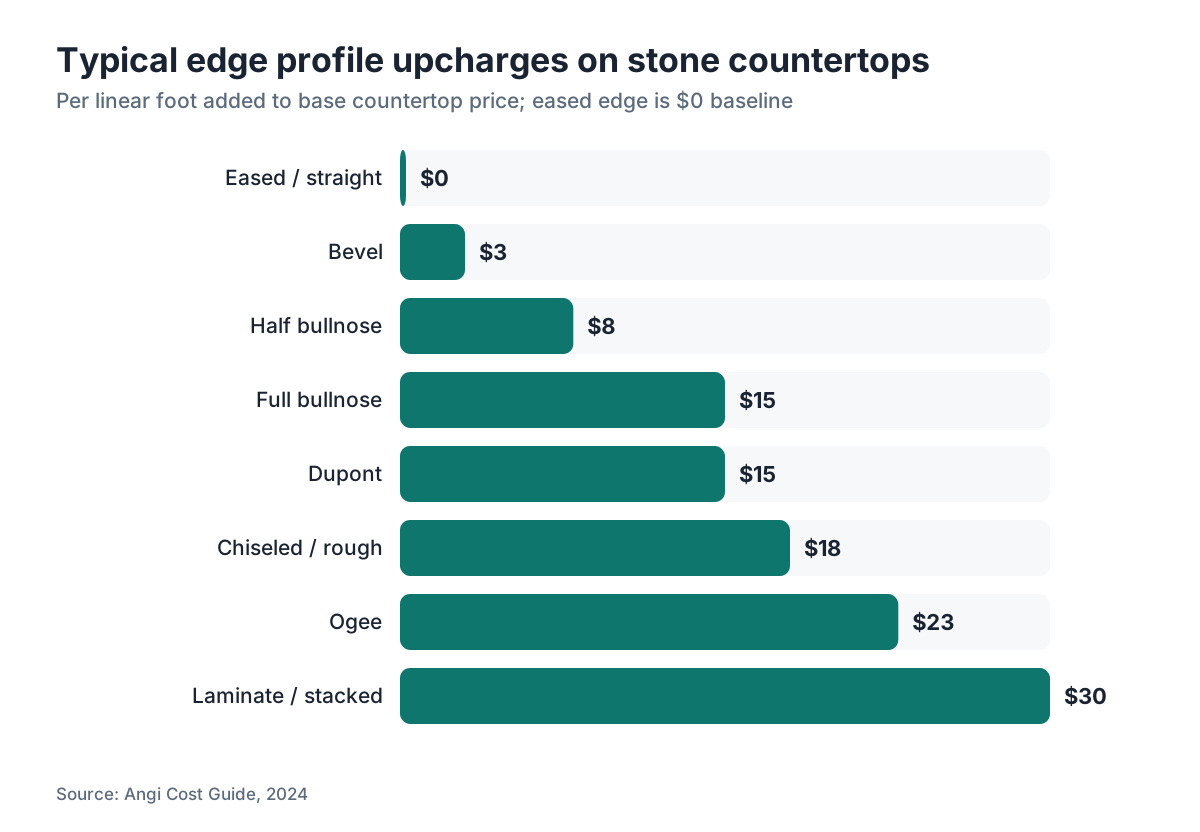
The eased edge is the baseline, and Lowe's includes it in the base square-footage price just like most fabricators. Everything fancier adds a per-linear-foot upcharge.
Expect roughly these ranges for custom stone counters ordered through Lowe's:
| Profile | Typical upcharge (per linear foot) |
|---|---|
| Eased / straight | $0 (included) |
| Bevel | $0, $5 |
| Half bullnose | $5, $10 |
| Full bullnose | $10, $20 |
| Ogee | $15, $30 |
| Dupont | $10, $20 |
| Chiseled / rough | $10, $25 |
| Laminate / double stacked | $20, $40 |
These numbers come from published fabricator price lists and contractor pricing guides, not a single authority, because Lowe's doesn't publish a national edge-price schedule. [2] Coastal markets run higher, the Midwest runs lower, and your actual quote will differ.
A typical kitchen has 25 to 40 linear feet of exposed edge. So an ogee upgrade at $20 per foot adds $500 to $800 to your total, sometimes more. That's real money. Most homeowners don't think about it until the final quote lands. Budget for it early.
Laminate countertops from Lowe's generally carry no edge upcharge because the profile is fixed. If you want something different on a laminate counter, you're looking at edge banding or a different product line entirely.
Which edge profile is best for a kitchen countertop?
There's no single right answer. There are wrong answers for specific situations.
Got young kids or elderly family at home? A sharp square edge or a full beveled edge is a bad call. Hip-height island corners are exactly where a toddler's head lands. A half or full bullnose rounds that off. CPSC injury data lists kitchen counter and cabinet corners as a documented source of lacerations and contusions, especially for young children. [3]
For a busy cooking kitchen where you lean on the counter all day, a square eased edge is comfortable and easy to clean. Ogee and dupont profiles collect crumbs and dried food in their recessed channels. Every baker I know eventually regrets an ogee.
For resale and broad appeal, the half bullnose is probably the most universally liked profile going. It reads as finished and traditional without being fussy.
For a modern or minimalist kitchen, an eased edge on a thick 3cm slab looks clean and deliberate. The waterfall-edge island trend is still strong as of 2025, though it piles on material and labor cost.
The chiseled or rough edge splits people. Some buyers love the organic look. Others read it as unfinished. If you're selling within five years, skip it.
For granite countertops, a simple eased or half bullnose shows off the stone better than a complicated profile, because the veining runs uninterrupted across a wider visible face.
What's the difference between a bullnose, ogee, and eased edge?
These three come up in almost every countertop conversation, and they really are different in both looks and function.
An eased edge is a 90-degree square edge with the top corner knocked back a hair (about 1/8 inch). It looks nearly square but won't slice your hand. It's the default for a reason. Simple, cheap, and it works in any kitchen.
A bullnose is a rounded edge. Half bullnose rounds only the top. Full bullnose rounds top and bottom into a continuous arc. The full bullnose was everywhere in the 1990s and early 2000s, and it's less common now, which can date a kitchen if you're aiming for something contemporary. It's still the right pick for a safety-conscious household.
An ogee is the most ornate profile Lowe's typically carries. Picture an S-shaped curve: a concave channel near the top flowing into a convex lower curve. It reads traditional or formal. In a Shaker or farmhouse kitchen it fits. In a flat-front modern kitchen it looks wrong. It costs the most and cleans the least easily.
The dupont (sometimes written DuPont) is a step profile. The flat top drops 90 degrees, then a small quarter-round or bevel brings it back in. You get visual thickness without the material cost of a true double-stacked edge.
Laminate countertops and Formica countertops skip most of these. Their manufacturing bonds the laminate sheet over the substrate at a fixed radius. Want a custom edge on laminate? You'd need wood edge banding or a PVC edge strip, which is a whole different product category.
Does the edge profile change the price of the whole countertop or just the edge?
Just the edge. The per-linear-foot upcharge applies only to the length of edge that gets profiled, not the full square footage of the stone.
Here's where people get confused. Not every edge gets profiled. In a standard kitchen, the exposed edges are the fronts of the counters and any sides facing open space, like an island end. The edges against the wall sit buried under a backsplash or against the cabinet face. You only pay for what shows.
So a 20-linear-foot exposed run at a $15 upgrade runs $300 total, on top of whatever the base stone costs.
If you're pricing through Lowe's installation program, the measure-and-quote step should break this out clearly. If it doesn't, ask. A quote that folds the edge upcharge into a per-square-foot price is harder to compare against other bids.
Fabricators who handle their own quoting, or who use software like SlabWise, usually itemize edge charges separately because the linear-footage math happens automatically during templating. That's cleaner for everyone.
One more thing. Inside corners and mitered joints can complicate the edge. Not every profile miters cleanly. An ogee at an inside corner takes extra hand work. [9] Ask before you commit.
What edge profiles are available for Lowe's laminate countertops specifically?
Post-form laminate countertops (the pre-cut sections Lowe's sells in 4-foot, 8-foot, and 10-foot lengths) come with one edge option: the post-formed rolled front edge with an integrated backsplash. That profile happens during sheet forming. You can't change it in the field without wrecking the piece. [7]
Want a different edge look on laminate? Two paths.
-
Square-edge laminate slabs. Some fabricators build a flat laminate top from separate substrate and laminate sheet, then wrap the edge with a wood, PVC, or aluminum band. It looks more contemporary than post-form and takes a wider range of edge shapes. Lowe's carries this category sometimes, but it's rarer in their in-store inventory than post-form.
-
Self-edge laminate. A strip of the same laminate glues onto a square-cut substrate edge. It looks thin and flat, which is popular in modern kitchens.
If your goal is a visible bullnose or ogee on a laminate top, here's the honest answer: that's not a laminate strength. The material doesn't machine like stone. You'd be better off with a different material or living with the post-form profile.
For Corian countertops and other solid-surface materials, the story flips. Solid surface routes into almost any profile because it machines like hardwood. Lowe's sold DuPont Corian for years, and those materials support real custom edge work.
Can you get a metal countertop edge profile through Lowe's?
Metal edge profiles are a separate product category. Lowe's sells aluminum and stainless edge trim strips (sometimes labeled tile edge trim or countertop edge molding) in the tile and flooring aisle. These are metal extrusions that clip or adhere to the exposed edge of a tile or concrete counter, giving a finished metal edge without machining the stone itself.
That's not the same as a metal countertop with a profiled edge. Want an actual stainless steel countertop with a formed bullnose or radius edge? That's custom sheet metal fabrication, and Lowe's doesn't do it. Restaurant supply companies and sheet metal shops handle that work.
The metal trim strips Lowe's does sell run roughly $3 to $8 per linear foot depending on gauge and finish. They work fine for tile projects and some DIY laminate rework. They won't fake the look of a machined stone profile, but they're a legitimate option for a tile countertop where you want a clean, durable exposed edge without grout.
For solid stone or quartz ordered through the Lowe's installation program, the edge gets machined into the stone. Metal trim never enters the picture.
How does Lowe's countertop edge process work from order to installation?
The process has more steps than most homeowners expect.
You start by picking a material and general style in the store or online. You pay a templating fee (Lowe's has charged anywhere from $35 to $100 for this historically, and it often gets applied toward the final purchase). A templating crew, working for the third-party fabricator in your region, comes to your home and makes an exact template of your cabinets using either a physical template board or a digital laser device. [4]
At the template appointment or right after, you confirm the edge profile. This is where you push for the specific profile name in writing. Different fabricators use different names. What Lowe's calls a "standard beveled" might differ slightly from what another shop calls the same thing. Ask to see a physical sample.
The fabricator cuts and finishes the stone, edge work included, then schedules installation. The full cycle from template to install runs 7 to 14 days for standard materials, longer for exotic stone or complex profiles. [5]
Want the whole picture beyond the edge? The countertop installation guide walks the full sequence.
Watch this one thing. Edge profiles lock in once the stone is cut. Change your mind after templating and you can eat a restocking or recutting charge. Pick the profile before the template appointment, not during it.
Which Lowe's edge profile holds up best over time?
Durability here is mostly about chipping and cleaning, not structural strength.
The eased edge is the most durable, and the reason is simple. The slight knock-off means the most vulnerable spot (the very corner of the stone) is already gone in a controlled way. There's no sharp stone edge waiting to chip.
The ogee and dupont profiles have a concave section, and if the stone takes a hard hit, the thin upper lip can fracture. On granite that's a real risk. On quartz, which flexes more than natural stone, it's less common but still happens.
The full bullnose is inherently strong because it has no thin sections. The rounded surface sheds impact instead of concentrating it at a corner.
For marble countertops, softer than granite (roughly 3 to 4 on the Mohs scale versus 6 to 7 for granite), edge chip risk climbs across every profile. [6] An eased or half bullnose is the practical choice.
Cleanability matters as much as chip resistance for long-term happiness. Grease and food debris collect in the ogee channel and the dupont step. If you cook every night and don't wipe down obsessively, those channels get grimy. Eased and bullnose edges wipe clean in one pass. Sounds like a small thing. After five years of cooking it isn't.
How do Lowe's edge profiles compare to what independent fabricators offer?
An independent stone shop usually offers more profiles than the Lowe's program, and they're more willing to do custom or combination work. A local fabricator might list 20 to 30 profiles, including specialty options like a cove-and-step, a triple pencil, or a waterfall-with-mitered-end, all of which need more hand time on the CNC and polishing wheel.
Lowe's runs a regionalized installation network where standardization drives quality control and pricing consistency. Fewer options means fewer ways for edge finishing to go sideways at scale.
For most kitchens, the 8 to 12 profiles Lowe's offers cover the huge majority of what homeowners actually want. The gap shows up when you have a specific vision: an unusual combination profile, a very thick slab (40mm or 50mm) needing special treatment, or a waterfall island end that demands precise mitering.
Pricing comparison is hard to generalize because fabricator pricing swings so much by market. [10] In some regions Lowe's is competitive with local shops once you count the convenience. In others, local fabricators undercut Lowe's on both material and edge work. Get at least two quotes.
Fabricators using modern quoting tools (including software that calculates edge linear footage automatically during estimating) tend to give tighter line-item breakdowns than handwritten quotes. Ask how the shop generates its numbers.
What edge profile should you choose for a bathroom vanity versus a kitchen island?
A bathroom vanity and a kitchen island have different needs.
On a vanity, the exposed edge is usually the front and maybe two short sides. Total linear footage is low, so the upcharge gap between profiles is small. You can afford to go decorative. An ogee on a small vanity runs maybe $60 to $100 extra and makes the space feel finished. Size cuts the other way on safety too: vanity corners sit at hip height for adults and face height for kids. A bullnose is the right call in a kids' bathroom.
On a kitchen island the math changes. An island might carry 12 to 16 linear feet of exposed edge across all four sides. An ogee at $20 per foot runs $240 to $320. More to the point, island edges take more daily contact. People lean on them, kids run into them, grocery bags land against them. The eased or half bullnose is more practical.
The waterfall edge (where the stone runs vertically down the island side to the floor or a base shelf) is a design statement, not a profile choice. It needs extra material and precise mitering. Figure $300 to $800 or more depending on island size. It looks great in the right kitchen and reads as trying too hard in the wrong one.
For a butcher block countertop, the edge gets cut with a router and the menu changes: roundover, chamfer, ogee, or table edge (a thick profile with a slight inward curve). Those are woodworking profiles, not stone profiles, and the cost structure is different.
Are there edge profiles Lowe's does not offer that you might want?
Yes, a few.
A waterfall island end with a 45-degree mitered joint (where the top slab and vertical side panel meet invisibly) is possible through Lowe's in some markets, not all. The miter has to be cut and matched on both pieces, and not every regional fabricator in the network is set up for it.
A honed or leathered finish paired with an eased edge is a combination some homeowners want: textured surface, simple profile. Lowe's offers honed on some stone options, but pairing it with a specific edge isn't always available as a package.
A stacked or mitered edge (where two or three layers of stone laminate together to fake a 6cm or even 9cm slab) shows up at specialty fabricators but rarely through the standard Lowe's installation program.
If any of these matter to you, weigh what Lowe's can actually deliver (get it in writing at the quote stage) against an independent shop. For a complex island, the independent shop may be your only realistic path.
For Cambria countertops specifically, Cambria publishes its own edge profile catalog, and authorized fabricators (some of them Lowe's program partners) work from that list. [8] If your Cambria dealer sits in the Lowe's network, ask for the Cambria edge brochure rather than assuming the general Lowe's list applies.
Frequently asked questions
Does Lowe's charge extra for edge profiles on quartz countertops?
Yes. The eased edge is included in the base price. Any other profile on a quartz countertop ordered through Lowe's installation program adds a per-linear-foot charge, typically $5 to $30 depending on the profile. Ogee and stacked profiles sit at the high end. Request a full itemized quote before signing.
What is the most popular edge profile at Lowe's?
The eased edge and the half bullnose together account for most countertop orders at most fabricators. Lowe's doesn't publish its own profile sales data, but industry fabricator surveys consistently show these two as the top choices, with ogee a distant third. The eased edge dominates modern and contemporary kitchens; the half bullnose dominates traditional ones.
Can I change my edge profile after the template is done?
In theory yes, in practice it's hard and may cost extra. Once the stone is cut and the edge is machined, changes mean recutting. If you catch it before cutting begins, a profile change is usually free or a small administrative fee. After cutting, you may face a recutting charge or have to accept the original profile. Confirm the profile in writing at the template appointment.
What is an eased edge on a countertop?
An eased edge is a square-cut stone edge with the very top corner knocked back slightly, removing about 1/8 inch at an angle to kill the razor-sharp corner. It's the standard default at Lowe's and most fabricators. It looks nearly square, cleans easily, and costs nothing extra. It's the right choice for modern and contemporary kitchens.
Does the edge profile affect how easy a countertop is to clean?
Yes, noticeably. Eased, beveled, and bullnose edges wipe clean in one pass. Ogee and dupont profiles have concave channels where grease, crumbs, and dried food collect. If you cook often, a complex profile means more scrubbing. This is one of the most practical reasons experienced kitchen owners pick simple profiles even when they can afford ornate ones.
What is a dupont edge on a countertop?
A dupont edge (sometimes called a DuPont edge) is a step profile. The stone surface drops 90 degrees at the front, then a small quarter-round or bevel curves back in at the bottom. It creates the look of a thicker slab without the material cost of a stacked or laminated edge. It's a popular choice for traditional kitchens and usually sits mid-range on upcharge cost.
Are Lowe's edge profiles different from Home Depot edge profiles?
Mostly no. Both retailers use regional third-party fabricators, and those fabricators tend to offer similar lineups because they run similar CNC tooling. Naming conventions vary slightly (one calls it a 'standard bevel,' the other a 'medium bevel'), and the specific upcharge amounts differ. The underlying physical profiles are largely the same. Always ask for a sample before committing.
Can you get a waterfall edge through Lowe's countertop installation program?
In some markets yes, but it's not universally available through the standard Lowe's program. A waterfall edge needs a precisely mitered joint where the countertop meets the vertical side panel. Not every regional fabricator in the Lowe's network is equipped for it. Ask directly at the quote stage, and get written confirmation that the waterfall option exists in your area before planning your island around it.
How many linear feet of edge does a typical kitchen countertop have?
A typical U-shaped or L-shaped kitchen has 25 to 40 linear feet of exposed edge (the fronts and any open sides). An island adds another 10 to 16 linear feet. Only exposed edges get profiled and charged for. Edges against walls or backsplashes are cut square and never seen. Knowing your linear footage lets you estimate edge upcharge costs before the quote arrives.
What edge profile works best for a white quartz countertop?
An eased or half bullnose works well on white quartz and keeps the look clean without fighting the surface color. A full bullnose on white quartz can look dated depending on the cabinet style. Ogee on white quartz reads formal and fits a traditional kitchen. The safest choice for broad appeal and easy resale is the eased or half bullnose.
Do edge profiles affect countertop installation time?
Not the installation day itself, but they change the fabrication time. An ogee or complex dupont takes more CNC and hand-polishing time at the shop than an eased edge. That can stretch lead time by a day or two on busy weeks. Simpler profiles mean faster turnaround from template to install, which matters if you're working against a remodel deadline.
Is a beveled edge the same as an eased edge?
No. An eased edge removes a tiny amount of material at the top corner (about 1/8 inch) to prevent a knife edge. A beveled edge takes a more aggressive 45-degree cut across the top corner, creating a visible diagonal face. Both look roughly square from a distance, but the bevel is more pronounced and deliberate. Bevel is standard or a small upcharge; eased is always included.
Sources
- Natural Stone Institute (formerly Marble Institute of America), Natural Stone Countertop Guide: Standard countertop edge profiles offered by stone fabricators include eased, beveled, bullnose, ogee, dupont, and chiseled styles
- Angi, Countertop Installation Cost Guide: Edge profile upcharges on stone countertops typically range from $0 for a standard eased edge to $30 or more per linear foot for complex profiles like ogee
- U.S. Consumer Product Safety Commission, Home Safety Products and Injury Data: Kitchen counter and cabinet corners are a documented source of lacerations and contusions, particularly for young children
- National Kitchen and Bath Association (NKBA), Kitchen Planning Guidelines: Countertop projects begin with an in-home template of the cabinets, made with a physical template board or a digital laser templating device
- National Kitchen and Bath Association (NKBA), Kitchen Planning Guidelines: Typical countertop fabrication and installation cycle from template to install is 7 to 14 days for standard materials and profiles
- U.S. Geological Survey, Mineral Hardness and the Mohs Scale: Marble typically rates 3 to 4 on the Mohs hardness scale; granite rates 6 to 7, making marble more susceptible to edge chipping
- Angi, Laminate Countertop Cost and Options: Post-form laminate countertops have a fixed rolled edge profile built into manufacturing; custom profiles require square-edge laminate fabrication
- Cambria, Edge Profile Collection: Cambria as a quartz manufacturer publishes its own authorized edge profile catalog which authorized fabricators use
- Natural Stone Institute, Dimension Stone Design Manual: Inside corner ogee profiles require additional hand-finishing work because CNC tooling cannot complete the full curve at an inside junction
- U.S. Bureau of Labor Statistics, Producer Price Index: Regional variation in stone countertop fabrication labor costs contributes to significant geographic price differences in edge profile upcharges
Last updated 2026-07-09