TL;DR
- A kitchen island countertop usually costs $300 to $5,000 or more installed, depending on material and size.
- Quartz and granite are the most common picks.
- Standard island tops run 36 inches deep with a 12-inch seating overhang.
- Material choice drives 60 to 70% of the final price.
- This guide covers every option, what installers actually charge, and what to skip.
What is a kitchen island countertop and how is it different from a perimeter countertop?
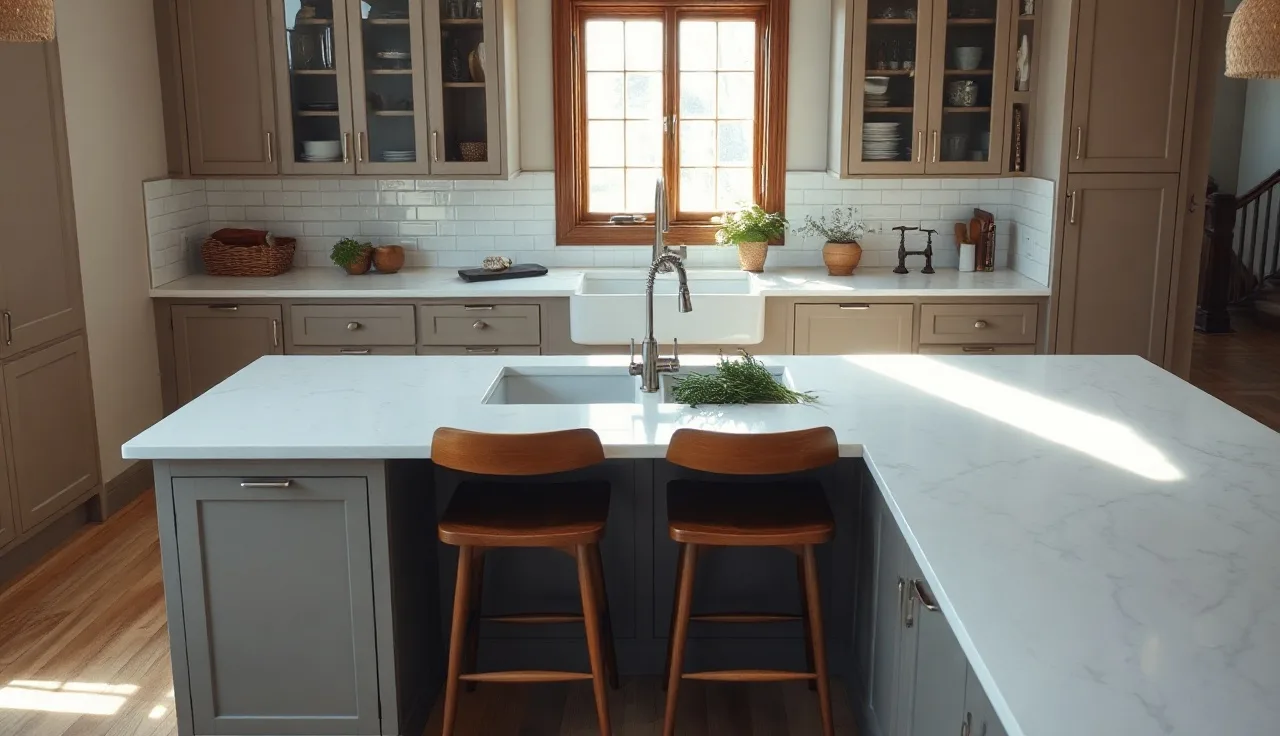
A kitchen island countertop sits on a freestanding or semi-freestanding cabinet base in the middle of the room, not along a wall. That one difference changes almost everything about how it gets fabricated, supported, and finished.
Perimeter countertops usually have one exposed edge (the front) and three sides that land against walls or appliances. An island top has four exposed edges, and at least one of them needs a finished edge profile. That means more edge-finishing labor and more linear feet of polished edge priced into your quote.
Islands also get cantilevered on one or more sides to make room for seating. That overhang creates a load the material itself has to carry, which matters a lot for thin or brittle stones. A 3/4-inch laminate can flex and crack when someone leans on an unsupported 18-inch overhang. Three-centimeter granite or quartz shrugs it off.
An island is a visual centerpiece, so fabricators spend more time on layout. If the slab has dramatic veining, they may book-match slabs or aim the pattern in a particular direction. You're buying something people walk around and stare at, not something they lean against while the stove does its thing.
What are the most popular kitchen island countertop materials?
Quartz and granite together account for roughly 60% of all residential countertop installations in the U.S., and quartz has pulled ahead over the last decade [1]. For islands the order shifts a little, because islands get more scrutiny and more social contact.
Quartz (engineered stone) is the most common island pick right now. It's non-porous so it never needs sealing, it comes in consistent patterns that make large islands easier to match across slabs, and it's hard enough that normal kitchen use won't scratch it. The catch: it's not heat-proof. A hot pan set straight on quartz can discolor the resin binders. Material plus fabrication typically runs $70 to $150 per square foot installed [2].
Granite is still the top choice for people who want a natural stone look and don't want to think about upkeep beyond an annual seal. Granite is harder than quartz in many cases, fully heat-resistant, and every slab is unique. The downside is variation. If your island needs two slabs, matching them is harder than with engineered stone. Installed granite typically runs $60 to $130 per square foot [2]. More detail on granite countertops.
Marble is gorgeous on islands if the kitchen is more of a show space than a workhorse. Marble etches from acids (lemon juice, wine, vinegar) and scratches from metal utensils. If your island is where you actually chop and cook, marble shows it fast. Installed marble runs $75 to $250 per square foot depending on how rare the stone is [2].
Quartzite gets confused with quartz constantly, but quartzite is a metamorphic natural stone, not an engineered product. It's harder than marble and more acid-resistant, but it still needs sealing and can cost as much as rare marble. Worth knowing before your fabricator quotes you.
Butcher block is the single best choice for islands that work as prep stations. The wood is easy on knife edges, renewable (you sand and re-oil it), and warm in a way stone never is. It scratches, stains, and needs regular oiling. Installed cost runs roughly $40 to $100 per square foot [3]. Full breakdown at butcher block countertops.
Laminate is badly underrated. Modern laminate from brands like Formica can mimic stone convincingly, installs cheap (often $15 to $40 per square foot installed), and is easy to swap out if you remodel again in 10 years [4]. It chips at the edges and can't be refinished, but if budget is the main constraint, it's a real option, not a consolation prize. See laminate countertops and Formica countertops for a closer look.
Stainless steel shows up in high-end kitchens and is genuinely practical. Non-porous, heat-resistant, hard to kill. It scratches (some people love the patina), shows fingerprints all day, and the look splits people hard. Installed cost runs $75 to $150 per square foot for a kitchen-grade gauge [5].
Concrete allows custom shapes, integral sinks, and embedded objects. It also cracks, needs sealing, and lives or dies on the skill of whoever pours it. A bad concrete top is a mess you own. Installed cost runs $65 to $135 per square foot.
How much does a kitchen island countertop cost?
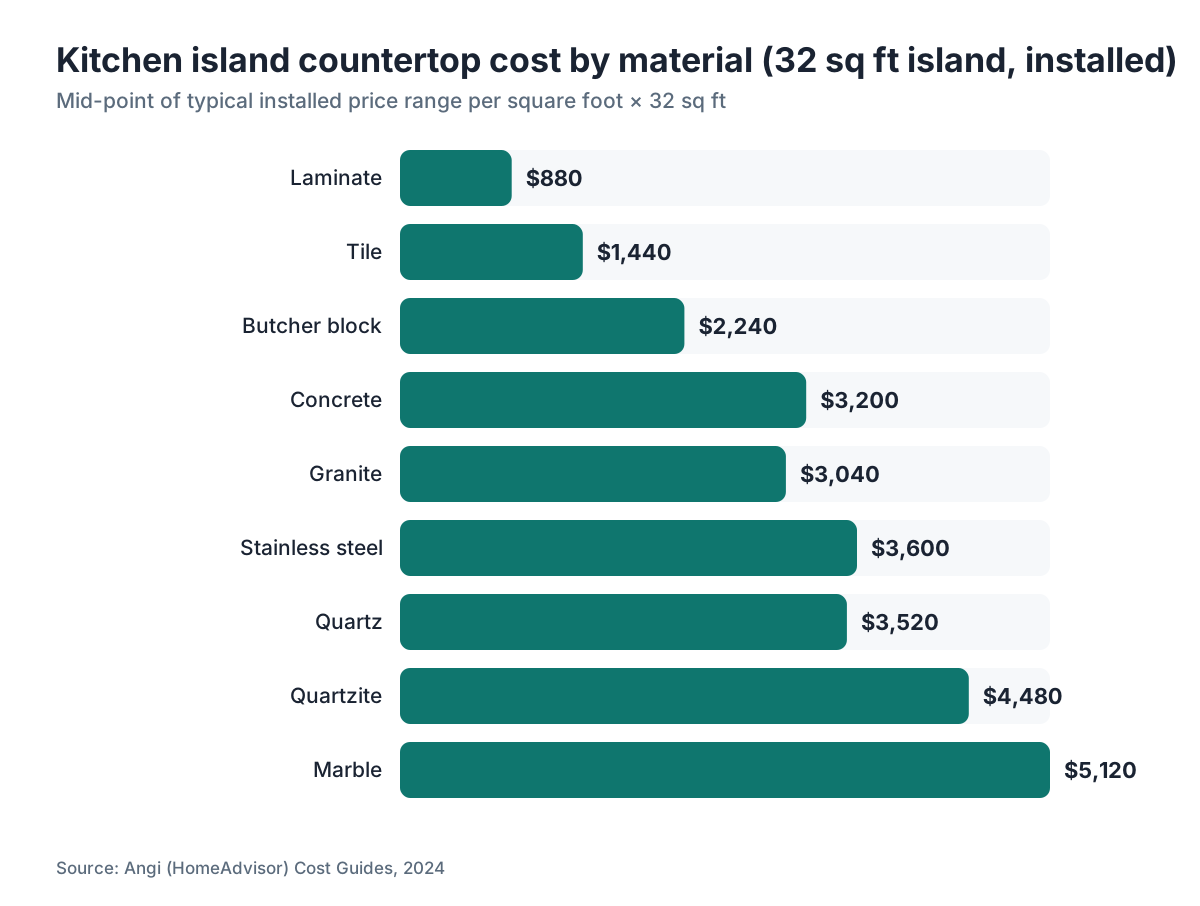
Total installed cost comes down to three things: material price per square foot, the square footage of your island top, and the extras (edge profiles, cutouts for sinks or cooktops, seams, and delivery).
A typical kitchen island runs 24 to 48 square feet of surface. A 4-foot by 8-foot island is 32 square feet, which is a fine planning number.
| Material | Typical installed cost per sq ft | 32 sq ft island estimate |
|---|---|---|
| Laminate | $15, $40 | $480, $1,280 |
| Butcher block | $40, $100 | $1,280, $3,200 |
| Tile | $25, $65 | $800, $2,080 |
| Granite | $60, $130 | $1,920, $4,160 |
| Quartz | $70, $150 | $2,240, $4,800 |
| Marble | $75, $250 | $2,400, $8,000 |
| Quartzite | $80, $200 | $2,560, $6,400 |
| Concrete | $65, $135 | $2,080, $4,320 |
| Stainless steel | $75, $150 | $2,400, $4,800 |
Those ranges are wide for a reason. A 2-cm quartz slab from a builder-grade supplier in a market with competitive fabricators lands at the bottom. A 3-cm exotic-veined quartz from a premium brand, with a waterfall edge, a farmhouse sink cutout, and a seam through the middle, lands well above the top.
Edge profiles add cost. A standard eased edge is usually included in the base price. A mitered waterfall edge (where the slab wraps down the side of the island) can add $500 to $1,500 just for the edge work, depending on linear feet and material [5].
Sink and cooktop cutouts usually run $100 to $300 each. If you put a cooktop on your island, budget for both the cutout and the extra structural support that may need to go under the stone.
For fabricators building quotes: island work is more complicated (four finished edges, possible seams, pattern matching), and that usually earns a shop-time premium over a simple wall run. Tools like SlabWise handle the nesting and quoting for islands with multiple edge profiles, so you're not hand-calculating edge linear footage and cutout pricing separately.
What size should a kitchen island countertop be?
Standard island depth (front to back) is 24 to 36 inches. If your island doubles as a breakfast bar, you almost always want 36 inches so you get 12 to 15 inches of clear counter on the working side plus a 12-inch overhang on the seating side. That's the minimum comfortable knee clearance for standard stools at counter height.
For counter-height seating (about 36 inches), stools need 9 to 12 inches of overhang. For bar-height seating (42 inches), you want 12 inches or more [6].
Length depends on the kitchen, but the rule holds: an island needs at least 42 to 48 inches of clearance on every walkable side. The National Kitchen and Bath Association recommends 42 to 48 inches for comfort and safe traffic flow [6]. Measure your rough opening before you fall in love with a dimension.
Thickness matters too. Most stone comes in 2 cm (about 3/4 inch) or 3 cm (about 1.2 inches). For islands, 3 cm is standard. It looks more substantial from the seating side, has more strength for unsupported overhangs, and usually skips the full plywood substrate under the stone. Some fabricators use 2-cm stone with a laminated edge build-up to fake the 3-cm profile, which saves money on exotic stones.
Overhang limits without support: Natural Stone Institute (formerly the Marble Institute of America) guidance suggests 3-cm granite or quartz can cantilever unsupported up to about 10 to 12 inches. Past that, add corbels or brackets [7]. Want a 15-inch or 18-inch seating overhang? Plan for corbels or a furniture-style leg.
What edge profile should I choose for an island countertop?
Edge profiles matter more on islands than on perimeter runs because every side is visible. Here are the common options and where they actually make sense.
Eased edge (a slight softening of the 90-degree corner) is the default. Clean, modern, cheap, and safe for kitchens with kids because there's no sharp point. Most fabricators include it in the base quote.
Bullnose (fully rounded top and bottom) looks traditional and shrugs off chips. It also reads dated to some buyers. Your call.
Ogee has an S-curve profile that looks formal and classical. Great on thick stone, fussy on thin stone. Not the move for a contemporary kitchen.
Bevel (a 45-degree cut across the top corner) is clean and geometric, sitting between an eased edge and a full mitered look. Chips a little more easily on softer stones.
Waterfall edge isn't really an edge profile, it's a design choice: the countertop wraps 90 degrees down the side of the cabinet in one continuous stone panel. It needs a mitered joint (two pieces cut at 45 degrees and glued into a right angle), careful vein matching if you care about the look, and a lot more stone and labor. Stunning done right, expensive to fix done wrong. Budget $800 to $2,000 for a single waterfall side on a typical island.
For seating overhangs, a slightly thicker or more pronounced profile (a 1.5 cm eased edge or a small bevel) at the overhang edge makes the stone look more finished from the seat below.
Can I put a sink or cooktop in my kitchen island countertop?
Yes, and it's common. There are practical and structural things to know before you commit.
Sinks in islands need drain and supply lines run under the floor or through the cabinet base. That's plumbing you budget separately, often $500 to $2,000 depending on how far the lines run from the main stack [8]. The sink cutout itself adds $100 to $250 to the stone fabrication. Undermount sinks (mounted below the countertop surface) need a finished edge on the cutout opening, which takes more fabrication time.
Cooktops in islands add ventilation headaches. A wall-mounted range hood won't work over an island, so you need either a ceiling-mounted hood (ductwork through the ceiling) or a downdraft system built into the cooktop or counter. Ceiling hoods often run $1,000 to $5,000 installed for the hood alone, plus duct rough-in [8]. The cooktop cutout in the stone is typically $150 to $250 for the fabrication cut.
Structurally, cooktops don't push enough heat through the bottom to hurt stone in normal use. But if you run a wok burner or a high-output pro gas cooktop, the sides of the cutout can get hot. Stone handles that fine. Laminate does not.
Putting both a sink and a cooktop on one island? Work with your fabricator to place any seam away from both cutouts. A seam running through a cutout area is a structural weak point and looks bad.
How do I care for and clean a kitchen island countertop?
The answer depends entirely on the material, and this is where people burn money by treating all stone the same.
For natural stone (granite, marble, quartzite, soapstone), sealing is the baseline. Most granite should be sealed annually or every few years depending on the stone's porosity, and denser slabs need it less often [9]. Marble and quartzite are more porous and generally need sealing more often. A water-drop test tells you when: if water beads, you're fine. If it soaks in within a few minutes, reseal.
For daily cleaning, mild dish soap and water works on nearly every surface. Skip acidic cleaners (vinegar, lemon-based sprays) on marble and limestone, which etch chemically. Skip abrasive scrubbers on polished surfaces. On quartz, avoid bleach and highly alkaline cleaners, which break down the resin over time.
For more specific stone care, see how to clean stone countertops, how to clean quartzite countertops, and how to clean soapstone countertops.
Butcher block needs the most active care. Sand out deep cuts with 80-grit then 120-grit. Re-oil with food-safe mineral oil every few months or whenever the wood looks dry. Keep standing water off the surface. It raises the grain and eventually warps or cracks the seams.
Laminate and Corian (solid surface) are the lowest-maintenance options. Laminate can't be sanded or refinished but handles ordinary cleaning fine. Solid surface like Corian countertops can be buffed to remove light scratches, which is a real advantage.
What are the best kitchen island countertop ideas for different kitchen styles?
Style matching is partly taste, but some pairings work and some reliably fight each other.
Modern and contemporary kitchens pair well with matte or honed quartz (the low-sheen surface suits flat-front cabinets), concrete, or stainless steel. Waterfall edges in quartz or marble fit this style especially well.
Traditional and transitional kitchens usually look right with polished granite, marble with ogee or bullnose edges, or a thick butcher block top on turned legs. A contrast island (a different color or material than the perimeter) works well here: picture a dark soapstone island against white perimeter quartz.
Farmhouse and cottage kitchens lean toward butcher block, honed or leathered granite, or soapstone. Soapstone has a matte, almost chalky look with a slight blue-gray warmth that photographs beautifully in that context. See how to clean soapstone countertops if that material appeals.
Budget renovations can still look deliberate. A bold-patterned laminate island over a painted cabinet base reads as a design choice, not a cost cut, if the execution is clean. Formica's laminate lines now include convincing stone looks that hold up fine for islands under normal use.
Two-material islands keep getting more common: stone perimeter for cooking and prep, a butcher block section at one end for a built-in cutting board. This needs a seam between two different materials, which has to be planned at the cabinet level (usually a separate base section) and accounted for in the template and install.
For a broader material overview that covers the perimeter too, kitchen countertops lays out the full landscape.
What mistakes do homeowners most often make with island countertops?
The mistakes that cost the most pain and money aren't about material choice. They're about process.
Ordering before templating. A surprising number of homeowners (and some contractors) try to measure and order countertops before the island base cabinet is physically set and leveled. Fabricators template after the base is in place for a reason: cabinets are almost never perfectly square or level, and a template captures the real field dimensions. Order early and you're betting your cabinets arrive exactly as planned. They won't.
Forgetting the seam in the quote. If your island needs two slabs (anything over about 10 feet long, or sometimes triggered by slab width limits around 63 inches), there will be a seam. Where it lands matters. Demand a layout drawing, or at least ask exactly where the seam falls before you approve the fabrication.
Underestimating the overhang. Twelve inches is the minimum for comfortable knee clearance at counter height. Plenty of homeowners spec 9 or 10 inches to save stone, then find the seating cramped. The cost difference between 10 and 15 inches is usually minor (you're already buying the slab to size). The comfort difference is not.
Choosing material for photos, not for use. Honed white marble looks incredible in magazine spreads. It also etches from a single splash of orange juice. If your island is the real prep and cooking center, choose for how you cook, not how you want the kitchen to photograph.
Ignoring structural support for long overhangs. Stone cracking at a support point is expensive and ugly. Want an overhang over 12 inches in stone? Ask your fabricator what support method they recommend and get it in the plan before install day.
Skimping on the seating-side edge finish. The underside of the seating overhang is at eye level for anyone sitting there. A rough, unfinished stone edge bottom is immediately obvious. Specify a polished or eased underside on overhang edges, and confirm it's in the scope.
How is a kitchen island countertop installed, and what should I expect on install day?
Stone installation for an island follows a set sequence. Knowing it helps you coordinate with your contractor and dodge delays.
Template day comes first, usually after the island cabinet base is set, leveled, and secured to the floor. The fabricator measures the actual top (and sometimes the legs or panel faces if a waterfall is planned), then builds either a physical template of cardboard or luan or a digital scan with a laser system. Template-to-install turnaround runs 5 to 10 business days for most shops, longer during busy seasons [10].
Fabrication happens at the shop. The slab gets cut, edges get profiled, cutouts get made, pieces get polished. For islands, the crew lays the pieces out on a worktable to confirm fit before loading them.
Install day for a typical island top takes 2 to 4 hours. Pieces get carried in (stone is heavy: 3-cm granite runs about 18 to 20 pounds per square foot [7]), set dry to check fit, then bedded in silicone on the cabinet tops. Seams get joined with color-matched epoxy and clamped. Undermount sink clips go in.
Expect the kitchen to be off-limits for 24 hours after install while the adhesive cures. The installers usually apply a first sealer coat. If they don't, ask why and when you should.
For a full walkthrough of the process, countertop installation is worth reading before you schedule.
Fabricators running several island jobs at once benefit from software that handles slab nesting efficiently. When you're cutting four finished edges and pulling a waterfall piece from the same slab, the layout puzzle matters. SlabWise automates the nesting for exactly these multi-piece, high-edge-count jobs.
Is a kitchen island countertop worth the investment?
From a resale angle, kitchen upgrades still return some of the higher percentages in remodeling ROI, though returns have cooled from their peak. Remodeling Magazine's 2024 Cost vs. Value Report found a midrange major kitchen remodel returned about 49.5% of cost at resale nationally, and an upscale major kitchen remodel returned about 38.7% [11]. The island countertop is one piece of that package. You can't isolate its ROI cleanly.
What the data does suggest: buyers in mid-range and above markets expect stone countertops. In a market where comparable homes have granite or quartz, showing up with laminate shrinks your buyer pool, even if the laminate works perfectly well.
From a use standpoint, a well-planned island top changes how the kitchen works every day. More prep space, more seating, and a room where people gather. That's real value that never shows up in a resale calculation.
The honest answer: if you're selling in two years, keep the island material mid-range (granite or builder-grade quartz) and spend the savings elsewhere. If you're staying 10 years, buy the material you actually want to live with, because that's what you'll be living with.
Frequently asked questions
What is the best material for a kitchen island countertop?
For most kitchens, quartz is the best all-around choice: non-porous, consistent in pattern across large islands, hard enough for daily use, and mid-range at $70 to $150 per square foot installed. If you want natural stone, granite is right behind it. If the island is mostly a prep station, butcher block is genuinely the best functional pick. There's no single right answer; it depends on how you cook and what you'll maintain.
How much overhang do I need for seating at a kitchen island?
For counter-height seating (36-inch island), allow 9 to 12 inches of overhang for comfortable knee clearance, with 12 inches being more comfortable. For bar-height seating (42-inch island), you typically want 12 inches or more. The National Kitchen and Bath Association recommends at least 12 inches of knee space for seating. Overhangs past 12 inches in stone generally need corbel or bracket support.
What thickness of countertop is best for a kitchen island?
Three-centimeter (roughly 1.2-inch) stone is standard for islands and the better call for most situations. It handles unsupported overhangs up to about 10 to 12 inches without extra support, looks more substantial from the seating side, and usually skips the plywood substrate. Two-centimeter stone costs less on exotic materials but needs full support and typically requires a laminated edge build-up to look proportional.
Can a kitchen island countertop have a seam?
Yes, and for large islands it's common. Slabs have size limits (often around 63 inches in one dimension), so any island wider or longer than that will likely need a seam. Seam quality depends on the fabricator's skill at matching color and pattern, the epoxy color match, and how tightly the pieces join. Ask your fabricator to show you the layout drawing so you can approve seam placement before fabrication starts.
What countertop material is easiest to maintain on a kitchen island?
Quartz and solid surface (like Corian) are the lowest-maintenance options. Both are non-porous, so they never need sealing, and neither reacts to common food acids. Laminate is equally easy to clean but can't be refinished if it chips. Natural stones (granite, marble, quartzite) need periodic sealing and more care around cleaners. Butcher block needs the most active upkeep: oiling and occasional sanding.
How long does it take to get a kitchen island countertop installed?
From template to installation, most shops take 5 to 10 business days. During busy seasons (spring and fall remodel peaks), some run 2 to 3 weeks out. Installation itself takes 2 to 4 hours for a typical island. Add 24 hours for adhesive cure before you use the surface. If the job includes an undermount sink, cooktop cutout, or waterfall edge, fabrication may run a few days longer.
What edge profile works best for a kitchen island with seating?
An eased edge (slightly softened 90-degree corner) is the most practical and most common for seating overhangs. It's comfortable to lean on, safe for kids, and clean-looking. A small bevel or a 1-centimeter eased profile also works well. Avoid sharp mitered edges on the seating side; they're uncomfortable to lean against. On the upper visible edges, you have more room to choose a decorative profile like an ogee or a waterfall.
Can I put a waterfall edge on any kitchen island countertop material?
Technically yes, but some materials suit it far better. Quartz, granite, and marble waterfall edges are common and look great when the vein or pattern is matched across the miter joint. Butcher block can do a waterfall, but the end grain at the miter is tricky to seal. Laminate can't do a true mitered waterfall; it needs a different edge construction. Concrete can do waterfall shapes but requires careful form work.
Do I need a special countertop for a kitchen island with a cooktop?
No special material is required, but avoid laminate or solid-surface materials right around a cooktop if you plan to set hot pans on the nearby surface. Stone (granite, quartz, quartzite) handles the ambient heat fine. The cooktop cutout itself is a standard fabrication step. You'll need to plan ventilation (a ceiling-mounted hood or downdraft system) separately, which is often a bigger cost and logistics challenge than the countertop.
How do I get an accurate price quote for a kitchen island countertop?
Measure your island base cabinet (length and width to the outside edges). Decide on overhang depth for each seating side. Note how many edge profiles you need (all four sides plus any seating overhang underside). List any cutouts (sink, cooktop). Take those numbers to at least two or three local fabricators and ask for itemized quotes showing material per square foot, edge linear footage, and cutout costs separately. That breakdown lets you compare apples to apples.
Is quartzite the same as quartz for an island countertop?
No, they're completely different materials. Quartzite is a natural metamorphic stone, quarried and cut like granite. Quartz (also called engineered stone) is a manufactured product made of about 90 to 95% ground quartz particles bound with resin. Quartzite needs sealing; quartz does not. Quartzite is typically more heat-resistant than engineered quartz. Both are durable island choices, but their care and pricing differ, and the naming confusion leads to real purchase mistakes.
What is a good size for a kitchen island countertop?
A useful working island needs at least 24 inches of depth (front to back) and 4 feet of length. If you want seating, 36 inches of depth fits a 12-inch overhang plus 24 inches of working surface. The National Kitchen and Bath Association recommends 42 to 48 inches of clearance on all walkable sides. Most designers consider 4 by 6 feet (24 sq ft of top) a practical minimum for an island that does real work.
Can I install a kitchen island countertop myself?
You can install laminate or butcher block yourself if you're comfortable with basic tools. Stone is different: 3-cm granite or quartz at 18 to 20 pounds per square foot means a 32-square-foot top weighs 575 to 640 pounds, before you factor in the pieces being awkward and breakable. Fabricators almost universally recommend professional installation, and most will void the fabrication warranty if the stone is damaged during a DIY attempt.
What's the difference between honed and polished finish for an island countertop?
Polished stone has a glossy, mirror-like surface that reflects light and shows color depth. Honed stone is matte or satin, softer-looking, and less reflective. On islands, honed finishes hide fingerprints and light scratches better in daily use. Polished finishes wipe clean more easily because the pores are more sealed from the polishing. On marble, honed forgives etching because the surface is already matte; etches on polished marble stand out sharply.
Sources
- Statista, U.S. countertop material market share data: Quartz and granite together account for roughly 60% of residential countertop installations in the U.S., with quartz growing in market share over the past decade.
- HomeAdvisor (Angi), Countertop Installation Cost Guide: Typical installed countertop costs by material: granite $60-$130/sq ft, quartz $70-$150/sq ft, marble $75-$250/sq ft.
- HomeAdvisor (Angi), Butcher Block Countertop Cost Guide: Butcher block countertops typically cost $40 to $100 per square foot installed.
- HomeAdvisor (Angi), Laminate Countertop Cost Guide: Laminate countertops typically cost $15 to $40 per square foot installed.
- HomeAdvisor (Angi), Stainless Steel Countertop Cost Guide: Stainless steel countertops run $75 to $150 per square foot installed; waterfall edge work adds $800 to $2,000 for a single island side.
- National Kitchen and Bath Association (NKBA), NKBA Kitchen Planning Guidelines: NKBA recommends at least 42 to 48 inches of clearance on all walkable sides of an island, and a minimum 12-inch knee space for seating at counter height.
- Natural Stone Institute (formerly Marble Institute of America), Technical Manuals: 3-cm granite or quartz can cantilever unsupported up to approximately 10 to 12 inches; longer overhangs require corbels or brackets. 3-cm granite weighs approximately 18 to 20 pounds per square foot.
- HomeAdvisor (Angi), Kitchen Plumbing Cost Guide: Running drain and supply lines to a kitchen island costs $500 to $2,000 depending on distance from the main stack; ceiling-mounted range hoods can run $1,000 to $5,000 installed.
- Natural Stone Institute, Care and Maintenance of Natural Stone: Most granite countertops should be sealed annually or every few years depending on porosity; denser granites may require less frequent sealing.
- Marble and Granite Inc., Countertop Fabrication Process Overview: Typical template-to-installation turnaround for stone countertops is 5 to 10 business days for most fabrication shops.
- Remodeling Magazine, 2024 Cost vs. Value Report: A midrange major kitchen remodel returned approximately 49.5% of cost at resale nationally in 2024; an upscale major kitchen remodel returned approximately 38.7%.
- U.S. Census Bureau, American Housing Survey: The American Housing Survey tracks kitchen remodeling and home improvement spending by U.S. households, showing kitchens among the most frequently remodeled rooms.
- U.S. Department of Housing and Urban Development (HUD), Rehab Guides: HUD guidance covers residential kitchen rehabilitation standards including cabinetry, countertop support, and installation practices.
- National Institute of Standards and Technology (NIST), Engineering Laboratory building materials research: NIST publishes materials research on stone and engineered surfaces including flexural strength and load behavior relevant to countertop cantilever limits.
Last updated 2026-07-09