TL;DR
- Kitchen countertop options range from laminate at $15-40 per square foot installed to exotic quartzite or marble above $150.
- The right pick depends on your budget, how hard you cook, and how much maintenance you'll actually do.
- Engineered quartz and granite cover the largest middle ground.
- Soapstone, butcher block, and concrete suit specific looks but each carries real trade-offs.
What are the main kitchen countertop options available today?
Three broad buckets: natural stone, engineered surfaces, and organic materials. Natural stone means granite, marble, quartzite, soapstone, and slate, each quarried and cut from the earth, each one unique. Engineered surfaces means quartz composites (brands like Silestone, Cambria, Caesarstone), solid surface (Corian and its competitors), and laminate. Organic materials means butcher block, stainless steel, concrete, and ceramic or porcelain tile.
Every one of these works as a countertop. The differences are appearance, how they react to heat and stains, what they cost fabricated and installed, and how much upkeep they need over the next decade. Nobody can hand you a single right answer without knowing those four things for your situation.
The US countertop market has grown a lot over the past decade. The National Kitchen and Bath Association reported in its 2023 Design Trends Study that quartz (engineered) was the most specified material in kitchen remodels, followed by granite, then laminate [1]. That ranking reflects value perception more than raw quality. Laminate is technically excellent in a kitchen with light use and a tight budget.
How much do different kitchen countertop materials cost?
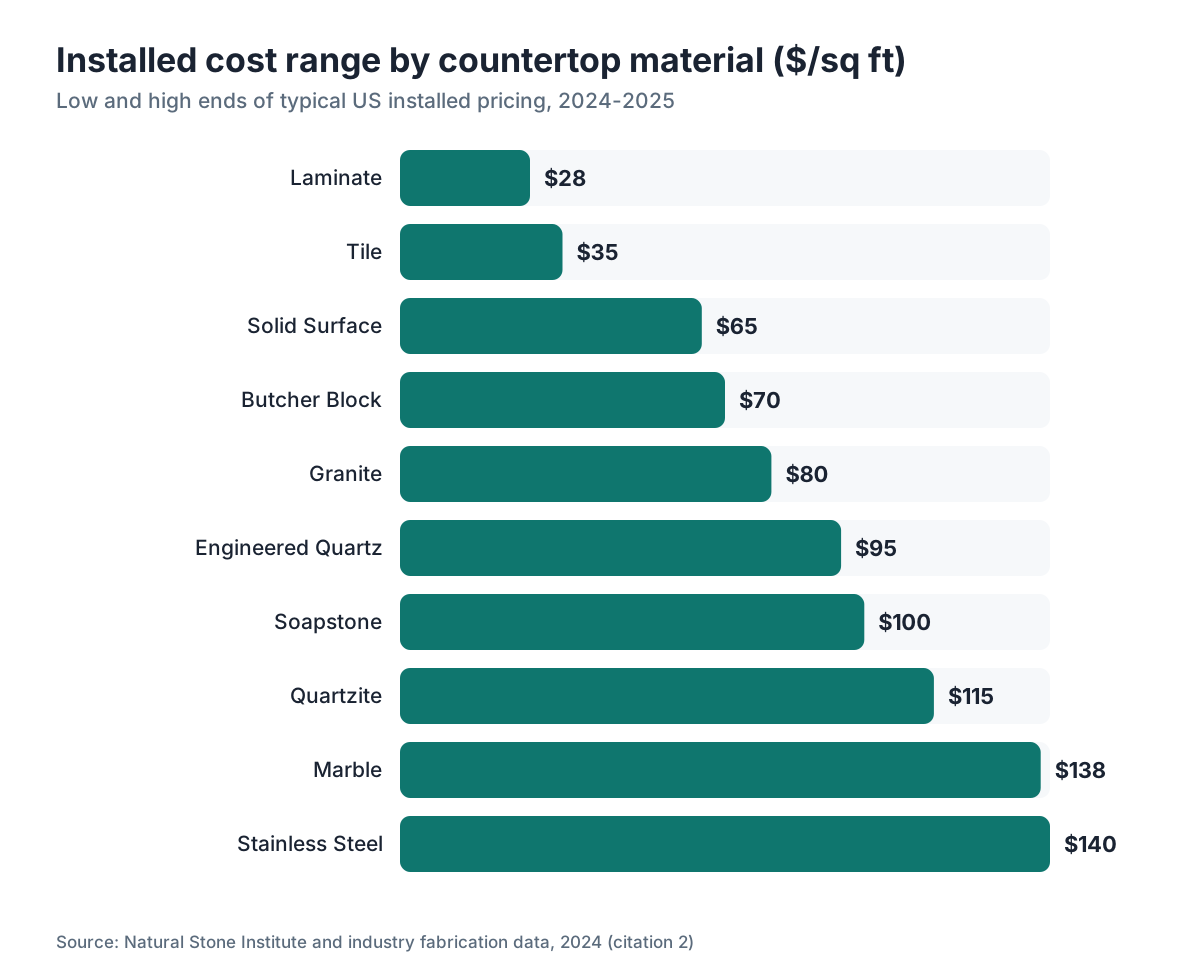
Installed cost per square foot is the number that matters, not material-only cost. Fabrication and installation often equal or beat the raw material price on stone.
Here are honest installed ranges based on typical US fabrication pricing for 2024-2025. The ranges are wide because regional labor, edge profiles, cutouts, and slab thickness all move the number [2].
| Material | Installed cost ($/sq ft) | Notes |
|---|---|---|
| Laminate (post-form or custom) | $15 - $40 | DIY-possible; cheap cutouts |
| Tile (ceramic/porcelain) | $20 - $50 | Grout lines are the real issue |
| Solid surface (Corian, etc.) | $45 - $85 | Sinks can be joined invisibly |
| Butcher block | $40 - $100 | DIY-possible; oil or seal |
| Engineered quartz | $60 - $130 | Most popular midrange choice |
| Granite | $40 - $120 | Wide range by color/origin [3] |
| Soapstone | $70 - $130 | Rarer fabricators; prices vary |
| Quartzite | $80 - $150+ | Often mislabeled; verify with acid test |
| Marble | $75 - $200+ | Etches; maintenance commitment |
| Concrete | $80 - $150 | Custom; sealing required |
| Stainless steel | $80 - $200+ | Restaurant look; noisy |
A standard kitchen with 40 square feet of countertop (a common but modest layout) runs roughly $600-$1,600 in laminate, $2,400-$5,200 in engineered quartz, or $3,000-$8,000+ in premium natural stone with complex edges. Add 10-20% if your layout has a lot of cutouts (sink, cooktop) or unusual angles. Fabricators price complexity more than material [2].
What is the most durable kitchen countertop material?
Durability splits into two things people mix up: scratch resistance and heat resistance. They don't always move together.
On scratch resistance, quartzite and granite top the natural stone list. Both score 6-7 on the Mohs hardness scale [4]. Engineered quartz also scores around 7, which is why nothing in your kitchen (including knives, typically 5-6 Mohs) scratches it in normal use. Marble is softer, around 3-4 Mohs, so a knife dragged across it leaves a mark. Soapstone sits even lower at 1-2 Mohs, so it does scratch, though fans argue the scratches blend in and can be sanded out.
Heat resistance flips the ranking. Natural stone almost always wins. A hot pan set directly on granite or quartzite does no damage. Engineered quartz is different: the resin binders in quartz composites can discolor or crack from sudden heat above about 300 degrees Fahrenheit [5]. Solid surface materials like Corian are also heat-sensitive. Laminate scorches. Stainless steel and concrete take heat well.
Want the single most punishment-resistant kitchen surface for daily cooking? Quartzite or granite with a proper seal is hard to beat. Want low maintenance with no sealing to remember? Engineered quartz wins on simplicity, as long as you use trivets for hot pots.
One thing fabricators rarely say loud enough: the edge profile affects durability in practice. A sharp 90-degree eased edge on granite chips at the corners over years of cabinet-door contact. A full bullnose or an eased-and-beveled profile on the same stone lasts far better.
Which countertop materials need the most maintenance?
Marble is the high-maintenance leader. It's a calcium carbonate stone, so acids etch it. Lemon juice, wine, tomato sauce, vinegar, even citrus-based cleaners leave dull marks chemically etched into the surface, which is different from a stain. Polishing them out takes a pro, or at minimum a specialty marble polishing compound. If you cook with acidic foods and want a polished marble countertop, plan to wipe spills immediately and accept that the surface will change over time. Some people love the patina. Others regret the choice within a year.
Granite needs sealing about once a year, though some very dense granites (Black Absolute, Blue Pearl) need it rarely if ever [3]. The Marble Institute of America recommends a simple water-bead test: if water soaks in within a few minutes, the stone needs sealing. If it beads for 30 minutes, you're fine [6].
Quartzite gets sold as maintenance-free, which is wrong. Good quartzite needs sealing because it's a naturally porous stone. Verify what you're buying: real quartzite (metamorphosed sandstone) is very hard, but a lot of what yards label "quartzite" is actually a soft marble or dolomite. The acid test (a few drops of muriatic acid or even lemon juice on a hidden spot) reveals a soft calcium-based stone by fizzing [4]. True quartzite won't react. See how to clean quartzite countertops for the full care routine.
Engineered quartz needs the least maintenance of any midrange-to-premium option. No sealing, ever, and most household cleaners are fine. Skip high-concentration bleach and abrasives.
Soapstone needs mineral oil rubbed in now and then to darken evenly and prevent blotchiness, but it isn't "sealed" in the traditional sense. More at how to clean soapstone countertops.
Laminate needs almost no maintenance but can't be restored once scratched or scorched, so it lives and dies by how careful the household is. See laminate countertops for specifics on longevity.
Is granite still a good kitchen countertop choice?
Yes, absolutely, though it's no longer the default premium pick it was in 2005-2015. Granite got squeezed from below by engineered quartz (more consistent, no sealing) and from above by quartzite and marble (more visual drama). What granite still has: genuine uniqueness (no two slabs match), heat resistance, a wide price range from builder-grade beige to exotic Brazilian patterns, and a fabrication trade that knows it cold.
Imported granite from Brazil, India, and Norway drives the affordable end. Rarer colors and origins (Madagascar Arabescato, for example) push into marble territory. The granite market is mature enough that competitive pricing is easy to find. Get at least three quotes.
One honest concern: some studies from earlier eras raised questions about radon emissions from certain high-uranium granites. The US Environmental Protection Agency studied this and concluded that the average contribution of granite countertops to indoor radon is very small compared to radon entering through foundations, and that most granites tested well below levels of concern [7]. That's not a total dismissal. If you're in a high-radon region and worried, you can have a slab tested before you buy.
For deep detail on granite, see granite countertops.
How does engineered quartz compare to natural stone?
Engineered quartz is about 90-95% ground quartz particles bound with polymer resins and pigments. It has no natural voids, so it doesn't need sealing. The manufacturing gives you very consistent color and pattern, which appeals to people who want one look throughout an open-plan kitchen without variation between slabs.
Natural stone's variation is either a flaw or a feature depending on who you are. A slab that looks gorgeous in the yard can have veining that runs through the kitchen in an unexpected way once it's cut and installed. That's natural stone's character and its risk in the same breath.
Heat is where quartz loses. The resins break down under sustained or sudden heat above roughly 300 degrees Fahrenheit. Brands like Cambria state plainly in their care guides that hot pots and pans should not go directly on quartz [5]. Granite, quartzite, and soapstone don't have this limit. If you bake heavily and move hot pans around, natural stone is more forgiving. See Cambria countertops as an example of a premium engineered quartz line.
For appearance and low-fuss maintenance on a set budget, quartz is genuinely hard to argue against. For cooking performance and long life without behavioral constraints, natural stone is the better call.
What are the best budget kitchen countertop options?
Budget means different things to different people. At the absolute floor, laminate (including Formica-brand laminate) runs $15-$40 installed. It isn't glamorous, but it isn't garbage either. Modern laminate printing does a very good job approximating stone patterns, and if a countertop gets replaced in 10-15 years anyway (during a full kitchen renovation), laminate's shorter lifespan barely matters. See Formica countertops for current pattern options and quality notes.
Tile (ceramic or porcelain) competes at $20-$50 installed and gives real stone-like looks with durable fired surfaces. The persistent problem is grout lines. They collect bacteria, they stain, they crack. Epoxy grout helps but doesn't fully solve it. In a heavy-use kitchen, tile is more work over time than its cheap installation suggests.
Entry-level granite (giallo ornamental, Santa Cecilia, colonial white) turns up fabricated and installed for $45-$65 per square foot if you buy a remnant or catch a sale on a heavily imported color. That's real stone at a laminate-adjacent price in some markets. Call local fabricators and ask what remnants they have in the 40-50 square foot range. Many will work with you.
Solid surface like Corian countertops sits in the $45-$85 range and has a practical edge: it's repairable. Scratches and shallow burns can be sanded out in place by a pro. That's a real advantage over laminate and quartz, which can't be refinished.
What kitchen countertop is best for people who cook a lot?
Heavy cooks care about heat tolerance, stain resistance, and easy cleaning. The worst choice for active cooking is polished marble: acidic foods etch it and knife marks show right away. Beautiful, but punishing.
The best practical surfaces for hard cooking use:
Granite, sealed properly, handles everything. Heat, cutting (though knives dull faster on stone than on wood), stains if it's sealed. It's been the workhorse of high-use kitchens for two decades for good reason.
Soapstone is the traditional bakers' surface. It's non-porous, stain-resistant (no sealing, just oiling for looks), and takes heat without complaint. Dense soapstone from Virginia or Brazil is the most reliable. The soft surface does scratch, but a light sand-and-oil fixes minor damage. Read how to clean soapstone countertops before committing.
Stainless steel is what restaurant kitchens use. It's hygienic, heat-resistant, and easy to sanitize. It also shows every scratch and fingerprint, it's loud, and it looks industrial in a way most homeowners find cold. If you genuinely cook like a restaurant, the functional argument holds up.
Butcher block countertops are wood, so they're genuinely risky around water and staining, but for prep they're unmatched. A lot of heavy cooks do a hybrid: stone or quartz around the perimeter with a butcher block prep island. Best of both.
How do you choose a countertop if you're reselling your home?
Real estate advice on countertops is surprisingly consistent: the return on a countertop swap is real but not unlimited. Remodeling Magazine's Cost vs. Value Report found that a major kitchen remodel (which includes countertops) returns roughly 31-49% of its cost at sale depending on region and year, while a minor kitchen update (which can include a countertop swap) returns better, sometimes 77-85% in the top-performing regions [8].
For resale, granite and engineered quartz are the safest bets. They read as premium to most buyers, they're expected in mid-to-upper price ranges, and they photograph well. Unusual choices like concrete, soapstone, or butcher block narrow your buyer pool. Some people will love it, and some will see replacement work before they've even moved in.
Laminate is fine in a house priced at the entry level for its market. Buyers at that price point expect it. Laminate in a kitchen staged to sell at $600,000 reads as unfinished.
Don't over-invest relative to your neighborhood. A $15,000 marble countertop install in a house worth $280,000 will not return its cost. Spend what's typical for your market and price point.
What do fabricators actually charge for, and how does quoting work?
The material cost of a slab is only one line on your invoice. Fabricators charge for the slab itself (by the square foot, with waste built in), cutting and shaping, edge profiles (simple eased edges are often included; waterfall, mitered, and multi-layer laminated edges cost more), cutouts for sinks and cooktops ($60-$200 per cutout), backsplash fabrication if you want it, delivery, and installation including adhesive and silicone.
Waste matters. A rectangular kitchen with a single sink cutout might see 15-20% material waste. A kitchen with an island, irregular angles, or a book-matched vein pattern can waste 30-40% of the slab [2]. That waste usually gets priced into the per-square-foot charge, but ask. Some fabricators price by the slab, not the square foot, which changes the math when your kitchen is small.
Shop quoting keeps moving to software. Fabrication shops use tools like SlabWise to generate quotes from digital templates and optimize nesting (how pieces get cut from slabs to minimize waste). For homeowners, the practical effect is that quotes from technology-equipped shops tend to be more accurate, because the waste estimate comes from an actual cut plan rather than a rule of thumb. Asking a fabricator how they calculate waste is a useful screening question.
Get quotes from at least three fabricators. Bring the same material and layout to each so you're comparing apples to apples. See countertop installation for what install day actually involves.
How do you compare countertop materials for sustainability?
This question comes up more often now, and the honest answer is that "sustainable countertop" is complicated. Natural stone is quarried, which disturbs land and runs heavy equipment, but the stone itself is inert, lasts potentially forever, and off-gasses nothing in your home. Engineered quartz uses polymer resins from petrochemicals and produces more manufacturing emissions than cutting a slab, but it disturbs less quarry land. Neither has a clean story.
Laminate uses particleboard substrates and melamine surfaces, both of which historically involved formaldehyde-based resins. California's Air Resources Board rules (CARB Phase 2) cap formaldehyde emissions from composite wood products sold in California, and most major manufacturers comply nationally as a practical matter [9]. If off-gassing concerns you, ask for CARB 2 compliant products and low-VOC adhesives during installation.
Butcher block is wood, and wood from certified sustainably managed forests (FSC certification) is available. It stores carbon while it's in use. The oils and finishes vary in VOC content, so check the product specs.
Recycled glass countertops (cement or resin matrix with recycled glass aggregate) are a niche option with genuine recycled content, typically 70-100% recycled glass. They run $50-$125 installed and chip at the edges more easily than stone.
How do you actually pick the right countertop for your kitchen?
Start with budget (installed, not material only), then maintenance honesty, then looks. That order matters.
If your installed budget is under $40 per square foot, laminate done well is your best execution. At $40-$70, you're in entry granite, solid surface, and lower-end quartz. At $70-$120 installed, mid-grade granite and quartz are fully in play. Above $120, quartzite, marble, and exotic stones make sense if the look is what you're after.
Be honest about maintenance. If you've owned granite and never sealed it, you won't suddenly start sealing quartzite every six months. Choose quartz or soapstone if sealing won't happen. If you cook with a lot of acids (citrus, wine reductions, tomato sauces) and treat your counters as a dumping zone, avoid marble and unsealed porous stone.
Bring samples home. Stone looks completely different under kitchen lighting than under a showroom's track lights. Order large samples (12x12 or bigger) and live with them for a week before deciding. If you're ordering quartz or laminate, the pattern consistency makes samples reliable. Stone samples are less reliable because slabs vary, but they still tell you more than a photo does.
For a kitchen countertops overview of the buying and installation process start to finish, that guide covers the full sequence from template to install day.
Frequently asked questions
What is the most popular kitchen countertop material right now?
Engineered quartz is the most specified material in kitchen remodels according to the National Kitchen and Bath Association's 2023 Design Trends Study, followed by granite and then laminate. Quartz's lead comes from its no-seal maintenance and consistent appearance. Granite still holds strong in the $50-$100 installed range, where it offers real stone at competitive pricing.
How long do kitchen countertops last?
Natural stone (granite, quartzite, soapstone, marble) can last 50-100+ years with reasonable care. Engineered quartz typically carries a 10-15 year warranty but realistically lasts 25+ years without chipping or cracking. Laminate usually lasts 10-20 years depending on use. Solid surface can be refinished and extend indefinitely. Butcher block lasts decades if you keep it oiled and never leave it waterlogged.
Which kitchen countertop material is easiest to clean?
Engineered quartz is the easiest. It's non-porous, so spills don't penetrate, and most household cleaners work fine. Soap and water handles daily cleaning. Soapstone is a close second: naturally non-porous and resistant to bacteria. Granite sealed properly is also easy, but granite that's gone unsealed can soak up oils and stain, which makes cleaning much harder.
Can you put hot pots directly on kitchen countertops?
On natural stone (granite, quartzite, soapstone, marble), yes, with no damage to the stone. On engineered quartz, no: the resin binders can discolor or crack above roughly 300 degrees Fahrenheit, and quartz brands including Cambria explicitly advise against direct hot-pan contact. Laminate scorches. Solid surface marks. Stainless steel and concrete handle heat fine. Always use trivets on quartz.
What kitchen countertop adds the most home value?
Granite and engineered quartz are the safest choices for resale value. They read as standard premium upgrades to most buyers and appraisers. Remodeling Magazine's Cost vs. Value Report data shows minor kitchen updates (including countertop swaps) can return 77-85% of cost in top-performing regions. Unusual materials like concrete or soapstone appeal to some buyers and alienate others, which adds risk.
What is the difference between quartzite and quartz countertops?
Quartzite is a natural metamorphic rock quarried from the earth, made mostly of sandstone that recrystallized under heat and pressure. It needs sealing and has natural variation. Engineered quartz is a manufactured material: 90-95% ground quartz minerals bound with polymer resins. Quartz needs no sealing but is heat-sensitive because of those resins. The names are confusingly close; the materials are very different.
Is marble a bad choice for a kitchen countertop?
Marble etches and scratches more easily than granite or quartz. Acids (lemon juice, wine, vinegar) leave dull spots that need professional polishing to fix. If you cook acidic foods often and won't wipe spills immediately, marble will look worn within a few years. If you love the look and accept the patina, or you're disciplined about maintenance, marble can work. It's not a bad choice; it's an honest trade-off.
How thick should kitchen countertops be?
Standard stone and quartz countertops come in 2cm (about 3/4 inch) and 3cm (about 1-1/4 inch) thicknesses. The industry has moved heavily toward 3cm for kitchen tops because it's stronger and doesn't need a plywood substrate. Laminate post-form tops are typically 1-1/2 inches thick including the substrate. Butcher block runs 1-1/2 to 2 inches for standard kitchen use, with heavier commercial blocks going thicker.
Can I install kitchen countertops myself to save money?
Laminate and butcher block are DIY-realistic if you're comfortable with a circular saw and router. Natural stone and engineered quartz generally are not: the material is extremely heavy, cutting needs a wet saw with diamond blades, and mistakes mean wasted expensive material. The labor portion of stone installation is typically 20-40% of the total invoice; the savings exist, but the risk of breakage or poor fit on a costly slab is real.
What is the cheapest kitchen countertop that doesn't look cheap?
Modern laminate is the honest answer. High-resolution printing now replicates stone patterns convincingly, and a clean laminate kitchen photographs well. Formica and Wilsonart both produce patterns that pass casual inspection. Entry-level granite remnants are the other option: fabricators often sell off-cut pieces from larger jobs at steep discounts, giving you real stone at laminate-adjacent pricing if your countertop square footage is modest.
What countertop is best for a white kitchen?
White kitchens pair well with quartz (bright whites and whites-with-veining are easy to find from any major brand), Carrara or Calacatta marble (the classic combination), and light granite like White Ice or Alaska White. For a budget white kitchen, white laminate or solid surface gives a clean uniform look. Color consistency matters most in white kitchens, which favors engineered materials over stone.
How do I know if a fabricator's quote is fair?
Get three quotes with the same material spec (same brand, color, thickness) and the same edge profile. Fair quotes should land within 15-20% of each other. Large gaps usually mean different assumptions about waste, edge pricing, or what's included in installation. Ask each fabricator to itemize: material, fabrication, cutouts, edges, delivery, and installation separately. That breakdown shows where prices diverge.
What kitchen countertop is best for a rental property?
Laminate or solid surface. Both are cheap to replace if a tenant damages them, need no special maintenance instructions, and hold up reasonably well under normal use. Granite is a reasonable stretch if the rental commands a premium rent and you plan to hold the property long-term. Marble and quartzite in a rental are a financial mistake: maintenance requirements won't be followed and damage is costly.
Do kitchen countertops affect indoor air quality?
Natural stone and quartz off-gas negligibly and are not a meaningful indoor air quality concern. Laminate with particleboard substrates historically used formaldehyde-based binders, but CARB Phase 2 rules (now the federal standard via TSCA Title VI) cap formaldehyde emissions from composite wood products. Look for CARB 2 or TSCA Title VI compliant labels. Adhesives and sealers used during installation are a short-term VOC source; ventilate well for 24-48 hours after install.
Sources
- National Kitchen and Bath Association, 2023 Design Trends Study: Engineered quartz was the most specified countertop material in kitchen remodels in 2023, followed by granite and laminate.
- Natural Stone Institute, Fabrication and Installation Standards: Fabrication pricing components include material, cutting, edge profiles, cutouts, delivery, and installation; waste varies by layout complexity from 15% to 40%.
- Natural Stone Institute, Granite Consumer Guide: Granite installed cost ranges widely by color and origin; very dense granites like Black Absolute may need sealing rarely if ever.
- United States Geological Survey, Mineral Hardness (Mohs Scale): Granite and quartzite score 6-7 on the Mohs hardness scale; marble scores 3-4; soapstone 1-2.
- Cambria, Care and Maintenance Guide: Cambria (engineered quartz) explicitly advises against placing hot pots or pans directly on quartz surfaces due to resin binder heat sensitivity.
- Marble Institute of America (now Natural Stone Institute), Stone Care Guidelines: The water-bead test is the recommended method to determine if granite needs sealing: if water soaks in within a few minutes, seal; if it beads for 30 minutes, the stone is adequately protected.
- U.S. Environmental Protection Agency, Radiation Protection: Granite Countertops: The EPA concluded that the average contribution of granite countertops to indoor radon levels is small compared to radon entering through foundations, and most granites tested well below levels of concern.
- Remodeling Magazine, Cost vs. Value Report 2023: A minor kitchen update returns approximately 77-85% of cost at sale in top-performing regions; a major kitchen remodel returns 31-49% depending on region.
- California Air Resources Board, Airborne Toxic Control Measure for Composite Wood Products (CARB Phase 2): CARB Phase 2 regulations limit formaldehyde emissions from composite wood products including particleboard substrates used in laminate countertops.
- U.S. EPA, Toxic Substances Control Act Title VI (TSCA Title VI): TSCA Title VI established federal formaldehyde emission standards for composite wood products, effectively adopting CARB Phase 2 limits nationally.
- National Stone, Sand and Gravel Association, Industry Overview: Natural stone countertops are quarried and processed with significant energy use; inert in use with no off-gassing in the home.
Last updated 2026-07-09