TL;DR
- Most homeowners pay $1,500 to $5,500 for kitchen countertop installation, materials and labor together.
- Laminate sits at the low end ($10 to $25 per square foot installed), and natural stone runs $55 to $150 per square foot.
- Your total depends on square footage, material, edge profile, number of cutouts, and whether old countertops need demo.
What does kitchen countertop installation actually cost?
It depends on material more than anything else. But you can pin down a useful range in about a minute.
Cost data from HomeAdvisor and Remodeling Magazine puts a typical kitchen countertop project between $1,500 and $5,500, material plus fabrication plus installation [1]. That range covers most mid-size kitchens, 25 to 50 square feet of surface, with one sink cutout. Add an island, pick an exotic stone, or ask for a waterfall edge and the number climbs fast.
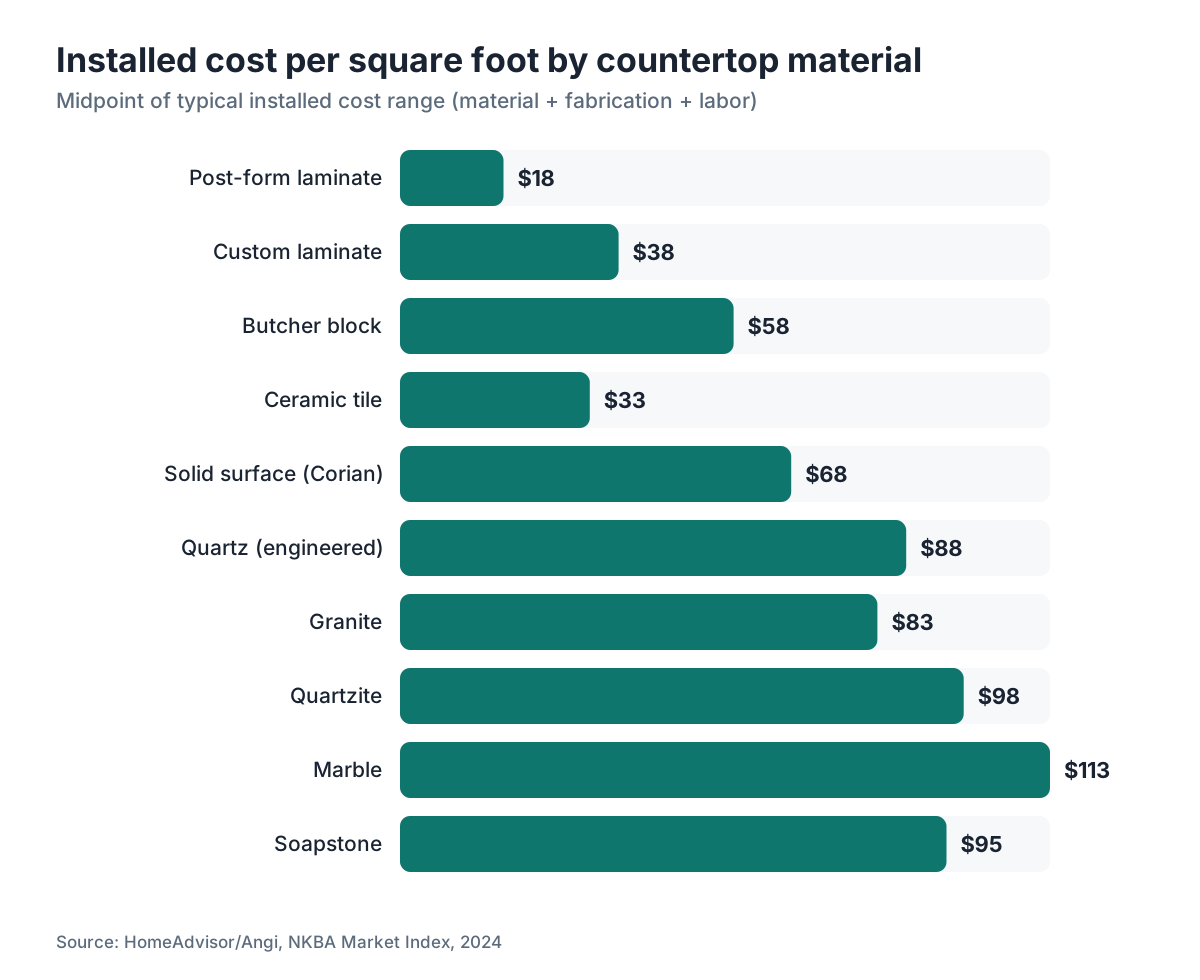
Here is a material-by-material breakdown. Prices are installed cost per square foot, material and labor combined:
| Material | Installed cost per sq ft | Notes |
|---|---|---|
| Laminate (post-form) | $10 to $25 | Pre-formed, minimal fab needed |
| Laminate (custom) | $25 to $50 | Cut-to-size, custom edges |
| Butcher block | $35 to $80 | More if oiled/finished on-site |
| Ceramic tile | $20 to $45 | Labor-heavy grout work |
| Solid surface (Corian) | $45 to $90 | Seam-hidden look, moderate fab |
| Quartz (engineered stone) | $55 to $120 | The mid-market default |
| Granite | $55 to $110 | Varies by slab origin and color |
| Quartzite | $65 to $130 | Often confused with quartz, harder to cut |
| Marble | $75 to $150 | High waste factor, seaming skill matters |
| Soapstone | $70 to $120 | Niche, fewer local fabricators |
These ranges come from contractor cost surveys and NKBA member data, not guesses [2]. Your quote will land somewhere in these bands depending on your ZIP code, how complicated your kitchen layout is, and the shop you hire.
Most homeowners miss one thing. Installation labor is only part of the invoice. You also pay for template creation (measuring and building a physical or digital template of your countertop shape), fabrication (cutting, edging, polishing), delivery, and any permits your city requires.
How much does laminate countertop installation cost?
Laminate is the cheapest countertop you can install, and its cost structure is different from stone. Most laminate sells either as pre-formed post-form sheets or as custom-cut pieces a fabricator bonds to a substrate.
Post-form laminate is the rounded front edge you see in rental kitchens. Material plus installation runs $10 to $25 per square foot [1]. A 40-square-foot kitchen lands around $400 to $1,000 total. Labor alone, if you supply the material, is often $200 to $500 for a standard kitchen.
Custom laminate costs more: $25 to $50 per square foot installed. A fabricator cuts high-pressure laminate sheets and bonds them to particleboard or MDF, so you get any shape, any edge, and a much wider pattern range including the convincing stone-look laminates. Cost rises with seams. L-shaped and U-shaped kitchens need more of them, and seaming laminate cleanly takes real skill. A bad seam traps water and swells the substrate over time.
A laminate cost calculator asks for four things: square footage, number of corners, sink type, and edge profile. Those inputs drive most of the variance. Undermount sinks are a bad idea in laminate because water reaches the exposed particleboard edge. Drop-in is the right call. Want a quick estimate without calling anyone? Start with 45 square feet as a U-shaped baseline and multiply by your local per-square-foot rate.
One honest note: laminate cannot be repaired invisibly if it chips or burns. If longevity matters more than upfront price, the gap between laminate and quartz has closed enough that pricing both is worth your time.
For more on the products themselves, see our guide to laminate countertops and the classic Formica countertops overview.
What drives the cost of kitchen countertop installation up or down?
Fabricators price jobs on a handful of real cost drivers. Know them and you can negotiate, trim scope, or at least stop being blindsided by the quote.
Square footage. The obvious one. Shops measure in square feet of finished surface, and every extra foot adds material and cut time. Islands pile on square footage fast.
Number of cutouts. Every sink hole and cooktop opening takes 30 to 60 minutes of careful CNC or hand work. Expect $75 to $200 per cutout depending on material hardness and complexity [3]. An apron-front farmhouse sink costs more than a standard undermount because the cabinet opening means notching the front edge of the slab.
Edge profiles. A simple eased edge (knocking the 90-degree corner down slightly) adds almost nothing. An ogee, a waterfall, or a multi-step profile on thick mitered stone adds $15 to $40 per linear foot [3]. Do the math on a 20-foot perimeter. A fancy edge tacks $300 to $800 onto a stone job.
Number of seams. Every seam in stone means color matching, epoxy work, and polishing. Fabricators charge $75 to $150 per seam, and some layouts demand four or five. Laminate seams cost less to execute but show more, because the material does not polish the same way.
Demolition of existing countertops. Removing old tile, glued-down laminate, or a stone slab adds $150 to $400 to most jobs. Tile demo is the worst. Thin-set bonds the substrate to the cabinet, and the tear-out is slow and messy.
Job site access. Third-floor condo with no elevator? Narrow hallway? Fabricators add a delivery surcharge of $50 to $200 for hard access.
Your local market. Labor rates in San Francisco or New York City run 30 to 50% higher than the rural Midwest for identical scope, a spread the Bureau of Labor Statistics wage data backs up across construction trades [8]. No calculator fully accounts for this. Three local quotes beat any online estimate.
What is the step-by-step process for installing kitchen countertops?
Hire a full-service shop or run the project yourself, the sequence is the same. Skip a step or do them out of order and things go wrong.
Step 1: Cabinet prep and leveling. Countertops are rigid. Cabinets that are not level, or not all the same height, will crack stone slabs or leave visible gaps under laminate. A good installer checks every cabinet run with a level and shims or adjusts before anything gets measured.
Step 2: Template. This is where precision gets set. For stone and solid surface, the fabricator builds either a physical template (luan strips or cardboard) or a digital laser template (a Proliner or similar device). Templating takes 30 to 60 minutes for a typical kitchen and should happen after cabinets are fully installed and the plumbing rough-in is complete.
Step 3: Fabrication. The template goes back to the shop. A CNC machine or bridge saw cuts the slab to shape. Edges get profiled on a CNC router or by hand with grinding and polishing pads. Cutouts get made. This takes one to five business days depending on the shop's queue and the material.
Step 4: Delivery and dry fit. The fabricator brings the finished pieces and sets them in place with no adhesive first. This is your moment to catch gaps, levelness problems, or bad seam placement before they turn permanent.
Step 5: Final installation. Stone gets set with silicone adhesive, not mortar. Laminate gets screwed up from below through cabinet corner brackets, or fastened with adhesive. Seams get epoxied, clamped, and polished. Backsplash caulk lines run after the countertop cures.
Step 6: Plumbing reconnect. The plumber comes back to reconnect the sink, faucet, and disposal. Separate trade, separate cost, typically $100 to $200 for a simple reconnect [4]. Budget for it.
Template to usable countertop runs five to ten business days for most jobs.
How long does kitchen countertop installation take?
Template day and install day are two separate visits, with a fabrication window between them. For granite or quartz in a busy shop, expect five to seven business days between template and install. Some shops quote two to three weeks during peak season, meaning spring remodel months and the pre-holiday fall rush. Laminate moves faster. Many shops template and install within two to four days because post-form pieces get cut at the distributor level.
The install itself takes two to four hours for a typical kitchen. Bigger jobs with islands, multiple seams, or tough access run four to eight hours. The slab is heavy. A 10-foot run of 3 cm granite weighs 300 to 400 pounds, so a two-person crew is the floor and three is standard for large jobs.
After install, silicone adhesive needs 24 hours to cure before you load weight on the counter. Most fabricators tell you not to set anything heavy on it or use the sink for at least a day.
If you are running a full kitchen remodel, the countertop is almost always the last trade in. Electrical and plumbing rough-in first, then drywall, then cabinets, then countertops, then backsplash tile, then finish plumbing. Get the sequence wrong and you add cost and delay.
Do you need a permit to install kitchen countertops?
In most places, a countertop swap-out (same footprint, no structural changes) needs no building permit. Replacing laminate with granite on the same cabinets is usually treated as cosmetic work [5].
Permits show up when the project moves plumbing (relocating the sink), adds electrical circuits for an island, or structurally changes cabinets. Those scopes cross into work almost every municipality permits.
The International Residential Code governs most single-family home work in the U.S. and does not specifically require a permit for countertop installation. Local amendments vary. Some jurisdictions with aggressive inspection programs require permits for kitchen remodels above a dollar threshold. The only reliable way to know is to call your building department. Most answer in one phone call.
One more wrinkle in older houses. If your home was built before 1978 and demo disturbs painted surfaces around the counters, the EPA's Renovation, Repair, and Painting Rule (40 CFR Part 745) can require lead-safe work practices from the contractor [9]. Ask about it if you are tearing out old backsplash or wall material.
Hire a licensed contractor and they pull any required permits. Do it yourself, or hire someone skipping a permit on a job that needs one, and it can complicate a future home sale inspection. That risk is real even when it feels unlikely.
Can you install countertops yourself, or do you need a professional?
Honest answer: post-form laminate is a reasonable DIY job for someone with basic carpentry skills, a jigsaw, and patience. The pieces come pre-edged and pre-finished. The work is mostly clamping mitered corners with draw bolts and cutting the sink hole carefully.
Custom laminate, solid surface, and stone are another story. A 10-foot run of 3 cm quartzite tops 300 pounds, cracks if it flexes during placement, and needs polished seam work that looks terrible without the right tools. Stone fabricators train for years on seams alone. A DIY stone seam is visible from across the room.
Quartz makers like Cambria and Silestone state in their warranty documents that installation must be done by a professional installer [6]. A self-installed quartz counter can void the warranty entirely. Spending $3,000 on quartz, that matters.
Stone fabrication carries a health angle too. OSHA's respirable crystalline silica standard (29 CFR 1910.1053) covers cutting engineered and natural stone, and dry cutting quartz throws off dangerous silica dust [10]. Pros use water-fed tools and dust control. A garage with a circular saw does not, which is another reason to leave stone to a shop.
For laminate DIY, the biggest risk is the sink cutout. Use a template, go slow, and support the cutout piece so it does not drop and crack the laminate on the way out. A $40 jigsaw blade made for laminate cuts cleaner than a general-purpose blade.
Fabricators reading this for a benchmark: installation labor runs roughly 15 to 25% of total job revenue, per NKBA member surveys [2].
How do you compare quotes from countertop installers?
Three quotes is the minimum. Variance between shops on the same job runs 40 to 60%, and quality does not always explain it. Some shops carry lower overhead, some are slower, some are hungry for work that month.
Make sure every quote itemizes: material cost per square foot, fabrication, installation labor, edge profile charges, cutout fees, demolition if any, and delivery. A quote that just reads "installed granite countertop, $4,200" tells you nothing about what happens when scope changes.
Ask about slab selection. Some shops let you pick from their inventory in person, which matters for natural stone where every slab is different. Others work from distributor catalogs. For granite countertops or marble, seeing the actual slab before you buy it is worth the trip.
Check turnaround time and whether the shop does its own templating and fabrication or subcontracts either piece. A shop that owns the whole process usually turns out more consistent results than one that templates in-house but ships slabs to a third-party fab shop.
Shops running quoting software (tools like SlabWise generate itemized quotes from actual slab inventory and room measurements) tend to turn around faster, tighter quotes that are easier to compare (slabwise.com). A quote that comes back in hours with a full line-item breakdown signals a tighter operation than one that takes a week to call you back with a handwritten number.
Verify licensing and insurance. A fabricator who drops a slab on your cabinets without liability coverage becomes your problem. Ask for a certificate of insurance before anyone shows up to template.
What should you do to prepare for countertop installation day?
Clear everything off the existing counters the day before. Installers will not move your small appliances, spice racks, or dish drying racks. They show up expecting a clear work surface.
Disconnect the sink plumbing before the crew arrives, or have your plumber do it the morning of. Installers are not plumbers and usually refuse to disconnect live supply lines. Same goes for the garbage disposal.
If old countertops are coming out, empty the upper cabinets directly above them. Prying up an old tiled counter sends vibration through the cabinets and slides dishes off shelves.
Be home for the full install. You need to approve seam placement (fabricators usually ask before they epoxy) and check the finished work before the crew leaves. Problems found after they drive away are much harder to fix.
Keep kids and pets out of the kitchen during install. A 400-pound slab moving through a kitchen is genuinely dangerous. No exception to this one is worth making.
Wait 24 hours after install before the plumber reconnects the sink. Silicone around an undermount sink needs that cure time to hold the weight of a full basin.
How do stone countertops get sealed, and is that included in the installation?
Most natural stone needs sealing after install. Granite, marble, quartzite, and soapstone are porous to varying degrees. An unsealed marble counter absorbs red wine in under a minute. Unsealed granite may or may not, depending on its density.
Some fabricators include one application of sealer in the install price. Many do not. Ask flat out.
The Natural Stone Institute (formerly the Marble Institute of America) recommends a simple porosity test: drop a little water on the stone, and if it absorbs within 10 minutes, seal it [7]. Quartzite, despite looking like marble, often needs sealing more often than granite because its surface is more porous.
Quartz and laminate need no sealing. Solid surface like Corian does not either. Butcher block countertops need periodic oiling with food-safe mineral oil, which is ongoing maintenance rather than a one-time seal.
For keeping stone clean after install, our guide on how to clean stone countertops covers the right products and what to avoid. For soapstone, which builds a natural patina, see how to clean soapstone countertops.
Budget $50 to $150 for a quality penetrating sealer (StoneTech BulletProof and Miracle Sealants 511 are common in the trade) and plan to reapply every one to three years depending on use and stone type [7].
What are the most common installation mistakes and how do you avoid them?
Talk to fabricators and read contractor forums and the same mistakes come up again and again.
Templating before cabinets are done. If one cabinet is still not level, or the appliances are not set, the template comes out wrong and the slab will not fit. The fabrication fee is non-refundable once cutting starts. Wait until every cabinet is installed and leveled.
Choosing a slab without seeing it in person. Natural stone slabs from the same quarry batch can look wildly different. Picking from a small online photo has produced a lot of unhappy homeowners. Buying granite or marble, go to the slab yard.
Underestimating the weight. Countertops are heavy. If your cabinets are old and not anchored to studs properly, a heavy stone top can destabilize them. A good installer checks cabinet construction before setting stone. Reusing old cabinets? Have a carpenter confirm they are solid.
Skipping plumbing coordination. The number-one source of install-day delays is a plumber who has not disconnected the sink. Book the plumber before you schedule the countertop crew.
Approving seam placement without reading it. Where seams fall in natural stone affects both the look and the strength. A seam directly behind a cooktop cutout is weak and cracks under thermal stress. Ask the fabricator to walk you through seam placement during the template visit, not after fabrication.
Fabricators: if you want a faster way to generate quotes that carry all these line items automatically and flag seam placement during layout, a tool built for countertop shops like SlabWise runs that workflow from quote to cut list.
What is the best countertop material for most kitchens?
This question has a real answer, even though everyone wants to tell you it depends.
For most people who cook often, entertain sometimes, and want something that lasts 15-plus years without babysitting, quartz engineered stone is the best all-around pick. No sealing. Resists staining. Comes in consistent colors, unlike natural stone slabs that vary slab to slab. And it sits in a price band ($55 to $120 per square foot installed) that competes with granite.
Granite is still excellent and costs about the same. Its porosity varies more, it needs periodic sealing, and slab selection takes more legwork. But many people prefer the natural variation. Like that look? Granite is a fine choice.
Laminate is the right call when budget is the main constraint, or when you are renovating a rental or a house you plan to sell soon. Modern large-format laminates (some Formica and Wilsonart patterns genuinely fool people) have come a long way. The stigma is partly outdated.
Marble is beautiful and honestly impractical for heavy kitchen use. It etches from acid (lemon juice, tomato sauce, wine) and stains if unsealed. People put it in kitchens where looks matter more than durability, and they accept the patina that develops. Know that going in and it is a valid choice. See the full breakdown in our marble countertops guide.
For a side-by-side of every option before you commit to install, our kitchen countertops overview covers each material in detail.
Frequently asked questions
How much does it cost to install kitchen countertops per square foot?
Installed cost per square foot runs $10 to $25 for post-form laminate, $55 to $120 for quartz, and $75 to $150 for marble. That number includes material, fabrication, and labor. A standard 40-square-foot kitchen runs $400 to $1,000 for laminate and $2,200 to $4,800 for quartz. Edge profiles, cutouts, and demo of existing countertops add to those baselines.
How long does it take to install new kitchen countertops?
Template and install are separate visits. For stone and quartz, fabrication takes five to seven business days in most shops. The install itself takes two to four hours for a typical kitchen. Laminate can sometimes be templated and installed within two to four days. Plan for the sink to be out of service for at least 24 hours after install while silicone cures.
What is included in countertop installation cost?
A full-service quote should include templating, fabrication (cutting and edging the slab), delivery, and installation labor. It may or may not include demo of existing countertops ($150 to $400 extra), sealer application, and plumbing reconnect. Always ask for an itemized quote so you know exactly what is and is not covered before you sign.
Can I install laminate countertops myself?
Post-form laminate is a feasible DIY project for someone comfortable with basic carpentry. The main skills are cutting a clean sink hole with a jigsaw and joining miter corners tightly with draw bolts. Custom laminate with seams is harder. Stone should always be professionally installed. DIY stone risks cracking the slab, throwing silica dust, and voiding manufacturer warranties on engineered stone like quartz.
Do I need to hire a plumber when installing countertops?
Yes. Countertop installers do not disconnect or reconnect plumbing. You need a plumber to disconnect the sink supply lines and drain before the crew arrives, then reconnect after install. Budget $100 to $200 for a simple reconnect. If you are upgrading to an undermount sink at the same time, the plumber visit gets more involved and costs more.
How do I use a laminate countertop installation cost calculator?
Enter total square footage (countertop depth times the linear length of each run), number of inside corners, sink type (drop-in vs. undermount), and edge profile. Those four inputs drive most of the cost variance. Multiply your square footage by your local per-square-foot rate: $10 to $25 for post-form, $25 to $50 for custom. Add $75 to $150 per seam for multi-run kitchens.
Does countertop installation require a permit?
In most U.S. jurisdictions, replacing countertops on existing cabinets without moving plumbing or adding electrical circuits does not require a permit. The International Residential Code treats it as cosmetic work. Permits are required if you relocate the sink, add an island circuit, or exceed your municipality's threshold dollar amount. Call your local building department to confirm.
What is the cheapest countertop to install in a kitchen?
Post-form laminate is the least expensive option at $10 to $25 per square foot installed, all-in. A typical kitchen can be done for $400 to $1,000. Tile is close on material cost but higher on labor because of the grout work. If budget drives the decision and you want a current look, the high-definition stone-print laminates from Formica and Wilsonart are worth a look before you rule laminate out.
How much extra does an undermount sink cutout add to installation cost?
Expect $75 to $200 for a sink cutout depending on material. Granite and quartzite take longer to cut than quartz or laminate, so hard stone sits at the high end. An apron-front farmhouse sink notch adds more because it means modifying the front edge of the slab. Cooktop cutouts price similarly and need extra care to avoid cracking the slab near the opening.
How do I find a reputable countertop installer?
Ask for referrals from local kitchen designers or cabinet dealers, who work with fabricators constantly. Get three itemized quotes, not ballpark numbers. Verify the fabricator carries general liability insurance and ask for a certificate before templating. Check that they do their own fabrication rather than outsourcing it, since shops that control the whole process turn out more consistent seams and delivery timelines.
What is the difference between countertop fabrication and installation?
Fabrication happens in the shop: cutting the slab to shape from the template, profiling the edges, and drilling cutouts. Installation is the on-site work: bringing the finished pieces in, setting them on the cabinets, seaming and epoxying joints, and caulking the backsplash line. Most full-service shops quote both together. Some big-box stores sell fabrication and installation as separate line items.
Should I seal my new stone countertop right after installation?
Most fabricators apply one coat of sealer before delivering, but not all do. Ask your shop. If sealer was not applied, seal granite, marble, quartzite, and most natural stones within a few days of install. Test first: drop a few water droplets on the surface. If they absorb within 10 minutes, seal it. StoneTech BulletProof and Miracle Sealants 511 are standard in the trade.
What countertop thickness should I choose, 2 cm or 3 cm?
3 cm (about 1.25 inches) is the U.S. standard for kitchen counters today and what most fabricators quote by default. It needs no substrate build-up and handles cutout edges and sink clips better. 2 cm (about 0.75 inches) is thinner, cheaper, and sometimes used for vertical applications or budget jobs. It needs a plywood substrate layer and cracks more easily near cutouts. Choose 3 cm for kitchens.
Sources
- HomeAdvisor (Angi), Cost to Install Countertops: Typical kitchen countertop installation costs $1,500 to $5,500 all-in; laminate runs $10 to $25 per square foot installed
- National Kitchen and Bath Association (NKBA), Kitchen and Bath Market Index: Installation labor typically represents 15 to 25% of total countertop job revenue; per-square-foot cost ranges cited reflect NKBA member survey data
- Remodeling Magazine, Cost vs. Value Report: Edge profile upgrades add $15 to $40 per linear foot; sink cutouts add $75 to $200 per opening for stone materials
- HomeAdvisor (Angi), Plumber Cost Guide: Plumber reconnect for sink and faucet after countertop installation typically costs $100 to $200 for a simple reconnect
- International Code Council, International Residential Code (IRC), Section R105 Permits: Cosmetic countertop replacement without plumbing or structural changes does not typically require a building permit under the IRC
- Cambria, Limited Lifetime Warranty documentation: Quartz manufacturer warranty documents state installation must be performed by a professional installer for coverage to remain valid
- Natural Stone Institute, Care and Maintenance Guidelines: The water drop test (absorption within 10 minutes indicates sealing needed) and resealing every 1 to 3 years recommendation for natural stone
- U.S. Bureau of Labor Statistics, Occupational Outlook Handbook: Construction and Extraction: Tile and stone installer labor rates and regional wage variation support the 30 to 50% cost differential between high-cost and rural markets
- EPA, Renovation, Repair, and Painting Program (40 CFR Part 745): Homes built before 1978 may require lead-safe work practices during demo of existing countertops and surrounding painted surfaces
- OSHA, Respirable Crystalline Silica Standard (29 CFR 1910.1053): OSHA silica dust regulations apply to stone countertop fabrication; dry cutting of engineered stone is regulated under the respirable crystalline silica standard
Last updated 2026-07-10