
TL;DR
- Customer reviews are the cheapest lead source most countertop shops ignore.
- Shops with 50-plus Google reviews and a 4.5-star average close more jobs at higher margins.
- The playbook is short.
- Ask every customer at install, respond to every review inside 48 hours, fix the one-star problems at the root, and publish review content where buyers actually search.
Why do reviews matter so much for countertop shops specifically?
Countertops are a high-anxiety purchase. A homeowner is about to spend $3,000 to $15,000 on something permanent, and they almost never get to touch every slab they're considering. Social proof carries the weight instead. A 2023 BrightLocal survey found that 93% of consumers say online reviews influence their purchase decisions, and 87% read online reviews for local businesses [1].
Fabrication runs on trust. The homeowner isn't buying stone. They're trusting you to measure right, cut clean, and show up on install day. One botched kitchen costs you the job, the referral, and a one-star review that every future prospect reads before they call. That asymmetry makes reputation matter more in this trade than in almost any other home-services category.
The lead-cost math is brutal in your favor. Most fabricators pay $30 to $80 per click on Google Search ads for terms like "granite countertops near me." Organic traffic from a strong review profile costs nothing per click after setup. Reviews do the work of paid search, except they compound instead of stopping the second you pause the budget.
The kitchen countertops category pulls hundreds of thousands of monthly searches. A shop with 90 reviews and a 4.7 average sits in the Google Local Pack and catches those searches without bidding a dime. A shop with 11 reviews and a 3.9 average gets buried under everyone else.
How many reviews does a countertop business actually need to rank and convert?
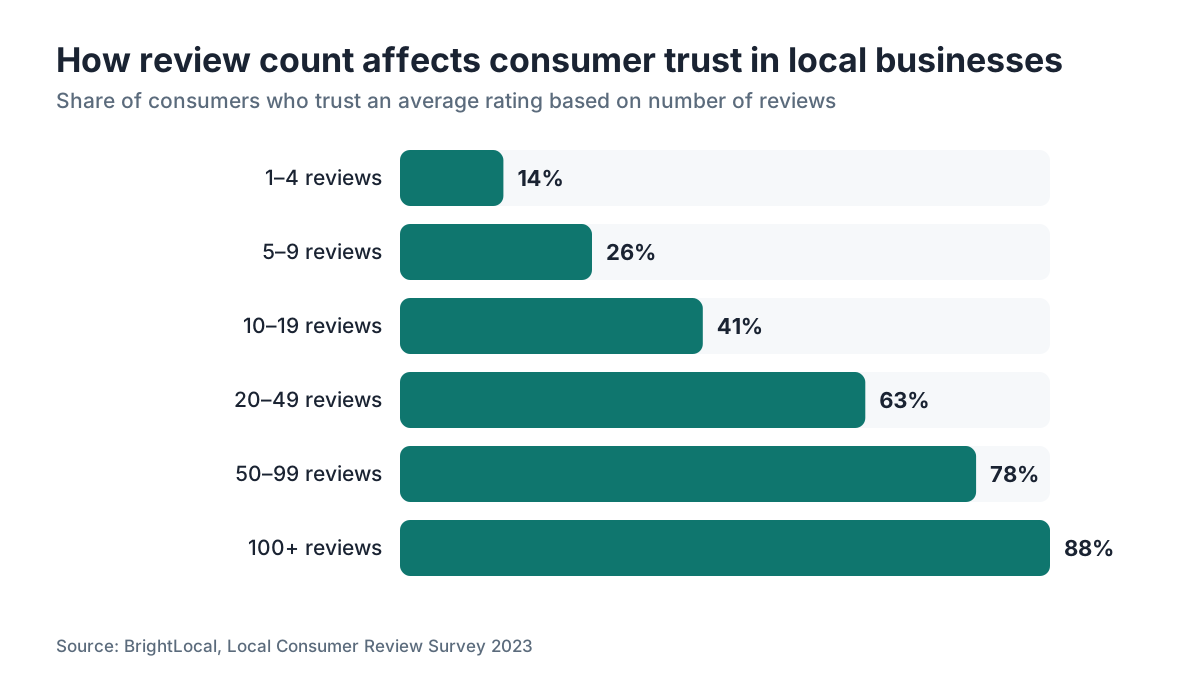
There's no magic number, but there are real benchmarks. BrightLocal's 2023 Local Consumer Review Survey found consumers want to see at least 20 reviews before they trust an average rating, and recency matters a lot: 61% of consumers say they only care about reviews written in the last 12 months [1].
For the Local Pack, the threshold is relative. If your three closest competitors each have 40 to 60 reviews, reaching 80 with a 4.5-plus average pushes you above them. Google's own guidance says review count, recency, and response rate all feed local ranking, though the company won't publish exact weights [2].
Here's a rough target by market size:
| Market size | Minimum reviews to appear competitive | Target reviews to dominate |
|---|---|---|
| Small town (under 50k pop.) | 20 | 50 |
| Mid-size metro suburb | 50 | 120 |
| Large metro | 100 | 250+ |
Recency is the part shops forget. Collect 80 reviews three years ago, then stop asking, and Google treats your profile as stale. Aim for three to five new reviews a month. A shop doing 20 to 30 jobs a month hits that by asking roughly one in six customers, which is easy.
Star ratings behave in a way that surprises people. A 2022 Spiegel Research Center study at Northwestern found that products rated 4.0 to 4.7 stars outsell both lower-rated items and perfect 5.0-star items, because buyers distrust a flawless score [3]. The same pattern shows up in local services. Don't lose sleep over dropping below a perfect 5.0.
When and how should you ask customers for a review?
Timing decides everything. The best moment is the end of a good install, when the homeowner is standing in their kitchen looking at the finished slab and feeling great about it. That emotional peak is when they say yes and actually follow through.
The worst move is an automated email two weeks later, after the excitement fades and the homeowner has moved on. Those requests convert at maybe 5 to 10 percent. An in-person ask right after install, followed by a single text with the direct link, converts at 30 to 40 percent in most shops that bother to track it.
Here's the script that works. Your installer or project manager says, roughly: "We really appreciate your business. Our shop lives on word of mouth, and a Google review from happy customers makes a huge difference. Would you be willing to leave us one? I can text you the direct link right now so it only takes two minutes." Then you pull up the template on your phone and send it.
The text should contain one thing. The direct review link. Not your website, not a long explanation, not a survey. Generate your Google review link through Google Business Profile (open your profile, click "Get more reviews") and shorten it with a free tool so it taps clean on a phone [2].
For customers who didn't convert at install, a follow-up email at the 48-hour mark still pulls decent numbers. After that, conversion drops fast. Don't send reminders past the seven-day mark. It feels desperate and it annoys people who weren't leaving a review anyway.
One hard rule: Google's terms of service prohibit incentivizing reviews, meaning no discounts, gift cards, or any reward in exchange for a review. The FTC enforces similar rules under its endorsement guidelines [4]. Don't do it. Losing your entire review profile is not worth a coupon.
What review platforms matter most for countertop businesses?
Google Business Profile is first, second, and third. It feeds the Local Pack, it feeds Google Maps, and it's the platform homeowners check most for local service work. If you focus on one platform, make it Google.
Houzz is the secondary platform that earns its keep for fabricators. Houzz users skew toward active remodelers with real budgets, so a 4.8-star Houzz profile with 30 reviews can produce better leads than 200 reviews on a site nobody visits. Houzz reports that 90% of its users are homeowners planning or in the middle of a renovation [5].
Yelp splits opinion hard. Some markets (California, dense urban areas, certain demographics) still lean on it. Others dropped it for Google years ago. Check whether your direct competitors have active Yelp profiles with recent reviews. If they do, you need to be there. If their Yelp pages are dead, yours can be too.
Every home-services owner knows the Yelp catch. Yelp's software filters reviews from users without an established account, which means a real chunk of your legitimate reviews can end up hidden in the "not recommended" section. This isn't a conspiracy. It's Yelp's spam defense, and it hits small local shops hardest because their customers rarely have existing Yelp accounts [6].
Angie's List (now Angi) and HomeAdvisor are worth a presence, mostly for SEO. Reviews there don't convert directly, but they add review content to pages that sometimes rank above your own website on branded searches.
Facebook reviews earn their place for shops whose customers live on Facebook, which skews toward suburban homeowners over 40. If your demographic fits, a Facebook Business Page with 50-plus reviews pulls traffic from the local groups where people ask for contractor recommendations.
How should you respond to positive reviews, and does it actually matter?
Yes, it matters. Google has confirmed that responding to reviews factors into local search ranking [2]. More practically, future prospects read your replies. A genuine, specific response tells them a real business with real people stands behind the work.
The common mistake is the generic template: "Thank you for your kind words! We appreciate your business." Every competitor types the same line. It reads as automated and it burns the opportunity.
A better response points to something specific from the review, restates your value, and takes maybe 30 seconds. If the customer mentions an installer named Marcus did great work, say Marcus's name back. If they name the quartz color, name it too. "So glad the Calacatta Laza turned out exactly as you pictured it" beats a generic thanks by a mile.
Respond to every positive review inside 48 hours. A shop doing 20-plus jobs a month can clear the queue in about 20 minutes a week. Block it on the calendar. Many shops hand this to their office manager or coordinator.
How do you handle negative reviews without making things worse?
This is where shops win back trust or torch it. Your public reply to a one-star review isn't for the reviewer. It's for every future customer reading over their shoulder.
Step one: wait 30 minutes before you type anything. Never reply while angry. Fabrication is hands-on and personal, and owners take criticism to heart. Understandable. But a defensive or combative reply reads terribly to everyone who sees it later.
Step two: respond publicly with a calm, short acknowledgment. Something like: "We're sorry this experience didn't meet our standards. Please call [owner name] directly at [number] so we can make this right." That's it. Don't argue the project in public. Don't call the customer wrong. Don't list every way the problem wasn't your fault.
Step three: actually call them. The point is to fix the problem, not to manage optics. If there was a real installation error, fix it. A homeowner who leaves one star, then gets a personal call from the owner and a repair visit that solves the issue, often updates their review. Not always. But often enough that the call pays for itself every time.
Fake negative reviews happen. If you get a one-star review from someone you have no record of serving, flag it for removal through Google Business Profile. Google removes reviews that break its policies, including reviews from people who were never customers. The process runs one to four weeks and doesn't always end in removal, but it's worth filing [2].
One number to keep in your head: 89% of consumers read business responses to reviews, per BrightLocal's 2022 data [10]. Your response isn't an afterthought. It's a sales pitch.
How do you turn reviews into marketing content?
Most shops collect reviews and leave them sitting on Google where only searchers see them. That's an asset going to waste.
The highest-return move is pulling your best reviews onto your own website. On a service page for granite countertops, embed or quote three or four reviews that mention granite jobs specifically. Do the same on marble countertops, countertop installation, or any material page you run. Schema markup (Review and AggregateRating schema) lets Google show your star rating right in search results, which lifts click-through rates by a documented 10 to 35% [7].
Before-and-after photos attached to reviews beat testimonial text. If a customer describes their kitchen transformation in a review, ask permission to post the photos on your website and social. Most happy customers say yes, and user-generated content usually outperforms professional photography in A/B tests because it feels real.
For Facebook and Instagram, screenshot your best reviews and post them (with the customer's permission, or with identifying details stripped out). Do it once or twice a month and it doesn't read as spammy. Frame it as a customer story, not a brag.
Email marketing barely gets used in fabrication. A monthly note to past customers with one real project story, one customer quote, and a gentle referral ask costs nothing and keeps your shop in mind. When that customer's neighbor starts a kitchen remodel six months later, the referral shows up on its own.
What systems keep the review flow consistent without burning out your team?
The shops that win on reviews long-term don't run one campaign and quit. They build a system that runs every month without the owner having to remember it.
Start simple. A laminated card, no bigger than a business card, that installers hand over at the end of every job. Print the Google review link as a shortened QR code and add a line like "Five minutes of your time helps us more than you know." QR codes scan reliably on any phone now, so this actually works.
Layer a text automation on top. Most home-services CRM tools (Jobber, ServiceTitan, and similar platforms) can fire an automatic text 24 hours after a job is marked complete. That message carries the review link and nothing else. Set it up once and it runs forever.
Shops running quoting and job-management software can often trigger review requests from the same system they invoice with. If you're still doing quotes and job tracking by hand, this is one of the real gains from moving to purpose-built fabrication software. The link between job completion and follow-up needs no extra steps when it lives in one system. SlabWise, for example, tracks job status from quote to install, which gives you clean timestamps to fire follow-up workflows at the right moment.
For the owner or manager: pick a monthly date to audit your review platforms. Check your average rating, your response rate, your review count against last month, and whether any reviews need a reply or a flag. That audit takes 20 minutes and stops the slow neglect that lets profiles go stale.
How do reviews affect how much you can charge per square foot?
This one's hard to measure directly, because nobody has run a controlled trial on countertop pricing against review scores. The directional evidence is clear anyway.
A Harvard Business School working paper on Yelp restaurant ratings found that a one-star increase in a business's Yelp rating led to a 5 to 9% jump in revenue [8]. That study covered restaurants, not fabricators, but the mechanism (consumer confidence in a high-consideration purchase) carries straight over. When a homeowner trusts your shop because 140 people reviewed you well, they stop shopping purely on price. They're buying certainty.
In practice, fabricators with strong review profiles report closing more jobs at their quoted price without haggling. The homeowner who found you through 90 five-star reviews is a different animal from the one who found you through a generic search and is stacking three bids on cost alone. The first buyer half-decided before they called. The second is undecided and price-sensitive.
That difference in buyer psychology is worth real money per square foot. Well-reviewed shops often command $15 to $40 per square foot more than thin-reviewed competitors for the same materials. The review profile is part of what the customer is paying for.
What are the legal and ethical rules for review collection?
The FTC's Endorsement Guides, updated in 2023, require that any "material connection" between a business and a reviewer be disclosed [4]. Handing customers a discount, gift card, or any incentive in exchange for a review creates that connection and demands disclosure at a minimum. In practice, most platforms, including Google, Yelp, and Houzz, ban incentivized reviews outright in their terms.
The FTC also made clear in its 2023 guidance that businesses can't suppress negative reviews or cherry-pick who they ask. Review requests have to go to all customers or a random subset, not only the ones you expect to be happy. The FTC's guidance warns against "a review campaign that is structured to solicit only positive reviews" [4].
Buying fake reviews is a serious gamble. The FTC finalized a rule on fake reviews in 2024 with civil penalties reaching $51,744 per violation. Google has sued fake-review sellers, and its software actively detects and removes review spam. The short-term bump from purchased reviews isn't worth a penalized or suspended Google Business Profile.
State consumer protection law adds another layer. New York and California have pursued businesses under state law for fake review practices. The FTC pursues these cases under Section 5 of the FTC Act as unfair or deceptive acts [9]. Check your state attorney general's guidance if a specific practice worries you.
How do you use reviews to improve your shop's actual quality?
Reviews are feedback before they're marketing. The fastest-growing shops treat them that way.
Read every review, especially the ones that sting. When three customers in a quarter mention the installer left a mess, that's a training issue. When two mention the template measurer showed up late, that's a scheduling issue. When someone says they were confused about pricing, that's a quoting communication issue, and a clear quoting process fixes it directly.
Aggregate the negative feedback monthly. One complaint might be an outlier. Three complaints about the same thing are a pattern. Patterns tell you exactly where to spend your training and process-improvement budget.
Shops handling materials like laminate countertops, butcher block countertops, or Corian see maintenance confusion as a common complaint. Customers don't know how to care for a new surface, then blame the shop when something goes wrong. A simple care card or follow-up email with instructions (linking to a resource like how to clean stone countertops) cuts those complaints hard and sometimes flips a would-be negative into a positive.
The best fabricators debrief any job that draws a complaint before the review even posts. They call the customer, understand what broke, and fix it. That posture, humble and fast, is what separates a 4.7-star profile from a shop stuck at 4.1.
What does a realistic review growth plan look like for a small fabrication shop?
Here's a 90-day plan built for a shop doing 15 to 30 jobs a month.
Week one: claim and complete every review platform profile. Google Business Profile, Houzz, Yelp, Facebook. Add photos of finished work, your service area, your materials. Fill every field. Generate your Google review short link.
Week two: train the install crew. Hand everyone the script. Print the QR code cards. Run a quick role-play with your install lead so the ask feels natural instead of awkward. The ask has to come from the installer, not from an email the homeowner will ignore.
Week three: set up the 24-hour text follow-up in whatever CRM or project tool you run. Test it on a real job. Confirm the link works, the message doesn't trip a spam filter, and the timing lands right.
Week four onward: respond to every incoming review inside 48 hours. Audit your star averages monthly. Share one review per month on social. At the 90-day mark, compare your review count to where you started. Shops doing this consistently add 10 to 20 reviews in the first 90 days.
At six months, reassess the platform strategy. If Google is climbing but Houzz is flat, double down on Google. If Yelp is sending measurable traffic (check Google Analytics or your phone log), invest there too. Follow the data.
Shops running job-management software like SlabWise can tie review-request triggers straight to job completion status, which kills the manual step and holds the flow steady through busy seasons, when staff forget everything except the job in front of them.
Frequently asked questions
Can I ask my family and friends to leave reviews for my countertop business?
Google's terms of service prohibit reviews from people who haven't had a genuine experience with your business. Reviews from employees, family, or friends violate platform policies and can be removed. The FTC's 2023 endorsement guidance also requires disclosure of any personal relationship. Stick to asking real customers who completed a job.
How do I get my Google review link to send to customers?
Log into Google Business Profile at business.google.com, find your verified listing, and look for the "Get more reviews" or "Share review form" option. Google generates a direct link. Shorten it with a free URL shortener so it's easy to paste into a text message. Test the link yourself before sending it to anyone.
What should I do if a competitor is leaving fake negative reviews on my profile?
Flag each review in Google Business Profile using the three-dot menu next to the review and select "Report review." Document the reviews with screenshots. If the pattern is clear and ongoing, escalate through Google Business Profile support. Google removes reviews that violate its policies, though it may take one to four weeks and isn't guaranteed.
How long does it take for a new Google review to show up?
Most Google reviews appear within a few hours of being submitted, sometimes within minutes. Occasionally a review is held for spam screening and takes one to three days. If a customer tells you they left a review and you don't see it, it may be in Google's spam filter or caught by the platform's review-detection system.
Does responding to every review actually improve Google ranking?
Google has stated in its local ranking guidance that responding to reviews improves your visibility in local search. The exact weight isn't published, but response rate is a confirmed signal. Beyond ranking, 89% of consumers read business responses to reviews before making contact, so responses do direct conversion work independent of any ranking benefit.
What star rating is best for a countertop shop, and is 5.0 actually good?
Research from the Spiegel Research Center found purchase likelihood peaks around 4.0 to 4.7 stars. A perfect 5.0 actually raises consumer suspicion that reviews are fake or cherry-picked. A 4.5 to 4.8 average with a substantial number of real reviews is more credible and converts better than a suspiciously flawless score.
How do I handle a one-star review where the customer is clearly wrong?
Respond calmly and briefly in public, invite the customer to contact you directly to resolve it, then don't argue the facts in the reply. Future readers care more about how you responded than who was technically right. A defensive reply signals to prospects that you'll behave the same way if they have a problem. Keep it short, professional, and solution-oriented.
Should countertop shops use Houzz or Yelp in addition to Google?
Houzz is worth the investment because its users are active remodelers with real renovation budgets, which makes the lead quality high. Yelp depends on your market: check whether your top local competitors have active, reviewed Yelp profiles. If they do, you need to be there. If their pages are dormant, skip it and put the effort into Google and Houzz.
Can I offer a discount or gift card to customers who leave a review?
No. Google, Yelp, and Houzz all prohibit incentivized reviews in their terms of service. The FTC's updated endorsement guidance also requires disclosure and effectively bans this practice for most businesses. The risk is losing your entire review profile if the platform detects it. Reviews must be voluntary and unprompted by any incentive.
How do I use reviews to show up in the Google Local Pack for countertop searches?
Google's local ranking uses proximity, relevance, and prominence. Reviews feed prominence. Shops with higher review counts, better average ratings, and consistent recent reviews rank higher. Complete your Google Business Profile fully, add service categories, upload real photos, and collect reviews consistently. Responding to reviews also signals active business management to Google.
How many review requests should I send before I stop following up with one customer?
One in-person ask at installation and one text or email follow-up within 48 hours. That's it. A second reminder is acceptable if the customer explicitly said they would leave a review and you haven't seen one after a week. Beyond that, it becomes annoying and risks a negative reaction from someone who was previously happy.
Do reviews on my own website help with SEO?
Yes, with the right markup. Adding Review and AggregateRating schema markup to your website lets Google display star ratings directly in search results, which can raise click-through rates by 10 to 35% according to structured data research. Reviews also add keyword-rich content to your pages. User-generated review text often includes the exact phrases homeowners search for.
What is the FTC rule on fake reviews and what are the penalties?
The FTC finalized a rule on fake reviews and testimonials in 2024, with civil penalties up to $51,744 per violation for businesses that buy, create, or suppress reviews. Businesses are also prohibited from only soliciting reviews from customers expected to respond positively. The rule targets fake reviews, insider reviews without disclosure, and review suppression.
Sources
- BrightLocal, Local Consumer Review Survey 2023: 93% of consumers say online reviews influence purchase decisions; 87% read online reviews for local businesses; 61% only care about reviews from the last 12 months
- Google, Google Business Profile Help, Manage your reviews: Google confirms that review count, recency, and response rate factor into local search ranking, and provides tools to generate direct review links
- Spiegel Research Center, Northwestern University, How Online Reviews Influence Sales (2022): Products with 4.0 to 4.7 star ratings outsell both lower-rated and perfect 5.0-star items because consumers distrust a flawless score
- Federal Trade Commission, FTC Guides Concerning the Use of Endorsements and Testimonials in Advertising (2023 update): FTC prohibits review campaigns structured to solicit only positive reviews and requires disclosure of material connections between businesses and reviewers
- Houzz, Houzz & Home Study 2023: 90% of Houzz users are homeowners planning or in the middle of a renovation
- Yelp, Yelp Support Center, About Yelp's Recommendation Software: Yelp's recommendation algorithm filters reviews from users without established accounts, which can hide legitimate reviews in the 'not recommended' section
- Google, Search Central, Structured Data (Review snippet): Review and AggregateRating schema markup allows Google to display star ratings in search results, increasing click-through rates
- Harvard Business School Working Paper, Reviews, Reputation, and Revenue: The Case of Yelp.com (Michael Luca, 2016): A one-star increase in Yelp rating leads to a 5 to 9% increase in revenue for restaurants, demonstrating the revenue impact of online review scores
- Federal Trade Commission, FTC Act Section 5: Unfair or Deceptive Acts: FTC can pursue fake review practices as unfair or deceptive acts; civil penalties for fake review violations finalized at up to $51,744 per violation
- BrightLocal, Local Consumer Review Survey 2022: 89% of consumers read business responses to reviews before contacting a business
Last updated 2026-07-11