
TL;DR
- Turning down a countertop job professionally means being prompt, specific, and brief.
- Thank the customer, give an honest reason (capacity, material fit, budget gap, or scope mismatch), and point them somewhere better when you can.
- Done right, a polite decline often generates a referral or a callback when circumstances change.
Why would a countertop fabricator turn down work in the first place?
Most shop owners spend the first few years saying yes to everything. That instinct makes sense early on. It stops making sense fast.
A job that looks like revenue on Monday can look like a loss by Friday. Thin margins. Problem clients. Scopes that don't match your equipment, materials you can't source reliably, timelines that collide with work you already promised, budgets that don't cover overhead. Any one of these turns a countertop project into a money-loser or a reputation hit.
The Small Business Administration treats job selection as a core part of managing a profitable trade business. You can't quote your way out of picking the wrong jobs. [1]
There's a softer reason too. Saying no to a bad fit protects capacity for good fits. A shop running at 85 percent of capacity on clean jobs makes more money than one running at 110 percent on mixed jobs. That's not theory. It's what shop owners find the moment they start tracking job-level profit instead of gross revenue.
Turning down work is a real business tool. The fabricators who use it on purpose tend to outlast the ones who don't.
What are the most common legitimate reasons to decline a countertop project?
Know why you're saying no and the conversation gets easier. Vague declines feel personal. Specific ones don't.
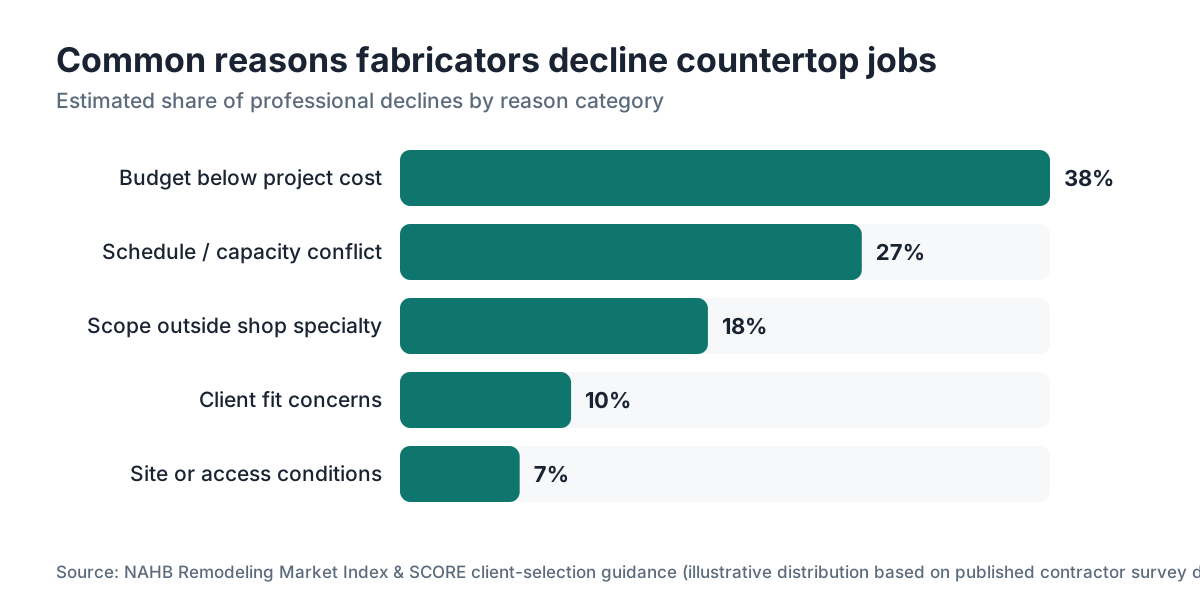
Here are the situations that most often justify a professional no:
Capacity and scheduling. Your backlog can't hit the customer's window. Overpromising a timeline and missing it is worse than declining. If a homeowner needs countertop installation done before a family event in three weeks and you're booked six weeks out, that's a clean reason.
Budget mismatch. The budget doesn't cover the material and labor the job needs. This is the most common one. Granite countertops in a premium tier can run $70 to $175 per square foot installed depending on the slab, edge profile, and cutouts. [2] If someone has $1,200 for a 45-square-foot kitchen and expects full-bullnose granite, no amount of efficiency closes that gap.
Material or scope mismatch. Some shops specialize. If you're a stone fabricator and someone wants laminate countertops or Formica countertops, you may not be set up to do that work well. Doing it badly costs you more than passing.
Site conditions you can't safely work around. Structural problems, mold, access issues, or a project mid-renovation with no firm finish date ahead of your template.
Client fit. Harder to say out loud, but real. A customer who has fired two previous fabricators, demands prices below your cost, or was abusive during quoting is telling you something. A contract can't fix a genuinely adversarial relationship. [3]
Liability exposure. Work outside your license, your insurance coverage, or your skill set in ways that could put you on the hook for a claim.
How soon should you decline, and why does timing matter?
As soon as you know. That's the whole rule.
Every day you sit on a decline is a day the customer isn't collecting other quotes. They're waiting on you. Say no after a week of silence and the irritation isn't about the no, it's about the time you cost them. That's what turns a professional decline into a one-star review.
Speed of response ranks among the top drivers of customer satisfaction in service businesses, even when the answer is no. A fast decline lands better than a slow one almost every time. [4]
Here's the practical version. If you've read a project request and already know it's not a fit, send the decline inside 24 hours. If you need to think, set your own deadline, check capacity and margin, and answer within 48 to 72 hours at most.
What should you actually say? A practical script for declining
The structure that works is gratitude, reason, close. Three parts. No more.
Here's a template that hits all three without going cold:
"Hi [Name], thank you for reaching out and for the time you spent sharing the project details. After reviewing it, I have to be honest: we're not the right fit for this one. [Specific reason]. I'd hate to take on something I can't do well for you. [Optional: I'd suggest reaching out to X, or checking the [name of local fabricator referral network].] Thanks again, and I hope the project goes smoothly."
The reason can be short. "Our current schedule puts your timeline two weeks past what you need" is enough. "Your budget is below what this material and scope requires to do right" is enough. You don't owe a line-item breakdown.
Declining over client fit? You don't have to say that part out loud. "We're not the right shop for this project" is honest and complete.
Go light on the apology. One "I'm sorry this doesn't work out" is plenty. Three apologies signal that you're uncomfortable, and that invites negotiation you don't want.
Skip "maybe later" and "let's revisit" unless you mean it. False hope is worse than a clean no.
Should you refer the customer somewhere else when you decline?
Yes, when you can do it honestly. A referral turns a disappointing call into a useful one, and customers remember who helped them.
Honestly is the operative word. Don't hand someone off to a shop you know does sloppy work just to clear your inbox. If your referral botches the job, that reflects on you.
Good referral options to keep in your back pocket:
- Other local fabricators whose work you respect and whose pricing or specialty fits the project
- Big-box installed countertop programs (Home Depot and Lowe's both run installation programs that handle lower-budget jobs) [5]
- Material-specific alternatives the customer hasn't considered (if granite is out of budget, butcher block countertops or laminate countertops can be a real solution)
- Trade association directories, like the Natural Stone Institute's member locator, which help customers find vetted local shops [6]
A referral costs you nothing and leaves the customer with something to act on. That's the difference between a dead end and a good experience with your business even though you never did the work.
How do you decline in person or on the phone without it getting awkward?
Phone and in-person declines are harder because the customer pushes back in real time. Walk in with your reason already decided.
Keep the call short. The longer you stay on the line after the no, the more likely you get talked into something or say something you regret. Here's a loose script:
"Thanks for your time on this. I've looked at the details and I don't think we're the right shop for this particular job. [Reason.] I wanted to tell you directly rather than just go quiet on you. If it's helpful, [referral]." Then stop.
If they push, hold steady: "I hear you, and I appreciate the interest. But I'd rather be upfront now than take this on and not do right by you." Graceful and firm.
If they get angry, stay calm and brief. "I understand that's frustrating. I hope you find a great shop for it." Repeat as needed. You don't have to defend the decision at length.
In person, same logic. Don't have this conversation at their house during a measure if you can help it. Measure, be professional, send the written decline afterward. Written declines give the customer room to process without a live audience.
What's the right way to decline after you've already given a quote?
This one's delicate. You've put in time, and so has the customer.
Say you sent a quote, the customer accepts, and then you realize the project isn't viable (site conditions changed, material came in priced wrong, your schedule shifted). Now you owe a real explanation, not a two-line note.
Be specific about what changed. "When I sent this quote, I had a template slot open in your timeframe. That slot is gone because a prior project ran long" is honest and easy to understand.
If your quote was accepted and you're backing out of a signed proposal or contract, call your attorney first. Most written estimates aren't binding contracts. Signed agreements with deposits are a different animal. What you owe depends on your state's contractor licensing law and the language in your agreement. [7]
For post-quote, pre-signature situations, a written decline with a full explanation is the standard. Offer to waive any quote fee if you charge one. That gesture costs little and shows good faith.
Keep a copy of every decline. If a customer later disputes something or leaves a review claiming you vanished, you have the record.
How do you handle a budget dispute without losing the customer entirely?
A budget gap doesn't have to end in a hard no. Sometimes it's a chance to reshape the project.
Before you decline on price, try a few things. Ask what's flexible. Some customers have a fixed material budget but room on timeline, or they're open to a different material once you explain the trade-offs. Marble countertops and Cambria countertops hit different price points for buyers who want a stone look.
Next, scope. Can you do the perimeter counters now and leave the island for phase two? Partial projects bridge a lot of budget gaps.
Then be direct about the numbers. "Your budget is $3,000 and this scope at my material and labor cost is $4,200. I can't get there." Respectful and honest. Most customers don't know what things actually cost, and plenty appreciate the education even when the answer is no.
If none of that moves and the budget just won't work, the decline is the kind outcome for both of you. Taking a job you'll lose money on helps nobody.
Want a faster way to run this math before the call? Quoting software like SlabWise shows you job-level margin in real time, so you know exactly where your floor is before you pick up the phone.
Can turning down a job actually help your reputation?
Sounds backward. It's true anyway, and it's consistent.
When a fabricator declines well, customers tell the story as a compliment. "They were honest that they couldn't do it right, and they pointed me to someone who could." That's a referral wearing a disguise.
Contractors who take every job regardless of fit end up with mixed reviews and shaky word-of-mouth. Selective shops that communicate clearly build better reviews over time, because every finished job is one they were equipped to nail.
The Better Business Bureau's complaint data on home services points to unmet expectations, not price, as the recurring problem: promises made and not kept. [8] Declining jobs that would set you up to break a promise is a direct investment in your review profile.
There's a positioning angle too. A shop that says "we do natural stone and full kitchens, and we're not taking smaller or laminate jobs right now" sounds confident and focused. That signal pulls in the customers who match your ideal project.
Being known as selective isn't the same as being known as difficult. The whole difference lives in how you deliver the no.
What should you document when you turn down a job?
Every decline deserves a record, even the small ones. This isn't paperwork for its own sake. It's risk management.
At minimum, save the written decline (email, text thread, or a note in your CRM). Log the customer name, project address, inquiry date, decline date, and the stated reason.
Why bother? If a customer later leaves a review claiming you ghosted them, you have proof otherwise. If a dispute escalates, you have a paper trail. And if you want to spot your decline patterns over time (which job types you keep turning away, a hint that your pricing or marketing needs a tweak), you need records to see them.
If you run project management or quoting software, log the decline reason as a custom field. Over a year, the pattern shows up: are you declining mostly on budget? On timeline? On scope? That tells you something about where you sit in the market.
Many state contractor licensing boards require you to keep client communication records for roughly one to three years, depending on the state. [9] A decent decline log satisfies that on its own.
Are there legal considerations when declining a countertop job?
For most declines, no. A business can turn down work it isn't equipped or available to do.
The one area where federal law creates a duty is the Fair Housing Act. Under 42 U.S.C. § 3604, businesses providing services connected to dwellings cannot refuse service based on race, color, national origin, religion, sex, familial status, or disability. [10] The statute makes it unlawful "to discriminate against any person in the terms, conditions, or privileges of sale or rental of a dwelling, or in the provision of services or facilities in connection therewith." That reaches contractors serving residential properties, countertop fabricators included. Declining for any reason tied to a protected class isn't just unprofessional, it's illegal.
In practice, your stated reason needs to be honest, business-based (capacity, budget, scope, timeline), and applied consistently. If you decline a project for "budget too low" but recently accepted comparable budgets from other customers, that inconsistency creates exposure.
After a deposit changes hands, state contractor law governs what happens if you back out. Many states require a full deposit refund when the contractor cancels a signed agreement without cause. Check your state contractor licensing board's published guidance. [11]
If you're declining because a customer made you feel unsafe, document the behavior specifically and talk to an attorney before you respond. Your safety isn't up for debate, and the record protects you if the customer retaliates.
Any time money has moved or a contract exists, a quick call with your business attorney is worth it.
How do you track which jobs you're turning down, and what can that data tell you?
Most fabricators don't track declines at all. That's money left on the table.
Log every inquiry, including the ones you turn down, and record the reason. Six months in, you'll see your funnel clearly. How many inquiries become quotes? How many quotes become jobs? Where do the losses happen, and why?
Say 40 percent of your declines are budget-related. That likely means your marketing is pulling in price-sensitive buyers your pricing doesn't serve. Adjust your website copy to signal your range earlier and you save both sides the time of a quote that was never closing.
If most declines are timeline-related, that's a capacity signal. Hire, add equipment, or raise prices until demand matches what you can produce.
Shops on dedicated quoting and shop management software, like SlabWise, can build this tracking into the quote workflow so decline reasons pile up automatically instead of living in a spreadsheet nobody updates.
The National Association of Home Builders publishes quarterly data on remodeling contractor demand and backlog through its Remodeling Market Index. [12] Fabricator backlogs in many markets have run around four to eight weeks in recent years. If you're turning down jobs because you're full, you probably have room to raise rates until the backlog settles where you can manage it.
Tracking your declines is how you find that room.
Frequently asked questions
Is it rude to turn down a countertop job?
No. Taking a job you can't do well, can't afford at the quoted price, or can't finish on time is far worse for the customer than a prompt, honest decline. Most customers respect directness. What feels rude is ghosting or going quiet after showing initial interest. A clear, brief decline with a reason is professional by any standard.
How do I decline without losing the customer forever?
Be honest about why and leave the door open genuinely, not for show. If schedule is the issue, say so and invite them back for a future project. If it's budget, explain the gap without judgment. Customers who feel respected after a no often come back when the timing aligns, or they refer someone whose project fits you better.
What if the customer gets angry when I turn them down?
Stay brief and calm. "I understand that's frustrating and I'm sorry this doesn't work out," said once, is enough. Don't defend at length, don't negotiate under pressure, and don't reverse a decision just to stop the discomfort. An angry reaction to a professional no is itself information: it often confirms the project would have been hard. Document the exchange and move on.
Can I turn down a job after giving a quote?
Yes, as long as the customer hasn't signed a binding agreement and paid a deposit. A quote is an offer, not a contract. If circumstances change after you send it, a prompt written explanation is the right move. If a deposit has changed hands or a contract is signed, check your state's contractor licensing rules and, if needed, an attorney before withdrawing.
Should I explain why I'm declining or just say I can't take the job?
A brief reason beats none almost every time. "We're at capacity for your timeframe" or "your budget doesn't cover the material costs for this scope" gives the customer something useful and makes the decline feel considered instead of arbitrary. One sentence does it. If the real reason is client fit, "we're not the right shop for this project" is honest and complete without being unkind.
Do I have to return a deposit if I back out of a countertop job?
In most states, yes. If a contractor cancels a signed agreement without cause, standard practice and most state contractor regulations require a full deposit refund. The specifics vary by state. Check your state's contractor licensing board guidance and review your contract language. If the amount is significant, get a lawyer's opinion before you respond to the customer.
What if I want to turn down a job because the customer was difficult during the quote process?
That's a legitimate reason and you don't have to say it directly. "We're not the right fit for this project" is honest. You don't owe an explanation of every reason. Document the difficult behavior in your notes in case the customer later disputes something or leaves a review. Protecting your team and your shop from a bad relationship is sound business judgment.
How do I decline a very small countertop job without sounding arrogant?
Be honest: "Our shop has a minimum project size and this one falls below it. It wouldn't be fair to charge you a setup cost that's out of proportion to the work." Practical and respectful. You can also point them toward big-box countertop programs, which are built to handle smaller jobs cost-effectively. No arrogance required.
Is it okay to decline because I'm too busy rather than giving a detailed reason?
Yes, absolutely. Capacity is one of the most honest and understandable reasons a fabricator can give. "Our current schedule doesn't allow us to meet your timeline" is complete. You don't need to explain what else is in your queue. Customers generally understand that a good shop is busy. The key is telling them promptly so they can find someone available.
Should I track jobs I've turned down?
Yes. Logging each declined inquiry with a reason builds data over time. If most declines cluster around budget, signal your price range earlier in your marketing to filter inquiries. If they cluster around timeline, that's a capacity signal. After six months, patterns that shape your quoting, pricing, and staffing decisions become visible.
Can I legally decline any countertop job I want?
Generally yes, with one major exception. Under the federal Fair Housing Act (42 U.S.C. § 3604), contractors providing services to residential dwellings cannot refuse service based on race, color, national origin, religion, sex, familial status, or disability. Every decline must rest on a legitimate, consistently applied business reason. Capacity, budget, timeline, and scope all qualify.
What do I say if a customer asks for a discount instead of accepting my decline?
Be clear about your floor. "I've already priced this at my minimum margin. I can't go lower and do the job well" is complete. If they counter with "just a little," repeat the same sentence. Discounting below your cost to dodge an awkward conversation is exactly the outcome a professional decline is meant to prevent. Hold the line.
How do I write a decline email for a countertop job?
Keep it to three parts: thank them for the inquiry, give one specific reason you can't take it, and close warmly with an optional referral. Five sentences, max. Skip the excessive apology, skip vague language like 'circumstances have changed,' and skip false openings like 'maybe next time' unless you mean it. Send within 24 to 48 hours of deciding.
Does turning down jobs hurt my revenue long term?
Done well, it usually helps. Shops that take every job regardless of fit carry higher rework costs, more disputes, and lower margins. Selective job acceptance means more completed work that hits your quality and margin targets, which builds the reviews and referrals that drive long-term revenue. The key is tracking your decline reasons so you're declining strategically, not at random.
Sources
- U.S. Small Business Administration, Manage Your Business: Job selection is a core part of managing a profitable trade business
- Angi, Granite Countertop Cost Guide: Granite countertops can run $70 to $175 per square foot installed depending on slab, edge profile, and cutouts
- SCORE, Client Selection Guidance: A contract cannot fix a genuinely adversarial customer relationship; client fit is a legitimate business reason to decline work
- Qualtrics XM Institute, Customer Experience Research: Speed of response is one of the top drivers of customer satisfaction in service businesses, even when the response is negative
- The Home Depot, Countertop Installation Services: Home Depot runs an installed countertop program that handles lower-budget residential jobs
- Natural Stone Institute, Member Locator: Trade association directories help customers find vetted local stone fabrication shops
- National Conference of State Legislatures, Contractor Licensing: Signed agreements with deposits create obligations governed by state contractor licensing law
- Better Business Bureau, Consumer Complaints: In home services, the most common complaint is unmet expectations: promises made and not kept
- U.S. Small Business Administration, Manage Your Business (recordkeeping guidance): State contractor licensing boards commonly require businesses to keep client communication records for roughly one to three years
- U.S. Department of Housing and Urban Development, Fair Housing Act 42 U.S.C. § 3604: Under 42 U.S.C. § 3604, contractors providing services to residential dwellings cannot refuse service based on race, color, national origin, religion, sex, familial status, or disability
- National Conference of State Legislatures, Contractor Licensing: State contractor law governs deposit refunds when a contractor backs out of a signed agreement
- National Association of Home Builders, Remodeling Market Index: Fabricator and remodeling contractor backlogs in recent years have run at four to eight weeks in many markets
Last updated 2026-07-10