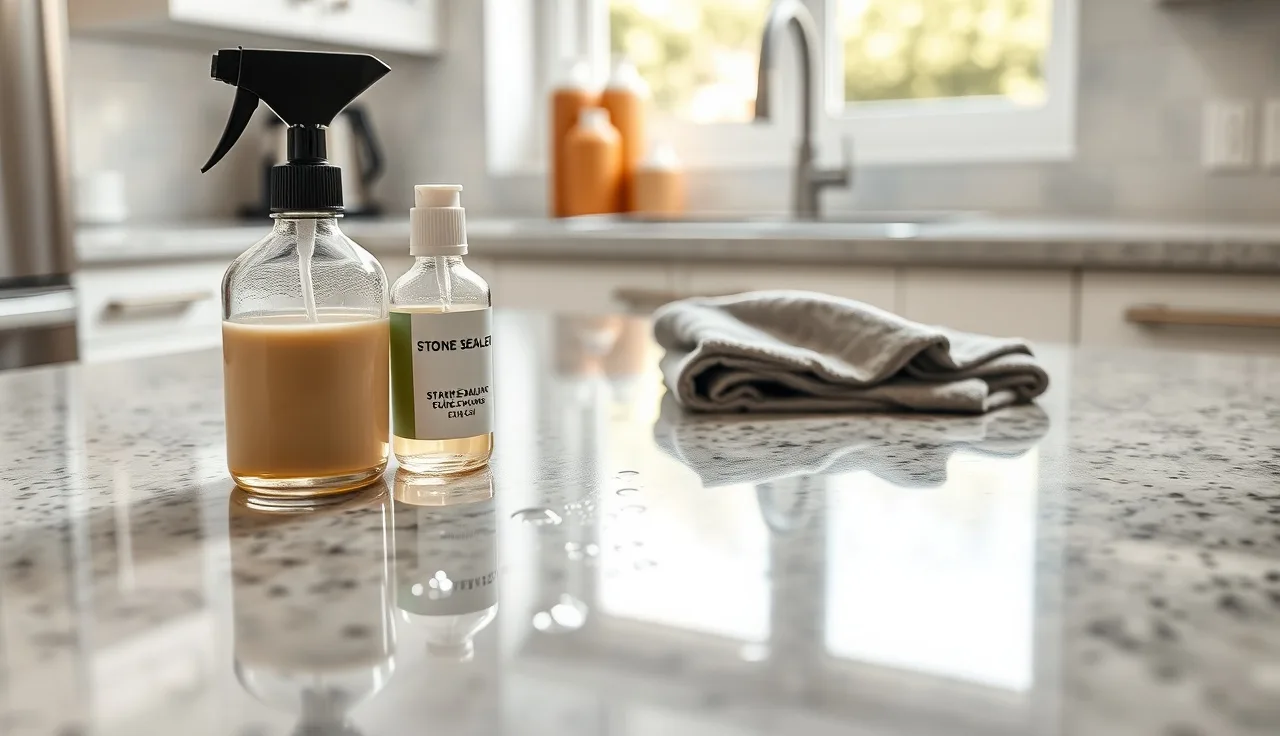
TL;DR
- Treating granite means three jobs: seal it to resist stains, clean it with pH-neutral products, and repair chips or etches before they spread.
- Most granite needs resealing every 1 to 3 years, and the water test tells you when.
- A quality penetrating sealer costs $20 to $50 and takes about 30 minutes to apply yourself.
What does 'treating' granite actually mean?
Granite is a natural igneous rock. It formed under heat and pressure from cooling magma, and that origin gives it real hardness (a 6 to 7 on the Mohs scale) along with a porous internal structure that can drink up liquids if you leave it unprotected. [10]
When people say they want to treat granite, they mean one of four things: sealing to block absorption, routine cleaning with the right products, pulling out an existing stain, or fixing a chip or crack. This guide covers all four, in order of priority.
Sealing is the one to get right. Everything else is maintenance built on top of it. Skip sealing or use the wrong product and cleaning turns into a daily fight instead of a rare chore.
Granite sits in a practical middle ground among stone surfaces: more forgiving than marble, more work than quartz. For how it stacks up against other materials, the kitchen countertops overview is worth a read before or after this one.
How do you know if your granite needs sealing?
Do the water test. Pour about a quarter-cup of water on the surface and leave it 15 minutes. If the water beads up and the stone underneath stayed the same color, your sealer is still doing its job. If you see a dark wet patch where the water sat, the stone absorbed liquid and needs sealing now. [2]
Run an oil test too. A few drops of cooking oil in a hidden spot, usually the back corner, catches problems the water test misses. Oil penetrates slower than water, so a surface that passes with water can still fail with oil. Darkening within 5 minutes means seal before you cook anything greasy near that spot.
Color matters here. Darker granites like Absolute Black or Black Galaxy are often so dense they barely need sealing at all. Light granites, especially whites and beiges with big crystalline patterns, run more porous and may want sealing every year. Color alone is not a rule, though. The water test is the only honest answer.
Most fabricators say test once a year. Mark a date on your calendar right after installation so it becomes a habit instead of something you remember after a stain has already set.
What type of sealer should you use on granite?
Two main categories exist: topical sealers and penetrating (impregnating) sealers. For kitchen granite, penetrating is almost always the right call.
Topical sealers sit on top of the stone and form a film. They can look plastic-y, they wear off in traffic areas and leave protection uneven, and they have to be stripped before you can reapply. That is more work than most homeowners want.
Penetrating sealers soak into the pore structure and cure below the surface. They do not change the look or feel of the granite, they do not peel, and they take a fresh coat only when the water test starts to fail. The active chemistry is usually silane, siloxane, or fluoropolymer. [3]
For food-prep surfaces, look for a sealer labeled food-safe after curing. The Natural Stone Institute notes that most penetrating sealers are safe for food contact once fully cured, which usually means 24 to 72 hours after application. Read your product label.
Price range for penetrating sealers runs $15 to $75 per bottle. Mid-range products like Tilelab Grout & Tile Sealer or Miracle Sealants 511 Impregnator commonly land at $25 to $40. One bottle covers 100 to 200 square feet, so most kitchens need one bottle per application. [4]
| Sealer Type | How It Works | Appearance Change | Reapplication Ease | Typical Cost |
|---|---|---|---|---|
| Penetrating / Impregnator | Fills pores below surface | None | Easy, no strip | $20-$50 |
| Topical film-former | Coats surface | Sometimes glossy | Hard, must strip first | $15-$40 |
| Color-enhancing penetrating | Fills pores + deepens color | Darker, richer | Easy | $25-$60 |
Color-enhancing sealers are a legitimate pick if your granite looks faded or you want the pattern to read deeper. Test in a hidden corner first. The change stays until the sealer wears off, so there is no undo button.
How do you apply granite sealer step by step?
Clean the surface first. Any grease, wax, or residue traps under the sealer and leaves a hazy spot. Use a granite-safe cleaner or a few drops of dish soap in warm water, rinse well, and let the surface dry completely. Granite holds moisture longer than it looks dry, so give it at least an hour in a ventilated room or run the exhaust fan.
Step 1: Read the product instructions. Cure times, dwell times, and ventilation rules change by brand. Some sealers want two coats, others are one-and-done.
Step 2: Pour a small amount onto the surface or load it onto a clean lint-free cloth or foam applicator, then work it in a circular motion. Cover sections of about 3 to 4 square feet so the sealer does not dry before you spread it.
Step 3: Let it dwell per the label, usually 5 to 15 minutes. Do not let it dry fully on the surface or it hazes.
Step 4: Buff off the excess with a clean dry cloth, working in circles. Sealer left on the surface dries to a film that is a pain to remove later.
Step 5: If the product calls for a second coat, wait the recommended time (often 1 hour) and repeat.
Step 6: Keep the surface dry and off-limits for at least 24 to 48 hours so the sealer cures into the stone. [2]
Active work runs about 30 minutes, plus drying time. This is a real DIY job. You do not need to hire anyone for basic sealing.
How often does granite need to be resealed?
It depends on the stone and how you use it. No single interval fits all granite, and anyone who quotes you one flat number is guessing.
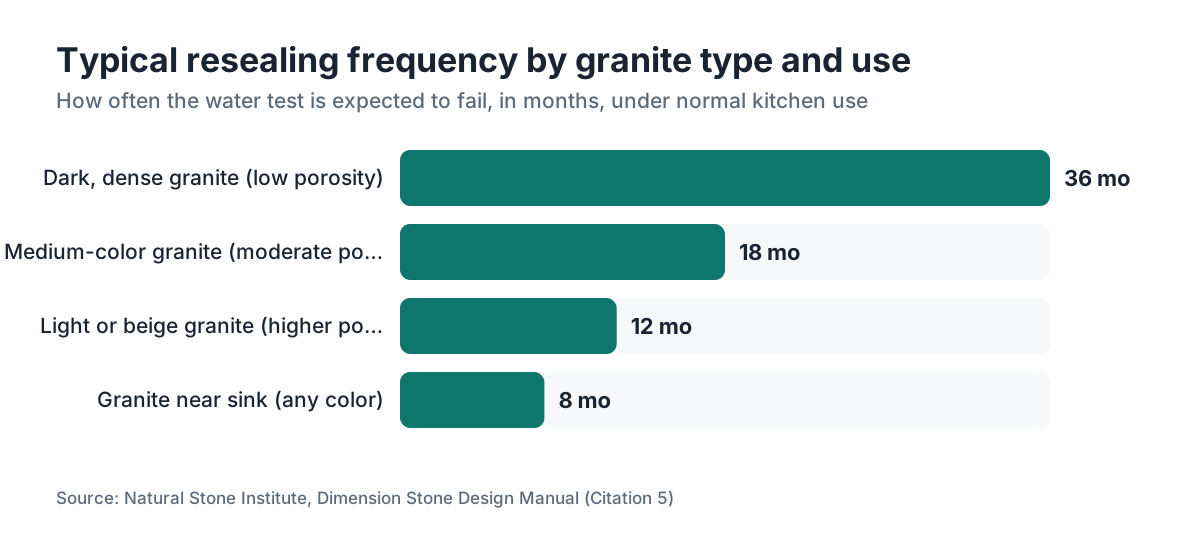
The Natural Stone Institute recommends letting the water test drive your schedule rather than a fixed calendar. [5] Most fabricators give practical guidance that lands in these ranges:
High-traffic kitchen granite in light or medium colors: every 12 months. Darker or denser granite with low porosity: every 2 to 3 years. Granite in low-use areas like bathrooms or bars: every 3 to 5 years.
Some habits burn through sealer faster. Daily cleaning with bleach or ammonia sprays, setting hot pots on the same spot again and again, and high-humidity kitchens where moisture cycles in and out of the pores all shorten the interval.
Other habits stretch it. Stick to pH-neutral cleaners, keep the surface dry between uses, and pick a sealer with fluoropolymer chemistry over basic silicone.
What cleaning products are safe for granite?
pH-neutral cleaners. That is the short answer, and it covers most of what you need.
Granite is built largely from silica minerals, which shrug off most chemicals but still give ground to strong acids and strong alkalis over time. Regular use of acidic cleaners (vinegar, lemon juice, many bathroom tile sprays) can etch the calcium-bearing minerals in the stone and chew through sealer chemistry faster than normal wear. [9]
Bleach and ammonia cleaners sit on the alkaline side. They will not etch the stone the way acid does, but they strip penetrating sealers over time, which means you reseal more often.
What actually works for daily cleaning:
Warm water and a microfiber cloth. For most messes this is genuinely enough. A few drops of dish soap in water. Rinse well afterward, because soap residue builds up and dulls the surface. A purpose-made granite cleaner spray, usually $8 to $15, pH-balanced and often carrying a little sealer to hold protection between full resealing.
Wipe spills right away. Sealer slows absorption, it does not stop it forever. Coffee, red wine, and cooking oil left sitting for hours can still work their way in. Speed matters more than what you wipe with.
For how to clean stone countertops across quartzite and soapstone, those surfaces carry their own chemistry quirks worth knowing.
How do you remove stains from granite?
Stain removal on granite works by drawing the staining agent back out of the pores, not by scrubbing it off the top. The tool is a poultice: a paste that sits on the stain, pulls it up as the paste dries, and lifts away with it. [6]
For oil-based stains (cooking oil, grease, hand lotion): mix flour or diatomaceous earth with a small amount of acetone or mineral spirits into a thick paste.
For water-based or organic stains (coffee, tea, wine, juice): mix flour or diatomaceous earth with hydrogen peroxide (12% if you can find it, drugstore 3% works slower) into a paste.
Application:
- Clean the surface.
- Spread the poultice about a quarter-inch thick over the stain, out past its edges.
- Cover with plastic wrap and tape the edges down to slow drying.
- Leave it 24 to 48 hours.
- Pull the plastic, let the poultice dry fully, then scrape it off with a plastic scraper.
- Rinse and check. Deep stains may need 2 or 3 rounds.
Metal stains (rust from a can or iron-rich water) need a different route: a commercial rust remover made for natural stone, which uses a chelating agent. Skip hardware store rust removers meant for metal. Many contain acids that etch granite. [6]
If a stain shrugs off three poultice treatments, a stone restoration pro may be able to help. Figure $100 to $300 for professional stain removal, depending on scope.
Can you fix chips and cracks in granite yourself?
Small chips and surface scratches take a two-part epoxy or a color-matched acrylic filler. The result is rarely invisible up close, but it stops the chip from growing and looks fine from standing distance.
Materials: a clear or color-tinted epoxy repair kit ($10 to $25 at hardware stores or stone supply shops), acetone for cleaning, a razor blade for leveling, and patience.
Process: clean the chip with acetone and let it dry. Mix the epoxy per directions. Apply a small amount, slightly overfilling the chip. Let it cure (often 30 to 60 minutes for a hard set). Hold a razor blade nearly flat and level the fill flush with the surface. Polish lightly with a soft cloth.
Running cracks are another animal. A hairline crack in the polish is cosmetic and fills the same way. A crack through the full thickness of the slab is structural. You can stabilize it with epoxy and color-matching dust, but the root cause needs attention too: weak support under the stone, a settling countertop, or a fragile point left in from fabrication. Get a fabricator or stone restoration specialist to look at any full-depth crack.
For where cracks usually start, the countertop installation guide covers substrate and support requirements in detail.
If you run a shop and track repair callbacks, a tool like SlabWise can flag which slabs had thin sections or difficult cutouts. That is where chips and cracks usually trace back to.
What should you never do to granite countertops?
A short list of habits causes most of the damage you see in granite over the years.
Do not use vinegar, lemon juice, or citrus cleaners on granite. The acid etches mineral surfaces and strips sealer. This is the single most common homeowner mistake, usually because people heard these count as "natural" cleaners.
Do not park extremely hot pans on the same spot as a routine. Granite handles brief heat without cracking in most cases, but repeated thermal cycling in one place stresses the stone, and silicone sealers start breaking down around 500 degrees F (260 degrees C). Use a trivet.
Do not let standing water pool in the same spot, especially near the sink. Even sealed granite wicks moisture at joints and edges over time, and that leads to discoloration.
Do not scrub with abrasive pads or powdered cleaners. Granite is hard, but its polished surface is a mechanical finish, and scratches in that polish are permanent without professional re-polishing.
Do not reach for generic bathroom or grout cleaners. Many carry acid or bleach concentrations that are fine on ceramic and aggressive on natural stone. [6]
Do not cut directly on granite. The knife will not damage the stone, but the reverse is not true: granite kills a knife edge almost instantly, and food residue gets pushed into micro-scratches.
How do you restore shine to dull or etched granite?
Dull granite has one of three causes: sealer residue from a sloppy application, soap scum from washing without rinsing, or actual etching of the polished surface. Sort out which one you have before you touch it.
For sealer haze or soap film: a stone-safe residue remover or a 50-50 isopropyl alcohol and water wipe, followed by buffing with a dry microfiber cloth, usually brings the shine back within minutes.
For mild etching or light scratches in the polish: a granite polishing powder ($15 to $30) worked in with a damp cloth in a circular motion. These carry very fine abrasives that level out shallow scratches. You are re-polishing a paper-thin layer of the surface.
For deep etching or widespread dullness: professional diamond-pad re-polishing. A stone restoration pro runs a sequence of increasingly fine diamond pads to rebuild the factory polish. Cost typically runs $200 to $600 for a kitchen area, depending on square footage and condition. [7] This one is not DIY. Get the sequence wrong and you leave swirl marks.
Reseal after any polishing work. Polishing takes off the existing sealer along with the surface layer of stone.
What is the annual maintenance schedule for granite?
A simple routine keeps most granite in good shape indefinitely without much effort. Here is what it looks like across the year.
Daily: wipe spills right away. Clean with warm water or a granite spray and a microfiber cloth. Dry the surface instead of letting water air-dry, because hard water leaves mineral deposits.
Weekly: a fuller clean with a granite-safe cleaner. Check for new chips near the sink edge and the stovetop.
Every 6 months: do the water test. If it fails, seal before the next check.
Annually (or whenever the water test fails): apply a fresh coat of penetrating sealer. Thirty minutes of work, $20 to $50 in materials.
Every 5 to 10 years (if needed): professional cleaning and re-polishing once the surface shows real dullness or traffic scratches.
For fabricators pricing granite, this maintenance reality shapes how you educate customers and what aftercare you fold into a quote. SlabWise's quoting tools let you bundle sealer and aftercare supplies into estimates so the customer has what they need on day one.
For comparison, marble countertops need more frequent acid-etch monitoring, while engineered surfaces like Cambria countertops need no sealing at all. Granite lands between them: some maintenance, not constant attention.
How much does professional granite treatment cost?
Costs shift by region and service, but these are realistic figures based on typical market rates. Sealing runs cheapest, re-polishing runs highest, and DIY sealing beats all of it on price.
Professional sealing: $100 to $250 for a kitchen countertop. Most stone care companies charge per square foot, roughly $1.50 to $3.00. [7]
Stain removal (professional poultice or chemical treatment): $75 to $300, depending on stain type and how many sessions it takes.
Professional cleaning and re-polishing: $200 to $600 for a typical kitchen. Honing a polished granite to a matte finish costs about the same.
DIY sealing: $20 to $50 in materials. A genuinely DIY-friendly job if you follow the steps.
The math favors DIY sealing for most homeowners. A professional seal every 5 years with DIY touch-ups in between is probably the most cost-effective long-term plan. Annual professional sealing only makes sense on a very large or complicated installation where even coverage is hard to hit on your own.
For how granite compares on total cost of ownership, the granite countertops overview covers installed price ranges and long-term value.
Frequently asked questions
How do I know when to reseal my granite countertop?
Do the water test: pour about a quarter-cup of water on the surface and wait 15 minutes. If a dark wet spot appears where the water sat, the stone is absorbing liquid and needs sealing. If the water beads and the stone stays the same color, the sealer is still working. Test at least once a year, more often on light-colored or high-use granite.
Can I use vinegar to clean granite?
No. Vinegar is acidic (pH around 2 to 3) and etches the mineral surface of granite over repeated use while degrading your sealer faster than normal wear. This mistake is common because vinegar works well on many other surfaces. Stick to warm water, a couple drops of dish soap, or a purpose-made granite spray. The short version: anything you would use on glass is fine, anything you would use on grout is not.
Is it safe to put hot pots on granite?
Granite handles brief heat without cracking in most cases. The real risk is to the sealer, which starts breaking down above 500 degrees F, and to repeated thermal stress on the same spot. The practical answer: use a trivet. It costs nothing and kills both risks. Setting one hot pot down once will not ruin your counter, but making it a daily habit eventually causes problems.
How long after sealing granite can I use the countertop?
Most penetrating sealers are safe to touch within an hour or two, but keep the stone dry and undisturbed for at least 24 hours, ideally 48 to 72, before you resume normal use. Check your product label: some fast-cure formulas say 24 hours, others say 72. Rush this and the sealer does not fully penetrate and cure, so you get less protection for the same effort.
What is the best homemade granite cleaner?
A small amount of dish soap in warm water is genuinely effective and close enough to pH-neutral for regular use. Rinse the soap off well, because residue builds up and dulls the surface over time. Some people add a little rubbing alcohol (isopropyl, about 30 percent in water) for a disinfecting effect. Avoid any recipe with vinegar, lemon, or baking soda, all of which are too acidic or too abrasive.
Why does my granite look dull after cleaning?
Dull granite after cleaning is almost always one of three things: soap or cleaner residue that never got rinsed off, sealer haze from a recent job where excess was not buffed away, or hard water deposits from letting water air-dry. Try buffing with a clean dry microfiber cloth first. If that fails, a 50-50 isopropyl alcohol and water wipe followed by buffing usually cuts through residue without harming the stone.
Can you use Windex or bleach on granite?
Windex is generally close to pH-neutral, and an occasional small use is unlikely to cause harm, but it is made for glass and contains ammonia, which degrades sealer over time with repeated use. Bleach is strongly alkaline and strips sealer chemistry much faster than neutral cleaners. Neither is recommended for regular granite care. A proper granite spray costs little enough that the tradeoff is not worth it.
How do you get oil stains out of granite?
Make a poultice from flour or diatomaceous earth mixed with acetone or mineral spirits into a thick paste. Spread it about a quarter-inch thick over the stain, cover with plastic wrap taped at the edges to slow drying, and leave it 24 to 48 hours. As the paste dries it pulls oil out of the pores. Remove, rinse, and check. Deep oil stains may need two or three rounds. Reseal the area once the stain is gone.
Does granite need to be sealed before first use?
Often yes, but not always. Many fabricators seal before installation, though quality and timing vary. Ask your fabricator whether they sealed it and which product they used. When in doubt, do the water test within the first week of installation. If the stone absorbs water, seal it before cooking or heavy use. Starting with good coverage is far easier than managing stains on an unsealed slab.
How do you treat granite countertops near the sink?
The sink perimeter gets more moisture, soap, and food contact than almost anywhere else. Reseal this area more often than the rest of the counter, even if the main surface still passes the water test. Keep the caulk line between sink and stone in good repair, because a failed joint lets water get under the stone and into the cabinet. Dry the area after use instead of letting water pool.
What is the difference between sealing and honing granite?
Sealing fills the pores of the stone with a water and oil repellent. Honing changes the surface finish from polished (glossy, reflective) to matte (smooth but not shiny). Two completely different processes. Honed granite still needs sealing, and actually needs it more often, because the matte surface has a more open texture than a polished one. Sealing does not change the finish. Honing does.
Can you repair a crack in granite yourself?
Small surface chips fill with a two-part epoxy kit ($10 to $25) and level flush with a razor blade once cured. The repair is rarely invisible under close inspection, but it stops the chip from growing. Cracks through the full thickness of the slab are structural and need a fabricator or restoration specialist to assess the underlying cause before any cosmetic fix. Never ignore a full-depth crack, because it tends to grow.
How does granite treatment differ from how you treat quartzite or soapstone?
Granite and quartzite both take penetrating sealers on similar schedules, though some quartzite runs more porous than granite and needs sealing more often. Soapstone is different: it does not absorb stains the way granite does, so sealing is not needed. Soapstone gets mineral oil instead, to darken it evenly and prevent uneven weathering. The guides on how to clean quartzite countertops and how to clean soapstone countertops cover those surfaces specifically.
Sources
- Natural Stone Institute, Care and Maintenance of Natural Stone: The water absorption test (water bead test) is the recommended field method for determining whether a stone surface needs resealing, and sealed surfaces should remain dry for 24 to 48 hours after sealer application.
- Natural Stone Institute, Technical Bulletin: Sealers and Protective Treatments: Penetrating impregnating sealers use silane, siloxane, or fluoropolymer chemistries that cure below the surface of the stone and do not change its appearance.
- Home Depot, Stone Sealers Product Category: Penetrating granite sealers at major retailers typically range from $15 to $75 per bottle, with mid-range products covering 100 to 200 square feet per application.
- Natural Stone Institute, Dimension Stone Design Manual: The Natural Stone Institute recommends performance-based resealing schedules driven by water absorption testing rather than fixed calendar intervals.
- Natural Stone Institute, Removing Stains from Natural Stone: Poultice stain removal using an absorbent material combined with a chemical appropriate to the stain type is the recommended method for extracting stains from porous stone; rust stains require chelating agents rather than acid removers.
- Natural Stone Institute, Stone Restoration and Maintenance: Professional stone polishing and sealing services for kitchen countertops typically range from $1.50 to $3.00 per square foot for sealing and $200 to $600 for full diamond-pad re-polishing of a kitchen countertop.
- EPA, Safer Choice Standard for Cleaning Products: The EPA Safer Choice program evaluates cleaning product chemistries for safety; many granite cleaners carry this designation, confirming food-contact safety after curing.
- Penn State Extension, home and garden resources: Acids including vinegar and citrus cleaners can etch calcium-bearing minerals present in granite and other natural stones, degrading both the surface and applied sealers.
- NIST, Standard Reference Materials program: NIST granite reference standards confirm heterogeneous mineralogy including quartz, alkali feldspar, plagioclase, and biotite, supporting variable porosity across granite types.
Last updated 2026-07-09