TL;DR
- A stocked countertop installation van needs six supply categories: lifting and handling gear, cutting and grinding tools, adhesives and caulks, surface protection, fasteners and hardware, and safety equipment.
- Miss any one on a job site and you're driving back to the shop.
- This guide covers what belongs in every bay, what to skip, and how to organize it so you find things fast.
Why does van stocking matter so much for countertop installers?
A missing tube of silicone or a dead grinder blade doesn't just slow you down. It means you leave a job unfinished or drive back to the shop, burning fuel, burning daylight, and burning the homeowner's trust. In a trade where referrals drive most new business, that second trip costs more than it looks like on paper.
Countertop work is material-heavy per square foot. You're handling stone that runs $50 to $200 per square foot installed [1], working inches from cabinetry that can cost more than the stone, and using chemicals that need specific consumables to apply right. The margin for error is thin.
The van is a mobile shop, not a truck. Treat it like one and you run tighter crews, faster installs, and fewer callbacks. Treat it like a junk drawer on wheels and every job has a "we gotta run and grab" moment.
This guide is built around what you actually need on the truck, not what a tool catalog wants you to buy. If something is optional or rarely earns its space, I'll say so.
What lifting and handling gear should be in every installation van?
Stone is heavy, and handling gear is the line between a clean install and two guys throwing out their backs. A typical 3 cm granite slab weighs roughly 18 to 19 pounds per square foot [2]. A standard 10-foot kitchen run hits 350 to 450 pounds before you cut the sink hole. You need the right lifting kit on board.
Here's the core lifting kit that belongs in every stone van:
| Item | Recommended Quantity | Notes |
|---|---|---|
| Rubber-grip stone lifters (suction cups, 4-6 inch) | 4 to 6 | Rated for at least 150 lbs each; check pad condition weekly |
| A-frame slab cart or panel cart | 1 | Folding versions save bay space |
| Moving straps / furniture sliders | 1 set | For navigating narrow kitchens |
| Rubber pads or carpet squares | 6 to 10 | Protect finished surfaces during staging |
| Pry bars (12 inch and 24 inch) | 1 of each | Removing old tops and leveling cabinets |
| Torpedo level and 4-foot level | 1 each | Cheap to carry, expensive to forget |
Suction cup lifters are the item most crews underbuy. Buy name-brand. Grabo, Nemo, and Wood's Powr-Grip all make units rated for wet or polished surfaces. A $30 import suction cup failing while a $2,000 slab hangs over a tile floor is not a risk worth taking.
The folding A-frame cart earns its keep even if you're skeptical. Getting a top from the van into a second-floor condo without one is a real injury risk. OSHA flags repeated manual lifting over 50 pounds as a musculoskeletal disorder risk factor [3], and countertop crews do that all day.
What cutting and grinding tools belong on a countertop installation van?
Most cutting happens at the shop. By the time the van rolls up, pieces are cut to template. But field adjustments happen constantly. A wall that isn't square. A plumbing stub that moved. A range hood that ended up 3/4 inch closer than the plan. If you can't make those cuts on site, you're going back to the shop.
The minimum cutting toolkit for stone installs:
- 4.5-inch angle grinder with variable speed (at least two on the truck, one as backup)
- 4-inch and 5-inch continuous rim diamond blades for dry cutting
- 4-inch segmented diamond blade for rough cuts
- 4-inch turbo cup wheel for back-grinding
- Grinding pads: 50, 100, 200, 400, 800 grit (at least two of each)
- Polishing pads: 1500 and 3000 grit
- Small circular saw or oscillating tool for laminate field cuts
- Router with flush-trim bit (essential for laminate countertops and formica countertops)
- Jigsaw with carbide-grit blades for sink cutouts in field-adjusted tops
- Cordless drill/driver with full bit set
- Hole saw set, 1.5 to 4.5 inch (for faucet holes)
- Diamond hole saw set for porcelain and engineered stone
Blade condition is the thing crews ignore until it bites them. A worn continuous rim blade on granite doesn't just cut slow. It chips the edge. Keep a blade log in the van if you run multiple installs a week. A quality 4-inch diamond blade costs $15 to $40 [4] and should come off before it starts dragging.
For wet cutting in the field, a small grinder water feed attachment or a portable Montolit or Mako-style rig is worth having if you do a lot of on-site work. Most small shops skip it. Dry cutting with a shop vac shroud handles 90% of field situations fine.
Oscillating multi-tools (Fein, Milwaukee, DeWalt) earn their slot for undermount sink work, scribing into tile backsplashes, and tight seam cleanup. Buy the good one. Cheap oscillators chatter and vibrate until you can't hold a line.
Which adhesives, sealers, and caulks should always be stocked?
This is the category where running out kills an install. Epoxy that's a component short. Silicone left uncapped. A sealer bottle down to the last squirt. Stock these generously and build a weekly replenishment habit.
Epoxy and adhesives:
- Two-part epoxy in clear, white, cream, and black at minimum. Color-matching epoxy on seams is a skill, but the base colors let you mix. Akemi, Tenax, and Integra are common shop brands. Stock 5 or 6 cartridges of your most-used color.
- Knife-grade polyester filler for chip repairs on granite and quartzite
- PL Premium or similar construction adhesive for attaching undermount sinks and securing tops to cabinets
- Mastic or thinset packets for any tile or travertine work
Silicone caulk:
Keep at least three colors of kitchen-grade silicone: white, almond, and clear. GE Advanced and Dow 786 are the workhorses. Color-matched silicone on dark stones matters more than crews admit. A bead of white silicone on an Absolute Black granite backsplash seam reads like a mistake from across the room.
Always stock 100% silicone, not "siliconized" latex. Latex-blend caulks mold faster and don't hold as well in wet kitchen conditions [5].
Sealers:
Impregnating sealer in a spray bottle for granite, marble, quartzite, and limestone. Tenax Proseal, Stonetech BulletProof, and Aqua Mix Sealer's Choice Gold are common picks. Stock at least one full liter. For marble countertops and granite countertops, sealing at installation is part of a professional handoff. Don't leave the homeowner to do it.
For Corian countertops and solid surface, sealer isn't needed, but you still need the manufacturer-supplied color-matched adhesive and the proper activator.
One more thing: mixing nozzles. You will run out of nozzles for two-part epoxy cartridges at the worst possible moment. Keep at least 20 spares.
What surface protection supplies prevent damage during and after install?
Every finished surface in a customer's home is your liability for the length of the install. Cabinet fronts, hardwood floors, appliances, tile. All of it is at risk when you're moving stone through doorways and around corners.
Protection supplies that earn their space:
- Ram Board or rosin paper (50-foot roll minimum) for floor protection
- Tape: blue painter's tape 1-inch and 2-inch, plus a roll of masking tape
- Kraft paper for taping off cabinet fronts before grinding
- Plastic drop sheeting (4 mil, 10x25 foot folded) for appliances and counters
- Corner guards (foam or cardboard) for doorways and cabinet corners during carry-in
- Shop vacuum with HEPA filter and dust shrouds for your grinders
The shop vac is the item you can't skip. Dry grinding stone throws silica dust, a serious respiratory hazard. OSHA's permissible exposure limit for respirable silica is 50 micrograms per cubic meter (μg/m³) as an 8-hour TWA, and stone grinding without dust control can blow past that by a factor of 10 or more [3]. A good vacuum with a shroud protects the homeowner's kitchen and keeps your crew legal and healthy.
Floor protection is the thing installers skip and then regret. One scuff on a freshly refinished hardwood floor from dragging stone runs $300 to $800 to repair [6]. Ram Board costs about $50 for a 100-foot roll. The math is easy.
For kitchen countertops specifically, tape off the cabinet interiors too. Silicone and epoxy drips inside cabinets are one of the most common complaints after a stone install.
What fasteners, hardware, and shimming materials should be on the truck?
Countertop installs live and die on small hardware. The right bracket, the right screw length, the correct shim. Show up without a selection and you're improvising, which means problems.
Keep a hardware organizer box (a Stanley or DeWalt sortable tray works fine) stocked with:
- Wood screws: #8 and #10, 1-inch and 1.5-inch, coarse thread
- Sheet metal screws: #10, 3/4-inch, for attaching to metal studs
- Toggle bolts or wall anchors in three sizes
- Undermount sink clips and mounting hardware in a mix of styles (sink brands vary)
- Cabinet corner clips and L-brackets
- Shims: plastic composite shims (these don't compress like wood), wedge shims, and flat washer shims
- Drywall anchors for backsplash installs when studs don't cooperate
The undermount sink clip situation is annoying because there's no universal standard. Blanco, Kohler, Kraus, and Elkay all run slightly different clip systems. Keep a grab bag of generic undermount clips plus a few brand-specific ones for the brands you see most. When a homeowner shows up with their own sink still in the box, you'll want options.
Adjustable cabinet legs sometimes need shimming where they've shifted since the original install. A 15-count bag of composite shims costs under $5 and saves you from carving shims out of cardboard on the floor.
What personal protective equipment and safety gear is required?
This is not the place to cut corners. Stone fabrication and installation is one of the dustiest trades, and silicosis (lung disease from respirable crystalline silica) is an irreversible condition that has caused documented deaths in the stone industry [7]. The gear matters.
PPE that belongs in every install van:
- N95 respirators (NIOSH-approved) or half-face respirators with P100 and OV cartridges. Keep a box of N95s and at least two reusable half-face units.
- Safety glasses (not sunglasses) with side shields, Z87.1-rated [8]
- Cut-resistant gloves, ANSI A4 or higher, for handling stone edges
- Knee pads (your knees, 10 years from now, will thank the version of you who bought these)
- Steel-toed boots (not optional, just wear them)
- First aid kit: adhesive bandages, gauze, medical tape, irrigation eyewash, and a SAM splint. Stone cuts go deep and fast.
- Fire extinguisher, ABC-rated, mounted in the van (required by most state commercial vehicle rules)
NIOSH classifies countertop fabrication as a high-exposure occupation for silica. The agency's hazard review found that workers who cut, grind, or polish engineered or natural stone "can be exposed to airborne concentrations of respirable crystalline silica that are several times the NIOSH REL" [7].
Stock the real respirators. Paper dust masks from the home center don't filter silica effectively. A NIOSH-rated N95 filters at least 95% of airborne particles at 0.3 microns, which covers the respirable silica range [9].
How should you organize the van to find things quickly on a job site?
Organization is the multiplier. A van with all the right supplies and no system is almost as bad as a poorly stocked one. Good installers know exactly where every item lives, even under time pressure and job-site chaos.
The system that works for most stone crews is zone-based organization:
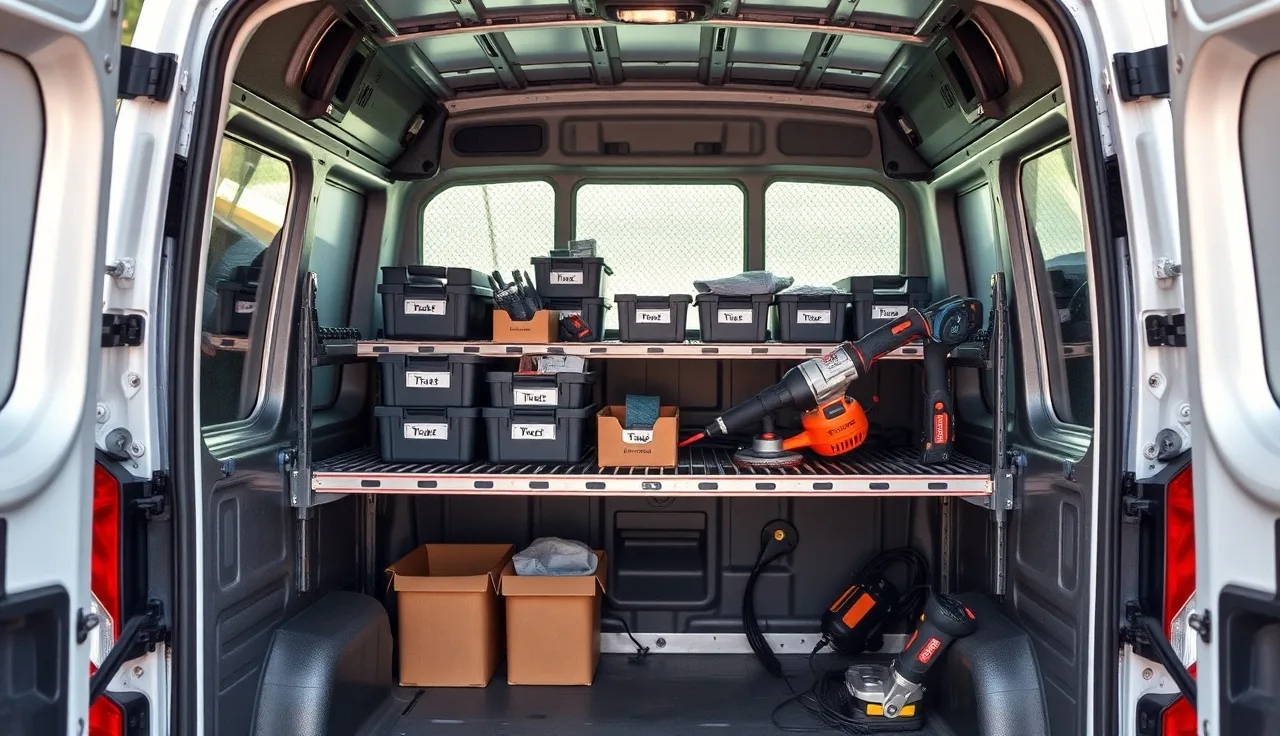
Zone 1 (bulkhead, near the cab): heavy equipment. Grinders, drill cases, and the shop vac live here. Heaviest stuff forward keeps the load balanced and the lighter reach area accessible.
Zone 2 (driver-side shelving): consumables in labeled bins. Blade organizer, adhesive and epoxy cartridges, caulk gun, mixing nozzles, caulks. Use clear bins or bins with label windows. A new crew member, or one working across trucks, needs to find silicone without asking.
Zone 3 (passenger-side shelving): hardware and protection. Hardware trays, shims, fasteners, tape rolls, drop sheeting, Ram Board. Keep like with like: floor protection together, fasteners together.
Zone 4 (rear doors): lifting gear and large items. Suction cups, the folded A-frame cart, pry bars, and levels. These come out first at every job.
A magnetic tool strip on the upper section of one side wall keeps pliers, Allen keys, and utility knives visible and off the floor.
Do a van walk every Friday afternoon or every Monday morning, whichever your crew will actually do. Check adhesive and caulk stock, blade condition, PPE supply. A 10-minute walk catches $200 worth of missing supplies before they cost you a job-site trip.
What's the difference in supplies needed for stone vs. laminate vs. solid surface installs?
Most install vans serve a mix of materials. The core kit above handles all of them, but each material has specific needs.
Natural stone (granite, marble, quartzite, soapstone): Diamond blades and pads, two-part epoxy for seams, impregnating sealer, color-matched silicone, suction lifters. Soapstone also needs mineral oil for finishing (see our guide on how to clean soapstone countertops). Quartzite needs the same care as marble at the seams; for maintenance, reference the how to clean quartzite countertops guide.
Engineered stone (quartz, Cambria, Silestone): Same diamond tooling as natural stone. For Cambria countertops, the manufacturer warranty specifies approved adhesives and seam placement, so keep the spec sheet accessible. No sealer needed. Color-matched epoxy matters more here because quartz colors are bold and uniform, so a bad seam fill shows immediately.
Laminate and Formica: Router, carbide flush-trim bits, contact cement, j-roller, edge file, and end-cap iron. A completely different chemical set than stone. A laminate-only van can skip almost all the diamond tooling.
Solid surface (Corian and similar): Color-matched solid surface adhesive and activator (brand-specific, buy ahead), sandpaper from 80 through 400 grit, random-orbit sander, seaming clamps, and a router for undermount sink reveal cuts.
If your shop runs 80% stone and 20% laminate, you don't need a router set on every van. Keep a laminate kit that travels to jobs when needed instead of burning shelf space in every truck.
Shops that use software like SlabWise to quote and track jobs by material type can pull reports on which material shows up most in a given week, which makes stocking decisions a matter of data instead of guessing.
How much does it cost to fully stock a countertop installation van?
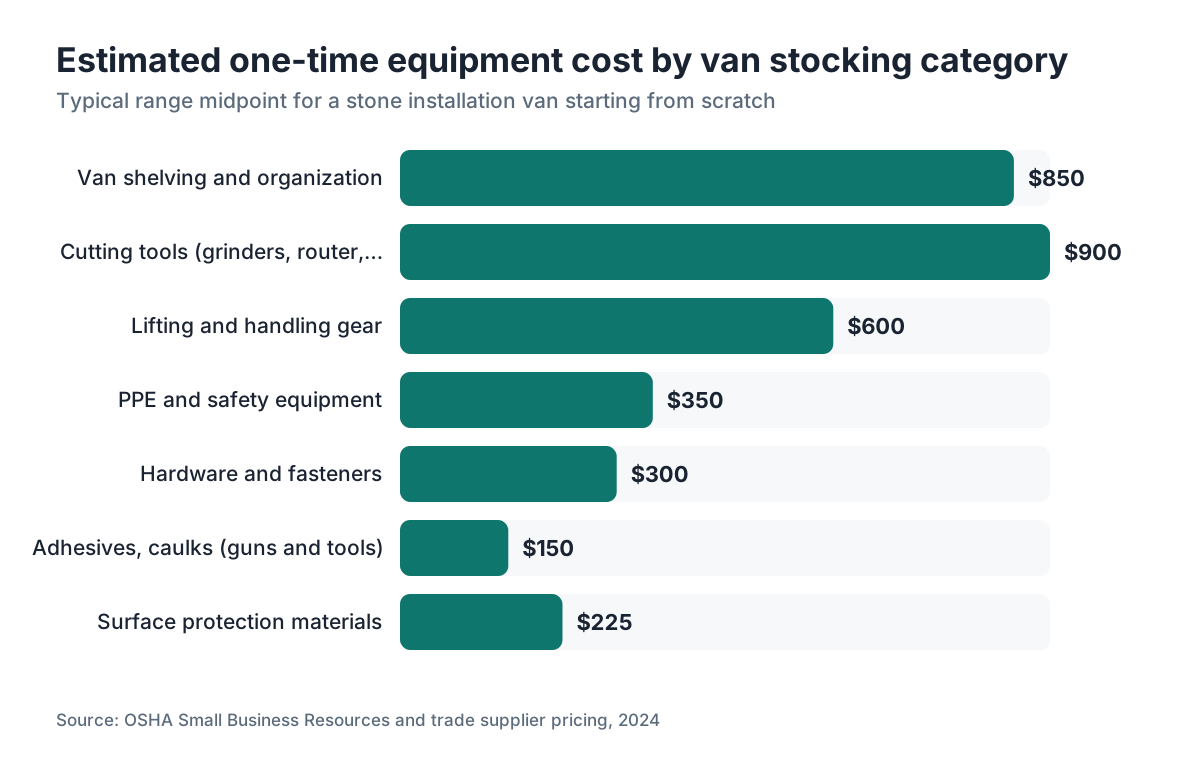
For a van starting from scratch, a complete stone installation kit runs $3,000 to $6,000 in equipment and tools, plus $400 to $800 a month in consumables [10]. The range depends on brand choices and what you already own.
Breakdown by category (rough ranges):
| Category | One-Time Equipment Cost | Monthly Consumable Cost |
|---|---|---|
| Lifting and handling | $400 to $800 | $20 to $60 (gloves, pads) |
| Cutting tools (grinders, router) | $600 to $1,200 | $80 to $200 (blades, pads) |
| Adhesives and caulks | $100 to $200 (guns, tools) | $150 to $350 (tubes, cartridges) |
| Surface protection | $150 to $300 | $100 to $200 (paper, tape) |
| Hardware and fasteners | $200 to $400 | $30 to $80 |
| PPE and safety | $200 to $500 | $60 to $120 (respirators, gloves) |
| Van shelving and organization | $500 to $1,200 | Minimal |
The biggest swing factor is tool brand. A DeWalt or Milwaukee cordless grinder costs $150 to $200. A Makita equivalent runs similar. A no-name import might be $60 and last six months of heavy use. For blades and grinding pads, the price gap between mid-grade and premium is real, but so is the lifespan gap. Premium blades usually work out neutral or better per linear foot of cut.
Setting up a second or third van as the shop grows costs less per van, because you already carry backup tools, organizational gear, and consumables in bulk. The first van is the expensive one.
What do experienced installers wish they'd stocked from day one?
These are the items that come up again and again when stone crews talk about what they wish they'd carried earlier:
A good caulk gun. Not the $8 squeeze gun. A smooth-rod or hex-rod ratchet gun, or better, a dripless pneumatic gun. The bead control on a long backsplash seam is a different world. These run $25 to $60 and outlast dozens of cheap guns.
Color-match cards or a reference photo kit. When you're mixing epoxy on site, a reference for what cream, beige, and oyster actually look like in your shop's epoxy brand saves blending time and mistakes.
Isopropyl alcohol in a spray bottle. Surfaces must be clean and dry before silicone or epoxy adhesion. IPA at 70% or higher cleans stone, cabinet tops, and sink rims fast and flashes off quick. Buy it by the gallon.
A headlamp. Cabinet interiors are dark. So are the utility closets where shutoffs hide. Hands-free light is not optional.
Garbage bags. Sounds obvious. Nobody stocks them.
A phone charging cable that works. Installers use phones for photos, digital levels, and spec lookups all day. A dead phone means communication breaks down.
The longer you run crews, the more you see that the miscellaneous stuff (bags, IPA, a headlamp, extra pencils) kills more time in aggregate than the big missing tools. Build a 20-item miscellaneous bin and restock it religiously.
For countertop installation work broadly, the van is the only asset that goes to every job. Keep it like a professional kitchen: everything in its place, restocked before the next service.
How do you maintain van inventory without letting it slide?
Every shop running multiple vans hits the same wall. One crew drains a van and doesn't restock, the next crew shows up with half the supplies they need, and now it's everyone's problem.
The systems that actually work:
The minimum quantity rule. Every consumable has a minimum quantity marked on the bin or shelf. When an item drops below that number, it goes on the restock list. The list lives physically in the van (a clipboard or a magnetic whiteboard on the wall), not in someone's head.
Friday end-of-week walk. The crew lead spends 10 minutes checking every bin against the minimums, then takes a photo or fills in a paper form. The shop manager orders or pulls from supply stock on Monday.
Dedicated install supply shelf in the shop. Not mixed with shop supplies. Just van replenishment items. When the walk turns up a shortage, the installer pulls from the shelf and marks what was taken. The shop manager restocks the shelf weekly.
Blade and pad log. A simple tally card on the grinder case: how many cuts this blade has made, or at minimum the date it went in service. Replace on a schedule instead of waiting for a field failure.
Digital inventory apps work for some shops. But a physical checklist on a clipboard in the van gets followed more consistently than an app that requires logging in. Use whatever your crew will actually touch.
SlabWise's job tracking helps shops see which materials and job types are running heaviest in a given month, which feeds straight into smarter ordering. If you're quoting 20 quartz jobs and 5 granite this month, your blade and epoxy needs look nothing like last month's mix.
Frequently asked questions
What's the single most important tool to have in a countertop installation van?
A quality variable-speed angle grinder with a fresh diamond blade covers more field situations than any other single tool: field cuts, grinding off a lip, smoothing a chipped edge, removing an old bead of silicone. If you had to pick one, that's it. But a grinder without a shop vac and dust shroud is a health hazard, so those two travel as a pair.
How many tubes of silicone caulk should I keep in the van?
A minimum of 6 tubes at all times: at least two clear, two white, and two in a color that matches your most common stone (often almond or gray). A full kitchen with backsplash can use 2 to 3 tubes. Running out mid-job is common and completely preventable. Buy silicone by the case once you settle on a brand.
Do I need different supplies for quartz countertops vs. granite?
The diamond tooling is the same. The main difference is sealer: granite and most natural stones need an impregnating sealer applied at install; quartz and engineered stone don't. Color-matched epoxy matters more with quartz because the surfaces are more uniform and blotches stand out. Keep manufacturer spec sheets handy for engineered stone brands with specific adhesive requirements.
What silica dust protection is legally required for countertop installation crews?
OSHA's silica standard (29 CFR 1926.1153 for construction) requires employers to limit worker exposure to respirable crystalline silica to 50 μg/m³ as an 8-hour TWA. Engineering controls (wet cutting, HEPA vacuums with shrouds) come first. Where those aren't enough, NIOSH-approved N95 respirators or better are required. The standard also requires medical surveillance for workers regularly exposed above the action level of 25 μg/m³.
How do you keep epoxy and adhesives from going bad in a hot van?
Heat kills two-part epoxy and silicone faster than anything. Park in shade when you can, and in summer, move temperature-sensitive adhesives to climate-controlled storage overnight instead of leaving them in the van. Most two-part cartridges have a shelf life of 12 to 18 months at room temperature; that drops sharply above 90°F. Rotate stock oldest-first, like food inventory.
What's the best way to stock a van for a small one-person installation operation?
Prioritize depth over breadth. A solo installer needs the same core categories in smaller quantities. Focus on: one reliable grinder plus one backup, a full range of blade grits, three silicone colors, two-part epoxy in four base colors, a basic hardware tray, N95 respirators, and cut-resistant gloves. Skip the A-frame cart only if every job has a second person. You can't solo-handle a 400-pound top safely.
Should installation vans carry seam sealer or grout for tile backsplash work?
Only if your shop handles backsplash installs regularly. Grout and thinset are heavy, and if you're only doing countertop drops, they eat space for no reason. If backsplash is part of your service, keep unsanded grout in the 4 most common colors you see, plus a tube of grout sealer. A margin trowel, sponge, and grout float add little weight and close a lot of jobs cleanly.
How often should angle grinder pads be replaced on a busy install van?
On a van running 3 to 5 installs a week, expect to replace 50-grit diamond grinding pads every 2 to 4 weeks and polishing pads every 4 to 8 weeks. The honest answer is that most crews replace them too late. A worn 50-grit pad cuts slow and builds heat that can microcrack the stone surface. If a pad is loading (clogging) or the cut rate drops noticeably, replace it.
What floor protection is best for hardwood floors during a countertop install?
Ram Board is the professional standard: dense enough to resist puncture from dropped tools, it breathes so moisture doesn't trap under it, and it won't slide. For large open areas, layer rosin paper under Ram Board. Avoid standard cardboard. It compresses, tears, and slides, and stone dust works through it onto the floor. Budget about $50 for a 100-foot roll, which covers 2 to 3 typical jobs.
What's a realistic monthly consumable cost for a countertop installation van?
For a van doing 15 to 25 installs a month across stone, laminate, and solid surface, expect $400 to $800 per month in consumables. That covers blades and grinding pads, silicone and epoxy cartridges, tape and floor protection, respirators and gloves, and miscellaneous hardware. Shops doing volume laminate work spend less on blades and more on contact cement and edge-banding supplies.
Can I use a regular shop vac for silica dust control during countertop installation?
Not safely. A standard shop vac doesn't capture particles at the size of respirable silica. You need a vacuum with a HEPA filter rated to capture particles at 0.3 microns with 99.97% efficiency. OSHA's silica standard specifically calls out HEPA-filter vacuums for housekeeping tasks, and many cutting operations require a shroud-and-HEPA-vac setup as the primary engineering control.
Do installation vans need a fire extinguisher?
Yes, and it's more than a good idea. Most states require commercial vehicles carrying flammable materials to carry an ABC fire extinguisher. Countertop vans carry silicone, contact cement, acetone, and IPA, all flammable. A 2.5-pound ABC dry-chemical extinguisher mounted near the rear doors costs under $30 and satisfies most commercial vehicle rules. Check your state DOT requirements for your vehicle class.
What's the best way to organize blade and grinding pad inventory in the van?
A labeled soft-sided tool roll or a rigid plastic organizer with dividers by grit works well. Store pads flat to avoid warping, since curved pads don't sit flush on the grinder. Label each divider with the grit number, more than a color. New crew members shouldn't have to guess what "the blue one" means. Keep two of each grit minimum: one in service, one as backup.
Sources
- HomeAdvisor (Angi) - Granite Countertops Cost Guide: Granite and stone countertops typically cost $50 to $200 per square foot installed, depending on material and region
- Natural Stone Institute - Dimensional Stone Design Manual: 3 cm granite slab weighs approximately 18 to 19 pounds per square foot
- OSHA - Silica, Crystalline (construction standard 29 CFR 1926.1153): OSHA permissible exposure limit for respirable crystalline silica is 50 μg/m³ as an 8-hour TWA; stone grinding without dust control can exceed this. OSHA also flags repeated manual lifting over 50 pounds as a musculoskeletal disorder risk factor
- The Home Depot - Diamond Blade Product Listings: Quality 4-inch diamond blades for angle grinders cost $15 to $40 depending on style and brand
- USDA Forest Service - Forest Products Laboratory, Wood Handbook (Adhesives chapter): 100% silicone caulks maintain adhesion and mold resistance better than siliconized latex blends in wet environments
- HomeAdvisor (Angi) - Hardwood Floor Repair Cost Guide: Repairing scuffs and damage on hardwood floors costs $300 to $800 depending on extent of damage
- CDC/NIOSH - Hazard Review: Health Effects of Occupational Exposure to Respirable Crystalline Silica (Publication 2002-129): NIOSH found that workers cutting, grinding, or polishing engineered or natural stone can be exposed to respirable crystalline silica at levels several times the NIOSH REL; countertop fabrication is classified high-exposure
- American National Standards Institute - ANSI/ISEA Z87.1 Occupational Eye and Face Protection Standard: Safety eyewear for occupational use must meet ANSI Z87.1 impact resistance standards
- CDC/NIOSH - National Personal Protective Technology Laboratory, N95 respirator guidance: NIOSH-approved N95 respirators filter at least 95% of airborne particles at 0.3 microns, covering the respirable silica particle size range
- OSHA - Small Business Resources: Tool and consumable cost estimates for skilled trades installation operations; equipment ranges used as basis for countertop van stocking estimates
- OSHA - Respirable Crystalline Silica Standard for Construction, 29 CFR 1926.1153: OSHA requires HEPA-filter vacuums for housekeeping tasks generating silica dust and mandates engineering controls before respirator use
Last updated 2026-07-11