TL;DR
- Removing a kitchen countertop takes 1 to 4 hours for laminate or tile and half a day for heavy stone.
- Disconnect the sink and appliances first, cut the caulk seams, unscrew the mounting brackets from below, then lift out.
- Stone slabs need two people minimum.
- DIY saves $200 to $500 in labor.
- Full removal with disposal runs $300 to $1,000 depending on material and crew.
What tools do you need to remove a kitchen countertop?
You can get through most countertop removals with tools you already own or can rent for under $40. The list is shorter than you'd expect.
For any material: a utility knife, a stiff putty knife, a pry bar (18 inches is ideal), a cordless drill or screwdriver, safety glasses, and work gloves. Add a headlamp because the space under the cabinets is dark.
For stone slabs (granite, quartz, marble): you'll also want suction cup handles. Two-handle sets rent from most home centers for around $20 to $30 a day. A slab of 3 cm granite weighs roughly 18 to 20 pounds per square foot [1], so a 25-square-foot countertop can top 450 pounds. Suction cups let you grip and steer that weight safely. You cannot do this alone.
For tile: an oscillating multi-tool with a grout blade cuts demolition time in half. You can chip out tile with a cold chisel and hammer, but the multi-tool spares your wrists.
For laminate or Formica countertops over plywood: a jab saw or oscillating tool helps if the screws are stripped and you need to cut the mounting points free.
One item people forget: a bucket and old towels for the trap water that spills when you disconnect the P-trap under the sink. Even a dry drain holds a quart or two of stagnant water.
How do you shut off the water and disconnect the sink before removing a countertop?
This step has to come first. Skip it and a countertop removal turns into a flooded kitchen.
Find the shutoff valves under the sink, one for hot and one for cold, and turn them clockwise until they stop. If the valves are old and won't close fully (a common problem in houses built before 1990), shut off the main house supply. Turn on the faucet handles to bleed the pressure and drain the lines. Then open the cabinet doors under the sink and put towels down.
Disconnect the supply lines where they attach to the faucet shanks. Have a cup or small bucket ready. Loosen the slip-joint nuts on the P-trap by hand or with slip-joint pliers, then slide the trap off the drain tailpiece into the bucket. Keep the P-trap; you'll reinstall it with the new sink.
If you have a garbage disposal, unplug it from the outlet under the sink (it's a standard plug, not hardwired in most homes). Twist the mounting ring counterclockwise to detach it from the sink flange and lower it onto the cabinet floor. If a dishwasher drain hose loops into the disposal or the drain, disconnect that hose and plug it temporarily with a rag to stop backflow odor.
Cooktop removal is similar. Shut off the gas at the shutoff valve behind the range or at the dedicated line under the cooktop (call your gas utility if you're not certain which valve to use), disconnect the flex connector, and cap the line with a listed gas cap. For electric cooktops, flip the circuit breaker, confirm the circuit is dead with a non-contact voltage tester, then pull the power connector.
The Consumer Product Safety Commission recommends confirming appliance disconnection before any adjacent demolition [2]. That recommendation exists for a reason.
How do you cut the caulk seams to free the countertop?
The countertop is bonded to the wall and sometimes to the top of the cabinet frames with silicone or latex caulk. Cutting those seams cleanly is what separates a smooth removal from a drywall-gouging mess.
Score the caulk bead at the backsplash-to-wall joint with a sharp utility knife. Run the blade flat along the wall face, then flat along the top of the backsplash. You may need two or three passes. Old silicone gets surprisingly tough, and a fresh blade makes a real difference here. Pull the softened bead out with the putty knife.
Check the joint where the countertop sits on top of the cabinet base as well. Most installers run a bead there too. Slide the putty knife under the countertop edge and work it along the front to break that bond.
If you have an undermount sink, the sink rim is epoxied and clamped to the underside of the stone. The clips have to come off before you lift the top. Reach under with your drill or screwdriver and remove every clip. The sink will drop slightly once the last clip releases, so have a helper hold it from below. Granite and quartz fabricators typically use a two-part epoxy rated at several hundred pounds of pull force [3], so don't expect the sink to fall free on its own even after the clips are gone.
How do you unscrew and detach the countertop from the cabinets?
Cabinet installers fasten countertops from below through corner blocks or triangular mounting brackets inside the cabinet. Get your headlamp on and look up from inside each cabinet. Count the screws. There are usually four to eight per run of cabinets.
Back out every screw. If a screw is stripped, use a screw extractor or just drive the screw sideways to break the wood around it. You're removing the countertop, not saving the bracket.
Some older laminate tops were also glued with construction adhesive directly to the cabinet top rail. Once the screws are out, try lifting gently. If it doesn't budge, slide the pry bar under the front edge and apply steady upward pressure while a helper pushes down on the wall side to pivot the top free. Go slowly. Sudden pops can send a slab shifting fast.
For laminate countertops specifically, the substrate is usually particleboard, which is heavy and soaks up moisture. Laminate tops are rarely as light as they look. An 8-foot section can weigh 60 to 80 pounds.
Butcher block countertops are fastened similarly but with expansion clips that let the wood move seasonally. Pop those clips out of the groove with a flathead screwdriver first, then lift.
How do you remove a heavy stone countertop safely?
Stone removal is where people get hurt. 3 cm granite weighs roughly 18 to 20 lb/sq ft [1], so a standard 30-square-foot kitchen section runs 540 to 600 pounds. You need at least two adults, ideally three. OSHA guidance recommends two-person lifts for anything over 50 pounds, and slabs at these weights really call for mechanical help or extra hands [8].
Attach suction cup handles to the top surface before you try to lift. Place one cup near each end, centered front-to-back. Test each cup: press it down firmly, flip the lever, then tug. If it releases with light pressure, the stone surface may be too porous or dusty for that cup model. Wipe the surface with a damp cloth and try again.
Lift straight up. Stone countertops usually sit by gravity alone once the silicone and brackets are cut free, so there's no hidden fastener waiting to catch you. Lift, walk the slab backward, and set it flat on moving blankets on the floor. Never stand a full slab on edge without bracing unless you enjoy emergency room visits.
If the kitchen layout is tight (island removal, for example, where you can't walk the slab straight back), plan your exit path before you lift. Measure doorways. A standard slab is 26 inches deep and a standard interior doorway is 32 inches wide. It'll fit, but not if you angle it wrong.
For granite countertops or marble countertops you want to salvage for resale, keep the slab horizontal the whole time. Resting it on a thin support mid-span can crack it. Lay it flat, or on two sawhorses set close to the ends.
How do you remove a tile countertop?
Tile countertops almost never come off cleanly. The tile sits in thinset mortar over a cement backer board or plywood substrate, and the grout lines mean the top surface is a mosaic of individual pieces bonded together.
Decide first whether you want to save the substrate. If yes, use an oscillating multi-tool to cut through the grout lines at the perimeter, then pry individual tiles off with a wide putty knife. Expect breakage. If you're tossing everything, score a line around the perimeter with a grout saw, then smash through with a demolition hammer and haul out the debris in pieces. Wear eye protection either way. Tile chips fly.
The substrate (cement board or plywood) is usually screwed to the cabinet top rails. Once the tile is off, back out those screws and pry the substrate free.
Tile removal makes a lot of sharp debris. Use a heavy-duty contractor bag, not a standard trash bag. Most tile fragments will puncture a 3-mil bag.
What does it cost to remove and install kitchen countertops?
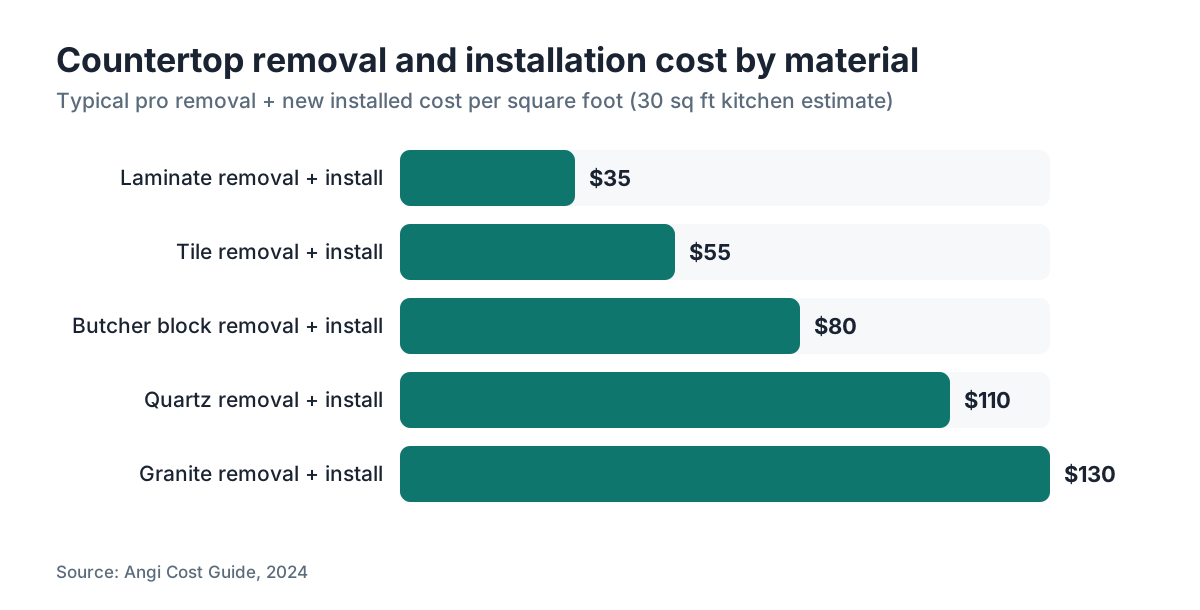
Cost varies by material, crew size, disposal method, and your location. Here's an honest breakdown based on contractor cost data and industry price surveys.
| Countertop type | DIY removal cost | Pro removal cost | New installation cost (pro) |
|---|---|---|---|
| Laminate / Formica | $0, $30 (supplies) | $100, $300 | $20, $50 per sq ft installed [4] |
| Tile | $0, $50 (tools/disposal) | $150, $400 | $25, $65 per sq ft installed [4] |
| Butcher block | $0, $30 | $100, $250 | $40, $100 per sq ft installed [4] |
| Quartz / Engineered stone | $20, $60 (rental) | $200, $600 | $55, $155 per sq ft installed [4] |
| Granite / Natural stone | $20, $60 (rental) | $250, $700 | $45, $200+ per sq ft installed [4] |
Dumping fees add $50 to $150 per truckload at most municipal transfer stations [5]. Some fabricators haul away your old stone slab for free if you're buying from them, so ask before you schedule a separate disposal run.
The total cost to remove and install kitchen countertops rides mostly on square footage and material choice. A 30-square-foot laminate replacement might run $700 to $1,800 all-in (removal, material, and installation). The same project in granite runs $1,800 to $7,000 or more depending on stone grade [4].
Fabricators who use shop quoting software like SlabWise can generate material and labor estimates from a floor plan in minutes. If you're pricing a replacement before you pull the old top, ask a local shop to quote the job digitally. It usually costs nothing and gives you a real number to budget against.
One thing that inflates costs: unexpected substrate damage. If the cabinet top rails are rotted or warped, that's a repair job before the new top goes down. Budget $100 to $300 for substrate leveling and repairs as a contingency [4].
How do you handle backsplash removal when taking out a countertop?
The backsplash complicates things. If your backsplash tiles or stone panels run behind the countertop rather than sitting on top of it, you may crack or chip them when pulling the top away, because the caulk joint acts as a hinge point.
The safest approach: score every caulk bead thoroughly before you apply any upward pressure. Use the utility knife on the wall side of the backsplash-to-countertop joint and the wall side of the backsplash-to-drywall joint. A flexible plastic scraper is less likely to gouge painted drywall than a metal putty knife.
If you plan to replace the backsplash anyway, none of this matters. Tape off the area above the tile with painter's tape, lever the top free, and let the tiles crack. Pull them separately later.
If you want to keep the backsplash intact, work in short sections. Slide the putty knife along the countertop-backsplash joint in 6-inch increments, breaking the bond gradually rather than prying the whole top at once. It takes twice as long but saves the tile.
Drywall damage is common and normal here. Silicone bonds to drywall paper and often pulls the facing off when you pry. Keep a tube of joint compound and a small can of primer on hand for the touch-up.
Can you remove a countertop without damaging the cabinets?
Usually yes, if you're methodical. Two damage scenarios come up over and over: a screw that strips and takes a chunk of the corner block with it, and adhesive that pulls the top rail veneer when the countertop lifts.
For corner block screws, use the right bit size and apply firm downward pressure while turning. A stripped Phillips head responds well to a rubber band laid over the head (the rubber fills the stripped channels). If that fails, use a screw extractor. Forcing the drill on a stripped screw is how you split the corner block.
For adhesive on the top rail, score it with the utility knife along the cabinet rail line before prying. The knife cuts the adhesive bond at the surface rather than tearing the veneer with it. This saves you a cabinet repair most of the time.
Some older kitchens have the countertop glued and nailed from the top (visible nail heads through the surface). In those cases, the top rail veneer is almost certainly going to lift. That's fine if you're replacing the cabinets too. It's annoying if you're not. Patching veneer over a top rail goes faster than most people think: heat-activated edge banding and a household iron handle it in under an hour.
How long does countertop removal take from start to finish?
Laminate or wood tops in a standard 10x10 kitchen: 1 to 2 hours, including sink disconnection and cleanup.
Tile: 2 to 4 hours for the demo work alone, plus disposal time.
Stone slabs (granite, quartz, marble): 2 to 4 hours with two experienced people, longer if the layout is complicated or you're working alone.
The single biggest time variable is unexpected adhesive. A builder who ran construction adhesive along every cabinet rail can turn a 90-minute laminate pull into a 3-hour battle.
If you're having a new countertop installed, the template appointment and the installation appointment are separate trips. Templating happens after removal (the installer needs to see the bare cabinet top), fabrication usually takes 3 to 10 business days depending on the shop's queue, then installation takes 2 to 4 hours [6]. Plan to be without a working kitchen sink for at least 5 to 14 days from removal to reinstall.
Line up your replacement quotes before you pull the old top. Getting quotes for countertop installation while the old surface is still in place means the fabricator sees the space at its easiest, and you don't burn kitchen downtime waiting on numbers.
How do you dispose of an old countertop after removal?
Disposal is the step everyone underplans.
Laminate on particleboard: most curbside services won't take it because of the size. You'll likely need a trip to the municipal transfer station or a junk removal service. Transfer station fees typically run $40 to $150 depending on weight and local rates [5]. Particleboard is not recyclable and goes to landfill.
Natural stone: some stone yards and salvage stores will take granite or marble slabs if they're intact and a desirable color. Worth a phone call. If nobody wants it, stone is heavy enough that junk removal costs more, often $150 to $300 for a full stone countertop.
Tile: same as laminate. Transfer station or junk hauler. Tile is inert and goes to landfill in most jurisdictions.
Butcher block: if it's in decent shape, post it on a local buy-nothing group or Facebook Marketplace. Solid wood gets reused more often than stone. If it's rotted or warped, it's trash.
Recycling options vary by municipality. The EPA treats construction and demolition debris as its own waste stream, separate from household trash [7], which in practice means some jurisdictions run C&D recycling facilities that accept concrete-based substrates. Check your local public works website before assuming everything goes to the landfill.
When should you hire a pro instead of doing it yourself?
Stone removal is the clearest case for hiring out. A 500-pound slab in a tight kitchen with no straight exit path is a back injury and a broken slab waiting to happen if you're not experienced. The $250 to $700 a pro charges for removal is cheap next to an emergency room visit or a cracked slab you were hoping to resell.
Hire out if you have any uncertainty about the gas disconnection for a cooktop or range. Gas work that goes wrong is not a minor inconvenience. Your gas utility will often disconnect the line for free or low cost, so call them before touching a gas flex connector if you're unsure.
Hire out if the countertop is Corian countertops or another solid surface bonded directly to the cabinet with construction adhesive all the way across. Solid surface is lighter than stone, but adhesive-bonded solid surface can need enough prying force that you risk splitting the cabinet face frames without the right technique.
DIY makes the most sense for laminate, tile, and butcher block tops under 8 feet of run, with a straightforward sink (no undermount stone) and standard shutoff valves. Those jobs cost almost nothing to do yourself and need no specialized skill. The risk profile is low.
What do you do after the old countertop is off?
Inspect the cabinet top rails before anything else. Look for soft spots that point to moisture damage from a leaky sink or dishwasher. Press on the wood with your thumb. Good substrate feels solid; rot feels spongy and may leave a dent. Any soft area needs to be cut out and replaced with new 3/4-inch plywood before the new top goes in. A new countertop set on a rotted rail will flex, and a stone slab that flexes will crack.
Check that the rails are level. Put a 4-foot level across the cabinets in both directions. A variance of more than 1/8 inch over 10 feet will cause problems for stone and solid-surface installations. Shim low spots with roofing shingles or composite shims. Plane or sand high spots. Fabricators cannot professionally warrant a stone installation on an out-of-level substrate.
Clean off any old caulk, adhesive, or silicone residue from the top rail. A scraper and a rag with mineral spirits handle most residue. The new installer wants a clean, flat surface.
If the sink rough-in is staying in the same location (most replacements keep the same hole position), measure the new sink cutout dimensions now and compare them to your new countertop order. If you're upgrading to a larger undermount sink, confirm the new cutout fits the cabinet opening. This mismatch delays jobs by a week all the time.
Once the substrate is in good shape, you're ready to bring in a fabricator for templating. For a full overview of what comes next, the kitchen countertops guide covers material selection and the installation process from template to finished install.
Frequently asked questions
Can one person remove a kitchen countertop alone?
Laminate and tile tops, yes. A single 8-foot laminate run weighs 60 to 80 pounds and is manageable solo with careful maneuvering. Stone cannot be safely removed by one person. A 25-square-foot granite countertop can weigh 450 to 500 pounds. You need at least two adults and suction cup handles for any natural or engineered stone slab.
Do you have to turn off the water to remove a countertop?
Yes, every time. Turn off the shutoff valves under the sink before disconnecting supply lines or removing the sink. If the valves are old and won't close fully, shut off the main house water supply. Open the faucet to bleed pressure from the lines before loosening any fittings. Skipping this step will flood your cabinet box.
How do you remove a countertop that has been glued down?
Score the perimeter caulk with a utility knife first, then slide a stiff putty knife or pry bar under the front edge. Apply steady upward pressure rather than sharp jerks. For construction adhesive bonding the top to cabinet rails, short bursts of a heat gun on low can soften the adhesive if prying alone isn't working. Patience beats force every time.
How do you remove a granite countertop without breaking it?
Free all caulk seams first, remove undermount sink clips, and use suction cup handles rated for stone. Lift straight up with two or three people, keep the slab horizontal at all times, and set it flat on moving blankets. Never rest a slab on a single mid-span support; the unsupported weight will crack the stone. Rental suction cups cost about $20 to $30 per day.
How much does it cost to have a countertop removed by a pro?
Professional countertop removal runs $100 to $300 for laminate or tile and $250 to $700 for stone, depending on slab size and access. Disposal adds $50 to $150 at a transfer station. Many fabricators include removal in their installation quote when you're buying from them, so always ask before scheduling separate removal.
Can you remove a countertop without removing the backsplash?
Yes, but you have to cut every caulk seam thoroughly before prying. Score along the backsplash-to-countertop joint and along the backsplash-to-wall joint with a sharp utility knife. Work the putty knife in short sections rather than levering the whole countertop at once. Expect some drywall paper damage at the wall joint regardless of how carefully you work.
How do you remove an undermount sink with the countertop?
The sink comes out before the countertop, not with it. Disconnect plumbing first, then reach into the cabinet and remove every mounting clip from below. The sink should drop slightly once the last clip releases. Have a helper support it from below. The epoxy between the sink rim and stone will resist; score it with a utility knife or thin putty knife run along the inside of the rim.
What happens to my cabinets if I remove the countertop?
The cabinet boxes are structurally independent and will be fine. The top rails may show adhesive residue or minor veneer lifts, both fixable before the new top goes in. Inspect for moisture damage while you have access: soft or discolored wood on the top rail near the sink signals a past leak and needs replacement before new countertops go in.
How do I remove a laminate countertop without destroying it?
Remove all screws from the corner blocks inside the cabinets, score the perimeter caulk cleanly, then lift. Laminate tops are rarely worth salvaging because the particleboard substrate soaks up moisture over time, but if you want to try, avoid prying from the front face. Lever up from the underside at the back edge to protect the exposed laminate surface.
How long before I can have a new countertop installed after removing the old one?
Fabricators template after removal, then fabricate over 3 to 10 business days, then install. Total timeline from countertop removal to a working kitchen is typically 5 to 14 days for stone and quartz. Laminate and prefab tops from home centers can be cut and installed in a day or two. Plan for no working kitchen sink during that window.
Is countertop removal included in most installation quotes?
Not always. Some fabricators include it, others charge separately ($100 to $500 depending on material and square footage), and some don't offer it at all. Ask for an itemized quote that specifies whether removal and haul-away are included. Getting clarity up front avoids a surprise charge on installation day.
Can I reuse my old granite countertop in another room?
Possibly. Granite is durable enough to reuse as a laundry room top, outdoor prep station, or utility surface if it comes out intact. The catch is that kitchen granite is templated to fit one exact space, so you'd likely need it cut down or reconfigured by a stone shop. Most shops cut and polish a salvaged slab for $50 to $200 depending on the cuts required.
Sources
- Marble Institute of America (now Natural Stone Institute), Stone Weight Reference: 3 cm granite weighs approximately 18 to 20 pounds per square foot
- U.S. Consumer Product Safety Commission, Home Improvement Safety: CPSC recommends confirming appliance disconnection before any adjacent demolition work
- Marble Institute of America / Natural Stone Institute, Fabrication Best Practices: Two-part epoxy used for undermount sink attachment is rated at several hundred pounds of pull force
- HomeAdvisor (Angi), Countertop Installation Cost Guide 2024: Countertop installation costs range from $20/sq ft for laminate to $200+/sq ft for premium stone; substrate repairs add $100, $300
- U.S. Environmental Protection Agency, Reducing and Reusing Basics: Transfer station disposal fees typically run $40, $150 per truckload for construction debris including countertop material
- National Kitchen and Bath Association, Kitchen Remodeling Project Timelines: Stone countertop fabrication after templating typically takes 3 to 10 business days; installation takes 2 to 4 hours
- U.S. Environmental Protection Agency, Construction and Demolition Materials: EPA categorizes construction and demolition debris separately from household waste; some jurisdictions operate C&D recycling facilities for concrete-based materials
- Occupational Safety and Health Administration, Ergonomics for the Prevention of Musculoskeletal Disorders: OSHA guidelines recommend two-person lifts for objects over 50 pounds; stone slabs weighing several hundred pounds require mechanical assists or additional workers
Last updated 2026-07-09