TL;DR
- A restaurant countertop quote has four cost layers: material, fabrication, removal and disposal, and installation.
- Commercial jobs add health-code surface rules, food-safe sealers, ADA counter heights, and after-hours labor that can double the complexity of a home job.
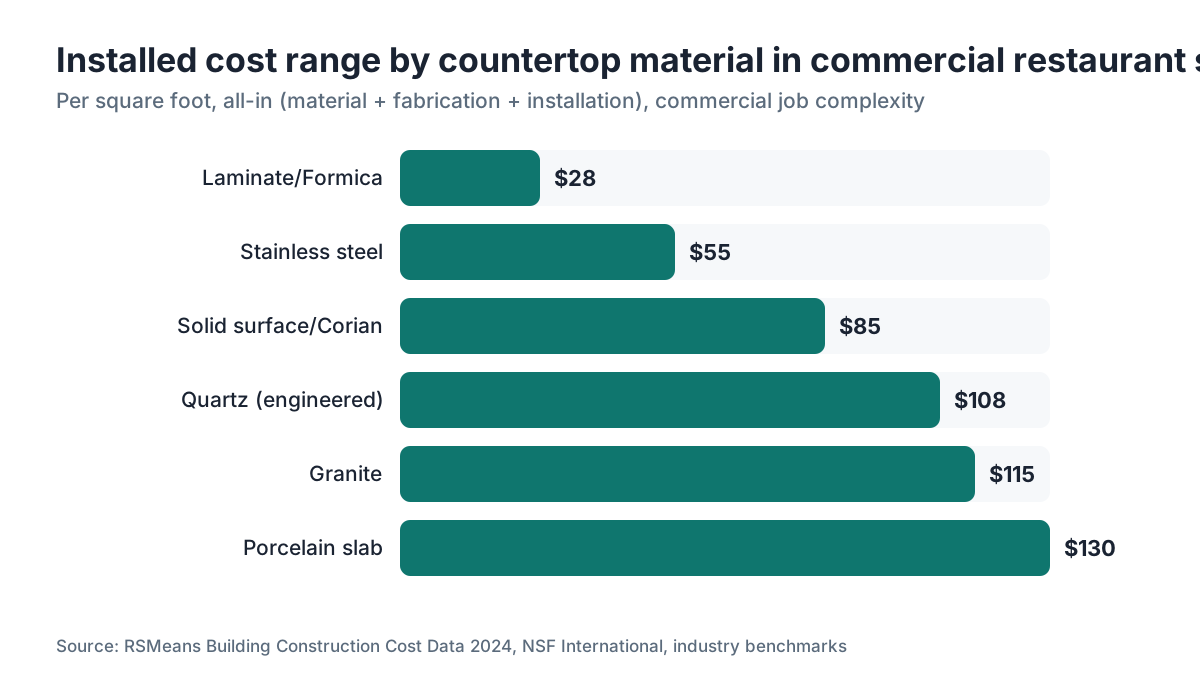
- Expect $45 to $200 per square foot installed depending on material, with commercial complexity adding 20 to 40% over a comparable residential job.
Why restaurant countertop quotes are harder than residential jobs
A home kitchen quote is mostly square footage and edge profiles. A restaurant quote is a small construction project inside a running business. You're dealing with health department surface rules, ADA counter heights, phased installs that keep service running, grease resistance specs, and owners who answer to insurance carriers and landlords before they answer to you.
Fabricators fail here by treating a restaurant like a big house. You measure the bar top, price it like quartz in a condo, and email a number. The owner says yes. Then you show up and find the hood runs 18 inches lower than the plan showed, the substrate is wet OSB under three layers of old laminate, and they need you gone before the lunch rush. That's all money you didn't charge for.
Restaurant owners fail the opposite way, by taking the lowest bid without checking what it covers. A quote that skips demo, disposal, substrate repair, and NSF-compliant sealer is not the same quote as one that includes all of it. Ask every bidder to break their number into line items before you compare.
Commercial food-service countertops get inspected. The FDA Food Code and state health rules spell out what a surface has to do. Surfaces in food-contact and splash zones must be smooth, nonabsorbent, and cleanable [1]. That rules out some materials and finishes, and it means your sealer choice is not cosmetic. It's regulatory.
What materials actually work in a commercial kitchen or bar?
Not every countertop belongs in a restaurant. Here's how the main options hold up under real commercial conditions.
Quartz (engineered stone) is the common pick for bar tops, service counters, and host stations. It's nonporous without sealing, tolerates heat to around 150°F (don't push past that), and wipes clean fast. Installed cost runs $65 to $150 per square foot on a commercial job, depending on edge and thickness.
Granite works in lower-heat prep areas and dining bars. It needs annual sealing in a food-service environment, which is a maintenance conversation you owe the owner at quote time. Some inspectors flag unsealed granite in food-prep zones, so confirm local rules before you spec it. See granite countertops for material properties.
Stainless steel is the standard for true food-prep and back-of-house surfaces. It's what NSF-certified commercial equipment uses. Fabrication is a different trade (usually a sheet-metal shop), and per-foot cost is lower ($30 to $80 installed), but the finish work is a separate skill set.
Laminate still shows up all over lower-budget commercial work: cashier counters, hostess stands, back-office desks. It's approved for food-contact surfaces under the FDA Food Code when it's in good repair and nonabsorbent [1]. Laminate countertops run $15 to $40 per square foot installed, which makes them real for capital-constrained owners. Formica countertops are the dominant brand here.
Butcher block appears in some concepts for the look. It's porous, needs oiling, and is hard to get approved in food-prep zones in most jurisdictions. Some health departments allow it for display or non-prep surfaces. Confirm before you spec it. See butcher block countertops for the details.
Porcelain slab is growing in bar and front-of-house use. Scratch-resistant, nonporous, heat-resistant. Fabrication is demanding (brittle, large format), which drives labor up.
Corian and solid surface (Corian countertops) are approved for food-contact use, can be coved to the wall with no seam at the backsplash (a detail inspectors love), and repair in place. Good for busy bars and service counters where chip repair matters.
| Material | Installed cost/sq ft (commercial) | NSF food-contact friendly | Sealing required | Best use in restaurant |
|---|---|---|---|---|
| Quartz | $65 to $150 | Yes (check brand) | No | Bar tops, host stands, service counters |
| Granite | $70 to $160 | Yes (when sealed) | Yes, annually | Dining bars, lower-heat prep |
| Stainless steel | $30 to $80 | Yes | No | Back-of-house, food prep |
| Laminate/Formica | $15 to $40 | Yes (in good repair) | No | Cashier counters, back office |
| Porcelain slab | $80 to $180 | Yes | No | Bar fronts, decorative counters |
| Solid surface/Corian | $50 to $120 | Yes | No | Busy bars, service lines |
| Butcher block | $40 to $90 | Jurisdiction-dependent | Yes | Display only, confirm locally |
How do you measure a restaurant countertop job accurately?
Measure everything twice, photograph everything once. Restaurants get modified by contractor after contractor over the years, and what the owner thinks the drawing says is rarely what the field shows.
Bring a laser measure, a standard tape, and a 4-foot level. Check every run for plumb and level. A bar top that's out of level by half an inch across 20 feet will gap against the wall and fail inspection.
Measure in place, not from plans. Renovations rarely match original drawings. If the owner hands you a PDF, treat it as a starting point and nothing more.
Key things to capture on site:
- All countertop lengths and depths, including returns and angles
- Sink cutout locations and sink model numbers (you'll need the template or specs)
- Faucet hole locations and quantities
- Cooler insets or drop-in equipment openings
- Edge clearances at walls, columns, and equipment
- Substrate condition (knock on it, look under the overhang, ask when it was last replaced)
- Overhead obstructions, including hood height and any ductwork that limits slab maneuvering
- Door and corridor widths from the truck to the install spot (a 10-foot slab that can't make the hallway turn is a fabrication problem)
For templating, a laser arm or photogrammetry system saves time on irregular shapes like curved bars and custom islands. Templating by hand? Use hardboard or luan, never paper.
Square footage is where measurement starts, not where it ends. Count every cutout, sink, seam, and edge linear foot on its own, because those are all billable line items.
What line items should a restaurant countertop quote include?
This is where fabricators leave the most money on the table. A complete commercial quote covers these categories.
Material cost. Slab price, waste factor (usually 15 to 25% for a restaurant with multiple cutouts and odd angles), plus any specialty-material upcharge.
Fabrication labor. Cutting, shaping, polishing, cutouts, edge profiling. Commercial jobs pack more cutouts per linear foot than residential. A bar top with 12 drain holes and 6 speed-rail cutouts is a different quote than a smooth residential island.
Template fee. Charge for it. If the job doesn't close, you still cover your site visit. Many shops charge $150 to $400 for a commercial template and credit it to the job if it proceeds.
Removal and disposal. Demo of existing tops, disposal fees, hauling. Budget $3 to $8 per square foot for demo labor and add actual disposal from your local transfer station. Don't guess. Call and ask.
Substrate inspection and repair. Old restaurants often hide rotted or delaminated substrate under the old tops. Quote it as an allowance or a separate line with a not-to-exceed ceiling. Find bad substrate you didn't price, and you eat the repair.
Installation labor. Setting, leveling, shimming, scribing to walls, silicone. Commercial installs run slower than residential because clearances are tighter and conditions are rougher.
Sealer. If the material needs sealing (granite, marble, some quartzite), spec the commercial food-safe product, name it, and price the labor. Don't let the owner assume it's included when it isn't.
After-hours or phased premium. If the restaurant needs you working 10 PM to 4 AM to protect service, that's a premium. State it. Night labor typically adds 25 to 50% to installation labor.
Permitting. Some jurisdictions require a permit for commercial interior work above a dollar threshold. Check local rules. The owner may not know they need one.
ADA compliance. If any counter is a service point for customers, the ADA Standards for Accessible Design require part of it to sit at 34 inches maximum height with adequate knee clearance [3]. Modify that counter and you may trigger a compliance requirement. Flag it in your quote. The liability is the owner's, but nobody wants the surprise after install.
Warranty and liability terms. A commercial top takes more abuse than a residential one. Spell out what your warranty covers and what voids it (cutting straight on quartz, drain cleaner on marble, impact from commercial equipment).
How does health code affect material and finish choices?
The FDA Food Code is the baseline federal guidance most states adopt in some form, though each state's health department writes its own rules [1]. For food-contact and food-splash surfaces, the requirement is that they be smooth, nonabsorbent, easily cleanable, and durable. That language sits in Section 4-101 of the Food Code.
In practice:
- Sealed porous stone (granite, marble, quartzite) is acceptable when the sealer is food-safe and maintained; unsealed porous stone is not
- Any surface with visible cracks, chips, or worn finish that blocks cleaning fails inspection
- Grout joints, exposed substrate edges, and raw wood in food-splash zones get failed on sight
- Caulk joints between countertop and backsplash have to stay clean and intact; some inspectors prefer integral coved backsplashes (solid surface does this well)
NSF International certifies equipment and materials for food-service use. NSF/ANSI Standard 51 covers food equipment materials [4]. Some health departments require NSF-listed materials for food-prep surfaces; others just apply the FDA Food Code language. Find out which one your city uses before you spec anything.
For the fabricator, name the finish type and surface roughness in your quote. A polished finish is smoother and more sanitary than honed or leathered. Honed granite in a food-prep area is a harder sell to a health inspector than polished quartz.
How do you handle job scheduling and minimizing restaurant downtime?
Downtime is money for a restaurant, and a fabricator who runs a commercial job like a residential one gets one job and no referrals.
Talk operating hours before you write the quote. Find the slowest window: Monday mornings, late January, the two weeks after New Year's. A bar replacement is much easier to schedule in off-peak weeks.
Plan the phases. Most restaurant countertop swaps can go section by section, keeping part of the operation running. A bar with three sections can often be done over three nights. Price it that way.
Template on day one, fabricate during normal shop hours, install in the off-window. The owner does not want to learn on install day that the slab is two weeks out. Give a fabrication timeline at quote time.
Build in contingency for substrate surprises. If you find rotted decking at 10 PM, you need a plan: proceed, call the owner, or stop and reschedule. Write the protocol into the contract.
On large jobs, tie a milestone payment to each phase. It protects you and keeps the owner engaged with scheduling.
What does a restaurant countertop replacement actually cost?
The honest answer is a broad range, because the variables are large. Here are real benchmarks to work from.
A small fast-casual or café with about 100 square feet of quartz, including demo, fabrication, and install on a single overnight, runs $8,000 to $18,000 total depending on complexity.
A full-service bar top and service counter, 300 to 500 square feet in quartz or granite, with after-hours install and multiple cutouts, runs $25,000 to $75,000. The spread reflects local labor rates and how much substrate repair you hit.
A hotel lobby bar or high-end restaurant with 200 square feet of porcelain slab or premium quartzite, complex shapes, and night work, can run $40,000 to $120,000.
Cost drivers that push numbers up:
- Night or weekend labor premiums
- Sink and equipment cutouts (each adds $150 to $400 in fabrication time)
- Irregular shapes, curves, mitered waterfall edges
- Slab material (quartzite over standard quartz is a $20 to $60 per square foot swing in material alone)
- Substrate repair
- Seam complexity (a long bar with multiple seams that need precise alignment in a dark room is skilled work)
The National Kitchen and Bath Association's 2023 market outlook reported average fabrication revenue per residential countertop job of roughly $3,200 [5]. Commercial restaurant jobs typically run 3 to 8 times that, with the complexity to match.
Pricing your first commercial job? Don't discount to win it. Commercial clients call you back when you do good work, and they refer other restaurants. Price it right the first time.
How do you write the actual quote document for a restaurant client?
A restaurant owner or their general manager will stack your quote against two others. Make it easy to read line by line, and make crystal clear what's in and what's out.
Structure the quote in sections:
- Project summary (address, scope, material spec, timeline)
- Material line items (slab, quantity, color/brand, thickness)
- Fabrication charges (by section or item: top, cutouts, edges)
- Demo and disposal
- Substrate inspection allowance (with escalation language if repair is found)
- Installation labor (note if an after-hours premium applies)
- Sealing (product name, coats, included or separate)
- Permitting (excluded with an explanation, or included as an allowance)
- Payment schedule
- Warranty terms
- Exclusions list (anything a reasonable person might assume is included that isn't)
The exclusions list is not bad faith. It's protection for both sides. If you're not doing plumbing reconnection, say so. If the owner needs to move equipment before you arrive, say so. If the quote assumes the substrate is sound, say so.
Payment terms for commercial: 30 to 50% deposit to order material, a progress payment at template or when the slab lands in your shop, and the balance on completion. Net-30 on the full balance is not appropriate for a small fabrication shop. Get paid before you leave the job.
Running several commercial projects at once? Job-costing software that scores actual time and material against your quote line by line will show you exactly where you're bleeding margin. SlabWise lets you build commercial quote templates with the cutout and after-hours lines already structured, so you don't miss them under pressure.
Send the quote as a PDF with a clear expiration date (30 days is standard; material prices move). Add a signature line or e-sign. A quote that forces the client to call you to accept is a quote that delays your start.
What are the biggest mistakes fabricators make on commercial countertop bids?
Underestimating install time is the most common. A restaurant install is not a kitchen install. You're working around live equipment, in a space never designed for construction access, often at night, and the substrate is an unknown until you're in it.
Missing the seams. A 20-foot bar counter will have seams. Where they land matters, both to the eye and to the structure. Planning seam placement takes time that has to live in your labor estimate.
Skipping the site visit. Quoting off photos or a phone call is how a 34-inch hallway your slab can't clear becomes your problem. Always go, or send someone.
Assuming the owner knows what they want. Plenty of restaurant owners are buying countertops for the first time. They saw a material they liked on Instagram and have no idea it's high-maintenance stone in a kitchen. Material education is part of the job. Skip it and you're in a warranty dispute six months later when the marble by the bar gun is etched.
Ignoring the general contractor. On a renovation there may be a GC coordinating trades. Before you quote, find out whether you're working directly with the owner or under a GC. GC relationships bring markup, insurance requirements, certified payroll in some states, and different invoicing terms.
Carrying the wrong insurance. Commercial work often demands higher general liability limits than residential, sometimes $2 million per occurrence. Confirm your policy before bidding. Restaurant groups and hotel chains often want a certificate of insurance before they award the job [7].
ADA requirements: what does the fabricator actually need to know?
The ADA Standards for Accessible Design, issued by the U.S. Department of Justice and the U.S. Access Board, require at least one portion of any sales or service counter to be no higher than 34 inches above the floor [3]. That covers any counter where transactions or services happen, so a bar counter, a host stand, a café order counter, and a cashier area all potentially trigger it.
Replace those counters and you may be required to bring them into compliance. Under the ADA, alterations to an existing facility must comply with the standards to the maximum extent feasible [3]. That phrase has legal wiggle room, but flag the requirement in your quote and let the owner (and their attorney or contractor) make the call. Don't ignore it.
What that means on site: measure the existing counter height. If it's 36 inches across the board and a service transaction happens there, the owner has a compliance question. You're not the code enforcer, but don't install a noncompliant counter without documenting that the owner was told.
Knee clearance under the accessible section (27 inches high, 19 inches deep minimum) matters if you're fabricating that section. It drives substrate design and whether a cabinet goes below.
The U.S. Access Board publishes the full ADA Standards for Accessible Design and guidance documents on its website [3].
How do you close the sale with a restaurant owner or manager?
Restaurant owners decide fast or not at all. If they like you and trust your quote, they move. If there's ambiguity, they stall until they get a third bid, then pick by price.
The close starts at the site visit. Show up on time, bring samples, ask real questions about the operation. Learn their busiest service and their best window for downtime. Owners remember the fabricator who listened.
Answer the timeline question before they ask it. Tell them when you can template, how long fabrication takes (usually 5 to 10 business days for stone), and when you can install. A concrete schedule sells harder than a low price.
Offer a reference from another commercial job if you have one. Restaurants talk. A bar owner who calls a friend across town and gets a good report signs faster than one making a blind bet.
On price: don't drop your labor rate. If you need to find savings, offer a material alternative or a simpler edge. Full bullnose on a 40-foot bar adds real polishing time. An eased or beveled edge gets the look for less. That's a genuine concession that leaves your margin intact.
Want to know which commercial bids close and at what margin? Keeping quote data in one place matters. SlabWise's quoting module shows your win rate by job type, which raises the real question: are you competitive, or are you winning everything because you're underpriced?
Get a signed contract, not a verbal handshake. Commercial restaurant work is a big enough number that a handshake protects neither party. Your contract should reference the quoted scope, the payment schedule, and what happens when substrate conditions differ from what you assumed.
What questions should a restaurant owner ask before signing a countertop fabrication contract?
If you're the owner reading this, here's your checklist before you sign.
Is the quote all-in? Ask the fabricator to confirm in writing that it includes demo, disposal, substrate inspection, and installation. Get a list of what's excluded.
What material is spec'd, and does it fit your use? Polished quartz for a bar that serves hot plates is fine. Honed marble for a prep counter is a maintenance headache. Ask for written maintenance requirements.
What's the install schedule and what's on you? Do you move equipment? Cut water to the bar? Have staff on hand to accept delivery? Know it in advance.
What happens if they find bad substrate? Ask for the escalation process and the maximum additional cost.
What warranty is included? Get it in writing. Ask exactly what voids it.
Are they licensed and insured for commercial work in your state? Ask for a certificate of insurance. Contractor licensing rules vary by state [6]. In California, a C-54 (tile) or C-61 (specialty) license covers countertop work; Texas handles licensing differently. Check your state's contractor licensing board.
Will the finished surface pass health inspection? Ask the fabricator to confirm the material and finish will pass your local health department. If they've done other restaurant work locally, they should know.
For care after install, see how to clean stone countertops for general guidance, and countertop installation for what to expect on install day.
Frequently asked questions
How long does a restaurant countertop replacement take from start to finish?
From signed contract to finished install, budget 3 to 4 weeks for a typical stone job. Template happens on day one or two, fabrication takes 5 to 10 business days after template for stone, and install runs one to three nights depending on scope. Laminate or solid surface jobs move faster, sometimes two weeks total. Material availability is the most common delay, so confirm lead times before you lock a schedule with the restaurant.
Can a restaurant stay open during countertop replacement?
Usually yes, if the work is phased or scheduled off-hours. Most fabricators with commercial experience plan installs for night or early-morning windows to protect service. Sections of a bar or service counter can come down and get replaced while adjacent sections stay in use. Talk through the phasing plan at the quote stage. A fabricator who claims they can do it all in one shot with zero disruption should explain exactly how.
What surface finish is best for restaurant countertops from a sanitation standpoint?
Polished is the safest choice for health inspections. A polished surface has lower microscopic roughness than honed, leathered, or brushed finishes, so it wipes clean faster and traps less bacteria in tiny pits. Some inspectors are unfamiliar with honed finishes and flag them even when the material is technically nonporous. For food-contact or food-splash zones, polished finish is the path of least resistance.
Do I need a permit to replace restaurant countertops?
It depends on jurisdiction and scope. Replacing a countertop in-kind usually needs no building permit in most cities. But if the work touches plumbing rough-in, structural substrate, or the job value tops a threshold (often $500 to $1,000 depending on the city), a permit may be required. The owner or general contractor usually handles permits, but as the fabricator you should flag the question in your quote rather than assume it's covered.
How much does it cost to replace a bar top in a restaurant?
A bar top replacement in quartz or granite, including demo, fabrication, and after-hours install, typically costs $150 to $350 per linear foot of bar for a full-service job. A 30-foot bar runs $4,500 to $10,500 in material and fabrication alone, before night-labor premiums. Total project cost with substrate repair and sealing often lands at $8,000 to $25,000 for a mid-size bar. Porcelain slab or premium stone pushes higher.
What is the most durable countertop material for a high-traffic restaurant?
Quartz and stainless steel are the most durable options for high-traffic food service. Quartz resists staining without sealing, handles commercial cleaners better than natural stone, and stays consistent across the slab. Stainless is the standard for back-of-house prep. For front-of-house bars and service counters, quartz is the practical pick for most operators. Porcelain slab beats quartz on scratch resistance but is brittle and harder to repair if it chips.
How do I compare countertop quotes from different fabricators?
Ask each fabricator for an itemized breakdown: material, fabrication, demo, disposal, install, sealing, and any after-hours premium. Confirm every quote covers the same scope. A quote that skips demo looks cheaper but isn't. Check what each warranty covers and for how long. Ask for references from other commercial restaurant jobs. Price alone is the wrong comparison metric; timeline certainty and commercial experience matter more on a restaurant job.
What should be in the contract for a restaurant countertop job?
The contract should name the full scope with material spec, color, thickness, and edge profile; the payment schedule; the install date or window; escalation language for substrate surprises; an exclusions list; warranty terms and what voids them; and the change-order process if scope shifts. For commercial jobs, also include liability limits, insurance requirements, and what happens if the owner delays access. Both parties sign before material is ordered.
Can marble be used in a restaurant?
Marble can go in a restaurant, but it's high-maintenance in any food-service environment. It etches from acids (citrus, wine, vinegar, many cleaners) and stains if unsealed. Front-of-house decorative surfaces with low liquid exposure are the reasonable use. In bar tops or prep areas where spills never stop, marble looks damaged fast. If an owner insists on it, document the maintenance requirements in writing and have them sign off. See marble countertops for the properties.
How do you price after-hours installation for a restaurant?
Night and weekend labor typically adds 25 to 50% to your installation labor line. Take your crew's base hourly rate, apply the premium, and estimate the hours including setup, install, cleanup, and travel. Add a buffer for the unexpected; commercial installs at night with nobody around to answer questions run longer than daytime residential jobs. Be explicit in your quote that after-hours work carries a premium instead of burying it in the total.
Does ADA apply to restaurant countertops?
Yes. The ADA Standards for Accessible Design require at least a portion of any sales or service counter to be no higher than 34 inches above the floor. That covers host stands, bars, café order counters, and cashier areas. When you replace these counters, you may trigger an obligation to bring them up to current ADA standards. Fabricators should flag this in the quote and let the owner determine compliance; installing a noncompliant counter without disclosure is a liability risk for both parties.
What is a reasonable warranty for commercial countertop fabrication?
One to two years on fabrication workmanship (seams, edge polish, cutout quality) is typical for commercial jobs. Material manufacturer warranties vary: engineered quartz brands often offer 10 to 15 year limited warranties, though commercial-use terms are frequently shorter or separate from residential. Be clear about what voids your warranty, including impact damage, wrong cleaning chemicals, or heat damage from commercial equipment. Don't reuse your residential warranty terms without adjusting for commercial abuse.
What is NSF certification and does it matter for restaurant countertops?
NSF International certifies food equipment and materials under NSF/ANSI Standard 51, which covers materials safe for food-contact surfaces. Some local health departments require NSF-listed materials for food-prep surfaces; others use the broader FDA Food Code language about smooth, nonabsorbent, and cleanable surfaces. Ask your local health department which standard applies before you spec materials. Many quartz brands aren't NSF-listed as a product, yet the material may still meet FDA Food Code standards.
How do you handle seams in a long restaurant bar top?
Plan seam locations at the quote and template stage. Seams should land at structural support points, not mid-span over open cabinet space. On a bar top, place them where they'll be least visible and out of the splash zone. Color-matched epoxy done well on polished quartz reads at about 1mm from the surface; done poorly, it's obvious. Budget seam time in your labor estimate. A 30-foot bar might carry two to four seams, and each one is a skilled step, not an afterthought.
Sources
- U.S. Food and Drug Administration, FDA Food Code 2022: Food contact surfaces must be smooth, nonabsorbent, easily cleanable, and durable under FDA Food Code Section 4-101
- NSF International, NSF/ANSI 51 Food Equipment Materials Standard: NSF/ANSI 51 covers certification of materials used in food equipment and contact surfaces for commercial food service
- U.S. Access Board, ADA Standards for Accessible Design: ADA Standards require at least one portion of a sales or service counter to be no higher than 34 inches above the floor, and alterations must comply to the maximum extent feasible
- NSF International, Food Equipment Certification: NSF/ANSI Standard 51 specifies requirements for materials used in the construction of food equipment, including countertop surfaces in food-preparation areas
- National Kitchen and Bath Association, 2023 Kitchen and Bath Market Outlook: Average fabrication revenue per residential countertop job was approximately $3,200 in the NKBA 2023 market survey
- California Contractors State License Board, License Classifications: Contractor licensing requirements for countertop installation vary by state; California requires a C-54 or C-61 specialty license for countertop work
- U.S. Department of Justice, ADA.gov Title III Technical Assistance: Title III of the ADA requires places of public accommodation, including restaurants, to comply with ADA Standards when making alterations to existing facilities
- U.S. Small Business Administration, Regulations for Food Service Businesses: Food service businesses are subject to federal and state health codes governing food contact surfaces and facility conditions
- Occupational Safety and Health Administration, Construction Industry Standards 29 CFR 1926: Commercial construction work including countertop installation in occupied food-service facilities is subject to OSHA construction standards for worker safety
- RSMeans Building Construction Cost Data 2024: Commercial countertop installation labor rates and material cost benchmarks used in construction estimating nationally
Last updated 2026-07-11