TL;DR
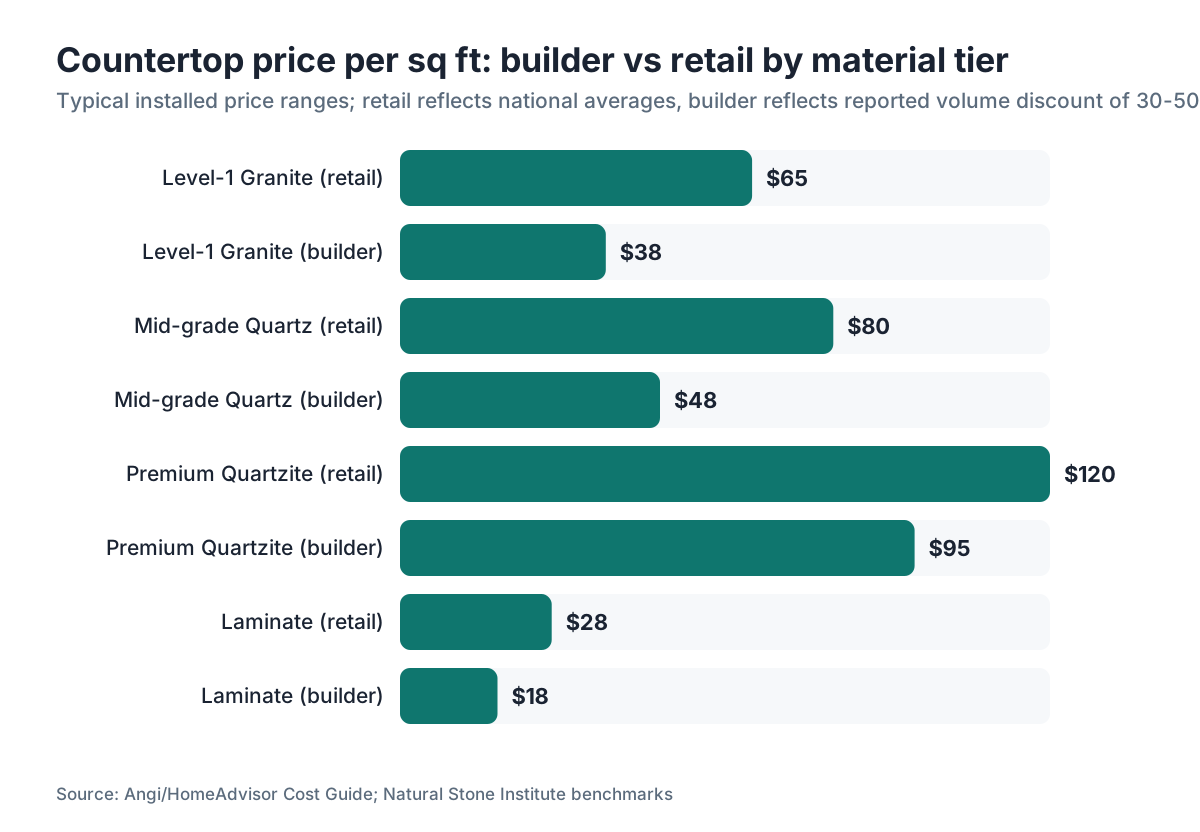
- Builder accounts typically pay 30 to 50 percent less than retail customers for the same countertop material.
- Fabricators justify the discount through volume, predictable scheduling, and faster payment terms.
- Retail pricing covers showroom time, design consultations, and one-off installs.
- This article breaks down how to structure both tiers, what margins to target, and how homeowners can sometimes reach builder-adjacent pricing.
What is the actual price difference between builder and retail countertops?
Builders typically pay 30 to 50 percent less than a retail homeowner for the same slab and edge profile. On a granite kitchen that retails for $4,500, a tract-home builder might pay $2,250 to $3,150 for identical scope. That gap is not a secret discount the fabricator hides from retail buyers. It reflects real structural differences in how those two jobs land on the shop floor.
Retail jobs are expensive to sell. A homeowner books a showroom visit, spends an hour or two picking slabs, asks about seventeen edge profiles, and then changes the sink cutout twice after templating. Sales and design time on a single retail kitchen can run two to four hours before anyone makes a cut [1]. Builder jobs arrive with a spec sheet and a purchase order. No hand-holding. No showroom overhead.
The price difference also reflects risk and predictability. A builder sending 10 to 30 kitchens a month gives a fabricator steady machine time and predictable labor scheduling. That has real dollar value. A one-time retail customer does not.
How do fabricators calculate their retail countertop pricing?
Most fabricators start with material cost per square foot, then apply a multiplier to cover labor, overhead, and margin. A common retail multiplier runs 3x to 4x on installed material cost for entry-level granite or quartz. On premium materials it compresses toward 2x to 2.5x because the slab itself is already expensive and customers get price-sensitive at the top of the market.
Here is a simplified retail cost build-up for a typical kitchen:
| Cost component | Example amount |
|---|---|
| Slab material (35 sq ft at $18/sq ft wholesale) | $630 |
| Fabrication labor (cutting, polishing, edge) | $420 |
| Template and install labor | $280 |
| Shop overhead allocation | $210 |
| Sales and design time | $160 |
| Target margin (18-25%) | $340 |
| Retail customer price | ~$2,040 |
That works out to roughly $58 per square foot installed, which lines up with published national averages for mid-grade granite. HomeAdvisor's aggregated data puts granite countertop installation at $40 to $100 per square foot installed, with the national average around $60 to $75 [2]. Entry-level quartz runs a bit higher on material but the labor math is similar.
Fabricators who do not separate these line items often find their margins are thinner than they thought. If you run a shop and you do not know your fabrication labor cost per square foot independent of material cost, you are guessing at your own price floor.
How should a fabricator structure builder account pricing?
Builder pricing is more than a discount off retail. It needs its own logic anchored in your actual costs at builder volume. The framework:
Set a true cost floor first. Know your all-in cost per square foot including material, labor, overhead, and a thin margin. For most mid-size shops fabricating granite or quartz, that floor lands somewhere between $28 and $42 per square foot depending on local wages, equipment depreciation, and material sourcing [3]. No builder job should go below that floor, regardless of volume promises.
Price by tier, not by negotiation. The worst pricing structure is one where every builder gets whatever they can talk you into. You end up with five different builders paying five different prices, resentment when they compare notes, and no way to predict your own revenue. Build two or three named tiers instead. A common structure:
| Tier | Volume threshold | Discount off retail |
|---|---|---|
| Preferred Builder | 6+ jobs/month | 25-30% |
| Volume Builder | 15+ jobs/month | 35-42% |
| Tract/Production Builder | 30+ jobs/month | 45-50% |
Build in payment terms as a condition. Builder discounts assume fast, reliable payment. Net-15 or net-30 with a credit application is reasonable. A builder who pays in 90 days is not actually a preferred customer regardless of volume, because you are financing their project. Price the cost of that float back in, or make payment terms a condition of the tier.
Include upgrade pricing in your builder schedule. Most builder contracts specify a base material (often a level-1 granite or quartz). When a homeowner upgrades to level-2 or level-3 at the design center, you need a clear price schedule for those upgrades. Set them in advance with the builder. Negotiating upgrade pricing job-by-job with a builder's design center coordinator is a time sink.
What margin should fabricators target on builder vs retail jobs?
Gross margin targets differ a lot between the two channels, and that is by design.
Retail jobs should carry 35 to 50 percent gross margin (price minus direct material and direct labor). That sounds high, but retail has real overhead: showroom rent, a salesperson or designer, longer install windows, higher customer service costs. A retail job that clears 30 percent gross margin often nets out below 15 percent after overhead allocation.
Builder jobs can run at 18 to 28 percent gross margin and still turn a profit because overhead per job is much lower. No showroom time. Templating is faster because cabinet tolerances are tighter on new construction. Installs cluster geographically. Your truck and crew run three or four stops in the same subdivision instead of driving across the metro.
The trap fabricators fall into is treating builder margin as a discount on their retail margin target. That framing pushes you to underprice retail (because you see the builder number as your baseline) or overprice builder (because you anchor on the retail premium). They are separate channels with separate cost structures. Model them separately.
Shops that run both channels well usually find that builder volume covers fixed overhead (equipment, facility, core labor) while retail margin funds profit and growth capital. That is a reasonable and intentional business design, not a problem.
What do builders actually look for when choosing a countertop fabricator?
Price matters, but it is rarely the only driver and often not the biggest one. Builders get burned by fabricators who miss schedule far more often than they get burned on price. A countertop that arrives late holds up cabinet hardware, appliance delivery, and the final walkthrough. On a tract home, a one-week delay on countertops can push closing and cost the builder more in carry costs than any countertop discount is worth.
Beyond schedule reliability, builders care about:
Consistent quality on commodity materials. They are not usually specifying exotic stone. They need clean edges, accurate cutouts, and no callbacks on level-1 and level-2 materials. A fabricator with tight quality control on standard jobs is worth more than one with a fancy showroom.
Clean billing and paperwork. Builder AP departments process high volume. Invoices that match the PO exactly, with the right lot numbers and addresses, get paid. Invoices that require a phone call to sort out get deprioritized. This sounds trivial. It matters enormously for cash flow.
A single point of contact. Builders want one person who owns their account, knows their spec book, and solves problems without escalation. If your shop has no dedicated account management for builder relationships, that is a gap worth fixing before you pitch volume pricing.
Fabricators who compete on price alone for builder accounts tend to attract builders who leave the moment someone comes in 5 percent cheaper. Fabricators who compete on reliability and ease of doing business build relationships that last years.
Can a homeowner get builder-level countertop pricing?
Rarely, and usually only through indirect channels. A homeowner remodeling a single kitchen is not going to walk into a fabricator and get volume pricing. The cost structure does not support it.
There are a few situations where retail customers can reach pricing closer to builder rates:
Buying through a builder's design center. Some production builders let buyers select non-standard upgrades through their design center even on existing homes, especially during model-home closeouts or in planned communities. The fabricator is already on contract with the builder, so the pricing reflects that relationship.
Working with a contractor who has a fabricator relationship. A kitchen remodeling contractor who does real volume with a local fabricator often passes some of that value to their customers, either in price or in scheduling priority. If you are doing a full kitchen remodel, ask your contractor who they use for stone and whether there is a trade account.
Buying remnants. Fabricators cut large slabs and have leftover pieces called remnants. A smaller kitchen or bathroom can often be cut from a remnant at a steep discount, sometimes 40 to 60 percent off the cost of ordering a full slab [4]. This is not builder pricing exactly, but it achieves a similar result for the right project.
Homeowners should also understand that some fabricators do not take retail customers at all. Production shops focused on builder volume may not have the showroom setup or the sales staff to handle retail well. That is not a slight. It is a business model choice, and it usually means the shop is very good at what it does for builders.
How does material selection affect the builder vs retail pricing gap?
The gap between builder and retail pricing is widest on commodity materials and narrowest on premium stone. Here is why.
On a level-1 granite or an entry-level quartz, the material cost is low and fabrication is straightforward. Retail margin on these jobs is often inflated relative to actual cost because the shop needs to cover sales overhead. The builder, who generates no sales overhead, gets a much leaner price. The gap can hit 50 percent on a basic colonial white granite kitchen.
On a premium natural stone like a quartzite or a book-matched marble slab, the material cost dominates the total price. A slab that costs $800 wholesale leaves less room for percentage-based discounts before you hit your cost floor. The gap on these premium jobs might only run 15 to 25 percent between builder and retail, and the builder probably is not specifying book-matched marble in a tract home anyway.
For fabricators pricing a material menu for a builder contract, the practical move is to set builder pricing as a fixed dollar amount per square foot by material tier, not as a percentage discount off retail. This protects your margin on commodity materials and keeps the builder from reverse-engineering your retail markup.
For homeowners, this dynamic means granite countertops and laminate countertops show the biggest spread between what you pay retail and what a builder pays. Marble countertops and other premium materials show a smaller gap in percentage terms, though the absolute dollar amounts can still be large.
What should a fabricator include in a builder pricing agreement?
A verbal understanding is not a builder account. If you are going to offer discounted pricing, put it in writing. The agreement does not need to be a heavy legal document (though having an attorney review it once is smart), but it needs to cover:
Volume commitments. The discount assumes volume. Define what happens if volume drops below the threshold. Either the pricing reverts to the next tier or you renegotiate. Without this clause, you are locked into low pricing even when the builder's activity dries up.
Material specifications. List the exact materials covered by the builder pricing. Edge profiles, sink cutout types, and standard sizes should all be defined. Anything outside the spec is priced as an upgrade. This prevents scope creep and billing disputes.
Lead times and scheduling windows. Define how much notice you need for template and install appointments, and what happens when a builder misses a scheduled slot. Missed appointments cost you real money in labor scheduling. A missed appointment fee or a rescheduling policy protects you.
Change order policy. New construction generates changes. Cabinets get moved, islands get resized, sinks change. Define how changes are priced and who authorizes them. A change order signed by the builder's site supervisor, not the subcontractor's framer, prevents he-said-she-said situations.
Warranty terms. Be explicit about what you warranty and what you do not. Natural stone movement, substrate settling, and improper support are not your responsibility. Put it in writing so a callback three years later does not become your cost.
Shops running high volumes of builder work should also track cost per job against their contracted rate quarterly. Material costs move. Labor costs move. A builder contract priced 18 months ago may no longer be profitable at current costs. Build in annual review language.
How does quoting software change the math on builder vs retail pricing?
Manual quoting is the single biggest source of margin leakage in fabrication shops. When a salesperson quotes a builder job from memory or from a price sheet they have not updated in six months, they underprice edge work, forget to charge for complex cutouts, or use stale material costs. On a retail job, that error hurts once. On a builder contract with 200 kitchens a year, that error compounds.
Quoting software that integrates material costs, edge pricing, and cutout complexity gives you a real-time cost floor on every job before the quote goes out. For builder accounts specifically, the ability to build a pricing template around a builder's spec sheet and run quotes in under five minutes is a real operational advantage. It also gives you an audit trail when a builder disputes a line item.
SlabWise (slabwise.com) is built for this workflow: fabricators can create builder-specific price books, run quotes against live material costs, and see margin at the quote stage rather than discovering it at month-end. If your shop is doing more than 20 builder jobs a month on spreadsheets, the time cost of manual quoting alone probably justifies a software review.
For homeowners, knowing that fabricators use pricing software means the quote you get is usually not pulled from thin air. It reflects real cost inputs. The variation between quotes from different shops reflects differences in overhead, material sourcing, and margin targets, not one shop being more honest than another.
What are the tax and accounting differences between builder and retail countertop sales?
This matters more than most fabricators realize, and the rules vary by state.
In most states, the sale of fabricated stone countertops is treated as a retail sale subject to sales tax when sold to a homeowner. The fabricator collects tax on the full price. When selling to a builder or general contractor for incorporation into a new structure, the tax treatment can differ. Some states treat the contractor as the end consumer (tax is paid on materials at purchase, not collected on the installed price). Others treat the sale as tax-exempt at the supply stage if the contractor holds a valid resale or contractor exemption certificate [5].
The practical implication: before you set up a builder account, verify how your state taxes contractor sales of fabricated materials. If you should be collecting tax on builder sales and you are not, that is a liability. If the builder should be providing you an exemption certificate and they have not, that is also a liability on your books.
For new construction specifically, the IRS has no separate category for countertop installation, but the builder's accountant may capitalize countertops as part of the property cost basis, which affects how they track the purchase. That is the builder's tax issue, not yours, but understanding it helps when builders ask for documentation or invoice formatting that supports their accounting.
If you operate in multiple states (delivering across a state line is common in metro areas), you may have nexus in states where you install. Talk to a CPA who handles construction contractor taxation before you expand geographic reach significantly [6].
How should fabricators handle pricing when a builder's market changes?
Builder activity is cyclical. When housing starts drop, builders press their vendors on price. When starts are high, builders need volume and reliability more than the lowest number. Fabricators who set fixed builder pricing and never revisit it through cycles often get locked into unprofitable contracts at the bottom or leave money on the table at the top.
The U.S. Census Bureau tracks monthly housing starts, and the data is worth watching if builder work is a big share of your revenue [7]. A sustained drop in single-family starts in your metro is a leading signal that builder volume will compress. If you see that coming, it is better to have a pricing review conversation early than to be told a builder is going to a competitor six months later.
Practically, the best protection is the annual review clause mentioned above, combined with a material cost escalator. Language like "pricing adjusts annually based on wholesale material index changes exceeding 5 percent" protects you from a year where slab costs jump without any ability to reprice. Several stone industry trade publications track wholesale slab pricing indices, and the Natural Stone Institute (formerly the Marble Institute of America) publishes industry data that works as a reference benchmark [8].
Fabricators who spread their channel mix, keeping builder volume to 50 to 60 percent of revenue while holding an active retail book, ride out cycle volatility better than shops that go all-in on builder. The retail channel has higher margin and runs on remodel activity, which does not track new construction perfectly. When builders slow down, remodels often pick up as homeowners invest in existing homes rather than trading up.
Frequently asked questions
How much of a discount do builders typically get on countertops?
Builders generally pay 30 to 50 percent less than retail customers for the same material and edge profile. The exact discount depends on monthly volume, payment terms, and job complexity. A builder sending 6 to 10 jobs per month might get 25 to 30 percent off. A production builder doing 30 or more jobs per month can negotiate 45 to 50 percent off retail pricing.
What is a level-1, level-2, or level-3 countertop and how does that affect pricing?
Fabricators and builders use material tier levels to organize their price schedules. Level-1 covers the most common, readily available materials (basic granite or entry-level quartz). Level-2 moves into more varied colors and patterns. Level-3 covers exotic or premium stone. Builder contracts usually specify a base level included in the home price, with upgrade pricing defined separately for higher levels. The gap between retail and builder pricing is widest at level-1.
Can a homeowner negotiate countertop prices with a fabricator?
Yes, but the room to negotiate is limited without volume. The most effective tactics: paying cash or check rather than card (saves the fabricator 2 to 3 percent in processing fees), being flexible on scheduling (off-peak slots have lower labor costs), and asking about remnant material for smaller projects. Asking for a builder-level discount without builder volume usually does not work because the cost structure genuinely differs.
What payment terms are standard for builder countertop accounts?
Net-15 or net-30 is the most common expectation fabricators set for builder accounts. Some large production builders push for net-45 or net-60, which fabricators should price into the contract or decline. Payment at template or payment at install (rather than after closing) is a reasonable ask for smaller builders with less established credit. A signed credit application with trade references is standard before extending any terms.
Should a fabricator require a minimum volume commitment to offer builder pricing?
Yes. Builder pricing without a volume floor is just a discount with no upside. A reasonable minimum is 4 to 6 jobs per month to reach the first tier of builder pricing. Write this into the agreement with a clause that pricing reverts to standard trade or retail rates if volume falls below the threshold for two consecutive months. This protects your margin and gives the builder a clear reason to consolidate their countertop work with you.
How does edge profile pricing work in a builder contract?
Builder contracts almost always specify one standard edge profile included in the base price, typically an eased or beveled edge. Upgrades to ogee, waterfall, or other decorative profiles are priced as line-item adds. Define these upgrade prices in the contract as fixed dollar amounts per linear foot, not as a percentage of the job. This prevents billing disputes and gives the builder's design center accurate upgrade pricing to present to buyers.
What is a sink cutout and how should it be priced for builder accounts?
A sink cutout is the hole cut in the countertop for an undermount or drop-in sink. Standard cutouts are usually included in builder pricing. Complex cutouts (farmhouse sinks, double cutouts, or non-standard configurations) should be priced as upgrades. A typical add runs $75 to $150 per non-standard cutout for builder accounts, and $100 to $200 for retail customers. Define what counts as standard in the contract to avoid disputes.
How do I find out if a builder account is actually profitable for my shop?
Track cost per square foot by channel, more than revenue. Pull your last 90 days of builder jobs and calculate: total material cost plus direct labor divided by total square feet produced. Compare that to your contracted builder price per square foot. If the gap is less than 15 percent, you are likely unprofitable after overhead. Most shops find they need at least 18 to 22 percent gross margin on builder work to cover indirect costs and justify the account.
Do fabricators charge differently for countertop installation in new construction vs remodels?
Often yes, and legitimately so. New construction installs are generally faster and cheaper: cabinets are clean, there is no existing countertop to remove, and the site is accessible. Remodel installs add demolition time, haul-away costs, and the risk of damaging existing finishes. Retail remodel jobs typically carry a $150 to $300 premium for removal and haul-away compared to new construction installs of the same size.
What is the difference between a trade account and a builder account at a stone fabricator?
The terms get used interchangeably but there is a useful distinction. A trade account typically means any professional who buys regularly, including kitchen designers, contractors, and remodelers. Builder accounts specifically mean volume new construction. Trade accounts often get 10 to 20 percent off retail. Builder accounts get deeper discounts (30 to 50 percent) in exchange for higher volume and simpler jobs. Some fabricators keep separate pricing schedules for each.
How does countertop pricing vary by material type for builders?
Granite and basic quartz dominate builder volume, and those are where builder pricing is most aggressively discounted. Porcelain slabs are growing in new construction because of their cost predictability. Premium materials like quartzite or natural marble rarely appear in builder specs except at the luxury end. For a fabricator, having a clear price-per-square-foot by material and tier in your builder contract is far cleaner than percentage discounts that swing with retail.
Should a small fabrication shop pursue builder accounts or focus on retail?
Depends on your capacity and cost structure. Builder accounts need production consistency and fast turnaround. If your shop has one or two CNC machines and relies on custom work, builder volume can overwhelm capacity and erode quality. Retail margins are better and the work is more flexible. Builder volume makes sense if you have reliable equipment, a dedicated install crew, and the administrative setup to handle high-volume billing and scheduling reliably.
How often should a fabricator review their builder account pricing?
At minimum annually, ideally every six months if material costs are volatile. Stone slab wholesale prices have moved significantly in recent years due to import costs and fuel surcharges. A contract priced in a flat-cost environment can turn unprofitable fast when material costs spike. Build an annual review clause into every builder contract and track your actual margin per job monthly so you catch problems before they compound over a full year.
What countertop materials are most commonly specified in builder accounts?
Level-1 and level-2 granite and quartz make up the bulk of builder countertop volume in most U.S. markets. Laminate remains common in entry-level and affordable housing. Quartz has grown its share in mid-market new construction significantly over the past decade because of its consistency and low maintenance. Premium materials are rare in standard builder specs but appear in luxury custom home builder contracts, where the pricing dynamics run closer to retail than to production builder accounts.
Sources
- Natural Stone Institute, Industry Benchmarking Data: Sales and design time for retail countertop customers averages significantly more per job than for builder or trade accounts due to showroom consultations and change requests
- Angi (HomeAdvisor), Granite Countertops Cost Guide: Granite countertop installation costs $40 to $100 per square foot installed nationally, with averages around $60 to $75 per square foot
- Bureau of Labor Statistics, Occupational Employment and Wage Statistics: Stone fabrication labor wages vary significantly by region, informing shop cost-per-square-foot floors for quoting purposes
- Natural Stone Institute, Remnant Slab Practices: Stone countertop remnants are often available at 40 to 60 percent below full-slab pricing for smaller bathroom and kitchen projects
- Federation of Tax Administrators, State Sales Tax on Construction Contractors: State tax treatment of fabricated materials installed by contractors varies: some states tax the contractor as end consumer on materials, others require collection at point of sale to the homeowner
- IRS, Publication 334: Tax Guide for Small Business: Businesses operating across state lines may have sales tax nexus obligations in states where they perform installation services
- U.S. Census Bureau, New Residential Construction (Housing Starts): Monthly single-family housing starts data from the Census Bureau is a leading indicator of builder countertop volume demand for fabricators
- Natural Stone Institute, Market and Industry Statistics: The Natural Stone Institute publishes wholesale slab pricing benchmarks and industry economic data used by fabricators to index builder contract pricing
- Natural Stone Institute, Fabricator Business Practices Survey: Fabricators who diversify between builder and retail channels report more stable annual revenue than those concentrated in a single channel
- Small Business Administration, Pricing Strategy for Service Businesses: Gross margin targets for skilled trade service businesses typically range from 30 to 50 percent on retail sales to cover overhead and yield net profit
Last updated 2026-07-11