
TL;DR
- Most countertop fabricators price with a cost-plus model: total your direct material and labor, then apply a multiplier (usually 2.0x to 3.5x) that absorbs rent, equipment depreciation, insurance premiums, and target profit.
- Miss that multiplier by 10 percent and you separate a healthy shop from one that quietly bleeds out over a year.
Why do so many countertop shops underprice their work?
Most shops underprice because they quote from memory instead of a cost model. The owner knows the wholesale slab price, knows roughly what the shop across town charges, and splits the difference. That habit ignores rent, insurance, equipment loans, blade wear, employee benefits, and a dozen other line items that drain the account every month.
The U.S. Bureau of Labor Statistics tracks cost structures across industries. In stone and fabricated product categories, overhead (everything that isn't direct material or direct labor) usually runs 35 to 55 percent of total revenue [1]. Leave that out of a quote and you're subsidizing your customer with your own margin.
There's a second trap, and it's psychological. Fabricators confuse cash in the bank with profit. A shop can be booked solid, pushing 400 square feet a week, and still lose money if the price per square foot doesn't cover the real cost of keeping the lights on. This article breaks down every cost category you need to account for and gives you the math to price it right.
What are the main overhead cost categories for a countertop shop?
Overhead splits into two buckets. Fixed costs hit every month no matter how many jobs you run. Variable costs scale with volume. Both belong in your price.
Fixed costs include:
- Facility rent or mortgage on your shop space
- General liability insurance premiums
- Workers' compensation insurance (required by law in every state for shops with employees) [2]
- Equipment loan payments (bridge saw, CNC router, polisher, vehicle)
- Software subscriptions and phone/internet
- Base salaries for salaried staff or owners drawing a wage
- Licensing and business registration fees
Variable costs include:
- Consumables: saw blades, grinding pads, router bits, adhesives, sealer
- Fuel and vehicle maintenance for delivery trucks
- Hourly labor wages beyond salaried staff
- Credit card processing fees (typically 2.5 to 3.5 percent of revenue)
- Subcontractor costs for plumbing, electrical, or specialty work you pass through
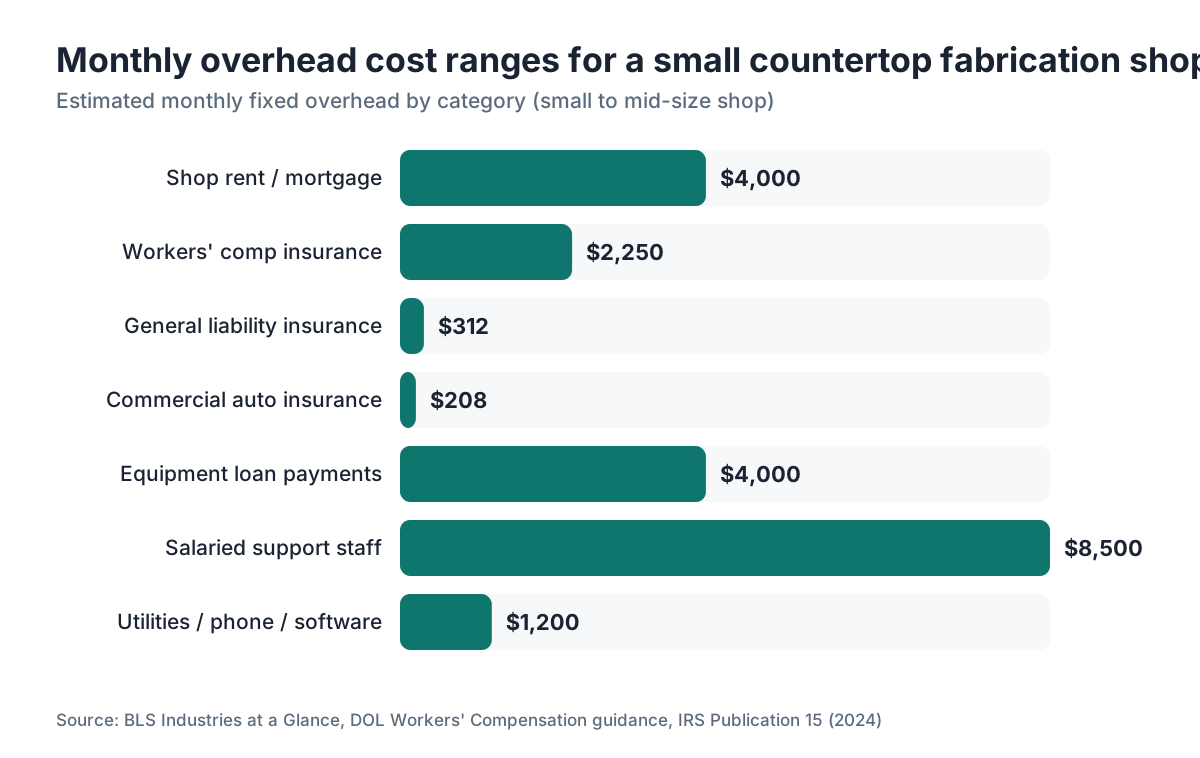
A small-to-mid shop running 1,500 to 3,000 square feet of floor space might carry $12,000 to $25,000 in fixed overhead per month before touching a single slab. That's not padding. It's rent at $2,000 to $6,000, insurance at $1,500 to $4,000 (general liability plus workers' comp plus commercial auto), equipment payments at $2,000 to $6,000, and payroll for support staff at $5,000 to $12,000 [1][5].
How much does business insurance actually cost for a countertop fabricator?
Insurance is one of the most underestimated line items in countertop pricing. Four types cover most shops, and they stack up fast.
| Insurance Type | Typical Annual Premium (small shop) | What It Covers |
|---|---|---|
| General liability | $1,500 to $4,000 | Third-party bodily injury, property damage, completed operations |
| Workers' compensation | $3,000 to $9,000 (varies heavily by payroll) | Employee injuries on the job |
| Commercial auto | $1,200 to $3,500 per vehicle | Delivery trucks, installation vans |
| Inland marine / tools & equipment | $500 to $1,500 | Saws, CNC machines, hand tools in transit |
Workers' comp premiums for stone cutting and installation work run roughly $8 to $18 per $100 of payroll in most states, and the exact number depends on your state's rates and your claims history [2]. A shop with $200,000 in annual direct labor payroll could owe $16,000 to $36,000 a year in workers' comp alone. That's not a rounding error. It's a line item that has to sit inside every square-foot price.
General liability for a fabricator gets underwritten on two things: revenue and completed-operations exposure, meaning your liability if a finished countertop falls, cracks, or hurts someone after installation. Shops doing $500,000 to $1.5 million in annual revenue usually see GL premiums between $2,000 and $5,500. Shops that also do stone floor installation pay more, because slip-and-fall exposure runs higher.
Budget $6,000 to $18,000 a year for the full insurance stack on a small shop. That's $500 to $1,500 a month. Every quote carries a slice of it.
How do you calculate your shop's overhead rate per square foot?
This is the core calculation, and it takes four steps.
Step 1: Total your monthly overhead. Add every fixed and semi-fixed cost: rent, all insurance premiums (annualized, divided by 12), equipment payments, salaried labor, utilities, software, and consumables at their average monthly spend.
Step 2: Estimate your monthly billable square footage. Be honest. If your shop can handle 800 square feet a week but you're actually billing 500, use 500. Overhead doesn't care about capacity. It hits whether you run at 40 percent or 100 percent.
Step 3: Divide. Monthly overhead divided by monthly billable square feet equals your overhead cost per square foot.
Here's the math on a real example. A shop with $18,000 a month in overhead, billing 1,800 square feet a month, carries $10.00 of overhead per square foot before a single dollar of material or labor. Say you quote kitchen countertops at $45 a square foot installed, your granite slab costs $12 a square foot, and labor costs $8 a square foot. Your gross margin before overhead looks like $25. Subtract the $10 overhead rate and your actual profit is $15, not $25.
Step 4: Add a profit target. Overhead recovery isn't profit. Aim for net profit before owner draws of 10 to 20 percent of revenue for a healthy shop. Add it on top.
Most shops should price to a fully-loaded number (material plus labor plus overhead plus profit) that runs 2.5x to 3.5x their direct material cost on natural stone and engineered quartz. For budget materials like laminate countertops or formica countertops, where material is already cheap, the multiplier often has to climb higher, because you can't cut labor and overhead just because the sheet was inexpensive.
What is the right markup formula for countertop quotes?
Two methods run the industry: cost-plus markup and gross margin pricing. They sound alike, they produce different numbers, and mixing them up is a common, expensive mistake.
Cost-plus markup adds a percentage on top of your costs. If your total cost (material plus labor plus overhead allocation) is $40 a square foot and you add a 50 percent markup, you charge $60. Your margin on that job is 33 percent, not 50.
Gross margin pricing targets a percentage of the selling price. Want 40 percent gross margin? Divide your cost by (1 minus 0.40), so $40 / 0.60 = $66.67 a square foot.
Experienced fabricators think in margin, not markup, because margin percentages map straight to the income statement. A shop running 35 percent gross margin on $1,000,000 in revenue keeps $350,000 to cover overhead and profit. A shop running 25 percent on the same revenue keeps $250,000. That $100,000 gap is almost pure pricing discipline.
The Small Business Administration advises product-based businesses to target gross margins of 30 to 50 percent to sustain operations and growth [4]. Countertop fabrication blends product and skilled labor, and it sits comfortably in that range when priced right.
Here's the same 50 square foot granite job run both ways:
| Item | Cost-Plus 50% Markup | Gross Margin 40% Target |
|---|---|---|
| Direct material ($14/sq ft) | $700 | $700 |
| Direct labor ($9/sq ft) | $450 | $450 |
| Overhead allocation ($10/sq ft) | $500 | $500 |
| Total cost | $1,650 | $1,650 |
| Selling price | $2,475 | $2,750 |
| Gross margin % | 33.3% | 40% |
The gap on one job is $275. Across 200 jobs a year, that's $55,000 that either lands in profit or cushions the jobs that go sideways.
How does workers' compensation insurance affect pricing for shops with installers?
Workers' comp is a percentage of payroll in each job classification, and stone and tile setting carries high rates because the work is physical and injury-prone. The National Council on Compensation Insurance (NCCI) sets base rates that states then adjust, so your actual rate depends on your state and your claims history [2].
Here's what that does to pricing. Your installer's $25-an-hour wage costs you more than $25 an hour. Add workers' comp at, say, $12 per $100 of wages (a mid-range rate for this class) and that installer runs $28 an hour loaded. Add the employer share of FICA (7.65 percent of wages) and you're near $30 an hour [3]. Throw in paid time off, benefits, or a uniform allowance and you're past $32 to $35 an hour in true labor cost.
Quoting labor at the bare wage rate, no benefits and no insurance loaded, is one of the most common and damaging pricing errors in the trade. Fully-loaded labor cost for a skilled fabrication or install worker usually lands at 1.25 to 1.45 times the base wage [3].
Work the numbers on a job with 4 hours of install labor plus 2 hours of template and shop prep. Six hours at $32 an hour fully loaded is $192 in true labor cost. Quote $150 because you thought $25 an hour was the right figure, and you just gave away $42 before counting a dime of overhead or profit.
Should you charge a separate line item for insurance or build it into the rate?
Build it in. Never itemize insurance as its own line on a customer quote.
A customer who sees "insurance surcharge: $85" will fight it, try to negotiate it away, or feel nickel-and-dimed. Insurance is a cost of running a real business, same as rent. Nobody adds a line for rent. You price to cover it.
What you do want is precise tracking on your internal cost model. Know exactly what insurance costs you per square foot. Recheck that number at every policy renewal, because premiums move. A workers' comp audit that catches a jump in payroll can hit you with a surprise premium bill mid-year, and if you haven't been pricing to your real costs, that bill stings.
For jobs with unusual risk (oversized islands over 100 lbs, second-floor installs, commercial kitchens with tight delivery access), build a risk premium into the quote. Don't call it "extra insurance." Call it "complex installation" or fold it into the install price. Either way, you get paid for the real cost of the job.
What should a countertop price per square foot look like when overhead is fully covered?
Prices swing hard by material, region, and shop size. Here's a working reference range for installed countertops with overhead and insurance properly baked in, drawn from National Kitchen and Bath Association research and Angi's public cost guides [6][7]:
| Material | Low end (installed, per sq ft) | High end (installed, per sq ft) |
|---|---|---|
| Laminate | $20 | $50 |
| Butcher block | $40 | $100 |
| Granite | $50 | $130 |
| Quartz (engineered) | $60 | $150 |
| Marble | $75 | $200 |
| Quartzite | $70 | $180 |
| Cambria quartz | $80 | $160 |
Those ranges look wide because they are. The low end on granite countertops assumes a smaller shop in a cheaper market running thin margins on entry-level slabs. The high end reflects premium stone in a high-rent metro with a skilled crew, strong coverage, and a profit margin that keeps the business growing.
Quoting below the low end of your material category? Stop and run your cost model. Either your overhead is unusually low (possible if you own your building and carry no equipment debt) or you're not covering costs. A cost check before every significant job isn't paranoia. It's basic financial hygiene.
Homeowners, read this part twice. A price below the low end of these ranges usually means something is missing: insurance coverage, proper equipment, licensed staff, or just the ability to stay in business long enough to honor a warranty.
How does job complexity change the overhead calculation?
Overhead based only on square footage falls apart the moment you compare a plain 30 square foot bathroom vanity to an 80 square foot kitchen with two waterfall islands, an undermount apron sink, and a cooktop cutout. The vanity takes 2 hours of shop time. The kitchen might take 12. Give both the same per-square-foot overhead rate and the simple job ends up subsidizing the complex one.
Two fixes handle this.
Time-based overhead allocation divides monthly overhead by total available shop hours instead of square feet, then prices each job on the hours it actually eats. More accurate, but it needs good time tracking.
Complexity modifiers keep the square-foot base and add flat fees or percentage upcharges for cutouts, radius edges, miter joints, and unusual sink setups. Same goal: the price reflects the resources the job actually burns.
For countertop installation on jobs with more than two cutouts or more than 20 linear feet of edge profile work, a complexity modifier of 15 to 30 percent over your base rate is common in well-run shops.
Software carries the load here. Tools like SlabWise build cutout fees, edge profiles, and material waste into the quote automatically, so you're not doing this arithmetic by hand on every job and risking a slip.
The point is that overhead isn't flat. Your CNC machine, your delivery truck, and your crew's time are the real drivers. A job that uses twice the resources should carry twice the overhead allocation.
How do you account for material waste in countertop pricing?
Slab yield never hits 100 percent. Fabricators typically see 15 to 35 percent waste depending on layout complexity, slab shape, and how aggressively they nest remnants for future jobs [8]. Buy a 55 square foot slab, bill only the finished square footage, and ignore the waste, and you underprice every natural stone job by design.
The standard move is to apply a waste factor to material cost before you calculate price. Say your slab costs $600 and you expect 25 percent waste, so you get 41 usable square feet from a 55 square foot slab. Your effective material cost is $600 / 41 = $14.63 a square foot, not $10.91. Over a year, that gap is real money.
Remnant management offsets some of it. Shops that sell remnants or use them for small vanity and bar tops recapture part of the waste cost. But don't price your main jobs assuming every remnant sells. Treat remnant revenue as a bonus, not a subsidy.
For materials like marble countertops and cambria countertops, where book-matching or pattern alignment comes into play, waste can climb past 40 percent on tricky layouts. Price for it.
What's the best way for a small shop to track and review its true costs?
The minimum system is a monthly cost tracker: one spreadsheet (or an accounting export) that lists every overhead expense, totals it, and divides by the square footage you actually billed that month. Run it at month-end, every month. Compare the actual overhead rate to the rate you built into your quotes. If they don't match, find out why.
QuickBooks and similar small-business tools pull this automatically once your chart of accounts is set up right. IRS Publication 334 for small businesses and Publication 535 on business expenses spell out which costs are deductible and how to categorize them, which also helps you build a cost tracker that serves both pricing and taxes [9][10].
Run a pricing review every 90 days. Re-figure your overhead rate and check it against your live quotes. Insurance renewals, equipment purchases, and rent increases land throughout the year, and every one of them moves your break-even price per square foot.
For higher-volume shops, quoting software that embeds your cost model straight into the estimate pays for itself quickly. Change your overhead rate in one place and every future quote reflects it, instead of hoping each estimator remembered the new number. The SlabWise demo shows how that runs in a real fabrication workflow.
Are there any legal or licensing requirements that affect countertop pricing?
Yes, and they vary by state. Most states require a contractor's license for countertop installation, especially when the work connects plumbing for a sink or needs permits [11]. Licensing carries direct cost: license fees, continuing education, and the bond or insurance minimums that come with the license all feed overhead.
In California, the Contractors State License Board (CSLB) requires the right specialty license (such as a C-29 Masonry classification) for certain countertop work, and contractors must carry general liability coverage that meets the board's minimum. Those minimums push premiums above what an unlicensed operator would pay [11].
Payroll taxes are another legal cost that feeds pricing. Federal payroll taxes (the employer share of FICA at 6.2 percent Social Security plus 1.45 percent Medicare) and federal unemployment tax (FUTA, 6 percent on the first $7,000 of each employee's wages, though a state credit cuts that for most employers) are mandatory for any shop with W-2 employees [3]. These aren't optional. They're a pricing input.
Some cities also require permits for installs that involve gas cooktop cutouts or plumbing reconfiguration. Pass the permit cost through to the customer and you're fine. But the time to pull and manage permits is overhead the shop eats, and it belongs in your cost model.
Frequently asked questions
What percentage of a countertop quote should cover overhead?
For most fabrication shops, overhead (everything except direct material and direct labor) runs 30 to 50 percent of total revenue. As a share of the quote, that means $30 to $50 of every $100 you charge pays for rent, insurance, equipment, and admin. If your overhead share drops below 25 percent, either your cost of goods is unusually low or you're missing cost categories.
How do I figure out my break-even price per square foot?
Add your total monthly fixed and variable overhead, then divide by the square feet you actually bill in an average month. That's your overhead rate per square foot. Add your direct material cost per square foot and your fully-loaded labor cost per square foot. The sum is your break-even. Any price below it loses money. Any price above it contributes to profit.
Should countertop installers carry their own insurance or does the shop's policy cover them?
W-2 employees fall under the shop's workers' compensation and general liability policies. 1099 subcontractors are different. If they can't prove their own coverage, your policy may get forced to cover them and your premium will reflect it. Collect certificates of insurance from any subcontractor before they set foot on a job. Your insurer can spell out the exposure in your state.
What's the difference between markup and margin in countertop pricing?
Markup is a percentage added on top of cost. Margin is a percentage of the selling price. A 50 percent markup on a $40 cost gives you a $60 price and a 33 percent margin. A 50 percent margin on a $40 cost gives you an $80 price. Fabricators who confuse the two underprice steadily. Think in margin, because it maps straight to your income statement and compares cleanly across jobs.
How much does workers' compensation insurance cost for a stone fabrication shop?
Workers' comp for stone cutting and installation runs roughly $8 to $18 per $100 of payroll in most states, depending on your state's base rates and your claims history. A shop with $200,000 in annual direct labor payroll could owe $16,000 to $36,000 a year. The NCCI sets base rates in most states, and carriers adjust them with your experience modification factor.
Can I just add a flat dollar amount per job for insurance instead of calculating a rate?
You can, but it's less accurate than a rate. A flat $150 per job covers costs differently on a 20 square foot vanity than on a 100 square foot commercial kitchen. If you use a flat fee, recalibrate it at least quarterly: divide total monthly insurance premiums by your average number of jobs per month and confirm the fee still covers the real cost.
How do countertop prices differ between residential and commercial jobs?
Commercial jobs often carry lower per-square-foot prices because of volume, but they bring tighter timelines, harder logistics, union wages on some sites, and higher insurance minimums. Net margin on commercial work is frequently thinner than residential once you account for slow payment cycles and contract compliance. Price commercial jobs with a full overhead audit, never by discounting your residential rate for volume.
How much should I charge for sink cutouts and edge profiles?
Most shops charge $75 to $200 per standard undermount sink cutout and $10 to $30 per linear foot for decorative edge profiles beyond a basic eased edge. These numbers reflect real CNC time, blade wear, and finishing labor. Charge less than $75 for a cutout on expensive stone and you're likely losing money on that line item once tooling wear gets counted.
What insurance do I need before starting a countertop fabrication business?
At minimum: general liability (most clients and GCs want at least $1 million per occurrence), workers' compensation if you have any employees (required by law in every state), and commercial auto if you drive to job sites. Tools and equipment coverage (inland marine) is strongly advisable for saws and CNC machines. Budget $6,000 to $18,000 a year for the full stack, depending on payroll and revenue.
How do I handle material price increases without losing customers?
Put a price escalation clause in quotes valid for 30 days, not open-ended. Distributor slab prices can move 5 to 15 percent on short notice when tariffs shift or supply tightens. If a quote gets accepted and material jumps before fabrication starts, a clear escalation clause lets you adjust the material line without reopening the whole contract. Most GCs and homeowners accept this when you disclose it upfront.
Is it better to price countertops by square foot or by the job?
Square-foot pricing is easy to explain and quick to quote, but per-job pricing is more accurate on complex work. Most shops start with a square-foot rate and add flat fees for cutouts, edge profiles, delivery distance, and install complexity. What matters is that every component, overhead and insurance included, gets covered somewhere in the total regardless of format.
How often should I update my countertop pricing model?
At minimum, review your overhead rate and insurance costs at every policy renewal, whenever you hire or lose staff, and whenever shop rent or equipment payments change. In practice, a quarterly review catches most of the drift. Wait a full year to discover your overhead rate rose by $3 a square foot and every job in those 12 months was underpriced by that margin.
Do I need to charge sales tax on countertop installation?
It depends on your state and how the work is billed. Some states tax the full installed price. Others tax only materials and exempt separately billed labor. A few exempt custom fabrication entirely. The Streamlined Sales Tax Governing Board tracks state-by-state rules, but for accurate guidance, consult your state's department of revenue directly or a tax professional who works with contractors.
Sources
- U.S. Bureau of Labor Statistics, Industries at a Glance: Nonmetallic Mineral Product Manufacturing: Overhead costs in stone and fabricated product industries typically run 35 to 55 percent of total revenue
- U.S. Department of Labor, Workers' Compensation: Workers' compensation insurance is required by law for employers with employees in every U.S. state; premiums for stone work vary by state base rates and claims history
- IRS, Employer's Tax Guide (Publication 15): Employer FICA contributions are 6.2% Social Security plus 1.45% Medicare on employee wages; FUTA is 6% on the first $7,000 of wages per employee
- U.S. Small Business Administration, Calculate Your Startup Costs: Product-based businesses should generally target gross margins of 30 to 50 percent to sustain operations and growth
- U.S. Small Business Administration, Fund Your Business: Guidance on estimating fixed operating costs such as rent, insurance, and payroll for small businesses
- National Kitchen and Bath Association, NKBA Industry Research: Installed countertop price benchmarks across material types in the U.S. residential market
- Angi (formerly HomeAdvisor), Countertop Installation Cost Guide: Installed countertop prices range from approximately $20/sq ft for laminate to $200/sq ft for premium natural stone
- Natural Stone Institute, Standards and Publications: Stone fabricators typically see 15 to 35 percent material waste depending on layout complexity and slab shape
- IRS, Tax Guide for Small Business (Publication 334): IRS guidance on categorizing and deducting business expenses for small businesses
- IRS, Business Expenses (Publication 535): IRS guidance on which business costs are deductible, supporting proper cost categorization for pricing and tax purposes
- California Contractors State License Board (CSLB): California requires a contractor's license for certain countertop installation work and sets minimum liability coverage requirements
Last updated 2026-07-11