TL;DR
- Stress cracks at inside corners happen because sharp 90-degree notches concentrate tension.
- The fix is a drilled relief hole (minimum 3/8 inch diameter, ideally 1/2 inch) at every inside corner before the saw enters.
- Use a sharp diamond blade, keep water flowing, and never let the blade stop mid-cut.
- Do those three things and inside corner failures drop to near zero.
Why do inside corners crack on stone countertops?
Stone and engineered quartz are strong in compression but weak in tension. Cut a sharp 90-degree notch into a slab and you create what engineers call a stress concentration point. Any load on the countertop, a heavy pot dropped nearby, thermal expansion, even vibration from a refrigerator compressor, generates tensile stress that radiates out from that corner. The corner has no material to absorb the load, so a crack starts there and can run across the whole slab in seconds.
The physics is well documented. The stress concentration factor (Kt) for a sharp notch in a brittle material can exceed 3.0, meaning the local stress at the corner tip is more than three times the nominal load on the slab [1]. Granite, marble, and engineered quartz all behave as brittle materials under tensile load. Their fracture toughness is low next to steel: granite typically runs 0.6 to 1.7 MPa·m^0.5 against roughly 50 MPa·m^0.5 for structural steel [2].
This is not a theoretical risk. Fabrication shops consistently name inside corner failures as one of the top two causes of slab breakage during fabrication, right alongside blade binding. The crack either shows up the instant the saw exits or hours later as residual stress lets go.
What is a relief hole and why does it prevent cracking?
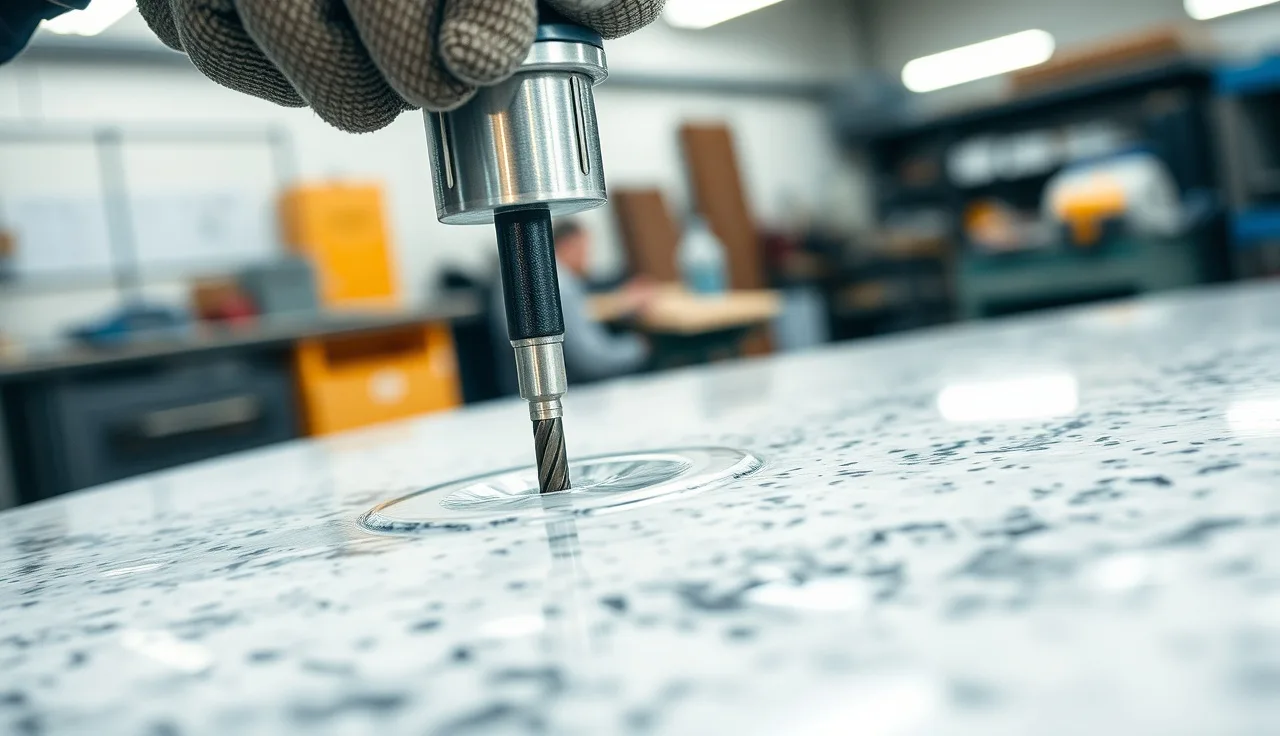
A relief hole is a fully drilled circular hole placed exactly at the inside corner of the cut before the saw ever touches that area. The circle replaces the sharp notch with a curve. A curve has no stress concentration the way a sharp corner does. The load spreads around the arc instead of focusing at one point.
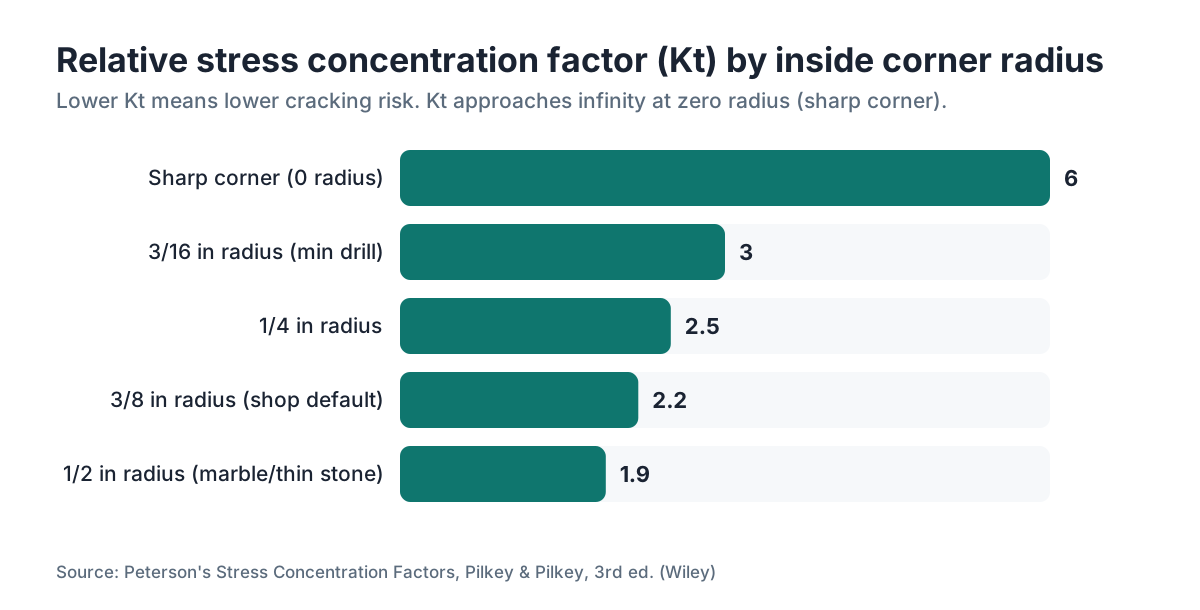
The geometry matters. A perfectly square inside corner has a theoretical stress concentration factor approaching infinity for a truly brittle material. A circular hole with a 3/16-inch radius (4.8 mm) drops that factor to roughly 3.0. Bump the radius to 1/4 inch (6.4 mm) and it comes down near 2.5. A 1/2-inch radius (12.7 mm) gets you below 2.0 [1]. That is why fabricators who drill larger relief holes see fewer failures even when their sawing technique is a little sloppy.
The practical minimum is a 3/8-inch diameter core drill bit, which gives you a 3/16-inch radius. Most shops now run 1/2-inch or even 5/8-inch bits as the default because the extra time costs nothing and the failure rate drops noticeably. Some fabricators reach for a 1-inch hole saw on very large cutouts like cooktop openings, especially in marble or thin quartzite where cracking risk is highest.
One thing that trips people up: the drilled hole must sit dead center on the inside corner of the finished cut line, not offset inward. Offset it inward and you leave a small V-shaped notch between the hole and the saw cut, which defeats the whole point.
What drill bit should you use to drill the relief hole?
Use a diamond core drill bit rated for wet cutting in stone. A dry carbide masonry bit works on ceramic tile, but it generates too much heat in granite or quartz and can micro-fracture the material around the hole, creating the exact weakness you are trying to prevent.
Diamond core bits come in two main types: electroplated (sometimes called vacuum-brazed) and sintered (segmented). For relief holes in countertop work, sintered bits outlast electroplated ones by a wide margin. Electroplated bits are fine for occasional use or DIY situations. A good sintered diamond core bit in the 3/8-inch to 5/8-inch range runs roughly $15 to $45 [3]. Cheap bits lose their diamonds faster, need more pressure, and generate more heat, all of which raise micro-cracking risk.
Water cooling is not optional. Run a steady stream over the bit through the entire drilling operation. Many fabricators use a suction-cup water dam (a small rubber ring that holds a pool of water around the drill point) when drilling away from a wet saw. Skip the water and the bit glazes, and the friction heat can cause thermal shock cracking in materials like Calacatta marble or thin quartz.
Drill speed matters too. Most manufacturers recommend 600 to 900 RPM for a 1/2-inch diamond core bit in granite. Higher speeds without enough water cooling cause premature bit wear and heat buildup. Lower speeds, under about 400 RPM on a 1/2-inch bit, cut slower with no safety benefit [3].
What is the correct cutting sequence for an inside corner cut?
The sequence is short: mark, drill, saw from one direction, saw from the other, and never let the blade stop inside the cut. Every step earns its place.
First, mark your cut lines clearly. Use a silver or white pencil on dark stone, a standard pencil on light stone. Mark the exact center of your relief hole at the inside corner intersection.
Second, drill the relief hole completely through the slab before the saw touches anything. Clamp or secure the slab so it cannot shift. Apply steady, moderate downward pressure. Let the diamond do the work. Forcing it makes heat.
Third, make your first straight cut, coming into the relief hole from one direction. The blade should exit through the edge of the drilled hole, not past it. It meets the hole tangentially and stops there.
Fourth, reposition and make your second straight cut from the perpendicular direction, again running into the relief hole from the other side.
The relief hole connects the two cuts and forms the inside corner. You are left with a corner that has a small visible radius instead of a sharp 90-degree notch. That radius is your insurance policy.
One common mistake sinks a lot of slabs: stopping the blade inside the cut and then restarting. When a spinning blade stops mid-cut in stone, it can grab or deflect as it slows, and the slab can crack from the shock. If you have to stop, back the blade out of the cut while it is still spinning at full speed, then cut water flow and let it stop safely outside the material.
Does the blade type or speed affect stress cracking at inside corners?
Yes, a lot. A dull blade needs more feed pressure to cut, which means the saw pushes harder against the stone right as it nears the relief hole. That extra force can start a micro-crack at the hole edge before the blade even arrives.
For granite countertops, a continuous-rim diamond blade is the standard for finish cuts. Segmented blades cut faster but leave a rougher edge and shake more, which raises cracking risk near inside corners. Turbo-rim blades split the difference: faster than continuous-rim, smoother than segmented.
Blade speed guidance from most diamond blade makers puts the optimal surface speed for a 14-inch blade cutting granite at roughly 3,000 to 3,500 surface feet per minute (SFPM) [4]. Most bridge saws run fixed RPM settings calibrated for that range. For inside corner cuts, the number that bites you is feed rate, not blade RPM. Slow the feed as you approach the relief hole. Come in too fast and the blade deflects slightly, the cut drifts, and the relief hole no longer sits exactly at the corner.
For engineered quartz like Cambria (see Cambria countertops), the resin binder makes the material slightly more forgiving than natural stone, but the polymer can melt from heat if water flow is weak, leaving a rough edge. Same relief hole rule applies. Quartz fabricators who skip it still see corner failures, just a little less often than with marble.
How do you cut inside corners on laminate countertops without cracking?
Laminate is a completely different animal from stone, and it fails differently. The substrate, usually particleboard or MDF, does not crack from stress concentration the way granite does. On laminate countertops, the failure mode is chipout and delamination of the decorative surface layer at the corner.
For Formica countertops and similar high-pressure laminate surfaces, the standard technique is a sharp jigsaw with a fine-tooth upcut blade, cutting from the underside whenever possible, since the laminate surface tears on the upstroke. Or score the cut line on the face side with a sharp utility knife before sawing.
Inside corners on laminate still benefit from a relief hole, but for a different reason: the drill gives the jigsaw blade a clean starting point so it cuts smoothly in one direction from the start instead of plunging into the material. A 3/8-inch or 1/2-inch hole at the inside corner works well.
For sink cutouts in laminate, many fabricators use a router with a straight-cut bit and a template guide for clean corners. The router produces a crisp edge, follows a template exactly, and leaves a consistent small radius at each inside corner.
What radius at the inside corner is structurally sufficient?
There is no universal code requirement for countertop inside corner radii in residential construction, but the fabrication industry has settled on practical minimums drawn from failure experience.
For granite and natural stone, a 3/16-inch (5 mm) radius is the absolute minimum most fabricators accept. A 1/4-inch (6 mm) radius is standard practice. For thin slabs (anything under 3/4 inch or 2 cm thickness) and for particularly brittle stones like Calacatta marble, thin quartzite, or onyx, a 1/2-inch (12 mm) radius is the safer call.
For engineered quartz at 3/4-inch (2 cm) or 1.25-inch (3 cm) thickness, a 3/16-inch radius is generally adequate, but high-volume shops default to 3/8 inch because it adds essentially no time and cuts callbacks.
For marble countertops specifically, go bigger. Marble has lower fracture toughness than granite, so it propagates a crack more easily once one starts. A 1/2-inch relief hole is the right default for marble inside corners. Some fabricators working with heavily veined material push to 5/8 inch or 3/4 inch when a prominent vein runs toward the corner.
The visible radius does register with homeowners aesthetically. A 3/8-inch radius corner is barely noticeable in person. A 3/4-inch radius starts to read like a design choice rather than a fabrication detail. Most homeowners never notice anything under 1/2 inch.
Can you repair a stress crack that started at an inside corner?
Sometimes. It depends on how far the crack ran and where it went. A hairline crack that traveled less than an inch into the field of the slab, and has not widened, can often be stabilized with a color-matched epoxy or UV-cure adhesive. The crack gets cleaned out, the adhesive is worked in under vacuum or with a syringe, then cured and polished back. The repair is visible up close but not obvious from a normal viewing distance.
A crack that ran 6 or more inches into the slab, crossed a vein in marble or a flaw in granite, or split the slab into two pieces is basically not repairable to a standard that holds up in a kitchen. The piece needs replacing.
Repair economics are simple. A good stone repair technician charges roughly $100 to $300 for a crack stabilization repair on site [5]. A full slab replacement for a kitchen island or a peninsula, including material, fabrication labor, and reinstallation, can run $800 to $4,000 or more depending on stone type and size. That math is why spending an extra two minutes drilling a proper relief hole always pays.
For fabricators tracking job profitability, software that logs per-piece labor time can show whether certain stone types or corner configurations are driving disproportionate rework. SlabWise, for example, lets fabricators attach notes and photos to individual pieces in a job, which makes it easier to spot where failures cluster across a production run.
Does stone thickness change how you approach inside corners?
Thicker slabs resist stress cracking at inside corners better, but not as much as you would hope. The stress concentration at a sharp notch scales with the notch geometry relative to the overall cross section. A 1.25-inch (3 cm) slab has more material around the corner than a 3/4-inch (2 cm) slab, so the total load before fracture is higher. But the crack still starts at the stress concentration, and once it starts in a brittle material it runs fast.
The practical difference: 3/4-inch (2 cm) slabs crack more easily and more often at inside corners than 1.25-inch (3 cm) slabs, all else equal. Working with 2 cm stone, the relief hole matters even more, and a larger radius (at least 1/2 inch) is the right move.
Mitered edge pieces add another wrinkle. A mitered 2 cm slab laminated to fake a 4 cm edge has a lamination seam running near the underside. If a stress crack starts at an inside corner and runs toward the lamination line, the piece can delaminate all at once. Mitered pieces earn extra care: larger relief holes and slower feed near corners.
For countertop installation in general, thinner slabs also want better substrate support. An unsupported span near an inside corner piles bending stress on top of the stress concentration, and the two compound.
What tools do homeowners need to safely cut an inside corner?
If you are a homeowner thinking about cutting an inside corner on a stone countertop yourself, here is the honest answer: the barrier is the equipment, not the skill. A proper bridge saw or CNC router is a five-figure machine that shops run every day. A 4-inch angle grinder with a diamond blade can cut stone, but steering it precisely enough to meet a relief hole from two directions cleanly is genuinely hard, and the blade-kickback risk is real.
The realistic DIY scenario is laminate or butcher block countertops, not stone. For those, a corded jigsaw with sharp blades and a decent drill are enough. A 1/2-inch spade bit or Forstner bit handles a relief hole in wood. A fine-tooth jigsaw blade rated for laminate keeps chipout off the decorative face.
For stone: if you need a new inside corner cut in a granite or quartz countertop that is already installed (say, adding a cooktop cutout), hire a fabricator with a wet saw and proper diamond core bits. The cracking risk during an uncontrolled angle-grinder cut on an installed countertop is high, and a failed slab does real damage to cabinets and flooring below. The fabricator will charge $100 to $400 for a sink or cooktop cutout on site, cheap next to the replacement risk [5].
That said, if you want to understand what a fabricator should be doing so you can ask smart questions, the relief hole check is the easiest one: ask what size core drill bit they use at inside corners. A good shop answers instantly.
How do fabricators handle inside corners on CNC machines?
CNC routers and CNC bridge saws come at inside corners differently from hand-guided saws, but the same physics rules. The machine has to exit the cut at the inside corner with a tool path that leaves a radius, not a sharp notch.
Most CNC CAM software for stone (the program that turns a shape drawing into machine tool paths) adds a corner relief pass automatically. The operator sets a minimum inside corner radius, and the software drops a circular arc into each inside corner of the cut path. The machine follows the arc and leaves the corner with the specified radius.
The risk on CNC is operator override. If a programmer manually draws a 90-degree inside corner in the CAD file and the CAM post-processor does not add a relief arc, the machine will try to cut a sharp corner. It physically cannot, because a round router bit always leaves a radius equal to its own radius at any inside corner. That is why bit diameter matters: a 10 mm bit leaves a 5 mm (3/16-inch) radius, a 20 mm bit leaves a 10 mm (3/8-inch) radius. Bigger bit, bigger corner radius, lower cracking risk.
For a shop running high volume, setting minimum inside corner radii in the CAM software defaults is the most reliable way to hold the line across all operators. SlabWise's quoting and nesting tools tie into job documentation, so shops can record the intended corner radius as part of the job spec, giving fabricators a written reference instead of relying on shop floor memory.
Shops running a mix of CNC and manual cuts should standardize on the same minimum radius across both so the finished pieces match regardless of how they were cut.
Are there stone types where inside corner cracking is especially common?
Yes. The risk is not uniform across all stone types. Fracture toughness, grain structure, and existing micro-flaw density all vary by material.
Marble is the highest-risk category. It is softer than granite (typically 3 to 4 on the Mohs scale versus granite's 6 to 7) and has lower fracture toughness. Heavily veined marbles are worse still, because existing veins are natural fracture planes. A stress crack starting at a poorly cut inside corner will often follow a vein straight across the slab.
Thin quartzite (under 3/4 inch) is nearly as risky as marble. Quartzite is hard but can carry cleavage planes from its metamorphic formation that act like pre-existing crack paths.
Granite has a wider fracture toughness range depending on the variety. Coarser-grained granites (like many Brazilian blacks) tend to be tougher than very fine-grained varieties. Even so, all granites benefit from proper relief holes.
Engineered quartz from Cambria, Silestone, and Caesarstone is more consistent than natural stone because the resin binder spreads stress more evenly. But the resin does not make it immune. High-load scenarios (a commercial kitchen, a heavy undermount sink hung without clips) still generate enough stress to crack quartz at a poorly cut inside corner.
Corian countertops and other solid surface materials are the exception. They are polymer-based and considerably tougher in tension. Inside corners on solid surface are typically routed, and the material can be repaired almost invisibly if a crack does occur. Same for butcher block countertops, where wood's grain gives it far more tensile flexibility than stone.
Frequently asked questions
What size relief hole do I need for a granite inside corner?
The minimum is a 3/8-inch diameter hole (3/16-inch radius) drilled exactly at the inside corner intersection before sawing. Most fabricators default to 1/2-inch because it meaningfully reduces the stress concentration factor and adds almost no time. For heavily veined or thinner slabs, go to 5/8 inch or larger.
Can I cut an inside corner on a quartz countertop with an angle grinder?
Technically yes, but the risk is high. An angle grinder with a diamond blade is hard to control precisely enough to meet a relief hole from two clean directions. One slipped pass can crack the slab or leave a rough edge that concentrates stress. For installed quartz, hire a fabricator with a wet saw. For laminate or butcher block, a jigsaw is the right tool.
Why did my granite crack at the inside corner even though I drilled a relief hole?
The most common reason is that the relief hole was offset: centered inside the finished cut line rather than exactly at the corner intersection. That leaves a small V-notch between the hole and the saw cut, which still concentrates stress. Other causes include a dull blade (more feed pressure), inadequate water cooling causing micro-fractures during drilling, or stopping the blade mid-cut.
Does the inside corner radius show after installation?
A 3/8-inch to 1/2-inch radius at an inside corner is barely noticeable in person. It reads as a slightly soft corner rather than a sharp 90-degree notch. Most homeowners never comment on it. Larger radii above 3/4 inch become more visible but are still considered acceptable and are common in commercial work.
How do professionals cut sink cutouts in marble without cracking the corners?
They drill a 1/2-inch to 3/4-inch relief hole at each of the four inside corners before the saw enters. Blade feed rate drops near each hole. Water flow stays high throughout. Many fabricators cut marble sink openings with a continuous-rim diamond blade rather than segmented, because continuous-rim blades vibrate less, and that vibration reduction matters with a brittle material.
What is the stress concentration factor for a sharp inside corner in stone?
For a theoretically sharp 90-degree notch in a brittle material, the stress concentration factor (Kt) approaches infinity as the root radius approaches zero. In practice, no real cut is perfectly sharp, but Kt values of 3 to 5 are realistic for poorly cut inside corners. A 3/16-inch radius drops Kt to roughly 3.0; a 1/2-inch radius brings it closer to 2.0, according to standard mechanical engineering references on stress concentration.
Do CNC machines automatically prevent inside corner stress cracks?
Not automatically. A CNC router physically cannot cut a corner sharper than its own tool radius, so it always leaves some radius. But if the CAM program specifies a very small router bit (5 mm or less), the resulting radius may still be too small to reduce stress concentration enough. Shops should set a minimum inside corner radius in their CAM defaults, typically 5 to 10 mm, to keep corners safe across all jobs.
How do I cut an inside corner on a laminate countertop for a sink cutout?
Drill a 1/2-inch hole at each inside corner of the marked cutout. Cut from the underside if possible to prevent chipout on the decorative face. Use a sharp jigsaw blade rated for laminate. Score the face side of the cut line with a utility knife before sawing if you must cut from the top. Move the jigsaw at a steady pace; stopping mid-cut causes burning and rough edges.
Can a cracked inside corner on a countertop be repaired?
A hairline crack under about an inch long can often be stabilized with color-matched epoxy or UV-cure adhesive by a stone repair technician, typically for $100 to $300. A crack that ran several inches into the slab or caused separation is generally not repairable to a kitchen-durable standard and needs slab replacement. Catching cracks early, before they propagate, gives you the best repair outcome.
Is inside corner cracking covered under a fabricator's warranty?
Most fabricator warranties cover defects in workmanship, and a stress crack at an inside corner that shows up shortly after installation is generally treated as a workmanship defect if the relief hole was inadequate or the cut sequence was wrong. Warranty terms vary widely, though. Get the fabricator's warranty in writing before the job starts and ask specifically whether it covers cracking.
What drill speed should I use for a diamond core bit drilling a relief hole in granite?
Most diamond core bit manufacturers recommend 600 to 900 RPM for a 1/2-inch bit in granite with continuous water cooling. Higher speeds increase heat and shorten bit life. Keep steady, moderate downward pressure, let the diamond cut at its own pace, and run water the whole time. Forcing the bit faster by pressing harder generates heat and can micro-fracture the stone around the hole.
How far in advance should the relief hole be drilled before sawing?
Drill it immediately before sawing, as part of the same cutting sequence. There is no benefit to drilling hours ahead, and if the slab moves between drilling and cutting there is a small risk of the mark shifting. Drill the hole, confirm the saw cut lines meet the hole correctly, and go straight to cutting.
Does the type of countertop affect how risky inside corners are?
Yes. Marble and thin quartzite are the highest-risk materials because of low fracture toughness and natural cleavage planes. Granite is moderately risky. Engineered quartz is somewhat more forgiving thanks to its resin binder. Solid surface materials like Corian and laminate carry the lowest risk because they are polymer-based and have meaningful tensile flexibility compared to stone.
Sources
- Pilkey, W.D. & Pilkey, D.F., Peterson's Stress Concentration Factors, 3rd ed., Wiley: Stress concentration factor Kt for notches in brittle materials; a sharp 90-degree notch approaches Kt infinity as root radius approaches zero; a 3/16-inch radius yields Kt near 3.0
- U.S. Geological Survey, Mineral Resources Program, Physical Properties of Common Rock-Forming Minerals: Fracture toughness of granite typically 0.6 to 1.7 MPa·m^0.5, confirming brittle tensile behavior relative to metals
- Diamond Tool Store (industry supplier product documentation), Diamond Core Drill Bit Speed and Feed Recommendations: Recommended speed for 1/2-inch sintered diamond core bits in granite is 600 to 900 RPM with continuous water cooling; retail price range for sintered bits $15 to $45
- Diamond Tool Store (industry supplier product documentation), Diamond Blade Surface Speed Guidelines: Optimal surface speed for a 14-inch diamond blade cutting granite is roughly 3,000 to 3,500 surface feet per minute (SFPM)
- HomeAdvisor (Angi) Cost Guide, Stone Countertop Repair Cost: Stone crack stabilization repair by a technician typically runs $100 to $300; on-site sink or cooktop cutout by a fabricator typically $100 to $400
- Occupational Safety and Health Administration (OSHA), Silica Rule for Construction, 29 CFR 1926.1153: Cutting stone generates respirable crystalline silica; OSHA requires engineering controls including wet cutting methods when cutting stone materials
- Natural Stone Institute, Fabrication and Installation Standards, Technical Manual: Industry guidance on minimum inside corner radius for stone countertops; relief holes at inside corners are standard fabrication practice
- Natural Stone Institute (formerly Marble Institute of America), Dimension Stone Design Manual: Fabrication best practices for natural stone including cutting sequence and corner treatment
- U.S. Consumer Product Safety Commission: General reference for kitchen surface failure and consumer safety; stone slab failures are a recognized product hazard category
- Natural Stone Institute, Quartz Surface Fabrication Guidelines: Engineered quartz requires the same relief hole practice as natural stone at inside corners; resin binder does not eliminate brittle fracture risk under tensile stress
Last updated 2026-07-11