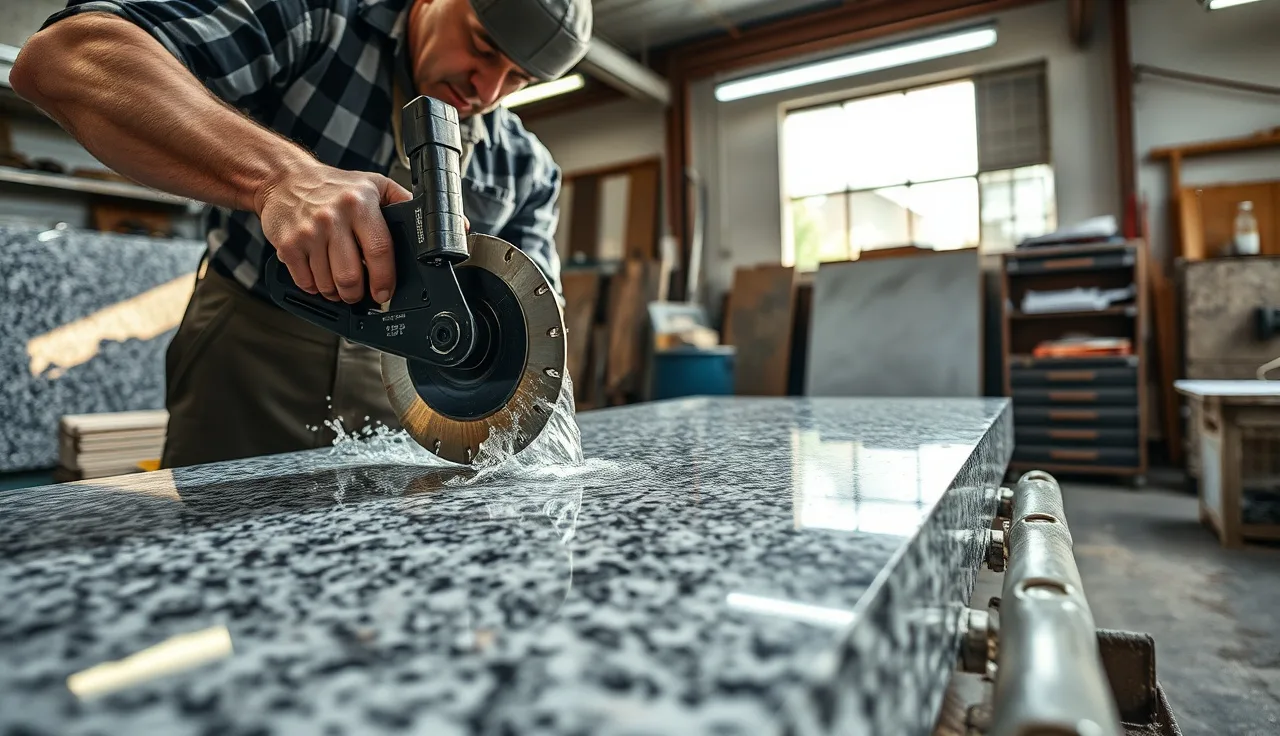
TL;DR
- A sharp 45-degree inside corner in granite almost always cracks because stress piles up at the apex.
- The fix is a relief hole at that point, at least a 3/8-inch radius, drilled before you make either angled cut.
- Use a wet saw or angle grinder with a continuous-rim diamond blade, keep water flowing the whole time, and feed slowly.
Why do inside corners crack granite so easily?
Granite is strong under compression and weak under tension. Cut two straight lines that meet at a sharp interior point and you leave a stress riser sitting at that apex. Vibration, a temperature swing, or weight on the slab all concentrate right there, and the stone splits outward from the point. This is not bad granite. It is fracture mechanics doing exactly what it does.
The sharper the angle, the worse it gets. A 90-degree inside corner is risky. A 45-degree inside corner is worse, because the geometry leaves less stone on at least one side of the point, so the moment arm on that thin section runs longer. Skip the relief step on a 45 and you get diagonal cracks running from the corner toward the nearest edge, sometimes several inches long.
Thickness helps a little. Standard 3 cm granite handles stress better than 2 cm because there is more mass to spread the load. Neither thickness makes a sharp inside corner safe. The crack often waits. It shows up weeks after installation, when a cabinet settles or the temperature changes and applies the last bit of load the corner could not take. [1]
What tools do you actually need for this cut?
You need a wet saw with a 10-inch or 14-inch continuous-rim diamond blade, or a 4-inch to 4.5-inch angle grinder running a continuous-rim diamond blade. A segmented blade cuts fine through the body of a slab, but it chatters and chips at an inside corner. Continuous-rim is the right call here.
You also need a core drill bit or a diamond hole saw for the relief hole at the apex. Common sizes are 3/8 inch, 1/2 inch, and 5/8 inch diameter. Bigger relief means a safer corner, but anything over 3/4 inch starts to look sloppy if the corner shows. For a corner that hides under an appliance or cabinet, go big and forget about looks.
A diamond-grit jigsaw blade (the kind sold for tile and stone) can handle curved relief cuts on thin slabs, but on 3 cm granite it wanders and overheats unless your water management is dialed in. Most shops grab the angle grinder for the relief work and the wet saw for the straight legs.
Water is not optional. Granite dust carries crystalline silica. OSHA's construction silica standard (29 CFR 1926.1153) requires engineering controls, and wet cutting is the listed method for stone fabrication tasks. [2] Cut dry for even a few minutes and you generate respirable dust well above the permissible exposure limit.
What is the correct sequence for making a 45-degree inside corner cut?
Sequence matters as much as tools. Do these steps out of order and the crack risk climbs.
Step 1: Mark your layout clearly with a pencil or soapstone. Draw both legs of the 45 all the way to the inside corner point, then mark the center of your relief hole at that point.
Step 2: Drill the relief hole first, before any saw touches the stone. Run your core bit or hole saw with continuous water and drill straight through. The hole should be tangent to both cut lines, or barely kiss them. If it sits back from the corner, you still have a stress riser. If it overlaps the lines by a hair, good. [3]
Step 3: Make the first straight cut with the wet saw, feeding slowly toward the relief hole. Stop the blade when it reaches the hole edge. Do not plunge past it. The cut should blend into the hole perimeter.
Step 4: Rotate the slab or reset the fence and cut the second leg of the 45, again feeding into the relief hole.
Step 5: The waste piece should fall or lift free. If it does not separate cleanly, do not pry. Use the angle grinder to trim any thin web of stone still connecting the waste to the hole.
Step 6: Grind and polish the radius. The inside of the relief hole shows from the front face. Polish it with a small drum polisher or a detail grinder to match the surrounding finish. A 3/8-inch radius on 3 cm granite takes maybe 10 minutes with the right tooling.
How big should the relief radius be at a 45-degree inside corner?
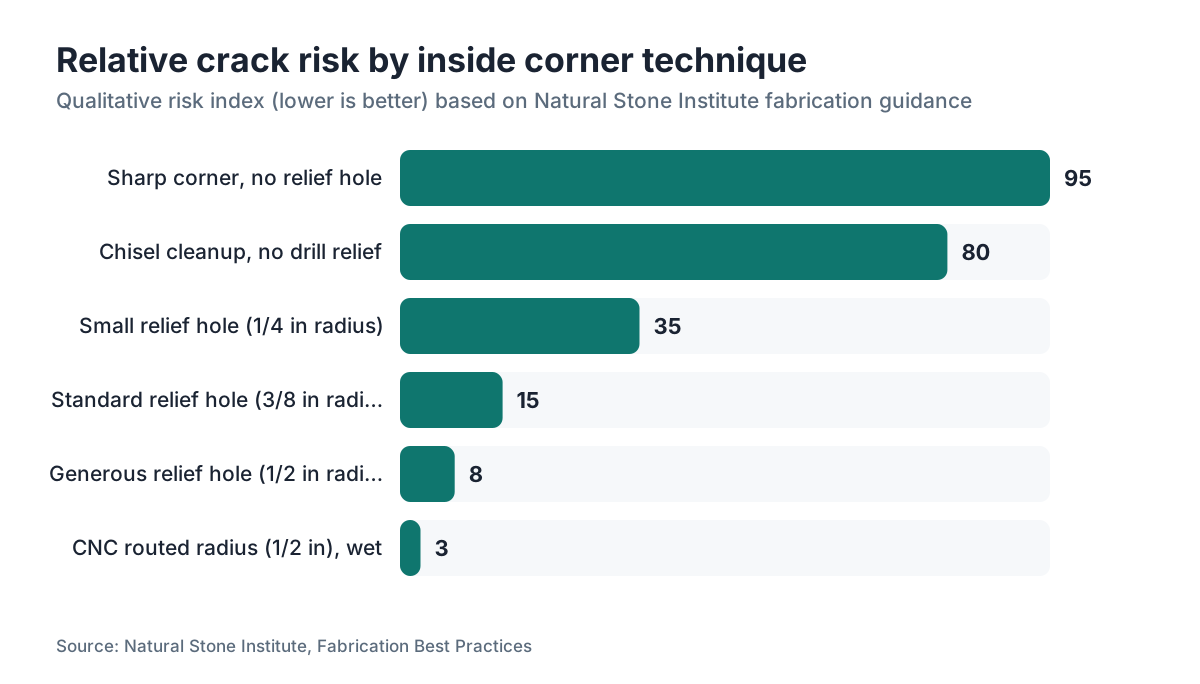
The working minimum is a 3/8-inch (about 10 mm) radius. Plenty of fabricators default to 1/2 inch because it gives more margin and still disappears once a faucet or sink clips it. The old Marble Institute of America guidelines, now run by the Natural Stone Institute, recommend a minimum 1/4-inch radius on any inside corner. Most working fabricators treat that 1/4 inch as the floor, not the goal. [4]
For corners that carry load, like a waterfall edge returning 45 degrees into a wall, bump the relief to 5/8 inch or more. For a plain notch around a cabinet filler strip that nobody will ever see, 1/2 inch is plenty.
Here is the mistake people make under shop pressure: bit diameter equals hole diameter, not radius. Want a 3/8-inch radius? You need a 3/4-inch hole saw. Hole diameter is always twice the radius. Get that backwards and your corner is half the size you planned.
What feed rate and blade speed should you use?
Slow is almost always right. Inside corner cuts fail from going too fast, not too slow. Rush the feed and the blade deflects a touch, the water cooling breaks down at the cut face, and microfractures start running ahead of the blade before you even reach the corner.
A 14-inch wet saw cutting 3 cm granite handles a feed rate around 10 to 15 inches per minute on the straight legs. In the final inch before the relief hole, slow down more. Let the blade do the work.
Blade RPM should match the manufacturer's rating. Most 14-inch granite blades run between 2,200 and 3,000 RPM. Run slower than rated and the diamond segments glaze. Run faster and heat builds quicker than water can carry it away. Follow the blade spec sheet. [5]
See steam at the cut? Your water flow is too low. Stop. Fix the water before you cut another inch.
Can you make this cut with an angle grinder instead of a wet saw?
Yes, and for some cuts a grinder gives you more control. A 4.5-inch angle grinder with a continuous-rim diamond blade plunges into the slab at any angle and follows a curved path to blend into the relief hole. That freedom helps when the piece sits templated and clamped on a bench where a wet saw fence would be awkward.
The catch is water. Wet saws flood the blade on their own. With a grinder you need a helper pouring a steady stream onto the cut, or a grinder with a built-in water swivel (some pro units have one). Cut granite dry with a grinder, even briefly, and you have a real silica hazard plus an overheated blade and stressed stone. [2]
Grinder cuts also take more practice to keep straight. Clamp a straightedge to the slab as a guide fence unless you have a lot of reps. The blade wants to wander, especially on entry.
What are the most common mistakes that cause inside corner cracks?
Skipping the relief hole tops the list. People make both saw cuts, then reach for a chisel or grinding wheel to clean up the corner. The chisel almost always cracks the stone, because it slams impact tension straight into the stress point.
The second mistake is a relief hole that is too small or in the wrong spot. If the hole does not fully intersect both cut lines, a thin web of granite survives at the apex. That web cracks.
Cutting dry is third, and it is worst with a grinder. Heat adds thermal stress on top of the mechanical stress from the cut geometry, and the two together break stone.
Fourth is overfeeding on the approach. The last half-inch of each cut leg is where cracks start if the blade moves too fast or deflects.
Fifth is handling the waste carelessly once both cuts are done. The waste now hangs on the slab only at the relief hole perimeter. Grab it and twist before it is fully free, and you drive torque through that thin connection and crack the good side, not the scrap.
Should a homeowner attempt this cut, or hire a fabricator?
Be honest with yourself. A clean 45-degree inside corner in granite takes a wet saw (which most homeowners do not own), a core drill bit, real water management, and enough reps to build a feel for feed rate. Granite runs roughly $40 to $200 per square foot installed depending on grade and region. [6] Crack the slab and you pay full replacement for that piece.
If this cut is part of a full countertop install, hiring a fabricator to do the cut and the install together is almost always the smart money. The fabricator's margin already pays for exactly this kind of difficult geometry.
Doing a repair or a simple notch in an existing top (fitting around a new appliance, say) with some stone experience? It is doable with rented gear. A wet saw rents for about $50 to $100 a day at most equipment yards. A 3/4-inch diamond core bit runs $20 to $50 and you buy it once. [7]
Fabricators running high volume lean on digital nesting and quoting tools to flag complex corner geometries before a job hits the saw. SlabWise is one option for that pre-production planning. Getting corner locations right in the quote and the cut plan cuts scrap from these exact mistakes.
The countertop installation guide covers what full installation involves.
How do you finish and polish the inside corner after cutting?
The sawn surface inside the relief hole and along the cut legs comes out rough. For a top where the corner shows (a sink cutout, faucet knockout, or appliance gap), you polish the exposed edge to match the surrounding finish.
Start with a 50-grit diamond hand pad to knock off saw marks, then work through 100, 200, 400, 800, and 1500 grit. For a honed finish, stop at 400. For polished, keep going to 3000 grit and finish with a granite polishing powder or cream. The inside curve of the relief hole is the tough part. Use a small drum-shaped detail polisher or a finger-shaped diamond bit on a rotary tool.
Seal the exposed edge with the same penetrating sealer you used on the slab face. The sawn edge is more porous than the polished face and drinks up stains faster if you leave it bare. [8]
For corners hidden under appliances or cabinets, skip the polish. One light pass with 100-grit to break the sharp edge is enough to stop chipping during install.
Does granite species or color affect how likely the corner is to crack?
Yes, but the differences are real without being big enough to change your technique. Coarse-grained granites (larger crystals) carry slightly lower tensile strength along the crystal boundaries, so they crack at corners a touch more readily than fine-grained stone. [9] Quartzite and marble cleave differently than granite, but the same relief-hole rule covers both.
Dark granites like Absolute Black or Black Galaxy run very fine-grained and cut cleanly. Exotics with big feldspar phenocrysts, like Blue Bahia or Typhoon Bordeaux, behave more unpredictably and earn a slower feed.
Color is a bad proxy for fracture risk. What matters is the slab's visible grain size and whether you can spot pre-existing microfissures running through the area you plan to cut. Hold the slab up to a raking light before you mark anything. A fissure heading toward your inside corner changes the plan. You may need to shift the cut or open up the relief hole.
For more on granite properties, see granite countertops.
What does a properly cut 45-degree inside corner look like, and how do you inspect it?
A good inside corner has a smooth, even radius at the apex. No sharp points. No saw marks running past the relief hole into the body of the slab. The two cut legs blend tangentially into the hole perimeter, so the shift from straight cut to curve reads smooth, not abrupt.
Run a finger along the inside of the corner to inspect it. You should not feel a step or ridge where the straight cut meets the curve. Under a flashlight or work light, hunt for hairline cracks radiating out from the corner into the slab. Even a crack that does not go all the way through is a problem. It will grow under load and temperature change.
Spot a hairline crack and the piece needs repair or replacement before install. Epoxy injection stabilizes small cracks, but that is a repair, not a fix, and the corner stays a weak point forever. On a hard-used kitchen surface, replacement is the cleaner call.
A corner cut by an experienced fabricator should be hard to pick out from the rest of the edge profile once polished. If it still reads as a corner, the radius is too small or somebody skipped the polish.
How do professionals handle 45-degree inside corners differently from DIY approaches?
Pros do a few things by habit that most DIYers skip. First, they template and cut the corner in the shop on a flat, supported slab instead of cutting in place. An in-place cut is riskier because the cabinets already constrain the slab.
Second, they run CNC routers for complex cutouts on high-end jobs. A CNC programmed with the right corner radius cuts the relief curve on its own, at a controlled feed rate, with steady water cooling. It repeats better than any hand cut, and the radius matches the drawing exactly. [10]
Third, they support the waste piece during the cut. On a CNC or a large-format wet saw, the table holds both sides so the waste never drops suddenly and tears the edge.
Fourth, they inspect with a strong raking light and a loupe before the piece leaves the shop. A problem caught in the shop costs a fraction of the same problem caught on site.
Fabricators who want to tie job costing to cut planning for complex geometries use tools that connect the quote to the actual cut layout, which trims exactly this waste. The SlabWise demo shows how that workflow runs.
Frequently asked questions
Can I use a regular circular saw with a diamond blade to cut a 45-degree inside corner in granite?
A circular saw with a diamond blade can make the straight cuts if you add water cooling, but it cannot make the relief hole and it is hard to control at slow feed rates. For a 45-degree inside corner you still need a core drill for the relief hole first. Anyone who owns a circular saw but not a wet saw is better off renting a proper wet saw for the day.
How do I cut a 45-degree inside corner in granite that is already installed?
In-place cuts are harder because you lose the flat, supported table under the slab. Use an angle grinder with a continuous-rim diamond blade and a helper pouring water on the cut. Drill the relief hole with a corded drill and a diamond core bit. Work slowly. Mask off the surrounding cabinets and floor from both water and stone dust.
What is the minimum radius for an inside corner in granite countertops?
The Natural Stone Institute recommends a minimum 1/4-inch radius, but most experienced fabricators use 3/8 inch as their working minimum and prefer 1/2 inch for any corner that carries load or shows. A 3/4-inch hole saw gives you a 3/8-inch radius. Remember: hole diameter equals twice the radius.
Will granite crack if I cut it without water?
Yes, and fast. Dry cutting with a diamond blade builds heat that expands the stone ahead of the blade. That thermal stress adds to the mechanical cutting stress and makes cracking far more likely, especially at inside corners. Dry cutting also throws crystalline silica dust at concentrations above OSHA's permissible exposure limit for construction workers.
Can epoxy repair a cracked inside corner in granite?
Epoxy can stabilize and cosmetically hide a cracked corner, especially when tinted to match the stone. Color-matched granite epoxy is sold for this. But an epoxied corner is structurally weaker than an uncracked one. For a hard-used kitchen surface, replacing the affected piece is more reliable than repair. For a low-traffic area, a careful epoxy repair is acceptable.
How do I stop the blade from wandering when cutting into a 45-degree inside corner?
Clamp a straightedge to the slab and run the saw base plate or grinder housing against it. Check that your blade is not worn unevenly. Feed slowly, especially in the last inch before the relief hole. A worn or out-of-round blade deflects more than a fresh one. Replace the blade if the segments show uneven wear.
What type of diamond blade is best for inside corner cuts in granite?
Use a continuous-rim (turbo-rim) diamond blade rather than a segmented blade for inside corner work. Continuous-rim blades produce less vibration and a smoother cut edge, which matters at a stress point. Segmented blades cut faster on straight runs through slab bodies, but the interrupted cutting action raises micro-fracture risk near corners.
How is a 45-degree inside corner different from a 90-degree inside corner in terms of cracking risk?
Both need a relief radius, but a 45-degree corner often leaves less material on one or both sides of the apex, which raises the bending moment on the thinner section. The geometry also drives stress through the stone at a more acute angle, which can spread cracks faster. Use the same relief-hole technique for both, and hold to the minimum radius more strictly on the 45.
How long does it take a professional to make a 45-degree inside corner cut in granite?
An experienced fabricator with a set-up wet saw and core drill finishes the relief hole, both cut legs, and rough cleanup of a single inside corner in 20 to 40 minutes. Polishing the exposed edge to finished quality adds another 10 to 20 minutes. CNC routing the same cut takes less hands-on time but more setup time if it is the only complex feature on the piece.
Do I need a special blade for drilling the relief hole in granite?
Yes. Use a diamond core bit or diamond hole saw rated for stone or tile. Standard drill bits will not cut granite and burn up immediately. Diamond core bits for granite are at tile supply stores and online in the sizes you need (3/4 inch for a 3/8-inch radius is the most common). Run a slow drill speed and continuous water into the hole while drilling.
Can I make a 45-degree inside corner cut in granite with a wet tile saw?
A wet tile saw handles thinner granite (2 cm), but most consumer tile saws top out around a 1.5-inch depth of cut, not enough for 3 cm granite without multiple passes. If your saw handles the depth, the technique is the same: relief hole first, then two slow straight cuts into the hole. Check your blade's rated depth before you start.
Does the direction of the 45-degree cut relative to the granite's veining or grain affect crack risk?
Yes, somewhat. Cutting across a natural fissure or vein that runs toward your inside corner is riskier, because that weak plane can guide a crack. Before cutting, inspect the slab under raking light and map any visible fissures. If a fissure meets your planned corner, move the corner if you can or open up the relief hole to shift the stress point away from the fissure.
Is a 45-degree inside corner in granite covered under fabricator warranty?
Coverage varies by fabricator. Most contracts exclude cracks from improper installation (settling cabinets, weak support), but a crack that shows up at an inside corner right after delivery is usually the fabricator's responsibility if the corner was not properly relieved. Get the warranty terms in writing before signing, and photograph the countertop before and after installation.
Sources
- Natural Stone Institute, Fabrication Best Practices: Sharp inside corners concentrate stress and are a leading cause of field cracks in fabricated stone countertops.
- OSHA, Respirable Crystalline Silica Standard for Construction (29 CFR 1926.1153): OSHA's silica construction standard requires engineering controls including wet cutting as a primary method for stone fabrication tasks.
- Natural Stone Institute, Fabrication Best Practices: Relief holes at inside corners must be tangent to both cut lines to eliminate the stress concentration at the apex.
- Natural Stone Institute, Countertop Design Standards: The Natural Stone Institute recommends a minimum 1/4-inch radius on any inside corner in fabricated stone.
- ANSI B7.1, Safety Requirements for the Use, Care and Protection of Abrasive Wheels: Diamond blades must be operated at or below the manufacturer's rated RPM to prevent heat buildup and blade failure.
- HomeAdvisor (Angi), Granite Countertop Cost Guide: Granite countertops cost between approximately $40 and $200 per square foot installed depending on grade and region.
- Home Depot Tool Rental: Wet saw rental at major equipment rental outlets runs approximately $50 to $100 per day.
- Natural Stone Institute, Stone Care and Maintenance: Sawn or cut edges in granite are more porous than polished faces and should be sealed to prevent staining.
- USGS, Engineering Properties of Rocks and Minerals: Coarser-grained igneous rocks have lower tensile strength along crystal grain boundaries than fine-grained equivalents.
- Natural Stone Institute, Fabrication Best Practices: CNC routing produces repeatable inside corner radii at controlled feed rates with consistent water cooling.
Last updated 2026-07-11