TL;DR
- Grey quartz countertops typically cost $50, $120 per square foot installed, depending on brand, edge profile, and region.
- They resist stains and scratches better than natural stone, never need sealing, and come in dozens of shades from pale silver to deep charcoal.
- The trade-offs are heat sensitivity and a look some people find too uniform.
What exactly is quartz countertop material?
Quartz countertops are engineered stone, not quarried rock. A typical slab is about 93 to 95% ground natural quartz crystals bound with polymer resins and pigments [1]. The ratio shifts by brand. Breton S.p.A., the Italian company that patented the original Bretonstone process in the 1960s, licenses the technology to most major producers worldwide, including Caesarstone, Silestone, and Cambria [2].
Because the material is manufactured, producers dial in color, pattern, and texture in ways natural stone can't match. That's where grey comes in. Grey is the most searched quartz color in North American kitchen remodels, partly because it pairs with almost every cabinet color and wood tone, and partly because it photographs well for real estate listings.
The resin binder is also what gives quartz its practical edge: a nonporous surface, no sealing, and consistent hardness across the slab. The same resin is the weakness. It can discolor or crack under direct heat above roughly 150°C (300°F), so you still need trivets [3].
How much do grey quartz countertops cost?
Installed cost runs $50, $120 per square foot for most residential grey quartz. The realistic average lands around $75, $90 per square foot for a mid-grade product in a straightforward kitchen [4]. That range covers material, fabrication, and standard installation. It does not cover demo of old countertops (add $3, $8 per square foot), plumbing disconnect and reconnect (often $150, $300 per fixture), or permits where your jurisdiction requires them.
Here's what moves the price inside that range:
Brand tier. Entry-level lines from MSI or similar distributors start around $50, $60 installed. Mid-range Caesarstone or Silestone typically lands at $65, $85. Premium lines like Calacatta Gold from Caesarstone or Cambria's Brittanicca Storm push $90, $120 or more.
Edge profile. A standard eased edge is usually included. Mitered waterfall edges or ogee profiles add $15, $40 per linear foot, sometimes more.
Slab thickness. 2 cm slabs (roughly ¾ inch) are cheaper but need a plywood substrate on most countertops. 3 cm (about 1¼ inch) slabs are heavier, stronger, and the current residential standard. Budget 10 to 15% more for 3 cm over 2 cm if your fabricator gives you a choice.
Cutouts. Each sink cutout typically adds $100, $250. Each cooktop cutout is similar. Undermount sinks with tight radii cost more to template and cut cleanly.
Region. Labor in San Francisco or New York runs higher than in the Midwest. The same slab and scope can differ by $15, $25 per square foot from labor market alone.
For a typical 40-square-foot kitchen with one sink cutout and a standard edge, you're realistically looking at $3,000, $4,800 for mid-grade grey quartz, all in. The high end of that range assumes a coastal market and a slightly unusual layout.
What are the most popular shades of grey quartz?
Grey quartz sorts into four rough categories that designers and fabricators use informally.
Light grey / silver. Close to white with cool undertones. Silestone Blanco Zeus Extreme and MSI Calacatta Vesper fall here. These work with white or light grey cabinetry and make small kitchens feel larger.
Mid grey / concrete look. The industrial-chic range. Caesarstone Airy Concrete or Dekton Kreta mimic polished concrete without the porosity problems of the real thing. These pair with warm wood cabinets and black hardware.
Veined grey / marble look. This is where most of the premium growth is. Caesarstone Statuario Maximus or Cambria Brittanicca Storm copy Carrara or Calacatta marble, grey-white veining on a grey or white base. If you want the marble look without sealing worries, this is your category.
Dark grey / charcoal. Deep tones like Silestone Expo Grey or MSI Fossil Gray. These show water spots more than lighter colors but create sharp contrast with white or light wood uppers.
One thing worth flagging: polished is the standard finish and the one in almost every photo, but honed and leathered finishes are available from most brands in grey. Honed grey quartz is warmer and hides fingerprints better than polished, though it's slightly harder to clean after raw meat or turmeric. Fabricators charge $3, $10 per square foot to hone a polished slab on-site, or you can order it factory-honed.
How does grey quartz compare to grey marble, granite, and quartzite?
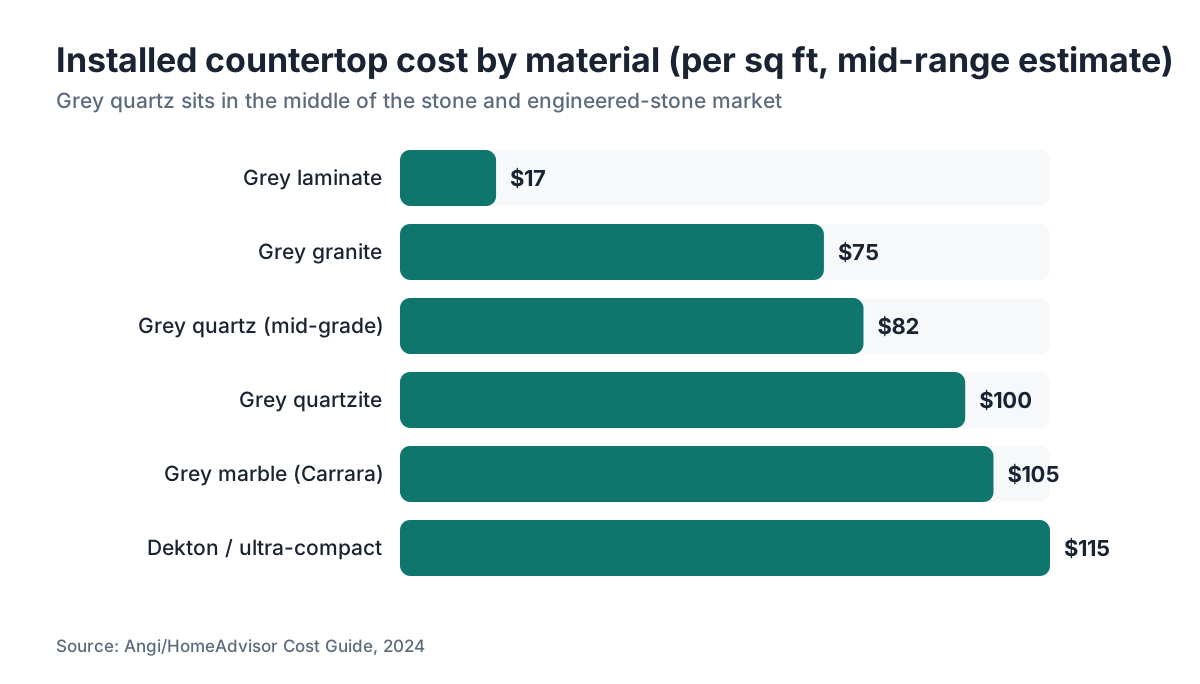
This is the question most homeowners actually need answered before they commit. Here's the honest comparison.
| Material | Hardness (Mohs) | Needs sealing | Heat resistance | Stain resistance | Installed cost (per sq ft) |
|---|---|---|---|---|---|
| Grey quartz | ~7 | No | Poor (>300°F) | Excellent | $50, $120 |
| Grey marble (Carrara) | 3 to 4 | Yes (1 to 2x/yr) | Good | Poor (acid etches) | $60, $150 |
| Grey granite | 6 to 7 | Yes (1 to 3 yrs) | Excellent | Good | $45, $110 |
| Grey quartzite | 7 to 8 | Yes (1 to 2x/yr) | Excellent | Good | $65, $140 |
| Grey laminate | N/A | No | Poor | Moderate | $8, $25 |
Granite is the closest natural competitor. It costs about the same, handles heat better, and if you buy a genuinely grey granite like Viscount White or Steel Grey, the movement and depth look more natural than most engineered options. The trade-off is sealing every year or two and some variation between slab segments [5]. See granite countertops for the full breakdown.
Marble is beautiful and acid-sensitive. Lemon juice, wine, and vinegar etch the surface permanently over time. If you have kids, cook a lot, or just don't want to think about it, grey quartz is the more practical pick. If you want real marble and are willing to manage it, marble countertops has the full picture.
Quartzite (not to be confused with quartz) is natural stone and harder than granite. True quartzite is heat-proof and very durable, but it still needs sealing and costs more than quartz in most markets. How to clean quartzite countertops covers the maintenance reality.
Laminate earns a mention because the gap has closed. High-pressure laminate in grey concrete or Calacatta patterns now looks genuinely good, and at $8, $25 per square foot installed it's a legitimate choice for rentals or tight budgets. See laminate countertops for current options.
What are the real disadvantages of quartz countertops?
The marketing brochures skip this part, so here it is straight.
Heat is the big one. The resin binder can crack, warp, or discolor from a hot pan, and warranty claims for thermal shock get denied because it's classified as misuse. Caesarstone's warranty specifically excludes "damage caused by extreme heat" [3]. You need trivets. Full stop.
UV exposure yellows some quartz formulations over time. This matters most in outdoor kitchens or rooms with hard south-facing sun. Manufacturers have improved UV stability, but some lighter grey slabs, especially older formulations, develop a warm cast near windows over 5 to 10 years. Doing an outdoor kitchen? Look for UV-rated products or pick a different material.
The look is consistent, which is both a selling point and a complaint. A natural slab of grey granite has movement, slight color shifts, and character. Engineered quartz is uniform, and in certain light that uniformity reads flat or plastic to some eyes. This is personal. It's also real.
Repairs are hard. A crack or chip in quartz is tougher to fix invisibly than in granite. Granite can often be polished or filled by a skilled hand and look nearly perfect. Quartz color matching is worse because the resin ages and the filler rarely lines up.
Then there's weight. A 3 cm quartz slab runs about 20 lbs per square foot. Older or non-standard cabinetry sometimes needs reinforcement before install. This is rarely expensive, but it's a line item your fabricator should flag during templating.
One more, for anyone in the trade: cutting engineered quartz dry releases respirable crystalline silica, a documented health hazard. OSHA sets a permissible exposure limit of 50 micrograms per cubic meter as an 8-hour time-weighted average [11], and both CPSC and OSHA have issued guidance on fabrication dust risks [10]. Wet cutting and proper ventilation are not optional in a shop.
Does grey quartz need sealing or special cleaning?
No sealing, ever. That's the clearest practical advantage over natural stone. The nonporous resin surface won't absorb liquids, so there's nothing for a sealer to fill [1].
Day-to-day cleaning is soap and water or a mild stone-safe spray. Skip high-concentration bleach (diluted bleach is fine for disinfecting), and stay away from abrasive scrubbers that dull a polished finish over time. NSF International guidance on food-contact surfaces confirms that nonporous solid surfaces clean effectively with standard dish soap and water [6].
The one mistake people make with grey quartz specifically: using oil-based conditioners or waxes meant for granite. They leave a hazy film that takes a degreaser to remove. Read the manufacturer's care guide. Every major brand publishes one online.
For cleaning questions on stone-adjacent surfaces, how to clean stone countertops covers the broader principles.
How do I pick a grey quartz for my specific kitchen?
Start with your cabinet color, not the countertop. Grey quartz reads very differently against white Shaker cabinets versus dark navy lowers versus warm oak. Ask your showroom for a physical sample, at least 6 inches square, and hold it against your actual cabinet door in your kitchen's light before you commit. Showroom fluorescent lighting lies.
Undertones matter a lot in grey. Most grey quartz leans cool (blue-green undertones, like concrete) or warm (beige-taupe undertones). Cool grey works with white, grey, or navy cabinetry and polished chrome. Warm grey reads better with wood tones and brass or bronze hardware. To spot the undertone, set the slab against a white sheet of paper in daylight.
Think about your backsplash second. A busy subway tile or patterned mosaic wants a solid or lightly veined grey quartz behind it so nothing competes. A simple backsplash gives a heavily veined grey quartz room to carry the visual interest.
For marble-look veined patterns, ask to see multiple slabs. Even engineered quartz varies between production runs. Most fabricators can pull two or three slabs from inventory and let you compare.
Consider the finish last. Polished grey quartz shows fingerprints and water spots more than honed. In a busy family kitchen, honed is usually the smarter call. In a low-traffic entertaining kitchen or a master bath, polished reads more formal.
What should I ask a fabricator before signing a quote?
Most homeowners don't know what to ask, and fabricators vary widely in how much they volunteer. These are the questions that actually matter.
What thickness slab is included? Get 3 cm unless you have a budget reason not to. If they quote 2 cm, ask what lamination or substrate comes with it.
Is the edge profile included in the price? Standard eased edges usually are. Anything fancier is an upsell. Know what you're getting.
How many pieces will the countertop take? Most kitchens need at least 2 to 3 pieces of stone, joined at seams. Ask where the seams land. Seams are hardest to hide in corners and near sinks, and a good fabricator will show you seam placement on the template layout before cutting.
What does the warranty cover? Ask specifically about heat damage and whether the manufacturer's warranty transfers to a second owner if you sell. Many don't.
What's the lead time? Grey quartz is one of the most stocked colors, but popular lines back-order. Ask how long from templating to installation and what happens if a slab shows a defect mid-job.
Do you template in person or use digital tools? Laser or digital templating cuts measurement error and helps fabricators nest your pieces to reduce waste. A shop still cutting paper templates in 2025 isn't automatically a dealbreaker, but it's worth knowing. Shops running software like SlabWise for quoting and nesting can show you exactly how your pieces lay out on the slab before they cut, which kills most surprises.
For a full walkthrough of what installation involves, countertop installation covers the process step by step.
Is grey quartz a good choice for bathrooms and outdoor kitchens?
Bathrooms: yes, with no real caveats. Grey quartz is one of the most popular vanity materials precisely because bathrooms see less heat stress than kitchens (no hot pans) and the nonporous surface resists the mildew that natural stone can harbor in humid air. The weight of a 3 cm slab on a vanity is rarely a structural concern.
For a double vanity, grey quartz in a honed or leathered finish reads clean and modern and hides toothpaste splatter better than polished. Undermount sinks are easier to keep clean with quartz than with porous stone.
Outdoor kitchens: more complicated. Standard indoor quartz is not rated for outdoor use by most manufacturers. UV exposure causes yellowing, and freeze-thaw cycles in cold climates stress the resin bond. Dekton (Cosentino's ultra-compact surface) and a handful of specifically outdoor-rated quartz products handle exposure better. If your outdoor kitchen is covered and in a mild climate, standard grey quartz sometimes holds up fine in practice, but your warranty won't cover it. For a genuinely exposed application, spec an outdoor-rated product or look at porcelain or granite.
How long does grey quartz last, and what can damage it?
Under normal residential use, a grey quartz countertop should last 25 years or more without significant degradation. The material doesn't etch, corrode, or stain from typical kitchen chemistry. The resin does slowly oxidize with UV exposure, but in an indoor kitchen that's rarely noticeable.
What actually damages quartz in real kitchens:
Heat. A cast iron pan straight from the oven leaves whitish thermal shock marks on quartz. This is the number one cause of premature damage. A single incident can crack the slab or cause discoloration no refinishing will fix.
Chipping at edges. Quartz is hard but brittle. Drop a heavy pot on a sharp edge, especially a mitered waterfall, and it can chip. Repairs are possible but visible up close.
High-pH cleaners. Oven cleaners, drain openers, and some concrete degreasers attack the resin binder. Spill one and wipe it immediately with water.
Installation stress. Poor substrate support or cabinets that aren't level create point loads that crack quartz over time. This is a fabricator and installer responsibility, not yours, but it's worth having them check cabinet level carefully before the countertop goes down.
How does grey quartz perform for resale value?
Quartz countertops generally lift home resale value, though the data is messier than the remodeling industry likes to suggest. The National Association of Realtors' 2023 Remodeling Impact Report found a complete kitchen upgrade (countertops included) recovered about 67 percent of its cost at resale [7]. That figure doesn't isolate countertop material on its own.
In practice, agents consistently note that buyers in the $400,000-and-up market expect stone or engineered stone. Laminate or tile gets flagged as an update needed. Grey quartz, being a neutral, avoids the niche polarization that bold stone colors create. A heavily veined green quartzite might thrill 15% of buyers and put off the rest. A soft grey quartz offends almost nobody.
Renovating to sell fast and spend little? A straightforward grey quartz in 2 cm with a simple edge is a defensible choice. Renovating for yourself and staying 10 years? Buy the material you actually love.
For how other materials affect resale, kitchen countertops has a broader roundup.
Which grey quartz brands are worth buying?
Brand selection matters more than most homeowners realize. Warranty service, slab consistency, and fabricator familiarity all vary.
Caesarstone is the original licensed manufacturer and the quality benchmark for most fabricators. Their Statuario and Airy Concrete lines are well-documented and consistent, and the warranty is honored by a company with 30-plus years behind it. Available through most stone distributors in North America.
Cambria is the only major quartz brand that manufactures entirely in the United States (Eden Prairie, Minnesota) and backs its slabs with a limited lifetime warranty for residential use [8]. Grey offerings like Brittanicca Storm and Swanbridge are popular with designers who want heavy veining. Price runs slightly higher than Caesarstone on average.
Silestone (Cosentino) has a large grey catalog and its HybriQ technology, which mixes in recycled glass and mirrors. The practical performance difference from older formulations is modest. Their service network is large and widely available.
MSI Quartz is the budget-accessible option, sold through Home Depot and independent distributors. Quality is adequate and improving, and the price gap is real: MSI grey quartz often runs $40, $55 per square foot fabricated versus $60, $80 for comparable Caesarstone specs. The trade-off is thinner warranty coverage and less consistency between production runs.
For Cambria specifically, cambria countertops has a detailed brand breakdown.
Frequently asked questions
What is the average cost to install grey quartz countertops?
Expect $50, $120 per square foot installed, with the realistic mid-range for a standard kitchen at $75, $90 per square foot. A typical 40-square-foot kitchen with one sink cutout runs $3,000, $4,800 all in. Price varies by brand tier, edge profile, slab thickness, and local labor market. These numbers reflect 2024 to 2025 North American residential conditions.
Does grey quartz look fake or artificial compared to natural stone?
Some people think so, some don't. Heavily veined grey quartz lines like Caesarstone Statuario Maximus or Cambria Brittanicca Storm fool many eyes. Solid or lightly patterned grey quartz reads more obviously engineered, especially in large formats. The uniformity is real. If natural variation matters to you, grey granite or grey quartzite looks more organic. Visit a stone yard and compare slabs side by side before deciding.
Can you put hot pans on grey quartz?
No. This is the most consistent mistake homeowners make. The polymer resin binder can crack or permanently discolor from a hot pan, and virtually every manufacturer's warranty excludes heat damage as misuse. Use trivets or hot pads every time. This applies to all quartz brands and all colors, including grey. It is not a matter of quality tier.
How do I clean grey quartz countertops daily?
Soap and warm water covers daily cleaning. A mild stone-safe spray handles grease. Avoid full-strength bleach, oven cleaners, and abrasive scrub pads, which dull the finish over time. Never use oil-based granite conditioners on quartz. Grey surfaces show water spots on polished finishes, so drying after cleaning keeps them looking sharp.
Does grey quartz stain?
Genuine staining is rare because quartz is nonporous. Most "stains" are surface deposits: hard water scale, dried coffee, or turmeric residue that didn't get wiped up. Those come off with a soft cloth and a little isopropyl alcohol or a quartz-specific cleaner. True permanent staining from penetrating liquids essentially doesn't happen with properly manufactured quartz.
What grey quartz looks most like Carrara marble?
Caesarstone Statuario Maximus, Silestone Calacatta Gold, and Cambria Brittanicca Storm are the most commonly cited marble-look grey quartz options. All have white bases with grey veining. None are perfect imitations under close inspection, but from a normal viewing distance they read convincingly marble-like. The advantage over real Carrara is no etching from acids and no annual sealing.
How thick should grey quartz countertops be?
3 cm (about 1¼ inches) is the current residential standard and what most fabricators default to. It's strong enough to span typical cabinet openings without a plywood substrate and looks proportionally correct on standard-height cabinets. 2 cm slabs are available and cheaper but need substrate support and look visually thinner at the edge unless you add a lamination strip. For most homeowners, pay for 3 cm.
Is grey quartz good for outdoor kitchens?
Standard indoor quartz is not recommended for outdoor use by most manufacturers. UV exposure can yellow lighter grey formulations over time, and freeze-thaw cycles stress the resin bond in cold climates. In a covered, mild-climate setting you may get away with it, but your warranty won't apply. Look at outdoor-rated quartz, Dekton, porcelain, or granite for genuinely exposed outdoor kitchens.
How long does grey quartz last?
Under normal residential use, 25 years or more without significant degradation. The main risks to longevity are heat damage from hot pans, chipping at edges from impact, and high-pH chemical cleaners. The material itself doesn't etch, corrode, or absorb stains. Proper installation with level cabinet support also matters: point loads from unlevel cabinets can cause cracking over years.
What is the difference between grey quartz and grey quartzite?
Quartz countertops are engineered stone: ground natural quartz crystals bound with resin, made in a factory. Quartzite is a natural metamorphic rock quarried from the earth. Quartzite is harder, handles heat better, and looks more organic, but it needs sealing and costs more. The names are similar; the materials and care requirements are quite different. Many showrooms mislabel quartzite as quartz, so ask for the technical data sheet.
Can grey quartz be repaired if it chips or cracks?
Minor chips can be repaired with color-matched epoxy or acrylic filler, but perfect invisible repairs are difficult because the filler ages differently from the slab surface. Cracks from thermal shock or structural stress are harder to fix cleanly. Granite repairs are generally more invisible than quartz repairs because stone is easier to color-match and polish. Budget for imperfect results if you ever need repair work.
Does quartz countertop color affect price?
Within a brand's lineup, yes. Solid colors and basic patterns sit in lower price tiers. Heavily veined, marble-look, or specialty finishes like leathered or honed cost more. The premium for a veined grey like Caesarstone Statuario Maximus over a solid grey like Pebble can be $10, $20 per square foot at the material level, before fabrication and installation.
What edge profile should I pick for grey quartz?
For most grey quartz kitchens, an eased or slightly beveled edge is the cleanest choice and is usually included in the base price. It reads modern, wipes clean easily, and doesn't compete with veining. Bullnose edges look dated to many designers now. Mitered waterfall edges are dramatic but expensive and hard to repair if chipped. Pick what you love, but know that fancier edges add real cost.
How do I compare quotes from different fabricators for grey quartz?
Make sure quotes specify the same slab brand and line, thickness (2 cm vs 3 cm), edge profile, number of cutouts, and whether demo and plumbing reconnect are included. A $500 price difference often disappears when you normalize for scope. Ask each fabricator to show you their templating method and seam placement plan. Shops using digital quoting and nesting tools can usually show you their layout before cutting, which reduces surprises.
Sources
- ASTM International, ASTM C1683 Standard Specification for Dimension Stone Quartz-Based Countertops: Engineered quartz countertops are approximately 93 to 95% ground natural quartz crystals bound with polymer resins.
- Breton S.p.A., Bretonstone technology and licensing: Breton patented the original Bretonstone process in the 1960s and licenses the technology to major engineered stone producers worldwide.
- Caesarstone USA, Residential Limited Warranty: Caesarstone's warranty specifically excludes damage caused by extreme heat, classifying it as misuse.
- Angi (formerly HomeAdvisor), Quartz Countertop Cost Guide 2024: Installed quartz countertop cost averages $50, $120 per square foot in North American residential markets.
- Natural Stone Institute, Care and Maintenance of Natural Stone: Granite countertops require periodic sealing, typically every one to three years depending on stone density and use.
- NSF International, NSF/ANSI 51 Food Equipment Materials standard: NSF guidance confirms nonporous solid surfaces clean effectively with standard dish soap and water for food-contact applications.
- National Association of Realtors, 2023 Remodeling Impact Report: A complete kitchen upgrade recovered about 67 percent of its cost at resale per NAR's 2023 Remodeling Impact Report.
- Cambria, Residential Warranty and U.S. Manufacturing: Cambria manufactures entirely in the United States and backs slabs with a limited lifetime warranty for residential use.
- U.S. Geological Survey, National Minerals Information Center: Quartz (industrial silica) is one of the most abundant industrial minerals used in manufacturing, including engineered stone.
- U.S. Consumer Product Safety Commission, guidance on silica dust in countertop fabrication: CPSC and OSHA have issued guidance on silica dust exposure risks during engineered stone fabrication and cutting.
- OSHA, Occupational Exposure to Respirable Crystalline Silica: OSHA sets a permissible exposure limit for respirable crystalline silica at 50 micrograms per cubic meter as an 8-hour time-weighted average.
Last updated 2026-07-09