TL;DR
- Grey marble countertops run $40 to $200 per square foot installed, depending on the variety and your region.
- They're beautiful and genuinely durable for low-acid use, but they etch and stain without consistent sealing.
- The best grey marbles for kitchens are Bardiglio, Grigio Carnico, and Pietra Grey.
- Expect to seal every 6 to 12 months and budget for honing if you want to hide wear.
What exactly is grey marble, and which varieties are available?
Marble is a metamorphic rock, meaning it started as limestone and got cooked under heat and pressure until the calcite crystals recrystallized into something harder and more interlocked. The grey color comes from graphite inclusions, clay minerals, or iron compounds locked in during that process. No two slabs are the same, which is the appeal and the logistical headache.
The most common grey marble varieties you'll find at a slab yard in North America are:
| Variety | Origin | Typical Vein Color | Finish options | Relative hardness (Mohs) |
|---|---|---|---|---|
| Bardiglio | Italy (Tuscany) | White, dark grey | Polished, honed | ~3.5 |
| Grigio Carnico | Italy | White, gold | Polished, honed | ~3.5 |
| Pietra Grey (Grafite) | Iran | White, beige | Polished, honed | ~3.5 to 4 |
| Grey Owl Marble | Canada | White | Honed | ~3 |
| Calacatta Grey | Italy | Warm gold/grey | Polished | ~3.5 |
| Silver Shadow | Turkey | White | Polished, honed | ~3.5 |
Pietra Grey is worth a special mention. It's denser than most Italian grey marbles and sometimes sold as a limestone hybrid; ask your supplier for the actual test data if porosity matters to you. Bardiglio is the classic workhorse: dark, consistent patterning, and available in jumbo slabs that can span a kitchen island without a seam.
Hardness matters less than porosity for day-to-day care. Marble sits at roughly 3 to 4 on the Mohs hardness scale [1], which means a steel knife won't scratch the surface, but a lemon wedge left pooling for 20 minutes will etch the finish. That's chemistry, not hardness.
How much do grey marble countertops cost?
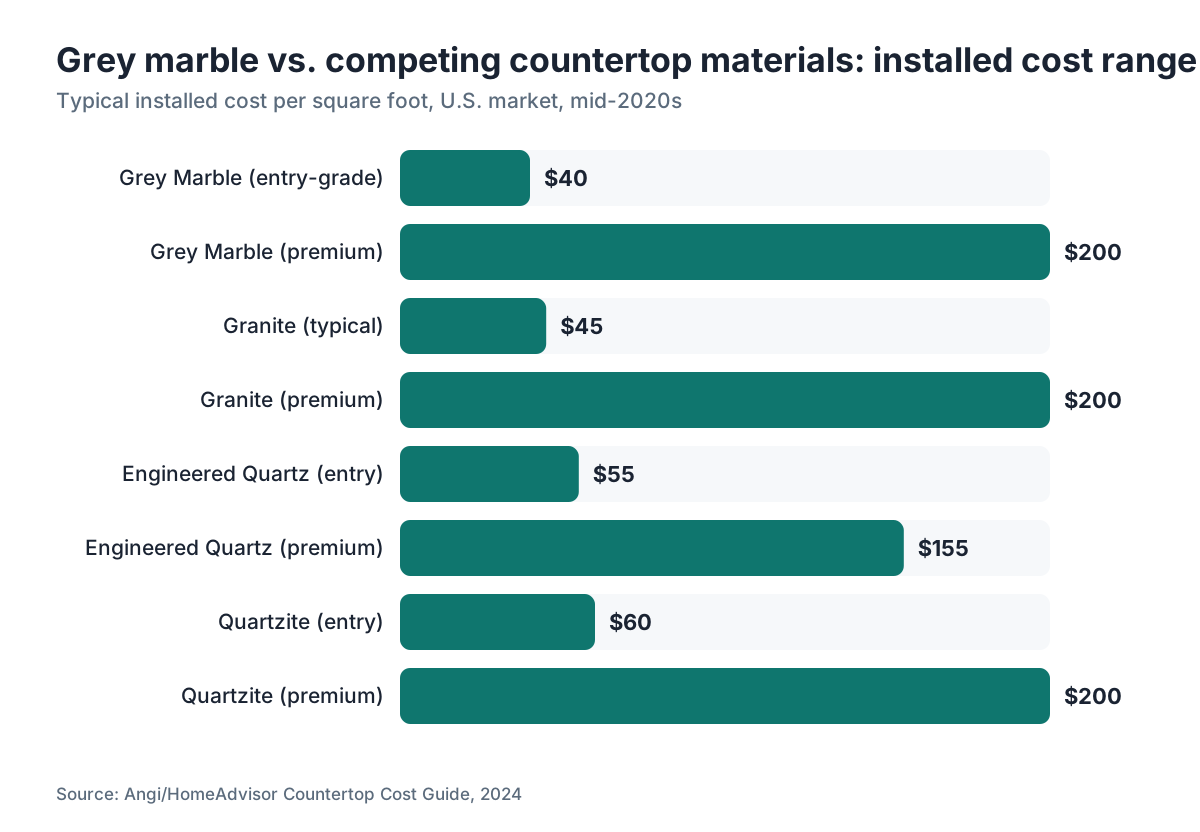
Installed cost for grey marble countertops runs $40 to $200 per square foot in most U.S. markets, with the widest spread driven by material grade and regional labor [2]. The breakdown looks roughly like this:
| Cost component | Low end | High end |
|---|---|---|
| Material (slab, per sq ft) | $20 | $120 |
| Fabrication (cut, edge, polish) | $15 | $50 |
| Installation | $10 | $30 |
| Sealer (first application) | $2 | $10 |
| Total installed | ~$40 | ~$200+ |
Commercial-grade Bardiglio from a domestic importer often lands at $35 to $55 per square foot for the slab alone. Calacatta Grey or rare bookmatched Pietra Grey can push $90 to $120 per slab square foot before anyone touches a saw.
A typical kitchen with 50 square feet of countertop runs $2,000 to $10,000 installed. That's a wide band. The honest reason is that shops price differently based on edge profiles, sink cutouts, and how many seams they have to make. A single-slab island with a waterfall edge costs more per square foot than a simple perimeter with an eased edge.
Here's what homeowners miss. You pay for the whole slab, not the square footage you actually use. A slab might be 55 square feet, but your counters only need 40. You still bought 55. Ask your fabricator about remnant credit programs if you're doing a smaller job. Shops running quoting software like SlabWise can show you the actual yield off a specific slab before you commit, which prevents the invoice surprise.
For comparison, engineered quartz runs $55 to $155 installed [2], and quartzite (which people often confuse with marble) runs $60 to $200. Grey marble isn't cheap, but it's not wildly out of line with comparable natural stone.
Does grey marble hold up in a kitchen?
This is the question everyone asks, and most answers online are either too optimistic or too scary. Here's the honest version.
Marble is porous and calcium-based. Acids etch the surface through a chemical reaction, not a scratch. Lemon juice, vinegar, wine, tomato sauce, and even some dish soaps can dull or pit a polished finish if they sit. Heat from a pan won't crack it the way it can engineered quartz (marble has been used in bakeries for centuries because it stays cool), but direct flame or an extremely hot cast-iron skillet can cause thermal shock in rare cases.
A honed or leathered finish hides etching and everyday wear far better than a polished finish. If you want grey marble in a busy kitchen and you don't want to baby it, choose honed. The matte look also happens to suit most grey marble's aesthetic better than a high-gloss polish.
For a kitchen where you cook seriously, grey marble at the perimeter works well for prep areas where you're not squeezing citrus constantly. Around the range or at a baking station, it's excellent. If your kitchen island doubles as a breakfast bar where juice glasses and wine bottles sit, marble will show that use over time. That patina is a feature to some people and a dealbreaker to others. Be honest with yourself before you buy.
Bathroom vanities are where grey marble truly excels with minimal compromise. Toothpaste and hand soap are mild, foot traffic is low, and the look in a bathroom is hard to beat. Many designers specify grey marble only for baths and choose quartzite or quartz for kitchens for exactly these reasons.
If you want a similar look with better acid resistance, leathered quartzite in a grey tone (think Crystal Fantasy or Azul Macaubas Grey) is worth a look. See kitchen countertops for a full material comparison.
How do you seal and maintain grey marble countertops?
Sealing is not optional if you care about the surface. A penetrating impregnating sealer soaks into the pores and slows liquid absorption; it does not make the surface acid-proof. That's a distinction most homeowners don't hear until after the first etch.
For most grey marbles, seal every 6 to 12 months in kitchens and every 12 to 24 months in bathrooms [3]. To test whether your slab needs resealing, put a few drops of water on the surface. If they bead up within a few minutes, the sealer is still working. If the water darkens the stone quickly, it's time to reseal.
Application process:
- Clean the surface thoroughly and let it dry completely (at least a few hours, ideally overnight).
- Apply the impregnating sealer with a clean cloth, working in sections.
- Let it penetrate for 5 to 10 minutes (follow product directions exactly, they vary).
- Wipe off any excess before it dries on the surface, because residue will haze the finish.
- Allow the full cure time before using the surface, typically 24 to 48 hours.
For daily cleaning, use a pH-neutral stone soap or just warm water and a soft cloth [4]. Avoid anything with bleach, vinegar, or citrus. Standard multi-surface sprays like 409 and most bathroom cleaners are too acidic for marble. The Marble Institute of America recommends mild dish soap diluted in water as an everyday cleaner.
Etch marks, those dull cloudy spots from acid exposure, are different from stains. Etching is surface damage, not a foreign substance in the pores. Light etching on polished marble can sometimes be buffed out by a stone restoration professional with diamond polishing pads. On honed marble, light etching often blends in on its own. Deep etching usually requires professional re-polishing or honing the entire surface to a consistent finish.
For broader stone care tips, see how to clean stone countertops.
What's the difference between grey marble and grey quartzite?
This is one of the most common points of confusion in the stone business, and some suppliers get it wrong intentionally or by accident. Grey quartzite and grey marble can look nearly identical at the slab yard, but they behave very differently.
Quartzite is a metamorphic rock that started as sandstone and recrystallized into a dense, hard material (Mohs 7+, compared to marble's 3 to 4). True quartzite is significantly more resistant to etching because it's silica-based, not calcium-based [5]. Marble is limestone's transformed version, and all that calcite is what makes it so reactive to acids.
The visual difference: marble tends to have softer, more flowing veins that look almost painted. Quartzite veins are often more angular, with a granular texture visible up close. Grey quartzite varieties like Azul Macaubas, Amazzonite, and White Macaubas often have a slightly sparkly quality from the interlocked quartz crystals.
The practical test: if you're unsure what you're looking at, put a drop of muriatic acid (diluted) on an inconspicuous spot. Marble fizzes immediately; quartzite does not. Your slab supplier should be able to give you the actual mineralogy report. If they can't, that's a flag.
For kitchens where you want the grey-and-white veined look with less maintenance anxiety, grey quartzite is the practical choice. For bathrooms or for people who love the look and accept the maintenance trade, true grey marble is wonderful. More on quartzite care at how to clean quartzite countertops.
What finishes work best for grey marble countertops?
Grey marble comes in polished, honed, brushed, and leathered finishes, and the finish choice affects maintenance, appearance, and where the stone works best.
Polished is the mirror-like finish you picture in magazine kitchens. It shows off veining depth and color contrast at its maximum. It also shows every fingerprint, water spot, and etch mark. On grey marble specifically, polished can look stunning but demanding.
Honed means the surface is ground to a consistent matte or satin texture. Grey marble in a honed finish has a softer look, hides etching better, and shows less smearing. The trade-off: the open pores in a honed surface absorb stains faster, so sealing matters even more. Most kitchen-focused designers default to honed for marble.
Brushed or antique-brushed finishes use wire brushes to create a slightly rough, aged texture. This hides wear extremely well and gives grey marble a warmer, more rustic appearance. Not every supplier stocks it.
Leathered is similar to brushed but with a slightly more textured surface that feels like thick paper. It's the most forgiving finish for busy kitchens, and on dark grey marbles like Bardiglio it looks genuinely exceptional. Water and crumbs sit on the high points rather than pooling in pores, which makes wiping down easier.
For bathrooms, polished is fine because acid exposure is minimal and you can enjoy the reflective quality. For kitchens, honed or leathered is the practical recommendation. If you love polished and plan to keep up with it, that's a legitimate choice. Just go in knowing what you're signing up for.
How does grey marble compare to granite and quartz?
The three-way comparison homeowners ask about most often is marble vs. granite vs. quartz. Here's a practical breakdown:
| Property | Grey Marble | Granite | Engineered Quartz |
|---|---|---|---|
| Hardness (Mohs) | 3 to 4 | 6 to 7 | ~7 (varies) |
| Acid resistance | Poor | Good | Excellent |
| Heat resistance | Good | Excellent | Moderate (can crack) |
| Scratch resistance | Moderate | High | High |
| Stain resistance (sealed) | Moderate | Good | Excellent |
| Typical installed cost | $40, $200/sq ft | $45, $200/sq ft | $55, $155/sq ft |
| Natural look | Yes | Yes | Close, not identical |
| Unique veining | Every slab | Every slab | Repeating pattern |
Granite is the durability workhorse of natural stone. It handles acids, heat, and daily abuse better than marble. If you cook aggressively and don't want to think about care, granite countertops are the more practical choice, though the softer look of grey marble is hard to replicate.
Engineered quartz (brands like Cambria) has no pores and resists staining and etching extremely well. The trade-off: you can see it's engineered if you look closely. The veining pattern repeats across a line, and the surface has a slightly plastic depth rather than the optical depth of natural stone. For people who put performance ahead of provenance, quartz is the logical pick.
Grey marble's advantage is that nothing looks quite like it. The depth of the veining, the variation within a single slab, and the way it catches light at different times of day is something engineered products haven't fully copied. That's worth something. Only you can decide if it's worth the maintenance trade.
What should you know about templating and fabrication for grey marble?
Grey marble is softer than granite or quartzite, which means a skilled fabricator can work it more easily, but it also chips more readily during cutting and transport if handled carelessly. Ask your shop specifically about their experience with marble, because a shop that mostly runs granite may not have the blade speeds and cooling protocols dialed in for softer stone.
Slab selection matters more with grey marble than with most other countertop materials. Grey marble varies enormously from slab to slab, even within the same lot. Go to the yard, see the actual slabs, and mark which ones you want. If you're doing a kitchen and a bathroom from the same material, try to get slabs from the same block to keep the veining consistent.
For grey marble specifically, watch for:
- Fissures: natural linear separations that may look like cracks. Many are structural, some are superficial. A fabricator can test with light and sound. Avoid slabs with fissures running through areas that will receive stress (near the sink, across seams).
- Mesh backing: some thinner imported slabs come with a fabric mesh backing to stabilize fragile areas. That's acceptable, but ask about it because it affects some edge profiles.
- Vein matching at seams: grey marble with strong directional veining needs a fabricator who knows how to plan the layout so seams don't look jarring. This adds cutting complexity and cost.
Fabricators who use digital templating and layout software can show you a to-scale rendering of exactly where each piece comes from the slab before any cutting starts. This is worth asking about, because with expensive grey marble you don't want surprises in slab yield or seam placement. See countertop installation for the full installation process breakdown.
Edge profiles on grey marble: simpler is usually better. An eased or slightly beveled edge is less likely to chip during daily use than an ogee or full bullnose on soft marble. If you love a decorative profile, honed marble is more forgiving than polished for edge durability.
Is grey marble a good choice for bathrooms and vanities?
Yes, unreservedly. The bathroom is where grey marble performs at its best and asks the least of you in return. Exposure to acidic cleaners is lower, traffic is lighter, and the material's sensitivity to heat is never an issue near a vanity sink.
Grey marble in a bathroom reads as luxurious in a way that's hard to achieve with other materials at a similar price point. A honed Bardiglio vanity top with a vessel sink is one of those design combinations that photographs beautifully and holds up in real life for decades with minimal care.
For shower walls, marble tile (not slab) is common, but slab marble in a shower is getting more popular with the right waterproofing substrate and grout-free installation. The sealing and care requirements intensify in a shower because of the constant moisture and soap exposure. If you go this route, use a penetrating sealer rated for wet applications and plan to reseal annually. Make sure your installer uses an appropriate membrane behind the stone.
For floor applications in a bathroom, honed or brushed grey marble is better than polished because polished marble gets slippery when wet. Check the DCOF (Dynamic Coefficient of Friction) rating for any floor tile you're considering. The Tile Council of North America recommends a minimum DCOF of 0.42 for wet floor locations [6].
From a design standpoint, grey marble works with almost everything. Warm brass fixtures push it toward classic European. Matte black hardware makes it feel more contemporary. White oak cabinetry with grey marble is one of the most-pinned bathroom combinations of the past five years for good reason.
What are the most common mistakes buyers make with grey marble countertops?
The mistakes cluster into a few categories, and most of them happen before installation.
Buying on budget without seeing the slab. Online slab marketplaces let you buy grey marble sight-unseen based on a stock photo. The slab that arrives can be dramatically different in character, fissure content, or coloration. For any marble purchase over a couple hundred dollars, see it in person or at minimum get hi-res photos of the specific slab with a reference object for scale.
Choosing polished finish for a busy kitchen. This isn't a wrong answer, but it's a high-maintenance commitment that a lot of homeowners underestimate. The first month looks incredible. By month six in an active kitchen, the etching and smearing can be dispiriting if you weren't prepared for it.
Skipping the sealer on installation day. Some installers seal before they leave, many don't. Ask explicitly whether the first seal is included and when it will be done. New stone should be sealed before any household use, ideally within the first 24 hours after installation.
Underestimates on square footage. Homeowners often calculate the footprint of their counters and expect that's what they'll pay for. Fabricators measure usable area after cutouts and waste from saw cuts. The actual slab square footage you buy will typically be 10 to 20 percent more than your net countertop area. Get a clear quote that specifies material square footage, more than net.
Confusing marble with quartzite at the slab yard. This happens more often than it should, especially in high-volume import yards where labels can be inaccurate or misleading. If you're paying marble prices, confirm you're getting marble. If you're paying quartzite prices and receiving marble, you'll be disappointed when it etches. Ask for a mineralogy report or at minimum confirm the seller's source.
Not asking about slab thickness. Standard countertop slabs come in 2 cm (about 3/4 inch) and 3 cm (about 1 1/4 inch). For grey marble, 3 cm is strongly preferred for countertops because it's more structurally stable and less prone to cracking during installation and use. 2 cm can work with a full plywood substrate, but most fabricators and designers default to 3 cm for kitchens.
How do grey marble countertops affect home resale value?
Natural stone countertops in general correlate with higher home sale prices, but isolating marble specifically from granite or quartzite in resale data is tricky because the studies don't always break it down that finely.
The National Association of Realtors 2022 Remodeling Impact Report found that kitchen upgrades including new countertops recover an average of 67 cents for every dollar spent at resale, with the recovered amount depending heavily on local market expectations and the starting condition of the kitchen [7]. In markets where buyers expect natural stone as a baseline, marble can be a genuine selling point. In markets where buyers worry about maintenance, marble is sometimes a neutral or even a minor negative with buyers who've done their homework.
What's clear is that grey marble reads as premium to most buyers at first impression. The visual signal is strong. Whether that translates to dollars depends on the buyer in front of you. Staging agents frequently note that a marble kitchen or bath photographs well and drives showings, even if the ROI on paper is not 1:1.
If you're installing grey marble primarily for resale, be honest that the math rarely justifies it on ROI alone. Install it because you'll enjoy it for the years you're in the house, and treat the resale benefit as a bonus rather than the reason. For a lower-cost option that also photographs well, laminate countertops or Formica countertops in stone-look patterns have gotten genuinely convincing in recent years and carry very different price tags.
Where can fabricators and homeowners get accurate quotes for grey marble work?
Getting an accurate quote for grey marble is harder than for a standard granite job because of the material variability, the seam planning complexity, and the finish options that affect labor time. A quote that doesn't specify material grade, slab thickness, finish type, edge profile, number of sink cutouts, and whether sealing is included is not a complete quote.
For homeowners, the fastest way to get a real number is to bring your kitchen dimensions (a rough sketch with measurements is fine) to a local fabrication shop and ask for an itemized quote. Get at least three quotes, because markup on imported marble slabs varies widely across suppliers.
For fabricators running shops, the challenge with grey marble jobs is that the slab cost variability makes margin hard to control. A block that runs high in fissures can dramatically change the usable yield from a slab and blow up a quote that was thin to begin with. Digital quoting tools that tie material cost to actual slab inventory, and that calculate yield before cutting, help prevent that. SlabWise is built specifically for countertop shops to do exactly this: connect the slab yard inventory to the quote to the cut layout, so you're not guessing at yield. If your shop is still quoting marble jobs off a spreadsheet, a software demo is worth the half hour.
For homeowners comparing quotes, the numbers to isolate are cost per slab square foot for material, fabrication rate per square foot, and any extras (edge upgrades, cutout fees, seam charges, delivery). Once you have those broken out, the quotes become comparable.
Frequently asked questions
What is the best grey marble for kitchen countertops?
Bardiglio is widely considered the most practical grey marble for kitchens because of its dense, consistent grain and availability in large slabs. Pietra Grey (also called Grafite) is another good option with slightly higher density. Both are best used in a honed finish to minimize visible etching. Avoid rare bookmatched varieties in a working kitchen unless you're prepared for the care.
How often do you need to seal grey marble countertops?
Plan to seal every 6 to 12 months in kitchens and every 12 to 24 months in bathrooms with light use. Test your slab by putting a few drops of water on the surface: if the water darkens the stone in under 4 minutes, it's time to reseal. Use an impregnating penetrating sealer, not a topical coating, and follow the manufacturer's dwell time instructions exactly.
Will grey marble countertops stain or etch?
Etching (dull marks from acid) and staining (absorbed substances) are both real risks. Etching happens from lemon juice, vinegar, wine, tomato products, and even some soaps. Staining happens from oils, coffee, and dark liquids that penetrate the pores. Sealing reduces staining but doesn't prevent etching, because etching is a chemical reaction with the calcium in the stone, not a porosity issue.
Is grey marble more expensive than white marble?
Not necessarily. Price in marble is driven by rarity, quarry source, and pattern consistency more than color. Common grey marbles like Bardiglio are priced similarly to common white Carrara, roughly $20 to $55 per square foot for the slab. Rare grey varieties like Calacatta Grey or bookmatched Pietra Grey can push above $100 per slab square foot, similar to premium white Calacatta.
Can you use grey marble around a kitchen sink?
You can, but it requires consistent care. The area around a kitchen sink is one of the highest-risk zones for marble: water sits, soap scum builds up, and citrus ends up near the drain constantly. Seal that area more aggressively, wipe standing water promptly, and consider a double bowl configuration that keeps the marble away from the primary wet zone. Honed marble shows water damage less than polished.
How do you remove a stain from grey marble?
Use a poultice: a paste of baking soda and water for oil-based stains, or a mix of hydrogen peroxide and baking soda for organic stains like coffee or wine. Apply it about a quarter inch thick over the stain, cover with plastic wrap, tape the edges, and let it sit 24 to 48 hours. Remove, rinse, and let dry. Repeat if needed. Never use bleach or acid-based cleaners on marble.
What edge profile should I choose for grey marble?
Simpler edge profiles hold up better on marble because the stone is softer than granite or quartz. An eased or beveled edge is durable and easy to clean. Mitered or pencil edges are fine. Avoid knife-sharp edges (they chip easily) and elaborate ogee profiles if the kitchen sees heavy use. For a polished finish, a flat eased edge shows off the stone cleanly. For honed marble, almost any simple profile works well.
Is grey marble good for an outdoor kitchen?
Not ideal. Marble is sensitive to freeze-thaw cycles, UV exposure, and the full range of outdoor acids (from rain, leaves, bird droppings). Most fabricators recommend against marble for outdoor horizontal surfaces. If you love the grey stone look outside, granite or a grey concrete countertop will perform significantly better. Honed bluestone is another option with a similar muted grey aesthetic built for exterior use.
How heavy are grey marble countertops?
Marble weighs roughly 13 to 15 pounds per square foot at standard 3 cm thickness. A 50-square-foot kitchen installation runs 650 to 750 pounds total. Standard kitchen cabinets handle this fine, but make sure your cabinetry is solid and level before installation. Older cabinets or non-plumb walls may need shimming. Your fabricator should inspect the cabinet condition before templating.
What's the difference between Bardiglio and Calacatta Grey marble?
Bardiglio is a dark charcoal-to-blue-grey marble from Tuscany with fine white or lighter grey veining. It's relatively consistent and available in large slab sizes, which makes it a workhorse material for countertops. Calacatta Grey is lighter, more of a warm medium grey, with bolder and more dramatic white and gold veins. Calacatta Grey is rarer, pricier, and has a showier appearance. Both are Italian, both are calcite-based marble with similar maintenance needs.
Can grey marble be repaired if it chips or cracks?
Minor chips can be repaired with a color-matched epoxy filler and a skilled stone restoration professional. The repair is often nearly invisible on darker grey marble like Bardiglio, since the uniform color makes matching easier. Cracks running through the full thickness are more serious and depend on location: a crack away from seams and not near a cutout may be stabilized with epoxy, while a crack at a weak point may eventually require a full section replacement.
How does grey marble compare to soapstone for countertops?
Both are grey natural stones with a classic look, but they behave very differently. Soapstone is non-porous and immune to acid etching, which makes it dramatically more practical for kitchen use than marble. It scratches more easily (Mohs 1 to 2 vs marble's 3 to 4) but scratches can be sanded out with mineral oil. Soapstone darkens over time with oiling, marble does not. For kitchen maintenance ease, soapstone wins. For variety of grey tones and veining patterns, marble wins. See more at how to clean soapstone countertops.
Is it worth paying for bookmatched grey marble?
Bookmatching (cutting two adjacent slabs and opening them like a book so the veining mirrors) is visually spectacular on dramatic grey marble. It's worth it if the design is the priority and you have the budget, particularly for a large island or a focal wall. It adds roughly 20 to 40 percent to material cost and requires careful seam planning. For a standard perimeter countertop with moderate veining, bookmatching rarely adds enough visual payoff to justify the premium.
Sources
- U.S. Geological Survey, Minerals Information: Marble: Marble hardness is approximately 3 to 4 on the Mohs scale, derived from its calcite composition.
- HomeAdvisor (Angi), Countertop Installation Cost Guide: Installed marble countertops cost $40 to $200 per square foot; engineered quartz runs $55 to $155 installed.
- Marble Institute of America, Care and Maintenance Guidelines: Impregnating sealers should be reapplied every 6 to 12 months in kitchens and every 1 to 2 years in lighter-use areas.
- Marble Institute of America, Residential Stone Care: The Marble Institute of America recommends pH-neutral cleaners or diluted mild dish soap for daily marble surface cleaning.
- U.S. Geological Survey, Mineral Resources Program: Silica and Quartz: Quartzite is silica-based with a Mohs hardness of 7 or greater, giving it substantially greater acid resistance than calcite-based marble.
- Tile Council of North America, ANSI A137.1 Standard for Ceramic Tile: TCNA recommends a minimum Dynamic Coefficient of Friction (DCOF) of 0.42 for wet floor tile locations.
- National Association of Realtors, 2022 Remodeling Impact Report: Kitchen upgrades including countertops recover an average of 67 cents per dollar spent at home resale, per NAR 2022 data.
- ASTM International, Standard C503 for Marble Dimension Stone: ASTM C503 establishes minimum physical property requirements for marble used in dimension stone applications including countertops.
- U.S. Geological Survey, Dimension Stone Statistics and Information: The USGS tracks domestic and imported dimension stone volumes, with marble among the top five imported stone types by value.
- Marble Institute of America, Slab Fabrication Standards: Standard countertop slab thicknesses are 2 cm and 3 cm; MIA guidelines recommend 3 cm for unsupported spans in kitchen applications.
Last updated 2026-07-09