TL;DR
- Granite countertops come in hundreds of natural color families, from classic white and black to rare blue and green exotics.
- Installed prices run roughly $40 to $200 per square foot depending on rarity, thickness, and edge profile.
- This gallery-style guide explains what drives visual differences, how to read a slab in person, and which looks hold up best in real kitchens.
What does a granite countertop actually look like, and why do slabs vary so much?
Granite is an igneous rock that forms when magma cools slowly deep underground. The slower the cooling, the larger the mineral crystals that grow, which is exactly why no two slabs look alike. What you see on the surface is a direct record of that cooling history, the mineral chemistry, and any veining introduced by later geological pressure.
The three main minerals in most granite are quartz (glassy, clear to white), feldspar (often pink, cream, or white), and biotite or hornblende mica (black, gold, or bronze flecks). Their ratios set the color. A slab heavy in pink feldspar looks pinkish-red. A slab where dark hornblende dominates looks almost black with bright crystal flashes.
Veining in granite comes from mineral intrusions called pegmatite dikes that cut through the parent rock after it formed. That is different from marble, where veining is metamorphic calcite. Granite veins tend to be wider, more jagged, and harder than the flowing hairline veins you see in Calacatta marble.
Every quarry in every country produces stone with a distinct mineral signature, so the number of visually distinct granites in commercial supply runs into the thousands. The quarry industry has no single naming authority, which means the same stone gets sold under multiple trade names at different distributors. Buy by looking at the actual slab, not the name on the ticket [1].
What are the main granite color families you will actually find at a slab yard?
Most granite falls into seven broad color families. Within each family the range is huge, so treat these as starting points, not guarantees.
White and light gray granite includes stones like White Ice, Colonial White, and Arctic White. These slabs have a white or cream base with black, gray, and sometimes gold or rust speckling. They pair with almost every cabinet color and stay the most requested category at most U.S. distributors.
Black and dark gray granite runs from near-solid Absolute Black (from India, technically a gabbro) to Ubatuba, a very dark green that photographs almost black indoors. These hide crumbs and wear well in busy kitchens.
Beige and brown granite covers Tan Brown, Santa Cecilia, and Giallo Ornamental. Gold and rust tones dominate. Most of these come from Brazil or India and land among the cheapest slabs in the market.
Red and pink granite includes Imperial Red, Balmoral Red, and Rosa Beta. The pink comes from high feldspar content. These are bold picks that suit traditional or farmhouse kitchens.
Blue granite is rare and genuinely expensive. Azul Bahia from Brazil and Sodalite Blue from Canada are the recognized names. The blue mineral is either lazurite or sodalite. Expect a steep premium. Some cheaper "blue granites" are actually dyed, so ask for documentation.
Green granite includes Uba Tuba (dark green-black with gold flecks), Verde Butterfly, and Forest Green. Chlorite and epidote give these their color. They rank among the better performers for hiding daily use.
Exotic and multi-color granite is a catch-all for slabs with dramatic movement, bold color contrasts, or large crystal formations. Typhoon Bordeaux, Blue Dunes, and Cosmic Black fall here. These work best as statement islands or featured surfaces rather than perimeter runs because they are hard to match when you need multiple slabs [2].
How much do different granite colors and styles cost per square foot?
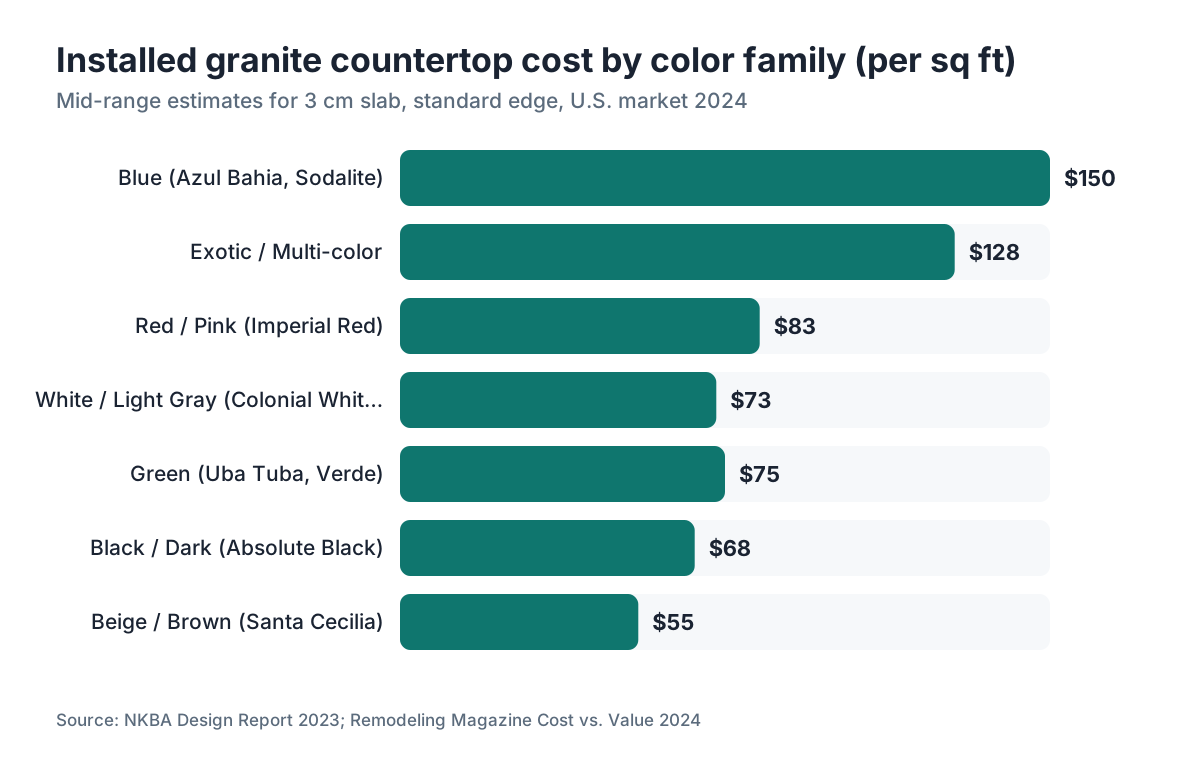
Price in granite comes down to four things: how far the stone traveled, how rare the quarry is, how thick the slab is (2 cm vs. 3 cm), and current supply at U.S. distributors. The National Kitchen and Bath Association tracks installed countertop costs in its annual Design Report, and the granite range has consistently landed between roughly $40 and $175 per square foot installed across U.S. markets [3].
Here is how the color families typically stack up at current distributor pricing:
| Color Family | Installed Cost Range (per sq ft) | Notes |
|---|---|---|
| Beige / Brown (Santa Cecilia, Tan Brown) | $40, $70 | High volume from Brazil and India keeps cost down |
| White / Light Gray (Colonial White, White Ice) | $55, $90 | Most popular tier; wide availability |
| Black / Dark (Absolute Black, Ubatuba) | $50, $85 | Absolute Black is often entry-level; dark exotics cost more |
| Red / Pink (Imperial Red, Balmoral Red) | $65, $100 | Scandinavian sources add freight cost |
| Green (Uba Tuba, Verde Butterfly) | $55, $95 | Very popular; easy to find |
| Blue (Azul Bahia, Sodalite Blue) | $100, $200+ | Rare quarries, high freight, small slab yield |
| Exotic / Multi-color (Typhoon Bordeaux, Cosmic) | $80, $175 | Varies wildly; full slab purchase sometimes required |
Those ranges assume 3 cm thickness, a standard edge profile, and a straightforward layout. A complex kitchen with an island, multiple cutouts, and a fancy ogee edge adds $15 to $40 per square foot in labor over a simple straight-cut job [4].
Want real-time pricing in your area? Most slab distributors post remnant and full-slab inventory online now, which gives you a live floor for negotiation.
What finish options are available and how do they change the look?
The finish applied at the fabrication shop changes both the appearance and the maintenance of the same stone by a lot.
Polished is the default. The surface gets ground progressively finer until it reaches a mirror shine. Colors deepen, crystals catch light, and veining pops. Polished granite shows fingerprints and water spots on dark stones, but it cleans easily and shrugs off scratches in normal use.
Honed finish stops the grinding before the shine develops. The result is a flat, matte surface that looks softer and more casual. Honed granite feels slightly velvety. The trade-off: it shows oils more readily and needs sealing more often than polished. Plenty of designers pick honed for perimeter runs when they want the stone to recede behind a bold backsplash.
Leathered (also called brushed or antiqued) uses diamond-tipped brushes to build a slightly textured surface with a low sheen. It hides fingerprints better than polished and has more visual depth than honed. It looks best on darker stones like Ubatuba or Absolute Black, where the texture adds dimension. Leathered finishes typically cost $10 to $25 extra per square foot because of the added machine time.
Flamed finish shows up almost exclusively on exterior applications or very rustic interiors. Heat makes the feldspar crystals pop, creating a rough, non-slip surface. You will not see it often in kitchen galleries, but it turns up in outdoor kitchen projects.
One thing to keep in mind for gallery browsing: photographs of polished slabs almost always look richer in color than what you will see in a showroom under overhead fluorescent light. Always view physical samples in your actual kitchen lighting before committing [5].
How do you read a granite slab before buying, and what should photos not hide?
Looking at granite countertops pictures, online or in a showroom binder, is genuinely useful for narrowing color families. It is not enough to make a final call. Here is what photographs routinely fail to capture.
First, fissures. Natural fissures are cracks or separations in the mineral structure that formed during cooling. They are not structural defects, but they can look alarming on a finished countertop. Run your fingernail across a suspicious line: if the nail catches, it is a crack; if it glides, it is a fissure or a vein. A reputable fabricator epoxy-fills fissures before installation, but you should see them in person before you sign.
Second, pits. Granite has microscopic pores, and some stones have small surface pits where a mineral crystal fell out. Under bright direct light at an angle, you can spot them. They collect oils over time. High-pit stones need more aggressive sealing schedules.
Third, color variation within a slab. Quarry blocks get sawn into sequential slabs, so adjacent slabs from the same block mirror each other. If your kitchen needs more than one slab, request sequentially numbered slabs from the same lot. A photo of a single beautiful slab can mislead you if the second slab from a different lot looks completely different.
Fourth, veining continuity across seams. In popular stones like White Ice or Typhoon Bordeaux, you will have seams. A skilled fabricator can orient the slabs so veins flow reasonably across the seam, but that takes full-slab viewing, not a photo. Ask your fabricator to lay the slabs out on the shop floor before cutting so you can approve the orientation.
Fifth, background color variation within a family. "White granite" can range from a nearly solid white to a heavily patterned salt-and-pepper look. No gallery photo, including the ones on this page, removes the need to look at the physical slabs your fabricator actually has in stock [6].
Which granite patterns and styles work best in a white kitchen?
White kitchens are the most common kitchen color scheme in U.S. remodels, so this is the question fabricators hear most. The short answer: more contrast tends to work better than less.
A pure white slab on white cabinets reads flat and cold unless your lighting is very warm. Stones with bold black or gold veining, like White Fantasy, Alaska White, or River White, give the eye something to follow and add visual warmth. Colonial White, with its rust and burgundy flecks, bridges the gap between modern and traditional.
For a contemporary white kitchen with flat-front cabinets, look at a honed white granite with a subtle pattern, or an Absolute Black leathered top for a high-contrast pairing. That white-cabinet-plus-black-countertop combination has stayed popular across two full design cycles, which is unusual.
For a traditional or shaker-style white kitchen, Giallo Ornamental (a warm beige-gold with black speckling) reads as classic. It has gone into American kitchens for decades and still shows up in designer mood boards because it does not date quickly.
Building a farmhouse kitchen with open shelving and mixed metals? Pair your granite countertops with a softer stone like Fantasy Brown (technically a quartzite or marble-granite blend depending on the block) or a heavily veined Bianco Romano. Both give the surface enough movement to feel natural instead of sterile.
One honest opinion: very busy patterns with three or more competing colors are hard to pull off on perimeter runs. Save the dramatic exotics for an island where you have one continuous slab and fewer items sitting on it to compete visually.
What granite finishes and colors work in bathrooms versus kitchens?
The use case changes the math. Kitchens get heat, stain risk from oils and wine, and heavy daily use. Bathrooms get moisture, cosmetic products, and toothpaste, but they see far less mechanical wear and almost no heat.
For bathroom vanities, you can push toward lighter, more delicate-looking stones because the surface will not take the abuse a kitchen does. Thin white or gray granites with soft patterning, like Bianco Romano or White Supreme, look clean against white cabinetry and stay bright because they are not sitting under cooking fumes.
Darker granites on bathroom vanities show water spots unless you dry them after every use, which almost nobody actually does. If you love the look of Absolute Black or Black Galaxy for a bathroom, a honed or leathered finish disguises water marks far better than polished.
Outdoor kitchens and fire pit surrounds are one of the best applications for granite. The stone is completely freeze-thaw resistant when properly installed and does not care about UV exposure the way quartz does. For outdoor use, a flamed or brushed finish gives grip if the surface might get wet. Darker colors absorb heat in direct sun, so a lighter gray or beige stays more comfortable to touch on a hot day.
For kitchen countertops, fabricators generally recommend 3 cm slabs over 2 cm because the extra thickness reduces flexing during installation and allows most edge profiles without a laminated buildup strip. In a bathroom, 2 cm is often fine and saves money on smaller surfaces.
How does granite compare visually to marble, quartzite, and quartz?
The visual confusion between granite, marble, and quartzite is real, and it costs homeowners money when they buy the wrong material for a use case based on looks alone.
Granite versus marble: marble veining is thin, flowing, and usually white-on-white or white-on-gray. Granite patterning is more granular, with visible crystals rather than flowing lines. From across the room, a heavily veined white granite like White Fantasy can pass for marble. Up close, the crystal structure gives granite away. Marble is softer (Mohs hardness around 3 to 4 versus granite's 6 to 7) and acid-etches from lemon juice, wine, and vinegar. Granite does not etch [7]. If the look you want is marble but you cook heavily, a marble-look granite is the practical answer.
For a thorough look at marble countertops, including maintenance realities, that article covers the trade-off in detail.
Granite versus quartzite: quartzite starts as sandstone that gets metamorphosed under heat and pressure into a harder, glassier rock. It often has a flowing, layered look closer to marble than to granite. Quartzite's hardness (Mohs 7+) actually beats granite in most cases. The confusion comes from stones sold as quartzite that are actually marble or a soft dolomitic stone. If a "quartzite" scratches easily with a knife, it is probably not true quartzite.
Engineered quartz (brands like Cambria, Silestone, Caesarstone) is not natural stone. It is ground quartz bonded with resin. The result is a very consistent pattern, no pitting, no sealing required, and better stain resistance than natural granite. The visual trade-off is that the pattern is man-made and lacks the random depth of a natural slab. For a comparison on Cambria countertops specifically, that article covers the engineered side of things.
If you want the visual interest of natural stone without the maintenance, a high-quality printed laminate countertop can now replicate granite patterns at a fraction of the cost, though the surface has none of granite's heat or scratch resistance.
What edge profiles are shown in granite gallery pictures, and which ones cost more?
Edge profiles are one of the most visually impactful choices after the stone itself, and gallery photos often show the sexiest profiles without mentioning the cost difference.
Eased edge (a simple 90-degree corner with a slight bevel) is the base price at most fabricators and comes with most quote estimates. It reads clean and contemporary and works in almost every style.
Bevel and demi-bullnose are the next step up. A bevel cuts the top edge at an angle; a bullnose rounds it into a half-circle. Both are common, add $5 to $15 per linear foot over an eased edge, and suit traditional kitchens well.
Ogee is the classic double-curve profile that looks elaborate and traditional. It adds $15 to $30 per linear foot and needs more machine passes. Ogee shows up heavily in older gallery photos from the early 2000s and less so in current contemporary work.
Waterfall edge drops the countertop slab vertically down the side of the cabinet for a continuous stone face. This is more of a design detail than an edge profile, requires an additional cut slab piece, and adds serious material cost. It photographs beautifully and has been dominant in high-end kitchen gallery photography for the past five years.
Mitered edge creates a thick-looking slab by joining two pieces at 45 degrees, giving the appearance of a 6 cm slab without the weight. For islands where the edge is visible on multiple sides, this reads as very substantial.
For countertop installation specifics on edge profile labor, that article goes into fabricator time and tooling in more detail [8].
How should you use granite gallery photos to plan your actual project?
Online granite countertops photo galleries are genuinely good for two things: narrowing your color family preferences and telling your fabricator what you are going for. They are not reliable for accurate color matching, texture assessment, or seam planning.
The best workflow: use gallery photos to identify two or three color families you respond to, then visit a slab yard in person to find specific slabs in those families. Most slab distributors let homeowners walk the yard. Bring cabinet door samples and a flooring sample if you can. Look at slabs in outdoor light, more than under warehouse fluorescents.
Once you have found a slab or two, ask your fabricator to do a digital layout. That overlays your cabinet dimensions onto a photo of the actual slab so you can see where seams fall and how the pattern will look in your kitchen. Software tools, including the quoting features in SlabWise, let fabricators generate these layouts quickly and share them with homeowners before any stone gets cut.
A few practical gallery-reading tips: ignore lifestyle props like bowls of fruit and cutting boards placed to make the photo pretty. They hide seams, edge details, and surface texture. Look for photos shot under flat overhead light from slightly above, because those show the real stone surface most honestly. Highly styled photography with dramatic side lighting makes even cheap stone look spectacular and makes evaluation almost impossible.
Always pull a sample tile or remnant of your chosen stone and live with it in your kitchen for a few days before you finalize. Lighting shifts through the day, and the stone will look different at 7 a.m. under LED task lights than at 6 p.m. with incandescent pendants on [9].
How do you care for granite countertops to keep them looking the way they do in photos?
The gap between how granite looks in a gallery photo right after installation and how it looks after five years of use is almost entirely a sealing and cleaning story.
Granite is porous. The pores are small, but without sealing, oils and pigmented liquids (wine, coffee, tomato sauce) migrate in and stain. Sealing fills those pores temporarily with a penetrating resin that buys time before liquids can absorb. Most fabricators apply a factory seal before delivery. That seal needs refreshing, typically once a year for kitchen surfaces, though some premium sealers claim five-year intervals.
The simple water test: pour a tablespoon of water on the surface and wait 10 to 15 minutes. If a dark ring forms, the seal is depleted and you need to reseal. If the water beads and wipes up without any darkening, the seal is still working [10].
For daily cleaning, dish soap and warm water is enough. Skip vinegar, lemon juice, and any acidic cleaner. They will not etch granite the way they etch marble, but they degrade the sealer over time and shorten its life. Skip anything abrasive that could dull the polish, too.
For a general guide on maintaining natural stone, how to clean stone countertops covers sealing schedules and cleaner compatibility in detail.
Heat: granite handles it better than any engineered surface. You can set a hot pan directly on granite without damage in almost every real-world scenario, though trivets are still good practice because thermal shock can stress grout lines at seams over time.
With proper sealing and routine care, a granite countertop installed today should look essentially the same in 20 years as it did on day one. That durability is why granite stays one of the two most specified natural stone countertop materials in the U.S. [11].
What questions should you ask a fabricator before choosing a granite based on pictures alone?
Pictures get you interested. The right questions protect you from an expensive mistake.
Ask: "Can I see the actual slabs you have in stock for this stone?" Many distributors and fabricators show gallery photos representing a stone category, not the specific slabs sitting in their yard. The real slabs may be lighter, darker, or more varied than the photo.
Ask: "How many slabs will my job require, and are they from the same lot?" For kitchens over roughly 55 to 65 square feet of countertop, you will almost certainly need two slabs. Slabs from different lots can vary dramatically in color and pattern.
Ask: "Where will the seams fall, and can we plan around the most visible areas?" Good fabricators steer seams toward corners, behind the sink, or under upper cabinets where they hide. A seam running through the middle of an island is avoidable with proper layout planning.
Ask: "Is this stone sealed before delivery, and what sealer do you use?" The sealer brand and type matter. Some cheap factory sealers last six months; better ones last two to three years. Get the product name in writing so you can maintain it properly.
Ask: "What is the price difference if I upgrade from a 2 cm to a 3 cm slab?" For most kitchens, 3 cm is worth the extra $5 to $15 per square foot in material because it eliminates the plywood underlayment and produces a more substantial edge profile.
Ask: "Do you have any remnants in this color family?" For small bathrooms, bar counters, or laundry room surfaces, remnants from larger jobs can cut your material cost by 30 to 60 percent. Most fabricators have a remnant pile that never gets advertised.
For a broader look at comparing natural stone to other surface options, the kitchen countertops guide covers the full material spectrum with installed cost comparisons [12].
Frequently asked questions
What is the most popular granite color for kitchen countertops right now?
White and light gray granites have led U.S. sales for about a decade. Stones like Colonial White, White Ice, and Alaska White show up most often in fabricator order logs. Among darker options, Absolute Black and Ubatuba rank near the top consistently. The NKBA's 2023 Design Report noted that white and gray stayed the dominant countertop color preferences among remodeling homeowners for the fifth consecutive year.
How can I find the name of a granite from a photo?
Google Lens and similar image-search tools can often identify common commercial granites from a photo. For rarer stones, the best move is to take the photo to a slab distributor in person, since they recognize stock from visual patterns. Keep in mind the same stone sells under many trade names, so even a correct identification may yield different names at different suppliers.
Is there a granite that looks like marble without marble's maintenance issues?
Yes. White Fantasy granite, Bianco Romano, and River White are often called marble-look granites because of their white backgrounds and gray veining. They do not etch from acids the way marble does and need less frequent sealing. The crystal structure is still visible up close, so they will not fool an expert, but in a kitchen they read as marble-adjacent without the vulnerability.
Do granite countertop photos accurately represent the real color?
Rarely with precision. Photography of stone is affected by lighting direction, white balance, and post-processing. Polished granite under studio side-lighting looks far more dramatic than the same stone under flat kitchen overheads. Treat online gallery photos as approximate color guides and always view physical samples in your own kitchen lighting before making a final choice.
How much does a granite countertop cost for an average kitchen?
The NKBA and remodeling cost-tracking sources generally put the average U.S. granite countertop installation at $3,000 to $5,500 for a typical kitchen of 45 to 55 square feet, including material, fabrication, and installation. High-end exotic stones or complex layouts can push past $10,000. Entry-level domestic or Indian granites in straightforward layouts can come in under $2,500.
What is the difference between a leathered and a honed granite finish?
Honed granite is ground to a smooth, flat, matte surface with no shine. Leathered (also called brushed) uses diamond brushes to build a slightly rough, textured surface with a low satin sheen. Both hide fingerprints better than polished. Leathered tends to add $10 to $25 per square foot in fabrication cost and works best on darker, coarser-grained granites where the texture adds visible dimension.
How thick should a granite countertop slab be?
3 cm (roughly 1.25 inches) is the standard for kitchen countertops in most U.S. markets and is what most gallery photos show. It does not need a plywood sublayer, spans cabinet openings without flexing, and accepts all standard edge profiles cleanly. 2 cm slabs cost less but need extra support and look thinner. For bathroom vanities, 2 cm is often acceptable given the smaller spans.
Can granite countertops be installed outdoors?
Yes. Granite is freeze-thaw stable and UV-resistant, making it one of the better natural stones for outdoor kitchens and fire pit surrounds. Use a flamed or brushed finish for grip on surfaces that might get wet. Darker colors absorb far more heat in direct sun, so a light gray or beige is more practical for outdoor surfaces in warm climates where direct contact is common.
How do I match granite slabs when I need more than one for my kitchen?
Request sequentially numbered slabs cut from the same quarry block, called a consecutive lot. These slabs are sawn in order, so the color and patterning stays as consistent as natural variation allows. Ask to see both slabs laid out side by side at the slab yard before they load them. Color variance between lots from the same named stone can be dramatic enough to look like different stones.
Does black granite stain or show wear differently than light granite?
Black granite shows water spots and light-colored residues (soap film, hard water deposits) more than light granite does. It hides dark stains like coffee or red wine better. A leathered or honed finish helps with water spotting on dark stones. Absolute Black from India is a very dense stone with low porosity, so it actually needs sealing less often than many lighter granites, despite looking more demanding.
What is blue granite and why is it so expensive?
True blue granite gets its color from sodalite or lazurite minerals, which form only under specific geological conditions and get quarried in a small number of locations, mainly Azul Bahia in Bahia state, Brazil, and a few Canadian deposits. The rarity of those quarries plus long freight distances and low slab yield per block drives prices to $100 to $200 or more per square foot installed. Dyed imitations exist, so ask suppliers for documentation.
How often does granite need to be sealed and what happens if you skip it?
Most kitchen granite needs resealing every one to three years depending on stone density and how much cooking happens on it. Skip sealing and oils and pigmented liquids gradually absorb into the pores, creating dark, permanent stains. The water bead test is the easiest diagnostic: if water stops beading and soaks in within 10 to 15 minutes, the seal is depleted. Professional resealing runs $100 to $250 for an average kitchen; DIY kits run $20 to $50.
Are granite remnants worth considering for small projects?
Remnants are often an excellent deal for bathroom vanities, laundry rooms, bar tops, and small island projects. Most fabricators sell remnants for 30 to 60 percent less than full slab price because the pieces are left over from larger jobs and would otherwise be waste. You may find high-end or exotic stones in remnant form that would be unaffordable as a full slab. The catch: remnants are one-of-a-kind, so you cannot order more of the same piece.
What is the Mohs hardness of granite and why does it matter for countertops?
Granite ranks roughly 6 to 7 on the Mohs hardness scale, which means it resists scratching from everyday kitchen tools but can be scratched by harder minerals, including diamond tools and some ceramics. In practice, granite will not scratch from knives or kitchen utensils in normal use. The hardness is higher than marble (3 to 4) and most engineered quartz binders, though engineered quartz's resin matrix resists chipping differently than granite does.
Sources
- U.S. Geological Survey, Mineral Commodity Summaries: Stone (Crushed and Dimension): Granite and other dimension stone are classified by mineral composition; no single naming authority governs commercial trade names.
- USGS, Dimension Stone Statistics and Information: Granite accounts for the largest share of dimension stone quarried in the U.S.; Brazil and India are major import sources for commercial granite slabs.
- National Kitchen and Bath Association, NKBA Design Report 2023: Installed granite countertop costs in U.S. kitchens range from approximately $40 to $175 per square foot; white and gray countertop colors were preferred by remodeling homeowners for the fifth consecutive year.
- Remodeling Magazine, 2024 Cost vs. Value Report: Complex kitchen layouts with islands and multiple cutouts add $15 to $40 per square foot in labor over a straightforward countertop installation.
- Marble Institute of America (Natural Stone Institute), Natural Stone Reference Manual: Finishes including polished, honed, and leathered are defined in the industry reference manual; leathered finish involves diamond brush processing and typically adds cost over standard polished finish.
- Natural Stone Institute, Guidelines for Selection of Natural Stone: Fissures in natural stone are not structural defects; fabricators are advised to epoxy-fill fissures before installation. Book-matching slabs from sequential lots is recommended for color consistency.
- ASTM International, ASTM C503 Standard Specification for Marble Dimension Stone: Marble has a Mohs hardness of approximately 3 to 4 and is susceptible to acid etching; granite at Mohs 6 to 7 does not etch under acid exposure.
- National Kitchen and Bath Association, NKBA Planning Guidelines: Edge profiles beyond a standard eased edge add $5 to $30 per linear foot depending on complexity; ogee and waterfall details require additional fabrication passes.
- Natural Stone Institute, Care and Cleaning of Natural Stone: Industry guidance recommends viewing stone samples in the actual installation lighting environment before final selection.
- Natural Stone Institute, Sealing Natural Stone Surfaces: The water drop test (10 to 15 minutes) is the recommended field diagnostic for determining whether a granite sealer is still effective.
- USGS, Minerals Yearbook: Stone, Dimension (2022): Granite and marble remain the two most specified natural stone countertop materials in the U.S. residential market.
- National Institute of Standards and Technology, Building Materials Directory: 3 cm slab thickness is the standard for granite countertops in U.S. residential construction; 2 cm slabs require additional substrate support.
Last updated 2026-07-09