TL;DR
- Faux granite countertops include laminate, engineered quartz, solid surface (like Corian), epoxy paint kits, vinyl contact paper, and concrete with granite-look finishes.
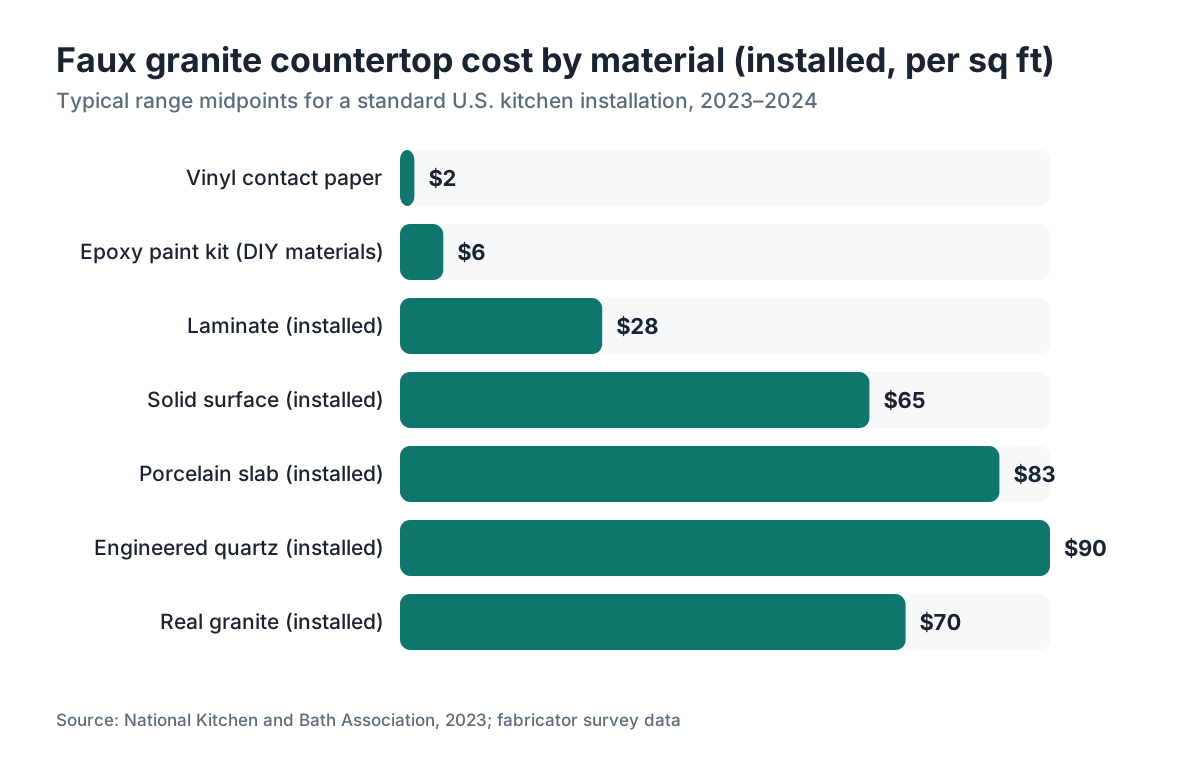
- Costs run $3, $120 per square foot installed.
- None look identical to real granite up close, but laminate and quartz get surprisingly close.
- Real granite runs $40, $100/sq ft installed and still wins on resale and heat resistance.
What counts as a faux granite countertop?
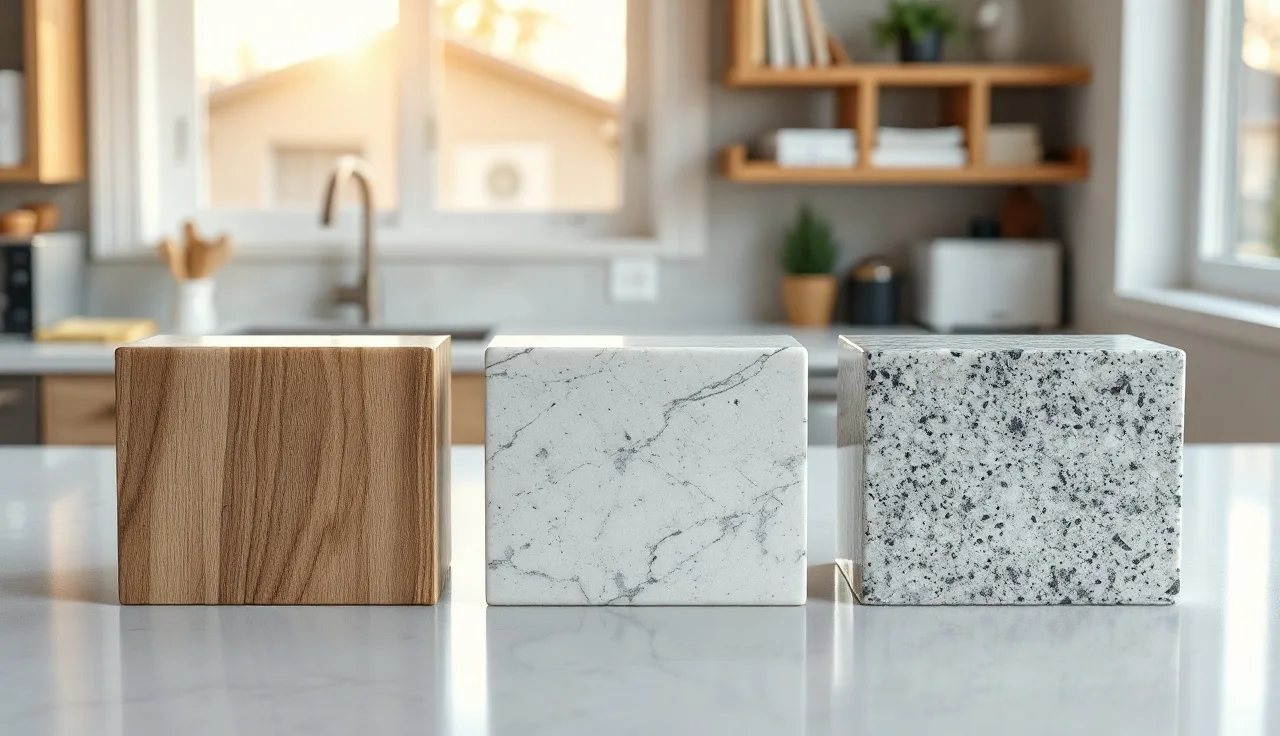
"Faux granite" is a loose term homeowners use for any surface that mimics the speckled, veined look of natural granite without being quarried stone. The category is broader than most people realize.
At the low end you have laminate sheets (think Formica) printed with high-resolution granite photography and sealed under a hard resin coating. Above that sits engineered quartz, which is ground stone bonded with polymer resin, produced in consistent granite-adjacent patterns. Solid surface materials like Corian occupy their own lane: they're acrylic or polyester composites, usually more uniform-looking than granite but available in speckled colorways. Then there's the DIY tier: epoxy countertop paint kits, poured epoxy with metallic pigments, and vinyl contact paper that you peel and stick directly onto existing laminate or tile.
Concrete countertops with integral pigment and aggregate can mimic granite's visual depth, though they land more in the "artisan look" category than a direct granite imitation. Porcelain slab is the newest player: large-format porcelain tiles or slabs printed with photographic granite patterns at resolutions that fool most eyes from a normal viewing distance.
None of these are granite. That sounds obvious, but it matters for durability expectations, resale conversations with real estate agents, and how you care for the surface. The rest of this guide breaks each option down.
How much do faux granite countertops cost compared to real granite?
Costs below are for supply plus professional installation on a typical kitchen of 40 to 50 square feet. DIY labor isn't counted in the low end for paint kits and contact paper because installation there is genuinely a one-person weekend job.
| Material | Cost per sq ft (installed) | DIY-friendly? | Realistic lifespan |
|---|---|---|---|
| Vinyl contact paper | $0.50, $3 | Yes | 1 to 3 years |
| Epoxy paint kit (Giani, Rust-Oleum) | $3, $8 (DIY materials) | Yes, with patience | 3 to 7 years |
| Laminate (Formica, Wilsonart) | $15, $40 | Partial | 10 to 20 years |
| Solid surface (Corian, etc.) | $45, $85 | No | 20 to 30 years |
| Engineered quartz | $60, $120 | No | 25+ years |
| Porcelain slab | $55, $110 | No | 20 to 30 years |
| Real granite | $40, $100 | No | 50+ years |
Laminate prices have climbed since 2021 on resin and paper feedstock costs. The National Kitchen and Bath Association's 2023 cost survey put the median installed laminate countertop at roughly $25/sq ft, up from about $18 in 2019 [1]. Engineered quartz sits right alongside mid-grade real granite on price, which surprises most homeowners and is worth knowing before you assume faux is always cheaper.
For a 45 sq ft kitchen, the total installed cost difference between laminate and quartz is often $2,000, $3,500. That's not trivial. But quartz will likely outlast the laminate by 15 years in a busy kitchen, so the annualized cost gap closes considerably.
See our broader guide to kitchen countertops for a full material comparison including concrete, butcher block, and tile.
What do laminate faux granite countertops actually look like?
Modern laminate is genuinely impressive. Wilsonart's HD line and Formica's 180fx series use large-scale photographic printing at resolutions that reproduce granite's natural movement, including the subtle translucency and crystal flash that cheaper laminates always got wrong [10].
The limitation is texture. Real granite has micro-relief: tiny pits, crystal edges that catch light at different angles. Laminate is flat. Under raking light (a window in late afternoon, a pendant light aimed low) that flatness reads as artificial to most adults. For countertops that face downward pendant lights, this matters. For countertops under cabinet LEDs pointing straight down, it matters less.
Seams are laminate's other tell. Standard laminate is sold in 4-foot and 8-foot sheets. A kitchen with a peninsula or an L-shaped run will have visible seams where sheets meet. Skilled fabricators can align the pattern across seams tightly, but the joint itself is a thin dark line that real stone doesn't have. Postform edges (the rolled front edge on most laminate) also read as obviously laminate to an informed eye. Upgrade to a wood or solid-surface edge build-up and the overall appearance improves a lot.
Read more about laminate countertops and Formica countertops specifically, since Formica's granite-pattern offerings have expanded a lot in the last few years.
Are epoxy faux granite kits worth it, or is it a waste of money?
My honest opinion: epoxy paint kits are worth the $80, $200 material cost if you're renting, if you're selling in under two years, or if you're renovating a rental and need something presentable fast. They are not worth it as a long-term solution for an owner-occupied home.
Here's why. The two most popular kits, Giani Granite and Rust-Oleum Countertop Transformations, work by layering a base coat, a sponged-on mineral powder or chip layer, and a polyurethane topcoat. The finish can look genuinely convincing in photos. In person, under normal kitchen light, the depth and variation of real granite isn't there. More to the point, the topcoat on these kits typically shows scratching within two to four years of normal use, especially around the sink and prep area. Rust-Oleum's own product page describes the finish as resistant to "household chemicals and stains" but doesn't claim scratch resistance beyond general durability language [2].
Application is also more demanding than the marketing implies. Surface prep takes most of a day. The topcoat requires 72 hours of cure time before you can put anything on it, and humidity over 85% during application causes adhesion problems [11]. First-time applicators frequently get uneven mineral distribution or bubbles in the topcoat.
If you do go this route, the best results come from surfaces already in good condition, laminate with no chips or delamination, and from using a foam roller rather than a brush for the topcoat. Don't try to apply it over tile with wide grout lines; the grout telegraphs through.
How does engineered quartz compare to real granite?
Engineered quartz is 90 to 95% ground quartz stone bound with polymer resins and pigments, pressed under heat and vacuum into slabs [3]. It's manufactured, not quarried, which means its appearance is designed: a factory decided what the pattern looks like, how consistent it is, and what colors appear.
For buyers who want a granite look, this is both the best and worst thing about quartz. Brands like Cambria, Caesarstone, and Silestone offer dozens of patterns that closely mimic specific granites. Cambria's Torquay, for example, reads as a white granite with dark veining to most observers. But if you put it next to actual Bianco Romano granite from Brazil, the engineered version looks more uniform, more controlled. Natural granite has genuine chaos in it. Some buyers love the controlled look. Some don't.
On performance, quartz wins on stain resistance because it's non-porous and needs no sealing. It loses on heat resistance: sustained heat above about 300°F (149°C) can discolor or crack the resin binders [4]. Real granite handles a hot pan fine. You'll hear fabricators say never put a hot pan on quartz, and they're right.
Quartz also has no UV stabilizers in most formulations. South-facing windows with direct sun can yellow certain white and gray quartz patterns over a decade. That's a real concern showrooms don't always mention.
For more detail on a top quartz brand, see Cambria countertops. For a full primer on the real thing, granite countertops covers geology, pricing, and sealing.
What is the most realistic-looking faux granite option?
Porcelain slab is the closest to real granite in appearance, and it's the option most fabricators mean when they say the faux category has gotten genuinely competitive.
Large-format porcelain (slabs up to 63" x 126" from brands like Dekton, Neolith, and Atlas Plan) uses digital inkjet printing at resolutions above 1,000 dpi to reproduce granite surface photography on a ceramic tile body. The result includes simulated crystal flash, translucent quartz zones, and feldspar patterns that are hard to tell from real granite at normal viewing distances. Unlike laminate, some porcelain products have a very slight surface texture that adds tactile realism.
The limitation is fabrication difficulty. Porcelain slabs are hard and brittle. Cutting them requires diamond blades, water cooling, and a lot more skill than laminate or even granite. Chip risk on inside corners and sink cutouts is higher. A fabricator who doesn't regularly work with large-format porcelain will struggle, and a poor cut can ruin a $600 slab. Installation costs for porcelain therefore often run 20 to 30% higher than for comparable granite work.
Engineered quartz with a high-movement pattern is the runner-up. It doesn't look as chaotic as real granite, but it's more consistent-looking than laminate and more durable than epoxy by a wide margin.
For homeowners who genuinely care about passing the "is that real stone?" test from across the room, either porcelain or a high-end quartz pattern will do it. Neither will fool a kitchen designer looking closely at the edges.
Does faux granite add home value the way real granite does?
Real granite (and to a lesser extent quartz) has a measurable positive association with home sale prices, particularly in the $300,000, $800,000 market segment where buyers have come to expect stone countertops. A 2019 analysis by Zillow found homes with granite or quartz countertops sold for a median premium of about $1,500 over comparable homes with laminate, though that figure varies widely by market and home price [5].
Faux granite doesn't carry that premium. Laminate is laminate in a buyer's agent's write-up. Epoxy is laminate with paint on it. Porcelain slab is an interesting case: it's genuinely a premium material that sophisticated buyers recognize as high-end, but average buyers may not know what it is, which blunts its resale signal.
Renovating to sell within two years? Spending $5,000 on laminate with a granite-pattern finish for a kitchen that currently has beat-up original laminate is a reasonable move. Spending $12,000 on engineered quartz to "add value" in a $250,000 home almost never pencils out.
The honest calculus is this: faux granite makes sense when you're optimizing for livability or budget, not for the appraisal. If resale value is the goal, mid-grade real granite or quartz is the safer bet in most markets. Quartz and granite remain the top two materials specified in new single-family kitchens, according to Home Innovation Research Labs [12].
How do you install faux granite countertops?
Installation varies completely by material. Contact paper: clean the surface, measure, cut, apply with a squeegee, trim edges. One afternoon, no tools beyond a utility knife. Epoxy kits: a full weekend of prep, application, and cure time. The kits include everything you need, though a random orbital sander for surface scuffing makes prep faster.
Laminate countertops are a different story. Sheet laminate can be glued to a substrate by a skilled DIYer with a router and contact cement, but postform countertops (the pre-built, rolled-edge runs you see at home centers) are faster and cleaner for most homeowners. A plumber still has to disconnect and reconnect the sink, which adds $150, $300 to the project cost regardless of who installs the countertop itself.
Engineered quartz, porcelain slab, and solid surface require professional fabrication. Templating, CNC cutting, edge profiling, polishing, and seaming are trade skills. A homeowner who tries to cut quartz in the driveway with an angle grinder is going to have a bad day and probably a cracked slab. See our countertop installation guide for what the professional process actually involves, step by step.
For fabricators pricing faux-granite jobs that include quartz or porcelain, accurate material yield calculations matter. Quartz slabs typically run 56" x 120". Porcelain runs larger but with more waste risk at cutouts. Software like SlabWise can nest countertop pieces against actual slab dimensions to cut waste before you quote, which matters on a $600 porcelain slab where a bad layout costs real money.
Demolition and haul-away of old countertops adds $50, $150 per linear foot for thick materials like tile-over-plywood. That cost is real and frequently left out of advertised "installed price" figures.
How do you clean and maintain faux granite countertops?
Cleaning faux granite depends on what the surface actually is, and getting this wrong can void warranties or wreck finishes.
Laminate: mild dish soap and water works for everything except dried-on grease, which responds to a baking soda paste. Never use abrasive scrubbers. They scratch the resin coating. Avoid bleach-based cleaners over time, since they degrade the edge seams. Wilsonart's care guide specifically recommends against cleaners with pH above 10 [6].
Epoxy-painted surfaces: treat them gently. Dish soap and a soft cloth. Avoid anything abrasive. The polyurethane topcoat is harder than the paint beneath but softer than any stone surface. It will show fine scratches over time regardless of care. That's normal and not a sign of a failed application.
Engineered quartz: non-porous, so daily cleaning with a mild all-purpose cleaner is fine. No sealing ever required. Avoid oven cleaner, nail polish remover, and acetone. These attack the resin binders. For stubborn stains, a plastic scraper and a small amount of isopropyl alcohol works without damaging most quartz surfaces.
Solid surface (Corian, etc.): minor scratches sand out with 220-grit paper followed by a Scotch-Brite pad. This is one of solid surface's genuine advantages over every other countertop material. Stains respond to diluted bleach on light colors (1:3 bleach-to-water). See Corian countertops for the full maintenance picture.
For general stone care principles that apply if you have real granite nearby, our guide on how to clean stone countertops covers sealing, pH safety, and stain removal in detail.
What are the durability tradeoffs of faux granite vs real granite?
Real granite is an igneous rock with a Mohs hardness of 6 to 7 [7]. It resists scratching from virtually any kitchen implement, tolerates heat from pots and pans, and with periodic sealing (every 1 to 3 years depending on porosity) resists staining well. It's also heavy, brittle, and cold to the touch.
Contact paper: scratch it with a fingernail if you press hard. Not durable. A realistic assessment is 1 to 2 years before it lifts at edges and shows visible wear.
Epoxy paint kits: harder than contact paper, but the topcoat is a soft polyurethane that scratches from knife use, hot pans, and even heavy ceramic dishes dragged across the surface. Budget for recoating every 3 to 5 years if you actually cook.
Laminate: the aluminum oxide layer in high-pressure laminate is genuinely hard. It resists scratching better than epoxy by a wide margin. Its failure mode is usually chipping at edges, delamination near water sources, or bubbling under sustained heat. Don't put a hot pan on it.
Engineered quartz: Mohs hardness of 7, equivalent to granite's upper range [3]. Scratch-resistant in all practical kitchen uses. Its vulnerability is heat (the resin binders) and UV (yellowing in direct sun) as noted above.
Solid surface: softer at around Mohs 2 to 3, so it scratches more readily, but scratches sand out. Stain-resistant. No real heat resistance. Use trivets.
For most households that cook regularly, the honest durability ranking is: granite = quartz > porcelain > solid surface > laminate > epoxy > contact paper.
Is vinyl contact paper for countertops actually any good?
Contact paper is the lowest-cost faux granite option and should be understood as a temporary cosmetic fix, not a countertop material.
It works. Applied carefully to clean, flat laminate, a granite-print vinyl film looks presentable at photo distance and functional at arm's length. At countertop height, most adults will spot it as film within a few seconds of looking at the edge or a seam.
The practical problems are consistent: edges lift within months near heat sources and water. The area around the sink almost always fails first. Bubbles appear under the film from any adhesion imperfection in the original laminate. Removing it leaves adhesive residue that requires Goo Gone or a similar solvent to clean off.
Where it actually makes sense: a rental apartment where the landlord prohibits permanent changes. A dorm room. A short staging scenario where photos are what matter. A child's play kitchen. Anywhere the countertop is a background prop rather than a working surface.
For any permanent installation where you're spending real money on appliances, cabinetry, or flooring, contact paper is a mismatch. The rest of the room will outlast the contact paper by a decade.
What about concrete countertops that look like granite?
Concrete with integral aggregate (granite chips, recycled glass, or marble dust mixed into the wet slurry) can produce surfaces with genuine visual depth that resembles natural stone without being stone. This is a legitimate choice that's underrepresented in the faux granite conversation.
The process uses ground granite aggregate in the concrete mix, which means the surface contains actual granite minerals even if the binder is cement. From a material science standpoint, it's closer to terrazzo than to a paint-on finish.
Cost runs $65, $135 per square foot installed for a quality custom pour, which puts it at or above mid-grade real granite. The advantage is fully custom fabrication: concrete can be cast around unusual sink configurations, incorporate drainage slopes, embed trivets, or match an exact color with pigment. The disadvantages are significant: concrete needs sealing every 1 to 3 years, is prone to hairline cracking over time in kitchens with minor structural movement, and will stain from acidic foods if the sealer is neglected. The Concrete Countertop Institute (an industry trade body) notes that proper mix design and fiber reinforcement substantially reduce crack risk, but don't eliminate it [8].
If you want the handmade artisan look and are willing to maintain the surface, concrete with granite aggregate is a genuinely interesting option. If you want a low-maintenance granite appearance, quartz or porcelain slab fits better.
When does it make sense to just buy real granite?
Real granite costs $40, $100 per square foot installed depending on color rarity, edge profile, and your region. That's not dramatically more than quartz or porcelain on the high end, and it's within reach of the mid-range for most kitchens with a 40 to 50 square foot countertop area.
You should probably buy real granite if: you're renovating a primary home you plan to stay in for more than five years; resale comps in your neighborhood show stone countertops as a standard expectation; you cook heavily and want heat resistance without thinking about it; or you want the natural variation that no manufactured product can exactly replicate.
Faux granite makes more sense if: you're on a tight budget and laminate is genuinely the difference between doing the kitchen this year or not; you're renovating a rental property where durability and cleanability matter more than aesthetics; you want a specific appearance (very uniform, very light) that natural granite doesn't reliably produce; or you're staging a home for a quick sale.
A middle path worth considering: mid-grade granite (think Uba Tuba or Santa Cecilia, both widely stocked and priced at $40, $55 installed in most U.S. markets) gives you real stone at prices that compete with solid surface and upper laminate. Granite countertops covers the full pricing landscape by stone type.
For fabricators running quotes on any of these materials, accurate slab yield calculations are what separate a profitable job from a break-even one. If you're quoting faux granite jobs in volume and still doing layout by hand, the SlabWise demo shows how automated nesting handles mixed-material kitchens in minutes rather than an hour.
Frequently asked questions
Can you put faux granite countertops over existing laminate?
Yes, with caveats. Epoxy paint kits and contact paper apply directly over existing laminate if the surface is clean, lightly sanded, and has no lifting edges or chips. New laminate sheets or postform countertops require removing the old countertop first. Quartz, porcelain, and solid surface always require full removal of existing tops before installation. Adding height with a new top-over-top can also cause problems with under-mount sinks and appliance clearances.
How long do epoxy granite countertop kits last?
Realistically 3 to 7 years before the polyurethane topcoat shows significant scratching and wear, especially around the sink and prep areas. Manufacturers typically warranty the finish for 1 to 5 years depending on brand. The underlying paint layers are more durable than the topcoat; many homeowners re-apply just the topcoat at year 3 to 4 to extend the life without redoing the full finish.
Does quartz count as faux granite?
Technically yes, because it's an engineered material designed to mimic granite's appearance rather than quarried stone. Quartz is the highest-performing option in the faux granite category and priced comparably to real granite, which is why it's sometimes grouped separately. The distinction matters for resale conversations: real estate listings often say "granite or quartz" as equivalent signals of kitchen quality, whereas laminate and epoxy finishes don't carry the same weight.
What is the cheapest way to make countertops look like granite?
Vinyl contact paper runs $0.50, $3 per square foot and takes an afternoon. Epoxy paint kits cost $80, $200 in materials for a standard kitchen and produce a more durable result. Both are genuinely temporary solutions. If you want something that lasts more than a few years and still want to minimize cost, laminate countertops in a granite pattern are the most economical permanent option at $15, $40 per square foot installed.
Is faux granite heat resistant?
It depends on the material. Contact paper and epoxy finishes are not heat resistant and will bubble or discolor from a hot pan. Laminate tolerates brief contact with warm dishes but not pots from a stovetop. Quartz handles brief heat better but sustained heat above 300°F can crack or discolor the resin. Porcelain slab is the most heat-tolerant faux granite option. Only real granite handles a hot pan without any concern.
Can you cut on faux granite countertops?
No, not without damage, for any faux granite material. Laminate, epoxy, and quartz will all show knife marks. Porcelain is hard enough to dull your knife before it shows a scratch. The rule for every countertop type, including real granite, is to use a cutting board. Granite is the only material that genuinely won't scratch from kitchen knives in normal use, and even then, using a cutting board protects the knife edge.
How do you tell the difference between real granite and faux granite?
Look at the edge. Real granite has visible crystal structure in cross-section. Laminate shows a dark core layer. Quartz shows a uniform stone-composite with no crystal flash on the edge. Epoxy and contact paper show a thin coating over an obviously different substrate. Touch the surface under raking light: real granite has micro-texture from crystal relief; laminate is flat and slightly shiny even in matte finishes. A small drop of water on real granite will bead or absorb depending on seal; on laminate it just sits.
Are faux granite countertops safe for food prep?
Laminate, solid surface, and quartz are safe for food contact when clean. The U.S. FDA classifies food-contact surfaces by their cleanability, not material type; any non-porous surface that can be washed with soap and water meets basic food safety requirements. Epoxy topcoats should be fully cured (72 hours minimum) before food contact. Fresh epoxy off-gasses compounds that are not food-safe. Contact paper isn't a food-prep surface by design; keep cutting boards on it.
Do faux granite countertops need to be sealed?
Laminate and engineered quartz never need sealing; both are non-porous by design. Epoxy surfaces need a fresh topcoat every few years but not a stone sealer. Solid surface is also non-porous and needs no sealing. Concrete countertops with granite aggregate do need regular sealing, typically every 1 to 3 years, using a penetrating sealer designed for concrete. Real granite needs sealing on a schedule based on its porosity. Faux granite's no-seal advantage is real and worth noting for maintenance-averse households.
What is the most durable faux granite countertop material?
Engineered quartz is the most durable option in the faux granite category, with a Mohs hardness of 7, no porosity, and a realistic lifespan of 25 or more years with normal use. Large-format porcelain is a close second on hardness but has higher chip risk at edges and cutouts. Solid surface is behind both in scratch resistance but wins on repairability. Laminate is the most durable affordable option. Epoxy and contact paper are at the bottom of the durability scale.
Can faux granite countertops be repaired if they get damaged?
Repairability varies widely. Solid surface is uniquely repairable: scratches and even burns sand out with 220-grit sandpaper. Laminate chips can be filled with color-matched filler, though the repair shows on close inspection. Epoxy topcoats can be re-applied over scuffed areas after light sanding. Quartz and porcelain slab are not repairable; a crack or deep chip means replacing the section. Contact paper just gets peeled up and replaced.
How much does it cost to redo countertops to look like granite on a tight budget?
A DIY epoxy kit for a standard 40 sq ft kitchen runs $100, $250 in materials. Postform laminate countertops in granite patterns from a home center cost $10, $18 per linear foot for the material, with installation adding $20, $40 per linear foot from a handyman. For a complete budget kitchen redo, plan $800, $1,800 total for laminate installed. Contact paper can do it for under $150 in materials but won't last more than two years in a working kitchen.
Does laminate with a granite pattern look fake?
At normal viewing distance (3 feet or more), high-end laminate like Formica 180fx or Wilsonart HD looks convincingly like stone. Up close, the flat texture and visible seam lines give it away to an informed observer. The postform rolled edge is the biggest visual tell. If you use a wood or solid-surface edge build-up instead, and choose a pattern with tight crystal structure rather than large veining, the result is a lot more convincing. In photos it's nearly indistinguishable from real stone.
What is solid surface and how does it compare to granite as a countertop?
Solid surface (Corian is the best-known brand) is an acrylic or polyester composite, non-porous, available in speckled granite-like patterns. It costs $45, $85 per square foot installed. Compared to granite, it's softer, more prone to scratching, and not heat-tolerant. Its advantage is repairability and continuous integration with undermount sinks (no visible joint). It doesn't look like granite up close but reads as a quality countertop material. See our full guide on Corian countertops for the detailed comparison.
Sources
- National Kitchen and Bath Association, 2023 Design and Industry Report: Median installed laminate countertop cost approximately $25/sq ft in 2023, up from about $18 in 2019
- Rust-Oleum, Countertop Transformations Product Page: Rust-Oleum Countertop Transformations described as resistant to household chemicals and stains
- Natural Stone Institute, Engineered Stone Overview: Engineered quartz is 90-95% ground quartz bound with polymer resins, pressed under heat and vacuum
- Caesarstone, Care and Maintenance Guide: Sustained heat above approximately 300°F can discolor or crack engineered quartz resin binders
- Zillow, 2019 Consumer Housing Trends Report: Homes with granite or quartz countertops sold for a median premium of about $1,500 over comparable homes with laminate
- Wilsonart, Laminate Care and Maintenance Guide: Wilsonart recommends against cleaners with pH above 10 on laminate surfaces
- U.S. Geological Survey, Rocks and Minerals: Granite has a Mohs hardness of 6-7
- Concrete Countertop Institute, Mix Design and Fiber Reinforcement Guidelines: Proper mix design and fiber reinforcement substantially reduce crack risk in concrete countertops
- U.S. Food and Drug Administration, Food Code 2022 (Section 4-101.11, Surface Characteristics): FDA Food Code classifies food-contact surfaces by cleanability; non-porous surfaces washable with soap and water meet basic food safety requirements
- Formica Group, 180fx Product Technical Data Sheet: Formica 180fx uses large-scale photographic printing to reproduce natural stone movement and translucency effects
- Giani Inc., Granite Countertop Paint Kit Instructions: Giani granite kit requires 72-hour cure time before surface use; humidity over 85% during application causes adhesion problems
- Home Innovation Research Labs, 2023 Annual Builder Practices Survey: Quartz and granite countertops remain the top two specified materials in new single-family kitchen construction
Last updated 2026-07-09