TL;DR
- Engineered marble (also called cultured marble or marble composite) is crushed natural marble bound with polyester or acrylic resin, then cast or pressed into slabs.
- It costs $40 to $100 per square foot installed.
- It stains far less than real marble but scratches easier than quartz.
- Good middle ground for buyers who want the marble look without the sealing ritual.
What exactly is engineered marble?
Engineered marble is manufactured, not quarried. A factory grinds marble down to powder or small chips, binds it with polyester or acrylic resin under heat and pressure, and presses it into a dense, uniform slab. Real marble mineral inside. Man-made structure around it.
The term covers two products that behave differently. "Cultured marble" is the older one: a thin gel-coat surface over a marble-powder-and-resin core, cast in molds, common in bathroom vanities since the 1970s. "Marble composite" or "engineered stone with marble aggregate" is the newer, higher-end version, where marble content can reach 90 to 93% by weight, built much like engineered quartz [1]. A few brands slap "porcelain marble" on large-format sintered porcelain that only imitates marble. That's a separate product, and I keep it separate here.
For countertops, you're almost always shopping the composite category. That's what most fabricators mean when they say engineered marble. Gel-coat cultured marble is a vanity or tub surround product, not a kitchen counter.
How does engineered marble compare to natural marble and quartz?
The honest comparison depends on which properties matter to you. Here's how the three materials stack up on the things countertop buyers actually argue about.
| Property | Natural Marble | Engineered Marble | Quartz (engineered) |
|---|---|---|---|
| Marble content | 100% | 75 to 93% | 0% (uses quartz aggregate) |
| Hardness (Mohs) | 3 to 4 | 3 to 4 (varies by resin) | 7 |
| Porosity | High | Low, medium | Very low |
| Stain resistance | Low (needs sealing) | Medium | High |
| Heat resistance | Moderate | Low, medium | Low (resin discolors) |
| Scratch resistance | Low | Low, medium | High |
| Veining appearance | Natural, unique | Consistent, printed or cast | Printed pattern |
| Cost installed ($/sq ft) | $60, $150 | $40, $100 | $50, $120 |
| Sealing required | Yes, 1 to 2x/year | Rarely to never | No |
The big win for engineered marble over natural marble is porosity. The resin fills the microscopic gaps that make real marble soak up red wine and lemon juice like a sponge. You still wipe spills promptly, but you're not racing a 10-minute clock the way you are with Calacatta.
The big loss against quartz is hardness. Resin is softer than quartz crystal, so engineered marble scratches easier than a standard quartz countertop. Set a cast-iron pan down hard, drag a ceramic dish across the surface, and you'll see it. Quartz shrugs it off.
Against granite, engineered marble is softer and less heat-tolerant. The look is cleaner and more marble-like, which is the whole reason to buy it.
What does engineered marble cost per square foot?
Material-only pricing for engineered marble slabs runs roughly $15 to $45 per square foot at the distributor level, depending on brand, thickness (2 cm vs 3 cm), and pattern complexity [2]. Fabrication and installation add another $25 to $55 per square foot for a typical kitchen, covering templating, cutting, edge profiling, and setting.
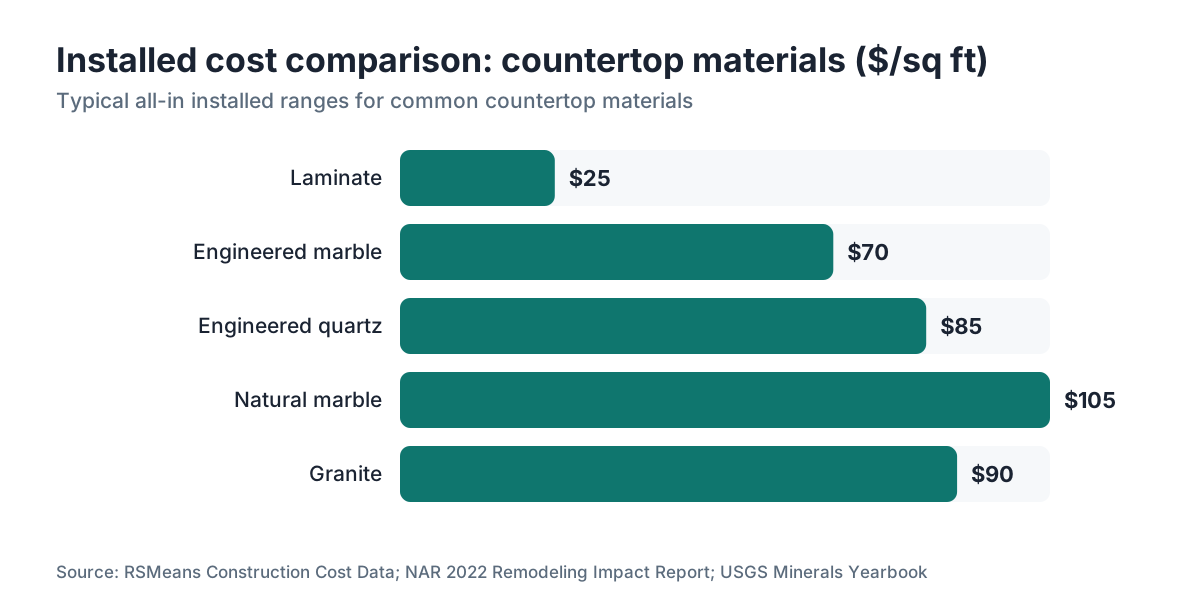
All-in installed cost lands most projects in the $40 to $100 per square foot range. A 40-square-foot island at mid-range pricing ($65/sq ft) comes to about $2,600. A full kitchen with 60 square feet of counter runs $3,000 to $6,000 installed.
Several things push the price up or down:
- Thickness: 3 cm slabs cost more but look more substantial and hold edges better.
- Edge profile: A simple eased edge is usually included in the fabrication price. An ogee or triple waterfall edge can add $15 to $30 per linear foot.
- Cutouts: Each sink or cooktop cutout typically adds $75 to $200 to the fabrication invoice.
- Brand premium: Named brands (some marketed as "marble-look composites") carry a 20 to 40% premium over generic imported product.
- Region: Labor swings hard. The Southwest and Southeast tend to run lower than the Northeast and West Coast.
For comparison, real Carrara marble installed runs $60 to $150 per square foot, and basic engineered quartz runs $50 to $120. Engineered marble sits at the affordable end of the stone-look category, above laminate countertops and Formica but below premium quartz.
Is engineered marble durable enough for a kitchen?
Durable enough? Yes. Carefree? No. That's the honest answer.
The resin makes engineered marble denser and less porous than natural stone, so it skips annual sealing and won't etch as dramatically from acidic foods. Etching still happens. That hazy dull spot from lemon juice or vinegar comes from acid reacting with calcium carbonate, and the marble aggregate is still calcium carbonate. The resin slows and shrinks the reaction. It doesn't cancel it.
Scratches are the bigger daily headache. Mohs hardness for marble aggregate sits around 3 to 4, and the polyester resin is softer still [3]. A steel knife or the bottom rim of a ceramic casserole dish will scratch it. So you use cutting boards. Always. Not sometimes, always.
Heat is the other soft spot. Polyester resin starts to soften and discolor above roughly 300 degrees F (150 degrees C) [4]. A hot pan straight from the oven leaves a permanent mark. Trivets are not optional.
For a busy family kitchen with kids, I'd steer you toward quartz for the main prep zone and save engineered marble for a lower-traffic surface like a butler's pantry or a powder room vanity. For a kitchen that sees moderate use, or a household that reaches for cutting boards and trivets by habit, engineered marble holds up fine for 15 to 20 years with reasonable care.
Does engineered marble need to be sealed?
Most engineered marble does not need periodic sealing the way natural marble does. The resin acts as its own sealant, filling the pores that would otherwise call for an external impregnator.
The caveat is gel-coat cultured marble. That thin surface layer can be wrecked by abrasive cleaners or harsh chemicals, and once the gel coat is compromised, the porous core underneath is exposed [5]. For cultured marble vanity tops, manufacturers usually say to skip abrasive scrubbers and acidic cleaners, and some suggest a light carnauba wax a couple times a year to hold the sheen.
High-density composite engineered marble, the kind used on kitchen counters, wants much less. Wipe spills with a soft cloth, clean with mild dish soap, and keep bleach and strong acid off it. That's the whole plan. No annual sealing appointment, no impregnator costs. The cleaning guide for stone countertops covers a general care routine that works well here too.
What are the main brands of engineered marble countertops?
The market runs on Italian, Spanish, and Asian manufacturers plus a few domestic brands. Names that show up consistently in fabricator supply channels:
Porcelanosa and Silestone (owned by Cosentino) offer marble-aggregate composites alongside their better-known quartz lines. Dekton by Cosentino is technically an ultracompact sintered surface, not engineered marble, even though it comes in marble patterns. Antolini and several Italian quarriers produce marble-composite slabs, often sold under distributor names in the U.S.
In the cultured marble/gel-coat category, American Standard and other plumbing fixture brands sell integrated vanity tops, a different application from kitchen counters.
Here's the catch: branding in this category is a mess. A slab sold as "marble composite" at one distributor may be identical in formulation to a "cultured stone" product at another. Ask for the marble-to-resin ratio by weight, the thickness options, and whether the pattern runs through the slab or only sits on top. Those three questions tell you more than the brand name ever will.
Fabricators who run quoting software like SlabWise can track supplier pricing and slab dimensions by product line, which makes comparing true cost per square foot across brands much faster than doing it by hand.
How is engineered marble made and what does the process mean for quality?
The manufacturing of composite engineered marble broadly follows the Bretonstone system, an Italian patented process built for engineered quartz and adapted across stone composites [1]. Marble aggregate meets polyester or acrylic resin at roughly 7 to 25% resin by weight, gets mixed, then poured into molds or spread on a belt and vibro-compressed under vacuum to pull out air pockets. The slab cures in an oven.
What separates a good slab from a cheap one:
- Void density: Fewer micro-voids means better density and stain resistance. A quick field test: wipe the back with water and watch for darkening.
- Resin type: Acrylic resin is generally more UV-stable than polyester, so it yellows less over time. That matters for counters near windows.
- Marble content: Higher marble percentage (above 85%) usually gives a more natural surface and better hardness than a heavily resin-loaded slab.
- Pattern consistency: Better manufacturers control veining and color through the slab thickness, not only on the polished face. Ask for a cross-section cut sample if you're on the fence.
For the fabricator, engineered marble machines much like natural marble. Same diamond tooling, similar feed rates, but the resin loads up polishing pads faster than straight stone. Edge quality is generally good because the resin cuts down on chipping.
What are the pros and cons of engineered marble for bathrooms vs kitchens?
Engineered marble has a longer track record in bathrooms than kitchens, and there's a reason. Bathroom stresses (faucet splash, the occasional hair product spill, light daily use) are gentler than what a kitchen counter takes.
For bathroom vanities, engineered marble beats natural marble on almost every practical count. It's less porous, costs less, and still delivers that warm creamy look that makes a bathroom feel like a spa. Scratch sensitivity barely registers because you're not prepping dinner on it. Want an integrated sink-and-top? Cultured marble has decades of reliable service there.
For kitchen counters, the call is closer. The upsides (lower porosity, no sealing, cheaper than natural marble) are real. So are the downsides: it scratches, it can't take heat, and it etches from acid. The happiest owners already keep cutting boards and trivets within reach, run a clean counter, and value the look over bombproof durability.
The unhappy ones wanted marble's look but assumed "engineered" meant it would act like quartz. It doesn't. It acts like a refined version of natural marble, not a substitute for quartz.
Want maximum durability in a hard-working kitchen? Quartz is still the practical pick. Designing a kitchen that gets photographed more than it gets abused? Engineered marble makes a lot of sense.
How do you install engineered marble countertops?
Installation follows the same process as most stone countertops, and the same trade skills apply. For a typical kitchen project:
- Template: A fabricator visits and templates the cabinet layout, noting dimensions, sink cutout locations, appliance clearances, and backsplash returns. Digital templating with a laser device is now standard and cuts measuring errors.
- Fabricate: The shop cuts the slab to template, profiles the edges, cuts sink and cooktop openings, and polishes the finished surfaces.
- Deliver and set: Slabs come in, usually in sections for larger kitchens (a single 10-foot span is heavy and awkward), get set on the cabinets with silicone adhesive, and seams are filled and polished.
- Sink and fixtures: Undermount sinks are bonded to the underside of the slab with epoxy and mechanical clips. Drop-in sinks skip most of that.
Engineered marble at 3 cm weighs roughly 18 to 20 pounds per square foot, similar to natural marble [6]. Cabinet structure has to carry that. Standard face-frame cabinets with a solid plywood substrate handle it without modification in most cases.
The full countertop installation guide walks through installation day in more detail.
One fabrication note: engineered marble is less forgiving of a bad cabinet base than engineered quartz. If your cabinets are out of level, a quartz slab bridges minor gaps without cracking. Engineered marble, stiffer and heavier with its higher natural-marble content, can show stress cracks over unsupported spans. Level cabinets matter.
How do you clean and maintain engineered marble countertops?
Daily cleaning is simple. A damp cloth or soft sponge with mild dish soap, then rinse and dry. That's the whole routine most days.
Avoiding damage is more about what you keep off the surface than what you put on it:
- No bleach or bleach-based cleaners. They degrade the resin over time and can discolor it.
- No abrasive scrubbers (steel wool, rough Scotch-Brite pads). They scratch the polished surface.
- No undiluted vinegar, lemon juice, or acidic cleaners. The marble aggregate still reacts to acid, and repeated exposure dulls the finish.
- No harsh drain cleaners or oven cleaners anywhere near the surface.
For stubborn stains, a paste of baking soda and water left for 10 to 15 minutes clears many organic stains. Stone-specific pH-neutral cleaners are safe and useful too.
Polishing is optional. Some engineered marble surfaces respond well to an occasional stone polish or marble cream that restores gloss. That's cosmetic, not protective, but it keeps the surface looking its best. Check with your fabricator or the slab manufacturer first, since resin type decides which products are safe.
The guide to cleaning stone countertops covers the core do's and don'ts that apply broadly.
Is engineered marble a good investment for home resale value?
Stone countertops generally lift perceived home value, and engineered marble reads as stone to most buyers. A 2022 survey by the National Association of Realtors found kitchen upgrades, including countertop replacements, returned a median of 67 cents on the dollar at resale [7]. Not a financial home run, but better than plenty of renovation projects.
Whether engineered marble returns more or less than natural marble or quartz at resale is hard to answer with good data. Buyers in most price tiers can't tell engineered marble from natural marble by looking at it. The ones who can, and who care, sit in the luxury segment where natural marble carries a premium. At mid-market, engineered marble is a non-issue for resale.
Where it could matter: a high-end renovation where buyers specifically ask about the countertop material. In that room, "engineered marble" may not carry the cachet of "Calacatta Gold marble" even if the two look alike from across the space.
For most homeowners doing a practical kitchen refresh, engineered marble is a reasonable investment. It looks expensive, it holds up decently, and buyers respond to the aesthetic. The decision shouldn't hinge on marginal resale differences nobody can quantify well.
What should you ask a fabricator before buying engineered marble?
A few questions separate fabricators who know the product from those who are just moving slabs:
- What's the marble-to-resin ratio? Higher marble content generally means better hardness and a more natural look. If they don't know, that's a signal.
- Is the pattern surface-only or through-body? Through-body patterns hold up better at edges and repaired chips.
- What edge profile do you recommend for this material? Some profiles (a sharp, thin pencil edge, for example) chip more in softer stone composites.
- How do you handle seams? Seams in engineered marble color-match reasonably well, but darker or heavily veined slabs show them more than lighter, uniform slabs.
- What warranty does the manufacturer offer? Most legitimate composite stone manufacturers offer 10 to 25 year warranties against manufacturing defects [8]. Installation warranties are separate and vary by shop.
- Can I see the full slab before fabrication? Always yes on this one. Sample tiles don't show how a full slab lands on your counter.
Fabricators running shop operations on quoting and nesting software like SlabWise can pull accurate per-job costs and slab utilization numbers quickly, so a quote from a tech-forward shop tends to be tighter than one done on a spreadsheet. When you compare bids, a quote that itemizes material, fabrication, edge work, and cutouts separately is worth more than a single per-square-foot number.
Ask about lead time too. Engineered marble is usually in stock at regional distributors, but specialty patterns and thicknesses can take 2 to 4 weeks to source.
Frequently asked questions
Is engineered marble the same as cultured marble?
Not exactly. Cultured marble is the older product: a marble-powder-and-resin core with a gel-coat surface, almost always used for bathroom vanities and tub surrounds. Modern engineered marble for countertops is a denser composite with 75 to 93% marble aggregate by weight, pressed into slabs. They share the basic concept but differ a lot in density, durability, and application.
Does engineered marble look like real marble?
Close, but not identical. Engineered marble has a repeating pattern set by the mold or printing process, while natural marble has unique, unrepeatable veining in every slab. From across a room, most people can't tell them apart. Up close, or where two slabs meet at a seam, the uniformity of engineered marble shows. It reads as marble aesthetically, just not as an individual natural stone.
Can engineered marble countertops be repaired if they chip or crack?
Minor chips fill with a color-matched polyester or epoxy filler and polish smooth. Because the aggregate and resin run uniform through the slab, a good repair often disappears on lighter patterns. Deep cracks or large chips are harder to hide, especially on dark or heavily veined slabs. Most fabricators offer chip repair as a service, typically $75 to $200 depending on size and location.
How does engineered marble handle etching from acidic foods?
It etches less than natural marble but still etches. The resin slows how fast acid reaches the marble aggregate, but the marble is still calcium carbonate, which reacts with acids. Lemon juice, vinegar, or tomato sitting on the surface for a while leaves a dull spot. Wiping spills quickly minimizes it. Polishing with a marble cream can sometimes reduce the look of light etching.
What thickness should I choose for engineered marble countertops: 2 cm or 3 cm?
3 cm is the better pick for kitchen counters. It's stiffer, which cuts the risk of cracking over unsupported spans, holds edge profiles better, and looks more substantial. 2 cm is lighter and cheaper, and it works fine for lower-stress spots like bathroom vanities or bar tops with full plywood support. Most U.S. fabricators default to 3 cm for kitchen work regardless of material.
Is engineered marble heat-resistant?
No, not reliably. The polyester resin in engineered marble starts to soften and discolor around 300 degrees F (150 degrees C). A hot pan from the oven or a cast-iron skillet off the stovetop leaves a permanent mark. Trivets and hot pads are not optional with this material. In that respect engineered marble is a lot like engineered quartz, which has the same resin-based heat limit.
How long do engineered marble countertops last?
With reasonable care, 15 to 25 years in a kitchen is realistic. Cultured marble vanity tops routinely go 20 to 30 years in low-traffic use. The main things that shorten lifespan are scratch buildup from abrasive use, heat damage from hot pans, and chemical damage from harsh cleaners. The resin can yellow slightly over decades in high-UV spots, worth asking about if your counter sits under a skylight.
Can I use engineered marble for outdoor countertops or an outdoor kitchen?
Not a great idea for most polyester-resin engineered marble. Polyester resin isn't UV-stable; it yellows and breaks down with prolonged sun. Some manufacturers offer acrylic-resin composites with better UV resistance, but confirm UV stability explicitly with the manufacturer before speccing it outside. For an outdoor kitchen, porcelain or granite are more practical choices.
How does engineered marble compare to Corian or solid-surface countertops?
Corian and other solid-surface materials are 100% acrylic or polyester with no stone aggregate. They're softer and more scratch-prone than engineered marble, but they can be sanded and renewed, which stone composites cannot. Engineered marble looks more like natural stone; solid surface looks more plastic. Cost is similar. See the Corian countertops overview for a full comparison of solid-surface options.
Does engineered marble require special fabrication tools or training?
A shop set up for natural stone or engineered quartz handles engineered marble without new equipment. Diamond-tipped CNC tooling, wet saws, and standard polishing pads all work. The main adjustment is pad management: the resin loads polishing pads faster than pure stone, so pads need cleaning or replacement more often. Edge finishing and seaming technique is the same as natural marble.
What's the difference between engineered marble and sintered stone or porcelain?
Engineered marble is a marble-aggregate-and-resin composite. Sintered stone (like Dekton) and large-format porcelain are fired ceramic products made from clay, feldspar, and minerals at very high temperatures. Sintered stone is harder (Mohs 7 to 8), nearly impervious to heat, UV-stable, and usually more expensive. It looks like marble by design but has no actual marble in it. For demanding uses, sintered stone beats engineered marble on nearly every durability metric.
Are there environmental or VOC concerns with engineered marble?
Polyester resin used in manufacturing releases styrene, a volatile organic compound, during production. Once the slab is cured and installed, off-gassing is generally considered minimal. The EPA classifies styrene as a possible human carcinogen based on occupational exposure data from manufacturing environments, not from finished installed products. If you have specific chemical sensitivities, ask the manufacturer for the product safety data sheet (SDS) before buying.
Can engineered marble be used as a bathroom floor tile or shower wall?
Shower walls and bathroom floors are common uses for cultured marble panels and engineered marble tile. On shower walls, the low porosity is a genuine advantage over natural marble. For floors, check the coefficient of friction rating before buying; polished stone surfaces, including engineered marble, get slippery when wet. A honed or matte finish improves slip resistance. Make sure any grout or installation system suits wet environments.
Sources
- Breton S.p.A., Bretonstone System technical overview: The Bretonstone vibro-compression process is used to manufacture engineered stone composites including marble-aggregate composites at 75 to 93% mineral content by weight.
- RSMeans Construction Cost Data, Flooring and Countertop Unit Costs: Engineered stone countertop material costs range from approximately $15, $45 per square foot at the trade level before fabrication and installation labor.
- U.S. Geological Survey, Mineral Resources: Calcite and Calcium Carbonate Minerals: Calcite (the primary mineral in marble) has a Mohs hardness of 3, confirming marble aggregate in engineered slabs retains that baseline hardness characteristic.
- ASTM International, polymer composite thermal properties references: Polyester resin composites used in stone countertop manufacturing begin to soften and discolor at temperatures above approximately 150°C (300°F) under sustained contact.
- National Kitchen and Bath Association (NKBA), Design and Product Guide: Cultured marble gel-coat surfaces are vulnerable to abrasive cleaners that can compromise the protective surface layer, exposing the porous core underneath.
- Natural Stone Institute, Technical Bulletin: Stone Weight and Structural Support: Marble and marble-composite slabs at 3 cm thickness weigh approximately 18 to 20 pounds per square foot, informing structural support requirements for cabinetry.
- National Association of Realtors, 2022 Remodeling Impact Report: Kitchen upgrades including countertop replacements returned a median of 67 cents on the dollar at resale, per the 2022 NAR Remodeling Impact Report.
- Cosentino (Silestone), Product Warranty Documentation: Major engineered stone manufacturers including Cosentino offer 10 to 25 year warranties on their composite slab products against manufacturing defects.
- U.S. Environmental Protection Agency, Integrated Risk Information System (IRIS): The EPA classifies styrene, released during polyester resin manufacturing, as a possible human carcinogen based on occupational exposure data; cured installed products have minimal off-gassing.
- ASTM International, standards for ceramic and stone tile installation: ASTM standards cover bonding and installation requirements for stone composite tiles in wet environments including showers and bathroom floors.
- U.S. Geological Survey, Minerals Yearbook: Dimension Stone: Natural marble countertop installed pricing ranges from $60, $150 per square foot depending on stone origin, rarity, and regional labor costs, per USGS dimension stone data.
Last updated 2026-07-09