TL;DR
- Elegant stone fabrication comes down to slab quality, edge profiles, tolerances held to 1/16 inch or tighter, and a fabricator who works stone daily rather than occasionally.
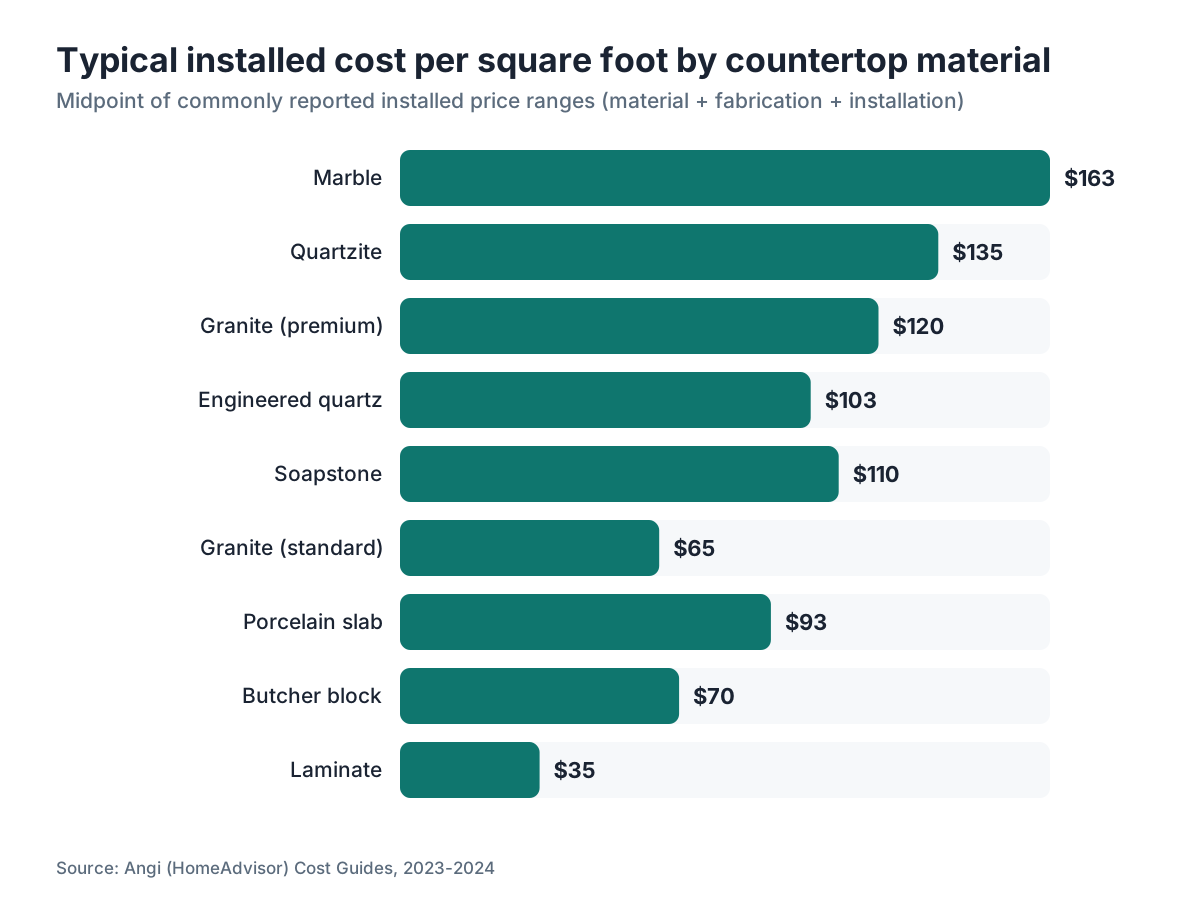
- Material costs run $40 to $200+ per square foot installed.
- The gap between a stunning result and a disappointing one is usually the shop's equipment, experience, and how carefully they template before cutting.
What does 'elegant stone fabrication' actually mean?
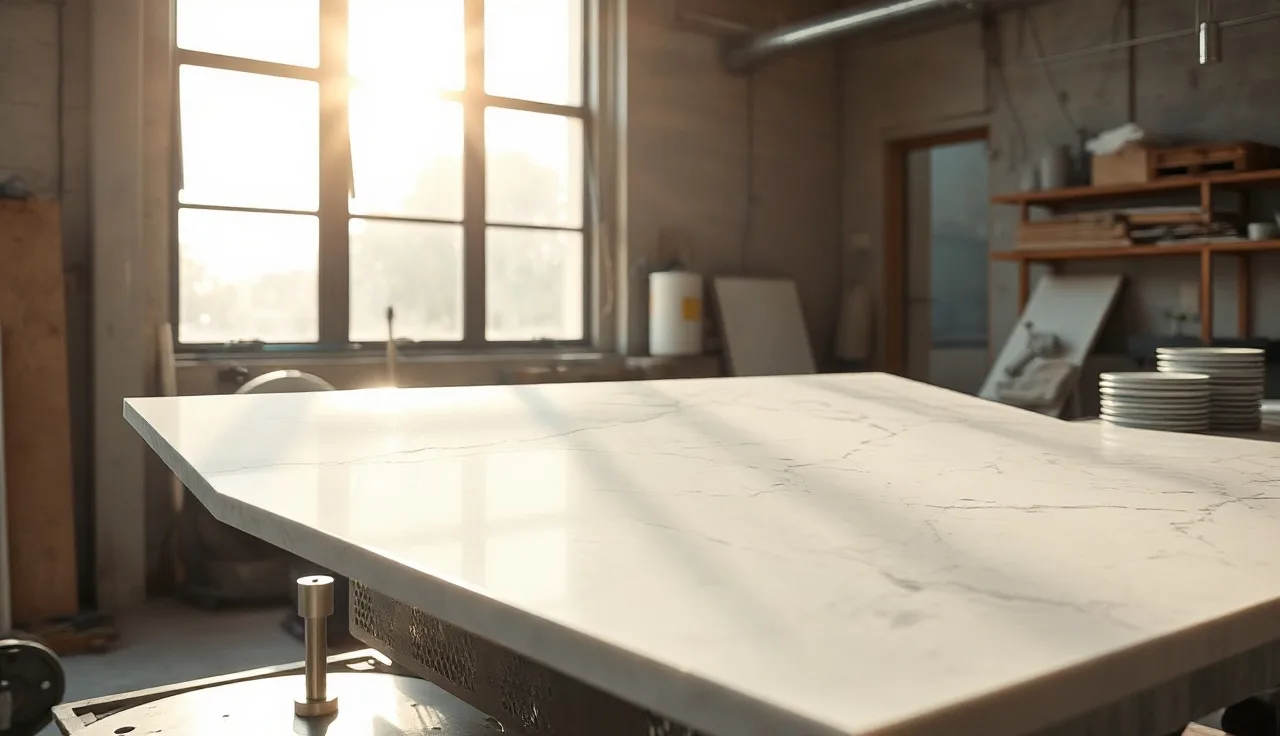
The phrase gets used loosely in showrooms and on contractor websites, but it has a practical meaning if you strip away the marketing. Elegant stone fabrication is work where the seams are tight and placed with intent, the edges stay consistent end to end, the stone's natural veining flows across cuts as if the slab were never cut at all, and the surface sits flat with no lippage between pieces.
That's it. No single material makes fabrication elegant. A well-executed laminate edge on quartzite can look worse than a sloppy one on basic granite. The craft is in the execution, not the price tag.
Four variables decide quality. The stone itself (its internal consistency, slab thickness, and natural movement). The templating method (digital laser vs. cardboard). The CNC or bridge saw's accuracy and the operator's skill. And the finishing work (edge profiling, polishing, seam filling). Shortcut any one of those and the result shows.
Which stone materials are best for high-end countertop fabrication?
There's no single winner, but some materials forgive more than others and some ask more from the fabricator.
Marble countertops are the classic prestige choice. Calcite-based stones like Calacatta and Statuario have dramatic veining and a warmth no engineered product copies. The tradeoff is real: marble etches from acids (lemon juice, wine, vinegar) and needs sealing once or twice a year depending on the stone's porosity. If you want mirror-polish marble in a heavy-use kitchen and refuse to accept any surface change, marble will disappoint you. In a low-traffic kitchen or a bathroom vanity, it's hard to beat.
Quartzite countertops sit in an interesting middle ground. True quartzite (not to be confused with quartz, which is engineered) is harder than marble and more acid-resistant, though it still needs sealing. Super White and Taj Mahal are among the most fabricated quartzite slabs in the U.S. right now.
Granite countertops remain the most fabricated natural stone in North America by volume. They're hard, scratch-resistant, relatively affordable, and available in thousands of natural patterns. Basic granite starts around $40 per square foot installed; premium exotics like Blue Bahia or Azul Aran run $150 to $200 or more per square foot installed [1].
Engineered quartz (brands like Cambria countertops) gives you a non-porous surface with consistent color and no sealing. It fabricates predictably, which many shops like. The limits: quartz can yellow under UV exposure and looks slightly artificial to a trained eye.
Soapstone is a quieter choice with a following among designers who love its matte, gray-green tones and soft texture. It's non-porous, so no sealing, but it scratches easily, which its fans accept as character. See how to clean soapstone countertops for care specifics.
| Material | Hardness (Mohs) | Sealing needed | Avg. installed cost/sq ft | Fabrication difficulty |
|---|---|---|---|---|
| Marble | 3-4 | Yes, 1-2x/year | $75-$250 | High (brittle, etches) |
| Quartzite | 7 | Yes, 1x/year | $70-$200 | Medium-high |
| Granite | 6-7 | Yes, 1x/year | $40-$200 | Medium |
| Engineered quartz | 7 | No | $55-$150 | Low-medium |
| Soapstone | 1-2 | No | $70-$150 | Medium (soft) |
| Quartzite-look porcelain | 7-8 | No | $55-$130 | High (brittle edges) |
How much does high-end stone fabrication cost?
The honest answer is a range, and anyone who quotes you a precise number without seeing your kitchen layout is guessing. Here are the real components.
Material (slab cost) is usually the largest line item. Standard granite groups run $10 to $30 per square foot for the raw slab. Premium marble, rare quartzite, and book-matched exotics can hit $100 to $500 per square foot for the stone alone [1].
Fabrication labor, meaning cutting, edge work, and finishing, typically adds $30 to $60 per square foot depending on your region, shop overhead, and job complexity (number of cutouts for sinks and cooktops, edge profile complexity, seam count). Complex waterfall islands with book-matched mitered edges cost more because mitering requires precise 45-degree cuts on expensive material, and any error wastes a large section of slab.
Installation adds another $10 to $30 per square foot in most markets [2].
A midrange kitchen (40 square feet of countertop surface) with granite, simple edge profiles, and one undermount sink cutout typically runs $2,500 to $5,000 installed. The same kitchen in premium Calacatta marble with waterfall edges and book-matched seams can easily reach $15,000 to $25,000. These ranges come from industry surveys and regional fabricator pricing, not one fixed source, so treat them as directional [1][2].
The cost most buyers underestimate is waste. Stone slabs don't come in your exact countertop shape. A 120-square-foot slab might yield only 55 usable square feet for a particular kitchen once cutouts, seam placement, and pattern matching are accounted for. Fabricators price by the square footage you actually use, but you pay for slabs in full. Ask your fabricator what the remnant policy is before signing.
What is slab templating and why does it matter so much?
Templating is the step where precise measurements of your actual cabinets and walls turn into a cutting plan. It happens after cabinets are installed but before any stone is cut. Get this wrong and nothing else matters.
Cardboard templating, where a tech traces your countertop footprint with cardboard strips, is cheap and still fine for simple layouts. It introduces human error at corners and curves and forces more field adjustment after the slab is delivered.
Digital templating uses a laser measuring device (Proliner, Laser Products LT-55, or similar) to capture your space in 3D with tolerances typically under 1mm [3]. The file goes straight into CNC software. For kitchens with many angles, curved islands, or book-matched layouts, digital templating is the only way to hold tight seams reliably. Most shops doing high-end work run it as the default.
The templater also decides seam placement during this visit. Good placement hides seams at natural visual breaks (inside corners, beneath upper cabinets) and keeps them out of heavy traffic areas. A skilled templater thinks about where the vein on your slab runs and positions cuts so the pattern continues across a seam as naturally as it can. That judgment call, made in 20 minutes at your house, shapes how the finished kitchen looks for decades.
What edge profiles show up in high-end stone fabrication?
Edge profiles are the cross-sectional shape of the countertop edge. They change the visual weight of the counter, how sharp or soft the kitchen feels, and how much light the edge throws.
Eased edge (a slightly softened 90-degree square) is the current default in contemporary and transitional kitchens. It reads clean and modern without the mechanical look of a fully square edge.
Mitered edge (two slabs joined at 45 degrees to create a thick-looking edge, often 1.5 to 3 inches apparent thickness) is a mark of high-end work. It burns material because you're essentially using two slabs to build one surface, and the 45-degree cuts must be perfect or the joint telegraphs.
Ogee profiles (S-curves) and bullnose profiles read traditional. They ruled the 1990s and early 2000s and have mostly given way to eased and mitered looks in new construction, though they still fit traditional and French country kitchens.
Waterfall edges, where the stone continues vertically down the cabinet side to the floor, took off around 2015 and remain a high-design choice for islands. A waterfall on an island with book-matched veining is one of the most technically demanding jobs a shop takes on.
For fabricators: profiling tools from Weha, Stadea, and Alpha Professional Tools dominate U.S. shops. Profile consistency over a long run depends heavily on wheel condition and water flow. A worn diamond profile wheel produces inconsistent radii that a picky client notices right away.
How do fabricators achieve tight seams on natural stone?
A tight seam on natural stone (under 1/16 inch visible gap, ideally under 1/32 inch in premium work) needs several things to go right at once.
First, the slab has to be flat. Natural stone warps slightly during quarrying and transport. A shop with a good bridge saw and a calibrated flat table catches this. A shop without them doesn't, then compensates with thicker epoxy fills that show.
Second, the CNC or saw cut has to be perpendicular and smooth. A diamond blade in poor condition leaves a rough kerf that fills with epoxy and telegraphs as a dark line.
Third, color-matched epoxy matters more than most buyers realize. Epoxy fill is a two-part mix that fabricators tint to match the slab's dominant color. On light stones like white marble, getting a near-invisible seam means testing the epoxy color on a scrap piece before filling. Some stones are nearly impossible to seam invisibly, including heavily veined stones where the vein doesn't continue across a seam and stones with strong directional movement.
Fourth, seam location has to account for support. Long spans of stone over cabinets without support underneath can stress seams over time, especially in thin (2cm) material. Most fabricators specify steel L-brackets or plywood subtops for spans over 24 inches, and the Marble Institute of America (now the Natural Stone Institute) publishes span tables for exactly this [4].
How do you choose a stone fabricator for high-end work?
The best signal is completed work you can actually see. Ask for references you can call and a shop visit if they allow it. A serious fabricator running premium jobs will have a clean, organized shop with a CNC machine, a bridge saw with a visible water cooling system, and polishing equipment. A shop doing mostly basic laminate work on the side is a different animal.
Ask directly: Do you use digital templating? What CNC equipment do you run? Who does the finishing work, in-house employees or subcontractors? What's your tolerance for seam gaps? For premium work, you want an answer under 1/16 inch and ideally a promise to reshoot if a seam misses that.
Licensing matters in some states. As of 2024, several states have specific contractor licensing requirements that cover stone installation, and general contractor licensing covers it in others. Your state's contractor licensing board is the place to verify [5].
Insurance is non-negotiable. A fabricator should carry general liability (minimum $1 million per occurrence is typical for residential work) and workers' compensation. Ask for certificates before any work starts.
For fabricators tracking their own job costs and material yield, shop management software (SlabWise is one option for quote-to-slab layout) shows which job types are profitable and which edge profiles cost more than you're charging for them. Accurate job costing is how a fabrication business knows whether it can afford better equipment.
Checking reviews on Google and Houzz gives you unfiltered customer feedback, but weight recent reviews more heavily than old ones because shop quality changes with ownership and staff.
What finishing steps turn good stone work into great stone work?
The finish is the last thing a fabricator does and the first thing a homeowner touches.
Polishing levels on natural stone run from honed (matte, low sheen) through satin, semi-polished, and high polish (mirror-like, 80+ gloss units by the ASTM C1209 test [6]). High polish shows movement in the stone and catches light. Honed gives a quieter, matte look that many designers prefer for marble because it plays down etch marks (etches are less visible on a honed surface than a polished one).
The polishing sequence in a shop typically climbs through diamond abrasive pads from 50 grit up to 3,000 or 5,000 grit, with a polishing compound at the end for mirror finishes. Rush the sequence or skip grit steps and you leave micro-scratches that show up as haziness in raking light.
Sealing isn't a fabrication step but it's close kin. Most natural stone should be sealed before installation. The standard field test: put a few drops of water on the surface and wait 10 minutes. If the stone darkens, it's soaking up water and should be sealed. The Natural Stone Institute recommends impregnating sealers (penetrating, not topical) for most natural stone countertop applications [4].
For how to clean stone countertops after installation, the rule is pH-neutral cleaners only. Skip anything acidic or alkaline, which rules out most commercial kitchen cleaners.
What are the most common mistakes in stone countertop fabrication?
Seams in bad locations top the complaint list. A seam in the middle of an island where everyone gathers, or across a sink front, is both a structural and a visual problem. It usually happens when a shop tries to use a remnant piece or doesn't plan the layout before cutting.
Over-relying on epoxy to hide blade marks or gaps is the second big one. Epoxy is a tool for seams, not a substitute for accurate cuts. You can feel an over-filled seam as a slight ridge when you run your finger across it.
Under-supporting long spans is a structural mistake that can crack expensive stone. Granite and marble both have low tensile strength compared to their compressive strength. They resist being crushed but they snap under bending loads. A 1.25-inch-thick granite slab spanning 36 inches without a corbel or bracket is a liability.
Ignoring vein direction when buying slabs leads to regret. The vein pattern you see on a slab lying flat in a warehouse looks different on a vertical surface or once it's cut for a kitchen. Bring your kitchen measurements to the yard and have them stand the slab upright. What you see standing is close to what you'll get installed.
Skipping the dry layout, where cut pieces get assembled on sawhorses before installation to check seams and overall appearance, is a mistake even some experienced shops make to save time. A dry layout catches problems before they're glued down.
What questions should homeowners ask before signing a fabrication contract?
The contract questions matter as much as the showroom conversation.
First: what's included? Fabrication quotes sometimes leave out sink cutouts, cooktop cutouts, or any edge profile beyond the basic eased edge. Get these itemized.
Second: who templates, and what method do they use? As covered above, digital templating is meaningfully more accurate for complex layouts.
Third: what's the seam policy? If a seam is visible at X distance, can you ask for it to be redone? Get the answer in writing.
Fourth: what happens if the slab cracks during fabrication? This happens now and then with veined stones where a natural fissure runs through the material. The answer tells you whether the fabricator absorbs that risk or passes it to you.
Fifth: what is the installation timeline? Most residential fabrication jobs run 1 to 3 weeks from template to installation if slabs are in stock. Custom orders from overseas quarries can stretch to 8 to 16 weeks [2].
Sixth: does the fabricator give aftercare guidance? A good shop walks you through the sealing schedule, compatible cleaners, and what to do if a chip happens.
For a full picture of what installation day looks like, the countertop installation guide covers sequencing, what to have ready, and how to inspect the work before the installers leave.
How does stone fabrication compare to alternatives like laminate, solid surface, and wood?
Natural and engineered stone dominate high-end residential work, but they're not the only sensible choice depending on budget and use.
Laminate countertops (including Formica countertops) have improved a lot in the last decade. High-resolution digital printing now produces laminate patterns that mimic stone at 3 to 5 feet convincingly. Installed cost runs about $20 to $50 per square foot, a fraction of stone. They scratch and chip at edges over time, can't be refinished, and feel hollow when you knock on them. For a rental property or a tight budget kitchen, modern laminate is a rational pick.
Butcher block countertops bring warmth that stone doesn't, and they're the only surface you can actually sand and refinish when scratched. They're not practical near sinks without exceptional sealing and maintenance discipline, and they're poor candidates for heavy baking use (heat from pans damages the finish).
Corian countertops and other solid surface materials are non-porous, repairable, and can be thermoformed into continuous shapes stone can't match. They scratch more easily than stone and don't carry the visual weight of a thick slab.
For most homeowners doing a real kitchen renovation with a 10-plus-year horizon, natural stone or engineered quartz gives the best mix of durability, resale value, and appearance. The National Association of Realtors' 2023 Remodeling Impact Report lists stone countertops among the top kitchen features buyers cite as influencing purchase decisions, though specific recovery percentages vary by market and weren't isolated to stone alone [7].
For kitchen countertops generally, the best material is the one that fits how you actually cook and clean, not the priciest option in the showroom.
How can fabricators price and plan high-end jobs more accurately?
Accurate pricing on premium stone work means knowing three things many shops undercount: material waste percentage by stone type, time per linear foot for complex edge profiles, and the real cost of a callback when a seam or edge misses the client's standard.
Waste runs 15 to 35 percent on typical residential jobs depending on layout complexity and pattern matching. Book-matched waterfall islands can push waste above 50 percent because both faces of adjacent slabs have to be used together. If your quote counts slab material at face value without accounting for waste, you're losing money on premium jobs.
Edge profiling time is easy to lowball. A simple eased edge might take 3 minutes per linear foot. An ogee or complex layered profile can take 12 to 20 minutes per linear foot with setup. Time-in-motion studies in fabrication shops vary widely by equipment, but tracking actual profiling time per job for 30 days shows you where margin disappears.
Software that ties slab inventory to job quotes and nesting layouts (SlabWise is built for this) lets fabricators see material consumption per job before cutting, not after. That matters because cutting is the point of no return on expensive material.
Pricing transparency also builds trust with high-end clients. Itemized quotes that break out slab cost, fabrication labor, edge profiles, cutouts, and installation as separate line items are standard among shops doing $500,000 or more per year in revenue, and they head off disputes at invoice time.
Frequently asked questions
How long does stone countertop fabrication typically take from template to install?
Most residential jobs run 7 to 14 business days from template to installation when slabs are in stock at the local yard or distributor warehouse. If you're ordering a specialty stone that has to come from an overseas quarry or a specific slab lot, add 8 to 16 weeks. Template date is usually 1 to 3 days after cabinet installation is complete. Rush fees exist at most shops but add 20 to 40 percent to fabrication cost.
What is book-matching in stone fabrication and when is it worth it?
Book-matching means opening two adjacent slabs like a book so their mirror-image veining creates a symmetrical pattern. It's done on walls, islands, and waterfall edges for dramatic effect. Worth it when the stone has strong, continuous veining like marble or quartzite. Not worth it on stones with random or subtle patterning where the effect doesn't read. Cost is substantial because you're using twice the slab material for the matched surface area.
Does stone thickness matter for countertop quality?
Yes, meaningfully. Standard residential countertops use 3cm (roughly 1.25 inch) slabs, which are structurally adequate for most spans and hold edges without chipping as readily as 2cm material. 2cm slabs are thinner and lighter, used mostly for vertical applications or when mitered to fake a thicker look. Thicker custom slabs (4cm or more) exist for heavy commercial use and certain designer applications. Always confirm the thickness before ordering.
Can stone countertops be repaired if they chip or crack?
Chips on edges can often be filled with color-matched epoxy and re-profiled, though the repair is usually visible under close inspection. Cracks are harder: a surface crack from a vein or impact can be stabilized with epoxy and a fiberglass backing patch on the underside, but structural cracks that run full thickness typically need slab replacement for that section. Prevention through proper support and avoiding thermal shock is far cheaper than repair.
What's the difference between quartzite and quartz countertops?
Quartzite is a natural metamorphic rock formed from sandstone under heat and pressure. It's mined, slabbed, and fabricated like granite or marble. Quartz countertops (like Silestone or Cambria) are engineered: roughly 90 to 95 percent ground quartz bound with polymer resins, then molded into slabs. Quartzite needs sealing; engineered quartz doesn't. Quartzite looks more organic and varied. Engineered quartz is more consistent in color and is non-porous.
How do I evaluate seam quality after a stone countertop is installed?
Run your fingertip slowly across the seam. You should feel no ridge or depression. View the seam at eye level in raking light (a flashlight held low and angled works). The gap should be 1/16 inch or less for good work, under 1/32 inch for premium fabrication. The epoxy fill should match the dominant background color of the stone. Seams that are obvious from 3 feet away or that feel rough to the touch indicate below-average work.
Is a honed finish or a polished finish better for marble?
For marble in a working kitchen, honed is usually the more practical choice. Honed marble etches from acid contact just as polished marble does, but the etch marks are less visible on a matte surface than on a mirror-polished one. Polished marble shows the stone's depth and color most dramatically and is beautiful in low-traffic spots like bathroom vanities or formal dining areas. There's no wrong answer; it depends on how much the surface variation will bother you daily.
What sealer should I use on natural stone countertops?
Use a penetrating impregnating sealer, not a topical film sealer. Topical sealers sit on the surface, peel, and can discolor. Penetrating sealers soak into the pores and repel liquids without changing the surface appearance. Products based on fluoropolymers or silicone are common. Apply after thoroughly cleaning and fully drying the stone, follow the manufacturer's dwell time, and buff off excess before it dries on the surface. Reapply annually or when water stops beading.
What should I look for when selecting a slab at the stone yard?
Look at the full slab standing upright, not lying flat on a rack, because the upright view is close to how it reads installed. Check for natural fissures (common in marble and some quartzites) by shining a light across the surface at an angle. Decide whether you're okay with fissures, which are structural features, versus cracks, which are fractures. Note where the primary vein runs and whether your layout lets you put the most interesting part of the slab where it's visible.
Do outdoor kitchens need special stone fabrication?
Yes. Outdoor stone countertops face UV exposure, freeze-thaw cycling (in climates below 32°F), and bigger thermal swings than indoor surfaces. Granite and quartzite handle outdoor conditions better than marble, which can develop surface damage over time outdoors. Porcelain slabs are increasingly used outdoors for their UV stability and frost resistance. Sealers need more frequent reapplication outdoors, typically every 6 to 12 months. Edge profiles with flat surfaces (eased, square) drain water better than profiles with upturned lips.
How do fabricators handle large or unusual countertop shapes?
Large shapes are templated digitally to capture curves and angles precisely, then cut on a CNC waterjet or CNC router. Unusually large single pieces (islands over 100 inches, for example) may need to be fabricated in sections because standard slabs typically run 110 to 130 inches long and 60 to 65 inches wide. The fabricator plans seam locations to minimize visibility. Curved edges (ogee, radius corners) require profiling tools capable of radius work, which not all shops own.
Can I use natural stone on kitchen islands with a waterfall edge?
Yes, and it's one of the most common premium fabrication requests. A waterfall island uses a main horizontal slab for the top and one or two vertical slabs for the sides, all joined with a mitered 45-degree cut. The visual goal is the look of one continuous piece of stone. Book-matching the top and side slabs gives the most dramatic result when the stone has clear veining. Expect to pay significantly more: material waste is high and the mitered cuts require precision.
What's the labor cost difference between simple and complex edge profiles?
A basic eased edge on granite might add $10 to $15 per linear foot over a raw cut edge. Complex profiles like layered ogee, mitered waterfall, or custom beveled details run $25 to $60 per linear foot in most U.S. markets depending on the shop's equipment and labor costs. Mitered edges on thick or stacked material sit at the high end because they require extra slab material and precise cuts on expensive stone where errors are costly.
How do I compare fabrication quotes from different shops?
Get at least three itemized quotes breaking out slab cost, fabrication labor, edge profile charges, cutout fees (sink, cooktop, etc.), and installation separately. Verify each quote uses the same slab and the same edge profile so you're comparing like jobs. Ask each shop the same questions about digital templating, seam tolerance, and what happens if a slab cracks during fabrication. Price alone is a poor guide; a $500 difference is irrelevant if a shop produces a seam you'll see every day for 20 years.
Sources
- HomeAdvisor (Angi), Granite Countertops Cost Guide: Granite countertops range from roughly $40 to $200+ per square foot installed depending on stone grade; premium exotics reach higher.
- HomeAdvisor (Angi), Countertop Installation Cost Guide: Installation labor typically adds $10 to $30 per square foot; custom or overseas stone orders can add 8 to 16 weeks to the timeline.
- Laser Products Industries, LT-55 XL Digital Templating System: Digital laser templating systems capture room geometry in 3D with tolerances typically under 1mm.
- Natural Stone Institute, Technical Bulletins and Design Guidelines: The Natural Stone Institute publishes span tables for stone countertops and recommends penetrating impregnating sealers for natural stone countertop applications.
- U.S. Small Business Administration, State Contractor Licensing: Contractor licensing requirements for stone installation vary by state; as of 2024 multiple states have specific requirements that cover countertop fabrication and installation.
- ASTM International, ASTM C1209 Standard Terminology for Dimension Stone: ASTM C1209 defines stone polishing terminology and gloss measurement standards used in fabrication quality assessment.
- National Association of Realtors, 2023 Remodeling Impact Report: Stone countertops are among the top kitchen features cited by buyers as influencing purchase decisions, per the 2023 NAR Remodeling Impact Report.
- Marble Institute of America (Natural Stone Institute), Dimension Stone Design Manual: The Dimension Stone Design Manual specifies structural support requirements including corbels and L-brackets for stone spans over 24 inches.
- U.S. Geological Survey, Mineral Commodity Summaries: Stone, Dimension: USGS tracks dimension stone production and import data showing granite as the dominant fabricated natural stone in North American residential use.
- Occupational Safety and Health Administration (OSHA), Silica Dust in Stone Fabrication: OSHA regulates silica dust exposure limits relevant to stone fabrication shops cutting engineered quartz and natural stone materials.
- National Kitchen and Bath Association, Design Guidelines: NKBA design guidelines address countertop height, overhang, and support specifications relevant to stone countertop installation.
Last updated 2026-07-10