TL;DR
- Commercial stone fabrication covers cutting, shaping, and finishing stone for hotels, restaurants, offices, and retail spaces.
- Jobs typically run 20 to 500+ square feet per unit, require tighter tolerances than residential work, and cost $40 to $150 per square foot fabricated and installed depending on stone type and project complexity.
- Lead times of 3 to 12 weeks are normal on large jobs.
What is commercial stone fabrication and how is it different from residential?
Commercial stone fabrication turns raw slabs into finished surfaces for buildings that are not houses: hotel lobbies, hospital nurse stations, restaurant bars, office reception desks, retail storefronts, and residential towers. The stone moves through the same basic steps as a kitchen countertop, meaning templating, cutting, edge profiling, polishing, and installation. But the scale and the workflow change everything.
Residential jobs usually cover 40 to 80 square feet of countertop per house. A single hotel project might need 8,000 square feet of vanity tops across 200 rooms, all cut to identical dimensions within ±1/16 inch. That volume demands a different shop setup, a different quoting process, and a different relationship with the general contractor or construction manager running the job.
Tolerances are tighter in commercial work. A warped vanity top in a hotel bathroom gets photographed by guests and posted online. Building specifications on commercial jobs often cite ASTM C615, C616, or C629, which set dimensional and physical property standards for granite, marble, and slate respectively [1]. Residential work almost never names those standards, even though good fabricators follow the spirit of them anyway.
Lead time is the other big split. A residential kitchen can be templated and installed in one to two weeks. A commercial project with long-lead stone that has to be quarried, shipped from Italy or Brazil, and fabricated in sequence with other trades can carry a 12-week procurement tail. Miss that window and you delay a hotel opening, which can trigger liquidated damages clauses in the GC contract. The stakes are higher, and experienced commercial fabricators price that risk in.
What types of stone are most common in commercial projects?
Granite still dominates commercial countertop and vanity work. It holds up under heavy use, resists most surface chemicals, and comes in colorways consistent enough that a fabricator can match 200 slabs across multiple shipments. Granite runs 6 to 7 on the Mohs hardness scale, so it shrugs off scratches from cleaning carts and maintenance gear, which matters in hospitality.
Marble countertops show up in hotel lobbies, restaurant bars, and high-end retail because nothing else delivers the same visual weight. But marble is calcium carbonate, and acids etch it. Specifying marble for a coffee shop counter or a restaurant pass-through is usually a mistake unless the owner knows they are signing up to refinish it every few years. Good designers know this. Not all do.
Engineered quartz (Cambria, Silestone, and others) is growing fast in commercial work because it is non-porous, consistent in color across large runs, and needs no sealing. Cambria countertops, for example, carry NSF/ANSI 51 certification for food-zone surfaces, which matters in commercial kitchens and food prep areas [2]. Porcelain panels are gaining ground in facade and wall cladding where weight is the deciding factor.
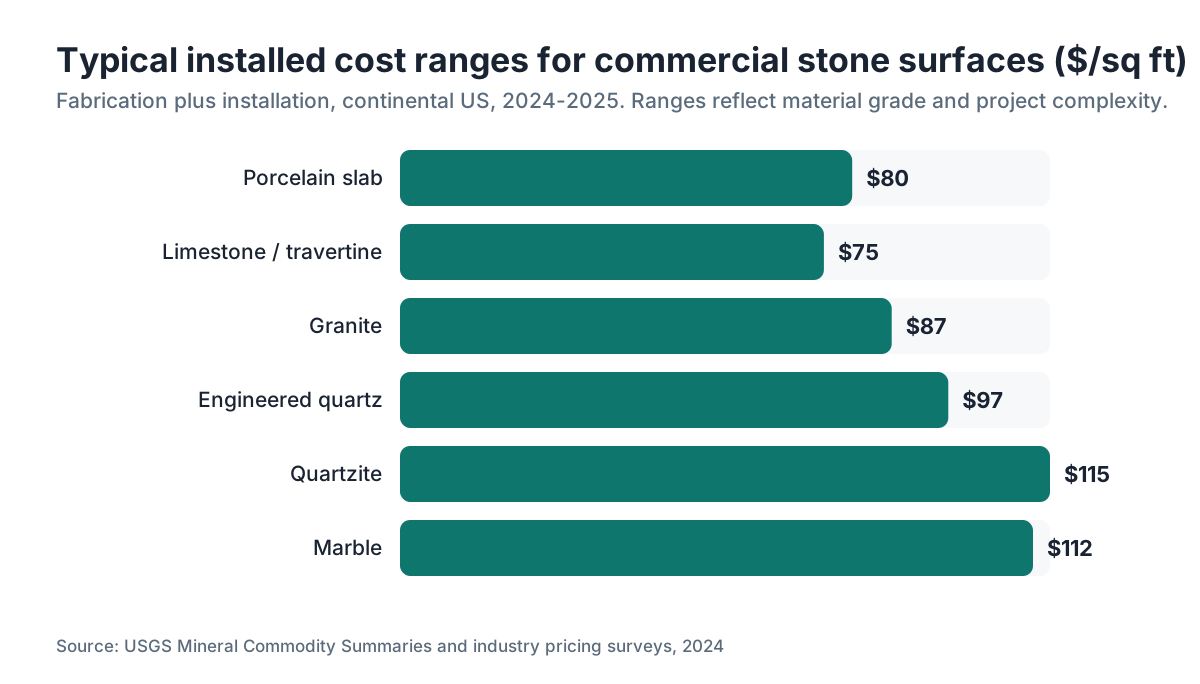
The table below gives a rough material comparison for commercial use.
| Material | Typical installed cost ($/sq ft) | Sealing required | Common commercial use |
|---|---|---|---|
| Granite | $55-$120 | Yes, every 1-3 years | Vanities, reception, foodservice |
| Marble | $75-$150 | Yes, frequently | Lobbies, bars, feature walls |
| Engineered quartz | $65-$130 | No | Offices, healthcare, restaurants |
| Quartzite | $80-$150 | Yes | High-use counters, bar tops |
| Porcelain slab | $50-$110 | No | Wall cladding, facades, flooring |
| Limestone/travertine | $50-$100 | Yes | Flooring, feature walls |
Costs reflect fabrication plus installation in the continental US as of 2024-2025 and vary by region, slab source, and edge complexity. Ranges are compiled from industry pricing surveys and fabricator interviews; no single federal dataset exists for these figures.
How does the commercial stone fabrication process work from start to finish?
The process has more handoffs than residential work, and each one is a chance to lose days.
It starts with the design documents. An architect or interior designer produces shop drawings that specify stone type, finish, edge profile, dimensions, and special conditions like undermount sinks, cooktop cutouts, or waterfall edges. The fabricator reviews these and flags conflicts before anything gets cut. On large jobs, this submittal-and-review cycle can eat two to four weeks by itself.
Material selection comes next. For a consistent look across a large run, most commercial fabricators buy slabs in a lot, meaning they source all the material from the same quarry batch at once and store it in their yard. A 200-room hotel might need 40 to 60 full slabs just for vanity tops. The fabricator inspects and approves each slab before committing, because a surprise vein pattern in slab 38 can blow the whole look.
Templating on commercial jobs is often digital. A laser templating device feeds measurements straight into CNC cutting software, skipping the physical template and reducing measurement error. Some jobs get templated from architectural drawings alone, with field verification happening later.
CNC saws and waterjets do the bulk cutting. A five-axis CNC bridge saw cuts complex angles and curves in minutes that would take a skilled hand-cutter hours. Edge profiles run on CNC edge polishers. Finished pieces get inspected, packed in A-frames or wooden crates, and staged for delivery in installation sequence.
Installation sequencing is where commercial work gets genuinely hard. A hotel project might install vanity tops floor by floor as construction finishes each level, with the fabricator timing deliveries so fragile stone never sits on an active site longer than it has to. That takes reliable production scheduling and real communication with the GC. Shops that are great at fabrication but poor at scheduling tend to struggle on commercial work.
What does commercial stone fabrication cost, and what drives the price?
Cost per square foot is almost meaningless without knowing the scope. A simple granite vanity top run for a 50-room hotel is a different financial exercise than a book-matched marble lobby wall with LED backlighting.
The main cost drivers are stone material cost (30 to 50 percent of total project cost on premium stones), fabrication labor (CNC time plus skilled finishing), edge complexity, cutout count, and installation logistics.
Commercial-grade granite slabs run roughly $10 to $40 per square foot at the slab level, depending on origin and rarity [3]. Engineered quartz slabs run $20 to $50 per square foot. Rare marbles like Calacatta or Statuario can hit $80 to $150 per square foot before a single cut is made.
Fabrication markup on commercial jobs is often lower per square foot than residential because volume lets shops run their CNC machines efficiently. But the total dollar value is higher, so payment terms and cash flow matter more. Large commercial fabricators often negotiate net-30 or net-60 terms with material suppliers and mirror that structure in their client contracts.
Bidding competitively while protecting margin comes down to accurate nesting (optimizing how pieces lay out on a slab to minimize waste). Waste on a complex job with lots of cutouts and angled pieces can hit 25 to 35 percent of material purchased. Nesting software can pull that down to 15 to 20 percent, which on a $200,000 material buy is a real number. This is the kind of job-level math that shop management tools like SlabWise are built to handle, turning a manual layout process into something repeatable and auditable.
Installation on commercial projects runs $15 to $40 per square foot depending on access difficulty, building floor level, and whether union labor is required. Some metro areas require union installation on publicly funded projects, which adds a cost layer you have to price from the bid stage.
What certifications and standards apply to commercial stone fabrication?
This is the part that catches residential-only fabricators off guard when they try to break into commercial work.
ASTM International publishes the primary material standards. ASTM C615 covers quarried granite, ASTM C616 covers quarried marble, and ASTM C629 covers slate [1]. These specify minimum physical properties like flexural strength and water absorption. When a commercial spec says "granite per ASTM C615," the fabricator cannot swap in a softer stone and call it close enough.
For food-contact surfaces in commercial kitchens and cafeterias, NSF/ANSI Standard 51 (Food Equipment Materials) is the certification that counts. It confirms a material will not leach harmful substances into food [2]. Most engineered quartz products carry it. Most natural stone does not, which is one reason engineered quartz has taken real market share in healthcare and foodservice.
LEED certification (Leadership in Energy and Environmental Design) comes up on many commercial projects. Stone can contribute to LEED credits under the Materials and Resources category, especially through regional sourcing (the LEED v4 MR credit for building product disclosure and optimization rewards supply-chain transparency) [4]. Fabricators on LEED jobs need documentation on where the stone was quarried and sometimes its embodied carbon.
Shop safety is regulated federally by OSHA. The standard that matters for stone fabrication is OSHA's silica rule, 29 CFR 1926.1153 for construction and 29 CFR 1910.1053 for general industry, which caps respirable crystalline silica exposure at 50 micrograms per cubic meter of air as an eight-hour time-weighted average [5]. Wet cutting, local exhaust ventilation, and respiratory protection programs are all required controls. California adopted a stricter standard for engineered stone in 2024, effectively banning dry cutting of high-silica engineered quartz in fabrication shops [6].
What equipment does a commercial stone fabrication facility need?
A shop set up for residential work can handle small commercial jobs, but high-volume commercial fabrication needs a different equipment profile.
The foundation is a CNC bridge saw with a large cutting envelope, usually able to handle slabs up to 130 by 78 inches, the standard full slab size. A waterjet cutter adds complex curves, mosaics, and inlays without putting thermal stress on the stone. A CNC router with a multi-head tool changer runs edge profiling, sink cutouts, and surface finishing in one setup instead of three.
Material handling is where a lot of shops underinvest. A slab of 3cm granite at full size weighs 700 to 900 pounds. Moving those slabs safely and fast takes A-frame storage racks, overhead cranes or vacuum-lift hoists, and enough yard space to stage material by project. Run a large commercial job in a shop without adequate material handling and you get slower throughput and higher injury risk.
Digital templating gear (Proliner from Prodim is common) feeds measurements straight to CAD/CAM software, cutting out transcription errors between the field and the shop programmer. On a 200-piece hotel job, that error reduction is worth real money.
Quality control equipment matters too. A straight edge calibrated to 0.005 inches, a moisture meter for natural stone, and a color-calibrated light source for visual inspection are all standard in a serious commercial shop. Some fabricators use 3D scanning to verify finished pieces against spec before they leave the building.
How do commercial stone fabricators bid and win large projects?
Commercial bidding is a different discipline from residential quoting. Instead of handing a homeowner a price during a showroom visit, a commercial fabricator responds to a formal Request for Proposal (RFP) or Invitation to Bid (ITB) issued by a general contractor or construction manager.
The bid package includes architectural drawings, specifications, material schedules, and addenda. The fabricator has to read all of it, find scope ambiguities, and submit Requests for Information (RFIs) before bid day. Missing a scope item in the drawings and pricing it as zero is how fabricators lose money on commercial jobs.
Takeoff is the process of measuring all the square footage from the drawings and counting every edge linear foot, every cutout, every special condition. It is painstaking on a large drawing set, and it is where most bid errors happen. A thorough takeoff on a mid-size hotel job can take 8 to 16 hours.
Markup strategy on commercial work usually runs lower than residential. Residential shops often add 40 to 60 percent gross margin. Commercial jobs might carry 20 to 35 percent gross margin, but the volume makes the absolute dollar profit larger. The trade-off is slower payment (commercial invoicing is progress-billing against milestones, not payment at installation like residential) and more administrative overhead.
Winning commercial work steadily comes down to relationships. Most GCs keep a short list of fabricators they trust to perform on schedule. Breaking into that list usually means starting with smaller commercial jobs, a restaurant tenant improvement or a medical office build-out, and building a track record before chasing the large hospitality or mixed-use tower jobs.
What are the lead times for commercial stone fabrication projects?
Lead time is the thing that surprises clients new to commercial stone. A kitchen countertop can go from template to install in 7 to 14 days. A commercial project has phases that stack on top of each other.
Material procurement is often the longest single phase. If the specified stone is a premium Italian marble or a rare Brazilian quartzite, the slab order might take 6 to 16 weeks from factory to the fabricator's yard, depending on ocean freight, customs clearance, and the quarry's production schedule. Domestic stones (some granites and limestones quarried in the US) can arrive in 2 to 4 weeks.
Submittal review adds 2 to 4 weeks on most commercial jobs. The fabricator submits shop drawings and material samples, the architect reviews and either approves or requests revisions, and the cycle repeats. Two rounds of revisions are common.
Actual fabrication for a large hotel job, once material is in house and drawings are approved, runs 3 to 8 weeks depending on shop capacity and complexity. Installation sequencing then stretches out further, because a 12-story building does not become ready for stone all at once.
Total elapsed time from project award to final installation on a large commercial project is commonly 4 to 6 months, and 9 to 12 months is not unusual on complex or large-scale work. GCs who do not understand this try to compress the schedule, and the result is either substituting a lesser stone that ships faster or going into installation with stone nobody has properly inspected. Neither is good.
How does silica safety regulation affect commercial stone fabrication shops?
This is the most consequential operational issue facing stone fabrication shops right now, and any fabricator who dismisses it is taking real legal and financial risk.
OSHA's crystalline silica rule for construction (29 CFR 1926.1153) set a permissible exposure limit of 50 micrograms per cubic meter of air as an eight-hour time-weighted average, with an action level of 25 micrograms [5]. The rule has been in effect since 2017 for construction and 2018 for general industry. Engineered stone (quartz composite) contains up to 93 percent silica by weight, which makes it far more hazardous to cut dry than natural stone.
California went further. In 2024, Cal/OSHA moved to effectively prohibit dry fabrication of engineered stone products with silica content above 40 percent by weight [6]. Other states are watching how California's approach plays out.
For commercial shops, compliance means wet-cutting all engineered stone, keeping local exhaust ventilation running at cutting stations, conducting air monitoring, offering medical surveillance to exposed workers, and training employees on silica hazards. The cost of building out a compliant shop is real but manageable. The cost of an OSHA citation, or a silicosis claim from a worker, is not.
OSHA maintains a dedicated silica page with compliance assistance resources, and the National Stone, Sand and Gravel Association (NSSGA) has published industry-specific guidance [7].
What should a property developer or GC look for when choosing a commercial stone fabricator?
The lowest bid is almost never the right answer on commercial stone work. A fabricator who wins by underbidding runs out of margin halfway through the job and starts cutting corners on material, labor, or schedule. The best GCs know this cold.
Capacity is the first thing to verify. Ask the fabricator for their current production backlog and how many large commercial jobs they are running at once. A shop running at 120 percent capacity has no buffer for your project's inevitable scope changes.
References from comparable jobs beat portfolio photos every time. A fabricator who has built beautiful residential kitchens is not automatically ready for a 300-room hotel. Ask for references from jobs of similar scale, with similar stone types, completed in the last three years. Call them and ask specifically about schedule performance and how the fabricator handled problems.
Financial stability is worth checking. A commercial contract might require the fabricator to buy $150,000 in slabs before receiving their first payment application. A shop with thin working capital cannot handle that. Ask for a bank reference or check for liens filed against the company in your county recorder's records.
A shop visit is non-negotiable on large jobs. You want to see the CNC equipment, the material handling setup, the yard capacity, and the quality control process. A messy, disorganized shop produces delayed, inconsistent work at scale. A well-run commercial stone fabrication facility looks more like a small manufacturing plant than a craft workshop.
For countertop installation on commercial jobs, ask whether the fabricator self-performs installation or subcontracts it. Self-performing shops have tighter control over schedule and quality. Subcontracted installation adds a communication layer that can cause problems.
How is stone fabrication for commercial projects evolving with technology?
The biggest shift in commercial stone fabrication over the last decade is the move from manual layout and paper drawings to integrated digital workflows. A shop running a full digital pipeline today templates in the field with a laser device, uploads the measurement file straight to CAD/CAM software, nests pieces on virtual slabs to minimize waste, programs the CNC in that same software, and tracks production status job by job.
That integration is more than convenient. It changes the economics of commercial work. Nesting optimization alone can cut material waste by 10 to 15 percentage points on a complex job, which on premium stone is real savings. Automated CNC programming eases the skilled labor bottleneck on the shop floor. Digital order tracking kills the phone-call overhead that consumes a shop manager's day.
Shop management software built for stone fabrication, like SlabWise, handles quoting, slab inventory tracking, job scheduling, and nesting in one place instead of across a patchwork of spreadsheets and whiteboards. For a commercial shop running 20 to 30 active jobs at once, that consolidation matters.
On the material side, ultra-thin stone panels (6mm to 12mm rather than the standard 20mm or 30mm) are opening up commercial applications in wall cladding and furniture where weight used to be prohibitive. Porcelain slab sizes have grown to 126 by 63 inches, making large-format single-panel installations possible that would have required natural stone book-matching before.
Robotic installation is still early, but a handful of commercial projects have used robotic arms to place stone tiles or panels in repetitive grid layouts. For custom commercial stone work with varied piece shapes, human installers remain the only practical option. That may change in the next decade.
Frequently asked questions
How much does commercial stone fabrication cost per square foot?
Fabricated and installed, commercial stone typically runs $40 to $150 per square foot depending on material, edge complexity, and regional labor rates. Granite vanity tops for a hotel sit toward the lower end of that range. Book-matched marble lobby walls with special edges sit toward the upper end. Material alone can be $10 to $80 per square foot before fabrication labor is added.
What is the typical lead time for a commercial stone project?
Plan on 3 to 6 months from contract to final installation on a mid-size commercial project, and 6 to 12 months on large or complex jobs. Material procurement (especially imported stone) often takes 6 to 16 weeks alone. Add submittal review, fabrication, and phased installation, and the schedule fills fast. Any GC telling you stone can be installed in four weeks on a new hotel build is either using stock material or guessing.
What stone is best for high-traffic commercial countertops?
Granite and engineered quartz hold up best in high-traffic commercial environments. Granite resists scratching (Mohs 6-7) and, when properly sealed, handles cleaning chemicals well. Engineered quartz is non-porous and needs no sealing. Marble etches from acids and soft drinks and needs more frequent maintenance, which makes it a poor choice for restaurant counters or coffee bars unless the owner accepts ongoing refinishing costs.
Does OSHA require anything special for stone fabrication shops?
Yes. OSHA's crystalline silica rule (29 CFR 1910.1053 for general industry, 29 CFR 1926.1153 for construction) caps respirable silica exposure at 50 micrograms per cubic meter of air as an eight-hour time-weighted average. Shops must use wet cutting, local exhaust ventilation, air monitoring, medical surveillance for exposed workers, and employee training. California added restrictions on dry fabrication of high-silica engineered stone in 2024.
What ASTM standards apply to commercial stone specifications?
The main ones are ASTM C615 (granite), ASTM C616 (marble), and ASTM C629 (slate). These cover physical properties like flexural strength, water absorption, and dimensional tolerances. When a commercial spec sheet cites these standards, the fabricator must use material that meets those minimums. Substituting a softer or more absorbent stone without architect approval is a contract and liability issue.
How do commercial stone fabricators handle large slab quantities for consistent color matching?
Experienced commercial fabricators buy slabs in a numbered lot from a single quarry batch. All slabs in one lot come from the same block run and have the closest possible color and veining consistency. They inspect every slab on receipt against the approved sample. For very large projects or heavily veined stone, fabricators sometimes bring the client or architect to the slab yard for lot approval before committing to the full purchase.
Can engineered quartz be used on food contact surfaces in commercial kitchens?
Many engineered quartz products carry NSF/ANSI 51 certification, which confirms they meet food equipment material safety requirements. Brands like Cambria explicitly market this certification for commercial kitchen and food prep applications. Natural stone generally does not hold NSF certification. If a health department or building inspector asks for documentation on food-zone surfaces, engineered quartz with NSF 51 is the easiest answer.
How is commercial stone fabrication billed on large projects?
Commercial stone contracts almost always use progress billing, also called schedule of values billing. The fabricator submits monthly pay applications tied to milestones: material procurement, fabrication complete, installation complete by phase. Payment terms are typically net-30 to net-45 from the GC. This differs from residential work where payment happens at or before installation. Commercial fabricators need working capital to bridge the gap.
What is slab nesting and why does it matter for commercial jobs?
Nesting is laying out the cut pieces for a job on a virtual slab to minimize waste before any cutting begins. On a simple rectangular vanity top run, nesting is straightforward. On a job with angled pieces, radius cuts, and multiple cutouts, poor nesting can waste 30 percent or more of expensive stone. On a $200,000 material budget, a 10 percentage-point improvement in nesting efficiency saves $20,000. CNC programming software with optimizer tools handles this automatically.
Do commercial stone projects require union labor for installation?
It depends on the project type and location. Publicly funded construction (government buildings, schools, public hospitals) in many metro areas requires union labor under prevailing wage laws. Private commercial projects may or may not. Check the project specifications and the local labor agreements before bidding. Union installation adds cost but also provides skilled labor with formal apprenticeship training. Factor this in from bid day, not after award.
What is the difference between a commercial and residential stone fabrication shop?
Commercial shops typically have larger CNC equipment (bigger cutting envelope, multiple heads), more material handling infrastructure (overhead cranes, larger A-frame storage), dedicated project managers for each job, digital templating and nesting software, and experience with submittal processes, LEED documentation, and progress billing. Residential shops optimize for quick turnaround on smaller jobs. Some shops do both well, but they run separate workflows for each.
How does LEED certification affect stone material selection on commercial projects?
LEED v4 Materials and Resources credits reward supply-chain transparency and regional sourcing. Stone quarried within 100 miles of the project site can contribute to regional materials credits. Fabricators on LEED projects need to document quarry location, processing location, and sometimes embodied carbon data for the stone. Not every stone product has this documentation ready, which can influence material selection on LEED-targeted projects.
What edge profiles are most common on commercial stone installations?
Eased and beveled edges dominate commercial vanity and countertop work because they are durable and fast to produce on a CNC. Ogee and bullnose profiles appear on higher-end hospitality projects where the design calls for a more residential feel. Waterfall edges (where the stone continues vertically down the cabinet side) are popular in contemporary hotel and restaurant design. Complex profiles add fabrication time and cost, so budget accordingly.
Sources
- ASTM International, Standards C615, C616, C629: ASTM C615, C616, and C629 define physical property and dimensional standards for quarried granite, marble, and slate used in commercial construction specifications.
- NSF International, NSF/ANSI Standard 51: Food Equipment Materials: NSF/ANSI 51 certifies that food equipment materials, including engineered quartz surfaces, do not leach harmful substances into food; Cambria and other quartz brands carry this certification.
- U.S. Geological Survey, Mineral Commodity Summaries: Stone (Dimension): USGS tracks dimension stone production and value in the US; commercial-grade granite slab pricing reflects raw quarry and import data tracked in these summaries.
- U.S. Green Building Council, LEED v4 Reference Guide: Materials and Resources: LEED v4 Materials and Resources credits reward regional material sourcing and supply chain transparency, affecting stone selection on LEED-targeted commercial projects.
- U.S. Department of Labor, OSHA, 29 CFR 1910.1053 and 29 CFR 1926.1153: Occupational Exposure to Respirable Crystalline Silica: OSHA's silica rules set a permissible exposure limit of 50 micrograms per cubic meter of air as an eight-hour time-weighted average and require wet cutting, ventilation, air monitoring, and medical surveillance in stone fabrication shops.
- California Department of Industrial Relations, Cal/OSHA Engineered Stone Silica Rule 2024: California adopted stricter rules in 2024 effectively prohibiting dry fabrication of engineered stone products with silica content above 40 percent by weight in fabrication shops.
- National Stone, Sand and Gravel Association, Silica Safety Resources: NSSGA publishes industry-specific silica compliance guidance for stone fabrication and quarrying operations.
- U.S. Geological Survey, 2022 Minerals Yearbook: Stone, Dimension: USGS Minerals Yearbook tracks dimension stone production volumes and values in the United States, providing baseline data on commercial stone market scale.
- U.S. Bureau of Labor Statistics, Occupational Employment and Wage Statistics: BLS tracks employment and wages for stone cutters and carvers, providing baseline labor cost data relevant to commercial fabrication shop operating costs.
- NSF International, Food Equipment Materials: NSF/ANSI 51 certification process and requirements for food equipment materials including countertop surfaces used in commercial kitchens.
Last updated 2026-07-10