TL;DR
- Dark quartz countertops run $50 to $120 per square foot installed, depending on brand, edge profile, and cutouts.
- They resist stains and never need sealing.
- The catch is fingerprints and dust, which show far more than on light slabs.
- The best dark options are charcoal, black, deep navy, and espresso tones from Silestone, Cambria, and MSI.
What are dark quartz countertops, exactly?
Dark quartz is engineered stone, not a slab pulled from a quarry. A typical quartz slab is roughly 93% ground natural quartz bound with polymer resins, then pigmented and pressed under heat and pressure. "Dark" just means the pigment leans toward black, charcoal, deep gray, navy, or espresso instead of white or cream.
The engineering is the whole story. Resin fills the pores that natural stone leaves open, which is why quartz never needs sealing and shrugs off most household stains. You get the drama of a dark slab without the care schedule of an absolute black granite that wants sealing every year.
The Natural Stone Institute classifies engineered quartz separately from natural stone, and that line matters for how you care for it and how long it lasts [1]. Quartz rates about 7 on the Mohs hardness scale, harder than granite in most cases.
How much do dark quartz countertops cost?
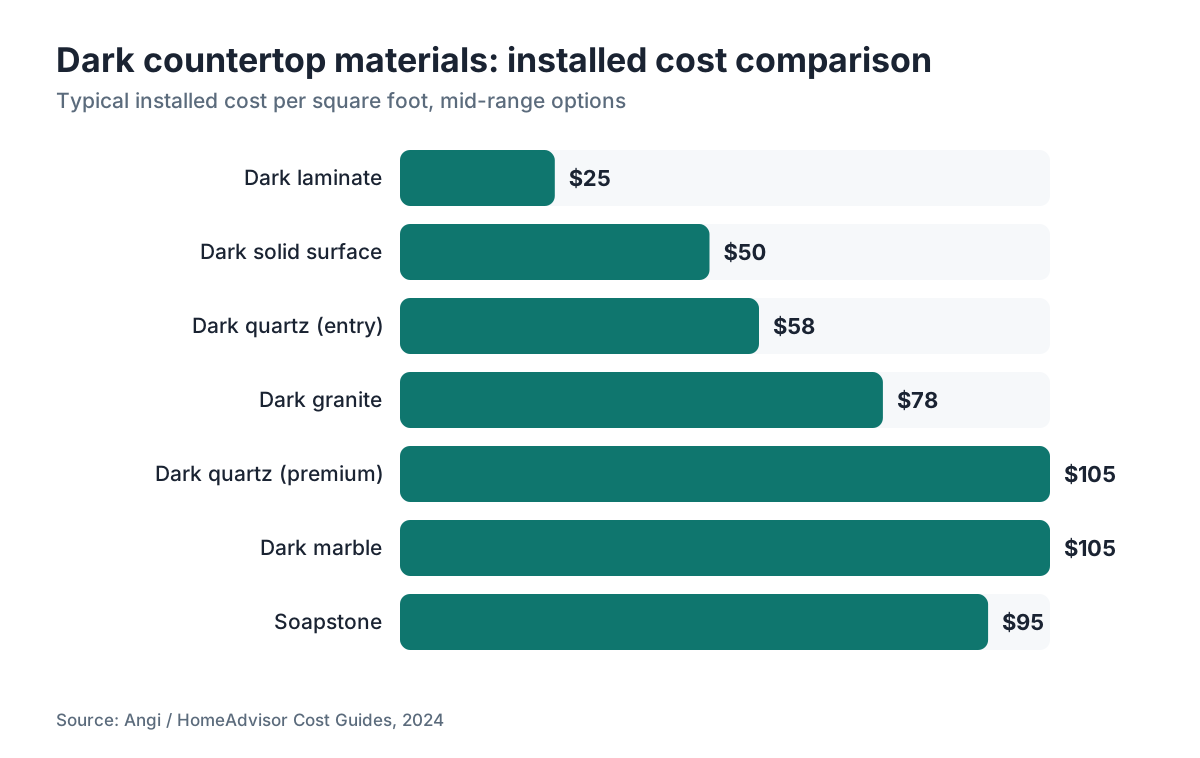
Installed dark quartz runs $50 to $120 per square foot. Most projects land between $65 and $95 once you add fabrication, edges, and standard cutouts for a sink and cooktop [2].
A few things push you toward the top of that range. A 3 cm slab costs more than 2 cm. Waterfall edges, mitered edges, and ogee profiles add labor. And the photorealistic designs that mimic Nero Marquina marble or veined charcoal quartzite carry a premium, because the printing and pressing behind them is more involved.
Here's a rough breakdown by tier:
| Tier | Material cost (per sq ft) | Installed total (per sq ft) | Example colors |
|---|---|---|---|
| Entry / builder grade | $25, $40 | $50, $65 | Solid charcoal, black shimmer |
| Mid-range | $40, $65 | $70, $90 | Veined graphite, dark concrete look |
| Premium / designer | $65, $100+ | $90, $120+ | Veined black, deep navy, espresso marble-look |
A typical 40-square-foot kitchen lands around $2,000 to $4,800 installed, depending on tier. Add an island and push to 70 square feet, and you're looking at $3,500 to $8,400. These ranges come from HomeAdvisor and RSMeans data, so treat them as honest ballparks. Regional labor rates swing hard, and a metro fabricator will quote more than a rural shop [2][3].
For how quartz sits against every other surface, see the kitchen countertops guide.
What dark quartz colors and styles are most popular?
The most requested dark quartz colors fall into five families. Which one fits comes down to your cabinets and your light, more than anything else.
Solid blacks and near-blacks. Absolute black, jet black, midnight. Dramatic, and heavy in a small room. Silestone's Negro Stellar and the dark base under MSI's Calacatta Noir both live here.
Charcoal and dark gray. The sweet spot for most homeowners. Dramatic without being stark. Cambria's Blackbrook, Cotswald, and Swanbridge all sit in the charcoal-to-deep-gray range with a little movement [4].
Veined dark quartz that mimics marble. Nero Marquina lookalikes, dark slabs with white or gold veining. This is the fastest-growing segment because you get the look of rare Italian marble without the porosity or the price. Calacatta Nuvo and MSI's Calacatta Vicenza pull it off.
Deep blues and navies. Less common, genuinely striking. Silestone's Blue Notte and a handful of MSI options push into this territory. They look great with brass or unlacquered hardware.
Espresso and brown-blacks. These carry a concrete or aged-wood undertone. Warmer than a pure black, and right at home in transitional or rustic-modern kitchens.
One warning worth repeating. Dark countertops on dark lower cabinets with little natural light turns a room into a cave. If you want all dark, put the countertop on white or light upper cabinets, or make the backsplash bounce light around.
Do dark quartz countertops show fingerprints and dust?
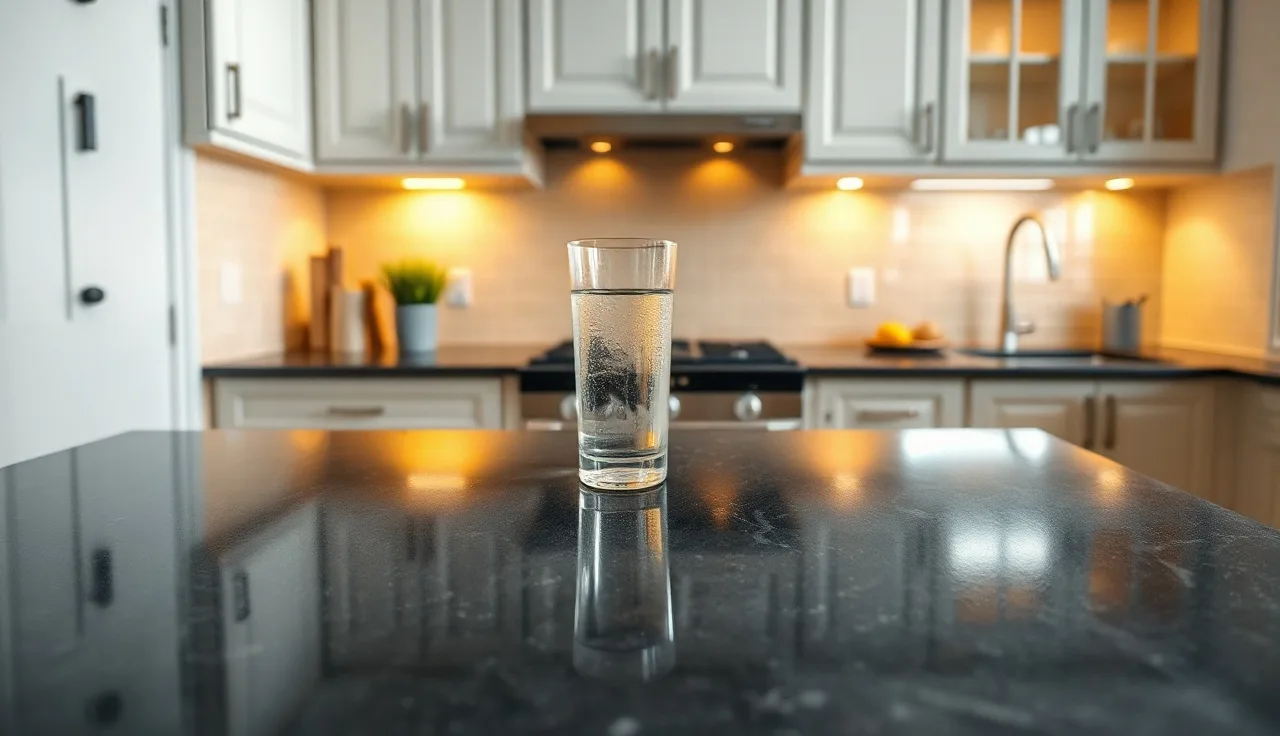
Yes, and this is the number one complaint. Dark surfaces show fingerprints, water spots, and fine dust more than white or light gray quartz. The reason is contrast. A greasy fingerprint on black creates a light-against-dark smudge you'd never notice on a white top.
Finish changes the math. Matte and honed dark quartz holds oils in the texture, so smears cling, but there's no reflection amplifying every mark. Polished dark quartz looks flawless when clean and shows every drop the second it's not. Pick your poison.
The fix is boring and it works: wipe the surface with a microfiber cloth after you use it. That's it. Quartz needs no special cleaner. Dish soap and water does the job. For hard-water spots, a little diluted white vinegar or a quartz cleaner like Granite Gold clears them without touching the resin [5].
If fingerprints would genuinely nag at you, drop a half-shade to a dark gray instead of a true black. You keep most of the drama and lose a lot of the visible upkeep. The how to clean stone countertops guide breaks down safe products by surface.
How does dark quartz compare to dark granite?
From across the room, a solid dark quartz and a dark granite like Absolute Black, Black Galaxy, or Black Pearl look nearly identical. Up close and in daily use, the differences are real.
Granite is natural stone, so it's porous and needs sealing every one to three years depending on the stone and how hard you use it [6]. Skip it and dark granite drinks up oils and liquids, leaving stains you can't easily reverse. Quartz's resin binder erases that worry.
Granite wins on heat. Set a hot pan straight on it, no damage. Quartz makers including Silestone and Cambria warn against direct contact with hot cookware because the resin can discolor or crack from thermal shock [7]. If you cook hot and drop pans without reaching for a trivet, that matters.
Granite also carries more natural variation, which cuts both ways. Engineered dark quartz can be made dead consistent in color and pattern, an advantage when you need two matching slabs for an island and perimeter.
On price they overlap heavily. A premium dark granite and a premium dark quartz usually land within $10 to $20 per square foot of each other installed. Entry-level dark granite can actually undercut entry-level quartz.
For granite on its own, see granite countertops.
How does dark quartz compare to dark marble or quartzite?
Dark marble like Nero Marquina or Portoro is beautiful and high-maintenance. Marble is calcium carbonate, so it etches the instant it meets acid. Lemon juice, wine, vinegar, tomato sauce, any of them leaves a dull mark on polished marble within seconds. On a dark slab, that etch shows up as a lighter matte spot that's very visible and very hard to fix without professional polishing [8].
Dark quartzite is harder and less prone to etching than marble, but it's still natural stone, still porous, and still needs sealing. The market confuses quartzite and quartz constantly, and the how to clean quartzite countertops guide covers what real quartzite actually asks of you.
For a homeowner who loves the dark veined look but doesn't want to babysit natural stone, a dark quartz with marble-look veining is the honest call. You keep 85 to 90% of the visual punch and lose all the etching risk.
Fabricators, take note: dark marble and quartzite raise the stakes at templating and install. Any chip on a dark edge shows instantly, and matching a rare slab for a repair is often impossible. Dark quartz is more consistent and more forgiving to work.
What are the best dark quartz brands?
A handful of brands consistently deliver on color depth, edge quality, and slab-to-slab consistency in the dark range.
Cambria is American-made and controls its whole production process. Its dark collections (Blackbrook, Swanbridge, Ironsbridge) are designer favorites for clean, consistent patterns. Cambria's lifetime warranty is among the strongest anyone offers [4].
Silestone by Cosentino has one of the widest dark libraries, from solid blacks to deep concrete looks to textured matte finishes. The Loft series holds some genuinely interesting dark textures. Silestone also runs a hybrid mineral technology it calls HybriQ, which swaps some petroleum-based resin for recycled glass and other minerals.
MSI Q Premium Quartz is everywhere, through home centers and independent dealers. It's strong value in entry and mid-range dark colors. The slabs aren't as consistent as Cambria or Silestone at the top end, but for builder-grade projects or budget-driven kitchens, MSI earns a look.
Caesarstone built its name on white quartz and has since pushed into darker palettes. Turbine Grey and Piatra Grey are popular, widely available, and backed by a long track record.
Vicostone and Pental Quartz are worth knowing if you're a fabricator. They price dark colors aggressively and often reach shops through trade distributors.
For more on what Cambria offers, see the cambria countertops guide.
Is dark quartz a good choice for kitchens and bathrooms?
In a kitchen, dark quartz works when you have enough light to balance the weight. Good natural light, white or light cabinets, or a reflective backsplash lets a very dark countertop breathe. Put charcoal quartz in a north-facing galley with no window over the sink and the room shrinks.
Here's the upside people forget. Dark quartz is genuinely practical for cooking. It hides coffee rings and red-sauce splatter far better than white quartz. The maintenance gripe is really about streaks and fingerprints you notice when the surface is clean, not about dinner messes.
In bathrooms, dark quartz reads luxurious, especially on a vanity with vessel sinks, a wall-mount faucet, and light tile. Bathrooms see constant toothpaste and water, so the fingerprint issue applies here too, maybe more. A matte or honed dark quartz vanity looks sophisticated and wipes down easier than you'd guess.
Skip quartz outdoors. UV exposure yellows and degrades the resin over time, and on a dark surface that reads as patchy, faded blotches. Natural stone handles the weather better.
Fabricators: dark vanity tops with undermount sinks are among the trickier jobs. The material shows any chip or inconsistency at the cutout instantly. Polished edges on dark quartz reveal tool marks a lighter material would hide. Slow, careful wheel work on the final polish pass pays off most on dark jobs.
What do fabricators need to know about cutting and finishing dark quartz?
Dark quartz is unforgiving. Scratches, swirl marks, or uneven polish catch the light in a way that's obvious in seconds, especially under undercabinet lighting. The gap between a well-polished edge and a slightly under-polished one is stark on black.
Four things matter more on dark material than light.
First, wheel sequence. Don't skip grits. Jumping from 400 to 800 and skipping 600 might vanish on a white slab, but on black it leaves a haze. Full grit progression, clean buff pad at the end.
Second, coolant. Grind dark quartz dry even for a moment and you scorch the resin, which leaves a permanent mark. Keep coolant flowing.
Third, edge profiles. A flat polish on a dark eased edge reads clean and professional. Over-complicated profiles on very dark quartz look busy and expose any inconsistency in hand polishing.
Fourth, layout and nesting. The consistent dark background often lets you match veining slab to slab, but any mismatch at a seam is visible. Digital templating and nesting software, the kind built into tools like SlabWise, cuts waste and lets you place seams before you cut. On dark material, getting seams right is doubly important.
For install specifics, see countertop installation.
How do you maintain dark quartz countertops over the long term?
Maintenance is simple. Quartz never needs sealing. The resin binder is non-porous, so stains have no path in the way they do with granite or marble.
Day to day, wipe spills soon and clean with dish soap and warm water on a soft cloth or microfiber towel. That covers 99% of messes. For dried-on food, lay a damp cloth over the spot for a few minutes to soften it, then wipe. Skip abrasive scrub pads. They scratch the polish, and those scratches show on dark quartz.
Hard-water buildup is especially visible on dark polished surfaces. A diluted white vinegar solution (about one part vinegar to three parts water) or a commercial quartz cleaner clears it. Don't let vinegar sit; a quick wipe and rinse is fine.
Avoid full-strength bleach, oven cleaner, paint remover, and highly alkaline cleaners. Over time they break down the resin or strip the polish. The Natural Stone Institute's care guidance, written for natural stone, lines up closely with quartz-maker advice on what to keep away [1][5].
Direct heat is the other real risk. Use trivets. Quartz resin can discolor or crack under a hot cast iron pan, and on a dark surface that discoloration often reads as a lighter patch. Cambria's published care instructions specifically call for trivets or hot pads [7].
Are dark quartz countertops good for resale value?
The data here is thin, and I'd rather say so than pretend otherwise. Real estate ROI studies lump all stone countertops together instead of splitting by color. The National Association of Realtors' 2023 Remodeling Impact Report found that hardwood floors, kitchen upgrades, and bathroom renovations all return measurable value, but it never broke countertops out by color [9].
What agents and appraisers say off the record: a dark countertop is a strong neutral when the rest of the kitchen is light and balanced. An all-dark kitchen can split buyers. The risk is less the countertop color and more whether the whole kitchen feels dated or heavy.
Quartz in general, dark or light, appeals to buyers because of the no-sealing story. Selling in a few years? Quartz is a safer bet than marble or an unsealed natural stone that shows wear.
If resale drives the decision, a dark charcoal with subtle movement beats an absolute jet black. It reads premium without being so bold that a buyer with different taste feels they have to tear it out.
For how quartz stacks up against other resale-friendly surfaces, the kitchen countertops overview has more.
How does dark quartz compare to other dark surfaces like soapstone or laminate?
Soapstone is a natural dark stone with a devoted following. It runs gray to near-black, stays non-porous without sealing, and builds a patina over years. It also scratches easily, which some people love (scratches sand out and oil away) and others can't stand. For soapstone care and character, see the how to clean soapstone countertops guide.
Dark laminate has come a long way in a decade. Good dark laminate from Formica or Wilsonart mimics stone convincingly at roughly $15 to $35 per square foot installed [10]. It lacks the depth and reflectivity of polished dark quartz, and clean edge finishing is harder, but for a tight budget or a rental it's worth a real look. The laminate countertops and formica countertops guides go further.
Dark solid surface like Corian sits between laminate and quartz on price and has a matte, non-reflective look that suits some modern kitchens. It sands and repairs. The corian countertops guide covers it in depth.
| Material | Installed cost (per sq ft) | Heat resistance | Stain resistance | Needs sealing |
|---|---|---|---|---|
| Dark quartz | $50, $120 | Low (trivet required) | High | No |
| Dark granite | $45, $110 | High | Medium (sealed) | Yes, every 1 to 3 yrs |
| Dark marble | $60, $150 | High | Low | Yes, frequently |
| Soapstone | $70, $120 | High | High | No |
| Dark laminate | $15, $35 | Low | Medium | No |
| Dark solid surface | $35, $65 | Low | Medium-high | No |
Frequently asked questions
Do dark quartz countertops fade over time?
Indoors, dark quartz holds its color. The pigments lock into the resin during manufacturing and don't react to household cleaners or normal indoor UV. Outdoors, or in a sunroom with intense direct sun, the resin can yellow or fade gradually, which is why most quartz makers exclude outdoor use from their warranties. Keep dark quartz inside and it should look the same in 15 years as it did on install day.
Can you see seams in dark quartz countertops?
More easily than in light quartz, yes. On white or light gray, seam adhesive blends right in. On black or charcoal, even a slightly off-color seam stands out. A skilled fabricator using color-matched epoxy and smart seam placement (away from heavy-use zones, kept as short as possible) can make seams barely noticeable, but they'll rarely be truly invisible. Ask to see examples of dark quartz seam work before you hire.
What edge profiles look best on dark quartz?
Clean, simple profiles show the material's depth and polished face best. An eased edge (a softened 90-degree edge) and a pencil round are both popular. Beveled edges look sharp on dark slabs too. Avoid ornate profiles like dupont or ogee on ultra-dark material, since the transitions look fussy and are harder to polish consistently. Waterfall edges on dark quartz are stunning but demand careful seam alignment.
Is a matte or polished finish better for dark quartz?
Both trade off. Polished dark quartz has a deep, reflective look that photographs beautifully and feels luxurious, and it shows water spots and fingerprints clearly. Matte or honed dark quartz looks understated and contemporary and hides some smudges, but it picks up grease differently and can be harder to wipe perfectly clean. Most designers find polished easier to maintain day to day despite the fingerprints, though matte is gaining ground in modern kitchens.
How thick should dark quartz countertops be?
The standard is 3 cm (about 1.25 inches), and it's what most fabricators recommend for kitchens. It looks substantial, needs no buildup strip at the edge, and spans well. Budget projects sometimes use 2 cm slabs with a laminated edge to fake thickness. On dark material, the 3 cm edge looks heavier and more intentional. For bathroom vanities, 2 cm or 3 cm both work fine.
Can dark quartz countertops crack?
They can, but rarely under normal use. Quartz is hard, about 7 on the Mohs scale [1]. Thermal shock (a very hot pan set straight on the surface) is the most common cause of cracking. A concentrated heavy impact, like dropping a cast iron skillet edge-on, can chip the edge. Repairs are possible but seldom invisible on dark material. Handle corners and edges carefully during install, since those are most vulnerable.
What cabinets go best with dark quartz countertops?
Light or medium cabinets give the most balanced result. White shaker cabinets with a charcoal or black quartz top is one of the most timeless combinations in contemporary design. Light oak, natural wood, and greige cabinets all work. Very dark cabinets with dark counters can look sophisticated but need strong lighting and a lighter backsplash or floor to keep the room from feeling cramped. Brass, matte black, and chrome hardware all pair naturally with dark quartz.
How long does dark quartz countertop installation take?
From slab selection to the day you cook on it, typical turnaround is one to three weeks. Templating happens after cabinets are fully installed and takes one to two hours on-site. Fabrication, meaning cutting, edging, and polishing, runs three to seven business days depending on shop workload. Install day itself is usually two to four hours for an average kitchen. Complex kitchens with islands or many cutouts take longer.
Do dark quartz countertops require special supports or substrate?
Standard plywood substrate (3/4-inch minimum) under the cabinets plus proper cabinet leveling are the main requirements. Dark quartz needs no different structural support than any other quartz. Spans over 24 inches without cabinet support underneath (common around dishwashers or on overhangs) may need corbels or steel brackets to prevent flex and cracking. Ask your fabricator about span guidelines; most won't warranty unsupported spans beyond 12 to 18 inches on typical 3 cm material.
Is dark quartz safe around food prep?
Yes. Quartz is non-porous, so bacteria don't penetrate the surface the way they can with porous natural stone. NSF has certified several quartz surfaces for food-contact safety [11]. You still clean properly after raw meat prep, as with any countertop, but quartz doesn't harbor bacteria in pores or cracks the way wood or natural stone can. Don't cut directly on it, though. You'll scratch the surface and dull your knives.
What's the difference between dark quartz and black quartz countertops?
Black quartz means near-solid black slabs with minimal veining or pattern. Dark quartz is the broader category that also covers charcoal, deep gray, navy, and espresso. True black quartz (like Silestone Negro Stellar or the base of MSI Calacatta Noir) reads stark and dramatic. Charcoal and dark gray have more warmth and flexibility. Which one fits depends on the whole room design more than the countertop alone.
How do I get an accurate quote for dark quartz countertops?
You need your kitchen's square footage (length times width of each run), your edge profile, and the number of sink and cooktop cutouts. Material tier (entry, mid, premium) drives most of the price. Get at least three quotes from local fabricators, and ask each to quote the same slab line so you're comparing apples to apples. Online quote tools that use your actual measurements give a faster starting point before you hit a showroom.
Are dark quartz countertops harder to keep clean than light ones?
Cleaning dark quartz takes the same effort as cleaning light quartz. The difference is visibility. Dust, water spots, and fingerprints contrast more against a dark background, so the surface looks dirty faster even when it isn't less sanitary. A quick daily wipe with a microfiber cloth handles most of it. If visual upkeep bugs you, a charcoal or dark gray is more forgiving than a true black.
Sources
- Natural Stone Institute, Technical Bulletins and Standards: Engineered quartz is classified separately from natural stone; quartz rates approximately 7 on the Mohs hardness scale.
- HomeAdvisor (Angi), Countertop Installation Cost Guide: Installed quartz countertops typically cost $50, $120 per square foot depending on brand and complexity.
- RSMeans Building Construction Cost Data, Gordian: Regional labor and material cost data for stone countertop fabrication and installation.
- Cambria, Product Warranty and Collections Overview: Cambria offers a lifetime warranty on its quartz surfaces; Blackbrook and Swanbridge are among its dark-toned collections.
- Granite Gold, Quartz and Natural Stone Care Guidance: Quartz-safe cleaners and guidance on removing hard water spots from dark quartz surfaces without damaging the resin.
- Penn State Extension, Stone Countertop Selection and Care: Granite countertops require sealing every one to three years depending on porosity and usage.
- Cambria, Care and Maintenance Instructions: Cambria recommends trivets or hot pads to prevent thermal shock damage to quartz resin.
- Natural Stone Institute, Marble Care and Maintenance Bulletin: Marble is calcium carbonate and etches on contact with acidic substances; etching on dark marble appears as a visible lighter matte patch.
- National Association of Realtors, 2023 Remodeling Impact Report: Kitchen renovations generate measurable resale returns; the report covers aggregate kitchen upgrades rather than countertop color specifically.
- HomeAdvisor (Angi), Laminate Countertop Cost Guide: Dark laminate countertops install for roughly $15, $35 per square foot depending on brand and edge treatment.
- NSF International, Certified Product Listings: Several engineered quartz surfaces have received NSF certification for food-contact safety due to their non-porous composition.
Last updated 2026-07-09