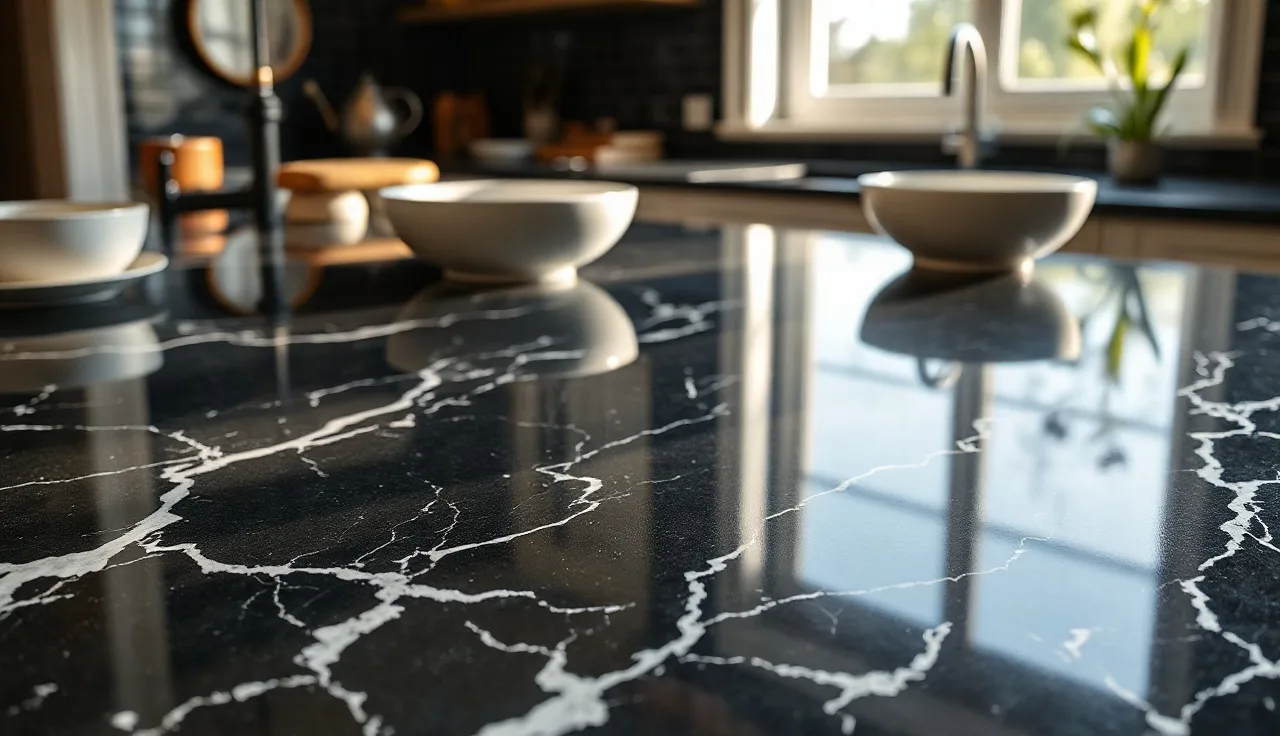
TL;DR
- Dark marble countertops run $60 to $200 per square foot installed, depending on stone origin and fabrication complexity.
- They look stunning but etch and stain more visibly than light marble on polished finishes.
- Honed or leathered surfaces hide damage better.
- If you want genuine marble drama without daily anxiety, a honed Nero Marquina is the most practical starting point.
What counts as a dark marble countertop?
Marble is a metamorphic rock, meaning limestone recrystallized under heat and pressure. The darkness comes from carbon, graphite, or other mineral inclusions absorbed during that process. A stone has to be true calcite-based marble to carry the name properly, which matters because calcite reacts with acids and etches. Some stones sold as "dark marble" are actually quartzite or dolomite, which are harder and more acid-resistant. Worth confirming before you buy.
The most common dark marbles you'll find in fabrication yards:
| Stone Name | Primary Color | Origin | Hardness (Mohs approx.) | Notes |
|---|---|---|---|---|
| Nero Marquina | Jet black with white veins | Spain (Basque Country) | 3 to 4 | True calcite marble; etches readily |
| Portoro | Black with gold/white veins | Italy (La Spezia) | 3 to 4 | True calcite marble; very high price |
| Black Fossil | Dark grey-black with fossil patterns | Morocco | 3 to 4 | True calcite marble |
| Grigio Carnico | Deep grey with white veins | Italy | 3 to 4 | True calcite marble |
| Absolute Black (Granito) | Pure black | India/South Africa | 6 to 7 | Often mislabeled; actually granite |
| Black Beauty | Dark grey-green | Brazil | 3 to 4 | May be soapstone-adjacent; verify |
Always ask the yard for the geological spec sheet or a scratch test. Granite is much harder (Mohs 6 to 7) and won't etch from lemon juice; marble will [1]. If you're comparing true dark marble to dark granite countertops or other alternatives, that acid sensitivity is the single biggest functional difference.
How much do dark marble countertops cost?
Material and installation together run $60 to $200 per square foot for most dark marble projects in the U.S., though Portoro and certain Italian blacks push above $250/sq ft [2]. That range is wide because it covers everything from imported slabs through a big-box distributor to book-matched Nero Marquina installed by a specialty shop.
Here's roughly where the money goes on a typical kitchen countertop job:
- Slab material: $30, $120/sq ft (at the yard, before fabrication)
- Fabrication (cutting, edge profiling, polishing): $20, $50/sq ft
- Installation: $10, $30/sq ft
- Sealer (first application): $1, $3/sq ft
- Cutouts for sinks and cooktops: $100, $300 per opening
A 45-square-foot kitchen, which is close to the U.S. average new kitchen countertop area, will cost roughly $2,700 to $9,000 installed for mid-grade dark marble. Portoro or fully book-matched installs on the same footprint can reach $15,000.
Dark coloring does not automatically mean cheap or premium. Nero Marquina is widely imported and reasonably available, so pricing is competitive. Portoro is rare, quarried in limited volumes, and expensive because of it, more than because it's dark [3].
Fabrication shops price dark marble the same as any natural stone by the square foot plus upcharges for edge complexity, number of cutouts, and whether the job needs book-matching. If you're a fabricator building quotes, tools like SlabWise let you nest dark slabs digitally and catch material cost before anything gets cut.
For a broader sense of what kitchen countertops cost across all material types, the price spread is significant: laminate starts around $10/sq ft installed while engineered quartz runs $70, $150/sq ft, putting dark marble squarely in the premium tier.
Do dark marble countertops etch and stain more than light marble?
Yes and no. The etching risk is identical regardless of marble color. Etching is a chemical reaction between calcite and acid (vinegar, citrus, wine, coffee), not a staining event. It leaves a dull or matte patch where the acid touched the surface. On a polished white Carrara, that etch shows up as a faint grey smudge. On polished Nero Marquina, the same etch shows as a lighter, slightly hazy patch against the dark background. Both are visible. Which one bothers you more depends on your eye.
Actual staining, where a pigment or oil penetrates the stone's pores, is arguably less visible on dark marble than on white marble. A drop of olive oil on white Carrara creates a dark spot immediately. That same oil on black marble? You might not notice it at all once it dries. The stone's porosity determines staining risk, and porosity varies by specimen, not by color [4].
So here's the practical upshot. A polished dark marble surface shows etching as light patches, which can be jarring. A honed (matte) dark marble surface hides etching dramatically better because the surface already looks uniformly matte. Most fabricators recommend honed or leathered finishes specifically for dark marble in kitchens. It's one of the more honest pieces of advice you'll get.
Nero Marquina in particular has a reputation for showing white calcium deposits from hard water near sinks. That's not etching, it's mineral buildup, and it wipes off with a damp cloth. Still, worth knowing before you commit.
For cleaning protocols that actually work on natural stone, see how to clean stone countertops for a material-by-material breakdown.
What finish works best for dark marble: polished, honed, or leathered?
Polished finish means the surface is buffed to a high reflective gloss. On dark marble, polished is dramatic. The blacks go deeper, the veins pop, and the counter reads as a luxury material. The tradeoff is that every etch, fingerprint, and water spot is visible. In a busy kitchen, keeping that look takes real effort.
Honed finish is matte or satin. It mutes the drama slightly but hides etching almost entirely. Hard water spots still show but are easy to address. Most designers and fabricators recommend honed for dark marble in kitchens used daily. It's not a compromise. Honed Nero Marquina still looks expensive.
Leathered finish is a newer technique where diamond brushes texture the surface to a soft, grainy feel. It keeps more of the stone's natural color depth than honed, hides fingerprints best of the three, and has a tactile quality polished stone lacks. It costs $5, $15/sq ft more than polished because of the extra fabrication time. For dark marble specifically, leathered is the most practical kitchen choice if the budget allows.
Some fabricators also offer brushed or antique finishes, which are variations on the leathered concept. Those are less standardized in terminology, so ask to see samples.
For a bathroom vanity or fireplace surround that doesn't see food acid, polished dark marble makes sense. For a kitchen island that gets daily use, go honed or leathered. That's the honest recommendation.
How do you seal and maintain dark marble countertops?
Marble needs a penetrating sealer, not a topical coating. Penetrating sealers (also called impregnating sealers) soak into the stone's pores and slow liquid absorption without changing the surface appearance. They do not make marble acid-proof. They buy you time, maybe 10 to 30 minutes instead of 10 seconds, before a spill causes a stain [5].
For dark marble, sealer choice matters visually. Some sealers slightly lighten the stone's appearance when dry; others enhance the color. Test on an inconspicuous scrap or edge before applying to the full surface. The Marble Institute of America's care guidance recommends a water absorption test: drop water on the stone and time how long it takes to darken. If it darkens in under 4 minutes, seal it. If it takes 30 minutes or longer, sealing may not be necessary [6].
Sealing schedule for most dark marble countertops:
- First application: done by the fabricator at installation
- Kitchen: reseal every 1 to 3 years depending on use and sealer type
- Bathroom: reseal every 3 to 5 years
Day-to-day cleaning should use a pH-neutral stone cleaner or plain warm water with a soft cloth. Avoid bleach, vinegar, lemon juice, and most all-purpose household cleaners. Those are all acidic or alkaline enough to etch or degrade the sealer. The same rules apply to dark soapstone, though soapstone's mineralogy differs, and how to clean soapstone countertops covers that material's specific quirks.
For etched patches that appear despite careful use: a marble polishing powder (tin oxide or aluminum oxide based) can restore polish on small areas. For honed surfaces, the fix is easier, since a light re-honing or even a polishing pad on a drill can blend most shallow etches. Deep etches need professional re-polishing.
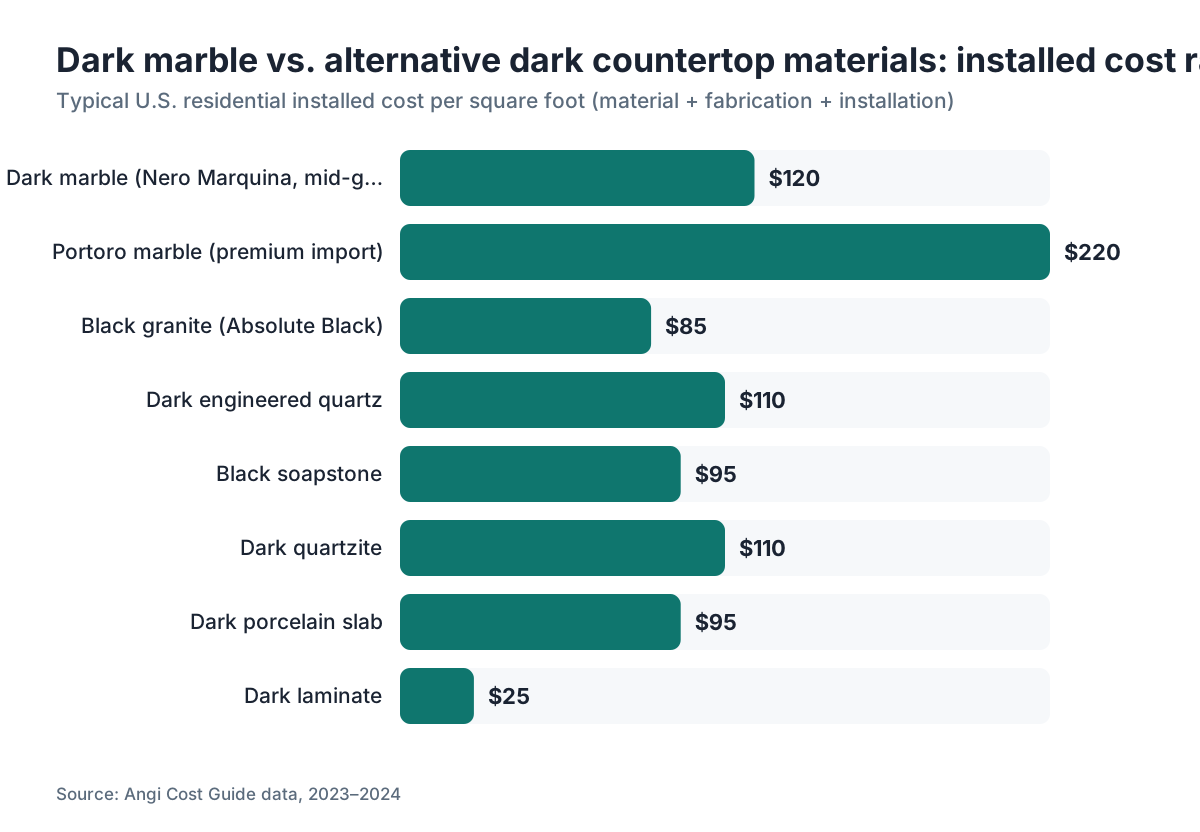
How does dark marble compare to other dark countertop materials?
Dark stone options are not interchangeable. The table below covers the most common dark material choices homeowners compare:
| Material | Acid resistance | Heat resistance | Cost installed ($/sq ft) | Maintenance | Best use |
|---|---|---|---|---|---|
| Dark marble (Nero Marquina) | Poor (etches) | Good | $80, $160 | Seal, pH-neutral cleaners | Baths, low-use kitchens |
| Black granite | Excellent | Excellent | $50, $120 | Minimal | Any kitchen |
| Dark quartzite | Good, Excellent (varies) | Excellent | $70, $150 | Seal, pH-neutral | Any kitchen |
| Black soapstone | Excellent | Excellent | $70, $120 | Oil periodically | Any kitchen |
| Black engineered quartz | Excellent | Poor (avoid heat) | $70, $150 | Easy | Any kitchen |
| Dark honed porcelain | Excellent | Excellent | $60, $130 | Easy | Any kitchen |
| Dark Cambria quartz | Excellent | Poor (avoid heat) | $80, $160 | Easy | Any kitchen |
Black granite is the most durable dark option and costs less to maintain. If your kitchen goal is a dark, dramatic surface you don't think about, black granite or dark quartzite gets you there without marble's acid sensitivity [7].
Dark engineered quartz (including Cambria countertops) is the low-maintenance pick. It won't etch, needs no sealing, and carries manufacturer warranties. The tradeoff is that it doesn't look or feel like natural stone up close, and it can't take hot pans directly.
Marble's appeal is hard to replace for people who want it. The veining is organic and impossible to fully copy. But go in with clear eyes about the maintenance.
For completeness, laminate countertops and Formica countertops also come in dark patterns at a fraction of the cost, and modern laminate is hard to tell from stone in photos, if not in person.
What kitchen and design styles work with dark marble countertops?
Dark marble countertops are not universal. They work hardest in kitchens with enough ambient light to keep the space from feeling like a cave. That's the design constraint most homeowners underestimate.
Design contexts where dark marble genuinely sings:
White or light cabinetry with dark marble is the classic pairing. The contrast is sharp. White Shaker cabinets with Nero Marquina counters is a perennial design choice for a reason: the white veining in the marble ties the cabinet and counter colors together.
Dark on dark, meaning dark cabinetry with dark marble, needs either a very light space overall (large windows, white walls, pale floors) or a deliberate moody design intent. Designers who work in this register know how to make it feel intentional rather than oppressive. Without the light sources to balance it, it can feel heavy.
Bathroom vanities and powder rooms are arguably the best residential use case for dark marble. Low acid exposure, lower traffic, and you only need a small slab, so even Portoro is budget-feasible. The drama-to-square-footage ratio is excellent.
Fireplace surrounds and hearths are another strong application. No acid, heat is handled well by natural stone, and the visual impact is high.
Open-concept kitchens where the island is the focal point work well with dark marble on the island and a lighter or more durable material on the perimeter counters. You get the look without the daily stress of keeping every surface perfect.
What should you ask a fabricator before ordering dark marble?
The questions that actually matter, in order of importance:
-
Can I see the actual slab I'm buying? Dark marble varies slab to slab, especially Nero Marquina, where some slabs run heavy white veining and others are almost pure black. Pick your specific slab at the yard. Don't pick a sample tile and hope for the best.
-
What's the geological confirmation this is marble and not granite or quartzite? Ask for the spec sheet or the country/quarry of origin. The difference matters for how you use and maintain it.
-
What finish do you recommend for my use case? A fabricator who immediately pushes polished without asking how you use your kitchen is not giving you their honest opinion.
-
What sealer do you apply at installation, and what do you recommend for resealing? Get the product name. Look it up. Apply it yourself on the right schedule.
-
How do you handle the waste on this slab? Dark marble slabs, especially book-matched pairs, need careful layout planning to cut waste and hold the veining continuous. If the fabricator can't walk you through their nesting plan, that's a concern. Digital nesting tools let fabricators show you exactly how the slab gets used before cutting starts.
-
What's your experience with this specific stone? Nero Marquina is common; Portoro is not. Fabricators who've worked Portoro before know where it tends to fracture along the gold veining lines. That experience matters.
For countertop installation specifics that apply regardless of stone choice, countertop installation covers what to expect on the day of install.
Are dark marble countertops a good investment for resale value?
Real estate agents and appraisers treat stone countertops as a positive for resale, but the data on stone-specific premiums is thin. The National Association of Realtors' "2022 Remodeling Impact Report" found that kitchen upgrades, broadly, recoup about 67 cents on the dollar at resale [8]. That's aggregate data across all materials. There's no reliable published study isolating dark marble specifically.
What practitioners generally observe: high-end buyers respond well to natural stone, and dark marble reads as a premium material to most buyers. The risk at resale is taste polarization. Some buyers see dramatic dark counters as a selling point; others see them as a maintenance concern or a design element they'd want to change. Neutral materials tend to perform more consistently across buyer pools.
If the choice is between dark marble and a mid-grade engineered quartz, the marble may read higher-end to buyers who value natural stone. If the choice is between dark marble and white marble, most resale data would favor the white marble simply because it has broader appeal.
Installing marble for resale is a gamble. Installing marble because you want it and you'll enjoy it for years is a reasonable personal choice. The honest advice: don't pick dark marble as a resale strategy. Pick it because you want to live with it.
For fabricators, knowing what homeowners in your market actually value in a countertop material helps you quote and advise more accurately. Accurate material-level pricing by stone type is something SlabWise tracks in its job costing tools, which helps shops quote dark exotic stones without underpricing complex jobs.
What are the most common problems with dark marble countertops and how do you fix them?
Etching is the most frequent complaint. On polished dark marble, etches appear as lighter, hazy patches. On a polished Nero Marquina, even a splash of sparkling water left to dry can leave a faint ring. Fixing a small etch on a polished surface: use marble polishing compound (available at stone supply houses) and a felt pad. Work in small circles. On large or deep etches, call a stone restoration professional. Aggressive grinding without experience can make it worse.
White calcium deposits near the sink are common, especially in hard water areas. These look like dried white rings or a general milky haze. This is not etching; it's mineral deposits sitting on the surface. A damp cloth and a neutral stone cleaner handle most of it. For stubborn buildup, a small amount of mineral deposit remover rated safe for natural stone works. Don't reach for the white vinegar, that will etch the marble while it removes the deposit.
Chipping at edges is more common with dark marble than many homeowners expect because the dark color highlights chips dramatically against the surrounding field. Thin, honed slabs are more vulnerable at the edges. Eased or beveled edges chip less than sharp 90-degree edges. If a chip occurs, a stone epoxy color-matched to the marble can be worked in by a fabricator and ground flush. Invisible? No. But serviceable.
Bowing or flexing during installation is a risk with thin dark marble slabs (under 3/4 inch). The solution is adequate substrate support and a fabricator experienced with marble, who knows to mesh-back thin slabs and support spans properly.
Dark residue or streaking in the veining after sealing sometimes happens when a sealer is applied too heavily or not fully wiped off. Strip it with a sealer remover and reapply with lighter coats.
For a related natural stone with different maintenance quirks, how to clean quartzite countertops explains why quartzite, despite looking similar, behaves differently chemically.
Is dark marble safe to use around food?
The FDA's food contact surface standards apply to commercial food service, not residential countertops, but the underlying logic is useful. Natural stone used as a food prep surface should be nonporous enough that bacteria can't colonize the subsurface, and it should be cleanable with food-safe cleaners [9].
Unsealed marble is moderately porous, around 0.5%, 2.0% absorption by weight depending on the specimen [1]. A properly sealed dark marble countertop is safe for food prep. Raw meat should go on a cutting board regardless of surface material, both for food safety and to protect the stone from scoring. The sealer itself, once fully cured, is inert for food contact purposes.
One practical concern: marble's soft surface can be scored by knives, and those micro-cuts can harbor bacteria over time. This is true of wood cutting boards too, and wood has research showing bacteriostatic properties in some species [10]. Marble does not have those properties, but regular cleaning with a neutral soap and water handles surface bacteria on any nonporous or sealed surface.
The honest answer: dark marble is fine for food prep if it's sealed and cleaned properly. It's not the best material for someone who wants to cut directly on the counter, but that's a surface-damage concern more than a food safety concern.
How does slab thickness affect dark marble countertop cost and performance?
Most residential countertop marble comes in two thicknesses: 2 cm (about 3/4 inch) and 3 cm (about 1 1/8 inch). Some specialty slabs run 4 cm or thicker for waterfall edges and dramatic overhangs.
3 cm is the standard for countertops in most U.S. markets, and for good reason. It's stiffer, less prone to cracking during handling and installation, doesn't need a plywood substrate (though support over base cabinets is still best practice), and looks more substantial at the edge. Dark marble at 3 cm, especially with a mitered or waterfall edge, is visually heavy in the best sense.
2 cm slabs cost less per square foot but require a build-up edge or a solid plywood substrate for structural integrity. They show up more in bathrooms and fireplace applications than kitchens. A fabricator working 2 cm dark marble needs to be careful about handling: the mix of thin slab, stone brittleness, and the visual prominence of any chips on dark material makes breakage more costly in both money and appearance.
Waterfall islands, where the countertop material continues vertically to the floor on one or both sides, require exact book-matching if you want the veining to flow continuously. That's more achievable on dark marble than on heavily veined white marble because the dark field is more uniform. It still costs more: expect a 15%, 30% premium for matched waterfall work versus a standard countertop-only installation [3].
Thicker stock costs more at the slab level and takes longer to fabricate, but the structural and visual benefits in a kitchen make 3 cm the default recommendation.
Frequently asked questions
What is the most popular dark marble for countertops?
Nero Marquina is the most widely used dark marble in U.S. countertop fabrication. It's a true calcite marble from Spain with a jet-black field and white veining, available at most stone yards in both polished and honed finishes. Portoro (Italian black with gold veining) is more coveted but significantly rarer and more expensive. Grigio Carnico, a deep grey Italian marble, appears frequently in higher-end bath and kitchen projects.
Do dark marble countertops show fingerprints?
Polished dark marble shows fingerprints prominently, more so than polished light marble because skin oils appear as lighter smudges against the dark field. Honed and leathered finishes reduce fingerprint visibility substantially. If you want polished dark marble in a kitchen or on an island, plan to wipe it regularly with a dry microfiber cloth. For a vanity or low-touch surface, fingerprints are a minor concern.
Can dark marble countertops be repaired if they chip or etch?
Yes. Small etches on polished surfaces can be buffed out with marble polishing compound and a felt pad; deep etches need professional re-polishing. Chips at edges are repaired with color-matched stone epoxy by a fabricator, then ground flush. The repair won't be invisible on close inspection, especially on a dark stone where the chip leaves a lighter-colored mark, but it's usually inconspicuous from normal viewing distance.
How often does dark marble need to be sealed?
In a kitchen, reseal every one to three years depending on use intensity and the sealer product. In a bathroom, every three to five years is typical. Do the water absorption test to check: drop water on the surface and time how long it takes to darken the stone. If it darkens in under four minutes, it's time to reseal. The Marble Institute of America uses this test as the standard benchmark for reseal timing.
Is dark marble more expensive than light marble?
Color alone doesn't set the price. Rarity, quarry origin, and slab quality do. Nero Marquina is available and competitively priced, often in the same range as mid-grade Carrara. Portoro is rarer and commands a premium regardless of comparisons to white marble. Some dark marbles from Morocco or Turkey run cheaper than comparable Italian whites. Ask for pricing by the specific stone, not by color category.
What backsplash works with dark marble countertops?
The most reliable pairings: white subway tile (creates contrast and visual breathing room), a matching dark marble slab backsplash (dramatic and cohesive, especially on a feature wall), or a neutral stone mosaic that picks up the veining color. Avoid busy patterns that compete with the marble's natural veining. The countertop already carries visual complexity; the backsplash usually works better if it's quieter.
Can you put hot pans directly on dark marble countertops?
Technically marble is heat-resistant enough to handle brief contact without cracking, but it's not recommended as a habit. Thermal shock from very hot pans set directly on a cold sealed surface can cause stress fractures over time, especially near edges and cutouts. Use trivets. This is the same advice that applies to engineered quartz, which is far more heat-sensitive than marble, and to most natural stone used in kitchen countertop applications.
How do dark marble countertops hold up in a bathroom versus a kitchen?
Bathrooms are the ideal environment for dark marble. Acid exposure is minimal (hand soap is mildly alkaline but not damaging, and most bath products won't etch marble), traffic is lower, and the surfaces stay drier overall. A dark marble vanity top in a bathroom takes far less maintenance than the same stone in a kitchen. Many fabricators and designers who would hesitate to recommend dark marble for a kitchen will recommend it freely for bathroom vanities.
What edge profiles work best with dark marble countertops?
Eased and beveled edges hold up better than sharp 90-degree edges because the slight softening at the corner reduces chipping risk. On thick 3 cm dark marble, a straight eased edge looks clean and modern. Ogee and other decorative profiles can look fussy against a bold dark stone; the material itself is already decorative. Waterfall edges and mitered edges are popular on dark marble islands and display the stone thickness beautifully but add fabrication cost and time.
Is dark marble harder to fabricate than light marble?
Not significantly in terms of cutting or polishing. The hardness is the same. The main fabrication difference is that dark marble, especially Nero Marquina, shows any fabrication imperfection more clearly: uneven polish reads as color variation, minor scratches from tooling show as lighter marks, and mismatched veining at seams is more visible against a dark background. Experienced fabricators plan seam placement carefully on dark slabs, ideally at a natural break in the veining pattern.
How do you tell real dark marble from a look-alike like quartzite or granite?
The acid test is definitive. Put a few drops of a 10% hydrochloric acid solution (muriatic acid diluted) on an inconspicuous spot: calcite marble will fizz immediately. Granite and quartzite won't react. For a non-destructive test, scratch a hidden edge with a steel knife: marble scratches easily (Mohs 3 to 4), granite does not (Mohs 6 to 7). Ask the supplier for the quarry documentation; reputable yards can provide country of origin and geological classification.
What are the alternatives to dark marble that look similar but perform better?
Black granite (like Absolute Black or Black Galaxy) gives a similar dark field without etching or staining risk and costs less to maintain. Dark quartzite, if it's genuinely quartzite and not misidentified marble, resists acid far better. Black soapstone has excellent chemical resistance and a soft, dark look. For zero-maintenance, a dark engineered quartz or large-format porcelain gives you the aesthetic without any of the natural stone upkeep.
Does dark marble countertop color fade over time?
Natural marble doesn't fade from UV the way some man-made materials do. The dark color in calcite marble comes from carbon or other stable minerals and won't bleach under normal indoor light exposure. What can change the perceived color over time: buildup of hard water mineral deposits (which lighten the surface), degraded sealer (which can turn slightly opaque), and accumulated micro-etching on polished surfaces. All are restorable with proper cleaning and professional re-polishing if needed.
How thick should a dark marble countertop slab be?
3 cm (about 1 1/8 inch) is the standard for kitchen and bath countertops in U.S. residential fabrication, and it's the right choice for most applications. It's structurally sound without a plywood substrate, holds up better during handling and installation, and looks proportionally correct at the edge. 2 cm slabs are lighter and cheaper but require a build-up edge or continuous substrate support and are more prone to cracking in larger spans.
Sources
- U.S. Geological Survey, Minerals Information: Stone, Dimension: Marble is a calcite-based metamorphic rock with Mohs hardness of approximately 3 to 4, significantly softer than granite (6 to 7), and reacts with acids due to its calcite content.
- HomeAdvisor (Angi), Marble Countertops Cost Guide: Dark marble countertops cost approximately $60, $200 per square foot installed in U.S. residential projects, with premium imported stones exceeding $250/sq ft.
- Marble Institute of America, Natural Stone Resource Library: Portoro marble from La Spezia, Italy is quarried in limited volumes and priced as a premium import; waterfall/book-matched installations typically carry a 15 to 30% fabrication premium.
- U.S. Geological Survey, Minerals Information: Stone, Dimension: Natural stone porosity and absorption vary by specimen and quarry rather than by color, which determines staining susceptibility independent of surface tone.
- Marble Institute of America, Care and Cleaning for Natural Stone Surfaces: Penetrating sealers slow liquid absorption but do not make marble acid-proof; they extend the window before a spill causes a stain rather than preventing chemical etching.
- Marble Institute of America, Care and Cleaning for Natural Stone Surfaces: The Marble Institute of America recommends a water absorption test: if the stone darkens in under 4 minutes, it should be sealed; if absorption takes 30 minutes or longer, sealing may not be necessary.
- National Stone, Sand and Gravel Association, Dimension Stone Facts: Granite's Mohs hardness of 6 to 7 gives it excellent acid and scratch resistance compared to marble, making it a more durable kitchen countertop surface for daily use.
- National Association of Realtors, 2022 Remodeling Impact Report: Kitchen upgrades broadly recoup approximately 67 cents on the dollar at resale according to the NAR 2022 Remodeling Impact Report.
- U.S. Food and Drug Administration, Food Code 2022, Section 4-101: FDA Food Code Section 4-101 sets standards for food contact surfaces in commercial settings: surfaces must be nonabsorbent, smooth, and cleanable; these principles inform best practices for residential stone countertop use.
- University of California Davis, Food Science and Technology: Bacteriological Study of Wood Cutting Boards (Cliver, 1993): UC Davis research found that certain wood species show bacteriostatic properties in cutting board applications; marble does not share these properties but is safe for food contact when properly sealed and cleaned.
- ASTM International, Standard C503: Standard Specification for Marble Dimension Stone: ASTM C503 defines minimum requirements for marble dimension stone including absorption by weight (max 0.20% for polished marble) and modulus of rupture, relevant to countertop slab performance.
- National Institute of Standards and Technology, Dimensional Stone Selection and Use: NIST guidance on dimensional stone notes that 3 cm thickness is standard for horizontal countertop applications due to structural rigidity; 2 cm slabs require continuous substrate support.
Last updated 2026-07-09