TL;DR
- Dark granite countertops run about $40 to $200 per square foot installed, depending on how rare the stone is and where your fabricator works.
- Colors go from jet black to deep brown and forest green.
- Dark stone hides crumbs and daily grime better than light stone, but shows water spots and dust more.
- Seal it once a year and it lasts decades.
What counts as a dark granite countertop?
Dark granite is any slab with a background tone of black, deep gray, dark brown, or deep green. Granite is an igneous rock formed from slowly cooled magma, and its color comes down to which minerals win. The dark ones win because they hold high concentrations of hornblende, biotite mica, augite, or dark feldspar. Quartz and potassium feldspar are still in there. They just get buried.
The stone trade has no hard cutoff for "dark." Fabricators and distributors sort slabs into light, medium, and dark by eye. Some dark slabs, like Absolute Black, show almost no variation at all. Others, like Black Galaxy, are jet black with gold or silver flecks that catch light and throw it around the room.
A few stones sold as dark granite aren't granite in the strict sense. Absolute Black from India is often gabbro or diabase, not true granite by the geologic definition [1]. It fabricates and wears exactly like granite, so the trade sells it as granite and nobody blinks. If the mineralogy matters to you (it usually doesn't), ask your fabricator for the country of origin and quarry name and look it up.
For how granite gets graded and sold across the full range, the granite countertops guide covers it.
What are the most popular dark granite colors and names?
A handful of names show up in almost every slab yard in the country. Here's what you'll actually run into, described the way they look in person, not the way a brochure describes them.
Absolute Black (India, South Africa): Nearly uniform black, very fine grain, no visible movement. The cheapest dark granite in most U.S. markets. Slabs from different quarries vary more than you'd think, so inspect in person.
Black Galaxy (India): Black background with tiny copper or silver flecks (they're bronzite and enstatite crystals). It glitters under kitchen lighting in a way that's either stunning or busy, depending on your eye. Popular for a solid decade, still widely stocked.
Ubatuba (Brazil): Very dark green, almost black, with gold, green, and black flecks. A top seller in the U.S. for over thirty years. The name gets applied loosely to similar Brazilian greens, so confirm the quarry if origin matters to you.
Black Pearl (India, Norway): Dark gray to black with a crystalline, almost blue-silver shimmer. Norwegian material runs finer-grained and more consistent than Indian. Both look great leathered.
Tan Brown (India): Not black at all. A very dark brown background packed with rust-brown, black, and gray feldspar crystals. One of the most-specified dark brown granite countertops in American kitchens. Warm, earthy, hides a lot of daily mess.
Baltic Brown (Finland): Same neighborhood as Tan Brown but with a cooler, taupe-brown base and rounder mineral pockets. Pairs well with cream or beige cabinets.
Imperial Coffee (Brazil): Dark chocolate brown with swirling lighter tan movement. More dynamic than Tan Brown. Harder to find in secondary markets, but worth chasing if you want warmth without black.
Blue Pearl (Norway): Dark gray with a strong blue-silver iridescence (labradorescence). Not exactly black, but dark enough to belong here. Usually pricier because Norwegian quarries run strict extraction limits [8].
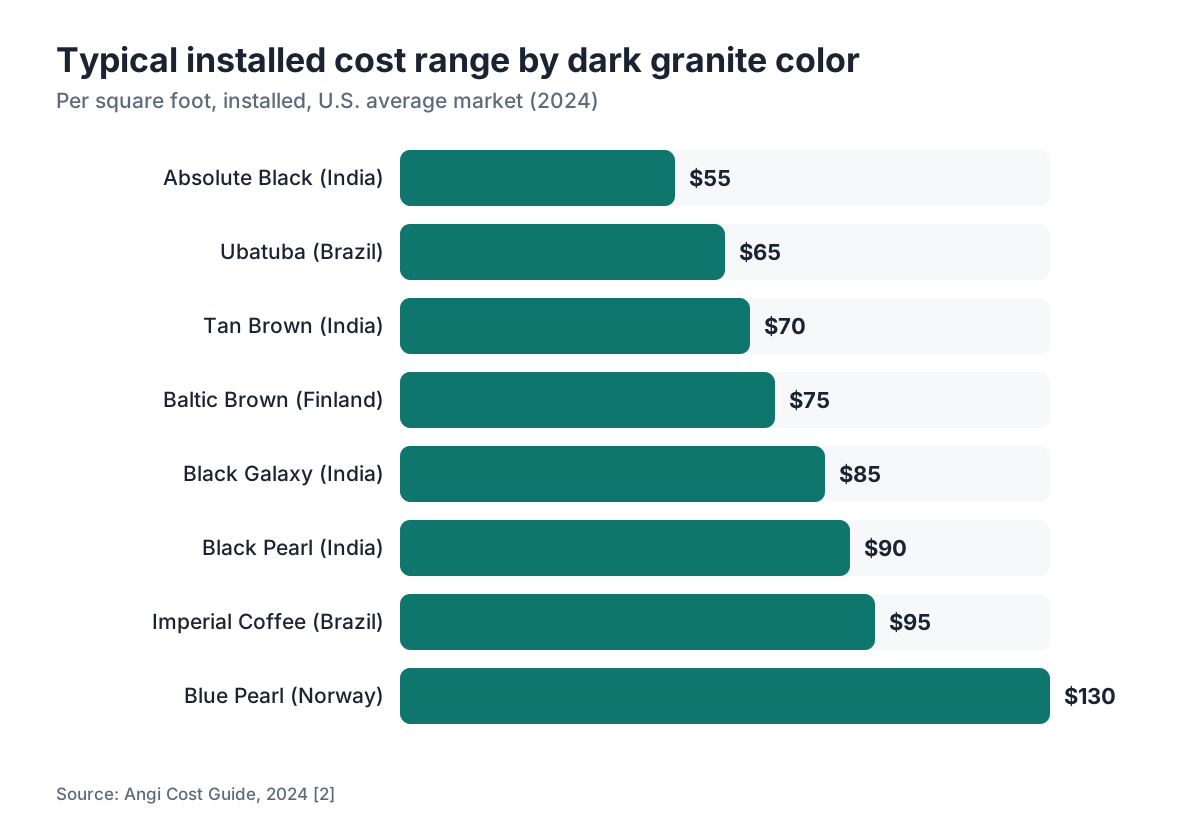
Prices swing by region, current shipping costs, and how much the yard has in stock. Ubatuba and Absolute Black stay cheapest because supply is steady. Blue Pearl and premium Black Galaxy can cost two to three times more.
How much do dark granite countertops cost?
Installed dark granite runs about $40 per square foot on the low end (Absolute Black, simple layout, a local fabricator with good stock) to $200 or more per square foot for rare material, complex edges, and high-cost metro markets [2].
The installed price bundles a few line items: the slab, fabrication (cutting, polishing edges, cutouts for sinks and cooktops), delivery, and install. Material alone might be $15 to $80 per square foot at the slab yard. Fabrication usually adds $30 to $60 per square foot depending on complexity. Edge profiles, undermount sink cutouts, and cooktop holes each add $50 to $200 or more to the job.
Take a typical kitchen with 40 square feet of counter, one undermount sink cutout, and an eased edge. A mid-tier dark granite like Ubatuba or Tan Brown might run $2,400 to $5,600 installed. Treat that as a budget anchor, not a quote. Get at least three written estimates.
Geography moves the number as much as the stone does. A shop in Dallas or Phoenix quotes differently than one in New York or San Francisco, partly because labor costs differ and partly because shipping distance from the quarry ports changes slab prices. A stone that's common in Houston can be a special order in Minneapolis.
Fabricators who run quoting software (tools like SlabWise let them price a job and optimize slab layouts in minutes instead of hours) tend to hand you faster, more itemized quotes. That makes comparison shopping easier on your end.
Dark granite sits in roughly the same price band as marble countertops, but it's harder and less porous, which cuts your long-term maintenance cost.
How does dark granite compare to other countertop materials?
A side-by-side is the fastest way to sort this out.
| Material | Typical installed cost ($/sq ft) | Heat resistance | Scratch resistance | Stain resistance (unsealed) | Maintenance |
|---|---|---|---|---|---|
| Dark granite | $40 to $200 | Excellent | Excellent (Mohs 6 to 7) | Moderate | Seal 1x/year |
| White/light granite | $40 to $200 | Excellent | Excellent | Moderate | Seal 1x/year |
| Marble | $50 to $250 | Good | Moderate (Mohs 3 to 4) | Poor | Seal 2 to 4x/year |
| Quartzite | $60 to $200 | Excellent | Excellent | Moderate | Seal 1 to 2x/year |
| Quartz (engineered) | $60 to $150 | Moderate | Very good | Excellent | None |
| Laminate | $10 to $40 | Poor | Moderate | Good | None |
| Butcher block | $30 to $100 | Poor | Moderate | Poor | Oil regularly |
Dark granite beats most materials on heat and scratch. Drop a hot pan on it and nothing happens. Cut on it without a board and you'll dull your knives long before you scratch the stone. The trade-off is porosity. Granite absorbs oil, wine, and acidic liquids once the sealer wears off. Engineered quartz is non-porous by construction and certified food-safe under NSF/ANSI 51, so it wins stain resistance outright [3].
Want zero maintenance? Look at laminate countertops or Corian countertops. Want the natural look and willing to seal once a year? Dark granite is one of the toughest surfaces you can put in a kitchen.
The kitchen countertops overview walks the whole material decision if you're still weighing it.
Do dark granite countertops show dirt, fingerprints, and water spots?
Dark granite hides crumbs and food mess well and shows water spots badly. That's the honest trade showrooms tend to skip.
Crumbs, food debris, everyday cooking splatter: dark stone forgives all of it far better than white or light gray. If you cook a lot and wipe down less often than you should, dark stone covers for you. That's a real benefit for a busy household.
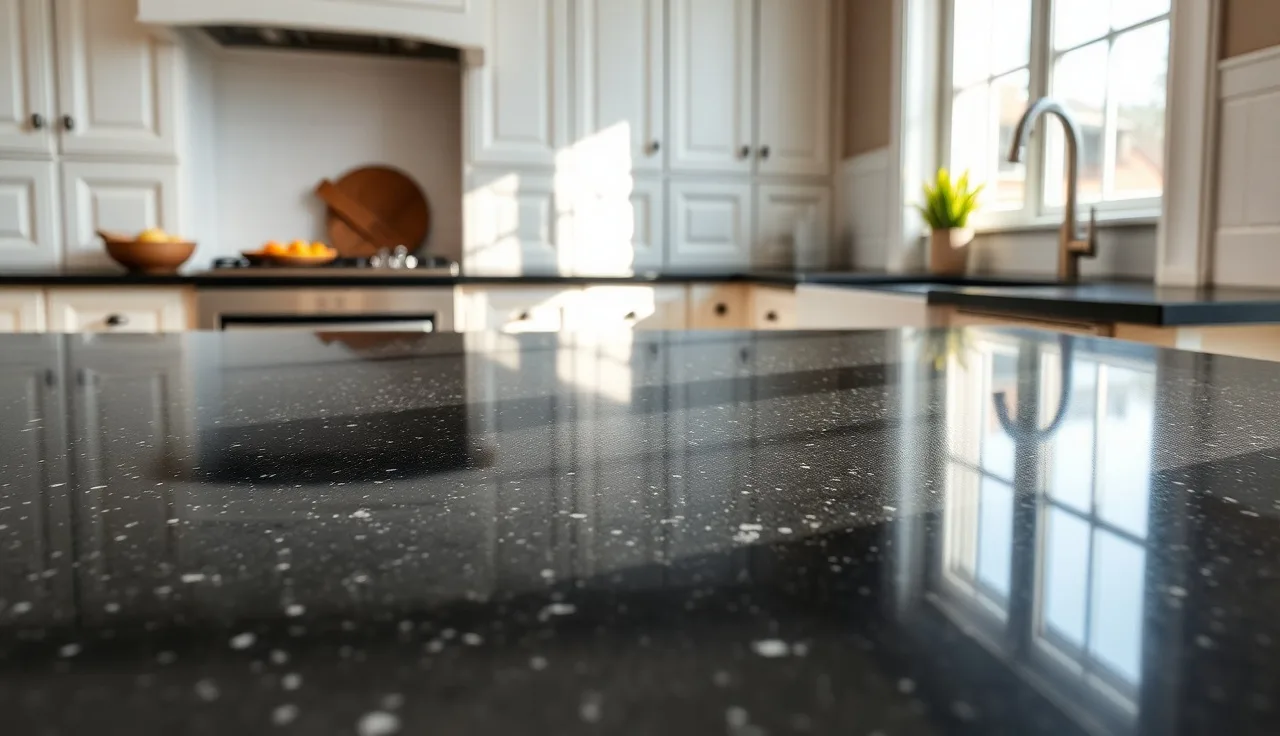
Water spots flip the story. Hard water leaves calcium deposits that stand out sharply on polished black or dark brown. A glass sitting on Absolute Black for thirty minutes can leave a ring you'll spot from across the kitchen. It's not damage. It wipes off. But it's a visual annoyance some owners never make peace with. Leathered or honed finishes scatter light and hide these spots better than polished. If water spots would bug you, get a leathered sample before you commit.
Fingerprints show on polished dark granite too, worst near the sink and along the edge closest to the stove. Same fix: leathered or honed finish, or just accept more frequent wiping.
Dust shows in low-angle light, like morning sun raking across the counter. It's the same dust that's on every surface. Dark stone just makes it visible. Not a dealbreaker. Worth knowing.
For cleaning methods and products across dark stone, the guide on how to clean stone countertops has the routine.
What finish works best on dark granite: polished, honed, or leathered?
Finish changes both the look and the daily feel of the stone. It's not a small choice.
Polished: The default. High gloss, mirror reflection. Colors read deepest and most saturated here, and Black Galaxy's sparkle only fully fires in a polished finish. Downside: it shows water spots and fingerprints most. Upside: it's the easiest to clean because the surface is least porous.
Honed: Matte or satin, no mirror. Softer, quieter look. Slightly more porous than polished, so it may want sealing a bit more often. Hides water spots and prints far better. A lot of people read honed dark granite as more contemporary.
Leathered: A textured surface made by running diamond brushes across the stone after honing. Soft, slightly rough to the touch, low sheen. Leathering closes some surface pores, so it can resist stains better than honed [4]. It hides everything: water spots, prints, crumbs, minor scratches. The catch is that debris settles into the texture, so cleaning takes a touch more effort. It works especially well on coarse-grained stones like Tan Brown or Ubatuba.
For a hard-working kitchen, leathered is what I'd pick. For a formal room where you want the drama of deep, glossy black, go polished. Honed sits between them and pairs cleanly with transitional or modern design.
Not every fabricator leathers in-house. Some outsource it or tack on a real upcharge, usually $10 to $25 per square foot over the polished price. Ask before you fall for the look.
How do you seal and maintain dark granite countertops?
Sealing is the one maintenance task that actually decides long-term performance. Granite is porous at the microscopic level, and a penetrating sealer soaks in to fill those pores so liquids can't.
Seal once a year for most granite. Denser stones like Absolute Black often go longer between coats [5]. The test takes a minute: put a tablespoon of water on the surface. If it beads for 10 to 15 minutes, the sealer's still working. If it soaks in and darkens the stone in under 5 minutes, reseal now.
Daily cleaning is plain dish soap and water. Skip anything acidic (vinegar, citrus cleaners), because acid breaks down the sealer and can etch some granites slightly over time. Skip bleach on colored or patterned stones. A stone-specific daily spray (Granite Gold or Rock Doctor, for example) is convenient but not required if you wipe with soapy water and dry the surface after.
The sealing job itself is simple. Most penetrating sealers (Aqua Mix Sealer's Choice Gold, Stonetech BulletProof, and Miracle Sealants 511 are common trade names) work the same way: clean the surface well, spread the sealer evenly, let it soak in for the time on the label (usually 5 to 20 minutes), then buff off every bit of excess. Let it dry on the surface and it leaves a haze.
The how to clean stone countertops article goes deeper on product picks. Comparing dark granite care to other natural stone? See how to clean quartzite countertops and how to clean soapstone countertops for their routines.
What cabinet colors and kitchen designs pair well with dark granite?
It's subjective, sure. But a few combinations show up over and over in real kitchens because they work.
White or cream cabinets with dark granite is the most common pairing in American kitchens, and it earns the spot. The contrast is high, the light cabinets take the visual weight off the dark stone, and it reads clean and classic. Absolute Black or Ubatuba with white Shaker cabinets is basically a formula now.
Wood-tone cabinets (natural oak, walnut, warm maple) go especially well with dark brown granite. Tan Brown or Imperial Coffee over medium-brown cabinetry builds a warm, layered look that feels substantial without going heavy. The trick is keeping enough contrast that the stone and cabinets don't blur into one brown mass.
Gray cabinets can go either way. Light gray with dark granite gives you good contrast. Dark gray with Absolute Black or Black Pearl can look intentionally moody, but it needs strong lighting or it turns into a cave.
Two-tone kitchens (white uppers, dark lowers) often use dark granite to tie the lowers to the stone while the uppers stay light. It's a practical trick and it photographs well.
For backsplash, light subway tile or a soft white mosaic is the safe play. Want more punch? A warm gold or copper metallic tile picks up the mineral flecks in Black Galaxy or Tan Brown.
Lighting is the make-or-break factor with dark surfaces. Under-cabinet lighting is close to mandatory if you want to see what you're prepping on a black counter after dark. Budget for it when you budget for the stone.
For how countertop materials fit into a whole kitchen plan, the kitchen countertops guide covers layout and design context.
Is dark granite a good choice for bathrooms and outdoor kitchens?
Dark granite works well in both bathrooms and outdoor kitchens, with a couple of caveats.
Bathroom vanities first. The surface is hard, water-resistant when sealed, and shrugs off daily use. The water-spot warning still applies: polished Black Pearl or Absolute Black on a vanity will show hard water marks near the faucet constantly. Either build the wipe-down habit or go honed. Undermount sinks are easy to fit because the fabricator cuts the opening before install, same process as a kitchen sink.
Outdoor kitchens next. Granite is one of the better natural stone picks outdoors because its density and hardness mean it doesn't soak up water fast, doesn't crack in freeze-thaw cycles as badly as more porous stones, and takes direct sun and heat without breaking down. UV won't fade the color the way it fades some engineered surfaces. The main change outdoors is sealing more often, maybe twice a year, because rain, sun, and grime chew through sealers faster than indoor conditions do [6]. Some fabricators steer you toward a commercial-grade sealer (higher solids content) for outdoor jobs.
One practical note: dark granite shows bird droppings and tree sap plainly outside. Not a reason to skip it. Just a realistic heads-up.
What should you check before buying a dark granite slab?
You're buying a specific slab, not a color name. Two slabs of Ubatuba from the same quarry can look noticeably different. Here's what to actually check before you sign.
View the full slab in person. Yards will pull slabs for you to see in natural light. If a fabricator quotes you off a 4x4-inch sample, that's nowhere near enough information for a full kitchen. Visit the yard, or ask for photos of your specific slab with something in frame for scale.
Check for natural fissures. Granite can have hairline fissures (natural separations in the stone, not cracks). They're common and usually stable, but a fissure running through a sink cutout area can turn structural. Ask the fabricator to point out any fissures and explain how they shape the layout plan.
Check slab thickness. Standard kitchen counters use 3-cm slabs (roughly 1.25 inches) [9]. Some budget jobs use 2-cm material with a laminated edge to fake the thickness. For most work, 3-cm earns its small premium because it's stiffer, holds up better at overhangs, and skips the plywood subtop.
Ask about origin and current supply. Some dark granites come and go. If your stone comes from a quarry with limited output (Blue Pearl from Norway, say), matching a slab for a future repair or addition gets hard. This matters if you're phasing a kitchen project.
Confirm your fabricator has enough slab for the job plus waste. A typical job needs 15 to 25 percent more square footage than the net counter area, to cover cuts, grain matching, and the stone lost around sink holes. A good fabricator calculates this upfront. Shops running layout software can show you exactly where each piece comes off the slab, which cuts waste and sometimes saves real money on material.
For the full run from template to final install, the countertop installation guide walks each step.
Does dark granite add resale value to a home?
Somewhat, yes. But the research is messier than granite showrooms let on.
The National Association of Realtors publishes remodeling impact data, and kitchen upgrades stay near the top of high-return interior projects [7]. Stone countertops get called out as a feature buyers like. But "stone countertops" spans everything from cheap granite to rare marble, and no clean data isolates the resale premium for dark granite specifically versus light granite or quartz.
Here's what the data does support. Kitchens with dated laminate or tile counters get cited by buyers as a reason to negotiate the price down. Swap in any quality stone or engineered surface and that objection usually goes away. The National Association of Realtors' 2023 Remodeling Impact Report found a full kitchen upgrade recovers about 67 percent of its cost at resale on average [7]. That's an average across a wide spread of projects, not a promise.
For a single homeowner, the practical framing is simpler. Dark granite is a durable, permanent-looking surface that most buyers recognize as quality material. It won't hurt your sale, and it'll likely help, especially if the kitchen reads as coherent. A mismatch between the counter and the cabinet color or the age of the home does more damage than the color of the stone ever will.
If budget is the real constraint and you're thinking long-term value, laminate countertops or Formica countertops cost far less upfront. Dark granite and comparable stone sit in the mid-to-upper range on cost, but also on buyer appeal.
Frequently asked questions
How often do you need to seal dark granite countertops?
Once a year is the standard starting point for most dark granites. Very dense stones like Absolute Black can go longer between coats. Test it by putting water on the surface: if it darkens the stone within 5 minutes, reseal now. If it beads for 10 to 15 minutes, you're still protected. High-traffic kitchens and outdoor installs may need sealing twice a year.
Will dark granite countertops scratch or chip?
Granite rates 6 to 7 on the Mohs hardness scale, so everyday knives, pots, and ceramic dishes won't scratch it. You're likelier to dull your knife than mark the stone. Chipping is possible at edges, mostly on polished 90-degree profiles, if something heavy hits a corner. Beveled or eased edges chip less than sharp square edges.
Do dark granite countertops make a small kitchen look smaller?
They can, especially with dark cabinets and low lighting. The fix is contrast and light: pair dark granite with lighter cabinets, add under-cabinet lighting, and use a lighter backsplash. In a well-lit kitchen with white or cream cabinets, dark granite reads as a bold design choice, not a space-shrinker. Small kitchens with lots of natural light handle dark counters fine.
What's the difference between Absolute Black and Black Galaxy granite?
Absolute Black is near-uniform jet black with almost no visible mineral variation. Black Galaxy has a black background covered in tiny bronze or silver flecks that sparkle under light. Absolute Black reads quieter and more modern. Black Galaxy is more decorative. Absolute Black is usually a little cheaper. Both come mainly from India and are widely stocked in U.S. slab yards.
Can you put hot pans directly on dark granite countertops?
Yes. Granite forms at temperatures far above anything a kitchen produces, so a hot pan from the oven or stove won't hurt the stone. The risk is to the sealer: repeated high heat degrades sealers over time, especially in small spots. Trivets are a good habit, but occasional hot pan contact won't leave visible damage the way it would on quartz or laminate.
Is dark granite or dark quartz better for a kitchen?
It depends on your priorities. Dark granite is natural, heat-resistant, and visually unique because every slab differs. Engineered quartz is non-porous, needs no sealing, and patterns more consistently. Granite wins on heat resistance and authenticity. Quartz wins on stain resistance and zero maintenance. Cost is roughly comparable. Cook heavily and want no worry? Quartz has the edge. Want natural stone character? Granite does.
What causes white haze or residue on dark granite?
Two common causes. First, hard water deposits: water evaporates and leaves calcium carbonate behind, worst near sinks. These wipe off with a damp cloth or a stone-safe cleaner. Second, over-applied or poorly buffed sealer leaving a film. If it's sealer haze, a stone sealer remover product (not vinegar or bleach) clears it. Always buff off excess sealer before it dries to avoid this.
How thick should dark granite countertops be?
Standard residential counters use 3-centimeter slabs (about 1.25 inches) for most work. Some fabricators offer 2-cm material at a lower price, but it needs a plywood subtop and flexes more at overhangs. For islands and long spans, 3 cm is worth it. For bathroom vanities or areas with full base cabinet support, 2 cm can work, though 3 cm is still the better call if the budget allows.
What's the best cleaner for dark granite countertops?
Plain dish soap and warm water handles most daily cleaning. Dry the surface after to cut down on water spots. For a dedicated stone cleaner, pH-neutral stone sprays (Granite Gold, Rock Doctor, Method Daily Granite) work well. Skip vinegar, lemon juice, Windex, bleach, and abrasive pads. None of these instantly ruins sealed granite, but repeated use degrades the sealer and can change the surface slightly over time.
How long does dark granite countertop installation take?
The full process from measuring to finished install usually takes one to two weeks. The fabricator templates the kitchen (physically or with a digital scanner) in one visit, fabricates the slabs at the shop, then comes back to install. Fabrication itself takes two to five days depending on shop workload. Install day usually runs two to four hours for a typical kitchen, not counting caulk cure time.
Is Ubatuba granite a good choice for dark countertops?
Ubatuba is one of the best-selling dark granites in the U.S. for good reason. It reads as black in most lighting but carries warm gold and green movement that keeps it from feeling cold or stark. It pairs well with warm wood tones and white cabinetry alike. It's widely stocked, so pricing stays competitive, and slabs run fairly consistent from reputable Brazilian quarries.
Do dark granite countertops fade or change color over time?
Not meaningfully from UV, which beats some engineered surfaces. Polished dark granite can dull slightly over years as micro-scratches from cleaning build up, but a professional re-polish restores it. Honed and leathered finishes don't show that dulling as readily. The mineral-based color in granite is essentially permanent under normal interior and exterior residential conditions.
What edge profile works best on dark granite?
Eased (a slightly softened square) or beveled edges cut chip risk compared to a sharp 90-degree square edge. Ogee and bullnose profiles have stayed popular for twenty years and still turn up in traditional kitchens. Waterfall edges (granite dropping vertically to the floor) show up often in contemporary designs and look dramatic in very dark stones like Absolute Black. Ask your fabricator which profiles they cut in-house versus outsource.
Can dark granite be repaired if it chips or cracks?
Small edge chips repair with color-matched epoxy filler. A skilled fabricator or stone restoration pro can make them nearly invisible on most dark stones, though matching color is harder on uniform black than on patterned stone. Full cracks through the slab are serious and usually need section replacement. That's rare in normal residential use, but heavy impact on an unsupported span can do it.
Sources
- USGS National Minerals Information Center, Granite and Related Rocks: Absolute Black is often gabbro or diabase rather than true granite by strict geologic definition, though the trade treats these dark igneous stones interchangeably.
- Angi Cost Guide: Granite Countertops: Installed granite countertop prices range from approximately $40 to $200 per square foot depending on material grade, complexity, and regional labor costs.
- NSF International, NSF/ANSI 51 Food Equipment Materials: Engineered quartz surfaces are non-porous and certified as food-safe under NSF/ANSI 51, giving them an inherent stain resistance advantage over natural stone.
- Natural Stone Institute, Care and Cleaning Guidelines: Leathered and honed surface treatments alter porosity and light reflection, with leathering closing some surface pores compared to a raw honed finish.
- Natural Stone Institute, Care and Maintenance Guidelines: Annual sealing is the standard recommendation for most granite countertops; denser granites like Absolute Black may require sealing less frequently.
- University of Florida IFAS Extension (EDIS): Outdoor stone installations should be sealed more frequently than interior ones, with twice-yearly sealing recommended due to UV exposure and precipitation breaking down sealers faster.
- National Association of Realtors, 2023 Remodeling Impact Report: A full kitchen upgrade recovers approximately 67 percent of its cost at resale on average; stone countertops are cited as a buyer appeal feature.
- USGS National Minerals Information Center, Dimension Stone Statistics: Brazil and India are leading exporters of granite dimension stone to the United States, supplying much of the dark granite including Ubatuba, Tan Brown, and Absolute Black.
- Natural Stone Institute, Dimension Stone Technical Bulletins: Standard residential granite countertop slabs are fabricated at 3 cm (approximately 1.25 inches) thickness for kitchen applications; 2-cm material is also available but typically requires plywood subtop reinforcement.
- U.S. EPA, Radiation and Granite Countertops: The EPA states granite countertops may emit low levels of radon but in most cases this does not represent a health concern in well-ventilated homes, and dark granites are not specifically higher-risk than light ones.
- ASTM International, ASTM C615 Specification for Granite Dimension Stone: ASTM C615 sets minimum physical requirements for granite dimension stone used in construction, including absorption, compressive strength, and modulus of rupture.
Last updated 2026-07-10