TL;DR
- Countertop edge profiles range from the flat eased edge (usually included in base price) to ornate ogee and waterfall styles that can add $15, $35 per linear foot.
- The right choice depends on your material, cabinet style, household safety, and budget.
- Most kitchens run 12 to 18 linear feet of edge, so profile upgrades add up fast.
What is a countertop edge profile, and why does it matter?
An edge profile is the shaped cross-section cut into the exposed front and side edges of a countertop slab. It is the last thing a fabricator does before polishing, and it changes how the counter looks, how it feels under your hands, and whether sharp corners will gouge a hip every time you walk by.
The profile is not cosmetic-only. Bullnose and eased edges are gentler on hips and forearms, which matters if you have young kids or elderly family members at counter height. Sharper profiles like the mitered or beveled edge catch light differently and read as more contemporary. Profiles with tight grooves (like the dupont) can trap crumbs and cleaning residue, so they need more attention in a working kitchen.
Fabricators classify edges as standard or premium. Standard edges are simple single-pass shapes that a CNC router finishes in one or two tool runs. Premium edges require more passes, more tooling time, or laminated sections of stone. That extra labor is where the price difference comes from, not material cost. The slab itself doesn't change.
If you are budgeting a full kitchen, edge choice is one of the easiest places to pull cost back without touching the material or slab size. It is also an easy place to add a custom detail without a major upgrade. Worth understanding before you sign anything.
What were the most popular countertop edge profiles in 2017?
By 2017, two shifts were well underway in the countertop industry. The elaborate multi-tiered ogee that dominated granite installs in the 2000s was losing ground fast, and the ultra-clean mitered (waterfall) edge was becoming the calling card of contemporary kitchen remodels. The National Kitchen and Bath Association's annual design trends survey reflected both of those movements [1].
The flat or eased edge and the soft-close eased edge (sometimes called a slightly eased or 1/8-inch-radius edge) claimed the top spots in modern and transitional kitchens. Simple. Inexpensive. Clean lines that don't compete with book-matched stone. Houzz's 2017 Kitchen Trends Study found that 56 percent of homeowners who remodeled that year chose a contemporary or transitional kitchen style [2], and edge profile choices followed: clean over ornate.
The pencil/demi-bullnose held steady for traditional and farmhouse kitchens. Full bullnose stayed popular on bathroom vanities where a softer silhouette makes sense. The waterfall edge, which isn't a profile in the classic sense but a fabrication detail where the stone drops vertically to the floor, was the aspirational pick of 2017 design coverage. It shows up in nearly every shelter magazine kitchen from that period.
Ogee profiles did not disappear. They kept a loyal market in traditional, Old World, and ornate kitchen designs, particularly on granite where the extra visual weight suits the material. But they stopped being the default upgrade the way they had been in the previous decade.
One honest caveat: good industry-wide sales data on edge profiles by year is thin. No major trade body publishes volume by profile type. The picture above is assembled from NKBA trend surveys, Houzz studies, and fabricator trade coverage from that period, not from audited sales data.
How much do different edge profiles cost?
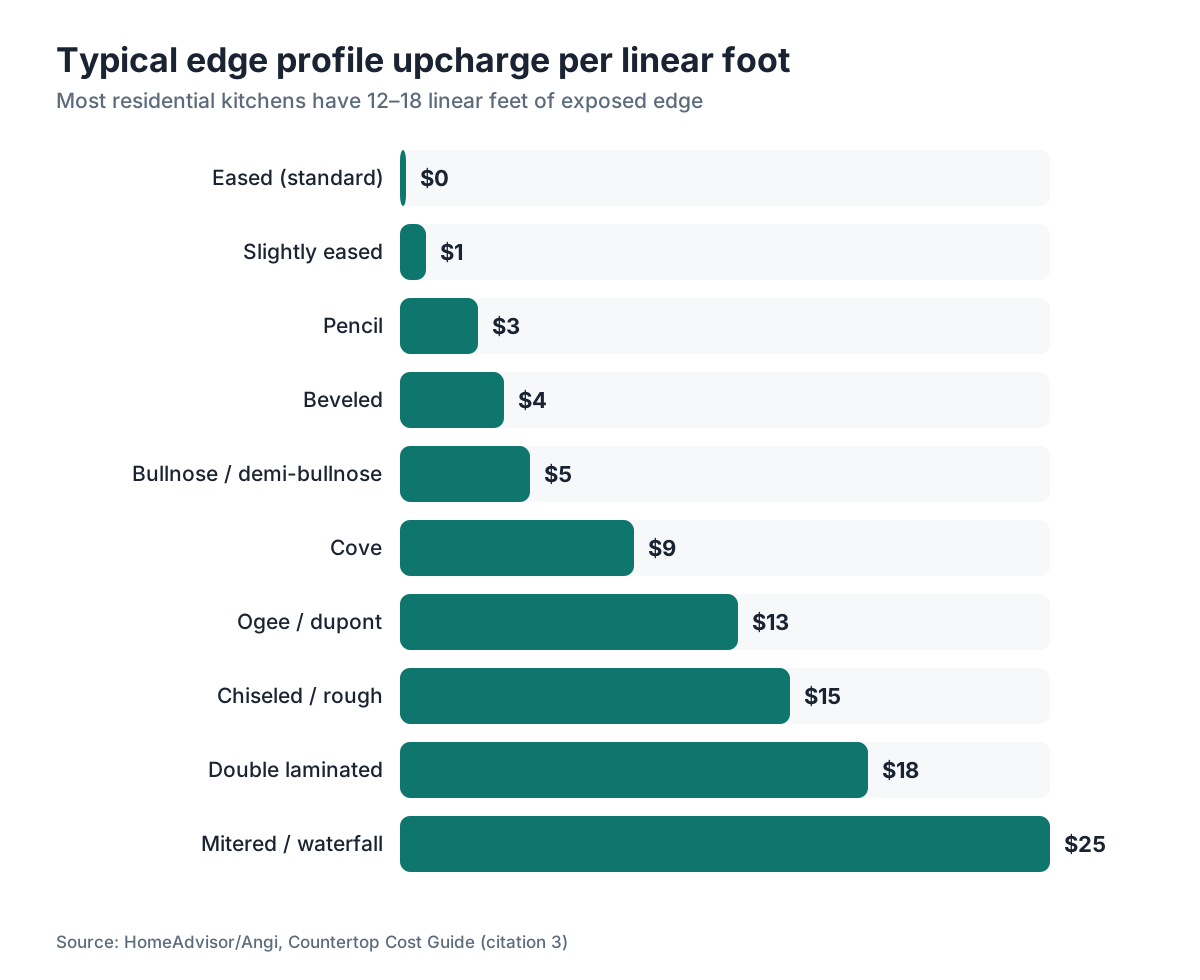
Edge profile pricing is almost always quoted per linear foot and added to the countertop fabrication price as a line item. Standard edges are often bundled into the base square-foot price; premium edges are itemized separately.
Real price ranges vary by region, material, shop overhead, and how competitive the local market is. The ranges below are typical for 2017 and remain broadly accurate today, with modest inflation adjustments [3].
| Edge Profile | Typical Upcharge ($/linear ft) | Category |
|---|---|---|
| Eased (flat, 90°) | $0 (included) | Standard |
| Slightly eased (1/8" radius) | $0, $2 | Standard |
| Beveled (angled flat face) | $0, $5 | Standard |
| Bullnose (full round) | $2, $8 | Standard |
| Demi-bullnose (half round top) | $2, $8 | Standard |
| Pencil (small radius) | $0, $5 | Standard |
| Ogee (S-curve) | $8, $18 | Premium |
| Dupont (ogee variant) | $8, $18 | Premium |
| Chiseled/rough edge | $10, $20 | Premium |
| Mitered (waterfall) | $15, $35+ | Premium |
| Double-stacked (laminated) | $12, $25 | Premium |
| Cove (concave) | $5, $12 | Mid/Premium |
A typical kitchen has 12 to 18 linear feet of exposed edge. At $15 per linear foot upcharge for an ogee, you are looking at $180 to $270 added to your quote. A full waterfall island can cost $300 to $600 or more in edge labor alone, before any structural considerations.
For laminate countertops the profile options are more limited since the material is thin and the edge is usually a post-formed radius or a square edge with a PVC or aluminum strip. Solid surface materials like Corian countertops can be routed to almost any profile because the material machines like wood, and the joints are invisible.
For natural stone, granite countertops and marble countertops take profiles well but very thin stone (under 3/4 inch) limits how much material a fabricator has to work with. Two-centimeter slabs often need a laminated edge to build up thickness before an ogee or mitered look is possible.
What are the main edge profile styles and how do they look?
Walking through each profile type in plain language is more useful than a glossary. Here's what you actually see and feel.
Eased. The factory edge of the slab with both corners knocked back to a tiny flat. No curve, no angle, just a clean 90-degree face with softened corners. Reads as flat and modern. The fabricator's fastest cut. Almost always free.
Slightly eased or 1/8" radius. Same as eased but the corners are rounded slightly more, to about 1/8-inch. Reduces chipping on brittle stones. Still reads flat from across the room. Most fabricators use this as their default standard edge on quartz and harder granites.
Beveled. The top front corner is cut at an angle (usually 45 degrees) rather than rounded. Catches light and adds a geometric detail without much complexity. Popular in contemporary and industrial kitchens. Affordable.
Bullnose. The entire top edge is a semicircle. Soft and friendly, no sharp corner anywhere. Classic choice for bathroom vanities. On a kitchen island it can look a bit dated in contemporary settings, though not in traditional ones. Full bullnose removes some slab material so you lose a bit of countertop thickness.
Demi-bullnose. Only the top half of the edge is rounded; the bottom half is flat. Combines the softness of bullnose with a little more visual definition at the bottom. Slightly more contemporary than full bullnose.
Pencil. A very small radius (usually 1/8 to 1/4 inch) on the top corner. Barely noticeable up close, but it eliminates the razor-edge you'd get from a true square cut. Low-cost and clean.
Ogee. The signature ornate edge: an S-curve profile that steps out and back. Traditional, formal, Mediterranean-influenced. When done well on a thick slab it looks genuinely rich. When applied to a thin slab it looks busy. This is the profile that defined granite kitchen upgrades in the early 2000s.
Dupont. A cousin of the ogee, with a small flat section at the bottom of the curve. A little more contained and geometric than ogee. Still premium pricing, still reads traditional.
Cove. The face of the edge curves inward (concave) rather than outward. Less common than most profiles. Creates an elegant shadow line. Popular on furniture-style islands. Takes skill to execute cleanly.
Chiseled or rough edge. The edge is left with a natural, broken texture rather than polished smooth. Popular on leathered or honed granite and quartzite. Adds a natural stone feel. Labor-intensive because each inch is hand-worked. Not for everyone but genuinely striking on the right material.
Mitered or waterfall edge. Two pieces of stone are cut at a 45-degree miter and joined to create a thick-looking edge that is actually two thicknesses joined. On a waterfall island, a third piece drops to the floor. Requires tight templating and precision cutting. The most expensive common edge treatment. Very much a 2017-forward design statement.
Double or triple laminated. Extra strips of stone are glued under the countertop edge to build apparent thickness before a profile is cut. Common on 2cm slabs that need a furniture-style thick edge. The seam should be nearly invisible with good stone selection and skilled fabrication.
Which edge profiles work best for each countertop material?
Not every profile works on every material. Some combinations are impractical; others are just bad ideas.
Quartz (engineered stone). Takes almost every profile well. The material is consistent and machines predictably on CNC equipment. Mitered waterfall edges on quartz islands were the defining 2017 luxury kitchen detail. Cambria countertops, for example, offered a range of edge options across their product line, with standard edges included and premium profiles priced per linear foot [4].
Granite. Very profile-friendly. Dense enough to hold crisp ogee and dupont details without chipping. Softer granites (lower density, more porous) can chip at thin ogee edges under impact. Always ask your fabricator about the specific stone's behavior. Chiseled edges look especially at home on rustic or leathered granite.
Marble. Profile-compatible but calcite-based marbles are softer than granite and chip more easily at tight ogee lips. Slightly eased, beveled, or cove edges tend to age better on marble than complex ogee. Mitered waterfall on Carrara or Calacatta marble is stunning and expensive, and it demands careful joint matching to hide the seam. See marble countertops for material-specific guidance.
Quartzite. Dense, hard, and profiles well. Fabricators who work quartzite regularly find it behaves like a hard granite. Some quartzites are porous at the surface, which can affect edge finishing. How to clean quartzite countertops covers surface care that applies to edges as well.
Soapstone. Soft stone (Mohs hardness around 1-2) [5]. Complex profiles are possible but thin sections will ding and dent in use. A simple slightly eased or bullnose profile suits the material's character. Those dents patina nicely on soapstone anyway, but a fragile ogee tip will eventually chip clean off.
Laminate. Post-formed laminate has a built-in curved front edge and flat back; no upgrade possible. Flat-lay laminate can be edge-banded with matching laminate, wood, or metal strips for different looks. Limited range compared to stone.
Butcher block. Wood is easy to route, so butcher block countertops can take almost any profile a router bit can cut: roundover, cove, ogee, chamfer. The constraint is oiling and maintenance, not the routing. Complex grooves trap food and oil unevenly.
Solid surface (Corian, etc.). The most profile-flexible material. Joints are invisible after sanding, so edge details that require glue-ups look continuous with no visible line. Corian countertops can be fabricated with almost any profile the customer specifies.
Which edge profiles are safest for homes with kids or elderly family members?
Sharp right-angle edges (true square or barely-eased) are the primary injury risk at counter height. A child's forehead or temple is exactly at counter height in many kitchens. The American Academy of Pediatrics notes that kitchen counter injuries are among the common household sharp-edge trauma sources for children under five [6].
Bullnose and full-radius profiles eliminate the sharp corner entirely. Demi-bullnose does so on the top where impact happens. Beveled edges are safer than square but the angled face still presents a hard corner at the top. Eased edges (1/8 to 1/4 inch radius) are meaningfully softer than square even though they don't look dramatically different.
For bathrooms used by elderly family members, a full bullnose on a vanity edge reduces the risk of forearm bruising from leaning on the counter, which is more common than people expect. That is an underappreciated argument for bullnose on bathroom vanities independent of aesthetics.
The tradeoff is that the softer the edge, the less crisp the visual line. In a contemporary kitchen with handleless cabinetry and a clean aesthetic, a full bullnose can look out of place. Slightly eased is usually the safe compromise: barely visible change from square, meaningfully less sharp in a fall, no upcharge.
How does edge profile affect how difficult a countertop is to clean?
This is a question fabricators often get asked and homeowners often forget to ask. The answer is real.
Flat or slightly eased edges are easiest to clean. One swipe of a damp cloth and debris comes off. The profile gives crumbs nowhere to collect.
Ogee and dupont profiles have an S-curve with a concave section near the bottom. That concave section collects crumbs, grease, and cleaning product residue. In a working kitchen that gets heavy use, those grooves require deliberate cleaning with a brush or soft cloth pushed into the cove. Not a dealbreaker, but not nothing either.
Chiseled edges are the hardest to clean. The uneven texture is the point, but it means bacteria, food debris, and mineral deposits from water find every crevice. Near a sink this gets old fast. On a bar edge that doesn't see food prep it is more forgiving.
Mitered edges are easy to clean on the face. The joint line at the miter can become a collection point if the adhesive joint is not perfectly sealed, which matters near a sink or prep area.
On materials that need regular oiling or sealing (see how to clean stone countertops and how to clean soapstone countertops), complex edge profiles make application harder. Getting sealer into the concave sections of an ogee requires a brush and attention. Skip the sealer there and you get uneven protection.
What does a waterfall edge island actually cost, and is it worth it?
A waterfall island is the move where the countertop surface material continues vertically down the side panels of the island to the floor, matching veining or grain across the miter joint. The look was everywhere in high-end kitchen photography by 2017.
The cost has several components. First, the waterfall panels are extra stone, typically cut from the same slab or book-matched slabs to align the pattern. Second, the miter cuts must be precise (45 degrees on both pieces) and the joints need to be tight enough to look intentional. Third, the substrate (the cabinet side panel) needs to be flush and plumb or the stone won't sit cleanly.
A typical island with two waterfall ends adds roughly 20 to 30 square feet of stone (the two side panels) plus the miter cutting labor. On a mid-range material running $60 to $80 per square foot installed, that is $1,200 to $2,400 just in extra material. The miter labor and edge finishing adds another $300 to $800 depending on the shop. Total premium over a standard island edge: $1,500 to $3,200 or more, before any exotic slab selection.
Is it worth it? For resale value, design data is mixed and no well-controlled study shows a dollar-for-dollar return on edge upgrades specifically. Remodeling Magazine's annual Cost vs. Value study tracks kitchen remodel ROI broadly [7], and high-end kitchen remodels typically return 53 to 60 cents on the dollar, which means premium details contribute to the kitchen's appeal without full payback. Waterfall islands read as high-end instantly in listing photos. If you're staying in the house, buy what you love. If you're flipping, a waterfall on a mid-grade kitchen is a mismatch.
For fabricators quoting these jobs, software that captures edge linear footage and automatically applies per-profile pricing makes the difference between a profitable quote and an expensive surprise. SlabWise's quoting module does exactly that, so shops don't have to manually price each edge detail.
How does edge profile affect the overall thickness the countertop appears to be?
Standard stone slabs come in two thicknesses: 2 centimeter (roughly 3/4 inch) and 3 centimeter (roughly 1-1/4 inch). The edge profile you choose either exposes that actual thickness or modifies how thick the counter reads visually.
A 3cm slab with a simple eased edge shows a clean, substantial 1.25-inch edge that reads as high quality without any tricks. That is why 3cm became the dominant residential thickness and why many shops won't install 2cm without a build-up.
A 2cm slab with a laminated edge (a strip of matching stone glued underneath) can look like a 4cm or even 6cm edge. That thick furniture-style edge is specifically designed to make the countertop read as more substantial. Done well, it is nearly invisible. Done poorly, the seam telegraphs through the polished surface.
A mitered waterfall edge on 3cm stone creates a visual edge that appears to be 6cm because the miter meets at the midpoint and both faces are full-thickness stone. It is genuinely one of the cleanest ways to get a thick-edge look without lamination.
For kitchen islands especially, the edge thickness is a prominent visual element. A thin edge on a large island can look undersized and oddly lightweight. If your slab is 2cm, build up the edge. If it's 3cm, the standard profile will likely read well as-is.
How do fabricators price and quote edge profiles in their jobs?
For fabricators, edges are one of the trickiest parts of quoting to get right. The standard approach is to measure total linear footage of exposed edge on the job, then apply a per-linear-foot rate for whatever profile the customer selects. Sounds simple. In practice, corners, inside radius cuts, and the difference between eased and ogee at the same footage can mean a 30 to 45 minute difference in machine time per job.
The profile also affects tooling costs. A simple eased edge might run with a standard polishing wheel. An ogee requires a specific ogee bit, which wears out and must be replaced. Some shops roll tooling cost into the per-linear-foot rate. Others treat it as shop overhead. Either way, the profile upcharge needs to cover that.
Nesting software and quoting tools that automatically calculate exposed edge footage from the template or CAD file, and then apply the correct profile rate, save real time and reduce the chance of under-quoting. The more complex the job (multiple profiles on one job, laminated edges, waterfall returns), the more the math matters. SlabWise's quoting tools handle edge profile pricing as a line item on each job, which is particularly useful on jobs where different rooms get different profiles.
For homeowners reviewing a countertop quote, the edge line item should appear separately and clearly. If it's buried in square footage, ask your fabricator to break it out. You want to see material, fabrication and labor, edge profile, cutouts (sink, cooktop), and installation as separate line items. That makes comparison shopping between shops honest. See countertop installation for a full breakdown of what goes into a typical quote.
Can you change an edge profile after the countertop is installed?
Yes, but it is rarely worth doing. A fabricator can re-profile an installed edge in place, but working on-site without a CNC table is slower, messier, and less precise than shop work. The cost is typically higher than doing it at fabrication time, and dust containment is genuinely difficult in a finished kitchen.
If you want to change from a bullnose to an eased edge, that is straightforward: material is removed, which is always easier than adding it. Going the other direction (adding an ogee to a currently eased edge) is only possible if the slab has enough material depth, which on 3cm stone with an eased edge it usually does.
Chiseled edges are essentially one-way. Once you've broken the natural stone texture into the edge, there is no going back to a polished face without removing enough material to reach below the chiseled surface, which changes your countertop depth measurably.
The honest answer for homeowners: decide before fabrication. Ask your fabricator to show you edge samples on the actual material you're ordering (most shops have physical sample boards), and live with the sample for a day before committing. Edge regret is real and the fix is expensive.
Are there edge profile trends that have shifted since 2017?
2017 was roughly the peak of the contemporary-clean edge trend. Since then, a few things have shifted.
The mitered waterfall edge went from aspirational detail to mainstream expectation in high-end kitchen projects. What cost a significant premium in 2017 is now a near-standard request at the high end, and fabricators have gotten faster at executing it.
The leathered or honed finish with a natural or chiseled edge picked up significantly as homeowners pushed back on the all-polished look. This is partly a material trend (quartzite, soapstone, leathered black granite) and partly an edge trend: rough, organic, handmade-looking.
Ultra-thin countertops (8mm to 12mm ultra-compact surfaces like Dekton and Neolith) created their own edge vocabulary. These materials can't take a traditional ogee or bullnose at all. They are typically installed with a mitred build-up or a simple eased edge, and that constraint has pushed some designers back toward simplicity.
Ogee is not dead. In traditional, craftsman, and transitional kitchens where the cabinetry has raised panels and decorative details, a simple ogee still fits and sells well. It just doesn't dominate the market the way it once did.
For the design-forward homeowner reading this in a reference context: the edge that will look right in ten years is almost always the one that matches the overall design register of your space, not the one that was trending in any given year. Timeless over trendy. Simple over busy, unless busy is genuinely the character of the room.
Frequently asked questions
What is the most popular countertop edge profile?
The slightly eased edge (a small 1/8-inch radius on the top corner) is the most common default choice in contemporary and transitional kitchens. It is clean, included in base price at most shops, and suits virtually every material. Ogee was the dominant premium choice through the mid-2010s; mitered/waterfall took that spot in high-end kitchens from 2017 onward.
How much does an edge profile upgrade cost on average?
Standard profiles (eased, pencil, slightly eased, basic bullnose) typically cost $0 to $8 per linear foot as an upcharge. Premium profiles like ogee, dupont, or mitered waterfall run $10 to $35 per linear foot. A typical kitchen has 12 to 18 linear feet of exposed edge, so an ogee upgrade might add $120 to $300 and a waterfall island significantly more.
What edge profile is best for granite countertops?
Granite suits almost any profile. A slightly eased or beveled edge is the cleanest modern choice. Ogee and dupont look at home on thicker, traditionally styled granite. Chiseled edges work beautifully on leathered granite. The main limit is slab thickness: 2cm granite needs a laminated build-up before complex profiles can be cut.
What countertop edge is easiest to clean?
A flat eased or slightly eased edge is easiest to clean. One swipe removes debris with no crevices. Ogee and dupont profiles have a concave S-curve that traps crumbs and grease and needs regular attention with a brush. Chiseled edges are the hardest to clean and should be avoided near sinks or high-use food-prep areas.
Is a bullnose edge outdated?
Full bullnose reads as dated in contemporary kitchens but remains appropriate and appealing in traditional, farmhouse, and casual spaces. It is still the preferred profile for bathroom vanities where softness and safety matter more than a sharp modern look. Demi-bullnose splits the difference and feels more current in many design contexts.
How do I choose an edge profile for a kitchen island?
Consider the island's role and your overall design style. A waterfall mitered edge is the high-impact option for contemporary kitchens and reads as a focal point. An eased or beveled edge is cleaner and lets the stone be the feature. If kids use the island regularly, avoid sharp square edges. Budget matters too: island perimeters are long, so profile upcharges add up fast.
What is a dupont edge on a countertop?
A dupont edge is a close relative of the ogee. Both feature an S-curve profile, but the dupont typically includes a small flat horizontal section at the bottom of the curve, giving it a slightly more geometric and contained look than a full ogee. It is priced in the same premium range as ogee ($8 to $18 per linear foot at most shops) and suits traditional design styles.
Can you get an ogee edge on quartz countertops?
Yes. Quartz machines consistently on CNC equipment and holds ogee profiles well. Most major quartz brands and independent fabricators offer ogee as a standard premium edge option. The upcharge applies regardless of whether the base material is quartz, granite, or marble, because the cost is in the machining time and tooling, not the material.
What is the difference between a mitered edge and a waterfall edge?
A mitered edge is a fabrication technique: two pieces of stone are cut at 45 degrees and joined to create a thick edge that shows stone on the face. A waterfall edge is a design application of that technique where the stone continues vertically down the side of the island or cabinet to the floor. All waterfall edges use a miter; not all mitered edges become waterfalls.
Does edge profile affect countertop resale value?
No credible study isolates edge profile as a resale value driver. Remodeling Magazine's Cost vs. Value report tracks kitchen remodel ROI broadly at roughly 53 to 60 percent return, not by edge detail. A cohesive kitchen where everything matches (profile, finish, style) reads better than a mismatch. An expensive waterfall edge on an otherwise budget kitchen probably doesn't recoup its cost.
How many linear feet of countertop edge does a typical kitchen have?
Most residential kitchens have 12 to 18 linear feet of exposed countertop edge. Larger kitchens with peninsulas or islands can reach 25 to 35 linear feet. The island alone typically adds 10 to 14 linear feet. Accurate linear footage is the first number your fabricator needs to price any profile upgrade honestly.
What edge profiles work on 2cm stone?
On a true 2cm slab, simple profiles (eased, pencil, bullnose, slight bevel) work fine within the 3/4-inch thickness. Complex profiles like ogee, dupont, or mitered edges require laminating an extra strip of stone underneath to build the edge to 4cm or more before the profile is cut. That lamination adds cost and means slab selection matters: the strip should match the main slab visually.
Is a chiseled edge a good choice for kitchen countertops?
A chiseled edge is striking on the right material (leathered quartzite, rustic granite, soapstone) and in the right kitchen (farmhouse, rustic, natural-material spaces). It is genuinely hard to clean in a working kitchen near a sink or prep area, because the texture traps everything. It is a better fit for a bar edge, a perimeter wall, or a low-traffic area than for a primary prep surface.
What edge profile should I avoid on marble countertops?
Thin ogee tips are the most vulnerable spot on marble because calcite-based stones are softer than granite and chip more easily under impact. A tight S-curve with a thin upper lip will eventually lose a piece if a heavy pot grazes it. Slightly eased, demi-bullnose, beveled, or cove edges age better on marble and show damage less dramatically if the stone does chip.
Sources
- National Kitchen and Bath Association, Design Trends Survey: NKBA annual design trends surveys tracked the shift from ornate ogee to cleaner eased and contemporary edge profiles during 2016-2017.
- Houzz, 2017 U.S. Houzz Kitchen Trends Study: 56 percent of homeowners who remodeled kitchens in 2017 chose a contemporary or transitional style, per the Houzz 2017 Kitchen Trends Study.
- HomeAdvisor (Angi), Countertop Installation Cost Guide: Edge profile upcharges typically range from $0 for standard eased edges to $15-$35+ per linear foot for premium mitered or waterfall profiles.
- Cambria, Edge Profile Options: Cambria offers a range of standard and premium edge profiles, with standard edges included and premium profiles priced as upcharges.
- National Institute of Standards and Technology (NIST), Stone and Masonry Material Properties: NIST materials data covers hardness and fracture properties of common countertop stones including granite, marble, and soapstone (soapstone Mohs hardness around 1-2).
- American Academy of Pediatrics, Home Safety and Injury Prevention: The AAP identifies kitchen counter sharp-edge injuries as a common household trauma source for children under five.
- Remodeling Magazine, Cost vs. Value Report 2017: High-end kitchen remodels returned approximately 53-60 cents on the dollar nationally per the Remodeling Magazine Cost vs. Value 2017 report.
- Natural Stone Institute, Dimension Stone Design Manual: The Natural Stone Institute publishes fabrication standards covering edge profile categories and the thickness requirements for complex profiles on natural stone.
- U.S. Consumer Product Safety Commission, Home Safety Data: CPSC injury data documents sharp furniture and counter edges as a consistent household injury source, supporting the case for soft edge profiles in homes with children.
- Tile Council of North America, Installation Handbook: Edge treatment standards and substrate requirements for countertop installations are referenced in the TCNA Installation Handbook.
Last updated 2026-07-09