TL;DR
- Budget granite runs $40 to $60 per square foot installed for common colors and a standard edge.
- Entry-level slabs wholesale for $10 to $25/sq ft before fabrication.
- Real savings come from picking Level 1 granite, skipping fancy edges, buying remnants, and timing the job.
- Labor and shop overhead, not the stone, drive most of the final price.
What does cheap granite actually mean?
Cheap granite means Level 1 stone: the entry tier suppliers grade for consistent color and predictable patterning, quarried in enough volume that the price stays low. Suppliers sort granite into Level 1, Level 2, and Level 3 (sometimes more, depending on the importer). Uba Tuba, Santa Cecilia, and New Venetian Gold are the workhorses. You see them in every big-box sample rack for a reason.
Level 1 slabs wholesale for roughly $10 to $25 per square foot depending on supplier, region, and current import prices [1]. Add cutting, polishing, edge work, and installation, and the retail installed price for Level 1 granite lands in the $40 to $60/sq ft range across most U.S. markets. Coastal metros push higher. Rural areas without a nearby fabricator can go either way.
Cheap granite is still real granite. It's natural igneous rock, quarried and processed the same way as the $120/sq ft slabs in the designer showroom. What you pay extra for at the high end is rarity, visual drama, and occasionally tighter color matching across multiple slabs. A Level 1 piece holds up the same on your kitchen counter as anything else. The kitchen doesn't care how dramatic the veining is.
How much do cheap granite countertops cost per square foot?
Cheap granite runs $40 to $60 per square foot installed for Level 1 material with a standard edge and one sink cutout. A full 40-square-foot kitchen lands around $1,600 to $2,400. Here's a realistic breakdown by what you're actually buying. All figures are 2024 to 2025 U.S. dollars and reflect the installed price a homeowner pays a local fabricator, not slab-only pricing.
| Granite tier | Typical installed range | Common examples |
|---|---|---|
| Level 1 (budget) | $40, $60/sq ft | Uba Tuba, New Venetian Gold, Santa Cecilia |
| Level 2 (mid) | $60, $90/sq ft | Giallo Ornamental, Absolute Black, White Ice |
| Level 3+ (premium) | $90, $150+/sq ft | Blue Bahia, Calacatta Gold, Van Gogh |
| Remnant slab | $200, $800 flat fee (job-specific) | Varies by shop |
These ranges come from countertop installer pricing surveys published by HomeAdvisor and Fixr, both of which track contractor-reported costs nationally [2][3]. Your actual number depends on square footage (small jobs cost more per foot because mobilization doesn't scale), edge profile, number of sink and cooktop cutouts, and local labor rates.
Here's the floor. A typical kitchen with 40 square feet of counter in Level 1 granite, one undermount sink cutout, and a standard eased edge runs roughly $1,600 to $2,400 installed in most markets. That's the real cheap-granite bottom for a full kitchen.
Where can you actually buy cheap granite countertops?
You have five real options for buying cheap granite, and they aren't equivalent: big-box stores, local fabricators, stone importers, remnant sales, and Habitat ReStores. Each trades price against selection and quality of workmanship.
Big-box stores (Home Depot, Lowe's). Both sell Level 1 granite packages, usually with installation through a subcontractor network. Pricing is transparent and standardized, which helps for comparison. The catch is limited slab selection and installers who may be less experienced than a specialty fabricator. Home Depot advertises granite installation starting around $45/sq ft installed as of 2024, though add-ons like sink cutouts and tricky layouts push that up fast [2].
Local stone fabricators. This is where the best value per dollar lives if you know what to ask for. Tell the fabricator you want Level 1 material and a standard edge, then ask about remnants. A busy shop has offcut slabs sitting in the yard they'll sell cheap just to clear space.
Stone importers and distributors. In most metro areas you can buy straight from a stone yard, though you still need a fabricator for cutting and installation. This step can shave $5 to $15/sq ft off material. It also adds coordination, and some fabricators charge more to work with customer-supplied stone.
Remnant sales. Most shops keep a remnant pile or room. These are offcuts from other jobs, usually 10 to 40 square feet. If your area is small (a bathroom vanity, a laundry room, a compact island), a remnant costs $200 to $600 for a piece that would otherwise run $600 to $1,200 cut new.
Habitat for Humanity ReStores. Some locations carry salvaged slabs pulled during remodels. Quality is a coin flip, but prices are genuinely low. Worth a look if you're on a tight budget and flexible on color.
For how granite stacks up against every other countertop material on cost and durability, the granite countertops guide covers that ground.
What are the cheapest granite colors and why are they cheap?
The cheapest granite colors are Uba Tuba, Absolute Black, New Venetian Gold, Santa Cecilia, and Colonial White. They're cheap for one reason: high-volume quarries in Brazil and India pump them out at scale, and abundant supply drives the price down. Price in granite tracks quarry output and shipping distance, not how the stone performs on your counter.
The consistently cheapest options in U.S. markets:
Uba Tuba. Dark green-black with gold and silver flecks. Quarried in large volumes in Brazil. Hides crumbs, masks seams, works in almost any kitchen. Cheap because it's abundant, not because it's weak.
New Venetian Gold. Warm gold-beige with burgundy and brown movement. Everywhere in the 2000s and still a budget staple. Pairs well with white cabinets.
Santa Cecilia. Similar gold palette, a bit more movement. Both are Brazilian granites available at high volume.
Absolute Black / Black Galaxy. Pure black, sometimes with gold or silver flecks. South Indian quarries produce enormous quantities. Seams disappear. The classic cheap-and-practical pick.
Colonial White / White Ice. Light gray-white, Brazilian origin, widely stocked. The go-to when someone wants a bright kitchen on a budget.
None of these are inferior products. Supply and demand did the pricing, not durability. The rare exotics (Blue Bahia, Azul Aran, certain Indian stones) cost more because quarry output is low and import logistics get complicated, not because the stone survives your counter any better.
How do you get the lowest price from a granite fabricator?
Get the lowest price by specifying Level 1 material, asking for remnants first, choosing a simple eased edge, minimizing cutouts, collecting at least three quotes, and buying during a shop's slow season. Fabricators have more pricing flexibility than most homeowners realize. Here's how to work with it.
Ask for remnants first. Before you look at full slabs, ask whether they have remnant material in a color you'd accept. For a bathroom vanity under 15 square feet, this is almost always the cheapest route.
Choose a simple edge profile. An eased edge (a slight break on the top corner) costs almost nothing to machine. Ogee, dupont, waterfall, and other decorative profiles add 15 to 30 minutes of CNC time per linear foot, which piles up across a full kitchen perimeter. An ogee edge on a 40-square-foot kitchen might add $200 to $400.
Minimize cutouts. Every sink and cooktop cutout costs money, usually $150 to $300 each depending on the shop. An undermount sink cutout needs precise machining and polish work on the exposed edge inside the bowl opening.
Get multiple quotes. For the same Level 1 material and the same edge, fabricator pricing swings 20 to 30% across shops in one city. No price-fixing runs this industry. Some shops are more efficient, some are hungrier for work. Three quotes is the minimum.
Time your purchase. Fabricators have slow seasons. In cold-weather states, January and February are typically dead. Buying during a slow stretch means they're more willing to negotiate or throw in an upgraded edge at no charge.
A precise quote is a sign the shop knows its costs. Shops running quoting software that calculates slab yield and material cost exactly (like SlabWise) tend to price accurately instead of padding estimates with a fudge factor for uncertainty.
Skip rush jobs. A 2-week lead time is standard. Need countertops in 3 days? You'll pay for it.
Compare granite to laminate countertops and formica countertops if budget is the hard ceiling. Well-installed laminate competes at $15 to $40/sq ft installed.
Is cheap granite lower quality, or is it just less expensive?
Cheap granite is less expensive, not lower quality. Physical performance holds across every price tier. The narrative that entry-level stone is somehow lesser has commercial roots: suppliers earn more selling Level 2 and Level 3 material, so they have a reason to talk down the cheap stuff.
Granite across all tiers is extremely hard (Mohs 6 to 7), heat-resistant, and scratch-resistant [4]. USDA guidance on food-contact surfaces treats non-porous sealed stone as acceptable for food preparation areas [5]. Hardness and porosity don't track with decorative tier. A Level 1 Uba Tuba shrugs off the same kitchen abuse as a Level 3 Blue Bahia.
What actually differs between tiers:
-
Visual complexity. Premium granites carry more dramatic movement, unusual color combinations, or patterns that can't be matched slab to slab. Level 1 stones look more uniform, which is an advantage when you need to match across pieces.
-
Color matching consistency. High-volume quarries produce consistent material. Exotic quarries vary more between lots. For a large kitchen needing two or three slabs, consistent Level 1 stone is easier to match.
-
Resale perception. This is real, even if it's irrational. Some buyers read a dramatic premium granite as more valuable. But the data on whether premium granite actually moves home resale price is thin.
The honest summary: cheap granite is not lesser granite for anything functional. The price reflects supply volume, full stop.
How does cheap granite compare to other budget countertop options?
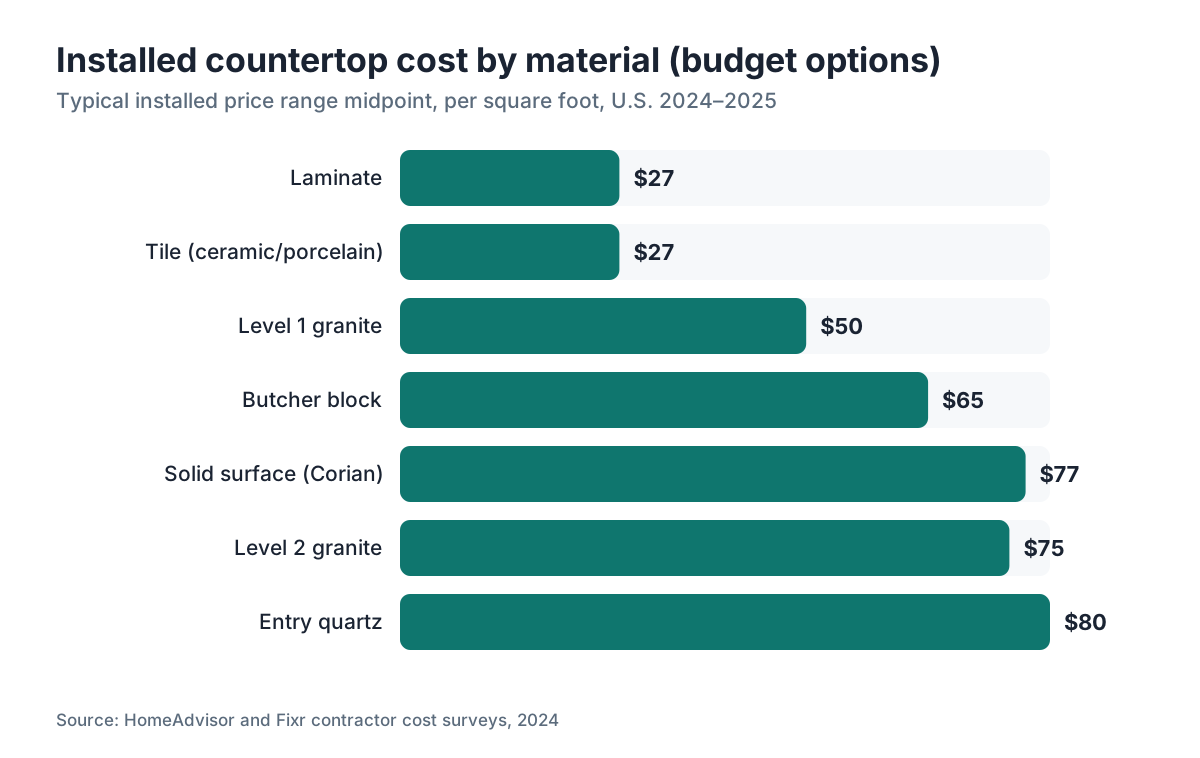
Budget granite competes with laminate, tile, butcher block, solid surface, and entry quartz in the $15 to $90/sq ft installed range. Against most of them, real stone at a synthetic-material price is a strong deal. Here's how they actually compare.
Laminate. Installed laminate countertops cost $15 to $40/sq ft. Modern stone-look prints look convincing and hold up for light use. Laminate doesn't resist heat or sharp impacts like granite, and it can't be refinished once damaged.
Butcher block countertops. Wood counters run $40 to $100/sq ft installed depending on species and thickness. They're warm and repairable (sand out the scratches), but they need oiling, take moisture damage, and the bacteria questions around raw-edge wood near raw meat prep are real enough to handle with care.
Corian countertops. Solid surface like Corian runs $55 to $100/sq ft installed. Seams vanish, the surface repairs cleanly, and it's non-porous without sealing. The trade-off is weaker heat and scratch resistance next to granite.
Tile. Ceramic or porcelain counters install for $20 to $35/sq ft including materials. Grout lines are the ongoing problem: they stain, harbor bacteria, and need maintenance. I wouldn't pick tile over budget granite for a kitchen when the prices are close.
Quartz. Engineered quartz (Cambria, Silestone) runs $70 to $120/sq ft installed. Non-porous, consistent, no sealing. If your budget stretches past $75/sq ft, quartz is worth a hard look over premium granite for the maintenance edge alone. Cambria countertops sit at the high end of quartz pricing with a strong quality reputation.
Budget granite's edge is plain: it's real stone at a price that fights engineered and synthetic materials, and it lasts effectively forever if you seal it.
What hidden costs should you watch for with cheap granite?
The main hidden costs are old-counter removal ($150 to $400), sink and faucet cutouts ($150 to $300 per sink, $50 to $100 per hole), plywood underlayment, sealing, backsplash, and slab overage from waste. The $40/sq ft headline rarely survives contact with a real quote. Here's what gets added.
Removal of existing countertops. Replacing old laminate or tile means someone tears it out. Expect $150 to $400 for a standard kitchen depending on material and who does the work.
Plywood underlayment. Granite needs solid, continuous support. Unsupported cabinet spans or bad substrate add cost.
Sink cutout and reveal polish. As noted, $150 to $300 per cutout. An undermount sink means the edge inside the opening gets ground and polished, which takes time.
Faucet holes. Each drilled hole (faucet, soap dispenser, side sprayer) adds $50 to $100 at many shops.
Sealing. Granite should be sealed at installation and resealed every 1 to 3 years depending on porosity and sealer [6]. Most fabricators include one application at install. DIY resealing material runs $20 to $60 per application. This isn't optional.
Backsplash. Countertop quotes usually leave out backsplash tile and its installation. Budget it separately.
Slab overage. Fabricators cut from whole slabs. Your 42 square feet of counter needs a slab with more area because of cutouts and the waste built into fitting stone to an irregular layout. Billing usually reflects actual slab area used, not net counter area.
For the full picture of what installation involves and costs, the countertop installation guide walks through each step.
How do you find a reputable fabricator for cheap granite without getting ripped off?
Vet a fabricator on digital templating, vertical slab storage, recent references you actually call, a line-item written quote, and a current state contractor's license. The risk with budget granite isn't the stone. It's the workmanship. A bad granite job shows visible seams, uneven edges, misaligned sink cutouts, and chipped edges from careless moving or storage. The stone lasts forever. The install is what varies.
Quality indicators to look for:
Digital templating. A fabricator using a laser templater or digital measuring tool (instead of cardboard) gets tighter seams and better fits. Ask directly.
Stone storage and handling. Slabs belong vertical on padded A-frames, never flat on the floor. A shop storing slabs horizontally has sloppy handling.
References from recent work. Ask for three references from jobs in the past six months, then call them. Ask whether the seams were smooth, whether the sink cutout was clean, and whether the crew was careful.
Line-item written quote. A quote that just reads "granite countertops, $2,200" tells you nothing. You want material cost, fabrication, edge profile, sink cutout, installation, and sealing broken out. That detail means the shop knows its costs and isn't hiding a fat buffer.
State contractor license. Most states require a contractor's license for countertop work because it touches plumbing disconnection. Verify the fabricator holds a current license. Your state contractor licensing board's website has a lookup tool [7].
Shops running modern management software for quoting, job tracking, and waste calculation tend to run tighter operations. A shop quoting on paper and spreadsheets is a shop managing margins loosely.
Can you install cheap granite yourself to save money?
You can install granite yourself, but for a full kitchen it rarely saves more than $400 to $600 after saw rental, blade, adhesive, and the very real risk of cracking a slab. Small drop-in projects are a different story. The stone is unforgiving of mistakes, and the mistakes are expensive.
Granite is heavy. A 3cm slab (the standard residential thickness) weighs roughly 18 to 20 pounds per square foot [8]. A 40-square-foot kitchen might get cut into two or three pieces for transport, but each piece still weighs 150 to 300 lbs and needs multiple people to move safely. Dropping a slab edge on a tile floor or a cabinet face is a costly error.
Seams demand precision. The gap between two granite sections should sit under 1/16 inch for a clean result. Hitting that at home without a CNC saw and a calibrated template is genuinely hard.
Sink cutouts need a wet saw with a diamond blade and steady technique. A chipped inside corner on a cutout is a stress point that can crack the slab under load down the road.
Small jobs are far more realistic. A bathroom vanity top on a single remnant, where the piece drops onto the cabinet with no seam, is a reasonable DIY project if you have help lifting and the patience to work slow. Read up on care before you start. The how to clean stone countertops guide is worth a look before install day.
My honest take on a full kitchen: hire a pro and negotiate the price there. The savings from doing it yourself almost never justify a cracked slab.
How long do cheap granite countertops last, and what maintenance do they need?
Cheap granite lasts the life of the home with basic care, and the only real maintenance is periodic sealing. The Marble Institute of America notes that properly maintained granite countertops can last effectively indefinitely [9]. The stone doesn't degrade, discolor, or lose structure under normal kitchen use.
The maintenance is sealing. Granite is porous to varying degrees by stone, and unsealed granite absorbs liquids over time, which can stain. Stone care manufacturers generally recommend sealing at installation and again every 1 to 3 years depending on density and sealer [6]. Test it yourself: drop a little water on the surface. If it beads, the seal is holding. If it soaks in within a few minutes, reseal.
Daily cleaning is simple. Warm water and dish soap handle most messes. Skip acidic cleaners (vinegar, lemon-based products), which etch the sealer and eventually the stone. Skip abrasive scrubbers. The how to clean stone countertops guide has the full protocol.
Chip and crack repair is possible but not always invisible. Small edge chips get filled with color-matched epoxy by a stone fabricator. Large cracks are trickier and sometimes mean slab replacement if they're structural. Honest context: a granite chip from normal kitchen use is uncommon. The chips that do happen usually come from dropping something heavy right on a corner or edge.
Is cheap granite a good investment for home resale?
For resale, any granite reads as an upgrade over laminate to most buyers, and the tier (Level 1 vs. Level 3) rarely moves the needle outside high-end markets. Spend the savings from Level 1 on cabinets or appliances, which buyers notice more. The data on countertop tier and resale is thin, and honesty demands saying so.
Researchers have studied kitchen renovations broadly, but isolating the value of granite tier, or even granite versus laminate, is something the literature handles poorly. The National Association of Realtors tracks the broad picture: its 2023 Remodeling Impact Report estimates a minor kitchen remodel (countertops included) recoups roughly 75% of its cost at resale on average [10]. "Average" hides wide variance by market, price tier, and what competing homes offer.
The practical read for most homeowners: upgrading from laminate to any granite lands positively with buyers. Choosing Level 1 over Level 3 rarely changes the sale price unless you're in a high-end market where buyers grade stone quality closely. In a median market, New Venetian Gold reads as granite the same way Blue Bahia does.
If resale is the goal, put the savings toward cabinets or appliances.
If a beautiful kitchen you'll live in for years is the goal, Level 2 or Level 3 might be worth the premium. But budget granite doesn't undercut your investment. It's a smart place to spend less.
Frequently asked questions
What is the cheapest type of granite countertop?
Level 1 granite is the least expensive tier. Common examples are Uba Tuba, New Venetian Gold, Santa Cecilia, and Absolute Black. These get quarried at high volume in Brazil and India, which keeps material costs at $10 to $25 per square foot wholesale. Installed prices typically run $40 to $60 per square foot for a standard edge and one sink cutout in most U.S. markets.
Can you get granite countertops for under $1,000?
For a full kitchen, under $1,000 installed is very unlikely unless you're in a rural area with rock-bottom labor. A small bathroom vanity (10 to 15 sq ft) using a remnant can land in the $300 to $700 range. For a kitchen, a realistic floor is around $1,600 to $2,000 for 40 square feet of Level 1 granite with a standard edge and one sink cutout.
Is cheap granite durable enough for a kitchen?
Yes. Granite's durability comes from its mineral composition, not its price tier. All natural granite rates 6 to 7 on the Mohs hardness scale, resists heat, and resists scratching from typical kitchen use. Level 1 granite holds up the same as premium granite under normal conditions. The only real difference is visual complexity and quarry rarity, not physical performance.
What is the cheapest granite color?
Uba Tuba (dark green-black), Absolute Black, New Venetian Gold, and Colonial White are consistently among the least expensive granite colors in U.S. markets. They're cheap because high-volume quarries in Brazil and India produce them from large consistent deposits. Wide availability means competitive pricing from multiple importers, which keeps the cost down.
How much does granite cost at Home Depot or Lowe's?
Home Depot advertises granite installation starting around $45 per square foot installed, including Level 1 material, a basic edge, and standard installation. Lowe's pricing is similar. Both use subcontractor networks, so crew quality varies locally. Add-ons like sink cutouts, decorative edge profiles, or difficult layouts push the total past the advertised starting price.
Are remnant granite slabs worth buying?
Yes, for small projects. Remnants are offcuts from previous jobs sold at a flat fee, often $200 to $800 for a usable piece. If your countertop area is under 20 square feet (a bathroom vanity, laundry counter, or small island), a remnant is almost always the cheapest route. The trade-off is limited color choice, since you take whatever the fabricator has on hand.
Does cheap granite need to be sealed?
Yes. All granite, regardless of price tier, should be sealed at installation and resealed periodically. The standard recommendation is every 1 to 3 years, with denser stones on the longer end. To test yours, drop a little water on the surface. If it soaks in within a few minutes instead of beading, reseal. DIY sealing products run $20 to $60 per application.
Is cheap granite better than laminate?
For most kitchens, yes. Budget granite ($40 to $60/sq ft installed) costs more than laminate ($15 to $40/sq ft) but gives meaningfully better heat resistance, scratch resistance, and longevity. A hot pan won't damage granite; it can blister or warp laminate. Granite also reads as stone to buyers at resale in a way laminate doesn't. If budget is a hard wall, laminate is still a reasonable pick.
How do you get the best price on granite countertops?
Specify Level 1 material, ask for remnants on small projects, choose an eased or beveled edge instead of a decorative profile, collect at least three quotes from local fabricators, and buy during slow season (January and February in cold climates). Each step can trim 10 to 20% off your price. Avoiding rush timelines and cutting down on cutouts also keeps costs down.
What is the difference between Level 1, Level 2, and Level 3 granite?
The levels are a supplier grading system based on visual complexity, rarity, and import cost, not durability or hardness. Level 1 is high-volume, consistent color, quarried at scale, typically $40 to $60/sq ft installed. Level 2 has more movement and variety at $60 to $90/sq ft. Level 3 and up covers rare exotics with dramatic patterns, unusual colors, or hard logistics, at $90 to $150+/sq ft installed.
Can cheap granite crack or chip?
Granite can chip along edges if struck by something heavy, and it can crack under structural stress or inadequate support. These risks apply equally across every price tier. Proper installation with solid support and careful handling during fabrication prevents most damage. Small chips can be repaired with color-matched epoxy by a stone professional, though the fix isn't always invisible.
What questions should I ask a fabricator before buying cheap granite?
Ask whether they have Level 1 remnants, what edge profiles are included in the base price, how many cutouts are included, whether templating is digital or cardboard, and for three recent references. Get a line-item quote, not a single total. Verify they hold a current contractor's license in your state. These questions filter out shops likely to cut corners on workmanship.
How does cheap granite compare to quartz?
Budget granite ($40 to $60/sq ft) costs less than entry quartz ($70 to $90/sq ft), but quartz has one real edge: it's non-porous and needs no sealing. Granite needs periodic resealing to resist stains. For homeowners who won't keep up with sealing, quartz may be the better long-term choice even at a higher upfront cost. For those who will seal on schedule, budget granite is an excellent value.
Is cheap granite a good choice for bathrooms?
Yes, often the best choice. Bathroom vanities are small (typically 10 to 25 sq ft), which makes them ideal for remnants. A remnant of Level 1 granite for a vanity can cost $200 to $600 total, competitive with or cheaper than a prefab vanity top. Granite in a bathroom sees less wear than in a kitchen and holds up extremely well with minimal maintenance.
Sources
- Marble Institute of America, Stone Industry Education: Granite is classified by suppliers into quality tiers; Level 1 slabs wholesale for roughly $10, $25 per square foot depending on origin and volume.
- HomeAdvisor, Granite Countertop Cost Guide: Installed granite countertop prices range from approximately $40, $60/sq ft for budget-tier material up to $150+ for premium stone in 2024 U.S. markets.
- Fixr, Granite Countertop Installation Cost: National contractor-reported data places average granite countertop installation at $40, $100 per square foot depending on material grade and project complexity.
- U.S. Geological Survey, Granite Mineral Resources: Granite rates 6 to 7 on the Mohs hardness scale due to its quartz and feldspar composition, making it highly resistant to scratching.
- USDA Food Safety and Inspection Service, Kitchen Food Safety: Non-porous, sealed stone surfaces are acceptable for food preparation areas in residential settings.
- Marble Institute of America, Care and Maintenance Guidelines: Stone industry guidance recommends sealing granite countertops at installation and resealing every 1 to 3 years depending on porosity and sealer type.
- National Association of State Contractors Licensing Agencies (NASCLA): Most U.S. states require a contractor's license for countertop installation work that involves plumbing disconnection; state boards maintain online license lookup tools.
- Natural Stone Institute, Technical Bulletins: Standard 3cm granite slabs weigh approximately 18 to 20 pounds per square foot, requiring multiple people and proper equipment for safe handling and installation.
- Marble Institute of America, Consumer Education: Properly maintained granite countertops can last the lifetime of the structure; the stone does not degrade under normal residential use conditions.
- National Association of Realtors, 2023 Remodeling Impact Report: A minor kitchen remodel recoups roughly 75% of its cost at resale on average according to NAR's 2023 Remodeling Impact Report.
- U.S. Census Bureau, American Housing Survey: Kitchen remodeling is among the most common home improvement projects tracked in the American Housing Survey, with countertop replacement a frequent component.
Last updated 2026-07-09