TL;DR
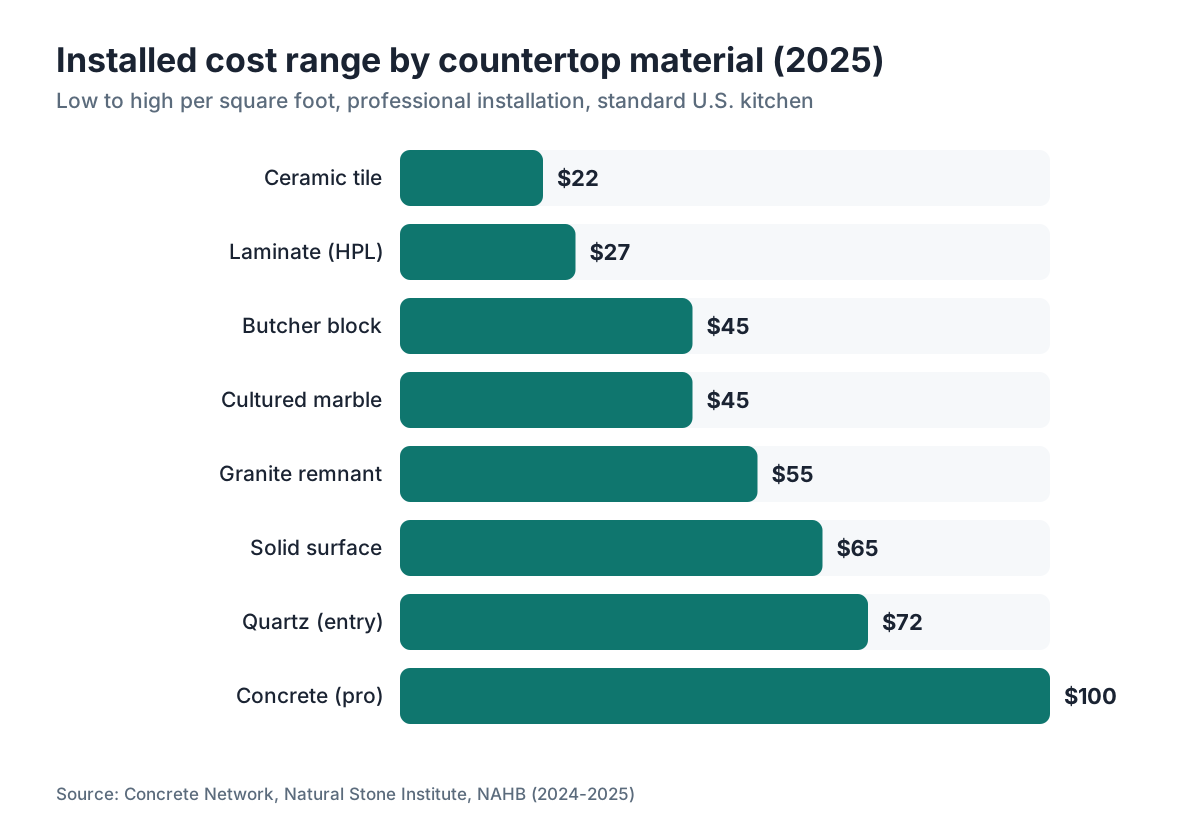
- The cheapest countertop materials installed are laminate ($15-40/sq ft), butcher block ($30-60/sq ft), and tile ($10-35/sq ft).
- Concrete and cultured marble cost a bit more but still beat quartz and granite.
- Each material has a real catch.
- This guide covers installed costs, durability, DIY potential, and which options fabricators say hold up in real kitchens.
What is the cheapest countertop material you can actually live with?
Laminate wins on price, full stop. It runs $15 to $40 per square foot installed, depending on edge profile and pattern complexity, and it holds up fine in a normal kitchen for 10 to 20 years if you keep it dry at the seams [1]. Butcher block comes in second at $30 to $60 installed, and it has something laminate never will: you can sand out a bad gouge and refinish it yourself. Tile can go as low as $10 per square foot for materials, though grout maintenance is the real cost nobody quotes you upfront.
None of these are consolation prizes. Laminate in 2025 is dramatically better than the peeling, bubbling sheets from the 1980s. High-pressure laminate (HPL) brands now print photorealistic stone patterns at resolutions that fool people standing two feet away. Butcher block looks expensive. It photographs well. It has been in high-end kitchens for decades alongside $150-per-square-foot marble.
The honest answer to "what is the cheapest countertop" depends on three things you need to settle before you shop: your tolerance for maintenance, whether you are willing to do any DIY, and how long you plan to stay in the house. A rental flip has different math than a forever kitchen.
How much do cheap countertops cost installed in 2025?
The table below pulls from contractor pricing surveys and material manufacturer published ranges. Installed price means supply plus standard labor for a typical U.S. kitchen with one sink cutout. Your region, edge complexity, and backsplash tie-in will shift these numbers.
| Material | Low ($/sq ft installed) | High ($/sq ft installed) | DIY-friendly? |
|---|---|---|---|
| Ceramic tile | $10 | $35 | Yes |
| Laminate (HPL) | $15 | $40 | Yes (post-form sheets) |
| Butcher block | $30 | $60 | Yes |
| Concrete (DIY mix) | $15 | $25 | Moderate |
| Concrete (pro-cast) | $65 | $135 | No |
| Cultured marble | $25 | $65 | No |
| Solid surface (Corian-type) | $45 | $85 | No |
| Quartz (entry-level) | $55 | $90 | No |
| Granite (remnants) | $35 | $75 | No |
Laminate and tile are the only two where a competent DIYer can bring the installed cost close to the material cost. A post-form laminate countertop from a home center runs $10 to $18 per linear foot as a prefabricated piece, and installation is a trim saw and some silicone. Tile requires a bit more patience but nothing exotic.
Granite remnants deserve a callout. A slab remnant is the leftover piece after a fabricator cuts a larger slab for another job. Remnants often sell for $35 to $60 per square foot installed, putting entry-level granite well inside the "cheap" conversation. A small kitchen or bathroom vanity can frequently be done from a single remnant. Ask fabricators directly; remnant inventory is not usually on a website. [2]
For a deeper look at installation costs across materials, the countertop installation guide breaks down labor line by line.
Is laminate still a good cheap kitchen countertop idea in 2025?
Yes. The objection to laminate used to be that it looked cheap and delaminated at the edges. Neither of those is the automatic fate of a modern HPL countertop. Wilsonart and Formica now produce sheets that credibly mimic Calacatta marble, concrete, and wood grain, printed with offset lithography at 1200 dpi or better, protected by aluminum oxide wear layers. The surface hardness is real: scratch resistance on quality HPL is roughly 400 Newtons by EN 438 test standards, which is harder than most softwoods and comparable to many coatings on solid wood furniture [3].
The genuine weaknesses of laminate are three: heat, moisture at seams, and the fact that damage is hard to reverse. Set a hot pan directly on laminate and you will bubble or scorch the surface permanently. Get water under a seam repeatedly and the particleboard substrate swells and the face lifts. And unlike butcher block, you cannot sand it back. The damage is the damage.
For most kitchens, those weaknesses are manageable. Use a trivet. Caulk seams. Do not run a sink right up to a raw edge without a properly sealed substrate. Laminate around a sink is the failure point almost every time. The laminate countertops and formica countertops guides on this site cover seam sealing and substrate choices in detail.
If you are doing a rental property, a budget flip, or a basement bar, laminate is probably the right call. It is fast to install, easy to replace, and the installed cost can be under $1,000 for a full kitchen.
How does butcher block compare to laminate on price and durability?
Butcher block costs more upfront, about $30 to $60 per square foot installed for standard edge-grain maple or oak, but it has an advantage that matters over time: repairability. A gouge, a burn, a ring stain from a plant pot can be sanded out with 80-grit and refinished with food-safe mineral oil or a hardwax oil finish. For a homeowner who wants to keep a kitchen for 20 years, the lifecycle cost of butcher block can actually undercut laminate if you factor in one or two laminate replacement cycles.
The maintenance ask is real, though. Butcher block needs oiling every one to three months when new, settling to once or twice a year once the wood is saturated. Leave it dry and it checks and cracks. Leave it wet constantly and it warps and grows bacteria in the cracks. It is not the right surface for someone who wants to wipe and forget.
Near the sink is the danger zone, same as laminate. Most fabricators recommend a different material for the sink run and butcher block for the dry prep areas. That is a practical and economical combination: laminate at the sink, butcher block for the island.
The butcher block countertops guide covers species, finish types, and the oiling schedule in full detail.
What about tile countertops: are they actually cheap?
Ceramic tile is the cheapest material by square foot, sometimes under $2 per square foot for the tile itself at a big-box store. The installed number climbs because of substrate prep, setting materials, and grout, landing most projects in the $10 to $35 range depending on tile size and complexity.
The functional problem with tile countertops is the grout lines. Grout is porous and stains. Grout between countertop tiles is lower than the tile surface, which means liquids pool there. You can use epoxy grout to dramatically reduce staining (Laticrete Spectralock is the name contractors reach for), and narrower grout lines help, but you are always managing the grout unless you go with large-format tile and nearly invisible joints.
Tile's real use case in cheap kitchen countertop ideas is a DIYer who wants the absolute lowest material cost and is willing to do the work carefully. The durability of the tile face is excellent: ceramic is essentially impervious to heat, scratch, and most chemicals. The grout is the liability. Sealing grout with a penetrating silicone sealer every one to two years keeps it manageable.
One more thing: tile countertops are harder to cut on than smooth surfaces. The texture and the seams are annoying if you do a lot of cooking prep. If your kitchen is mostly for reheating and you want the lowest possible number, tile is hard to beat.
Can you do a cheap concrete countertop yourself?
Yes, and the cost difference between DIY and professional concrete is enormous. A pro-cast and polished concrete countertop runs $65 to $135 per square foot because of formwork, finishing, grinding, and sealing labor [4]. A DIY pour using a bag-mix like Quikrete 5000 or a concrete countertop mix, done directly in place or cast upside down on a melamine form, can land under $25 per square foot in materials.
The tradeoff is skill and patience. Concrete countertops require proper mixing consistency, reinforcement (typically fiberglass mesh or rebar), a curing period of at least 28 days for full strength, grinding or sanding for a smooth surface, and a penetrating or film-forming sealer that has to be reapplied regularly. The sealer is critical: unsealed concrete stains from coffee, wine, and cooking oil within hours.
For a fabricator pricing concrete jobs, the material cost is the easy part. Labor and the sealer system are where the variability lives. Cheng Concrete and Buddy Rhodes publish formulas and training resources that the DIY community relies on heavily, and their guidance on water-cement ratio and consolidation is worth reading before you pour anything.
If you want a countertop that looks nothing like anything else in your neighborhood, a hand-cast concrete top with integral pigment costs less than entry-level quartz and gets you a genuinely one-of-a-kind surface. The maintenance ask is higher than quartz or laminate. You need to reseal it.
Are granite remnants a legit cheap countertop option?
Granite remnants are legitimately cheap and often overlooked. When a fabricator cuts a large slab for a kitchen, the leftover piece goes into a remnant pile. Those pieces sell for discounts of 40% to 70% off full-slab pricing because the fabricator needs to move inventory and the remnant has no carrying cost after the original slab is paid for [2].
For a bathroom vanity or a small kitchen, one remnant is often all you need. A standard bathroom vanity top is 22 by 48 inches, roughly 7 square feet. A kitchen island can sometimes be done from a single remnant if the island is under 30 square feet. You get real stone, real durability, natural variation, and the same fabrication warranty as a full slab job.
The limitation is color and pattern availability. You get what is in the pile. If you need to match an existing stone, a remnant is unlikely to work. But if you are open to the selection available, you can get a granite countertop installed for $35 to $60 per square foot, which is inside the budget of many options that look far less impressive.
Call local fabricators, not big-box stores. Independent fabricators move remnants faster and price them more aggressively. The granite countertops guide explains what to look for in slab quality and what thickness matters for durability.
Fabricators quoting remnant jobs can save significant time using software that calculates yield from irregular shapes automatically. SlabWise's quoting tool handles remnant nesting and shows material cost in real time, which is useful when you are pricing jobs from odd-shaped inventory.
What cheap countertop options should you actually avoid?
Cultured marble is worth a mention and a caution. It costs $25 to $65 per square foot installed, which puts it in the cheap-to-mid range, and it is common in bathrooms. But it scratches from abrasive cleaners, yellows over time with UV exposure, and the gel coat surface, once damaged, is difficult to repair without professional refinishing. In a bathroom with no direct sunlight and gentle cleaning habits, it lasts. In a heavily used kitchen, it underperforms.
Vinyl peel-and-stick countertop film is the product that shows up in low-budget renovation videos. It runs $1 to $3 per square foot and takes 90 minutes to install. It also peels at seams within months in a humid kitchen environment, does not handle heat at all, and looks like what it is at close range. For a temporary fix before a sale or a short rental, maybe. For anything you have to live with for a year or more, skip it.
Paper composite countertops (Richlite, PaperStone) are real products used in commercial kitchens and some residential builds, but they are not cheap, running $50 to $90 per square foot, and their maintenance requirements are similar to concrete. They are not in this conversation on price alone.
Solid surface like Corian sits at $45 to $85 installed and has real benefits: integrated sinks with no visible joint, repairable surfaces, no grout lines. But that price puts it outside the budget conversation for most shoppers looking at this page. If you can stretch to solid surface, the corian countertops guide is worth reading because it is a better long-term value than its price suggests.
How do cheap countertops affect home resale value?
This is where the numbers get murky. Remodeling Magazine's Cost vs. Value report tracks kitchen remodel returns annually, and the consistent finding is that a midrange kitchen remodel (roughly $27,000 in 2024 dollars) returns about 49 cents on the dollar at resale in the national average [5]. Full kitchen remodels do not pay back dollar for dollar. That math has held steady for over a decade.
Countertop material specifically is not broken out in the data. What the real estate research shows is that buyer perception of kitchen quality matters more than material specs. Laminate that is pristine, well-fitted, and consistent with a clean kitchen reads better to a buyer than cracked tile or a scratched solid surface that cost three times as much.
If you are remodeling to sell, the calculus is: do not spend more on countertops than the improvement in sale price you expect. For a house under $350,000, laminate or butcher block in good condition will satisfy most buyers. For a house in a market where quartz is standard in comparable homes, buyers will notice the difference and negotiate.
For your own home, where you live every day, the cheap option that fits your actual cooking habits and maintenance tolerance beats the expensive option you resent every time you clean it.
What's the cheapest countertop you can install yourself?
Post-form laminate countertops are the easiest DIY countertop installation available. They come pre-made from home centers in standard depths (25 inches for base cabinets) with a pre-applied backsplash lip and a rolled front edge, sold by the linear foot. A circular saw with a fine-tooth blade, a jigsaw for the sink cutout, and silicone adhesive are all you need. A competent first-timer can install a 10-foot kitchen section in a few hours.
Tile is the next easiest, though it requires more steps: cement board substrate, thinset, tile setting, and grouting. None of those steps are technically difficult, but each adds time and the margin for visible error is higher with tile than with a prefab laminate sheet.
Butcher block can be cut with a circular saw, drilled for sink cutouts, and mounted with figure-eight clips. The edge can be routed for a simple profile. The skill ceiling is low, and the material is forgiving of minor fitting errors in a way stone never is.
If you want to get a sense of what a professional shop would charge to fabricate and install any of these materials in your area, the SlabWise instant quote tool lets you enter your dimensions and material and see a real fabricated price before you call a single shop. Useful baseline before you decide whether to DIY.
For a full breakdown of what professional installation includes and what you are paying for, the countertop installation guide covers every step.
How long do cheap countertops last compared to stone?
Lifespan varies more by installation quality and owner habits than by material cost. A poorly installed granite top can fail at the seam in five years. A well-installed laminate top can last 20 years.
That said, the material matters too. Stone (granite, quartzite, even marble) is essentially permanent if it does not crack from impact or improper support. The limiting factors are the finish (a honed surface etches more visibly than polished), the sealer maintenance, and mechanical damage. A granite countertop outlasts most kitchens.
The U.S. Census Bureau's American Housing Survey has tracked housing characteristics including kitchen renovation cycles, and the median kitchen remodel interval in owner-occupied housing is roughly 15 to 20 years [6]. That is the practical planning horizon for a countertop purchase.
Laminate: 10 to 20 years with good care. Butcher block: 20 or more years if oiled and kept dry around the sink. Tile: indefinite on the tile itself, grout regrouting likely needed at 10 to 15 years. Granite: 30 or more years in normal use. That lifespan difference is the real argument for spending more on stone if you plan to stay in a house long-term.
For cleaning and care that extends any countertop's life, the how to clean stone countertops guide applies to natural stone options, and it has transferable principles for surface care generally.
Where can homeowners find the best deals on cheap countertops?
Fabricator remnant piles, as covered above, are the best source for stone at low prices. Call local stone shops, not chain stores. Ask specifically about remnant inventory and whether they have anything in your size range.
Habitat for Humanity ReStores are legitimate. They accept donated countertop materials including stone slabs, solid surface, and butcher block from remodels, and sell them at a fraction of retail [7]. Quality and availability are unpredictable, but checking a local ReStore before you buy new costs nothing.
Big-box stores (Home Depot, Lowe's) sell post-form laminate and tile at commodity prices. Their installed countertop services use third-party fabricators and are sometimes competitive on laminate. For stone, their pricing is typically not lower than a local independent fabricator, and the local shop usually gives you better fit and warranty attention.
Online marketplaces (Facebook Marketplace, Craigslist) occasionally surface full-kitchen laminate or solid surface sections from remodels. If the countertop is in one piece and fits your layout, this can be the cheapest possible option. The obvious risk is sizing and condition; measure twice before you commit.
For kitchen countertops specifically, getting three quotes from local fabricators is still the most reliable way to find market-rate pricing in your area. The variance between shops on the same job can be 30% or more.
Frequently asked questions
What is the cheapest countertop material for a kitchen?
Ceramic tile has the lowest material cost, sometimes under $2 per square foot, but laminate is the cheapest when you add labor because it installs faster and has fewer steps. Installed, laminate runs $15 to $40 per square foot. Tile installed is $10 to $35. Both beat butcher block, solid surface, quartz, and granite on total installed price for most kitchens.
Can you get cheap countertops that still look good?
Yes. High-pressure laminate in 2025 prints stone and wood patterns at high resolution and fools most people at arm's length. Butcher block looks genuinely expensive in photos and in person. Granite remnants give you real stone for $35 to $60 installed. Looking cheap and being cheap are not the same thing, and the products that bridge that gap have gotten substantially better in the past ten years.
How much does a cheap countertop cost for a whole kitchen?
A typical U.S. kitchen has 30 to 50 square feet of countertop. At laminate prices of $15 to $40 per square foot installed, that is $450 to $2,000 total. Butcher block at $30 to $60 installed runs $900 to $3,000. Tile at $10 to $35 is $300 to $1,750. Your specific layout, edge profiles, and whether you have a difficult sink cutout will move those numbers.
Is laminate or butcher block better for a cheap kitchen countertop?
Depends on how you cook. Laminate is lower maintenance: wipe and go, no oiling, no refinishing. Butcher block costs a bit more upfront but you can fix damage yourself and the surface is gentler on knife edges. For a rental or flip, laminate wins on speed and cost. For a kitchen you will use hard for 15 years, butcher block's repairability often makes it the better long-run value.
Are granite remnants cheaper than laminate?
Not always, but they can overlap. Granite remnants sell for $35 to $75 per square foot installed, which is higher than basic laminate but inside the range of premium laminate. For a small kitchen or vanity where one remnant covers the whole job, you get real stone durability, no edge banding, and a surface you cannot easily replicate with laminate, at a price that is not dramatically more expensive.
What cheap countertop is easiest to install yourself?
Post-form laminate from a home center. It comes prefabricated in standard depths with a built-in backsplash, sold by the linear foot. A trim saw and silicone sealant are the main tools. A careful first-timer can install a standard kitchen section in an afternoon. Tile requires more steps and more skill. Butcher block is manageable but requires routing for edges and careful sealing around any cutout.
How long does cheap laminate countertop last?
With normal care, 10 to 20 years. The failure modes are heat (scorched surface from hot pans), moisture at seams (substrate swells and face lifts), and edge damage from repeated impact. None of those are inevitable. Use trivets, caulk seams, and do not abuse the edges, and a quality high-pressure laminate countertop reaches or exceeds its expected lifespan in most kitchens.
Do cheap countertops hurt home resale value?
Not automatically. Remodeling Magazine's 2024 Cost vs. Value report found midrange kitchen remodels return about 49 cents on the dollar nationally, meaning overspending on countertops rarely pays back dollar-for-dollar. Laminate in perfect condition reads better to buyers than damaged stone. In markets where quartz is standard in comparable homes, buyers notice the absence, so the calculus changes depending on your price point and local competition.
What is the cheapest countertop for a bathroom vanity?
Cultured marble is common and runs $25 to $65 installed, but it scratches and yellows over time. A granite or quartz remnant is often comparable in price and dramatically more durable. Laminate works fine in a bathroom if the seams are sealed. For the smallest vanity tops under 20 square feet, a remnant from a local fabricator is often the best combination of price and quality.
Can you use peel-and-stick countertop film as a cheap alternative?
Only as a very temporary fix. Peel-and-stick vinyl countertop film costs $1 to $3 per square foot, installs in under two hours, and looks passable in photos. In practice, it peels at seams in humid kitchens within months, has essentially no heat resistance, and looks obviously synthetic at close range. For a short-term rental staging or a 90-day flip, it can work. For anything you live with beyond a year, it is a waste of money.
Where is the best place to find cheap countertop deals?
Fabricator remnant piles for stone, Habitat for Humanity ReStores for donated materials, and big-box stores for post-form laminate. Online marketplaces occasionally have full laminate or solid surface sections from remodels at very low prices. Call local independent fabricators directly about remnants; they price more aggressively than chain stores and remnant inventory is usually not listed anywhere online.
Is tile a good cheap kitchen countertop idea?
Yes, with caveats. Ceramic tile installed runs $10 to $35 per square foot and the tile face is nearly indestructible against heat and scratch. The grout lines stain and require maintenance. Using epoxy grout (Laticrete Spectralock is widely recommended) and sealing regularly minimizes that problem. Tile is best for heavy heat use and worst for cooks who do a lot of rolling or cutting directly on the surface.
What cheap countertop options work in a rental property?
Laminate is the standard choice for rental countertops: lowest installed cost, fast to replace, and clean-looking when new. Tile is a reasonable alternative if the tenant pool is rough on surfaces, since tile survives abuse better than laminate. Butcher block requires tenant cooperation on oiling and careful sink-area management, which makes it less ideal for rentals. Granite remnants are worth considering for mid-tier rentals where tenant expectations are higher.
Sources
- National Association of Home Builders, Study of Life Expectancy of Home Components: Laminate countertops have an expected lifespan of 10 to 20 years under normal residential use conditions
- Natural Stone Institute, Buying Natural Stone: Fabricator remnants typically sell at 40 to 70 percent below full-slab pricing because inventory carrying cost is minimal after the original slab purchase
- European Committee for Standardization, EN 438 High Pressure Decorative Laminates standard: EN 438 surface scratch resistance test for high-pressure laminate specifies a minimum 400 Newton resistance rating for Class 2 (horizontal) surfaces
- Concrete Network, Concrete Countertop Cost Guide: Professional cast-in-place or precast concrete countertops run $65 to $135 per square foot installed depending on complexity and finish
- Remodeling Magazine, 2024 Cost vs. Value Report: A midrange major kitchen remodel costing approximately $27,000 returns about 49 cents on the dollar at resale in the national average
- U.S. Census Bureau, American Housing Survey: The median kitchen remodel interval in owner-occupied housing is approximately 15 to 20 years based on American Housing Survey tracking of renovation cycles
- Habitat for Humanity, ReStore Home Improvement Stores: Habitat for Humanity ReStores accept and resell donated countertop materials including stone, solid surface, and butcher block at a fraction of retail price
- U.S. Bureau of Labor Statistics, Producer Price Index for Millwork and Cabinetry: Material and labor cost data underlying installed countertop price ranges reflect BLS PPI trends for wood products and construction labor
- Home Innovation Research Labs, Annual Builder Practices Survey: Laminate countertops remain among the most commonly installed countertop materials in new single-family construction due to cost and installation speed
- Tile Council of North America, Handbook for Ceramic, Glass, and Stone Tile Installation: TCNA recommends cement board substrate and epoxy or polymer-modified grout for countertop tile installations to minimize moisture infiltration and staining
- U.S. Department of Housing and Urban Development, Residential Construction Trends: HUD residential construction data tracks kitchen remodeling activity and material adoption rates in owner-occupied housing nationally
Last updated 2026-07-09