TL;DR
- Caesarstone is engineered quartz made from roughly 90 to 93% ground quartz bound with polymer resin.
- Installed prices run $55 to $130 per square foot depending on color series and region.
- It never needs sealing and shrugs off wine, coffee, and knife blades.
- It also chips at thin edges, scorches from a hot pan, and yellows under years of direct sun.
What exactly is Caesarstone quartz?
Caesarstone is an Israeli company founded in 1987 that holds one of the original patents on engineered quartz slabs [1]. The product is not natural stone. It's ground quartz crystals (roughly 90 to 93% by weight) bound with polyester or polymer resins, mixed with pigments and sometimes glass or mirror fragments, then pressed and cured into slabs [2]. The quartz makes it hard and scratch-resistant. The resin makes it non-porous.
That second part changes how you live with it. Granite, marble, and quartzite are all porous to some degree, which is why they need periodic sealing. Caesarstone and other engineered quartz never take sealer because liquids can't get through the resin. Wine, coffee, and cooking oil sit on top instead of soaking in.
Caesarstone makes slabs in Israel and at a plant in Richmond Hill, Georgia, and sells through distributors and stone fabricators worldwide [1]. You won't find it cut to size at a big-box store. A fabricator templates your kitchen, cuts the slab, and installs it. That fabrication and installation is a big chunk of your total price.
How much does Caesarstone cost per square foot?
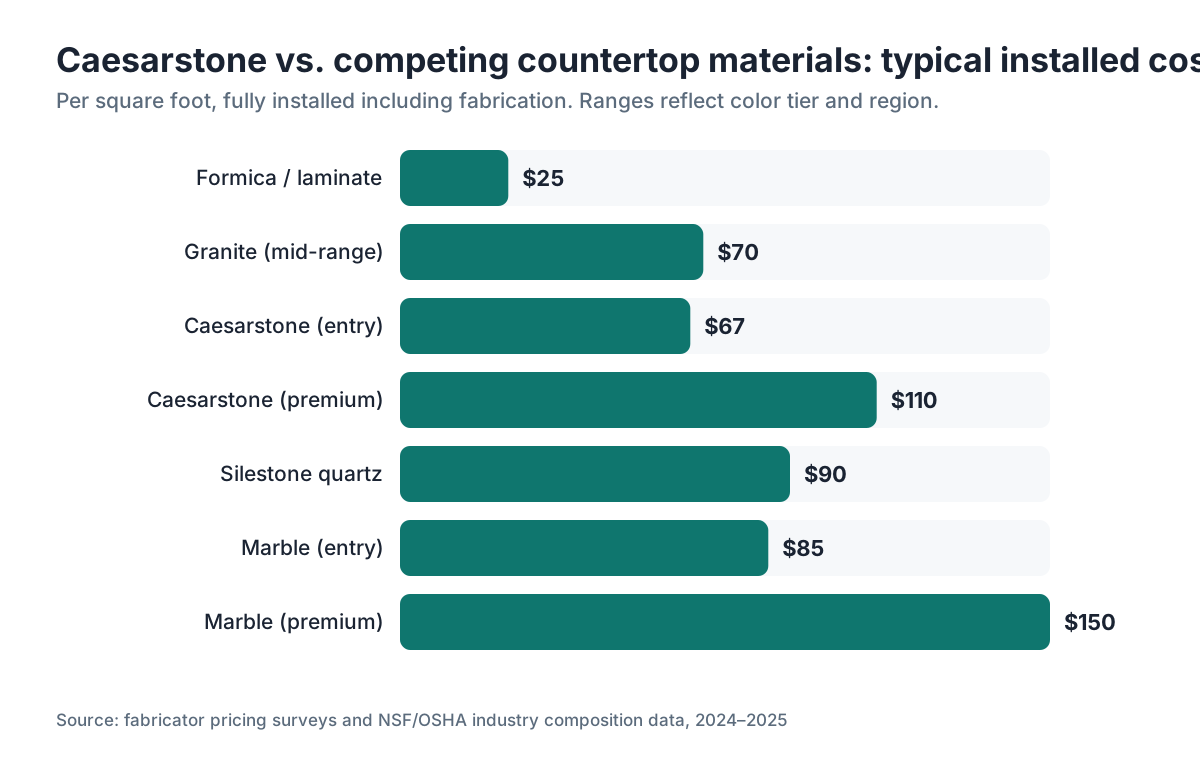
Budget $55 to $130 per square foot installed. Where you land inside that range depends on the collection, the edge profile, cutouts, and your region. Here's a realistic breakdown for 2025:
| Collection tier | Slab material only (per sq ft) | Installed estimate (per sq ft) |
|---|---|---|
| Entry (Classico, Supernatural Concrete) | $25, $40 | $55, $80 |
| Mid (Motivo, Supernatural Marble) | $35, $55 | $75, $105 |
| Premium (Airy Concrete, 5-cm options) | $50, $75 | $90, $130 |
These ranges come from fabricator pricing across 2024 and 2025. Your real number moves with edge profile, sink and cooktop cutouts, island overhangs, backsplash, and labor cost. Coastal metros run higher than the Midwest.
A typical U.S. kitchen has 30 to 45 square feet of countertop. At the midpoint of installed pricing ($85 per sq ft), a 40 sq ft kitchen lands around $3,400. Add a large island, a waterfall edge, or an undermount sink cutout and you're easily over $5,000.
Granite from a local quarry often runs $40 to $75 installed for common colors, so Caesarstone isn't cheap next to natural stone. What you pay for is sameness. Every slab looks like the sample. No veins that shift, no pits that need filling. See our full breakdown on granite countertops.
Waste shows up on your invoice too. A shop that cuts an island from one slab ends up with remnants it can't resell, and that cost sometimes lands on you as a minimum charge or a higher per-foot rate [2].
What are Caesarstone's main collections and colors?
Caesarstone groups its line into named collections that shift over time. As of 2025 the main ones are Classico, Motivo, Supernatural, and Airy Concrete.
Classico is the original line. Solid, simple patterns, mostly whites, grays, and creams. Pure White (2141) and Pebble (5141) have been in the catalog for years and sit in stock almost everywhere.
Motivo has textured surfaces with more movement. Some copy the look of concrete or leather.
Supernatural is built to mimic marble and quartzite veining. Statuario Nuvo and Empira White are popular right now, and this is where most of the upsell pressure lives.
Airy Concrete is the matte, low-gloss group that shows up in modern and Scandinavian kitchens.
The catalog is big, over 40 active colors in North America at any given time. What your local distributor actually stocks is usually 15 to 25 colors. Special orders add lead time (4 to 8 weeks is common) and sometimes leave you on the hook if the project gets cancelled.
If you're weighing quartz countertops generally, Caesarstone's main rivals are Silestone (Cosentino), Cambria (U.S.-made), MSI Q, and Vicostone. Color range and warranty terms vary enough that all four are worth a look when a specific look is driving your choice.
How does Caesarstone hold up in a real kitchen?
Very well for everyday use, with a few real limits that matter. Scratch resistance, stain resistance, and general abuse tolerance are strong. Heat, edge chipping, and long-term sun are where it falls short.
Scratch resistance is genuinely good. Caesarstone rates 7 on the Mohs hardness scale [2], and a steel knife blade sits around 5.5 to 6.5 Mohs, so normal cutting won't scratch it. Still don't cut directly on it. The knife dulls faster than the counter marks, but a bad slip won't ruin the surface.
Stain resistance is excellent for food and drink. Red wine, turmeric, coffee, tomato sauce, all wipe clean off the non-porous top. The catch is harsh chemicals. Strong alkaline cleaners (oven cleaner, drain opener), paint strippers, and acetone nail polish remover can etch or dull the resin. Caesarstone spells this out in its care guide [3].
Heat surprises people. Caesarstone's warranty excludes damage from direct heat [3]. The resin can scorch, discolor, or crack when a hot pan lands on it bare. A quick touch from a 400 degree F pan probably leaves no mark. A cast iron skillet pulled straight from a 500 degree F oven absolutely can. Don't test it. Use a trivet.
Edge chipping is the other common complaint. Thin eased or beveled edges chip if a heavy pot clips the corner. Thicker slabs (3cm over 2cm) hold up much better, which is why most fabricators push 3cm quartz for kitchens.
UV lightens or yellows some colors over years of direct sun. Caesarstone knows this, and outdoor installation voids the warranty [3]. A south-facing window that runs sun across the counter all afternoon can shift lighter colors over 5 to 10 years.
What is Caesarstone's warranty and what does it cover?
Caesarstone offers a limited lifetime warranty on residential installs and a 10-year warranty for commercial use [3]. It covers manufacturing defects in the slab itself. It does not cover the things that actually break countertops in real homes.
Excluded: thermal shock from hot pans, chips from impact, damage from bad cleaning products, outdoor use, installation errors, and normal wear. The warranty also requires installation by a certified Caesarstone fabricator to stay valid.
In practice, valid claims are almost always about material defects like cracks inside a slab or color inconsistency, not the excluded stuff. If your counter chips because a cast iron pan dropped on it, that's on you, not the warranty.
The "lifetime" label is a marketing choice. In most readings it holds only while the product stays in its original location with the original owner. Read the specific warranty document, because terms have changed across product years [3].
Before you lean on any manufacturer's warranty language, read the Federal Trade Commission's guidance on what "lifetime" and "limited" actually mean under U.S. law [4]. The FTC states that under the Magnuson-Moss Warranty Act a written warranty on a consumer product must be labeled "full" or "limited" so buyers know the coverage before they buy. That distinction is worth understanding before you hand over five grand.
How does Caesarstone compare to granite, marble, and other countertop materials?
This is the question most homeowners are actually asking. Here's a direct comparison across what matters:
| Factor | Caesarstone quartz | Granite | Marble | Silestone (quartz) | Formica (laminate) |
|---|---|---|---|---|---|
| Installed cost (per sq ft) | $55, $130 | $40, $100 | $60, $150+ | $55, $125 | $15, $35 |
| Sealing required | No | Yes, 1 to 3 yrs | Yes, annually | No | No |
| Heat resistance | Moderate (trivet needed) | High | Moderate | Moderate | Low |
| Scratch resistance | High (7 Mohs) | High (6 to 7 Mohs) | Low (3 to 4 Mohs) | High | Low |
| Stain resistance | Excellent | Good (sealed) | Poor | Excellent | Good |
| UV resistance | Poor (indoor only) | Good | Good | Poor | Moderate |
| Unique/natural look | No (consistent) | Yes | Yes | No | No |
| Outdoor use | No | Yes | Yes | No | No |
Granite countertops are a real alternative if you want something natural and you're fine sealing it now and then. Marble countertops are gorgeous, but etching from lemon juice and vinegar is a real problem that quartz skips entirely. Laminate countertops cost a fraction of the price and the realistic prints have gotten shockingly good, though durability is genuinely lower.
Caesarstone's core advantage over natural stone is that what you see on the sample is what you get across every slab, and maintenance disappears. Its core disadvantage is that same sameness. The patterns lack the organic variation that makes some natural stone look extraordinary.
Is Caesarstone safe? Does it contain silica dust risks?
The finished countertop in your kitchen is safe. The danger is in the fabrication shop, not your home. That distinction is the whole answer, and it deserves the detail below.
Engineered quartz including Caesarstone is 90 to 93% crystalline silica [2]. Cutting, grinding, and polishing the slabs throws off respirable silica dust. Long-term occupational exposure causes silicosis, an irreversible lung disease, and IARC classifies crystalline silica from occupational sources as a Group 1 known human carcinogen [5].
OSHA set the permissible exposure limit for respirable crystalline silica at 50 micrograms per cubic meter of air as an 8-hour time-weighted average, effective for construction and general industry across 2017 and 2018 [6]. The rule leans on engineering controls (wet cutting, local exhaust ventilation), more than respirators.
For fabricators: the silica standard is not optional, and enforcement has climbed. Quartz at 90%+ silica is a higher exposure risk than natural granite, which typically runs 20 to 45% quartz [10]. Shops running dry saws and dry polishing wheels without dust control are exposed to both worker harm and citations.
For homeowners: your installed counter poses no silica risk. The silica is locked in resin. You're not grinding it. Cooking and cleaning don't release dust. The risk lives entirely in the cutting environment.
Australia saw clusters of silicosis in young countertop fabricators and banned engineered stone countertops entirely as of July 1, 2024, per Safe Work Australia. The U.S. hasn't banned the material, but OSHA's silica standard covers exactly this exposure [6].
How should you clean and care for Caesarstone countertops?
Warm water, a few drops of mild dish soap, and a soft cloth handle almost everything. Caesarstone's own guidance is to use non-abrasive household cleaners and stay inside a pH of roughly 5 to 10 [3]. That's the entire daily routine.
For dried-on spills, a plastic scraper (never metal) lifts the crud without risk. Adhesive residue from tape or labels comes off with a little isopropyl alcohol on a cloth, then rinse it quickly.
Skip these: full-strength bleach cleaners, oven cleaner, Goo Gone with petroleum distillates, and any abrasive pad. Steel wool is an obvious no. Even a mild scouring powder like Comet dulls a polished finish over time.
Matte and textured finishes like the concrete series follow the same rules, but they show fingerprints and water spots more than a polished surface. Some people love the look. Some hate wiping constantly.
For broader stone cleaning, the same pH-safe logic applies to natural stone too: how to clean stone countertops covers the wider category.
One thing you never need: sealer. Not once. That isn't a marketing line, it's just how a non-porous resin works. If a fabricator or salesperson tries to sell you a quartz sealer, walk away from that upsell.
What's the fabrication and installation process for Caesarstone?
Four steps: template, cut, edge, install. Knowing the sequence saves you from surprises on timeline and cost.
Step 1 is the template. After cabinets are set and level, a fabricator measures by hand or with a digital tool (laser or photogrammetry) to capture your exact layout. That template drives the CNC cutting. Template to install is usually 5 to 10 business days for in-stock colors.
Step 2 is cutting. The fabricator programs a CNC waterjet or bridge saw to cut the slab to shape. Caesarstone slabs run about 56 x 120 inches or 63 x 126 inches depending on the collection [1]. Sink cutouts, cooktop holes, and mitered edges get cut in the same pass.
Step 3 is edge profiling. Your chosen profile (eased, beveled, bullnose, ogee, mitered waterfall) gets routed and polished. Hand labor varies most here. A simple eased edge takes minutes. A full ogee on a 10-foot island takes far longer and costs more.
Step 4 is installation. Installers carry the slabs in, set them on the cabinets with silicone and shims, then caulk seams and wall joints. Seams are never invisible on any material, quartz included. Good placement and color-matched epoxy minimize them, but plan for a seam on any run longer than the slab.
For fabricators quoting these jobs: the nesting step (how you lay cuts on a slab to cut waste) hits real dollars. Manual nesting leaves more waste than optimized nesting software. SlabWise's quoting and nesting tools are built for exactly this, so you can price accurately and shave material cost before the job starts.
Install day runs 2 to 6 hours for a typical kitchen. Cabinets need to be fully in and plumbing roughed before counter day. Don't schedule the countertop until the cabinets are truly done.
Who should (and shouldn't) buy Caesarstone?
Buy Caesarstone if you want a consistent look across a big kitchen with no slab-matching worries, you never want to think about sealing, you cook hard or have kids and need a surface that takes abuse, or you're prepping a home for sale and want a premium counter that photographs well.
Skip it if you're on a tight budget (laminate countertops or formica countertops do the job for a fraction of the price), you want the character of real stone veining that no engineered product fully copies, you have real outdoor counter area (Caesarstone is indoor only), or you're a fabricator whose shop lacks silica dust controls. Get those controls before you cut high-silica quartz at volume.
Some buyers fixate on the brand name. Caesarstone has strong recognition, but so does Cambria, which is American-made with a comparable warranty. At the same price and color match, the brand matters less than the fabricator. A great fabricator with a no-name quartz beats a mediocre one with Caesarstone every time. The seams, the polish, the level install: that's what you actually live with.
For a wider look at surface options, kitchen countertops covers the full range with cost and use-case breakdowns.
Where is Caesarstone made and how is it distributed in the U.S.?
Caesarstone was founded in Kibbutz Sdot Yam, Israel, and that plant still makes a large share of global volume [1]. The company opened a U.S. plant in Richmond Hill, Georgia in 2016 that supplies part of the North American market [1].
In the U.S., Caesarstone sells through regional stone distributors and stocking dealers. You'll find slabs at major distributors like MS International (MSI), Marble and Granite Inc., and regional operations. Home Depot carries some Caesarstone products through a fabricator partner network, not as direct DIY purchase.
Caesarstone has a "Find a Dealer" tool on its website [1] that shows local distributors and current inventory. Check real slab availability before you fall for a color. A color that shows online but sits backordered 8 weeks can drag a remodel timeline out badly.
On trade: products from Israel imported into the U.S. can qualify for duty-free treatment under the U.S.-Israel Free Trade Agreement, in effect since 1985 [8]. It doesn't swing retail pricing dramatically, but the material avoids the tariff burden that has hit some Chinese-made quartz.
Is Caesarstone a good investment for resale value?
Nobody has clean controlled data on quartz brand versus resale value. Appraisers and buyers see "quartz countertops" as a category, not a brand. Caesarstone helps in a listing because it's recognizable, but the premium over any other quality quartz is probably small.
The National Association of Realtors' 2022 Remodeling Impact Report found kitchen upgrades overall returned about 67 cents on the dollar at resale [9]. That figure covers a full kitchen, more than counters. Countertop replacement alone is a slice of that.
What the data does support: going from beat-up laminate or dated tile to stone-look quartz moves buyer perception and returns competitive value. Going from perfectly good quartz to premium Caesarstone is a lifestyle purchase, not a financial one.
If budget is tight and resale is the goal, a mid-grade Caesarstone or a competitor at $65 to $85 installed does roughly the same work as the $110 premium tier. The buyer of your home will never know the collection name.
Frequently asked questions
How long do Caesarstone countertops last?
With normal care, Caesarstone should last the life of the kitchen, 20 to 30+ years. The resin binder doesn't break down under typical indoor conditions. Chips and cracks from impact are the most common reason for early replacement, not wear. The material carries a limited lifetime warranty for residential use, but that covers manufacturing defects, not physical damage you cause.
Can you put hot pans on Caesarstone?
No. Caesarstone warns against setting hot pans, pots, or electric skillets directly on the surface, and thermal damage voids the warranty. The resin can scorch or crack from sudden heat above roughly 150 degrees C (300 degrees F). Always use a trivet or hot pad. Brief contact with a warm pan is low risk. A 500 degree F cast iron skillet straight from the oven is genuinely dangerous to the surface.
Does Caesarstone need to be sealed?
No. Caesarstone is non-porous thanks to its polymer resin, so sealing does nothing. Liquids can't get into the surface. If anyone tries to sell you a quartz sealer, skip it. This is one of the main practical advantages over natural stone like granite or marble, which do need periodic sealing to prevent staining.
What is the difference between Caesarstone and Silestone?
Both are engineered quartz with similar makeup, about 90 to 93% quartz bound with polymer resin. Silestone is made by Spain's Cosentino Group. The differences are color selection, warranty terms (Silestone offers 25 years on some products), price (roughly comparable), and what's in stock at your local distributor. Fabricator preference and regional availability usually drive the choice more than the products themselves.
Can Caesarstone be used outdoors?
No. Caesarstone excludes outdoor installs from its warranty. The resin yellows and degrades under prolonged UV and freeze-thaw swings. If you need outdoor counters for a grill station or outdoor kitchen, look at porcelain tile, natural granite, or a material specifically rated for outdoor use.
How do you repair a chip in Caesarstone?
Small edge or corner chips fill with color-matched epoxy from a quartz repair kit. It rarely matches perfectly on a polished surface, but it beats leaving raw material exposed. For larger cracks or interior damage, a fabricator may fill and polish the area. Bad damage usually means replacing a slab section. Fix it fast, because damage tends to spread.
Is Caesarstone quartz safe to use in a kitchen?
Yes, for homeowners using the finished product. The quartz is locked in resin and doesn't release silica dust during normal cooking and cleaning. The silica risk sits entirely with the workers cutting and polishing the slabs. The finished countertop is food-safe and non-toxic under normal kitchen use.
How thick is a Caesarstone countertop?
Caesarstone comes in 2cm (about 3/4 inch) and 3cm (about 1-1/4 inch). For kitchen counters, 3cm is the standard and most fabricators default to it. It's heavier, stiffer, and less prone to edge chipping. The 2cm goes into vertical work like backsplashes or furniture. Waterfall edges usually need matching 3cm slabs mitered at the corner.
What are the most popular Caesarstone colors right now?
As of 2024 to 2025, the Supernatural Marble series (whites and soft grays with veining, like Statuario Nuvo and Empira White) drives most premium sales. For cheaper options, the Classico whites (Pure White 2141, Fresh Concrete 4033) stay steady sellers. Matte concrete-look colors have grown in the modern and minimalist market. Availability varies by region and distributor stock.
Can Caesarstone be used for bathroom vanities?
Yes, and it works well there. The non-porous surface resists soap scum, toothpaste, and water spotting better than most natural stone. Bathroom use skips most of the heat risk that comes with cooking. Same cleaning rules apply: mild soap and water, no harsh chemicals. Caesarstone is a popular pick for master bath vanities where a consistent look across multiple tops matters.
How long does Caesarstone countertop installation take?
Template to installed counter usually takes 5 to 10 business days for in-stock colors, longer for special orders. Install day itself runs 2 to 6 hours for an average kitchen. Cabinets must be fully installed and level before templating. After install, silicone needs about 24 hours to cure before the counter sees heavy use or the sink gets reconnected.
Is Caesarstone cheaper than granite?
Usually not. Mid-range granite runs $40 to $75 per square foot installed for common colors. Caesarstone starts around $55 and climbs well above $100 for premium collections. On pure cost, granite is often cheaper, especially near active quarries. The trade-off: granite needs periodic sealing and every slab looks different, which is a plus or a headache depending on your priorities.
What cleaner should I use on Caesarstone daily?
Warm water and a few drops of mild dish soap on a soft cloth. For sticky or dried-on messes, a plastic scraper first, then the soap-and-water wipe. Caesarstone recommends staying inside a pH of 5 to 10. Skip full-strength bleach, abrasive powders, and acetone products. A microfiber cloth and dish soap outperform most specialty stone cleaners.
Does Caesarstone quartz yellow over time?
It can, mostly under direct prolonged sunlight. UV degrades the resin binder and can push lighter colors toward yellow or cream over years. That's why Caesarstone voids the warranty for outdoor installs. Indoors, normal ambient light is fine, but a kitchen with a big south-facing window running direct sun across the counter for hours a day may see very white surfaces shift over 10+ years.
Sources
- Caesarstone Ltd., corporate and product overview: Caesarstone founded 1987 in Israel, U.S. manufacturing plant in Richmond Hill GA, slab dimensions and collection details
- NSF International, engineered stone composition and hardness: Engineered quartz slabs contain approximately 90 to 93% ground quartz by weight bound with polymer resin; quartz hardness approximately 7 on Mohs scale
- Caesarstone, care, maintenance and warranty documentation: Caesarstone warranty excludes thermal shock, impact chips, outdoor use, and improper cleaners; residential limited lifetime warranty; prohibition on harsh chemical cleaners above pH 10
- U.S. Federal Trade Commission, warranties on consumer products (Magnuson-Moss Warranty Act guidance): FTC guidance on what 'lifetime' and 'limited' warranty terms legally mean for consumer products under the Magnuson-Moss Warranty Act
- International Agency for Research on Cancer (IARC), Monograph on crystalline silica: Crystalline silica inhaled from occupational sources is classified as a Group 1 known human carcinogen (causes lung cancer and silicosis)
- OSHA, Occupational Exposure to Respirable Crystalline Silica, 29 CFR 1926.1153 / 1910.1053: OSHA PEL for respirable crystalline silica is 50 micrograms per cubic meter (8-hour TWA); rule effective 2017 to 2018 for construction and general industry; requires engineering controls
- Office of the U.S. Trade Representative, U.S.-Israel Free Trade Agreement: U.S.-Israel Free Trade Agreement in effect since 1985 allows duty-free treatment for qualifying products imported from Israel
- National Association of Realtors, 2022 Remodeling Impact Report: Complete kitchen renovations recover approximately 67 cents per dollar of cost at resale according to NAR 2022 Remodeling Impact Report
- OSHA, Table 1 Engineering and Work Practice Controls, Silica Standard for Construction: OSHA identifies engineered stone with high silica content as presenting higher exposure risk than natural granite during fabrication; requires wet methods and local exhaust ventilation
Last updated 2026-07-09