What Is Standard Overhang?
Quick Definition
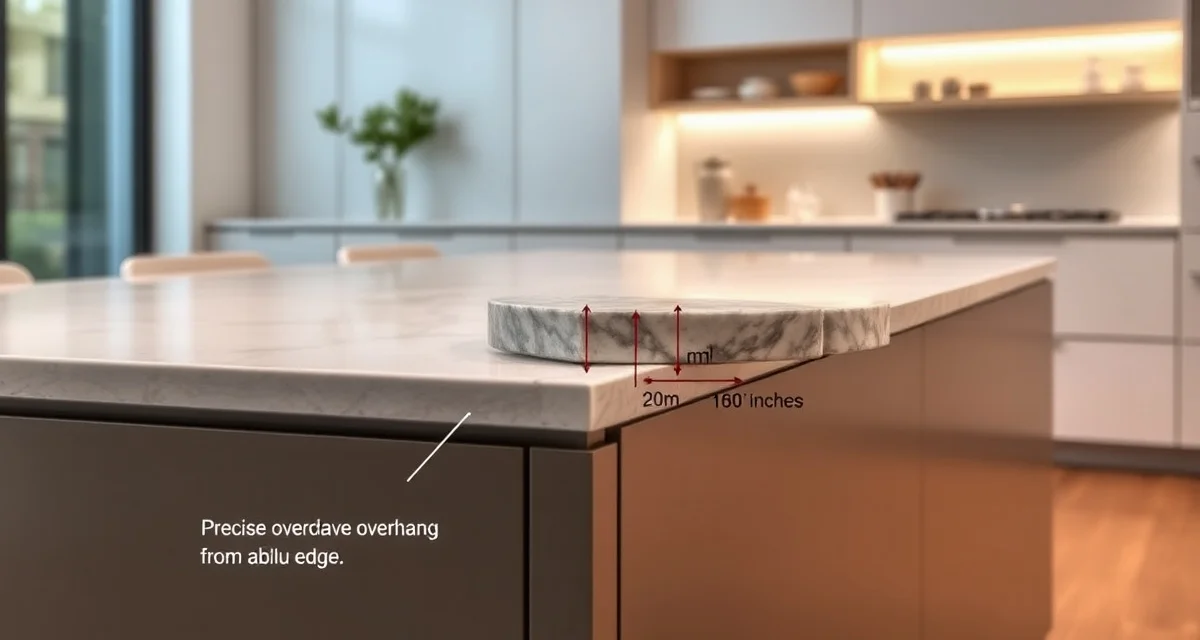
Standard countertop overhang is 1 to 1.5 inches past the face of the base cabinet. This small projection protects cabinet doors and drawer fronts from spills while providing a comfortable edge to grip or lean against. For bar-height seating areas, the standard overhang extends to 12-15 inches to allow space for knees and stools. Overhangs beyond 10-12 inches typically require support brackets.
TL;DR
- Standard front overhang is 1-1.5 inches past the cabinet face
- Bar/eating overhang is 12-15 inches for comfortable stool seating
- Unsupported overhang limits depend on material - granite and quartz can safely extend 10-12 inches without support
- Overhangs beyond 10-12 inches need steel brackets, corbels, or a support structure
- The overhang is measured from the face of the cabinet (not the wall)
- Side overhangs (on exposed cabinet ends) are typically 1 inch
- Overhang preferences are recorded during the template appointment
- Excessive unsupported overhang is a leading cause of countertop cracks
Standard Overhang Dimensions by Application
| Application | Overhang Distance | Support Required? |
|---|---|---|
| Standard front edge | 1-1.5" | No |
| Side (exposed cabinet end) | 0.5-1" | No |
| Back (against wall) | 0-0.25" | No |
| Breakfast bar / eating area | 12-15" | Yes (at 10-12"+) |
| Island with seating on one side | 12-15" | Yes (at 10-12"+) |
| Island with no seating (decorative) | 1.5-3" | Usually no |
| Peninsula with seating | 12-15" | Yes (at 10-12"+) |
| Desk or workspace | 10-12" | Depends on material |
Why the Standard Is 1-1.5 Inches
The 1-1.5 inch standard exists for several practical reasons:
Calculate your material waste savings
See exactly how much slab material and money you could save with optimized cutting layouts.
Try the free Waste CalculatorDrip protection. When liquids spill on the countertop, the overhang directs drips away from the cabinet face below. Without adequate overhang, water and other liquids run down the cabinet doors, damaging the finish over time.
Comfortable edge. A slight overhang creates a finished edge that is comfortable to lean against or grip when standing at the counter. A countertop that is flush with the cabinet face feels flat and unfinished.
Door and drawer clearance. Cabinet doors and drawers with knobs or pulls need slight clearance from the countertop edge above them. The overhang provides this clearance while keeping the countertop visually aligned with the cabinet face.
Visual proportion. From a design perspective, 1-1.5 inches creates a subtle shadow line that defines the countertop as a distinct element from the cabinets. Too much overhang looks heavy; too little looks unfinished.
Bar and Seating Overhang Requirements
When countertops double as eating or workspace areas, the overhang needs to be substantially deeper to accommodate seating.
Minimum Overhang for Seating
| Seating Type | Counter Height | Recommended Overhang | Min. Knee Space |
|---|---|---|---|
| Counter-height stools (24-26") | 36" | 12-15" | 12" |
| Bar-height stools (28-30") | 42" | 12-15" | 12" |
| ADA-accessible wheelchair | 34" max | 19" min | 27" height clearance |
The National Kitchen & Bath Association (NKBA) recommends a minimum of 12 inches of overhang for seating areas, with 15 inches being more comfortable. The deeper the overhang, the easier it is to sit without bumping your knees on the cabinet face below.
Width Per Seat
Allow 24-30 inches of counter width per seated person. A 6-foot island section accommodates 2-3 stools comfortably. Crowding more seats than the space allows leads to an uncomfortable eating experience.
Support Requirements by Material and Distance
Different materials have different structural properties, which affects how far they can safely overhang without support.
Maximum Unsupported Overhang by Material
| Material | Thickness | Max Unsupported Overhang |
|---|---|---|
| Granite (3cm) | 1.25" | 10-12" |
| Quartz (3cm) | 1.25" | 10-12" |
| Quartzite (3cm) | 1.25" | 10-12" |
| Marble (3cm) | 1.25" | 8-10" |
| Porcelain (12mm) | 0.5" | 6-8" |
| Dekton (12mm) | 0.5" | 6-8" |
| Granite (2cm) | 0.75" | 6-8" |
| Quartz (2cm) | 0.75" | 6-8" |
| Concrete | 1.5-2" | 8-10" |
| Laminate | 0.75" | 10-12" (with subtop) |
These are general guidelines. Actual limits depend on the specific slab's mineral composition, the presence of natural fissures (in stone), and whether the overhang has cutouts nearby that weaken the section.
Types of Overhang Support
When the overhang exceeds the material's unsupported limit, you need one of these support systems:
Steel brackets (most common for stone):
- L-shaped brackets screwed into the cabinet frame or wall studs
- Hidden beneath the countertop, not visible from normal standing height
- Rated for hundreds of pounds of load capacity
- Spaced every 24-30 inches along the overhang
Corbels (decorative support):
- Visible brackets made from wood, metal, or stone
- Serve both structural and decorative purposes
- Popular in traditional kitchen designs
- Must be properly secured to framing, not just the cabinet box
Plywood subtop (for thin materials):
- A layer of 3/4" plywood spanning the cabinet tops and extending to the overhang edge
- Provides continuous support for thinner materials like laminate or 2cm stone
- Hidden beneath the countertop
Legs or posts:
- Used for very large overhangs (18"+) or island designs where brackets are not practical
- Can be decorative (turned wood, stainless steel) or utilitarian
How Overhang Is Determined During Fabrication
The overhang is finalized during the template appointment. Here is how it typically works:
- The technician measures from the cabinet face - not the wall. The cabinet face determines the front overhang.
- Standard 1-1.5" is assumed unless you request otherwise.
- For seating areas, you tell the technician how much overhang you want (12-15" is typical).
- The template records the exact overhang at every point along the front edge - this matters because cabinets are not always perfectly aligned.
- The fabrication shop cuts to the specified overhang. If the overhang varies by even 1/4" along the front edge, it is visually noticeable.
This is where precision matters. If the template captures inconsistent overhang measurements (because the cabinets are not aligned or the technician was not careful), the finished countertop will look uneven from the front. Digital templating helps because it captures exact measurements at many points, allowing the fabricator to produce a consistent overhang even when cabinet faces are not perfectly aligned.
Template verification software like SlabWise catches inconsistencies in overhang measurements before the slab is cut. If the data shows the overhang jumping from 1.25" to 1.75" to 1" along a straight run, it flags the issue. The shop can then verify whether the cabinets are misaligned or the template data needs correction.
Common Overhang Mistakes
Mistakes Homeowners Make
- Requesting too much unsupported overhang - "I want 14 inches for seating but I do not want brackets." This is unsafe and risks cracking.
- Not accounting for stool size - Choosing 12" overhang with chunky stools that need 15".
- Ignoring ADA requirements - If anyone in the household uses a wheelchair, the overhang and counter height need specific clearances.
Mistakes Fabricators Make
- Inconsistent overhang - Failing to maintain uniform overhang along a run due to cabinet misalignment or measurement issues.
- No support brackets specified - Cutting a 14" overhang without confirming that support brackets are being installed by the contractor.
- Cutting overhangs near weak points - Large overhangs near sink cutouts create thin, fragile sections that can crack under load.
How Overhang Affects Cost
Overhang depth has a modest impact on overall project cost:
| Overhang Change | Cost Impact |
|---|---|
| Standard (1-1.5") | Included in base price |
| Extended (2-3" for decorative) | Minimal - may use slightly more material |
| Bar seating (12-15") | +$200-$600 for additional material |
| Support brackets | +$50-$150 per bracket (installed) |
| Corbels (decorative) | +$50-$300 per corbel |
The material cost increases roughly proportionally with overhang depth, since the countertop section is deeper. But the biggest cost consideration is support - if you need 4-6 brackets at $75-$150 each, that adds $300-$900 to the project.
What is the standard countertop overhang?
The standard front overhang is 1 to 1.5 inches past the face of the base cabinet. This provides drip protection, a comfortable edge, and clearance for cabinet hardware.
How far can granite overhang without support?
Standard 3cm (1.25-inch thick) granite can safely overhang 10-12 inches without support brackets. Beyond that, steel brackets or corbels are needed. Thinner 2cm granite should not overhang more than 6-8 inches unsupported.
What overhang do I need for bar stools?
A minimum of 12 inches is needed for bar stool seating, with 15 inches being more comfortable. The overhang creates knee space so you can sit without hitting the cabinet face below.
Do quartz countertops need support brackets?
For standard 1-1.5 inch overhangs, no. For extended overhangs beyond 10-12 inches (like bar seating areas), yes. Quartz has similar structural properties to granite and follows the same support guidelines.
Can a countertop overhang too much?
Yes. Excessive unsupported overhang creates a lever point that can crack the countertop, especially when someone leans or sits on the edge. Always follow the manufacturer's and fabricator's recommendations for maximum unsupported spans.
What is the overhang on an island?
Islands follow the same rules as perimeter counters. The standard overhang on non-seating sides is 1-1.5 inches. The seating side typically has 12-15 inches of overhang with support brackets underneath.
Does overhang affect counter depth?
Yes. Standard base cabinets are 24 inches deep. With a standard 25.5-inch countertop (24" cabinet + 1.5" overhang), the counter sits slightly forward of the cabinet face. Deeper overhangs increase the total countertop depth.
How many support brackets do I need?
Space brackets every 24-30 inches along the unsupported overhang. For a 6-foot bar overhang, you would need 3-4 brackets. The exact count depends on material thickness and the overhang distance.
Is overhang the same on all sides?
No. The front overhang is typically 1-1.5 inches. Side overhangs (on exposed cabinet ends) are usually 0.5-1 inch. The back (against the wall) has minimal or zero overhang - the countertop is cut to fit snugly against the wall.
Can I change the overhang after installation?
No. Once the countertop is cut and installed, the overhang is fixed. This is why confirming overhang preferences during the template appointment is important. Changes after fabrication require a new countertop piece.
What happens if my cabinets are not aligned?
If cabinet faces are not in a straight line, the fabricator has two options: cut the countertop to follow the cabinet misalignment (resulting in wavy overhang), or cut a straight front edge (resulting in varying overhang depth). Most fabricators cut a straight front and accept slight overhang variation, which is why checking cabinet alignment before the template is important.
Does overhang affect countertop stability?
The standard 1-1.5 inch overhang does not affect stability. The weight of stone or quartz (15-20 lbs per square foot) keeps the countertop firmly in place. Extended overhangs for seating create more leverage, which is why support brackets are required.
Every Inch Matters
Getting the overhang right means getting the template right. For fabricators, SlabWise's template verification flags overhang inconsistencies before they result in a countertop that looks uneven or is structurally unsound. Catch the errors before the saw, not after the install. Start your 14-day free trial.
Try These Free Tools
- Photo to Template -- Snap a photo of an existing countertop and get an AI-generated DXF template.
- Template Compare -- Upload two templates and see every dimension change highlighted instantly.
- AI Template Verification -- Cross-check your template against manufacturer specs before cutting.
Sources & Further Reading
- Natural Stone Institute - Countertop Support Guidelines
- International Surface Fabricators Association - Structural Support Requirements
- National Kitchen & Bath Association - Countertop Installation Standards
- ASTM International - C1526 Standard Specification for Serpentine Dimension Stone