How Are Countertops Installed?
Quick Definition
How are countertops installed is a common question from first-time buyers.
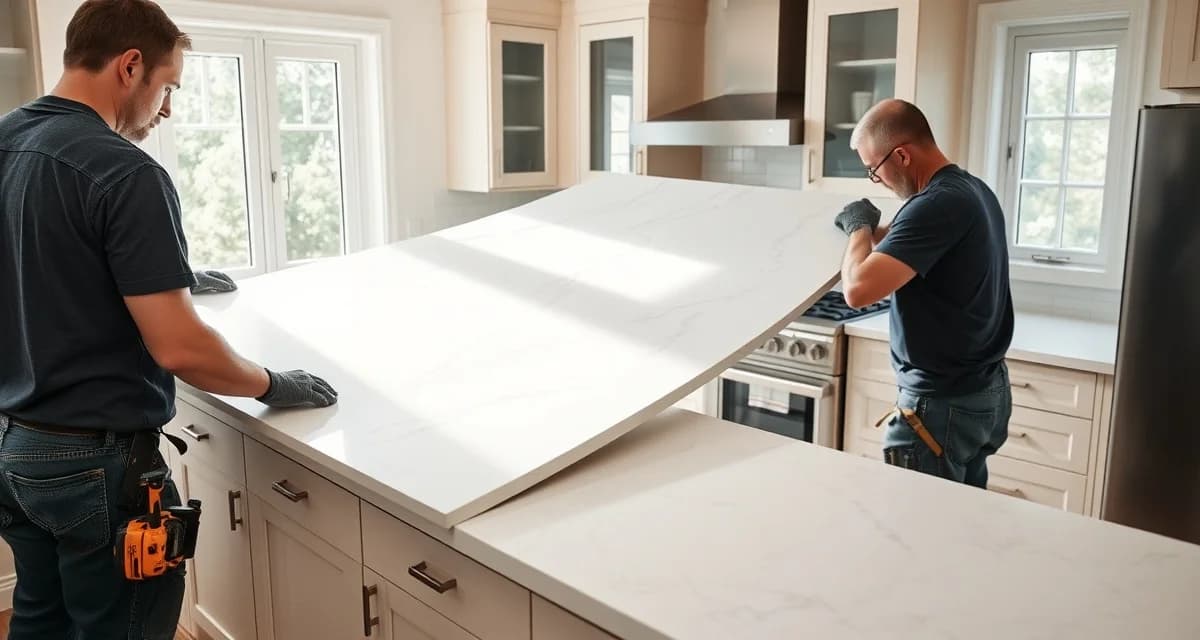
Countertop installation is the final step in a multi-week process that includes templating, fabrication, and delivery. A two-person installation crew carries pre-cut stone or quartz pieces into your home, dry-fits them on the cabinets, makes minor adjustments, bonds seams with color-matched epoxy, applies silicone adhesive, and connects sink and cooktop cutouts. A standard kitchen installation takes 2-4 hours.
TL;DR
- Installation day is typically 5-10 business days after the template appointment
- A two-person crew handles most residential kitchen installs in 2-4 hours
- Pieces are dry-fit first, then bonded with adhesive and caulked to the wall
- Seams are joined on-site using color-matched epoxy and clamped until cured
- Plumbing disconnection/reconnection is often the homeowner's responsibility (some fabricators include it)
- The countertop sits on the cabinets under its own weight - it is not bolted down
- Post-installation: Avoid heavy use for 24 hours while adhesives fully cure
- Installation quality depends directly on template accuracy and fabrication precision
The Complete Installation Process: Step by Step
Step 1: Pre-Installation Preparation
Before the crew arrives, several things should be in place:
Calculate your material waste savings
See exactly how much slab material and money you could save with optimized cutting layouts.
Try the free Waste CalculatorWhat the homeowner needs to do:
- Disconnect the plumbing (sink, faucet, dishwasher lines) or arrange for a plumber to do so
- Disconnect the cooktop or range if it sits in a cutout
- Remove the old countertop (some fabricators handle removal for an additional fee, typically $200-$500)
- Clear the kitchen of small appliances, dishes, and anything that could get in the way
- Ensure a clear path from the front door to the kitchen - the crew needs room to carry large pieces
What the fabricator verifies:
- Cabinets are level and secured to the wall
- Sub-tops or plywood support is in place where needed
- All appliances and fixtures are on-site (sink, cooktop, faucet)
- Access route into the home is clear and wide enough for the largest piece
Step 2: Delivery and Staging
The installation crew arrives with your finished countertop pieces loaded on a specialized truck with padded A-frame racks. Each piece is individually wrapped to prevent chips and scratches during transport.
What to expect:
- Crew size: 2 people for standard kitchens, 3-4 for oversized pieces or difficult access
- Each piece weighs 150-400 lbs depending on size and material
- The crew uses suction cups, carrying clamps, or A-frame dollies to move pieces from the truck
- Pieces are staged in the kitchen or nearby room before placement begins
Step 3: Dry Fitting
Before any adhesive goes down, the crew places each piece on the cabinets to check the fit. This is called a dry fit.
During the dry fit, the crew checks:
- Overall fit against walls, cabinets, and adjacent pieces
- Seam alignment - do mating pieces meet tightly?
- Level - is the surface flat across its full span?
- Overhang - is the front edge consistent (typically 1-1.5" past the cabinet face)?
- Cutout alignment - do sink and cooktop openings line up with plumbing and gas connections?
If walls are not perfectly straight (which is common), the crew may scribe the back edge of the countertop to match the wall contour. This involves marking the wall's profile on the stone and grinding away a small amount of material for a snug fit.
Step 4: Setting and Adhesive Application
Once the dry fit is confirmed, the real installation begins:
- Apply silicone adhesive to the top of the cabinets in a bead pattern. This holds the countertop in place and absorbs minor movement.
- Set the largest piece first - usually the longest straight section or the section with the sink cutout.
- Apply caulk along the back wall where the countertop meets the wall (or where the backsplash will sit).
- Check level again after setting. Shims (small plastic or wood wedges) are placed under the countertop if adjustments are needed.
The countertop is not bolted, screwed, or mechanically fastened to the cabinets. Its own weight (often 200-600 lbs total for a kitchen) keeps it in place, and the silicone adhesive prevents lateral movement.
Step 5: Seam Assembly
If your kitchen has seams (most do), the crew joins the pieces on-site:
- Clean and dry both mating edges - any dust or debris weakens the bond
- Mix color-matched epoxy - the installer blends tinted epoxy to match your stone's color and pattern
- Apply epoxy to both edges and press the pieces together
- Clamp the seam using specialized seam-setting tools that draw the pieces tight
- Clean excess epoxy before it hardens - typically within 10-15 minutes
- Allow cure time - full strength takes 30-60 minutes, though handling strength develops in 10-20 minutes
A well-made seam should be nearly invisible. The gap should be less than 1/16", level on both sides, and color-matched so closely that it blends with the stone's natural pattern.
Step 6: Sink and Cooktop Installation
Undermount sinks:
- The sink is attached from underneath using clips and silicone adhesive
- Clips are bolted into place using epoxy anchors on the underside of the stone
- Silicone sealant creates a waterproof barrier around the sink cutout edge
- The crew ensures the sink is centered in the cutout and level
Drop-in sinks:
- The sink rim sits on top of the countertop
- A bead of silicone around the cutout creates the seal
- Clips underneath pull the sink tight against the counter surface
Cooktop cutouts:
- The opening is left clear for the cooktop or range to be set in later
- Some fabricators install the cooktop; others leave it for the homeowner's electrician or gas fitter
Step 7: Finishing Touches
Before the crew leaves:
- Silicone caulk is applied along the wall-to-countertop joint and around sink edges
- Backsplash pieces are set with silicone adhesive if included in the project
- Final cleaning - the crew wipes down all surfaces and removes debris
- Walkthrough with homeowner - the crew reviews the installation, points out seam locations, and provides care instructions
- Final level check - confirms the surface is flat and properly supported
Step 8: Post-Installation
After the crew leaves:
- Wait 24 hours before using the sink or placing heavy items on the countertop. This allows adhesives and caulk to fully cure.
- Wait 48 hours before connecting plumbing if you want to be extra cautious with undermount sink bonds.
- Schedule a plumber to reconnect water supply lines, drain, faucet, and dishwasher. Some fabricators include basic plumbing reconnection; others do not.
- Apply sealer if you have natural stone (granite, marble, quartzite). Some fabricators seal at the shop; others leave this for the homeowner.
Installation Timeline: What to Expect
| Phase | Timeline | Duration |
|---|---|---|
| Cabinet installation | Week 1-2 | Varies |
| Template appointment | After cabinets | 30-90 min |
| Fabrication | 5-10 business days after template | 2-5 days |
| Installation day | 7-15 days after template | 2-4 hours |
| Plumbing reconnection | Same day or next day | 1-2 hours |
| Adhesive full cure | 24-48 hours after install | - |
| Ready for full use | 24-48 hours after install | - |
What Can Go Wrong During Installation
Most installations go smoothly, but when problems occur, they typically stem from earlier stages:
| Problem | Cause | Prevention |
|---|---|---|
| Piece does not fit against wall | Template error or wall changed | Template verification before cutting |
| Seam gap too wide | Inaccurate mating edge cuts | CNC precision cutting |
| Countertop not level | Cabinets not leveled before template | Pre-template cabinet inspection |
| Sink does not align with plumbing | Wrong sink model or cutout position | Confirm sink model at template |
| Crack during placement | Unsupported overhang or rough handling | Proper support and trained crew |
The common theme: most installation problems originate during templating or fabrication. By the time the crew arrives, the fit is largely predetermined by the accuracy of the template and the precision of the cuts.
This is why fabricators that verify template data before cutting - using tools like SlabWise's 3-layer template check - experience far fewer installation day surprises. When the template is right, the pieces fit. When the pieces fit, installation is fast and clean.
Cost of Countertop Installation
Installation costs vary by region and project complexity:
| Factor | Cost Range |
|---|---|
| Basic installation (per sq ft) | $10-$25 |
| Standard kitchen (40 sq ft) | $400-$1,000 |
| Complex kitchen with island | $800-$1,500 |
| Old countertop removal | $200-$500 |
| Plumbing disconnect/reconnect | $150-$350 |
| Backsplash installation | $200-$600 |
Many fabricators bundle installation into their per-square-foot price. When comparing quotes, always ask whether installation is included.
How long does countertop installation take?
A standard kitchen installation takes 2-4 hours. Simple vanity installations take 30-60 minutes. Large or complex kitchens with multiple seams and cutouts may take 4-6 hours.
Can I use my kitchen the same day?
You can use the countertop surface lightly the same day, but avoid running water through the sink for at least 24 hours. The silicone adhesive around sink cutouts needs time to cure to form a waterproof seal.
Do I need a plumber for countertop installation?
In many cases, yes. Some fabricators include basic plumbing disconnection and reconnection. Others expect the homeowner to arrange for a plumber separately. Ask your fabricator what is included before installation day.
Will the installers move my stove or refrigerator?
Most installation crews will move appliances that block access to the countertop area. However, disconnecting gas lines is not something the countertop crew should do - that requires a licensed plumber or gas fitter.
Is the countertop screwed into the cabinets?
No. Stone and quartz countertops sit on the cabinets under their own weight. Silicone adhesive between the countertop and cabinet top prevents lateral shifting. The weight of the stone (typically 15-20 lbs per square foot for 3cm material) is more than sufficient to keep it in place.
What if the countertop does not fit?
If a piece does not fit due to a fabrication or template error, the crew will note the issue and the fabricator will schedule a remake. This delays the project by several days to two weeks. The cost of the remake is the fabricator's responsibility in most cases.
Can I install countertops myself?
It is not recommended. Stone slabs are extremely heavy (15-20 lbs per square foot), require specialized handling to avoid breakage, and need precise placement for seams to align. Professional installation also protects your warranty. Improper installation voids most manufacturer warranties.
Do countertops need support brackets?
Overhangs of 1-1.5" past the cabinet face do not need additional support. Overhangs of 6-10" (for eating bars) may need corbels or brackets depending on the material. Overhangs beyond 10-12" almost always require steel support brackets.
What happens to my old countertop?
Some fabricators haul away old countertops as part of the removal fee ($200-$500). Others leave disposal to the homeowner. Laminate countertops can often go in a dumpster. Old stone countertops are heavy and may require special disposal or donation.
How do I prepare for installation day?
Remove all items from countertop areas and under sinks. Disconnect plumbing (or arrange for a plumber). Ensure a clear path from the front door to the kitchen. Have children and pets in another area of the home during the work.
What if my walls are not straight?
The installation crew can scribe the countertop to fit irregular walls. This involves marking the wall contour on the back edge of the stone and grinding a small amount to create a tight fit. Digital templating captures these irregularities precisely, making scribing on-site easier.
Do I need to be home during installation?
It is strongly recommended. The crew may have questions about final placement, overhang depth, or backsplash positioning. Being present lets you approve the work and ask questions before the crew leaves.
Good Installs Start with Good Data
When the template is right, the fabrication is right, and the installation goes fast. For fabricators who want every install to fit perfectly the first time, SlabWise's template verification catches errors before they become remakes - saving $1,500-$4,000 per job and cutting customer callbacks by 70%. Start your 14-day free trial.
Try These Free Tools
- Photo to Template -- Snap a photo of an existing countertop and get an AI-generated DXF template.
- Template Compare -- Upload two templates and see every dimension change highlighted instantly.
- AI Template Verification -- Cross-check your template against manufacturer specs before cutting.
Sources & Further Reading
- Natural Stone Institute - Countertop Support Guidelines
- International Surface Fabricators Association - Structural Support Requirements
- National Kitchen & Bath Association - Countertop Installation Standards
- ASTM International - C1526 Standard Specification for Serpentine Dimension Stone