What Thickness for Countertops?
Quick Definition
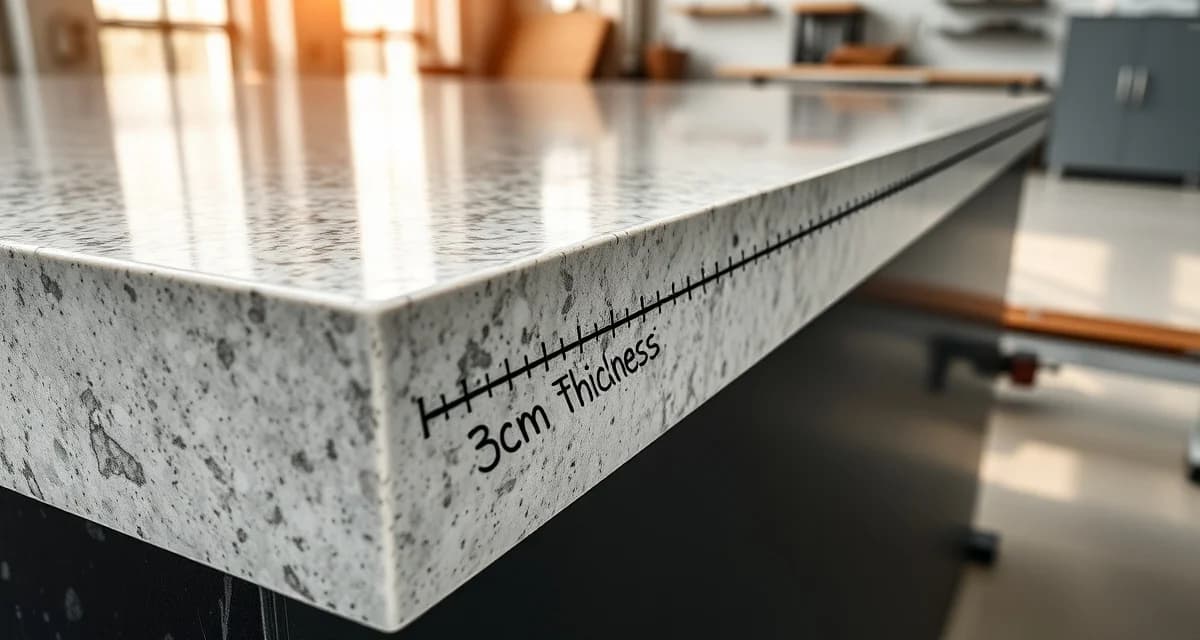
The standard thickness for stone and quartz countertops is 3cm (approximately 1.25 inches). This is the recommended thickness for kitchen countertops because it provides adequate strength for sink cutouts, overhang, and daily use without needing a plywood subtop. A thinner 2cm (0.75-inch) option is available and commonly used for bathroom vanities, fireplace surrounds, and applications where weight is a concern. Porcelain slabs come in even thinner profiles at 6mm, 12mm, and 20mm.
TL;DR
- 3cm (1.25") is the standard for kitchen countertops - strong enough for overhangs and cutouts without subtop support
- 2cm (0.75") works for bathroom vanities and low-stress applications but needs a plywood subtop for kitchens
- Porcelain slabs come in 6mm, 12mm, and 20mm thicknesses
- 3cm costs 15-25% more than 2cm of the same material
- 3cm is structurally stronger at sink cutouts, overhangs, and seam joints
- Most fabricators prefer working with 3cm because it is more forgiving during handling and installation
- Material thickness affects edge profile options - thicker slabs allow more ornate edges
- Going with 2cm in a kitchen to save money can backfire if you need to add a subtop ($200-$400 extra)
Thickness Options Explained
3cm (1.25 inches) - The Kitchen Standard
3cm is the default thickness for kitchen countertops across granite, quartz, quartzite, and marble. Nearly every fabricator in the US works primarily with 3cm material.
Calculate your material waste savings
See exactly how much slab material and money you could save with optimized cutting layouts.
Try the free Waste CalculatorWhy 3cm is standard for kitchens:
- Structural strength around cutouts. Sink and cooktop openings remove significant material. The remaining stone between the cutout and the countertop edge needs to be strong enough to resist cracking during installation and daily use. At 3cm, the cross-section is thick enough to handle this stress.
- Overhang support. Standard overhangs of 1-1.5 inches (and unsupported bar overhangs up to 10-12 inches) require the structural rigidity that 3cm provides.
- No subtop needed. 3cm material can sit directly on the cabinet frame without a plywood layer underneath. This saves $200-$400 in subtop materials and labor.
- Handling durability. Thicker slabs are less likely to break during transport, fabrication, and installation. Every time a piece is moved, it flexes slightly - thicker material flexes less.
- Full edge profile options. At 1.25 inches thick, you can get any edge profile: eased, bevel, bullnose, ogee, dupont, laminated (doubled) edge, and more.
Weight of 3cm material:
| Material | Weight per Sq Ft (3cm) |
|---|---|
| Granite | 18-20 lbs |
| Quartz | 15-18 lbs |
| Quartzite | 18-20 lbs |
| Marble | 16-18 lbs |
A 40 sq ft kitchen countertop in 3cm granite weighs roughly 720-800 lbs total.
2cm (0.75 inches) - Lighter, Thinner, Limited
2cm material is common for:
- Bathroom vanities (lower stress, smaller cutouts)
- Fireplace surrounds and hearths
- Wall cladding and backsplash panels
- Outdoor applications where weight on elevated structures is a concern
- Budget-conscious projects where every dollar matters
Limitations of 2cm in kitchens:
- Requires a plywood subtop. Without full support underneath, 2cm material can crack at sink cutouts and overhang points. A 3/4-inch plywood subtop adds the necessary support - and adds $200-$400 to the project.
- Limited edge profiles. At 0.75 inches, the edge is too thin for profiles like ogee or dupont. Most fabricators limit 2cm to eased or small bevel edges.
- More fragile during handling. Thinner slabs are more prone to breakage during transport and installation.
- Visually thinner. Some homeowners prefer the substantial look of a 3cm edge. A 2cm edge can look slight, especially in a large kitchen.
Cost comparison (approximate):
| Material | 2cm Cost/Sq Ft | 3cm Cost/Sq Ft | Difference |
|---|---|---|---|
| Level 1 Granite | $8-$14 | $10-$18 | +15-25% |
| Mid-Range Quartz | $14-$28 | $18-$35 | +15-25% |
| Quartzite | $25-$75 | $30-$100 | +15-30% |
| Marble | $20-$60 | $25-$80 | +15-30% |
The per-square-foot difference between 2cm and 3cm is typically 15-25%. But when you add the cost of a plywood subtop for 2cm installation in a kitchen ($200-$400), the net savings shrink substantially.
Porcelain and Ultra-Thin Options
Large-format porcelain slabs and sintered stone (Dekton) are available in thinner profiles:
| Thickness | Typical Use | Subtop Required? |
|---|---|---|
| 6mm (0.25") | Wall cladding, backsplash only | Yes (not for countertops) |
| 12mm (0.5") | Countertops, vanities | Yes |
| 20mm (0.8") | Countertops, vanities | Sometimes |
| 30mm (1.2") | Countertops | No |
Porcelain at 12mm is lightweight and strong, but it requires a full subtop and experienced fabricators who know how to handle and cut it without chipping. The thin profile creates a modern, minimal look that appeals to some design styles.
Laminated (Doubled) Edges
Some homeowners want the look of a very thick countertop (2-2.5 inches) without the weight and cost of solid thick stone. Fabricators achieve this by laminating - gluing a strip of matching material under the front edge.
How it works:
- A strip of the same stone or quartz (usually 1.5-3 inches wide) is bonded under the front edge
- The seam is hidden with color-matched adhesive
- From the front, the countertop appears 2.5-3 inches thick
- The rest of the countertop remains standard 3cm thickness
Cost: Laminated edges add $15-$40 per linear foot, or roughly $200-$600 for a typical kitchen.
How Thickness Affects Fabrication
From the fabricator's perspective, material thickness impacts nearly every step of the process:
Cutting and CNC Programming
- 3cm material uses different tooling parameters than 2cm - slower feed rates, different blade depths
- Thicker material generates more dust and requires more water for cooling during cutting
- CNC programs must specify thickness for edge profiles and cutout depths
Handling and Transport
- 3cm slabs are heavier but more rigid - they flex less during lifting and are less likely to snap
- 2cm slabs are lighter but must be handled more carefully on A-frames and during installation
- Porcelain requires specialized suction cups and careful handling due to its tendency to chip
Edge Profiling
| Edge Profile | 2cm Compatible? | 3cm Compatible? |
|---|---|---|
| Eased | Yes | Yes |
| Small Bevel | Yes | Yes |
| Full Bullnose | Limited | Yes |
| Half Bullnose | Limited | Yes |
| Ogee | No | Yes |
| Dupont | No | Yes |
| Pencil Round | Yes | Yes |
| Waterfall (mitered) | Yes (with skill) | Yes |
| Laminated | N/A | Yes |
Template Verification and Thickness
When fabrication software verifies template data, material thickness is a key parameter. A 3cm overhang calculation is different from a 2cm one - the maximum unsupported span changes, and the structural requirements around cutouts shift. SlabWise's template verification accounts for material thickness when flagging potential issues like overhangs that exceed safe limits for the specified material and thickness.
Choosing the Right Thickness: Decision Guide
Go With 3cm When:
- The countertop is for a kitchen (primary work surface)
- You want any edge profile beyond basic eased or bevel
- You plan on undermount sinks with large cutouts
- You want to avoid the cost and complexity of a subtop
- The countertop has overhangs for seating (bar areas)
- You are using natural stone that may have fissures or weak points
Go With 2cm When:
- The countertop is for a bathroom vanity with smaller cutouts
- You are doing wall cladding or a backsplash
- Weight is a concern (e.g., elevated structures, outdoor applications)
- Budget is the top priority and you accept a plywood subtop cost
- You want a thinner, more modern aesthetic
Consider Porcelain (12mm-20mm) When:
- You want an ultra-thin, contemporary look
- Weight matters significantly
- You have a fabricator experienced with porcelain
- You are willing to accept limited edge profile options
What is the standard thickness for kitchen countertops?
3cm (approximately 1.25 inches) is the standard for kitchen countertops in the US. This thickness provides the structural strength needed for sink cutouts, overhangs, and daily use without requiring a plywood subtop underneath.
What does 3cm mean in inches?
3cm equals approximately 1.18 inches, which is commonly rounded to 1.25 inches. The "3cm" label is an industry convention - actual thickness can vary slightly between slabs.
Is 2cm thick enough for a kitchen?
2cm can work in a kitchen, but it requires a plywood subtop ($200-$400) for structural support. It is also limited to simpler edge profiles and is more fragile during handling. Most fabricators recommend 3cm for kitchens.
Why is 3cm more expensive than 2cm?
3cm slabs contain roughly 50% more raw material than 2cm slabs. The additional material, combined with heavier weight for shipping and handling, accounts for the 15-25% price difference.
Can I use 2cm for a bathroom vanity?
Yes. 2cm is the most common choice for bathroom vanities. Bathroom countertops have smaller cutouts, shorter spans, and less daily stress than kitchen counters. A subtop is still recommended for vanities longer than 36 inches.
What thickness is quartz countertops?
Quartz countertops are available in 2cm and 3cm. Most kitchen installations use 3cm. Some manufacturers also offer 1cm quartz for specific applications like wall panels.
Does thicker mean more durable?
In terms of structural strength, yes - 3cm is significantly stronger than 2cm, especially around cutouts and overhang points. For surface durability (scratch and stain resistance), thickness makes no difference. A 2cm granite surface is just as scratch-resistant as a 3cm one.
How thick is a laminated edge?
A laminated edge makes the countertop appear 2.5-3 inches thick (6-7.5cm) at the front, while the rest of the slab remains standard 3cm thickness. It is achieved by bonding a strip of matching material under the front edge.
Can I mix 2cm and 3cm in the same project?
Technically yes, but it is uncommon. The height difference (about 0.5 inches) creates an uneven surface where sections meet. Some designers use this intentionally for multi-level countertops, but it adds fabrication complexity and cost.
What thickness do commercial kitchens use?
Most commercial kitchen countertops use 3cm stone, 3cm quartz, or stainless steel over a structural substrate. Commercial applications prioritize durability and the ability to support heavy equipment.
Does countertop thickness affect resale value?
3cm is the expected standard for kitchen countertops. Using 2cm in a kitchen will not negatively affect resale in most markets, but the thinner edge may be noticed by home inspectors or savvy buyers who recognize the cost-saving choice.
How does thickness affect weight?
A 3cm countertop weighs roughly 50% more per square foot than 2cm of the same material. For a 40 sq ft kitchen, that is the difference between roughly 500 lbs (2cm) and 750 lbs (3cm). Cabinet boxes and floor structures must support the weight.
Thickness Is a Fabrication Decision
For fabricators, material thickness determines tooling parameters, handling procedures, and structural verification. SlabWise's template verification factors in material thickness when checking overhang limits, cutout clearances, and structural integrity - catching problems that a generic check would miss. Start your 14-day free trial.
Try These Free Tools
- Photo to Template -- Snap a photo of an existing countertop and get an AI-generated DXF template.
- Template Compare -- Upload two templates and see every dimension change highlighted instantly.
- AI Template Verification -- Cross-check your template against manufacturer specs before cutting.
Sources & Further Reading
- Natural Stone Institute - Countertop Support Guidelines
- International Surface Fabricators Association - Structural Support Requirements
- National Kitchen & Bath Association - Countertop Installation Standards
- ASTM International - C1526 Standard Specification for Serpentine Dimension Stone