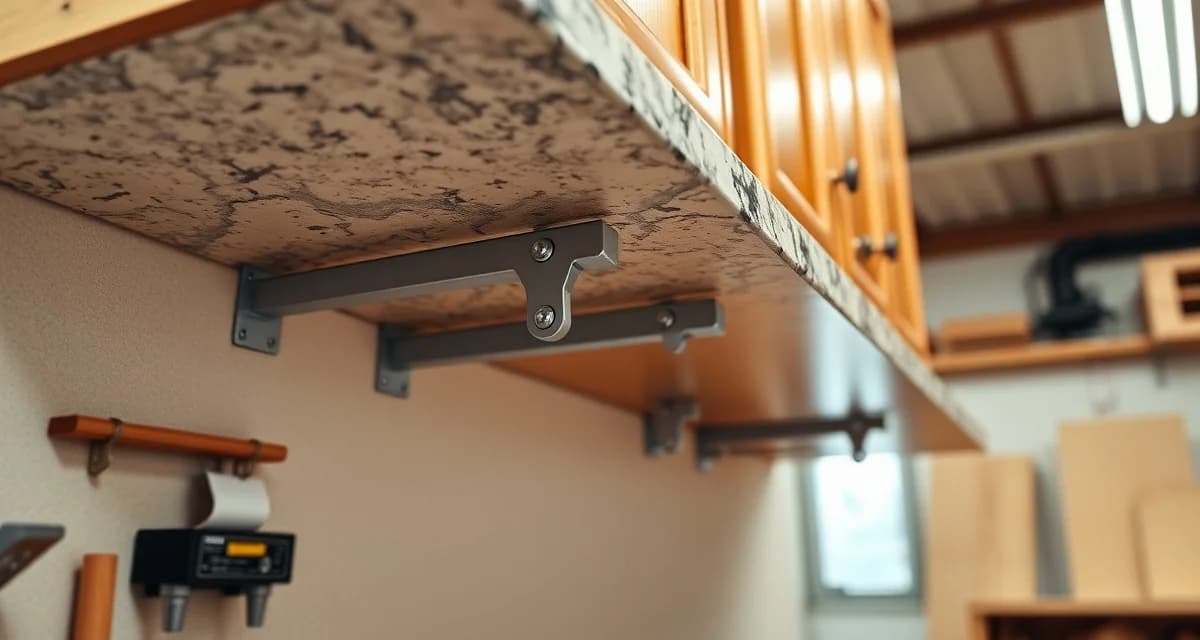
Countertop Support Brackets Guide
Quick Definition
Countertop support brackets are metal or wood reinforcements that prevent stone, quartz, and solid surface overhangs from cracking or collapsing under weight. Any overhang exceeding 8-10 inches on granite or 10-12 inches on quartz requires structural support. Brackets cost $15-$80 each and take 15-30 minutes to install per bracket.
TL;DR
- Granite overhangs past 8 inches need brackets - quartz gets slightly more leeway at 10-12 inches before support is required
- Steel L-brackets ($15-$40 each) handle most residential bar and island overhangs
- Hidden supports ($40-$80 each) mount inside cabinets for a clean look with no visible hardware
- Space brackets every 18-24 inches along the overhang - closer for granite, wider for quartz
- A 12-inch granite bar overhang on a 6-foot island needs 3-4 brackets minimum
- Bracket failure is the #1 cause of countertop breakage at overhangs - this is not optional hardware
- Always install brackets before the template appointment so your fabricator can account for them
Why Brackets Matter: The Physics of Stone Overhangs
Stone is strong in compression but weak in tension. When someone leans on a countertop overhang, the top surface compresses while the bottom surface stretches. Granite has a tensile strength of only 700-1,500 PSI - roughly 10% of its compressive strength. That's why a slab that can support a car sitting on top of it will snap if someone sits on an unsupported overhang.
Calculate your material waste savings
See exactly how much slab material and money you could save with optimized cutting layouts.
Try the free Waste CalculatorThe failure point is almost always at the back edge where the overhang meets the cabinet. Without brackets, all the stress concentrates at that single line. A 200-lb person sitting 12 inches from the cabinet edge creates roughly 200 ft-lbs of torque at the support point. Brackets distribute that force across a wider area and transfer it into the cabinet structure.
Types of Countertop Support Brackets
Steel L-Brackets (Corbel Style)
| Feature | Details |
|---|---|
| Cost | $15-$40 each |
| Material | 3/16" to 1/4" steel, powder coated |
| Visibility | Visible beneath the overhang |
| Load capacity | 150-500 lbs per bracket |
| Best for | Casual bars, open island seating areas |
| Installation | 4-6 lag screws into wall studs or cabinet framing |
These are the most common brackets in residential kitchens. They mount to the wall or cabinet side and extend outward to support the overhang. Available in decorative styles (scrollwork, hammered iron) or simple flat bar designs.
Pros: Affordable, high capacity, easy to install, available everywhere Cons: Visible hardware, can interfere with knee space for bar seating
Hidden Support Brackets
| Feature | Details |
|---|---|
| Cost | $40-$80 each |
| Material | Steel plate or channel, often zinc plated |
| Visibility | Concealed inside cabinet or wall |
| Load capacity | 100-300 lbs per bracket |
| Best for | Floating countertop looks, modern kitchens |
| Installation | Mounted inside cabinet, countertop sits on top |
Hidden brackets (also called floating brackets or concealed supports) bolt inside the cabinet box. The countertop rests on top of flat steel plates that extend outward. From the front, the counter appears to float with no visible support.
Pros: Clean aesthetic, no hardware visible, modern look Cons: More expensive, harder to install, may require cabinet modification, lower load ratings
Knee Wall / Pony Wall Brackets
These are used when the overhang is supported by a short wall (knee wall) rather than a cabinet. The bracket ties the countertop to the wall structure. Common in peninsula layouts.
Corbels (Decorative Wood)
| Feature | Details |
|---|---|
| Cost | $30-$150 each |
| Material | Hardwood (maple, oak, cherry) or MDF |
| Visibility | Prominent - they're decorative features |
| Load capacity | 50-200 lbs per corbel (varies widely) |
| Best for | Traditional, farmhouse, or craftsman kitchens |
| Installation | Screwed into cabinet side, countertop rests on top |
Wood corbels are as much design elements as structural supports. Not all decorative corbels are rated for load-bearing, so check the manufacturer's specifications. A purely decorative corbel might hold 50 lbs; a structural one can handle 200+.
Steel Support Bars
Long steel bars (3-4 feet) that mount horizontally inside or beneath the cabinet run and extend past the cabinet face. Used for very long overhangs or heavy materials. These are the go-to for commercial bar tops.
How to Size Your Brackets
The Overhang Rules by Material
| Material | Max Unsupported Overhang | Bracket Spacing | Notes |
|---|---|---|---|
| Granite (3cm) | 8-10 inches | Every 18-24 inches | Varies by color/quarry - some granites are weaker |
| Quartz (3cm) | 10-12 inches | Every 24 inches | Engineered stone is more consistent than natural |
| Quartz (2cm) | 6-8 inches | Every 18 inches | Thinner slabs need more support |
| Marble (3cm) | 6-8 inches | Every 18 inches | Marble is softer and more brittle than granite |
| Quartzite (3cm) | 10-12 inches | Every 24 inches | Very hard, similar to granite in practice |
| Porcelain (2cm) | 4-6 inches | Every 12-16 inches | Thin and rigid - cracks suddenly |
| Solid surface | 12 inches | Every 24-30 inches | More flexible, less brittle |
| Laminate | 12 inches | Varies by substrate | Support is in the particleboard, not the laminate |
Bracket Size Formula
The bracket should extend at least 2/3 of the overhang depth. For a 15-inch overhang, use brackets that are at least 10 inches deep. For a 24-inch breakfast bar overhang, use 16-inch brackets.
Bracket should also be mounted so it contacts at least 6 inches of the cabinet side or wall for adequate anchoring.
Example: Standard Kitchen Island Bar
- Island length: 8 feet
- Bar overhang: 15 inches
- Material: 3cm quartz
- Bracket type: Hidden steel supports
- Bracket size: 12-inch depth (2/3 of 15" = 10", round up)
- Number needed: 4 brackets (spaced 24" apart across 8 feet)
- Cost: $40-$80 each = $160-$320 total for brackets
Installation Guide
Before You Start
- Confirm bracket positions with your fabricator - some seam locations or cutout positions affect where brackets can go
- Locate studs if mounting to a wall (stud finder + confirmation drill)
- Check cabinet construction - brackets need solid wood or plywood to anchor into, not just 1/4" cabinet backs
Installing L-Brackets
- Mark bracket positions along the overhang, starting 3-4 inches from each end
- Space remaining brackets evenly between (18-24 inches apart)
- Hold bracket in position and mark screw holes
- Pre-drill pilot holes into cabinet side or wall studs
- Drive 3/8" x 3" lag screws (minimum 4 per bracket)
- Check bracket is level before tightening fully
- Apply a small bead of silicone to the bracket top surface - this prevents the stone from rocking on the metal
Installing Hidden Brackets
- Open the cabinet doors below the overhang area
- Mark the bracket mounting holes on the inside of the cabinet top rail
- Drill through the cabinet top from inside
- Bolt the bracket plate through the cabinet top
- The flat extension should protrude outward past the cabinet face
- Verify the bracket sits flush - any high spots can concentrate stress on the stone
Post-Installation Checklist
- All brackets level and flush
- Lag screws driven into solid wood (not just drywall or particleboard edges)
- Minimum 4 fasteners per bracket
- Bracket extends at least 2/3 of overhang depth
- No bracket interferes with planned seam or cutout locations
- Silicone applied to bracket tops
Common Bracket Mistakes
Mistake 1: Too Few Brackets
A single bracket on each end of a 6-foot island creates a stress point in the middle. The stone flexes and eventually cracks. Always space every 24 inches maximum.
Mistake 2: Brackets in Wrong Locations
Installing brackets where seams or sink cutouts will fall is a problem. Coordinate with your fabricator's shop drawings before drilling.
Mistake 3: Screwing into Weak Material
Lag screws into MDF, particleboard edges, or 1/4" cabinet backs will pull out under load. Always anchor into solid plywood, hardwood, or wall studs.
Mistake 4: Assuming the Countertop Doesn't Need Support
"My old laminate counter didn't have brackets" - laminate has a plywood substrate that provides its own spanning strength. Stone does not. Different materials, different rules.
Mistake 5: Installing After the Countertop
Trying to retrofit brackets under an installed stone countertop is difficult and risks cracking the slab. Always install brackets first.
What Fabricators Need From You
When you schedule your template appointment, your fabricator needs brackets already installed. Here's why:
- The template accounts for bracket positions - the fabricator marks where supports are so CNC cutouts and seams don't conflict
- Bracket height affects countertop height - especially with hidden brackets that add 1/4" to 1/2" of height
- No brackets = no template - many shops won't template an island with a 15-inch overhang and no brackets in place
Fabrication software like SlabWise can flag overhang measurements during template verification, alerting the shop if support brackets aren't documented in the job file. This prevents the slab from being cut before confirming adequate support is in place.
Bracket Sources and Pricing
| Supplier Type | Price Range | Pros | Cons |
|---|---|---|---|
| Home centers (Lowe's, Home Depot) | $15-$50 | Immediate availability | Limited selection |
| Specialty hardware (Federal Brace, etc.) | $30-$80 | Wide range, commercial-grade | Shipping time |
| Amazon | $12-$60 | Reviews, fast shipping | Quality varies |
| Custom welding shops | $50-$150 | Exact specs, heavy duty | Lead time 1-2 weeks |
| Your fabricator | $20-$80 | They know what works | May upcharge vs. buying direct |
FAQ
How far can granite overhang without support?
Most granite can overhang 8-10 inches without brackets when the slab is 3cm (1-1/4") thick. Beyond that, you need brackets. Some lighter-colored granites with more quartz content can handle 10 inches; darker granites with more mica may be weaker.
Are hidden countertop brackets strong enough?
Quality hidden brackets rated for 200+ lbs each are sufficient for residential use when properly spaced. Cheaper hidden brackets rated for only 75-100 lbs may not be adequate for bar seating areas where people lean heavily.
How many brackets do I need for a kitchen island?
Divide the overhang length by 24 inches and round up. For an 8-foot island overhang, that's 96" / 24" = 4 brackets. Add one more if the material is granite or marble, bringing you to 5 brackets.
Can I use wood corbels instead of steel brackets?
Only if the wood corbels are rated for structural support. Decorative corbels may only hold 50 lbs. Structural hardwood corbels rated for 150-200+ lbs can work, but they're bulkier than steel alternatives.
Do quartz countertops need support brackets?
Yes, if the overhang exceeds 10-12 inches on a 3cm slab. Quartz is more consistent than granite, but it's not immune to cracking under sustained load at unsupported overhangs.
When should brackets be installed - before or after countertops?
Before. Always before. Your fabricator needs brackets in place at the template appointment so they can design around them. Retrofitting brackets after stone installation risks cracking the slab.
What size brackets do I need for a 12-inch overhang?
Use brackets with at least 8-inch depth (2/3 of 12 inches). For granite, go with 10-inch brackets and space them every 18-20 inches.
Can I install countertop brackets myself?
Yes. L-brackets and hidden brackets are straightforward DIY projects. You need a drill, level, stud finder, and lag screws. Most installations take 15-30 minutes per bracket. Just verify positions with your fabricator first.
Do bar-height overhangs need more support?
Bar-height (42-inch) overhangs don't inherently need more support than standard (36-inch) overhangs of the same depth. The overhang depth and material type determine bracket needs, not the counter height.
What happens if a bracket fails?
The stone cracks at the support point, usually splitting along the weakest grain line or at the nearest cutout. Repair is rarely possible - it's a full replacement of that section. Replacement cost: $1,500-$4,000+ depending on material and size.
Don't Let Bracket Mistakes Turn Into Expensive Remakes
Bracket placement, overhang dimensions, and support verification are exactly the kind of details that get missed in busy shops. SlabWise's template verification system flags overhang specifications during the 3-layer check, so your team catches support issues before cutting a single slab.
Start your 14-day free trial - $199/mo for Standard, and it pays for itself the first time you avoid a $3,000 remake.
Try These Free Tools
- Photo to Template -- Snap a photo of an existing countertop and get an AI-generated DXF template.
- Template Compare -- Upload two templates and see every dimension change highlighted instantly.
- AI Template Verification -- Cross-check your template against manufacturer specs before cutting.
Sources & Further Reading
-
Natural Stone Institute - ADA Compliance Guidelines for Natural Stone Installations
-
National Kitchen & Bath Association - Universal Design and ADA Standards for Kitchen Countertops
-
ASTM International - Standard Practice for Accessible Counter and Work Surface Design