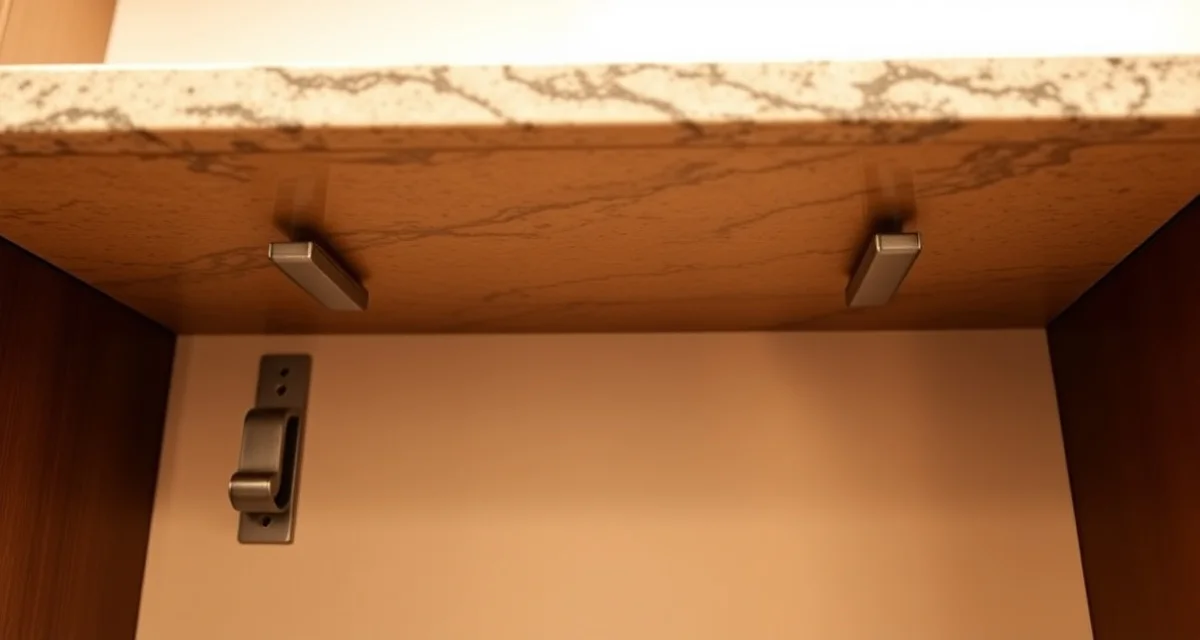
How to Support Countertop Overhang
Countertop overhangs need structural support when they exceed 10-12 inches for 3cm (1-3/16") stone or 6-8 inches for 2cm (3/4") stone. Support comes from brackets, corbels, steel rods, or a plywood subtop, depending on the overhang length, material type, and aesthetic preference. The standard kitchen overhang of 1-1.5 inches past the cabinet face requires no additional support. Bar and seating overhangs of 12-15 inches typically need brackets spaced every 24-36 inches.
TL;DR
- Standard 1-1.5" overhangs need no extra support for any material
- 3cm stone can overhang up to 10-12" without support (varies by material)
- 2cm stone can overhang up to 6-8" without support
- Overhangs exceeding these limits need brackets every 24-36 inches
- Bar seating overhangs (12-15") always require support
- Hidden steel support brackets are the most popular modern option
- Corbels provide visible decorative support for traditional kitchens
- Maximum recommended overhang for any stone: 15" with proper support
Maximum Overhang Without Support
The unsupported overhang limit depends on the stone thickness and material type:
Calculate your material waste savings
See exactly how much slab material and money you could save with optimized cutting layouts.
Try the free Waste Calculator| Material | 2cm Thickness | 3cm Thickness |
|---|---|---|
| Granite | 6" max | 10-12" max |
| Quartz | 8" max | 12-14" max |
| Marble | 6" max | 10" max |
| Quartzite | 6" max | 10-12" max |
| Porcelain (1.2cm) | 4" max | N/A |
Important: These are general guidelines. Specific limits depend on the stone's structural integrity, grain direction, fissures, and cutout locations (sink and cooktop openings weaken the stone near the overhang). Always consult your fabricator for material-specific recommendations.
Quartz is slightly more flexible than natural stone due to its resin content, which is why it gets a slightly higher unsupported overhang allowance.
Types of Overhang Support
Hidden Steel Brackets
The most popular modern support option. L-shaped steel brackets mount to the cabinet frame or wall studs, invisible beneath the countertop.
- Spacing: Every 24-36" along the overhang
- Load capacity: 75-150 lbs per bracket (depending on size)
- Cost: $15-$50 per bracket
- Best for: Modern and contemporary kitchens, bar overhangs, island seating
- Brands: Federal Brace, Granit-Plus, Countertop Support Bracket
Installation: Brackets mount to the interior cabinet wall or framing with lag screws. The countertop rests on top of the bracket's horizontal surface. The bracket is hidden from view when seated at the bar.
Decorative Corbels
Traditional bracket-style supports that are visible beneath the countertop. Made from wood, metal, or even stone.
- Spacing: Every 24-36" along the overhang
- Cost: $30-$200 per corbel depending on material and design
- Best for: Traditional, farmhouse, and transitional kitchens
- Materials: Wood (painted or stained), wrought iron, cast stone
Corbels serve a dual purpose: structural support and decorative accent. Choose a style that complements your cabinet hardware and kitchen design.
Steel Support Rods (Keeney Method)
Steel rods embedded in the countertop and the cabinet structure, providing completely invisible support.
- Installation: Holes are drilled in the cabinet face frame and matching holes in the countertop underside. Steel rods slide into both, creating a hidden cantilever.
- Cost: $10-$25 per rod plus installation labor
- Best for: Floating countertop looks with zero visible support
- Limitation: Requires precise alignment during installation
Plywood Subtop
A sheet of 3/4" plywood spans the cabinet tops, extending past the cabinet face to support the overhang. The countertop sits on the plywood.
- Overhang support: Up to 6-8" additional beyond the cabinet face
- Cost: $50-$150 for the entire kitchen
- Best for: Shorter overhangs, 2cm stone, and laminate countertops
- Limitation: Won't support long overhangs without its own bracket support
Half Wall or Pony Wall
For island overhangs, a half wall (18-24" tall) built at the overhang location provides continuous support.
- Best for: Large overhangs, breakfast bars, and raised bar tops
- Cost: $200-$600 for construction
- Downside: Reduces open sightlines and takes up floor space
Support Requirements by Use Case
| Scenario | Typical Overhang | Support Needed |
|---|---|---|
| Standard cabinet face | 1-1.5" | None |
| Eating bar (counter height) | 12-15" | Brackets every 24-36" |
| Raised bar (42" height) | 12-15" | Brackets every 24-36" plus vertical support |
| Island seating (one side) | 12-15" | Brackets every 24-36" |
| Peninsula seating | 12-24" | Heavy brackets or half wall |
| Desk area | 24-30" | Legs, half wall, or heavy brackets at 24" spacing |
Seating Overhang Guidelines
For comfortable seating at a countertop, you need:
- Standard counter height (36"): 12-15" overhang for bar stools without arms; 15-18" for stools with arms
- Raised bar height (42"): 12-15" overhang for standard bar stools
- Knee clearance: Minimum 15" depth under the overhang for comfortable leg room
- Width per seat: 24" minimum per person; 30" for comfortable spacing
Bracket Sizing and Spacing
Proper bracket selection prevents countertop failure:
Bracket size rule: The bracket should extend to at least 2/3 of the overhang depth. For a 12" overhang, use brackets that are at least 8" deep. For a 15" overhang, use 10" brackets.
Bracket spacing:
- Standard load (occasional leaning): Every 36"
- Heavy use (daily seating): Every 24"
- Extra heavy (near sinks or heavy appliances): Every 18-24"
Number of brackets by overhang length:
| Overhang Length | Brackets at 24" Spacing | Brackets at 36" Spacing |
|---|---|---|
| 4 feet | 3 | 2 |
| 6 feet | 4 | 3 |
| 8 feet | 5 | 4 |
| 10 feet | 6 | 4 |
Common Overhang Mistakes
Overhang too long without support: The most dangerous mistake. An unsupported overhang can snap under sudden weight (someone leaning or sitting on it), sending a 100+ pound piece of stone to the floor. This is a safety hazard.
Brackets too small: Undersized brackets don't reach far enough under the overhang to distribute weight properly. They may hold static weight but fail under dynamic loads (someone pushing down while sitting).
Brackets not attached to framing: Brackets screwed into drywall or thin cabinet material won't hold. They must be anchored to cabinet frame members, wall studs, or structural framing.
Ignoring cutout proximity: Sink and cooktop cutouts weaken the stone near the overhang. If a cutout is within 3" of the overhang edge, additional support is critical.
Not accounting for stone grain direction: Natural stone is weaker across the grain than along it. An overhang that runs perpendicular to the stone's grain direction needs more support.
FAQ
How far can granite overhang without support? 3cm granite can safely overhang 10-12 inches without additional support. Beyond that, brackets are required. 2cm granite should not overhang more than 6 inches without support.
What is the maximum countertop overhang? With proper support, countertops can overhang up to 15 inches for 3cm stone and 12 inches for 2cm stone. Beyond 15 inches, most fabricators recommend legs or a half wall for safety.
Are hidden brackets strong enough? Quality hidden steel brackets rated for countertop use support 75-150 lbs each. With proper spacing (every 24-36"), they easily handle the weight of the stone plus normal use loads (leaning, resting arms, setting items).
Do I need brackets for a 10-inch overhang? For 3cm stone (granite, quartz, marble), a 10-inch overhang is right at the limit of what's safe without support. Many fabricators recommend brackets at 10 inches as a precaution. For 2cm stone, brackets are mandatory at 10 inches.
Can I add brackets after the countertop is installed? Yes. Hidden brackets can be installed underneath an existing countertop by mounting them to the cabinet frame. The countertop doesn't need to be removed. Cost: $200-$500 for a professional to add brackets to an island overhang.
How much weight can a countertop overhang hold? A properly supported overhang can handle 50-100 lbs per linear foot of static load (resting weight). Dynamic loads (someone pushing down or sitting) require more conservative ratings. Don't sit or stand on countertop overhangs.
Do quartz countertops need overhang support? Same rules as natural stone: overhangs beyond 12-14" for 3cm quartz need brackets. Quartz's resin content gives it slight flexibility, but the overhang limits are similar to granite.
What about a 2-inch overhang past the cabinet? A 2-inch overhang requires no support for any countertop material. This is standard cabinet-to-countertop overhang and is structurally sound without brackets.
Get Your Countertop Quote
Planning an island with seating overhang? Use our cost calculator to estimate material and fabrication pricing for your specific layout, including overhang and support requirements.
[Try the SlabWise Cost Calculator →]
Try These Free Tools
- Cost Calculator -- Get instant countertop cost estimates by material, edge profile, and square footage.
- Compare Materials -- Side-by-side material comparison with pricing, durability, and maintenance ratings.
- Edge Profile Selector -- Browse edge profiles with cost impact and visual previews.