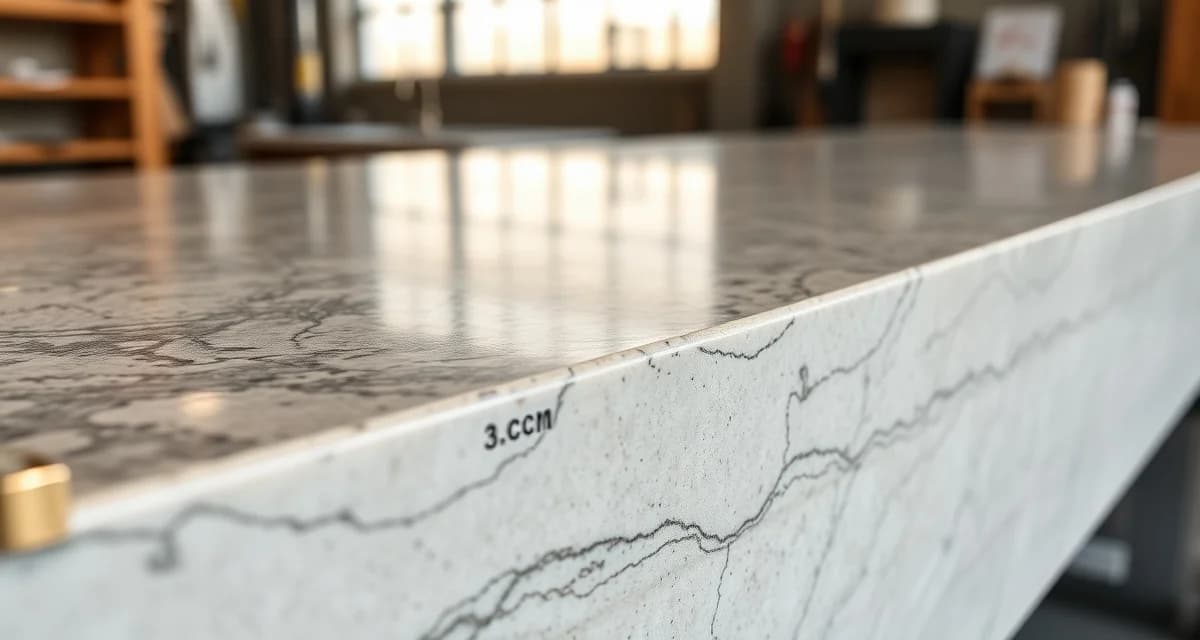
What Does 3cm Mean?
What does 3cm mean is a practical question for anyone planning a countertop project.
In the countertop industry, 3cm refers to the thickness of the stone slab - approximately 1 and 3/16 inches (1.18 inches to be exact). It's the standard thickness for kitchen countertops in the United States. When a fabricator or showroom says "3cm granite" or "3cm quartz," they're telling you the slab is about 30 millimeters thick from top to bottom.
TL;DR
- 3cm equals approximately 1-3/16 inches (1.18 inches or 30mm) - the industry standard for US kitchen countertops
- The stone industry uses metric measurements because most slabs are quarried and processed internationally
- 3cm slabs are strong enough to span standard cabinet widths (24 inches) without plywood support underneath
- 2cm slabs (about 3/4 inch) are the other common option - they're thinner, lighter, and cheaper but usually need plywood support
- Price difference between 2cm and 3cm is typically $5-$15 per square foot for the same material
- Most US kitchens use 3cm; most bathroom vanities can use either 2cm or 3cm
- A typical 3cm kitchen countertop slab weighs about 18-20 pounds per square foot
Why the Stone Industry Uses Centimeters
Walk into any slab yard in America and you'll see measurements in centimeters, not inches. This seems odd until you consider where stone comes from.
Calculate your material waste savings
See exactly how much slab material and money you could save with optimized cutting layouts.
Try the free Waste CalculatorThe majority of natural stone used in US countertops is quarried in Brazil, India, Italy, Spain, and China. These countries use the metric system. Slabs are cut at the quarry to metric thicknesses - 2cm and 3cm - and shipped to US distributors at those dimensions.
Quartz manufacturers (Caesarstone, Cambria, Silestone, MSI) also produce slabs in 2cm and 3cm because the global market expects those sizes. Converting to inches would create awkward measurements - nobody wants to market a "1-3/16 inch" slab.
So the convention stuck: the US stone industry uses centimeters for thickness, even though everything else (square footage, linear feet of edging, overhang measurements) stays in imperial units.
3cm in Context: How Thick Is It Really?
Here's how 3cm compares to objects you can visualize:
| Reference | Thickness |
|---|---|
| 3cm countertop | 1.18 inches / 30mm |
| Standard AA battery diameter | 0.57 inches (about half a 3cm slab) |
| US quarter (stacked x5) | ~0.35 inches (about 1/3 of a 3cm slab) |
| Smartphone | ~0.30-0.35 inches (about 1/3 of a 3cm slab) |
| Adult thumb width | ~0.75 inches (about 2/3 of a 3cm slab) |
Pick up a slab sample at a showroom and the thickness becomes immediately intuitive. It's substantial - thick enough to feel solid and permanent - without being excessively heavy.
3cm vs. 2cm: The Critical Differences
| Factor | 3cm Slab | 2cm Slab |
|---|---|---|
| Thickness | 1.18 inches (30mm) | 0.79 inches (20mm) |
| Weight per sq ft | ~18-20 lbs | ~12-13 lbs |
| Plywood backing needed? | No | Usually yes |
| Structural strength | Spans 24" cabinets unsupported | Needs continuous support |
| Price per sq ft | $5-$15 more than 2cm | Base price |
| Overhang limit (unsupported) | 10-12 inches | 6 inches |
| Edge profile options | All profiles available | Limited - thin edges only |
| Standard use | Kitchen countertops | Bathroom vanities, backsplashes |
Why Plywood Support Matters
A 3cm slab is thick enough to sit directly on top of your cabinet boxes without any plywood substrate underneath. The stone bridges the gaps between cabinets on its own.
A 2cm slab is thinner and more flexible under load. Without plywood underneath, a 2cm slab can crack if someone sits on an unsupported span or places a heavy object (like a stand mixer) over a gap between cabinets. That's why 2cm installations almost always include a 3/4-inch plywood subtop, which the slab is then glued onto.
The plywood adds about $3-$5 per square foot in material and labor, partially offsetting the cost savings of using a thinner slab.
Structural Strength Comparison
A 3cm granite slab can safely span a 24-inch cabinet opening (the standard depth of a kitchen base cabinet) without support. It can also handle unsupported overhangs of 10-12 inches for bar seating areas.
For overhangs beyond 12 inches with 3cm material, you'll need support brackets or steel reinforcement bars (corbels). The general rule: overhangs exceeding 1/3 of the total countertop depth need additional support, regardless of slab thickness.
Weight Considerations
Slab weight is a real factor during handling and installation. Here's what different countertop dimensions weigh in 3cm:
| Countertop Size | Approximate Weight (3cm) |
|---|---|
| Small bathroom vanity (4 sq ft) | 72-80 lbs |
| Standard bathroom vanity (8 sq ft) | 144-160 lbs |
| Kitchen L-shape (40 sq ft) | 720-800 lbs |
| Kitchen U-shape (55 sq ft) | 990-1,100 lbs |
| Large island (20 sq ft) | 360-400 lbs |
For a full kitchen installation, the total stone weight can exceed 1,000 pounds. This is why countertop installation is a 2-3 person job, and why delivery typically requires a truck with a lift gate or boom.
Your cabinets need to support this weight too. Standard kitchen cabinets are built to handle 3cm stone countertops - they're engineered for it. But if you're installing countertops on older or custom furniture-style vanities, verify the structure can handle the load.
Does Thickness Affect Appearance?
Yes, and more than most people expect. The edge of your countertop is the most visible indicator of thickness, and the difference between 2cm and 3cm is immediately noticeable.
- 3cm edge looks substantial and permanent. It's the thickness most people picture when they think "stone countertop."
- 2cm edge looks thinner and lighter. It can read as more modern or delicate, which is desirable for some designs but may look skimpy to others.
Some homeowners install 2cm slabs with a mitered or laminated edge that doubles the apparent thickness to 4cm. This achieves a thick look at a lower material cost, though the fabrication labor adds expense.
Which Thickness Should You Choose?
Choose 3cm for:
- Kitchen countertops - the extra strength handles daily kitchen life (heavy pots, appliances, people leaning)
- Islands with seating overhangs - 3cm can handle 10-12 inches unsupported
- Premium edge profiles - ogee, dupont, and full bullnose need 3cm thickness to look proportional
- Eliminating plywood - fewer layers means faster installation and no risk of plywood-related moisture issues
Choose 2cm for:
- Bathroom vanities - lighter loads, smaller spans, and thinner edges work fine
- Backsplashes - wall-mounted stone doesn't need structural thickness
- Fireplace surrounds - decorative applications where weight matters more than strength
- Budget-conscious kitchen projects - when paired with plywood support, 2cm works but adds installation complexity
Other Thicknesses You Might Encounter
| Thickness | Metric | Use Case |
|---|---|---|
| 1.2cm | 12mm | Ultra-compact surfaces (Dekton), porcelain slabs |
| 2cm | 20mm | Bathroom vanities, backsplashes, supported kitchen installs |
| 3cm | 30mm | Standard kitchen countertops |
| 4cm+ | 40mm+ | Custom thick-look installations (rare, heavy, expensive) |
| Mitered 6cm | 60mm apparent | Two 3cm pieces joined for thick-slab appearance |
FAQ
What is 3cm in inches?
3cm is approximately 1-3/16 inches or 1.18 inches. In millimeters, it's 30mm.
Is 3cm thick enough for kitchen countertops?
Yes. 3cm is the industry standard for kitchen countertops in the US. It's strong enough to span standard 24-inch cabinet depths without plywood support and handles daily kitchen use without structural concerns.
Why are countertops measured in centimeters?
Because most natural stone is quarried and cut overseas in countries that use the metric system. Brazilian, Indian, Italian, and Chinese quarries produce slabs in metric thicknesses (2cm and 3cm), and the US industry adopted these measurements.
Is 2cm too thin for a kitchen?
Not necessarily, but 2cm kitchen countertops require a plywood subtop for structural support. This adds cost and installation time. For most kitchen projects, 3cm is the more practical choice.
How heavy is a 3cm slab?
A 3cm stone slab weighs approximately 18-20 pounds per square foot. A full kitchen's worth of 3cm countertops (40-55 square feet) weighs between 720 and 1,100 pounds.
Can I get a thicker countertop than 3cm?
Yes. Some fabricators offer 4cm or custom-thickness slabs, and you can also use a mitered edge to make a 3cm slab appear to be 6cm or thicker. True 4cm+ slabs are rarer, heavier, and significantly more expensive.
Does 3cm cost more than 2cm?
Yes, typically $5-$15 more per square foot for the same material. However, 3cm doesn't require plywood backing, which saves $3-$5 per square foot in installation costs, narrowing the total price gap.
Which quartz brands offer 3cm slabs?
All major quartz manufacturers - Caesarstone, Cambria, Silestone, MSI, Viatera, and others - offer their full color lines in 3cm thickness. Most also offer 2cm for vanity and backsplash applications.
Does my cabinet need to be special for 3cm countertops?
No. Standard kitchen base cabinets are designed to support 3cm stone countertops. As long as your cabinets are level, properly installed, and in good structural condition, they'll handle 3cm stone without modification.
What does "3cm nominal" mean?
"Nominal" means the stated thickness is approximate. A "3cm nominal" slab might actually measure 2.8cm to 3.2cm. This slight variation is normal and doesn't affect performance or installation.
Get an Instant Countertop Estimate
Need to know how much a 3cm countertop costs for your project? SlabWise's Quick Quote generates a detailed estimate in about 3 minutes, including material, fabrication, and installation pricing. Start your 14-day free trial today.
Try These Free Tools
- Cost Calculator -- Get instant countertop cost estimates by material, edge profile, and square footage.
- Compare Materials -- Side-by-side material comparison with pricing, durability, and maintenance ratings.
- Edge Profile Selector -- Browse edge profiles with cost impact and visual previews.