How Are Countertops Measured?
Quick Definition
Countertops are measured through a process called templating, where a technician visits your home and records the exact dimensions of your countertop layout. Most professional fabricators use digital laser templating devices (Proliner, LT-2D3D, Flexijet) that capture measurements accurate to within 1/16". Some shops still use physical strip templates made from thin material. The measurements feed directly into CNC software for cutting.
TL;DR
- Digital laser templating is the current industry standard, with accuracy within 1/16" or better
- Physical strip templates are the older method - still used but less precise and more time-consuming
- A template appointment takes 30-90 minutes depending on kitchen complexity
- Measurements happen after cabinets are fully installed and level
- The template captures every wall angle, cabinet dimension, sink position, and cutout location
- Measurement errors are the #1 cause of costly remakes in countertop fabrication
- You do not need to measure your own countertops - always have the fabricator do it
The Two Methods of Countertop Measurement
Digital Laser Templating (Modern Standard)
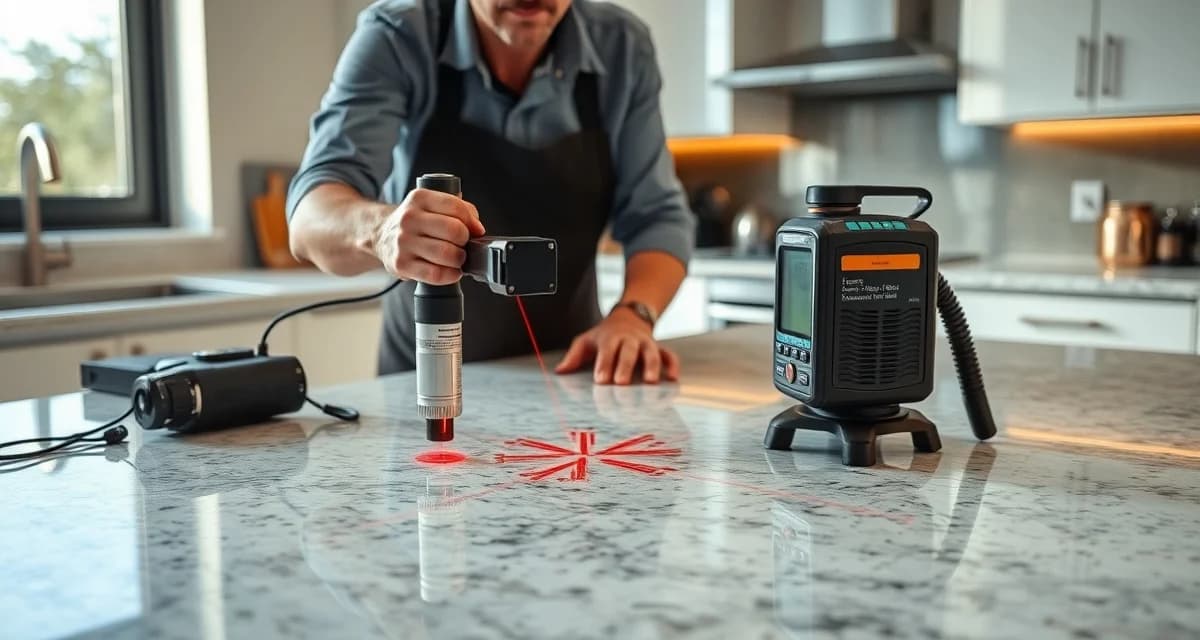
Digital templating uses a laser measurement device mounted on a tripod or portable stand. The technician places the device in the kitchen and takes readings by touching a probe or aiming a laser at key points along the countertop area.
Calculate your material waste savings
See exactly how much slab material and money you could save with optimized cutting layouts.
Try the free Waste CalculatorHow it works:
- The technician sets up the device near the cabinets
- Using a touch probe, they record points along every edge - front of cabinets, back wall, corners, sink location, cooktop position
- The device captures hundreds of data points and builds a precise digital map
- The data exports directly to a DXF file that CNC machines can read
- Back at the shop, the fabrication team uses the file to program cuts
Common digital templating devices:
| Device | Manufacturer | Typical Cost | Accuracy |
|---|---|---|---|
| Proliner | Prodim | $20,000-$35,000 | 0.5mm (1/50") |
| LT-2D3D | Laser Templator | $18,000-$30,000 | 0.5mm (1/50") |
| Flexijet | Flexijet | $25,000-$45,000 | 0.3mm (1/85") |
| Laser Products LT-55 | Laser Products | $15,000-$25,000 | 1.0mm (1/25") |
Digital templates are faster, more accurate, and produce files that integrate directly with fabrication software. The technician spends less time on-site, and the risk of transcription errors (misreading a handwritten number) drops to nearly zero.
Physical Strip Templates (Traditional Method)
Before digital devices became standard, fabricators used physical strips - thin pieces of luan plywood, MDF, or plastic - to create a full-size outline of the countertop.
How it works:
- Technicians lay strips of material along all edges of the cabinet tops
- They hot-glue the strips together to form the exact shape of the countertop
- They mark sink and cooktop cutout locations on the template
- The assembled template is transported back to the shop
- Fabricators lay the template on the slab and trace around it for cutting
Drawbacks of strip templates:
- Strips can shift during transport, changing dimensions
- Hot glue joints can flex or break
- Manual tracing adds human error at the cutting stage
- No digital file is produced - measurements cannot be verified electronically
- Takes longer on-site (60-120 minutes vs. 30-60 for digital)
Strip templates are still used by some smaller shops, particularly those without CNC equipment. But the industry has shifted heavily toward digital methods over the past decade.
What Happens During a Template Appointment
Before the Appointment
Your fabricator will schedule a template visit after your cabinets are fully installed. Before the technician arrives:
- Cabinets must be installed and level. Countertop measurements are taken from the top of the cabinets.
- Sink and cooktop should be on-site (or the exact model confirmed) so cutout dimensions are correct.
- Old countertops must be removed if this is a replacement project.
- Clear the countertop area. Remove small appliances, dishes, and anything on the cabinet surfaces.
- Ensure access. The technician needs room to move around the kitchen with equipment.
During the Appointment
A typical digital template appointment follows this sequence:
- Setup (5-10 minutes): Technician brings in the device, sets up the tripod, and calibrates.
- Measuring perimeter (10-20 minutes): Records every point along the countertop outline - front edges, back wall, corners, and angles.
- Marking cutouts (5-15 minutes): Positions sink, cooktop, and faucet hole locations. May place the actual sink on the cabinets to trace its outline.
- Recording details (5-10 minutes): Notes edge profiles, backsplash height, overhang preferences, and any special requests.
- Review with homeowner (5-10 minutes): Walks through the measurements and confirms choices before leaving.
Total time: 30-60 minutes for a standard kitchen, 60-90 minutes for complex layouts with islands or multiple sections.
After the Appointment
The digital file goes back to the fabrication shop where:
- A programmer imports the DXF into the shop's CNC software
- The layout is checked against the selected slab for fit and seam placement
- Edge profiles, cutout details, and special instructions are added
- The job enters the production queue
This is where measurement verification becomes critical. If the template data contains an error - a wall angle off by a degree, a sink cutout shifted by half an inch - the resulting countertop will not fit properly. Catching these errors before cutting saves the fabricator $1,500-$4,000 per avoided remake.
Why Measurement Accuracy Matters So Much
The countertop fabrication industry identifies template errors as the single largest cause of remakes. Industry data shows:
- Template-related errors account for 40-60% of all remakes
- Average remake cost runs $1,500-$4,000 including material, labor, and rescheduling
- Industry-wide waste rate sits at 10-15%, with a meaningful portion tied to measurement mistakes
Even with digital equipment, errors happen. Common causes include:
- Device not properly calibrated before the appointment
- Cabinets not level or not fully secured, causing measurements to shift when the countertop weight is added
- Backsplash walls that are not straight (common in older homes)
- Technician rushing and missing critical data points
- Sink or cooktop model change after the template was taken
How Fabrication Software Catches Errors
Modern fabrication platforms include verification layers that compare template data against expected parameters. SlabWise, for example, runs a 3-layer template verification check that:
- Validates geometry - Checks that angles, dimensions, and proportions are physically consistent
- Compares against standards - Flags measurements that fall outside normal ranges (e.g., a 30" deep countertop when the standard is 25.5")
- Cross-references cutout positions - Confirms that sink and cooktop cutouts are positioned within the countertop boundaries with adequate clearance
This verification happens between templating and cutting, giving the shop a chance to catch and correct issues before an expensive slab is committed. Fabricators using template verification report significantly fewer remakes and waste rates closer to 5-8% rather than the industry average of 10-15%.
Measurements Homeowners Should Know
While you should always let the fabricator measure your countertops, understanding basic dimensions helps you communicate effectively:
Standard Countertop Dimensions
| Measurement | Standard | Notes |
|---|---|---|
| Depth (front to wall) | 25-26" | Including overhang |
| Front overhang past cabinets | 1-1.5" | Standard for most kitchens |
| Bar/eating overhang | 12-15" | Requires support brackets at 15"+ |
| Backsplash height | 4-6" | Full-height backsplash is 15-18" |
| Counter height from floor | 36" | Standard for base cabinets |
| Bar height from floor | 42" | Standard for raised bars |
Measurements That Affect Your Quote
When getting initial estimates, you can provide rough measurements to speed up the quoting process:
- Total linear feet - Measure along the front edge of each countertop section
- Depth at widest point - Usually 25-26" for standard counters
- Number of cutouts - Count sinks, cooktops, and any specialty openings
- Edge profile preference - Standard (eased/bevel) or upgraded (ogee, bullnose, etc.)
- Backsplash - Whether you want a 4" stone splash, full-height splash, or tile
These rough numbers help fabricators prepare ballpark quotes. The precise template measurement is what drives the actual fabrication.
DIY Measuring vs. Professional Templating
Some homeowners try to measure their own countertops to get quotes or to skip the template appointment. Here is why professional templating is worth the cost:
| Factor | DIY Measuring | Professional Template |
|---|---|---|
| Accuracy | +/- 1/4" to 1" | +/- 1/16" |
| Wall angle capture | Rarely accurate | Precise |
| Cutout positioning | Approximate | Exact |
| CNC-ready file | No | Yes |
| Risk of remake | High | Low |
| Cost | Free | $150-$500 (often included in project) |
A $200 template fee that prevents a $3,000 remake is one of the best investments in your countertop project.
How long does a countertop template appointment take?
A standard kitchen takes 30-60 minutes with digital laser equipment. Complex layouts with islands, multiple sections, or extensive cutouts can take 60-90 minutes. Physical strip templates take longer - typically 60-120 minutes.
Do I need to be home for the template appointment?
Yes. The technician will need access to the kitchen and may have questions about sink placement, edge profiles, overhang preferences, and backsplash details. Being present ensures nothing gets overlooked.
Should cabinets be installed before the template?
Absolutely. Countertop measurements are taken from the installed cabinets. If cabinets are not in place, the measurements will be wrong. Cabinets should also be level and secured to the wall.
Can I measure my own countertops for a quote?
You can measure rough dimensions (length, depth, number of cutouts) for an initial estimate. But for the actual fabrication order, always use the fabricator's professional template service. DIY measurements are not accurate enough for CNC cutting.
What is a DXF file?
DXF (Drawing Exchange Format) is a digital file format that CNC machines can read. Digital templating devices export measurements in DXF format, which the fabricator imports into their cutting software. This eliminates manual transcription errors.
How accurate is laser templating?
Most professional laser templating devices are accurate to within 0.5mm (about 1/50 of an inch). This level of precision is far beyond what tape measures or manual methods can achieve.
What if my walls are not straight?
This is extremely common, especially in older homes. Digital templating devices capture the actual wall contour - every bump, bow, and angle - so the countertop is cut to fit the real wall, not an assumed straight line. This is one of the biggest advantages of digital templating.
How much does a template appointment cost?
Many fabricators include the template fee in the overall project cost. When charged separately, template appointments typically run $150-$500 depending on kitchen complexity and geographic location.
What happens if the template is wrong?
If the countertop does not fit due to a template error, the fabricator must cut a new piece. This remake costs $1,500-$4,000 and delays the project by days or weeks. This is why template verification before cutting is so valuable.
Can I change my mind after the template?
You can change edge profiles, backsplash height, and some details after the template without a re-measure. But changes to sink model, cooktop size, or countertop layout require a new template visit.
Do bathroom vanities need a template too?
Yes, though simpler vanities may use basic measurements. Any project being fabricated on CNC equipment benefits from a digital template for accuracy.
How soon after the template is the countertop installed?
Typical turnaround from template to installation is 5-10 business days. This includes programming, slab selection and cutting, fabrication (edging, polishing, cutouts), and scheduling the installation crew.
Accurate Templates Start With Verified Data
For fabricators, the template is where every job begins - and where most costly errors originate. SlabWise's 3-layer template verification catches discrepancies before they reach the saw, saving $1,500-$4,000 per avoided remake. Combined with slab nesting that improves material yield by 10-15%, the math adds up fast. Start your 14-day free trial.
Try These Free Tools
- Nesting Optimizer -- AI-powered slab layout that maximizes yield considering vein direction and defects.
- Defect Mapping -- Upload a slab photo and AI maps every fissure, pit, and color issue.
- Value Engineering -- Find dollar-quantified suggestions to save material without cutting margin.
Sources & Further Reading
-
Natural Stone Institute - Stone Selection and Specification Guide
-
International Surface Fabricators Association - Slab Selection Best Practices
-
National Kitchen & Bath Association - Countertop Material Selection Guidelines
-
Marble Institute of America - Natural Stone Inspection and Grading Standards