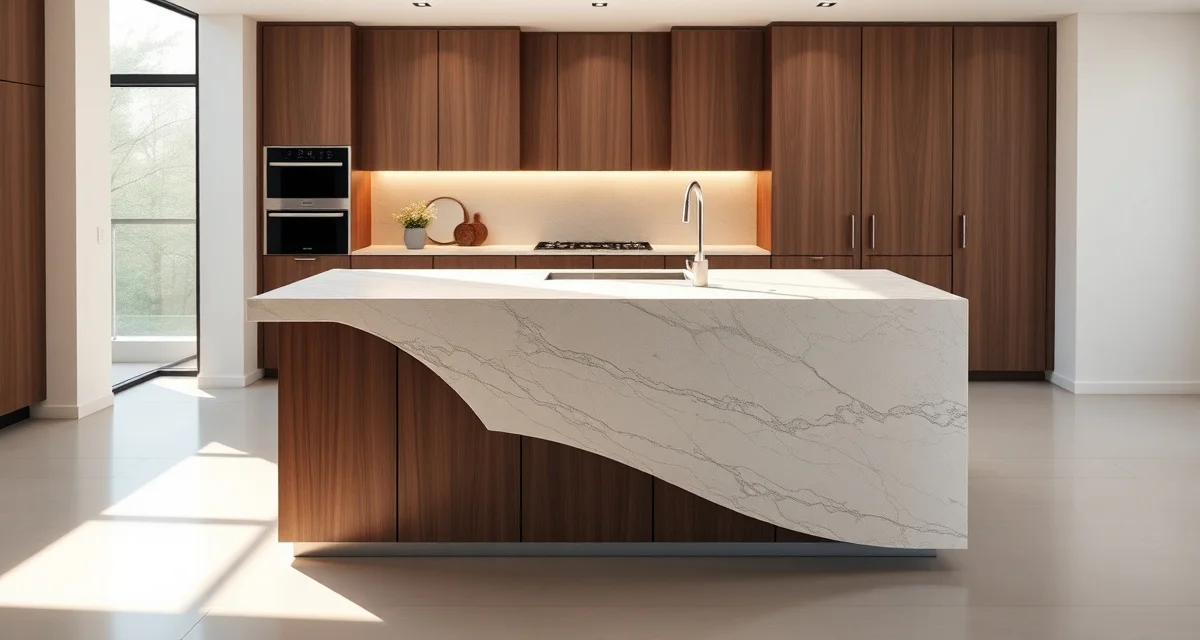
Kitchen Island Countertop Ideas 2026
A kitchen island countertop is the visual and functional centerpiece of any modern kitchen. Island countertops need to handle prep work, casual dining, and daily use while looking great from every angle - since unlike perimeter countertops, islands are visible on all sides.
TL;DR
- Waterfall edges remain the most requested island design feature in 2026
- Quartz and quartzite dominate the island countertop market due to durability and design range
- Contrasting materials - a different surface on the island than the perimeter - add visual interest
- Standard island size: 4 ft x 2 ft minimum (8 sq ft), with 7 ft x 3.5 ft (24.5 sq ft) being popular for large kitchens
- Cost range for island countertops: $800-$6,000+ depending on material, size, and edge treatment
- Overhang for seating: 12-15 inches is standard for bar stools, requiring support brackets
Popular Kitchen Island Countertop Materials
Quartz Islands
Quartz is the number-one island countertop material in 2026, and for good reason. It offers consistent color and pattern across large surfaces, requires zero sealing, and resists stains from the spills that inevitably happen at a kitchen island.
Calculate your material waste savings
See exactly how much slab material and money you could save with optimized cutting layouts.
Try the free Waste CalculatorBest for: Families, heavy-use kitchens, modern and transitional designs
Price range: $50-$120/sq ft installed
Popular quartz island choices:
- Calacatta-look quartz (white with grey veining) for a marble aesthetic without maintenance
- Concrete-look quartz in grey tones for industrial and modern kitchens
- Solid white quartz for minimalist and Scandinavian designs
Quartzite Islands
Natural quartzite has surged in popularity for islands because it offers dramatic veining similar to marble but with granite-level hardness. Each slab is unique, making the island a true one-of-a-kind feature.
Best for: High-end kitchens, homeowners who want natural stone with durability
Price range: $70-$180/sq ft installed
Marble Islands
Marble remains the aspirational choice for kitchen islands. The soft veining and luminous surface are hard to match with any engineered material. The trade-off: marble stains, etches from acids, and requires regular maintenance.
Best for: Low-use display kitchens, bakers (marble stays cool for pastry work), luxury homes
Price range: $60-$200/sq ft installed
Granite Islands
Granite offers natural beauty, heat resistance, and proven durability at a lower price point than quartzite or marble. It's a practical island choice that works in both traditional and contemporary kitchens.
Best for: Budget-conscious homeowners, traditional kitchens, heat resistance near cooktops
Price range: $40-$100/sq ft installed
Butcher Block Islands
Wood adds warmth and a distinct character to kitchen islands. Butcher block is a functional surface for food prep and pairs well with stone perimeter countertops for a mixed-material kitchen.
Best for: Farmhouse and rustic kitchens, dedicated prep surfaces, adding warmth to an all-stone kitchen
Price range: $25-$80/sq ft installed
Concrete Islands
Concrete countertop islands offer an industrial look with custom color and finish options. Each concrete island is cast to your exact dimensions, allowing for integrated features like drain boards or trivets.
Best for: Modern and industrial kitchens, custom shapes, unique color matching
Price range: $65-$120/sq ft installed
Kitchen Island Design Ideas
1. Waterfall Edge Island
A waterfall edge wraps the countertop material down one or both sides of the island, creating a continuous slab effect. This is the single most popular island design element in 2026.
| Configuration | Description | Added Cost |
|---|---|---|
| Single waterfall | Material drops on one end | $500-$1,500 |
| Double waterfall | Material drops on both ends | $1,000-$3,000 |
| Full wrap | Material covers all sides | $2,000-$5,000 |
Waterfall edges look most dramatic with heavily veined materials like marble, quartzite, or veined quartz where the pattern flows from the horizontal surface down the vertical face.
2. Contrasting Island Material
Using a different material on the island than the perimeter countertops creates visual separation and adds design interest.
Popular combinations:
- White quartz perimeter + butcher block island
- Granite perimeter + marble island
- White quartz perimeter + dark quartzite island
- Marble perimeter + contrasting marble island (different color)
3. Extended Island with Seating
Adding a bar-height or counter-height overhang for seating turns the island into a dining and socializing spot.
| Seating Type | Overhang Depth | Counter Height | Support Needed? |
|---|---|---|---|
| Counter-height stools | 12-15 inches | 36 inches | Brackets for 12"+ overhang |
| Bar-height stools | 12-15 inches | 42 inches | Brackets for 12"+ overhang |
| Raised bar section | 12-15 inches | 42 inches | Separate raised structure |
Stone overhangs greater than 10-12 inches require support brackets, typically steel L-brackets or corbels spaced every 24-30 inches. Budget $50-$150 per bracket.
4. Multi-Level Island
A multi-level island features two different heights, often with a lower prep surface and a raised bar section. This design hides kitchen mess from guests sitting at the bar.
Pros: Hides clutter, defines zones, adds visual interest Cons: More seams, more complex fabrication, higher cost
5. Island with Integrated Sink
Placing the sink in the island frees up perimeter counter space and creates a natural prep zone. Undermount sinks work best for stone island countertops.
Considerations:
- Plumbing must run to the island (adds $500-$1,500 if not already present)
- Sink cutout adds $100-$250 to fabrication
- Choose a sink size that doesn't overwhelm the island surface
6. Thick-Slab Island
Standard countertop thickness is 3 cm (1.18 inches). Opting for a thicker profile - through mitered edges or actual thick slabs - gives the island a substantial, furniture-like appearance.
| Thickness | Method | Added Cost |
|---|---|---|
| 3 cm (standard) | Standard slab | Included |
| 6 cm (2.4 inches) | Mitered edge buildup | $30-$50/linear foot |
| Custom thick | Actual thick slab | Material dependent |
7. Bookmatched Island
Bookmatching uses two consecutive slabs from the same stone block, opened like a book to create a mirror-image pattern. On a large island, this creates a symmetrical, dramatic design.
Best materials for bookmatching: Marble, quartzite, and some exotic granites
Added cost: 20-40% premium for bookmatched slabs due to sourcing and precise fabrication
Kitchen Island Sizing Guide
| Kitchen Size | Recommended Island Size | Countertop Sq Ft | Approx. Material Cost |
|---|---|---|---|
| Small (under 150 sq ft) | 4 ft x 2 ft | 8 sq ft | $400-$960 |
| Medium (150-250 sq ft) | 5 ft x 3 ft | 15 sq ft | $750-$1,800 |
| Large (250-400 sq ft) | 7 ft x 3.5 ft | 24.5 sq ft | $1,225-$2,940 |
| Very large (400+ sq ft) | 8 ft x 4 ft+ | 32+ sq ft | $1,600-$3,840+ |
Clearance minimums: Allow at least 36 inches of walkway around all sides of the island. 42-48 inches is preferred for high-traffic kitchens.
Island Countertop Cost Breakdown
Here's what a mid-range quartz island countertop costs for a 24-square-foot island (6 ft x 4 ft):
| Item | Cost |
|---|---|
| Quartz material and fabrication (24 sq ft @ $70/sq ft) | $1,680 |
| Sink cutout | $150 |
| Faucet hole | $35 |
| Half-bullnose edge (20 linear ft) | $200 |
| Installation | Included in sq ft price |
| Total | $2,065 |
Add a single waterfall end: +$800-$1,200 Add seating overhang with brackets: +$200-$400
Material Comparison for Islands
| Factor | Quartz | Quartzite | Marble | Granite | Butcher Block |
|---|---|---|---|---|---|
| Durability | Excellent | Excellent | Fair | Very Good | Good |
| Maintenance | None | Annual seal | Regular seal | Annual seal | Monthly oil |
| Heat Resistance | Fair | Excellent | Good | Excellent | Fair |
| Stain Resistance | Excellent | Very Good | Poor | Good | Poor |
| Unique Patterns | No | Yes | Yes | Yes | Yes (wood grain) |
| Price Range/Sq Ft | $50-$120 | $70-$180 | $60-$200 | $40-$100 | $25-$80 |
| Best Island Style | Modern | Luxury | Classic | Traditional | Farmhouse |
Island Edge Profile Options
The edge profile is more visible on an island than on perimeter countertops, so it's worth considering carefully.
| Edge | Look | Cost | Best For |
|---|---|---|---|
| Eased | Clean, modern | Included | Contemporary kitchens |
| Half Bullnose | Soft, approachable | $8-$12/LF | Family kitchens |
| Full Bullnose | Rounded, classic | $10-$16/LF | Traditional kitchens |
| Ogee | Decorative, formal | $14-$25/LF | Luxury kitchens |
| Mitered | Thick, substantial | $30-$50/LF | Modern luxury |
| Waterfall | Dramatic, seamless | $25-$42/LF | High-end modern |
For Fabricators: Island Countertop Considerations
Islands present specific fabrication challenges:
- Slab selection matters more. Islands are visible from all angles. Vein direction, pattern placement, and color consistency are more critical than on perimeter tops.
- Seam placement is visible. Unlike perimeter countertops where seams can be placed at corners or against walls, island seams are fully exposed.
- Overhangs require support engineering. Ensure you communicate bracket requirements to the customer before installation day.
- Waterfall edges demand precision. Pattern matching at the 90-degree turn separates good fabricators from great ones.
SlabWise's AI nesting helps fabricators optimize slab usage for island projects, where waste from large rectangular cuts can be significant. AI Template Verification catches measurement errors before they become expensive remakes. Try it free for 14 days at $199/month.
What is the best countertop material for a kitchen island?
Quartz is the most practical choice for most kitchen islands due to its durability, low maintenance, and wide design range. For a more unique look, quartzite offers natural stone beauty with similar durability.
How much does a kitchen island countertop cost?
Island countertop costs range from $800 to $6,000+ depending on material, size, edge treatment, and cutouts. A mid-range quartz island (24 sq ft) typically costs $1,600-$2,800.
What is a waterfall edge on a kitchen island?
A waterfall edge is when the countertop material continues down the side of the island to the floor, creating a continuous surface. It's the most popular island design feature in 2026.
How much overhang do I need for island seating?
Plan for 12-15 inches of overhang for comfortable bar stool seating. Any stone overhang greater than 10-12 inches requires support brackets.
Should the island be the same material as the perimeter countertops?
Not necessarily. Using a contrasting material on the island - like butcher block against quartz perimeters - is a popular design choice that adds visual interest.
How big should a kitchen island be?
The minimum functional island size is 4 feet by 2 feet. Most popular islands range from 5x3 feet to 8x4 feet. Ensure at least 36 inches of clearance on all sides.
Can I put a cooktop in my island countertop?
Yes. Island cooktops are a common design choice. The cooktop cutout adds $125-$300 to fabrication costs, and you'll need ventilation (overhead hood or downdraft).
Do kitchen island countertops need seams?
Slabs wider than about 63 inches (the typical maximum slab width) require seams. Most islands narrower than 5 feet can be fabricated from a single piece. Longer islands will likely need at least one seam.
What is bookmatching on an island?
Bookmatching uses two consecutive slabs from the same stone block, opened like a book to create a mirror-image pattern. It's a premium technique that costs 20-40% more than standard slab selection.
Is marble practical for a kitchen island?
Marble will stain and etch over time with regular kitchen use. It's best suited for low-traffic islands, display kitchens, or homeowners who accept the patina that develops. For heavy daily use, quartz or quartzite are more practical.
How do I support a countertop overhang on an island?
Steel L-brackets or decorative corbels support overhangs. Space brackets every 24-30 inches, and consult your fabricator for the specific requirements based on your material and overhang depth.
What edge profile works best for a kitchen island?
Eased edges suit modern kitchens, half-bullnose is family-friendly, and waterfall edges make the strongest design statement. Since islands are visible from all sides, the edge profile matters more than on perimeter countertops.
Pricing reflects 2026 national averages. Actual costs vary by material, location, fabricator, and project specifics.
Try These Free Tools
- Kitchen Visualizer -- Upload a kitchen photo and preview different countertop materials in place.
- AR Overlay -- See the actual stone pattern on your customer's cabinets using AR.
- Sink Finder -- Search compatible sink models by countertop dimensions and cutout specs.